

How to Choose a Marketing Agency PPC Partner You Can Trust
Last Updated

Before you even think about Googling for a marketing agency ppc, the very first move—and honestly, the most important one—is to get crystal clear on what success actually looks like for your business.
If you don't know the destination, you can't pick the right driver. This internal clarity is the absolute bedrock of a profitable agency partnership.
Defining Your Business Objectives and Budget
Look, before you can size up any agency, you need to know your own scorecard. Vague goals like "more traffic" or "better leads" just won't cut it. They’re useless. You need specific Key Performance Indicators (KPIs) that are tied directly to your bottom line. Without them, you're flying blind, and you'll have no real way to judge if an agency is delivering value or just burning through your cash.
An e-commerce brand, for example, might have a single North Star metric: a 4:1 Return On Ad Spend (ROAS). For every dollar they put into ads, they need to see four dollars in revenue come back out. Simple.
But a B2B SaaS company? They probably couldn't care less about immediate ROAS. Their game is all about filling the sales pipeline. Success for them might be hitting a Cost Per Qualified Lead (CPQL) of under $250 from their LinkedIn Ads campaigns. The goal isn't a sale today; it's a high-value prospect for the sales team to nurture.
Articulating Your Key Performance Indicators
Your KPIs are the language you'll use to communicate your goals to a potential agency. Nailing these down from the get-go prevents a world of pain, miscommunication, and unmet expectations later on.
To help you get specific, we've put together a quick framework. Most businesses fall into one of these categories, and your goals will look something like this:
PPC Goal Setting Framework by Business Type
| Business Type | Primary Goal | Example Platform | Key Metric (KPI) |
|---|---|---|---|
| E-commerce Retailer | Drive profitable sales | Google Shopping, Meta Ads | ROAS, Average Order Value (AOV) |
| B2B Service Firm | Generate qualified leads | LinkedIn Ads, Google Search | Cost Per Lead (CPL), MQLs |
| Local Small Business | Increase foot traffic/calls | Google Maps, Local Search Ads | Cost per store visit, click-to-call rate |
Thinking through this table should give you a solid starting point for defining what matters most. For B2B folks, it's not just about the number of leads, but their quality. To really get a handle on this, you'll want to implement some solid lead scoring. You can dig into lead scoring best practices to get that process dialled in.
And for anyone looking to go deeper, we've got a whole guide on the most important digital marketing performance metrics.
Establishing a Realistic PPC Budget
Right, let's talk money. Your budget isn't just your ad spend. This is a classic rookie mistake. You absolutely must factor in the agency's management fee—that's what pays for the expertise, the strategy, and the hands on keyboards making it all happen.
Your budget also has to be grounded in reality. The cost of a click isn't the same for every industry, and pretending otherwise is a recipe for disappointment.
A smart budget is more than just a number; it's a strategic plan. It should cover your ad spend and management fees, yes, but also set aside a little extra for testing new channels and have a contingency to double down when a campaign really takes off.
Here in Australia, the cost-per-click can vary wildly. An e-commerce click might average around AUD $1.82. But if you're in a hyper-competitive space like finance or legal services, you could be looking at clicks costing AUD $13.37 and AUD $10.61, respectively. Knowing these benchmarks before you start is crucial for setting expectations that are actually achievable.
A Realistic Checklist For Vetting PPC Agencies
Alright, you’ve got your goals mapped out and a budget in mind. Now for the fun part: vetting potential agencies. This isn't about getting wowed by a slick sales pitch; it's about doing your homework to find a partner who actually knows their stuff. A good checklist helps you cut through the fluff and systematically compare each contender.
Your mission is to find an agency whose real-world experience lines up perfectly with what you need. It’s one thing to talk a big game about PPC, but it's another thing entirely to have deep, practical experience on the platforms that matter most to your business.
This decision tree gives you a good visual of how a core business goal, like generating sales versus capturing leads, should shape your entire PPC strategy from day one.
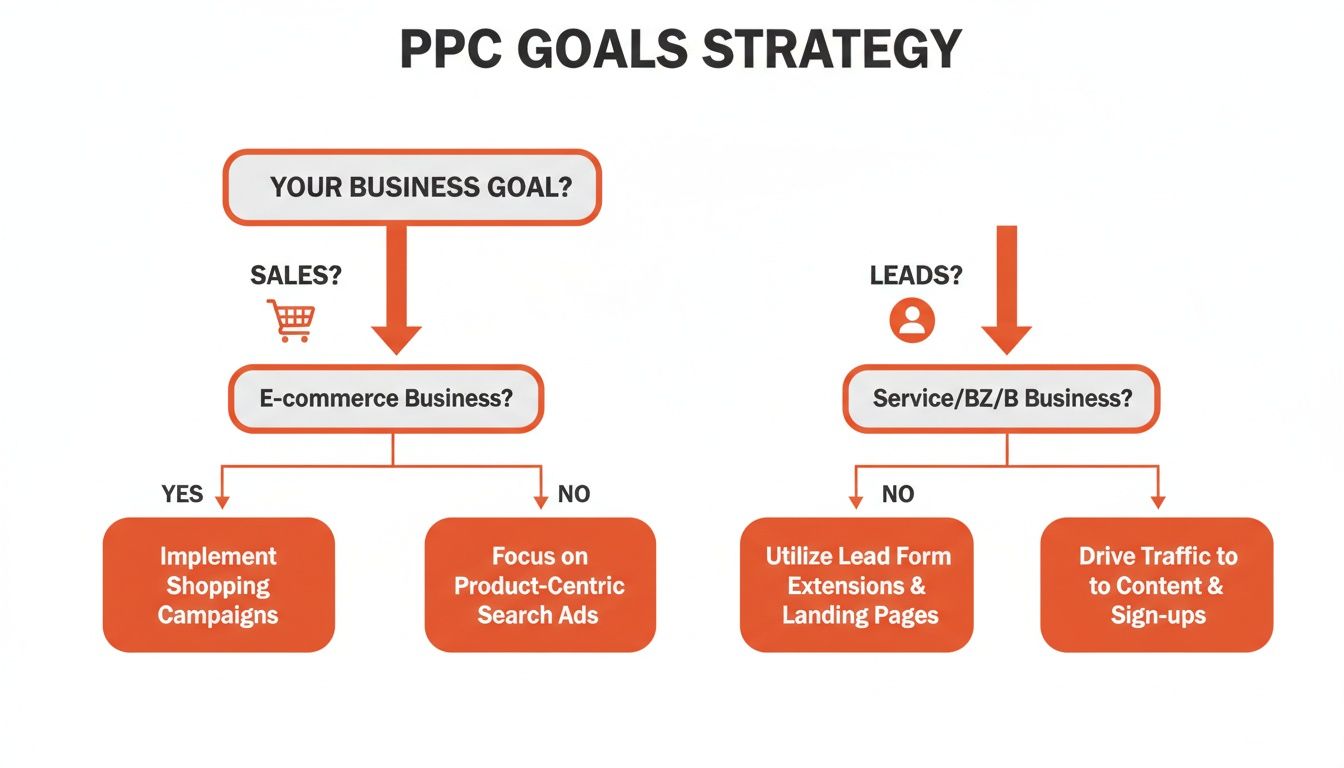
It clarifies why an e-commerce brand absolutely needs an agency that lives and breathes Google Shopping, while a B2B company will get far more value from a team with serious expertise in lead-gen platforms like LinkedIn.
Core Capabilities To Scrutinise
When you start talking to agencies, your focus should be on finding hard evidence of their expertise. You're looking for proof that they haven’t just run campaigns, but have successfully managed accounts similar to yours in size, industry, and complexity.
Here’s what to dig into:
- Industry and Platform Experience: Have they actually worked in your industry before? Don't be shy—ask for examples. A B2B tech company needs a seasoned pro in LinkedIn Ads, not a generalist. An e-commerce store selling clothes needs a Google Shopping guru who can wrestle product feeds into submission.
- Conversion Tracking Proficiency: This is a deal-breaker. Ask them to walk you through their process for setting up and verifying conversion tracking. A competent agency will immediately start talking about Google Tag Manager, the importance of server-side tracking, and how they nail down data accuracy from the get-go.
- Campaign Build and Structure: So, how do they actually build a new campaign from scratch? A good answer should involve audience research, keyword strategy, a logical ad group structure, and a proactive approach to negative keywords. If they give you a vague, hand-wavy response, consider it a red flag.
Vetting isn't just about ticking boxes on a skills list; it's about spotting potential red flags before you’re locked into a contract. Smooth talkers are great at promising the world, but they often lack the strategic depth to deliver when things get tricky. Real experts are transparent about their process and realistic about what they can achieve.
When building out your own checklist, it helps to know what bad habits to look for. Reading up on the signs your social media agency might be all talk and no action can give you a good sense of similar red flags to watch for in the PPC world.
Analysing Their Past Performance
Case studies are a fantastic starting point, but you need to read between the lines. Don’t just get impressed by the big headline numbers; dig into the details to see if their past success is actually relevant to what you’re trying to achieve.
Look for solid evidence of:
- Problem Solving: Did they take over a messy, underperforming account and turn it around? That shows they have both technical skill and strategic thinking.
- Sustained Growth: A single great month is nice, but look for long-term, consistent improvements in key metrics like ROAS or CPL.
- Client Collaboration: How did they actually work with the client to get those results? This gives you a peek into their communication style and how they approach a partnership.
This kind of detailed look separates the agencies that can consistently replicate success from the ones who just got lucky once or twice.
Powerful Questions to Uncover an Agency's True Value
This is your moment to get past the polished case studies and find out how a potential PPC marketing agency really thinks. The interview isn't about trying to stump them; it’s about understanding their strategic depth, their process, and how they react when things don't go perfectly to plan.
Anyone can give you a generic answer. You need to ask specific, scenario-based questions that reveal what they’re actually capable of. This is where you find out if you're talking to a genuine strategic partner or just another campaign manager. A great agency will welcome these conversations and give you thoughtful, detailed answers that come from real experience.
Unpacking Their Strategic Approach
Don't just ask if they can lower your Cost Per Lead (CPL). Ask them how they’d do it. Give them a real challenge your business is facing right now. Their response will tell you everything you need to know.
A weak answer is full of fluff and vague promises like, "we'll optimise the campaigns" or "we'll test new creative." A strong answer, on the other hand, sounds more like a mini-strategy session.
Try asking something specific, like this:
"Our primary goal is to lower the CPL for our B2B LinkedIn campaigns, which is currently sitting at $250. How would you approach this problem in the first 90 days?"
A quality response won't just focus on one thing. It will be layered and show they understand the whole picture.
You should hear them talk about things like:
- Audience Analysis: "First, we'd dig into your current audience targeting. Are you using precise job titles and company firmographics, or is it too broad? We'd look to tighten that up straight away."
- Offer and Creative Review: "Next, we'd look at the offer itself. Is the whitepaper or webinar genuinely compelling? We’d suggest A/B testing the ad copy and creative to see what resonates and gets a better click-through rate."
- Landing Page Optimisation: "Finally, we’d scrutinise the landing page conversion rate. A CPL problem is often a landing page problem. We'd review the form length, the copy, and the whole user experience to make it frictionless."
This kind of detailed, multi-faceted answer shows they get it. They understand that performance is the result of many interconnected parts, not just flipping one switch.
A truly valuable agency doesn't just execute tasks; they diagnose problems from multiple angles. Their ability to dissect your challenges and propose a structured, logical plan of attack is a clear sign of expertise.
Evaluating Their Processes and Communication
How an agency operates day-to-day is just as critical as its strategic brilliance. Clunky onboarding, poor communication, or chaotic project management can sour a partnership before it even gets off the ground. You need to dig into their operational DNA.
A fantastic question to get to the heart of this is: "Walk me through your standard onboarding process for a new client like us."
Their answer should be clear, organised, and make you feel confident. Look for them to mention specific steps and milestones, which shows they have a refined and repeatable system.
Key Onboarding Hallmarks of a Professional Agency
- Structured Kickoff Call: A proper agenda covering goals, KPIs, account access, and how you'll communicate.
- Technical Setup Plan: A clear process for getting access to ad accounts, analytics, and setting up conversion tracking properly, likely using Google Tag Manager.
- Defined Communication Cadence: Setting expectations from the start about weekly check-ins, monthly performance reviews, and what their reports look like.
- 90-Day Roadmap: A high-level plan that outlines what to expect in the first three months, from initial audits and campaign builds to optimisation and scaling.
If they can't clearly articulate a step-by-step process, it could be a red flag that their internal operations are messy. A smooth process from day one is essential for a successful, long-term partnership with any marketing agency running your PPC.
Decoding Agency Pricing and Spotting Contract Red Flags
Alright, let's talk money and contracts. This is often the part of the process where business owners feel a bit out of their depth. Agency pricing can seem like a black box, and the contracts can be dense with legalese, but breaking it down is the key to a healthy, transparent partnership.
The paid advertising space is booming. To give you some perspective, Australia's digital ad market recently soared to AUD $16.4 billion, marking an impressive 11.1% jump year-over-year. That growth means you have more specialist agencies to choose from, but it also means understanding their pricing is more important than ever. You can dig into some more stats on the expanding Australian ad market and what it means for businesses if you're curious.
Common PPC Agency Pricing Models
Most agencies stick to one of a few core pricing models. There's no single "best" one—the right fit really depends on your budget, your goals, and how complex your campaigns are going to be.
Here's a quick look at the structures you'll most likely come across.
| Pricing Model | How It Works | Best For | Potential Downside |
|---|---|---|---|
| Flat Monthly Retainer | You pay a fixed fee each month for a clearly defined scope of work. | Businesses needing predictable costs, especially small-to-mid-size companies. It's great for budgeting. | The fee is the same regardless of performance, which might not incentivise the agency to go the extra mile. |
| Percentage of Ad Spend | The agency's fee is a percentage of your total monthly ad spend, often between 10-20%. | Companies with larger, scaling budgets where management effort grows with the spend. | It can get expensive quickly, and it incentivises the agency to encourage higher spend, which may not always be efficient. |
| Performance-Based | Fees are tied directly to results, like cost per lead (CPL) or a share of revenue generated. | Businesses with very clear, trackable conversion goals who want to pay only for tangible results. | Agreements can be tricky to structure. It might also encourage a focus on the quantity of leads over the quality. |
Each model has its place. The key is to find one that aligns with your financial reality and campaign objectives. For a deeper dive, check out our guide on understanding various PPC pricing models to help you weigh the pros and cons for your specific situation.
Critical Contract Red Flags to Watch For
A good contract is there to protect both of you. If it feels lopsided, it probably is. You absolutely have to read the fine print, and there are a few common clauses that should make you pause immediately.
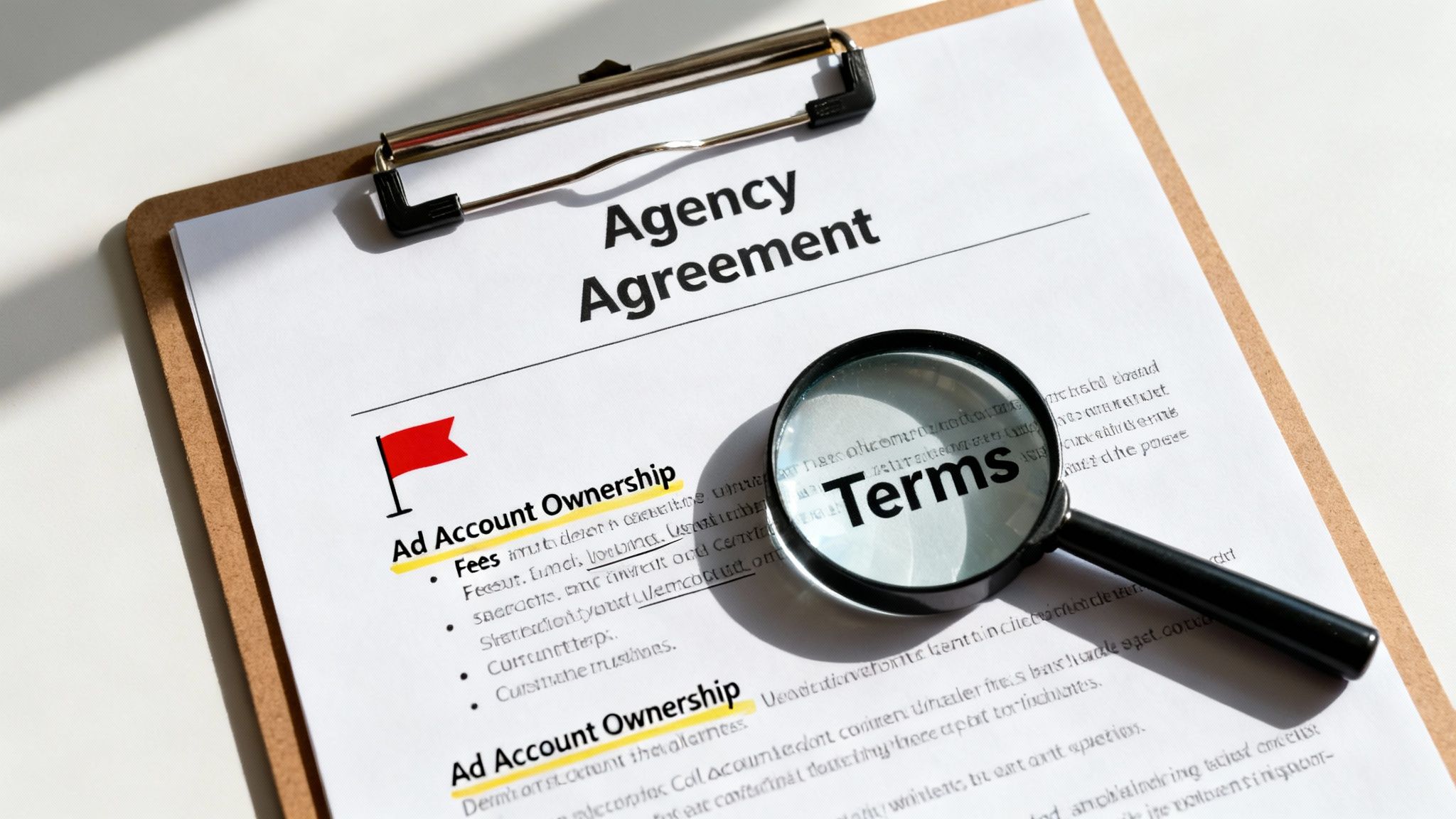
Let's be crystal clear on this: the most important clause in any PPC agency contract is about who owns the ad accounts. The answer is simple. You must always own your ad accounts. Any agency that sets up accounts under its own name is building a trap. If you decide to leave, they keep all your precious campaign data, history, and learnings.
Keep a sharp eye out for these warning signs before you put pen to paper:
-
Long-Term Lock-Ins without Performance Clauses: Be very cautious of any contract that wants to lock you in for more than three to six months without a clear, performance-based exit clause. A confident agency knows they can deliver results and won't need to trap you.
-
Ambiguity on Ad Account Ownership: As I just mentioned, this is a non-negotiable deal-breaker. The contract needs to state explicitly that you, the client, retain full ownership and administrative access to all ad accounts (Google Ads, Meta, LinkedIn—you name it).
-
Vague Scope of Work: The agreement should spell out exactly what's included. How often will they report? How many campaigns will they manage? Vague terms like "ongoing optimisation" are meaningless and just open the door to arguments down the line.
Setting Your Partnership Up for Success from Day One
Signing on the dotted line isn't the finish line; it's the starting pistol. The real work of forging a powerful PPC marketing agency partnership happens during the initial onboarding period. A smooth, organised process here sets the tone for everything to come and gets your investment working for you as fast as possible.

It all kicks off with a detailed kickoff call. This is where you'll align on goals, KPIs, and how you’ll communicate. Straight after that, it's time for the technical setup—granting secure access to your ad accounts, analytics, and crucially, getting robust conversion tracking in place. Without accurate data, every decision is just a shot in the dark.
The First 90 Days: What to Expect
Those first three months are all about building a solid foundation and soaking up data. It’s a time for intense learning and strategic tweaks, not overnight miracles. Expecting a massive return on day one just isn't realistic. Instead, you should be looking for steady progress against a clear roadmap.
Here’s a rough idea of how it should unfold:
- First 7 Days: This is all about the technical audit and setup. The agency will be getting account access, making sure conversion tracking is firing correctly, and starting their initial keyword and audience research. They're essentially learning the ins and outs of your business.
- First 30 Days: The first campaigns go live. This whole phase is about collecting baseline data. Your agency will be watching performance like a hawk, making small adjustments to bids and budgets to stabilise the account and sniff out any early wins.
- First 90 Days: Now the real optimisation kicks in. With a month or two of solid data under their belt, the agency can start making bigger, more strategic moves. They’ll be refining targeting, testing new ad creative, and beginning to scale up the campaigns that are showing real promise.
Communication and Reporting Rhythm
Good communication is the glue that holds the partnership together. It's vital to know the difference between the daily flood of data and high-level strategic insights. A great agency gives you both, but at a pace that's actually useful.
You should have access to a live dashboard for keeping an eye on daily metrics like clicks, impressions, and spend. That transparency is non-negotiable. But the real gold is in the scheduled performance reviews, usually held fortnightly or monthly. These meetings are where you collaborate on strategy.
A dashboard tells you what happened. A strategic review tells you why it happened and what you should do next. This collaborative deep dive is what fuels long-term growth and keeps your campaigns locked on your business goals.
This is also where sharp reporting becomes essential. You need to see performance trends over time, not just a single snapshot. To make this process seamless, a structured format can be a game-changer; our guide on creating a clear PPC reporting template is a fantastic place to start. A solid reporting structure ensures everyone is on the same page and focused on the metrics that actually move the needle for your business. This rhythm of collaboration prevents crossed wires and keeps the partnership pushing forward.
Got a Few More Questions Before You Sign?
Even after all the research, reference checks, and proposals, there are always a few lingering questions that pop up right before you make the final call. It’s completely normal.
Getting straight answers to these common queries can give you that last bit of confidence you need to move forward. Let’s tackle the most frequent ones I hear from clients.
How Long Until We See Real Results?
This is the big one, and the honest answer is: it’s a process.
You’ll see data like clicks and impressions almost immediately, but that’s just noise. The first 30 days are all about data collection and laying the groundwork. Think of it as the calibration phase where the agency is learning what works for your audience and setting up all the technical plumbing.
You should start to see some positive early trends in that first month, but the real, predictable Return on Ad Spend (ROAS) usually starts to materialise over the first 90 days. By then, the agency has enough hard data to get serious about optimising creative, refining your audience targeting, and making smart bidding adjustments. It’s a marathon, not a sprint.
Who Actually Owns the Ad Accounts?
This is non-negotiable. Your business must always own its ad accounts. Full stop.
Whether it’s Google Ads, Meta, or LinkedIn, the accounts need to be set up under your company’s name and ownership from day one.
An agency should only ever be granted managed or administrative access to do their work. If a potential partner insists on creating and owning the accounts themselves, walk away. It’s a massive red flag. This practice holds your campaign data and history hostage, forcing you to start from scratch if you ever decide to leave.
What’s a Reasonable Management Fee?
Agency fees are all over the map, and it really depends on the scope of work and their level of expertise. You’ll generally run into a few common pricing models.
There’s the flat monthly retainer (often anywhere from $1,500 to $5,000+), a percentage of your total ad spend (typically between 10-20%), or sometimes a hybrid of the two.
For most small to medium-sized businesses, a flat retainer is a great option because it gives you predictable monthly costs. The most important thing isn’t the price tag itself, but the value and transparency you get. A good agency will have no problem justifying their fee by showing you the depth of strategy, hands-on management, and results they plan to deliver.
How Much of My Time Will This Take?
The best agency relationships are genuine partnerships. They'll handle the day-to-day grind of technical management and optimisation, but your deep industry knowledge is the secret sauce they can't replicate.
You should plan to be actively involved in regular strategy calls, whether that’s weekly or monthly. Your job is to discuss performance, give crucial feedback on lead quality, and keep them in the loop on business changes like new promotions or market shifts. Your consistent input is what keeps the campaigns locked onto your actual business goals.
At Click Click Bang Bang, we build partnerships on transparency and results. Our flexible, no-lock-in PPC plans are designed to give you peace of mind while we focus on driving real growth for your business. Explore our PPC management services and see how our data-driven approach can work for you.
Read NeXt
Or Read Our Latest
- Manual vs Automated Bidding for PPC Success
- Conversion Tracking Setup: A Complete AU Guide
- Instagram Advertising Australia: Complete 2026 Guide
- Pay Per Click: A Beginner’s Guide for Australian Marketers
- Display Advertising on Google: The Complete Australian Guide
- Stakeholder Communication Plan How to Build One That Works
Click. CLick. Subscribe.
Get our best PPC insights, industry updates, and power moves delivered straight to your inbox. No fluff, just high-caliber strategies that actually work.
Don’t Leave Just Yet
Try Us For 30-Days,
Risk Free!!
We guarantee that you’ll love our work within the first 30 days, if not you’ll get your money back.
What have you got to lose?