

Boost Your Store with e commerce seo services to Grow Visibility and Sales
Last Updated
E-commerce SEO services are all about forming a strategic partnership to get your online store seen in search results. The goal isn't just traffic for traffic's sake; it's about driving qualified organic traffic that actually turns into sales. This isn't a simple technical checklist. It's a complete strategy designed to make sure your products are found by shoppers who are actively looking to buy them, turning your website from a digital ghost town into a bustling marketplace.
Why E-commerce SEO Is Your Most Valuable Asset
Imagine you’ve built a fantastic boutique filled with incredible products. The only problem? It’s tucked away on a hidden street with no sign, making it invisible to anyone who might want to shop there. This is what your online store looks like without search engine optimisation.
Professional e-commerce SEO services are your digital grand opening. They move your store to the busiest high street in town and put up a giant, flashing sign to attract your ideal customers.
It’s a foundational investment for sustainable growth, especially in the competitive Australian e-commerce market. The goal is simple: when a customer in Melbourne types "women's running shoes" into Google, you want your store to be right there at the top.
The Power of Organic Traffic
Paid ads can get you traffic fast, but that fire goes out the second you stop paying. SEO, on the other hand, builds a long-term asset. By earning high rankings, you create a consistent stream of free, high-intent traffic that keeps delivering value month after month.
It’s the difference between renting an audience and building your own loyal customer base. In the current Australian market, which has exploded to a whopping $1.5 billion in value, organic search drives an incredible 53% of website traffic for small and medium businesses, far outpacing social media and email. You can learn more about the state of SEO in Australia on searchscope.com.au.
An optimised e-commerce site doesn’t just attract more visitors; it attracts the right visitors. These are shoppers with clear purchase intent, leading to higher conversion rates and a much better return on investment.
Building Trust and Authority
Appearing organically in top search results also builds immense credibility. Shoppers inherently trust organic listings more than paid ads because they see them as being earned through quality and relevance, not just bought.
A strategic SEO partnership focuses on establishing this trust by:
- Improving User Experience: Making sure your site is fast, mobile-friendly, and dead simple to navigate.
- Creating Valuable Content: Publishing genuinely helpful product guides, comparisons, and articles that answer the questions your customers are actually asking.
- Earning Quality Backlinks: Gaining "votes of confidence" from other reputable websites in your industry.
Ultimately, a strong SEO presence turns your brand into a recognised authority in its niche, creating a powerful competitive advantage that’s hard for others to replicate.
The Blueprint for a Winning E Commerce SEO Strategy
A powerful SEO campaign isn't magic; it's a well-engineered machine with several core components working in harmony. Think of it like a high-performance race car. To win, you need a powerful engine, an aerodynamic body, a skilled driver, and a top-notch pit crew. An online store is no different—it needs its own set of specialised, interlocking parts to dominate the search results.
This strategic blueprint is all about how different e-commerce SEO services integrate to build a commanding online presence. Each piece supports the others, creating a result that's far greater than the sum of its parts.
This diagram shows how it all fits together, with SEO acting as the critical link between your website and your business success.
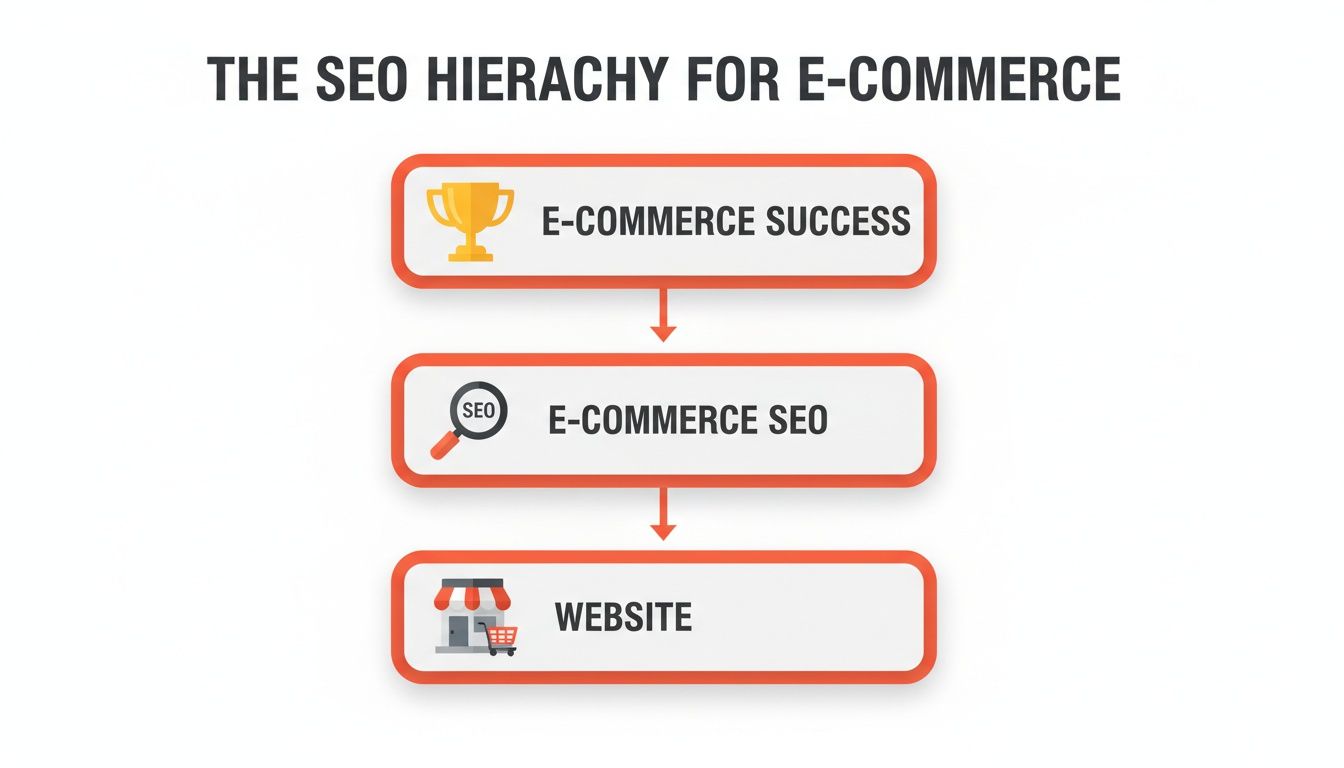
As you can see, overall e-commerce success rests directly on a strong SEO strategy, which in turn is built on the foundation of a solid, well-structured website. It's a simple hierarchy, but getting it right is everything.
Let's break down the core components—what I like to call the four pillars—that make up any effective e-commerce SEO service. Each one plays a distinct role, but they all drive towards the same goal: more traffic, more sales, and sustainable growth.
The Four Pillars of E Commerce SEO
This table summarises the essential components of a robust strategy. Think of it as your cheat sheet for understanding how all the moving parts work together to deliver real business outcomes.
| SEO Component | Core Function | Business Impact |
|---|---|---|
| Technical SEO | Optimising the website's "engine" for speed, security, and crawlability. | Faster load times reduce bounce rates and improve user experience, directly boosting conversions. |
| On-Page SEO | Merchandising product and category pages for users and search engines. | Higher rankings for commercial keywords and better click-through rates from search results. |
| Content Strategy | Building authority and attracting customers at all stages of their journey. | Drives top-of-funnel traffic, builds brand trust, and naturally earns valuable backlinks. |
| Link Building | Earning "votes of confidence" from other reputable websites. | Increases domain authority, leading to higher rankings across the entire site. |
By getting these four pillars right, you're not just "doing SEO"—you're building a powerful, revenue-generating machine. Let's dig a little deeper into what each one actually involves.
Technical SEO: The High-Performance Engine
Think of technical SEO as the engine and chassis of your website. It's all the crucial work that happens behind the scenes to make sure your online store runs flawlessly for both customers and search engines like Google. If your site is slow, confusing for Google's bots to crawl, or insecure, even the best products and content in the world won't get the visibility they deserve.
A professional e-commerce SEO service zeroes in on optimising these core technical elements:
- Site Speed: Making sure your pages load almost instantly. A tiny one-second delay can slash conversions by 7%, so in e-commerce, speed is literally money.
- Mobile-Friendliness: With most shoppers now browsing on their phones, a clunky mobile experience is a deal-breaker. It has to be seamless.
- Crawlability and Indexing: This is about laying out a clear red carpet for search engine bots, making it effortless for them to discover, understand, and rank all your important pages.
- Site Architecture: Organising your store logically so that anyone—human or bot—can navigate from your homepage to any product in just a few clicks. A clean structure is non-negotiable.
On-Page SEO: Expert Digital Merchandising
If technical SEO is the engine, on-page SEO is the expert visual merchandising you see in a high-end retail store. It's the art and science of arranging your product and category pages to be irresistible to both shoppers and search engines. This goes way beyond just sprinkling in a few keywords.
The goal is to position every single page to attract and convert the right customers. A crucial first step here is knowing how to conduct keyword research for SEO properly. It’s about learning to speak your customer's language so you can meet them where they are.
On-page optimisation directly impacts click-through rates from search and, ultimately, sales. A compelling title tag and meta description serve as your mini-advertisement on Google, while a well-crafted product description is what closes the deal.
Content Strategy: Your Digital Sales Team
Your content strategy functions as your 24/7 digital sales team. While your product pages are aimed at customers ready to pull out their credit cards, your blog posts, guides, and articles attract shoppers who are still in the research phase. They're there to answer questions, solve problems, and build trust long before someone even thinks about adding an item to their cart.
Creating genuinely valuable content, like detailed buying guides or head-to-head product comparisons, establishes your brand as an authority in your niche. This doesn't just pull in organic traffic for "how-to" and "best-of" searches; it also naturally earns backlinks, which are a huge factor in building your site's overall reputation with Google.
Link Building: Earning Votes of Confidence
Finally, link building is all about earning "votes of confidence" from other respected websites in your space. In Google's eyes, a link from another site pointing to yours is a powerful signal of authority and trustworthiness. It's the digital equivalent of a well-known industry expert telling their audience to check out your store.
But make no mistake, not all links are created equal. A quality e-commerce SEO service focuses on earning backlinks from relevant and authoritative sources, not spammy directories. This means targeting placements like:
- Industry Blogs and Publications: Getting your products featured in articles or annual roundups.
- Supplier and Partner Websites: Leveraging your existing business relationships for valuable links.
- Influencer Collaborations: Partnering with key figures whose audience hangs on their every word.
When you bring these four pillars together, you get a cohesive, powerful strategy that drives real, sustainable growth. You stop just selling products and start building a revenue-generating powerhouse.
Optimising Your Digital Storefront for Sales

Think of your e-commerce site like a premium department store. It's not enough to just have great products on the shelves; you need a layout that effortlessly guides shoppers from the front door right through to the checkout. Optimising your digital storefront is the art of creating this exact seamless experience, both for your customers and for search engines.
It all comes down to designing a shopping journey that feels so intuitive, it's almost invisible. This means structuring your site like clear store aisles, turning product pages into persuasive salespeople, and making sure the whole experience is lightning-fast. The result? A site that people genuinely love to shop on and that search algorithms love to rank.
Building an Intuitive Site Architecture
Your site’s architecture is its floor plan. A confusing layout sends shoppers straight for the exit, but a logical one guides them directly to what they want. The golden rule here is to make sure any product can be found within three clicks from your homepage.
This kind of logical structure is a cornerstone of any professional e commerce seo services package. It’s about building a clear hierarchy of categories and subcategories that actually mirrors how your customers think and search. Add in smart filtering and search functions, and you’ve essentially got helpful store assistants ready to help shoppers narrow down a massive inventory in seconds.
A well-organised site doesn’t just make for a better user experience; it’s a massive signal to search engines. It helps them understand the relationships between your pages, letting them crawl your site more efficiently and assign authority where it matters most—your key product categories.
And don't forget local SEO. It's becoming a powerhouse for Australian e-commerce, driving 28% of total search traffic and converting at three times the rate of generic organic results. With ‘near me’ searches through the roof and 78% of local mobile queries leading to a store visit within 24 hours, optimising for local intent is a must for any retailer with a physical footprint.
Crafting High-Converting Product Pages
Once a shopper lands on a product page, you have a tiny window to close the deal. This is where persuasive design and compelling copy have to work together perfectly. You’re not just listing features; you're selling a solution to a customer's problem.
Truly effective product pages blend a few critical elements:
- High-Quality Imagery and Video: Let customers see the product from every angle, and show it in use if you can.
- Persuasive Descriptions: Ditch the jargon and focus on the benefits. Tell a story that helps the customer imagine the product in their life.
- Clear Calls-to-Action (CTAs): Use prominent, action-focused buttons. Think "Add to Cart" or "Buy Now"—no ambiguity.
- Social Proof: Nothing builds trust like customer reviews, ratings, and user-generated photos. It helps shoppers overcome that last bit of hesitation.
Putting conversion rate optimization best practices into action here is non-negotiable. It’s what ensures all the valuable traffic you’re generating with SEO actually turns into revenue.
Prioritising Speed and Mobile Experience
In e-commerce, speed is everything. A mere one-second delay in page load time can slash your conversions by 7%. Slow sites don't just frustrate users; they lead directly to abandoned carts and lost sales. It's why site speed is always a top priority.
This means getting into the technical details: compressing images, streamlining code, and using fast web hosting. These tweaks create a much snappier, more enjoyable shopping experience that keeps people engaged. The first step is always a comprehensive technical SEO audit to pinpoint exactly what's slowing you down. For a deeper look at that process, check out our guide on technical SEO auditing.
Just as crucial is a mobile-first design. The majority of shoppers now browse and buy on their smartphones, so your site absolutely must work flawlessly on a small screen. We’re talking large, tappable buttons, simple navigation, and a checkout process designed specifically for mobile. By nailing these crucial storefront elements, you create an environment where shopping is easy, satisfying, and efficient.
How to Measure E-commerce SEO Success
Pouring money into e-commerce SEO services without a clear way to measure success is like sailing a ship without a compass. You’re definitely moving, but you have no idea if you're actually headed in the right direction. To really know if your strategy is paying off, you need to look past the vanity metrics and drill down into the numbers that directly fatten your wallet.
This means shifting the conversation from "how much traffic did we get?" to "how much revenue did that traffic actually generate?" A transparent performance report from a top agency should tell this story clearly, drawing a straight line from their SEO efforts to your business growth. Getting your head around these key performance indicators (KPIs) empowers you to have confident, data-driven conversations about your investment.
Key Performance Indicators That Actually Matter
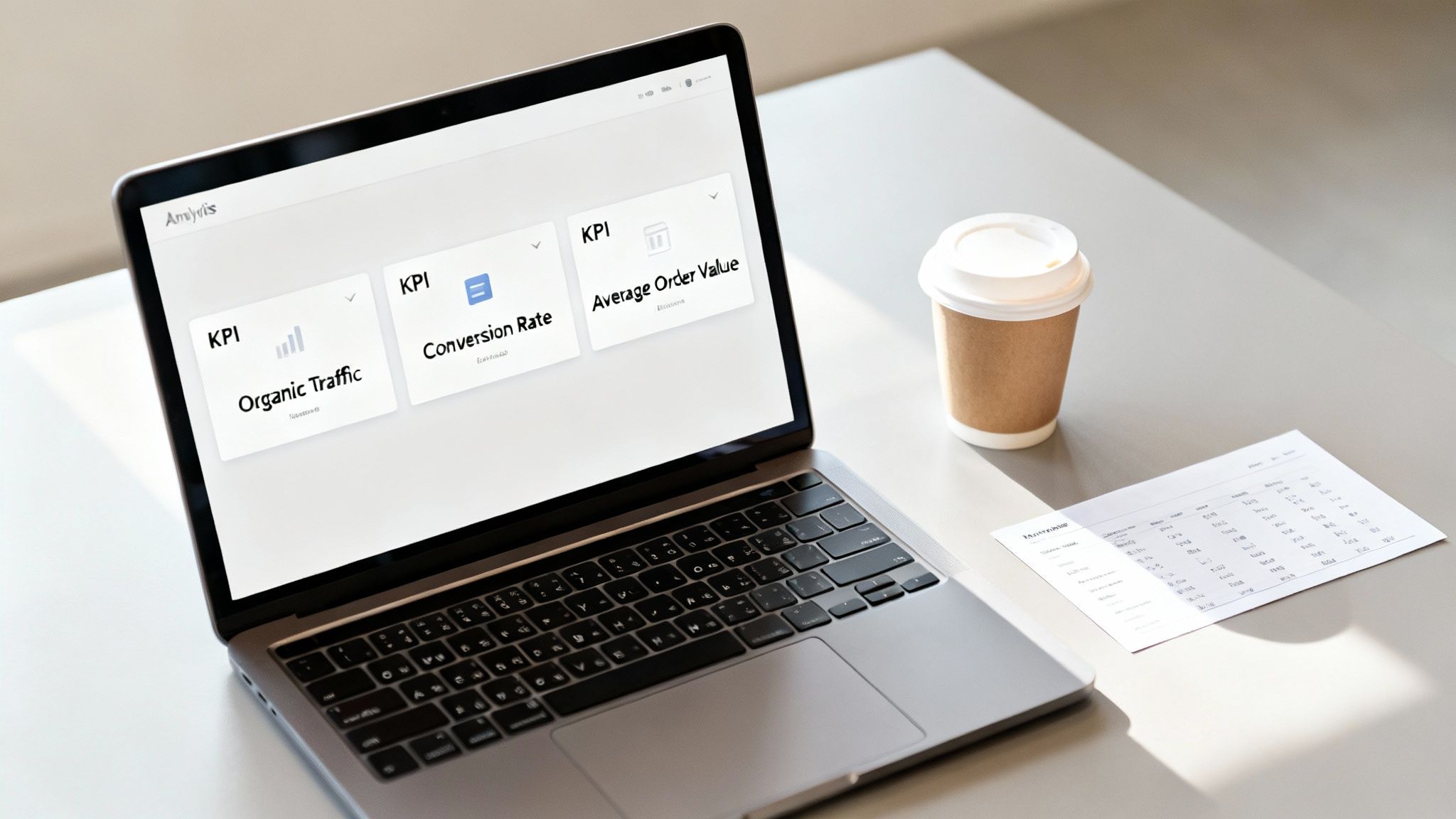
While there are dozens of metrics you could track, only a handful are essential for measuring the cold, hard cash success of an e-commerce SEO campaign. These are the KPIs that give you a crystal-clear picture of how organic search is contributing to sales.
Your main focus should be squarely on these data points:
- Organic Traffic Growth: This is your foundation. A steady climb in non-paid visitors to your site is the first sign that your SEO efforts are gaining traction and making you more visible.
- Keyword Rankings for Commercial Terms: You need to track your position for high-intent keywords like "buy women's leather boots" or "24-inch monitor for sale." Ranking well for these terms means you're capturing shoppers who have their credit cards out, ready to buy.
- Organic Conversion Rate: This one’s simple but powerful. It measures the percentage of visitors from organic search who actually complete a purchase. A rising conversion rate means you're not just getting more traffic, you're getting better, more qualified traffic.
- Average Order Value (AOV) from Organic Traffic: Understanding the average spend of an organic customer helps quantify the real value of your SEO traffic. Improving this metric often means you're attracting higher-quality buyers who are willing to spend more.
By zeroing in on these specific indicators, you move past guesswork and into a world of tangible results. You can see precisely how optimising your digital storefront is translating into real-world sales.
Measuring success isn't just about watching numbers go up. It's about understanding the story those numbers tell. A 10% increase in organic traffic is nice, but a 15% increase in revenue from that traffic is what truly defines a successful SEO partnership.
Calculating Your Return on SEO Investment
The ultimate measure of success for any marketing channel is its return on investment (ROI). Calculating this for SEO isn't as instant as it is for paid ads, but it's absolutely crucial for understanding the long-term value you’re building.
The formula is pretty straightforward:
(Revenue from Organic Search - Cost of SEO Services) / Cost of SEO Services = SEO ROI
For example, if you generate $25,000 in revenue from organic traffic in a quarter and your SEO services cost $5,000, your ROI is a very healthy 400%. This simple calculation cuts through all the noise and gives you a clear answer to the most important question: "Is this investment paying off?"
Realistic Timelines for Seeing Results
Let's be clear: SEO is a long-term strategy, not an overnight fix. While some quick technical wins can show results within weeks, a proper, comprehensive campaign builds momentum over time. Any reliable e-commerce SEO service will be upfront about this timeline.
Here’s a typical progression of what you can expect:
- Months 1-3: This is the foundational phase. Think technical fixes, on-page optimisation, and initial content development. You might see some early movement in rankings for less competitive keywords, which is a great start.
- Months 4-6: Now things get exciting. You should see significant improvements in keyword rankings and a noticeable lift in organic traffic. This is often when the ROI starts to become positive and easily measurable.
- Months 6+: By this point, your site's authority and brand presence are solidifying. This leads to stable, top rankings for valuable commercial terms and consistent, predictable revenue growth from your organic channel.
Patience really is a virtue here. SEO is about building a sustainable asset that will drive sales for years to come, and that process requires a strategic, consistent effort.
Choosing the Right E Commerce SEO Agency
Partnering with the right SEO agency can be the spark that ignites your online growth. But get it wrong, and you’re looking at wasted budgets and months of missed opportunities. The selection process is a critical business decision, one that requires you to look past polished sales pitches and really dig into the substance of their strategy.
Ultimately, you’re searching for a team that feels like a genuine extension of your own. A great partner doesn’t just promise results; they show a deep understanding of your specific market, your customers, and your commercial goals. They should be able to lay out a clear, customised plan that directly connects their SEO activities to your revenue. This guide will arm you with the right questions to find that perfect fit.
Evaluating Their Strategic Approach
The first real test of any potential agency is their strategic thinking. It's easy for an agency to offer a generic, one-size-fits-all package, but your business is unique, and your SEO strategy should reflect that. You need a partner who invests the time to understand your brand’s specific challenges and opportunities before a contract is even mentioned.
Ask them point-blank how they would approach your website. A top-tier agency will immediately start talking about conducting a thorough audit, analysing your competitors, and identifying high-value customer segments. Their initial conversation should feel less like a sales call and more like a strategic consultation, focusing on your business first and their services second.
A key differentiator is whether an agency presents a pre-packaged solution or a customised roadmap. Look for a partner who asks more questions about your business than they make statements about their own services in the initial discovery phase.
Questions to Ask About Their Process and Experience
When you’re vetting an agency, your questions need to be sharp enough to uncover their actual expertise and day-to-day style. Generic queries will only get you generic answers. Instead, focus on specifics that reveal their real proficiency in the e-commerce arena.
Here are a few essential questions to guide your conversation:
- What is your experience with e-commerce platforms like Shopify or Magento? An agency offering e commerce seo services must have deep, hands-on experience with the technical quirks of these platforms. They aren't all the same.
- Can you show me a case study from a business similar to mine? You're looking for proven success in your industry or a related niche. Ask about the specific challenges they faced and, more importantly, how they solved them.
- How do you integrate AI into your SEO workflow? Modern SEO relies heavily on AI for data analysis, trend forecasting, and content optimisation. Their answer will tell you if they are ahead of the curve or stuck in old habits.
- What does your communication and reporting cadence look like? You need a partner who provides transparent, regular updates that focus on the KPIs that actually matter to you, like organic revenue and conversion rates—not just rankings.
Finding an expert team means confirming they have the right skills and a transparent process. For a deeper look into what a partnership like this entails, you can explore the approach of a dedicated e-commerce SEO agency in Australia to see how specialists operate.
Finding a True Growth Partner
At the end of the day, you’re looking for more than just a service provider; you need a growth partner. This is a team that is genuinely invested in your success because their success is directly tied to yours. One of the clearest signs of this mindset is how they structure their contracts.
Look for agencies that are confident enough in their ability to deliver results that they don’t feel the need to lock you into a long-term contract. Flexible, month-to-month agreements are a huge green flag—it's a sign of an agency that plans to earn your business every single month.
This kind of flexibility shows that their focus is on building a lasting relationship based on tangible results and mutual trust. It proves they are prepared to be held accountable for the growth they promise, making them a true partner in your e-commerce journey.
Understanding E-commerce SEO Pricing Models
Trying to get a straight answer on what professional e-commerce SEO services cost can feel like a mission. It's a critical step for any online retailer, but navigating the different pricing structures agencies use can be confusing. The goal isn't to find the cheapest option, but to find a model that aligns with your budget and delivers real, long-term value.
Think of it like this: you wouldn't expect a single price for every car on the lot. The investment you need to make in SEO depends on your store's size, how cut-throat your industry is, and just how fast you want to grow.
Common Pricing Structures Explained
Most agencies in Australia will pitch you one of three main pricing models. Each has its place, and the right one for you really depends on your business needs and the scope of the work.
-
Monthly Retainer: This is by far the most common setup. You pay a fixed fee each month for a comprehensive, ongoing SEO strategy. This usually covers everything from technical audits and content creation to link building and reporting. It’s the perfect model for businesses that are serious about long-term, sustainable growth.
-
Project-Based Fees: Got a specific, one-off job in mind? This is the model for you. It involves a single payment for a clearly defined project, like a full website migration, a deep-dive technical SEO audit, or a targeted link-building campaign. It's ideal when you have a clear, short-term goal to smash.
-
Performance-Based SEO: While it sounds great on paper, this model is less common. Here, payment is tied directly to results—things like hitting specific keyword rankings or achieving a certain percentage jump in organic traffic. It can be tempting, but these deals often come with complex contracts and can end up being more expensive if the goals are met.
If you want to get into the nitty-gritty of what goes into these figures, our guide on how much search engine optimisation costs offers a much deeper look at the Australian market.
What to Expect for Your Investment
So, what's a realistic budget for e-commerce SEO in Australia? While it can vary wildly, a small to medium-sized e-commerce business should typically plan to invest between $2,000 and $7,500+ per month for a comprehensive retainer with a reputable agency.
Remember, you're not just paying for a checklist of tasks. You're investing in expertise, expensive industry tools, and a strategic partner who is genuinely focused on growing your revenue. A low price might look good at first glance, but it often means a lack of depth, experience, or the resources needed to actually compete.
Ultimately, the smartest way to approach this is to stop seeing SEO as a "cost." It's an investment in a powerful, revenue-generating asset for your business.
The right partnership will deliver a return that makes the monthly fee seem small, building a powerful stream of qualified, ready-to-buy customers that will drive your business forward for years to come. Choosing the right pricing model is the first step toward building that profitable relationship.
Your E-commerce SEO Questions, Answered
Even with a clear game plan, it's smart to have a few questions before you invest in professional e-commerce SEO. Here are some of the most common ones we get from business owners, with straight-up answers to help you make the right call for your online store.
How Long Does E-commerce SEO Take to Show Results?
While you might spot some early wins from technical fixes within a few weeks, the real, sustainable results from e-commerce SEO typically start to kick in around the 4 to 6-month mark.
That timeframe gives an agency enough runway to do the deep-dive audits, roll out a complete strategy, create content that actually ranks, build your site's authority, and—crucially—give the search engines time to notice and reward all that hard work.
Think of SEO less like a quick traffic hack and more like building a valuable business asset. The momentum you build in those first few months creates a powerful flywheel, driving growth that compounds over time.
What Is the Difference Between SEO and PPC Ads?
Imagine you're on the busiest highway in town. PPC (Pay-Per-Click) ads are like renting a massive billboard. It gets you eyeballs immediately, but the second you stop paying the rent, your billboard comes down and the traffic it sent you vanishes. It’s instant visibility for as long as your wallet is open.
SEO, on the other hand, is like building and owning the most popular, must-visit shop on that same highway. You put in the upfront work to build an incredible store that people naturally want to visit. The organic, unpaid traffic you earn is a lasting asset that keeps bringing in customers long after the initial work is done, delivering a much stronger long-term ROI.
Can I Manage E-commerce SEO On My Own?
Sure, business owners can definitely handle some of the basics, like writing decent product descriptions. But if you're aiming for serious growth, professional e-commerce SEO brings a level of expertise, advanced tools, and dedicated time that's nearly impossible to replicate in-house.
The online marketplace is a battlefield. Staying ahead means having a specialist's command of the nitty-gritty.
The deep complexities of technical SEO, detailed competitor analysis, strategic link building, and constantly adapting to Google’s algorithm updates are really best left to a dedicated team. For any business serious about scaling its revenue, partnering with an experienced agency is simply the most efficient path to success.
How Much Should I Budget for E-commerce SEO in Australia?
Your budget for e-commerce SEO services will depend on how competitive your industry is, the size of your website, and your specific growth targets. For a small to medium-sized online store in Australia, you can expect a comprehensive monthly SEO retainer to fall somewhere in the $1,500 to $5,000+ range.
It’s vital to see this as an investment in your primary channel for acquiring customers and building sustainable revenue, not just another marketing expense. A well-executed SEO campaign will deliver a return that turns that monthly investment into a profitable engine for business growth.
Ready to turn your online store into a revenue-generating powerhouse? Click Click Bang Bang specialises in AI-first SEO strategies that drive qualified traffic and tangible sales. Start your journey to the top of the search results today!
Read NeXt
Or Read Our Latest
- Manual vs Automated Bidding for PPC Success
- Conversion Tracking Setup: A Complete AU Guide
- Instagram Advertising Australia: Complete 2026 Guide
- Pay Per Click: A Beginner’s Guide for Australian Marketers
- Display Advertising on Google: The Complete Australian Guide
- Stakeholder Communication Plan How to Build One That Works
Click. CLick. Subscribe.
Get our best PPC insights, industry updates, and power moves delivered straight to your inbox. No fluff, just high-caliber strategies that actually work.
Don’t Leave Just Yet
Try Us For 30-Days,
Risk Free!!
We guarantee that you’ll love our work within the first 30 days, if not you’ll get your money back.
What have you got to lose?