

What Is a PPC Agency? 2026 Guide to Services and ROI
Last Updated

You're probably here because paid ads feel more expensive, more complex, and less predictable than they should.
A business owner starts with a straightforward goal. Generate more leads. Sell more products. Keep customer acquisition under control. Then reality kicks in. Google Ads spends budget on broad searches that don't convert. Meta finds attention but not buyers. Reporting looks busy, yet the pipeline doesn't move enough to justify the spend.
That's usually the point where the question changes from “how do I run ads?” to “what is a ppc agency, and do I need one?”
A good PPC agency doesn't just launch campaigns and send a monthly PDF. It translates business goals into a working system. That system covers targeting, offers, tracking, bidding, landing pages, creative, reporting, and the handoff from click to sale. It also looks beyond paid media alone. In many accounts, the strongest growth comes from a hybrid approach where PPC captures immediate demand while SEO builds long-term visibility and lowers dependency on paid acquisition over time.
Why Smart Businesses Outsource Paid Advertising
The pattern is familiar. Someone inside the business opens a Google Ads account, picks a few keywords, writes some ads, and turns campaigns on. For a week or two, everything looks promising. Clicks come in. The dashboard moves. Then the weak spots show up.
Search terms drift off target. Conversion tracking is incomplete. The wrong landing page gets used for high-intent traffic. Budget flows to campaigns that produce activity instead of revenue. Nobody has time to fix it properly because the same person running ads is also handling sales, operations, or the wider marketing plan.
That's why smart businesses outsource paid advertising. Not because they can't learn the platforms, but because paid media punishes part-time attention.
PPC has become too important to treat as an admin task. 74% of brands identify PPC as a huge driver for their business, 79% of marketers report that PPC is hugely beneficial for their operations, and global PPC spending is projected to reach $218.3 billion in 2026 according to KlientBoost's PPC statistics roundup. Businesses don't keep increasing investment in a channel like that unless it directly affects leads, sales, and growth.
What business owners usually get wrong
Most underperforming accounts don't fail because the platform is broken. They fail because the business is missing one of these:
- Clear commercial targets. The account is optimised for clicks when it should be optimised for qualified leads, booked calls, or profitable orders.
- Reliable measurement. If tracking misses phone calls, form quality, or purchase value, the platform learns from the wrong signals.
- Ongoing decision-making. PPC isn't “set and forget”. Search behaviour changes, competitors change offers, and algorithms respond to new data daily.
A campaign can look healthy inside the ad platform while quietly underperforming at the business level.
Why outsourcing changes the result
A specialist agency brings process where internal teams often rely on guesswork. That includes account structure, negative keyword control, creative testing, feed optimisation, landing page direction, and budget allocation based on actual commercial outcomes.
The better way to think about it is this. A PPC agency turns advertising from a spend line into a managed growth engine. It should know when to push harder, when to pull budget back, when to shift channels, and when PPC should support SEO rather than try to do everything alone.
That's the actual value. Not more clicks. Better decisions with your budget.
Defining the Role of a PPC Agency
A PPC agency is a specialist team that manages paid advertising across platforms such as Google Ads, Microsoft Ads, Meta, LinkedIn, and Google Shopping. But that definition is too shallow to be useful.
A better analogy is a financial adviser for your ad budget. The job isn't to spend money. The job is to allocate it intelligently, measure what comes back, and adjust decisions based on performance.

What a real PPC agency is responsible for
A proper PPC partner works across three layers.
First, there's strategy. That means deciding which channels fit the business model, where high-intent demand exists, what offer to push first, and how paid media should support the sales cycle.
Second, there's execution. This covers keyword research, audience building, ad copy, creative direction, campaign builds, shopping feed setup, remarketing, and bid strategy.
Third, there's measurement and optimisation. Good agencies earn their fee through these processes. They review search terms, improve conversion paths, test messaging, shift budgets, and use first-party data to improve performance over time.
Specialised PPC agency versus general digital agency
Not every agency that offers ads is a PPC agency in practice.
A general digital marketing agency usually spreads attention across websites, branding, organic social, email, SEO, and paid campaigns. That can work if the paid media team is strong. But often, PPC becomes one service among many.
A specialist PPC agency is narrower and deeper. It spends more time inside ad platforms, reports more closely on conversion quality, and usually has stronger control over bidding logic, audience refinement, and attribution. If your main question is performance, not just presence, that focus matters.
For businesses comparing channels, it also helps to understand where PPC fits relative to search engine marketing more broadly. This explanation of what SEM means in practice is useful because many owners confuse paid search with the wider search strategy that includes both paid and organic visibility.
Practical rule: If an agency talks more about impressions than revenue, it's acting like a media vendor, not a performance partner.
The role beyond media buying
The best PPC agencies don't stop at campaign management. They influence landing page structure, lead form friction, CRM feedback loops, product feed quality, and hybrid SEO plus PPC planning.
That's where the partnership becomes valuable. A click is only worth what happens after the click. Agencies that understand this tend to improve overall marketing performance, not just ad account metrics.
A Breakdown of Core PPC Agency Services
Most businesses don't need “more ads”. They need the right mix of paid channels tied to a clear commercial goal. A PPC agency's service list only matters if each service solves a specific business problem.
Search ads for high-intent demand
Google Search campaigns are for people already looking for a solution. If someone searches for a service, product category, or commercial problem, search ads let you show up at the point of intent.
Use this for:
- Lead generation when buyers are actively comparing providers
- Service businesses that need calls, enquiries, or booked consultations
- Bottom-of-funnel demand where speed matters more than long nurture cycles
This is usually the fastest paid channel for testing offer-market fit because search intent is explicit.
Meta and LinkedIn ads for demand creation and lead quality
Social platforms work differently. They're less about catching active demand and more about creating it, shaping it, and re-engaging it.
Meta is often useful for visual products, remarketing, and broad audience testing. LinkedIn is stronger when job title, industry, company size, and account-based targeting affect lead quality.
For Australian B2B campaigns, agencies use audience layering, Matched Audiences, and methodical creative testing because broad targeting wastes budget and floods sales teams with weak leads.
Google Shopping for e-commerce
Shopping campaigns are often the centre of an e-commerce PPC program because they combine product intent, pricing visibility, and scale. But they depend on clean feeds, correct tracking, and disciplined search query management.
That's where specialist work matters. In Australia, expert agencies improve e-commerce ROAS by 25 to 40% by implementing enhanced e-commerce tracking in Google Tag Manager. They also audit search term reports to negate 15 to 20% of wasted spend and use value-based bidding with Shopify data to boost revenue by 18%, according to this PPC agency breakdown.
Remarketing for missed conversions
Potential customers often won't buy on the first visit. Remarketing exists because interest is often real even when the first session doesn't convert.
Use this for:
- Recovering abandoned product views and carts
- Following up on quote or demo visitors
- Keeping your brand visible during longer sales cycles
Remarketing works best when messaging changes by audience. Someone who viewed a pricing page needs a different prompt from someone who only visited a blog article.
The strongest remarketing campaigns don't repeat the first ad. They answer the objection that stopped the conversion.
Tracking and analytics as the foundation
Without tracking, optimisation is mostly theatre. Agencies should set up and validate the events that matter, then map those events back to business value.
That includes:
- Micro-conversions such as add-to-cart, form starts, and key page views
- Primary conversions such as purchases, booked calls, and qualified lead forms
- Revenue data so bidding can optimise toward value, not volume
If you're in online retail, it also helps to understand which tools support product feeds, creative production, and merchandising decisions beyond the ad account itself. This round-up of essential AI for fashion e-commerce brands is a useful example of the wider stack many e-commerce teams now rely on.
Hybrid SEO and PPC support
Mature agencies separate themselves from click-and-spend operators through these strategies. Paid search can cover immediate demand, test messaging, and protect branded traffic. SEO can build long-term category visibility, reduce reliance on paid clicks, and improve landing page depth.
When both channels share search intent data, the business gets better decisions across the whole acquisition system.
The PPC Agency Workflow From Onboarding to Optimisation
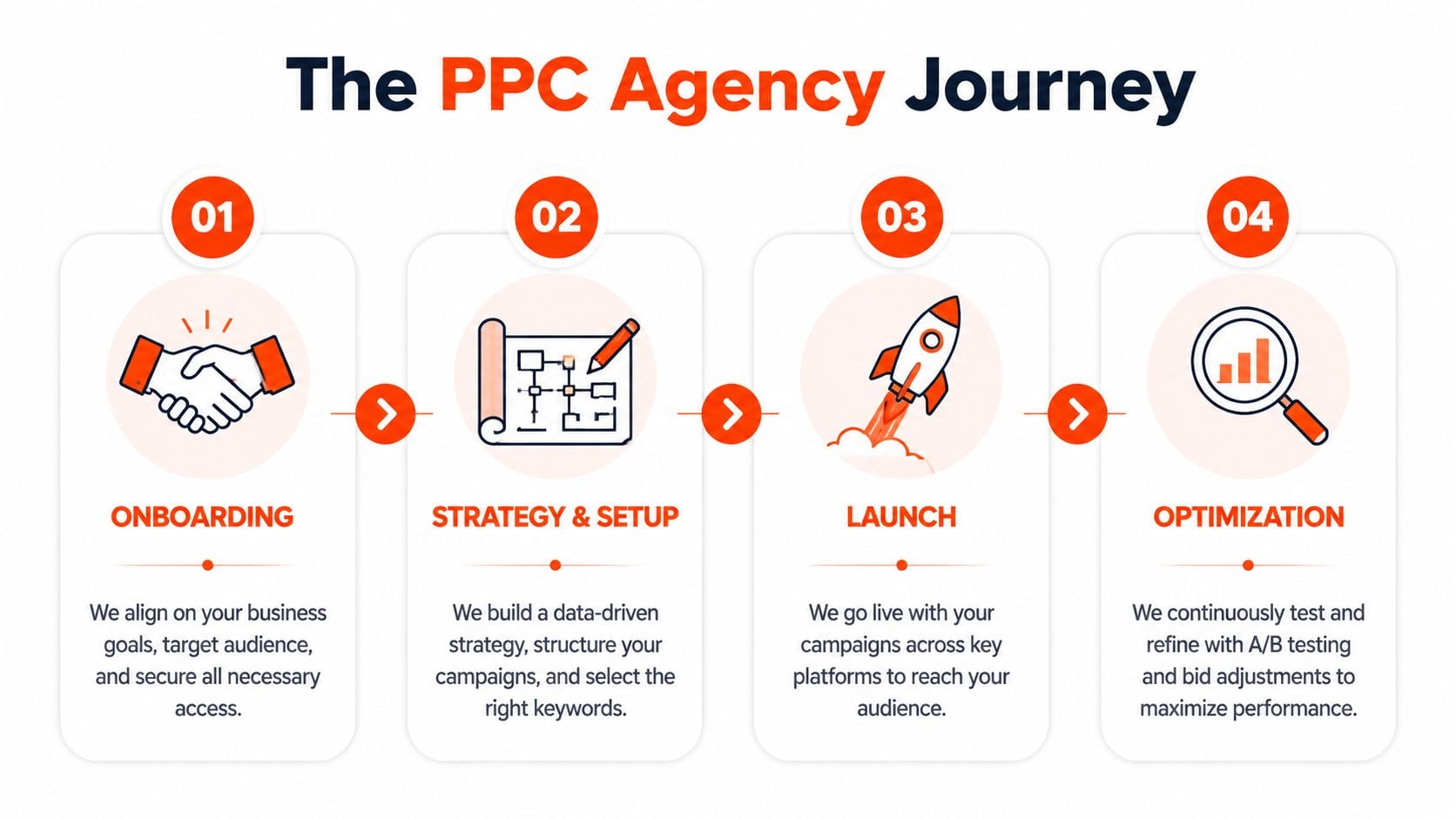
A professional PPC engagement should feel structured from day one. If onboarding feels vague, the campaign usually will too.
Step one starts before any ads go live
The first stage is alignment. The agency should ask practical questions that many businesses skip internally.
What counts as a good lead. Which products carry margin. Which locations matter most. Whether the sales team can handle volume. Which CRM events define real opportunity quality. If those answers aren't clear, campaign performance gets judged on the wrong basis.
This stage usually includes account access, analytics review, competitor checks, offer analysis, and conversion mapping across the website or landing pages.
Campaign build is part technical and part commercial
Once the agency knows the goal, it builds the account around it. That means campaign architecture, audience design, ad assets, extension setup, feed refinement, conversion event configuration, and budget allocation by priority.
This is also where smart agencies decide what not to launch. They might delay a broad campaign until tracking is reliable. They might hold off on scaling social until landing pages are strong enough. Restraint is often a sign that the team understands performance.
A provider such as Click Click Bang Bang, for example, describes a process built around onboarding questionnaires, strategist consultation, analytics integration, live reporting, and ads launched within seven days, with no long-term commitment. That's useful not because it sounds polished, but because it shows the agency has an actual operating system rather than an improvised workflow.
Optimisation is where the real work happens
After launch, the agency starts collecting signal. That signal drives testing and refinement.
Common optimisation work includes:
- Search term control to remove irrelevant traffic and tighten intent
- Ad testing to improve click quality, not just click volume
- Audience refinement across prospecting and remarketing pools
- Bid adjustments based on device, location, and conversion quality
- Landing page feedback when ad traffic reveals friction points
For Australian B2B programs, this process can materially improve lead quality. Agencies using LinkedIn Matched Audiences, account-based marketing lists, structured A/B testing, and API-driven bid management have achieved 2.5 to 4x higher lead quality scores while reducing average cost per lead from $150 to $85, according to Trafiki's PPC agency overview.
Good optimisation isn't constant activity. It's disciplined change tied to a clear hypothesis.
Reporting should support decisions
A serious PPC agency gives clients visibility without drowning them in dashboard noise.
The most useful reporting usually includes:
- Live dashboards for current spend, conversions, and trend monitoring
- Monthly summaries explaining what changed and why
- Commercial commentary tying platform data back to lead quality, revenue, and next actions
If you're interested in how machine learning fits into this process, this perspective on scaling performance marketing via machine learning gives useful context around automation, bidding, and model-driven optimisation.
The workflow matters because PPC success rarely comes from a single launch. It comes from a loop. Data in, decisions made, account improved, results reviewed, repeat.
How to Evaluate and Choose the Right PPC Partner
Choosing a PPC agency is less about who sounds impressive on the sales call and more about who thinks clearly under commercial pressure.
A lot of agencies can talk about channels, targeting, and automation. Fewer can explain how they'll connect ad spend to pipeline quality, revenue, and margin. That's the difference you should test for.
Questions that expose how an agency really works
Use the checklist below during sales conversations. It quickly shows whether you're speaking to operators or presenters.
| Area to Assess | Key Questions to Ask |
|---|---|
| Strategy fit | How do you decide which platforms to prioritise for our business model? |
| Tracking | What conversion tracking do you set up, validate, and review before scaling? |
| Lead quality | How do you measure qualified leads rather than just form submissions? |
| Testing process | What do you test regularly in ads, audiences, bids, and landing pages? |
| Reporting | What will we see in reporting each month, and how do you explain decisions? |
| Team structure | Who actually manages the account after the sale? |
| AI capability | How do you use AI tools in bidding, creative, and analysis without losing oversight? |
| Commercial flexibility | Do you require lock-in contracts, or is there a lower-risk way to start? |
If you're comparing specialist providers, looking at how a dedicated Google PPC company structures its service can help you benchmark what “focused” should look like.
What matters now that didn't matter as much before
Two modern filters matter more than they used to.
The first is AI capability with human oversight. According to a National Positions article citing 2026 Deloitte AU and IAB Australia data, only 12% of agencies offer 30-day risk-free trials, and AI-optimised PPC campaigns lifted e-commerce ROAS by 32% versus 15% for traditional methods. The point isn't that every business needs the newest feature. The point is that strong agencies know how to use automation without handing strategy over to the platform.
The second is commercial flexibility. If an agency insists on a long lock-in before proving it can manage your account well, that's a risk signal. Startups and growing businesses need room to test fit.
Red flags worth taking seriously
Watch for these:
- Guaranteed outcomes. No agency can credibly promise top position or perfect results across every auction.
- Vague answers on tracking. If they can't explain how they measure quality, they can't optimise for it.
- Reporting centred on vanity metrics. Impressions and clicks are context, not the goal.
- No clear owner. If you can't tell who will manage the account, delivery often gets diluted.
- One-size-fits-all strategy. Good agencies adapt by business model, sales cycle, and margin profile.
The right PPC partner doesn't just answer questions well. It asks better questions than other agencies do.
PPC Agency Pricing Models and Measuring ROI
Price matters, but pricing model matters more. The wrong fee structure can create the wrong behaviour inside the account.

The main pricing models
Most PPC agencies use one of three approaches.
-
Percentage of ad spend
This scales with budget and is simple to understand. The downside is obvious. The agency gets paid more when spend rises, which can misalign incentives if efficiency matters more than volume. -
Flat monthly retainer
This creates steadier expectations and often suits accounts that need strategic work, tracking, testing, and reporting beyond pure media buying. It tends to work well when both sides agree on scope. -
Performance-based pricing
This sounds attractive, but it only works when tracking is mature and both sides agree on what counts as success. If lead quality is messy or sales data is delayed, disputes show up quickly.
A more detailed PPC pricing model guide can help you compare these structures against your own sales cycle and reporting maturity.
How to measure real ROI
Don't judge an agency on clicks alone. A click is a cost. ROI comes from what happens after the visit.
The metrics that matter most are usually:
- Cost per acquisition
- Return on ad spend
- Qualified lead volume
- Revenue by campaign or channel
- Customer lifetime value, where repeat purchase or contract value matters
Benchmarks help with context, but they don't replace business economics. The average Google Ads conversion rate across industries is 7.52%, average cost per click is $5.26, Legal sees conversion rates of 8.2%, and B2B SaaS sees 6.8%, according to Shopify's PPC statistics. Agencies use AI tools for smart bidding and ad copy generation to outperform baseline benchmarks, but the important question is whether the account beats your target acquisition economics, not whether it matches an industry average.
For businesses budgeting spend, this Google Ads pricing guide for 2026 is a practical companion to understanding how auction costs affect planning.
A quick visual walkthrough can also help frame how cost and return interact in paid campaigns:
Why PPC and SEO work better together
PPC gives speed. SEO gives compounding visibility. Used together, they improve each other.
Paid search reveals converting queries, offer angles, and landing page signals quickly. SEO uses those insights to build durable content and organic presence. SEO content expands search coverage and lowers reliance on paid media over time. That's why the strongest agencies don't treat channels in isolation. They build a marketing system where each one sharpens the other.
If you were asking “what is a ppc agency”, the practical answer is this. It's a partner that turns media spend into a measured acquisition system and keeps that system aligned with business outcomes.
If you need that kind of partner, Click Click Bang Bang offers PPC and AI-first SEO services across Google, Meta, LinkedIn, remarketing, and Shopping, with transparent reporting, no long-term commitment, and a 30-day risk-free trial. It's a fit for businesses that want structured onboarding, clear performance visibility, and a paid media program tied to leads, sales, and ROI rather than just platform activity.
Read NeXt
Or Read Our Latest
- Manual vs Automated Bidding for PPC Success
- Conversion Tracking Setup: A Complete AU Guide
- Instagram Advertising Australia: Complete 2026 Guide
- Pay Per Click: A Beginner’s Guide for Australian Marketers
- Display Advertising on Google: The Complete Australian Guide
- Stakeholder Communication Plan How to Build One That Works
Click. CLick. Subscribe.
Get our best PPC insights, industry updates, and power moves delivered straight to your inbox. No fluff, just high-caliber strategies that actually work.
Don’t Leave Just Yet
Try Us For 30-Days,
Risk Free!!
We guarantee that you’ll love our work within the first 30 days, if not you’ll get your money back.
What have you got to lose?