

How to Start Advertising on LinkedIn: 2026 Guide
Last Updated
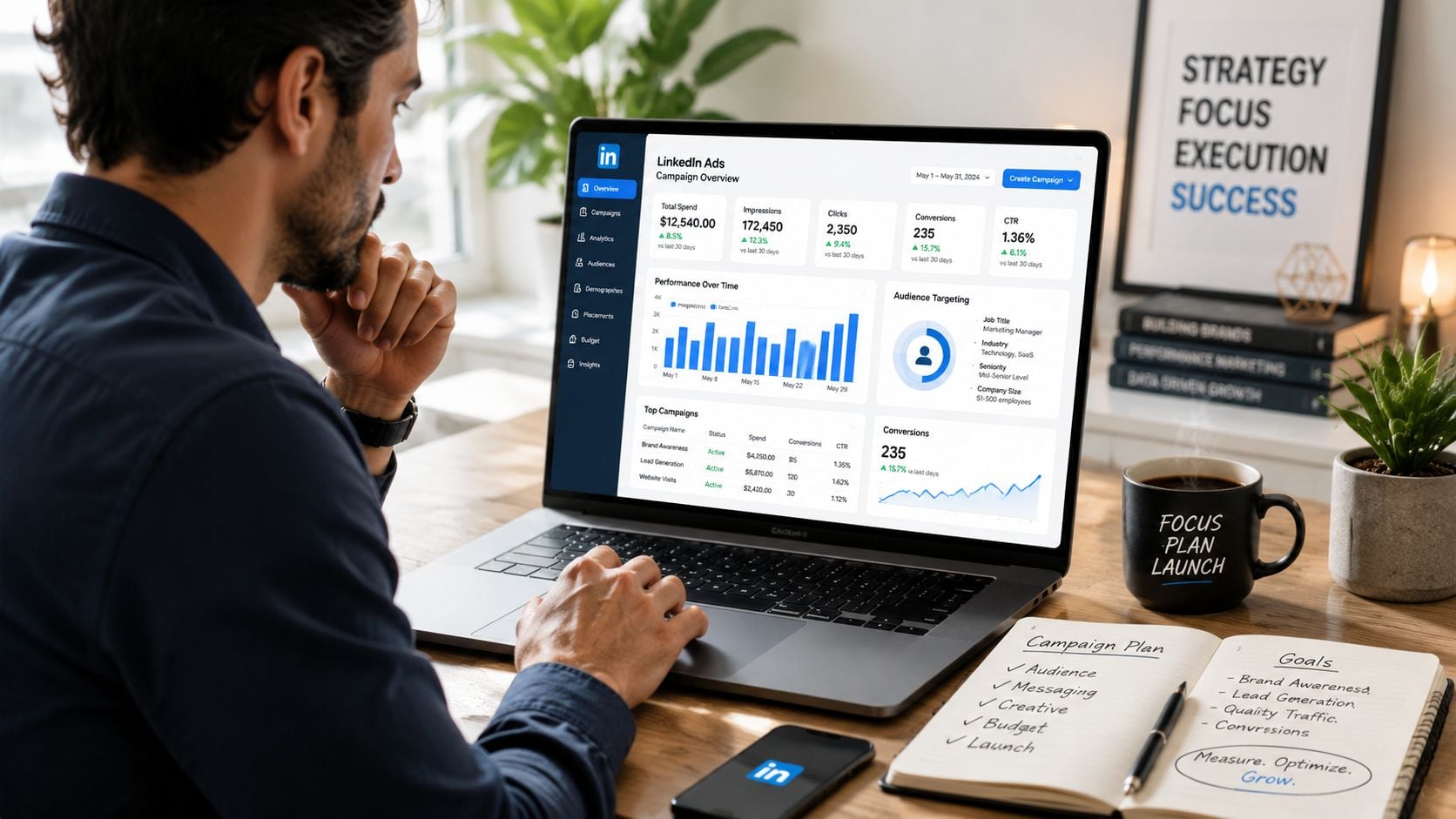
You know LinkedIn matters. Your sales team wants more qualified conversations, leadership wants leads that look like actual buyers, and you're staring at Campaign Manager wondering how this turns into a campaign that doesn't waste budget in week one.
That's where most first-time advertisers get stuck. They focus on buttons before strategy, launch before tracking, and targeting before they've decided what a good result even looks like. On LinkedIn, those mistakes get expensive quickly because you're buying access to a professional audience, not cheap reach.
The good news is that learning how to start advertising on LinkedIn isn't complicated once you treat it like a system. The account setup matters. The tracking setup matters more. Then come the choices that shape performance: objective, audience, format, bid model, message, and what you'll optimise after launch.
Your Guide to Effective LinkedIn Advertising
LinkedIn usually enters the conversation when a business has already outgrown broad social targeting. You've probably run campaigns elsewhere, generated traffic, maybe even picked up leads, but the quality hasn't matched the spend. Now you want to get in front of people by company, role, seniority, or industry, and LinkedIn is the obvious platform for that.
That's also why first campaigns often underperform. Marketers assume a professional audience will respond to the same offers, the same creative, and the same funnel logic they use on other platforms. It rarely works that way. Buyers on LinkedIn are in a work mindset. They respond to relevance, credibility, and clarity more than novelty.
Practical rule: Treat LinkedIn as a decision-maker platform, not a mass-attention platform.
The strongest campaigns start with a few disciplined decisions. You need tracking in place before traffic starts. You need one clear conversion goal. You need targeting that's specific enough to be useful, but not so narrow that the platform has no room to learn, especially in Australia where many B2B audiences are naturally smaller. You also need ad creative that respects the feed. Over-polished sales language usually struggles. Useful, direct messaging tends to travel better.
If you're mapping out your broader funnel alongside paid media, these proven LinkedIn lead generation techniques are a useful companion because they frame ads as one part of a larger demand and capture system, not an isolated tactic.
By the time you finish this guide, you should know where to set up your account, what to configure before launch, how to choose the right objective, how to build an audience without strangling delivery, and how to optimise based on signals that matter.
Build Your Foundation for Success
A common first-campaign scenario looks like this. The ads are approved, spend starts, clicks come in, and then the team realises no one can say which leads came from LinkedIn, who owns the account, or whether the right company page is attached. By then, the platform has already spent budget on weak data.
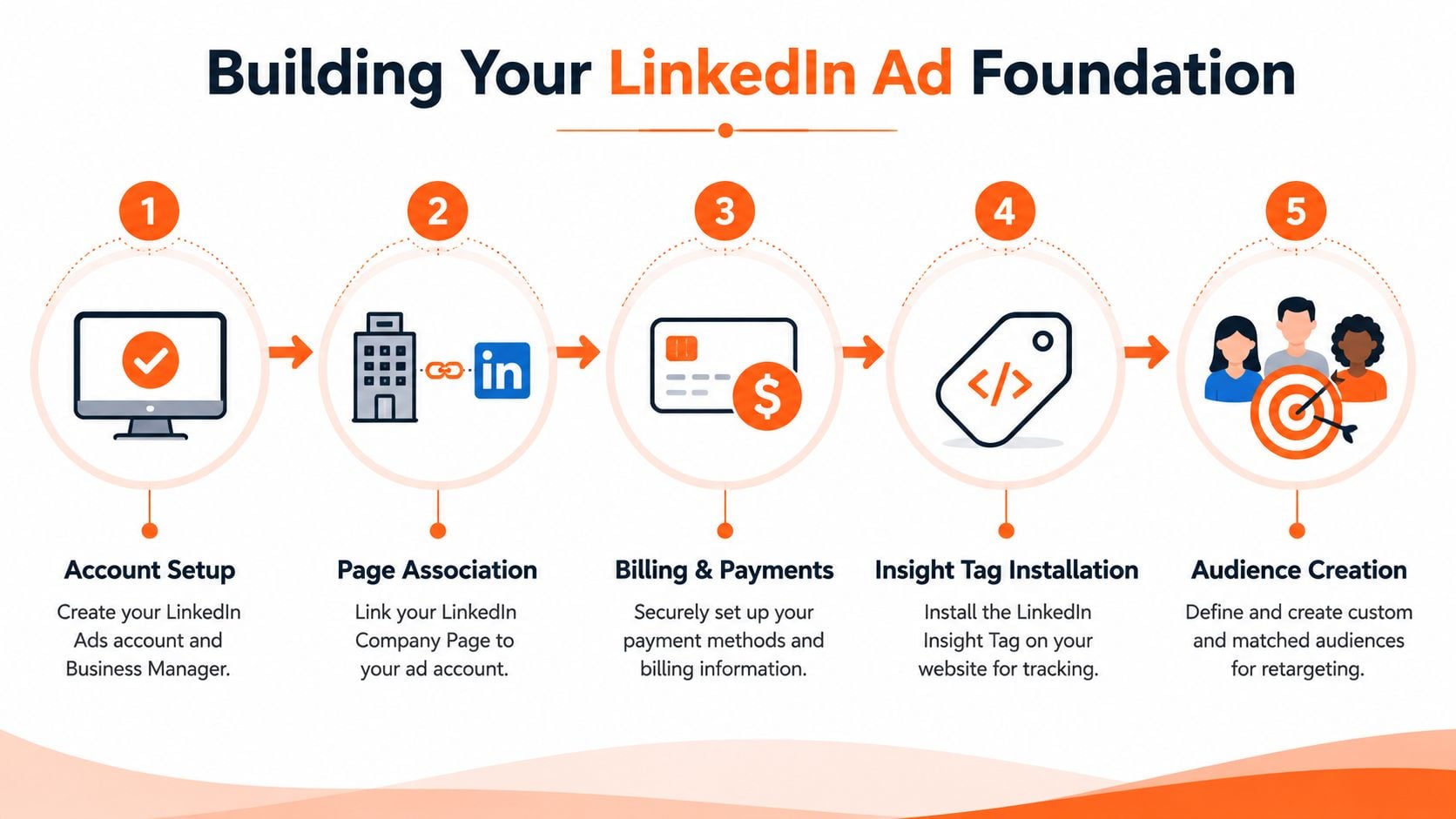
Start with access and account structure
LinkedIn setup is simple in the interface. The risk sits in the decisions behind it.
Use a verified personal LinkedIn profile to access Campaign Manager, then create the ad account under the business, not under whoever happens to be launching the campaign. That sounds administrative, but it matters later if staff change, an agency gets involved, or finance needs account history. In Australia, I also recommend confirming billing ownership and GST treatment early, because those questions tend to appear after launch when they are harder to fix cleanly.
The company LinkedIn Page needs to be linked to the correct ad account from the start. If the wrong page is connected, you can end up rebuilding ads or delaying approvals while permissions are sorted. Get page admin access, ad account access, and website access lined up before anyone touches campaign settings.
A clean setup usually includes:
- Business-owned ad account: Keeps control with the company.
- Correct LinkedIn Page association: Ensures ads run under the right brand identity.
- Billing configured in advance: Prevents approval or delivery delays.
- Clear team permissions: Marketing, paid media, and web support each need the access required to do their job.
If internal ownership is unclear, a LinkedIn advertising agency can set up the account structure and tracking properly. The better lesson is simpler. One person should own the process end to end.
Install tracking before you launch
Tracking goes in before creative review, before audience building, and definitely before spend.
LinkedIn's Insight Tag is the standard starting point because it supports conversion tracking, retargeting, and matched website audiences. LinkedIn also documents server-side options through its Conversions API, which can help if browser-based tracking is limited by consent settings, cookie restrictions, or a more locked-down website setup. For many Australian B2B advertisers, the practical trade-off is speed versus resilience. The Insight Tag is faster to deploy. Server-side tracking usually takes more development support but gives you a stronger measurement setup over time.
Set up your conversion events in Campaign Manager before launch. That means defining what counts as success on your site, such as a demo request, contact form submission, booked consultation, or qualified content download. If the event is vague, optimisation gets vague too.
Launching without tracking usually creates two problems. You cannot measure lead quality properly, and you cannot build retargeting audiences with confidence.
Build audiences after the plumbing works
Audience strategy should follow measurement, not the other way around.
If your tracked goal is a high-intent action like a demo request, you can justify narrower targeting and more direct messaging. If your goal is early-stage content engagement, you usually need broader audience construction and softer offers. That trade-off matters even more in Australia, where many B2B segments are smaller and can become too restricted fast.
Keep the setup order tight:
- Verified personal login
- Campaign Manager and business-owned ad account
- Company Page association
- Billing setup
- Insight Tag or server-side tracking
- Conversion event definitions
- Audience preparation
- Creative build
That foundation does not make the campaign profitable on its own. It does stop avoidable setup mistakes from distorting every result that follows.
Define Your Campaign Blueprint
A first LinkedIn campaign usually goes wrong before the ads run. The account is set up, tracking is in place, and then the campaign gets built around the wrong objective, the wrong format, or cost expectations pulled from cheaper platforms. That is where early budget gets wasted.
Choose the objective that matches the sale
Your objective tells LinkedIn what to optimise for. Pick the wrong one and you can get plenty of activity with very little commercial value.
Awareness is often the default choice for first-time advertisers because it feels lower risk. For lead generation, it usually creates the wrong kind of learning. You pay to reach people, but you do not give the platform a clear signal about who is likely to enquire, book, or download a high-intent offer. If the primary goal is pipeline, use Conversions or Lead Generation. If the offer is still being tested, Website Visits or Engagement can be a better starting point because they let you validate message and landing page fit before asking for a form fill.
LinkedIn's own guidance on choosing campaign objectives in Campaign Manager aligns with that approach. The objective should reflect the action you want the platform to find more of.
Here is the practical version:
| Business goal | Better LinkedIn objective | Common mistake |
|---|---|---|
| Generate demo requests | Conversions or lead generation | Choosing awareness because the audience is cold |
| Promote a webinar or report | Website visits or engagement | Optimising for leads before the offer is proven |
| Re-engage site visitors | Conversions | Sending them to generic pages |
| Build visibility in a niche account list | Awareness or engagement | Judging success only by clicks |
For Australian B2B campaigns, this choice matters even more. Audience pools are often smaller than marketers expect, especially outside major metros or within specialised industries. A vague objective burns through that limited reach without building useful optimisation signals.
Set expectations on costs early
LinkedIn is usually an expensive platform on a CPC basis. That does not make it overpriced. It means you are paying for access to verified professional data and high-value buyers.
The question is simpler. Can you afford the cost of reaching the right decision-maker if the downstream conversion rate and sales value are realistic?
LinkedIn publishes its ad auction and bidding mechanics in its Campaign Manager bidding documentation. In practice, costs rise fast when you combine senior audiences, narrow targeting, and high-friction offers such as demo requests. Costs can stay reasonable when the audience is broad enough to learn, the message is tightly matched to the role, and the conversion ask fits the buyer's level of intent.
A marketing manager in Australia should plan for this trade-off from day one. If you are targeting operations directors in mining, enterprise IT leaders, or healthcare executives, you are dealing with smaller reachable audiences and longer sales cycles. That usually means higher CPMs, slower learning, and a stronger need to qualify success beyond top-line lead volume.
Cheap clicks are not the goal. Commercially viable leads are.
Match format to the job
Format should be chosen at the same time as objective and offer. It changes how people engage, what they expect, and how much friction the campaign can carry.
For most first campaigns, single image Sponsored Content is the safest place to start. It appears naturally in the feed, it is easier to produce well, and it keeps the test focused on audience, message, and landing page quality. Video can work well when the message needs more explanation or when brand familiarity is low, but weak video often underperforms a clear static ad. Lead Gen Forms reduce friction and can be useful for webinars, reports, and event registrations. They also tend to attract lower-intent submissions if the offer is too broad. Conversation Ads can work for targeted follow-up or event promotion, but they are rarely the best first test for a new advertiser because there are more moving parts.
That trade-off is where beginners often slip. They choose the most interactive format instead of the format that gives the clearest signal.
A strong first campaign is usually narrow by design. One objective, one offer, one audience hypothesis.
If the offer is proven and the sales team can handle follow-up quickly, start with Sponsored Content and test either a website conversion path or a Lead Gen Form path. If the offer is still uncertain, reduce complexity first. Get the message right, then add more advanced formats after you know what buyers respond to.
Reach the Right Professionals with Precision Targeting
A first LinkedIn campaign often goes wrong here. The targeting options look so precise that it is easy to build an audience that feels perfect in Ads Manager and is far too small, too expensive, or too restricted to produce useful learning.
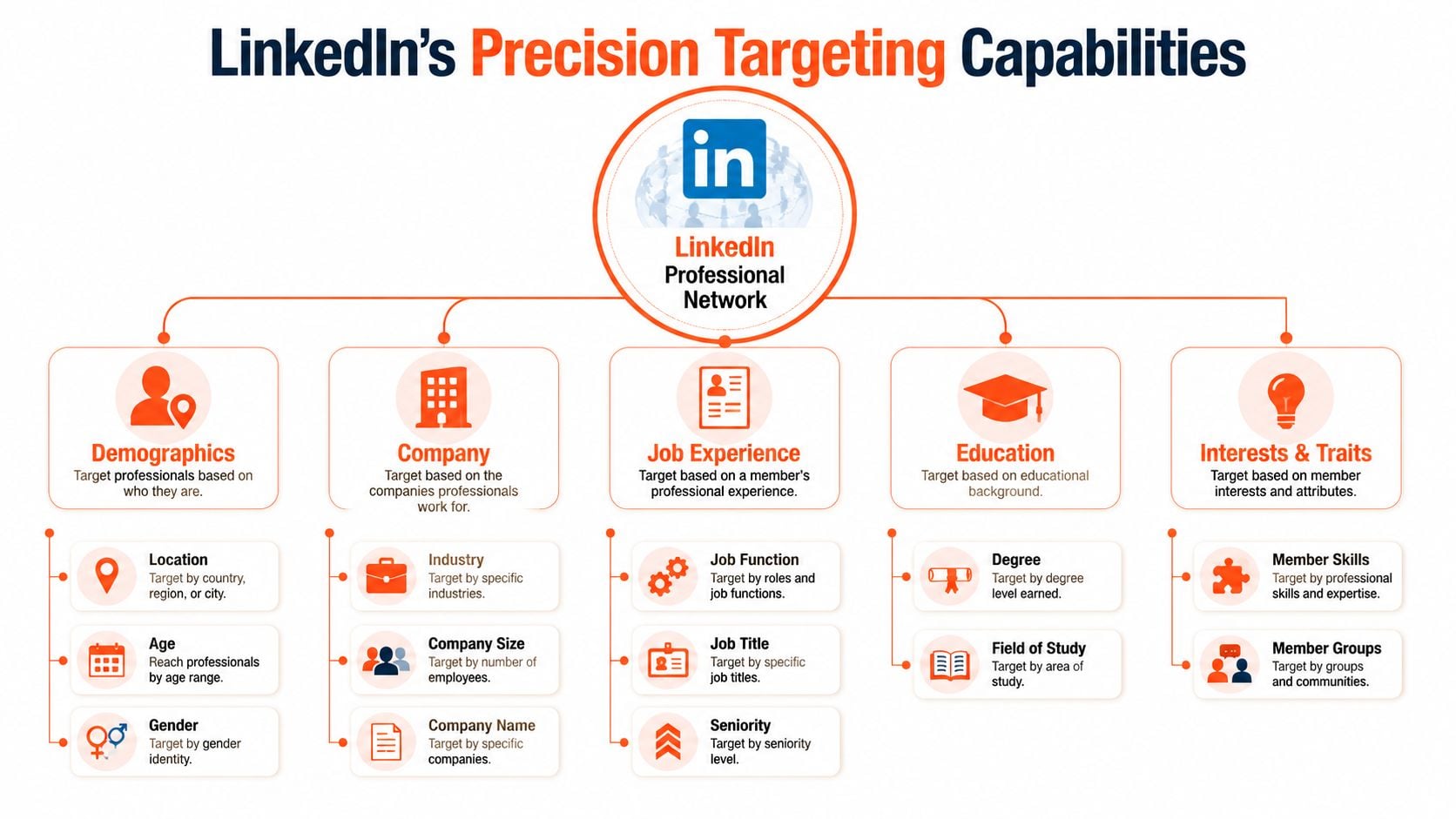
Start with buying relevance
Good LinkedIn targeting starts with the few signals that relate to the deal. For most B2B campaigns, that means choosing the market you can serve, the role closest to the problem, and one or two business-fit filters that matter commercially.
A practical starting setup usually includes:
- Location: The states, cities, or countries your team can actively sell into
- Job function or job title: The people who feel the problem or influence the shortlist
- Seniority: Useful if approvals sit at manager level and above
- Company attributes: Industry, company size, or named accounts if those factors affect qualification
That is enough to start testing.
Beginners often add skills, interests, groups, years of experience, extra exclusions, and niche company categories before they have any evidence those filters improve lead quality. The result is usually a tighter audience, higher CPMs, and less stable delivery. On LinkedIn, more filters do not automatically mean better targeting. They often mean less room for the platform to find reachable buyers inside your budget.
Australia changes the targeting maths
This matters more in Australia than in larger markets. Your ideal audience may only be a few thousand reachable professionals once you narrow by metro area, industry, title, and seniority. If you over-filter at that point, frequency climbs fast and performance can flatten before you have enough data to judge the campaign properly.
Hootsuite advises advertisers to start broader, then add professional attributes and matched audiences as performance data comes in, in its LinkedIn ads guide. That approach fits the Australian market well because many B2B niches do not have deep volume.
A better sequence looks like this:
-
Start with a broad but relevant professional segment
Use a job function or a tight cluster of related titles in your target geography. -
Check lead quality against pipeline reality
CTR can look healthy while sales rejects half the leads. Watch what turns into qualified conversations, not just what gets clicks. -
Refine after patterns appear
If enterprise accounts, a specific industry, or a seniority band clearly performs better, narrow the audience then.
In Australia, under-targeting is often less expensive than over-targeting. A slightly broader audience can still find the right buyers. A tiny audience often gives you weak delivery and misleading conclusions.
Choose filters that reflect how the deal gets made
The right audience is not always the final approver. Sometimes the better starting point is the team that owns the pain.
For example, a cyber security provider selling to mid-market firms in Australia might assume the target should be CIOs and IT Directors only. In practice, a first campaign can perform better by including IT Managers, Infrastructure Managers, and Security Leads, because those people are closer to the operational problem and often influence vendor research earlier. The senior audience still matters, but narrowing to executives too early can cut volume and raise costs before the account has enough traction.
This is also where creative and targeting need to match. A message aimed at strategic budget owners will not usually land with hands-on practitioners, and the reverse is true as well. If you need inspiration for how different audiences are addressed in-feed, review these LinkedIn ad examples for B2B campaigns.
A short explainer can help you visualise the targeting logic before you build:
Use matched audiences after your base audience works
Matched audiences are powerful once there is enough intent to work with. Website retargeting, contact uploads, and account lists can improve relevance because they rely on known behaviour or known fit, not assumptions.
The mistake is using them too early. If your site has low traffic or your account list is small, the campaign can become hard to scale and hard to learn from. Start with a clean base audience first. Then layer retargeting, customer exclusions, or account-based segments once you have enough activity to support them.
That approach usually saves the most money in an early LinkedIn account. Start with buyer relevance. Add precision after the campaign earns it.
Crafting LinkedIn Ads That Convert
A LinkedIn user in Sydney scrolls past your ad between meetings. You have a few seconds to show that the message is relevant, credible, and worth a click. If the ad reads like generic brand copy, you pay premium LinkedIn CPCs for very little.
Good LinkedIn ads work because they respect buyer context. The platform reaches people in a professional mindset, so the creative should speak to a real business problem, point to a clear next step, and make the action feel worth the time.
Match the format to the stage of awareness
Ad format should follow buying intent, not personal preference or whatever asset the team already has ready.
For cold audiences, Sponsored Content usually gives you the best first read because it appears naturally in-feed and can carry an educational angle without feeling too aggressive. For warmer audiences, direct-response formats can work well if the offer is specific enough to justify the ask. Conversation Ads can produce strong results for demo requests or tightly matched offers, but only when the targeting and message are narrow enough to feel personal rather than automated.
In practice:
- Single image ads suit one clear message, one audience problem, and one action.
- Video ads suit products or services that need a quick explanation, especially if the first few seconds show the problem clearly.
- Document ads suit lead magnets where the content itself is the reason to engage.
- Conversation Ads suit remarketing or high-intent segments where guided message paths add value.
For many Australian advertisers, especially in smaller B2B niches, simple formats are often the better starting point. They cost less to produce, make testing easier, and give you a cleaner signal on whether the offer and message are working.
Write for a buyer who is busy, sceptical, and specific
Weak LinkedIn copy sounds polished but empty. Strong copy sounds like someone understands how the job actually works.
Compare the difference:
| Weak angle | Stronger angle |
|---|---|
| “Transform your business growth” | “See where qualified leads are dropping out of your funnel” |
| “Solutions for modern teams” | “Reduce manual follow-up for sales-qualified enquiries” |
| “Book a demo today” | “See how your team can qualify inbound leads faster” |
Specificity does more than improve click-through rate. It also filters out the wrong clicks. That matters on LinkedIn because broad, flattering copy can attract curiosity from people who will never become pipeline.
Short copy helps earn attention. Clear copy helps get qualified action.
Make the creative look credible in a professional feed
LinkedIn creative does not need to look flashy. It needs to look competent. Clean layouts, readable text, a direct headline, and one clear CTA usually outperform ads that borrow too much from consumer social.
Message match matters just as much as design. If the ad offers a guide for operations leaders, the landing page should open with that same promise, not a vague company overview. A lot of early LinkedIn campaigns underperform because the ad is specific and the page is generic.
If you want a practical reference point, review these LinkedIn ad examples for B2B campaigns and note how the strongest ads make the audience, problem, and offer obvious at a glance.
One more point. Creative quality is not just about the ad itself. Tracking has to be clean enough to tell you whether the copy is attracting buyers or just clicks. If your reporting setup still needs work, this guide will help you master campaign performance.
A simple test works well before launch. If your target buyer saw the ad for three seconds, would they know who it is for, what problem it addresses, and what happens after the click? If the answer is unclear, rewrite it before you spend.
Launch, Measure, and Optimise Your Campaigns
A LinkedIn campaign isn't finished when it goes live. Launch just gives you the first clean read on whether your assumptions were right. That shift in mindset matters because optimisation works best when you treat it as structured refinement, not emergency repair.
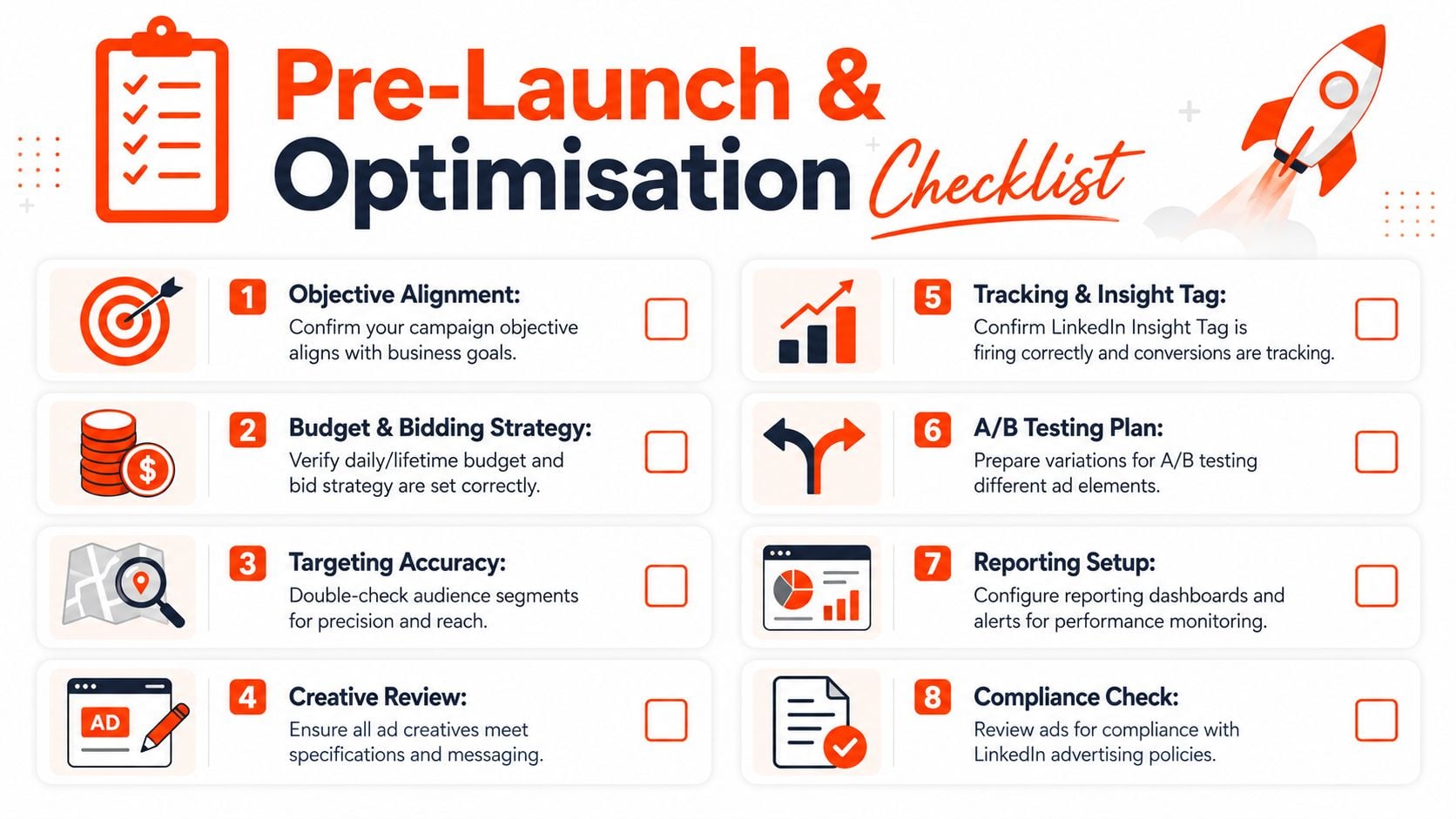
Use a pre-launch check before spend starts
Before you publish, pressure-test the campaign like a strategist, not just an operator.
- Objective fit: Does the selected objective match the commercial outcome?
- Audience logic: Is the audience relevant without being over-constrained?
- Creative alignment: Does the ad message match the landing page and offer?
- Tracking readiness: Are conversions firing in the platform?
- Testing plan: Do you have variations ready, or are you betting on one ad?
For AU advertisers, the first days matter because smaller audiences can produce noisy signals. Don't make aggressive changes too early unless something is clearly broken, such as a tracking issue or obvious message mismatch.
Optimise the variables that matter
LinkedIn makes it easy to obsess over the wrong numbers. A tidy click-through rate can look comforting while lead quality is poor. A high CPL can be completely acceptable if the leads are commercially strong. You need to optimise in the order that supports revenue.
The operational framework is simple:
-
Check tracking first
If conversion events aren't recorded correctly, every later decision is compromised.
-
Review early engagement signals
Low response can point to weak audience-message fit or poor creative packaging.
-
Compare lead quality by segment
Titles, functions, industries, and geographies often vary more in quality than in click behaviour.
-
Make small changes
Hootsuite recommends small, spaced budget changes to establish a baseline in LinkedIn delivery conditions, as noted earlier. That discipline usually produces cleaner learning.
-
Test one meaningful variable at a time
Change the hook, the audience thesis, or the offer. Don't change everything at once.
If you want a stronger reporting rhythm beyond the native dashboard, resources that help you master campaign performance are useful because they force clearer thinking around what should be monitored daily, weekly, and monthly.
For click behaviour, this guide on what is a good CTR is helpful when you need context without judging campaign health on click-through rate alone.
The goal of optimisation isn't constant movement. It's making fewer, better decisions with cleaner evidence.
When LinkedIn campaigns work, they usually don't do so because of one clever trick. They work because the setup was measured, the targeting was disciplined, the offer matched the audience, and the team adjusted based on real behaviour instead of guesswork.
If you want help setting up or managing LinkedIn Ads with proper tracking, audience strategy, and reporting from the start, Click Click Bang Bang offers PPC support across LinkedIn and other paid channels with strategist-led onboarding and conversion-focused campaign management.
Read NeXt
Or Read Our Latest
- Manual vs Automated Bidding for PPC Success
- Conversion Tracking Setup: A Complete AU Guide
- Instagram Advertising Australia: Complete 2026 Guide
- Pay Per Click: A Beginner’s Guide for Australian Marketers
- Display Advertising on Google: The Complete Australian Guide
- Stakeholder Communication Plan How to Build One That Works
Click. CLick. Subscribe.
Get our best PPC insights, industry updates, and power moves delivered straight to your inbox. No fluff, just high-caliber strategies that actually work.
Don’t Leave Just Yet
Try Us For 30-Days,
Risk Free!!
We guarantee that you’ll love our work within the first 30 days, if not you’ll get your money back.
What have you got to lose?