

Mastering Pay Per Click Management
Last Updated
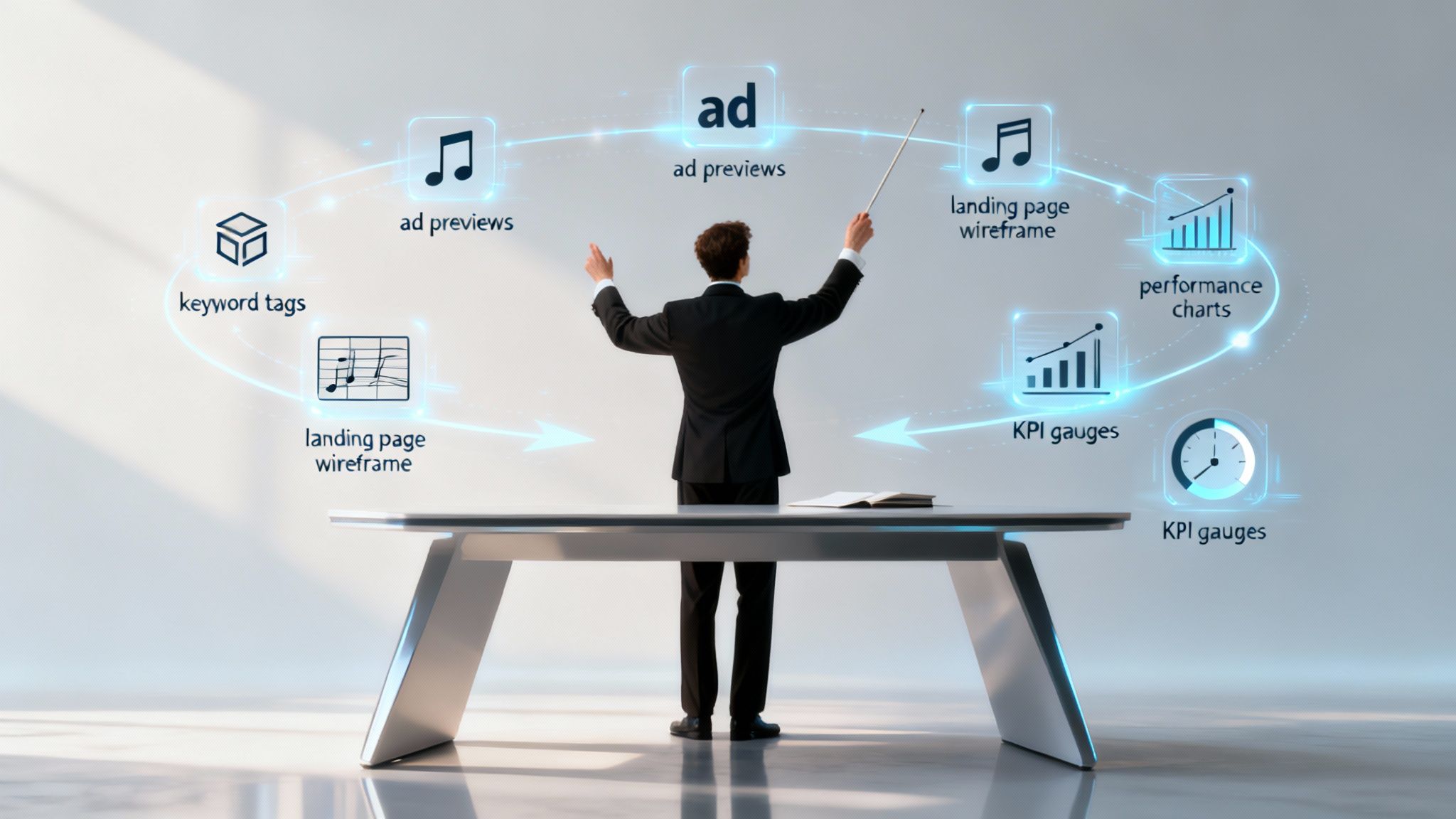
Pay per click management is the hands-on process of steering and fine-tuning a paid advertising campaign to get the best possible performance. It’s absolutely not a “set it and forget it” task; think of it as a constant cycle of strategic adjustments designed to push your results higher and boost your return on investment (ROI).
What Is Pay Per Click Management Really About?
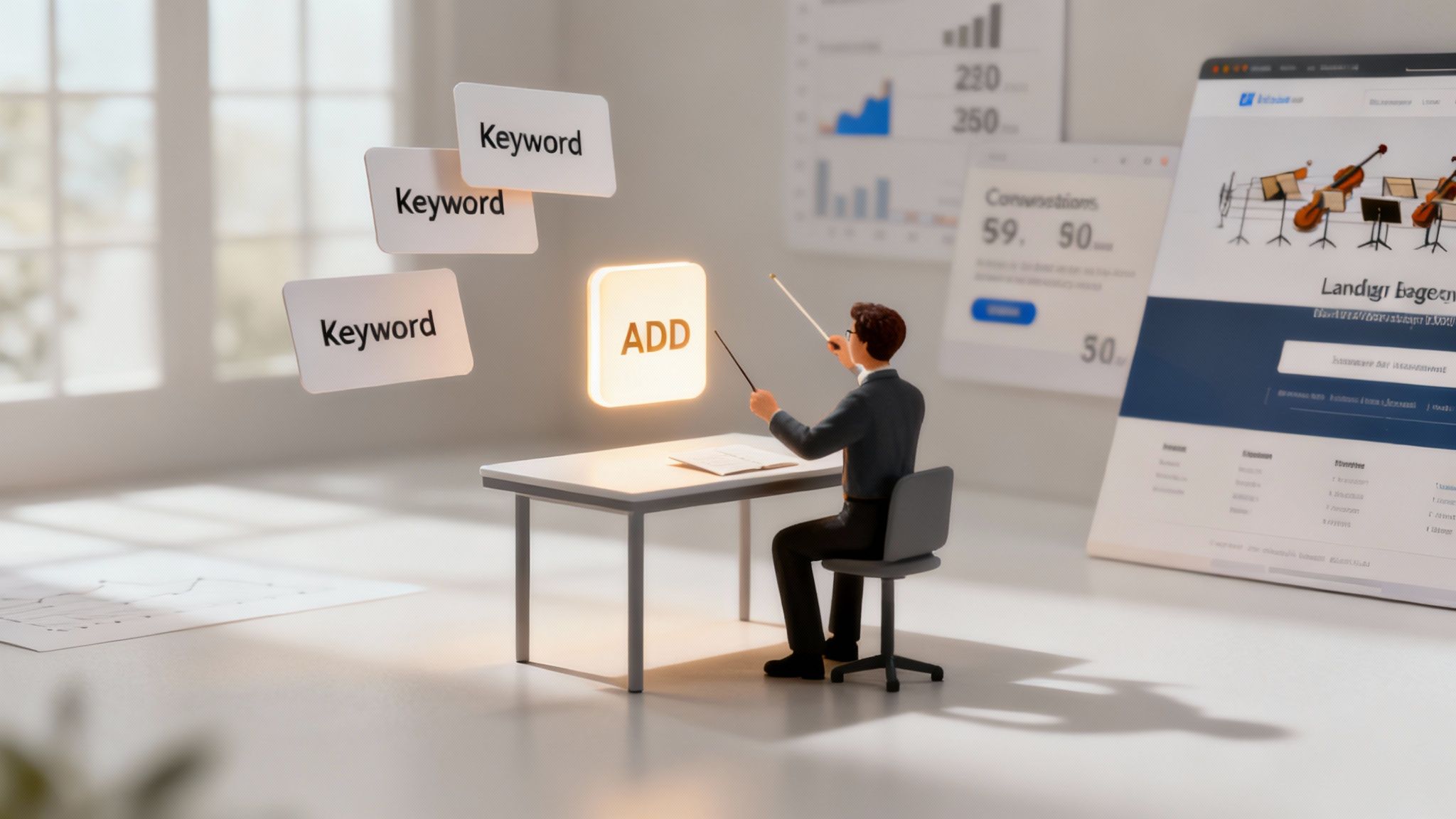
Imagine you're conducting a digital orchestra. Each keyword is an instrument, every ad is a musician, and the landing page is the grand concert hall. As the conductor, your job is to make sure all these moving parts work in perfect harmony to create a masterpiece—in this case, a profitable campaign that delivers real business growth.
This kind of strategic coordination goes way beyond a simple dictionary definition. It’s what turns your ad spend from a line-item expense into a powerful investment. You’re not just buying clicks; you're building a system that consistently brings in tangible outcomes like leads and sales. The whole idea is to make every single dollar count.
The Strategic Value of Continuous Management
Even a perfectly structured campaign can start bleeding money if left on autopilot. Market trends shift, your competitors change their game plan, and the way your audience behaves online is always evolving. Proper pay per click management is all about staying one step ahead of these changes through constant monitoring and refinement.
It's an active, hands-on process that involves meticulous keyword research, bid adjustments, A/B testing ad copy, and optimising landing pages to improve conversion rates. The goal is to continuously refine the campaign to ensure every component is performing at its peak.
The evolution of PPC right here in Australia really drives home the need for this kind of oversight. The increasing use of AI, automation, and deeper personalisation is having a huge impact on campaign results for Australian businesses. For example, with over 90% of the population online, keeping up with things like voice search keywords and sharper local targeting is essential for staying visible. You can dig deeper into the latest Australian PPC trends to see how fast things are changing.
This proactive approach ensures your advertising budget isn't just spent, but strategically invested. By focusing on data-driven decisions, you can methodically improve your results over time.
Why It Is More Than Just Running Ads
At the end of the day, pay per click management is what separates running ads from running successful ads. It demands a solid grasp of several key areas:
- Audience Targeting: Pinpointing the exact demographics, interests, and online behaviours of your ideal customer. It’s about finding the right people, not just any people.
- Budget Optimisation: Shifting your funds to the highest-performing keywords and ad groups while ruthlessly cutting out the wasteful spend.
- Performance Analysis: Using metrics like Click-Through Rate (CTR) and Cost Per Acquisition (CPA) to measure what’s working and spot opportunities to do better.
- Strategic Adaptation: Taking what the performance data and market shifts are telling you and turning it into smart adjustments to your bidding, targeting, and ad creative.
When you master these components, you stop just participating in the ad auction and start strategically winning it, locking in a consistent and measurable return on your advertising investment.
Building Your PPC Campaign Foundation
A winning PPC campaign is a lot like building a house. It needs a rock-solid foundation where every single piece is strong and perfectly connected. If you cheap out on the foundation, it doesn't matter how much money you throw at the fancy fixtures later—the whole thing will eventually come crumbling down.
To build this foundation right, you need to master four critical, interconnected parts. Think of them as your architectural blueprint, the persuasive sales pitch, your welcoming digital storefront, and the all-important cash register. When these elements work together in harmony, you construct a high-performance machine that sidesteps the common traps that sink so many other campaigns.
Start with Keyword Research
Keyword research is the architectural blueprint for your entire campaign. It dictates the structure, shapes your messaging, and ultimately decides who walks through your digital door. Getting this wrong is like building that house on sand; everything you build on top of it will be unstable from day one.
This isn't just about guessing what people search for. It's about digging deep to uncover the exact phrases and questions your ideal customers are typing into Google. Solid research zeroes in on three things:
- Relevance: Are these keywords a direct match for what you sell?
- Intent: What is the searcher trying to do? Are they just browsing, comparing options, or do they have their credit card out, ready to buy right now?
- Competition: Who else is bidding on these terms, and what's it going to cost you to play in that space?
By focusing on keywords with strong commercial intent, you ensure your ads are shown to people who are actively looking to make a purchase, not just kicking tyres.
A well-structured campaign begins by finding the keywords that bridge the gap between a user's problem and your solution. It’s the single most critical step in making sure your budget is spent attracting qualified traffic, not just clicks.
Craft Compelling Ad Copy
If keywords are the blueprint, your ad copy is the magnetic sales pitch that convinces someone to come inside. You’ve got just a few short lines of text to grab their attention, shout your value from the rooftops, and inspire a click. Crucially, your ad needs to speak directly to the user's search query, acting as an immediate confirmation that "Yes, you've found what you're looking for."
Great ad copy isn't about being clever for the sake of it; it's a direct, compelling response to the keyword that triggered it. This tight alignment between keyword and ad is measured by platforms like Google through a metric called Quality Score. A higher Quality Score doesn't just feel good—it can earn you better ad positions for a lower cost per click.
To create ads that actually work, focus on these must-haves:
- Include the Primary Keyword: Slap your main keyword right in the headline for instant recognition and relevance.
- Highlight a Unique Selling Proposition (USP): What makes you the obvious choice? Free shipping? A 30-day guarantee? Unbeatable expert advice? Make it pop.
- Use a Strong Call to Action (CTA): Tell people exactly what to do next. "Shop Now," "Get a Free Quote," or "Book a Consultation" leave no room for doubt.
Design High-Converting Landing Pages
The landing page is your digital storefront. After a user clicks your ad, this is where they land. It has one job and one job only: turn that click into a customer. One of the most common and costly mistakes is sending all your ad traffic straight to your homepage, which is usually a cluttered mess of competing messages.
A dedicated landing page should feel like a seamless continuation of your ad. It has to maintain message consistency, reinforcing the exact offer or promise made in the ad copy. A high-converting landing page is crystal clear, hyper-focused, and makes it ridiculously easy for the user to take the action you want them to take.
For those looking to build out a robust campaign from the ground up, exploring a detailed Google Ads campaign structure template is a fantastic starting point for organising your ad groups and landing pages for maximum effect.
A clear, well-organised campaign structure is the backbone of any successful PPC effort. Below is a checklist summarizing the essential components we've discussed, highlighting their purpose and what you should be focusing on for each.
Essential PPC Campaign Components Checklist
| Component | Primary Goal | Key Focus Area |
|---|---|---|
| Keyword Research | Attract relevant, high-intent traffic. | Uncovering terms with commercial intent and manageable competition. |
| Ad Copy | Persuade the user to click. | Aligning message to the keyword, highlighting a strong USP and CTA. |
| Landing Pages | Convert the click into a lead or sale. | Maintaining message consistency and providing a clear path to conversion. |
| Conversion Tracking | Measure results and enable optimisation. | Accurately capturing actions that drive business value (sales, leads). |
Getting these four pieces right isn't just a recommendation; it's the only way to build a campaign that is both scalable and profitable over the long term.
Implement Conversion Tracking
Finally, conversion tracking is the cash register of your campaign. It’s the feedback loop that tells you what’s actually making you money. Without it, you’re flying blind. Sure, you can see how many people clicked your ad, but you have no earthly idea if those clicks led to sales, leads, or phone calls.
Setting up conversion tracking allows you to measure the actions that truly matter to your business. This data is the lifeblood of pay per click management, giving you the power to see exactly which keywords, ads, and landing pages are driving real results. With that insight, you can confidently double down on what works and cut the dead weight, turning your campaign from a money pit into a predictable, profitable machine.
Executing a Winning PPC Management Workflow
Effective pay-per-click management isn’t a one-and-done setup. It’s a continuous cycle, an ongoing process of strategic refinement where every step informs the next. This creates a powerful feedback loop that drives consistent improvement. This workflow is what turns the vague idea of 'management' into a clear, repeatable process that keeps your campaigns moving in the right direction.
Think of it like training for a marathon. You don't just run once and hope to win. You follow a structured plan: run, analyse your performance, adjust your nutrition, and rest. It’s a constant cycle of action and refinement. A winning PPC workflow runs on the exact same principle.
Defining Clear Campaign Objectives
Before you spend a single dollar, you have to define what success actually looks like. Vague goals like "get more traffic" are useless because you can't measure them effectively. Your objectives need to be specific, measurable, and tied directly to your business’s bottom line.
A clear objective is your campaign’s North Star. It guides every single decision you make, from the keywords you choose to the bids you set. Without it, you're just throwing money at the wall and hoping something sticks.
Here are a few examples of strong, actionable objectives:
- Generate 30 qualified sales leads per month through the contact form.
- Achieve a 4:1 Return On Ad Spend (ROAS) for an e-commerce product category.
- Reduce the Cost Per Acquisition (CPA) for new software sign-ups by 15% over the next quarter.
Setting these concrete targets from the start gives you the clarity needed to build a focused and effective strategy. It becomes the benchmark against which all performance is measured.
Structuring Campaigns for Maximum Relevance
Once your objectives are locked in, the next job is structuring your campaign to maximise relevance. This is where so many businesses go wrong, lumping hundreds of unrelated keywords into a single ad group. That approach is a recipe for low Quality Scores and wasted ad spend.
The key is creating tightly themed ad groups. Each ad group should contain a small, closely related set of keywords that all share the same user intent. This allows you to write hyper-specific ad copy that speaks directly to what the searcher is looking for, creating a seamless and compelling user experience.
For example, instead of one giant ad group for "women's shoes," you should create separate ad groups for "women's running shoes," "women's black heels," and "leather ankle boots for women." This level of granularity is the secret to high relevance and better performance.
This meticulous structure ensures that when someone searches for a specific product, they see an ad that perfectly matches their need. This dramatically increases the chances of a click and, ultimately, a conversion.
The infographic below shows the fundamental flow from keyword to conversion, highlighting how each step must align for success.
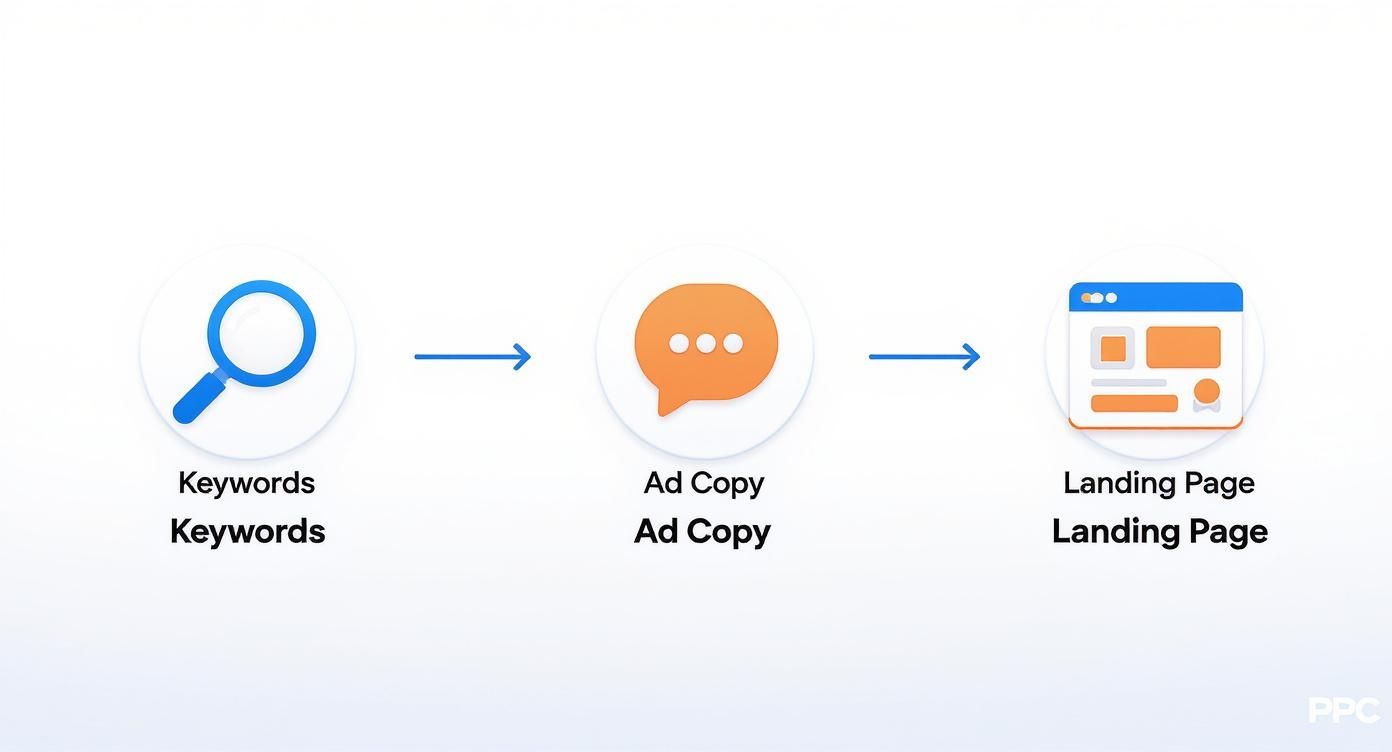
This visual makes it clear: a user's journey is a straight line. A break in relevance at any point—from a poorly chosen keyword to a confusing landing page—can derail the entire process.
Implementing Systematic A/B Testing
A great campaign is never truly finished; it's continuously optimised. The most powerful tool in your arsenal for this is A/B testing, also known as split testing. This is the methodical process of testing one variable at a time to see what resonates most with your audience.
You can—and should—test everything, but it makes sense to start with the elements that have the biggest impact on performance.
- Ad Headlines: Test different unique selling propositions (USPs). Does "Free Shipping" outperform "50% Off Today"?
- Calls to Action (CTAs): Compare different action words. Does "Get a Free Quote" work better than "Request a Consultation"?
- Landing Page Layouts: Test different button colours, headline copy, or form lengths to see what drives more conversions.
By making one small change at a time and carefully measuring the results, you can make data-driven decisions that lead to small but significant gains. Over a few months, these small wins compound, leading to a substantial improvement in your campaign’s overall profitability and the effectiveness of your pay-per-click management.
How to Budget and Manage PPC Costs in Australia
Figuring out the financial side of pay-per-click management, especially in a competitive market like Australia, can feel like you're trying to hit a moving target. Setting a budget isn't just about plucking a number out of the air; it's a strategic move that dictates how far your campaigns can reach and whether they'll sink or swim.
A smart budget turns every dollar into an investment, not just an expense.
First things first: you need to understand why costs can be so wildly different. A single click for a law firm in Sydney can be astronomically more expensive than a click for a local bakery in Perth. That gap comes down to a few key things: industry competition, how much a potential lead is worth, and the specific keywords you're chasing.
Understanding Australian PPC Cost Dynamics
The cost-per-click (CPC) isn't a fixed price. It’s the outcome of a live, real-time auction, and in some Australian industries, the bidding wars are fierce. Certain sectors see intense competition for the top ad spots, which sends costs soaring.
Recent data really shines a light on these differences.
The average CPC on Google Ads in Australia can swing from around AUD 1.82 for e-commerce to a staggering AUD 13.37 for finance and insurance. For the most cut-throat keywords, like 'insurance', costs can even climb past AUD 54 for just one click.
This tells you straight away that a one-size-fits-all budget is a recipe for disaster. If you're in a high-stakes field like legal services or finance, you'll need a much bigger war chest just to get in the game. You can check out more research on Australian Google Ads costs to see how your industry stacks up. Knowing these benchmarks helps you set realistic goals from day one.
Choosing the Right Bidding Strategy
Your bidding strategy is the engine that determines how your budget gets spent. Think of it as the set of instructions you give Google or Meta on how to bid in ad auctions to hit your targets. Nailing this choice is make-or-break for getting the most out of every dollar.
Broadly, there are two ways to go about it:
- Manual Bidding: This puts you in the driver's seat. With Manual CPC, you decide the absolute maximum you're willing to pay for a click. It's fantastic for anyone who wants total, granular control or is working with a seriously tight budget.
- Automated Bidding: This lets the platform's machine learning do the heavy lifting to optimise your bids. Strategies like Target CPA (Cost Per Acquisition) or Maximise Conversions automatically tweak your bids to score you the most conversions your budget can buy.
For many businesses just starting out, taking a manual approach is a safe way to learn the ropes without accidentally blowing the budget. But once your campaigns start collecting data, switching to an automated strategy can often deliver far better results by tapping into the platform’s powerful algorithms.
Practical Strategies for Budget Allocation
So you've got a total budget and a bidding strategy. What's next? You need to slice up that budget and allocate it smartly across your campaigns and ad groups. Good allocation means your money flows to the places that bring back the best returns.
Here are a few tips for getting it right:
- Prioritise High-Performing Campaigns: Dive into your data. If one campaign is consistently delivering a killer Return On Ad Spend (ROAS), feed it more budget. Starve the campaigns that are just eating your cash.
- Test with a Small Budget: When you're launching something new—a new campaign, a new audience, a new ad—start small. Use a controlled budget to get some initial performance data without taking a big financial gamble.
- Account for Seasonality: Does your business have a busy season? Plan to pump up your budget during these peak times to capture all that extra demand. And just as importantly, be ready to pull back when things get quiet.
Getting a handle on your PPC costs is a fundamental part of successful pay per click management. By understanding the Aussie market, picking the right bidding approach, and spending your money wisely, you can feel confident that your investment is actually working to deliver a solid return. For a more detailed look at how agency costs are structured, our guide on PPC pricing models offers some valuable extra insights.
Measuring the Metrics That Actually Matter

It’s dangerously easy to get lost in a sea of data. Your ad platform’s dashboard is crammed with numbers, but focusing on the wrong ones is like a pilot obsessing over the cabin temperature instead of the altitude. Proper pay per click management is about cutting through that noise and homing in on the handful of key performance indicators (KPIs) that reveal the true health and profitability of your campaigns.
We need to look straight past the "vanity metrics" like impressions and even clicks. Sure, they have their place, but they don't tell you if you're actually making any money. Instead, let's focus on the numbers that drive real business decisions and steer your campaigns towards success.
From Clicks to Conversions
The first step beyond simply counting clicks is to figure out how engaging your ads really are. This is where your Click-Through Rate (CTR) comes in. Calculated by dividing your total clicks by total impressions, it tells you what percentage of people who saw your ad were actually compelled enough to click on it.
A low CTR is often the first red flag that something is wrong. It can signal a serious disconnect between your keyword, your ad copy, and what the searcher was actually looking for. Improving your CTR is a core part of keeping your campaigns healthy and your costs down.
But a click is only the start of the story. The ultimate goal is to turn that click into a meaningful business action. This is measured by your Conversion Rate, which is the percentage of clicks that result in a desired action—be it a sale, a form submission, or a phone call.
A high CTR paired with a low conversion rate is a classic warning sign. It tells you your ad is successfully grabbing attention, but your landing page is failing to close the deal. This single insight immediately tells you where to focus your optimisation efforts.
The True Cost and Return of Your Efforts
Knowing you're getting conversions is great, but at what cost? This is arguably the most critical question in PPC. Your Cost Per Acquisition (CPA), also known as Cost Per Conversion, answers it directly. It calculates the average amount you spend to acquire one new customer or lead.
Your CPA is your financial reality check. An acceptable CPA depends entirely on your business model and the lifetime value of a customer. If you spend $50 to acquire a customer who only generates $40 in profit, your campaign is a sinking ship, no matter how many conversions you rack up.
This brings us to the final, and most important, metric on our dashboard: Return On Ad Spend (ROAS). This is the ultimate measure of profitability. It shows you exactly how much revenue you generate for every single dollar you put into advertising.
A ROAS of 4:1, for instance, means you're making $4 in revenue for every $1 spent. This is the number that tells you if your pay per click management is truly a success. Tracking all these metrics systematically is crucial, and using a well-structured PPC reporting template can help turn this data into actionable insights.
The table below breaks down these essential metrics, explaining what they measure and why they are so vital for effective campaign analysis and optimisation.
PPC Performance Metrics Explained
| Metric (Abbreviation) | What It Measures | Why It's Important |
|---|---|---|
| Click-Through Rate (CTR) | The percentage of impressions that result in a click. | Indicates ad relevance and how compelling your copy is to your target audience. |
| Conversion Rate | The percentage of clicks that result in a desired action. | Measures the effectiveness of your landing page and overall offer. |
| Cost Per Acquisition (CPA) | The average cost to generate one conversion (lead or sale). | Determines the cost-effectiveness and sustainability of your campaigns. |
| Return On Ad Spend (ROAS) | The total revenue generated for every dollar of ad spend. | Provides the ultimate measure of campaign profitability and business impact. |
By treating these four KPIs as the critical instruments on your campaign’s dashboard, you can make informed, strategic decisions to steer your budget away from waste and directly towards profit.
Advanced Strategies for PPC Optimisation

Once your campaigns are ticking along nicely and bringing in consistent results, it’s time to stop just managing and start truly optimising. This is where you move beyond the fundamentals and into the advanced tactics that separate the good campaigns from the great ones. Think of it as the difference between having a well-built car and giving it a high-performance tune-up to win the race.
These expert-level strategies are all about squeezing more efficiency, more conversions, and more profit from the budget you’re already spending. They’re what give you a serious competitive edge.
Re-Engaging High-Intent Audiences
One of the most powerful tools in any PPC expert's kit is Remarketing Lists for Search Ads (RLSA). This isn't about chasing people around the internet; it's a precision tactic for getting back in front of people who have already visited your website. Because they're already familiar with your brand, they are often far more likely to convert.
With RLSA, you can tailor your search campaigns just for them. You might adjust your bids, knowing they're a warmer lead, or show them a completely different ad that speaks to their prior visit. For example, you could bid 25% higher for anyone who abandoned a shopping cart, making sure your ad is right at the top when they search again.
Remarketing is about re-engaging warm leads at the exact moment they show buying intent again. It’s a second chance to make a first impression count, and it works. Studies have shown that retargeted visitors can be up to 70% more likely to convert.
This technique turns your pay per click management from a broad fishing net into a highly targeted spear, focusing your spend on the people closest to pulling out their credit card.
Hyper-Personalising Your Message with Segmentation
Audience segmentation is how you take your targeting to the next level. Instead of blasting the same ad to everyone, you can slice your audience into smaller, more specific groups based on their behaviour, demographics, or how they’ve interacted with you before. This lets you deliver hyper-personalised messages that actually resonate.
For instance, you could create segments for:
- New vs. Returning Visitors: Greet newcomers with a welcome discount while offering loyalty rewards to your regulars.
- High-Value Customers: Show ads for your premium products to users who have made big purchases in the past.
- Specific Page Visitors: Target users who checked out a specific product page but didn’t buy with an ad that reminds them of that exact item.
This approach ensures your ad copy is always relevant, which doesn't just improve click-through rates; it builds a stronger connection between your brand and each customer.
Shielding Your Budget from Irrelevant Clicks
Just as important as targeting the right people is actively blocking the wrong ones. This is where a smart negative keywords strategy comes in. These are simply terms you tell your campaign not to show ads for.
If you sell premium "men's leather shoes," you'd want to add negative keywords like "cheap," "repair," and "second-hand." This simple step acts as a shield for your budget, preventing wasted clicks from people whose search intent doesn't match what you offer.
A well-maintained negative keyword list is one of the quickest and most effective ways to boost your campaign's profitability. It keeps your ad spend laser-focused on genuine prospects who are actually in the market for what you sell.
Still Have Questions About PPC Management?
Even when you've got a solid strategy mapped out, a few practical questions always pop up once you start digging into the day-to-day of running campaigns. Getting a handle on these common concerns is a great way to build confidence and navigate the world of PPC more effectively.
Let's tackle a few of the most frequent questions we hear.
How Long Does It Take to See PPC Results?
This is the big one, isn't it? While you can technically start getting traffic the moment your campaign goes live, seeing meaningful, profitable results is a marathon, not a sprint. The first few weeks are a critical learning phase – both for you and for the ad platform's algorithm.
Most seasoned pros will tell you to give it at least three months. This timeframe gives you enough real-world data to properly test what's working, optimise your ads, and start seeing a stable return on your investment. Of course, the exact timeline will always depend on your industry, budget, and how well the campaigns were set up from the start.
What Is the Difference Between PPC and SEO?
PPC (Pay Per Click) and SEO (Search Engine Optimisation) are two sides of the same coin: getting traffic from search engines. But they work in fundamentally different ways.
Think of it this way: PPC is like renting a billboard on the busiest highway in town for immediate visibility. SEO is like buying the land and building your own storefront there for long-term value. Both are great real estate strategies, but they serve different goals.
With PPC, you’re paying for ad placements to get to the top of the search results right away – this is paid traffic. In contrast, SEO is all about optimising your website to earn a high ranking in the unpaid, organic search results. It’s a long-term play for building sustainable, free traffic. A truly strong digital marketing plan almost always uses both in tandem.
Should I Manage PPC Myself or Hire an Agency?
Managing your own PPC campaigns is definitely doable, especially for smaller businesses with a modest budget just dipping their toes into platforms like Google Ads. But be warned: the complexity and the time commitment can snowball quickly as you try to scale up.
Bringing in a professional agency gives you instant access to specialised expertise, powerful industry tools, and dedicated time for the constant monitoring and tweaking that great campaigns require. If you've got a decent budget, operate in a tough market, or just don't have the hours to spare, getting professional help often delivers a much better return and ends up being more cost-effective in the long run.
Ready to get expert eyes on your campaigns? The team at Click Click Bang Bang specialises in precision-driven PPC management that delivers measurable results. Start with a risk-free trial and see the difference professional oversight can make. Learn more at https://clickclickbangbang.com.au.
Read NeXt
Or Read Our Latest
- Manual vs Automated Bidding for PPC Success
- Conversion Tracking Setup: A Complete AU Guide
- Instagram Advertising Australia: Complete 2026 Guide
- Pay Per Click: A Beginner’s Guide for Australian Marketers
- Display Advertising on Google: The Complete Australian Guide
- Stakeholder Communication Plan How to Build One That Works
Click. CLick. Subscribe.
Get our best PPC insights, industry updates, and power moves delivered straight to your inbox. No fluff, just high-caliber strategies that actually work.
Don’t Leave Just Yet
Try Us For 30-Days,
Risk Free!!
We guarantee that you’ll love our work within the first 30 days, if not you’ll get your money back.
What have you got to lose?