

A Guide to Digital Marketing Services in Australia
Last Updated
So, what are digital marketing services, really? At their core, they’re the professional activities and tactics used to promote a business online, connect with the right audience, and ultimately, drive growth.
Think of them as the entire expert team you’d hire to build a thriving physical store—the architects, promoters, and sign makers. They make sure your business isn't just visible online, but that it's in the best possible location with bright, flashing signs that pull in a constant stream of your ideal customers.
What Exactly Are Digital Marketing Services?
Putting dictionary definitions aside, digital marketing services are the engine that powers your online growth. They’re a strategic framework of actions designed to build your brand’s presence, engage potential customers, and turn that interest into actual revenue. This isn't just about placing an ad here and there; it's a connected system of tactics all working together to hit specific business goals.
For most Australian businesses, investing in these professional activities is no longer a "nice to have." The market is incredibly crowded, and standing out demands a deliberate, expert approach. These services provide the structure and execution needed to compete effectively, whether you're a local shop in Fitzroy or a national e-commerce brand.
The Core Purpose of These Services
At its heart, the goal of any digital marketing service is to guide a potential customer through their entire journey—from that first moment of awareness all the way to becoming a loyal, repeat advocate for your brand. This takes a whole range of specialised skills.
The key objectives usually boil down to these four things:
- Building Visibility: Making sure your business actually shows up when potential customers are searching for the solutions you offer.
- Driving Targeted Traffic: Attracting the right people to your website—those most likely to be genuinely interested in your products or services.
- Generating Qualified Leads: Identifying and capturing the details of potential customers who have shown real buying intent.
- Fostering Customer Loyalty: Nurturing the relationships you have with existing customers to encourage repeat business and positive word-of-mouth.
This multifaceted approach is crucial. A small business, for instance, might find it impossible to juggle all these components on its own. Our guide on digital marketing for small business offers a deeper dive into building a strategy that’s both manageable and effective from the ground up.
Why Professional Management Matters
The sheer scale of the digital marketing industry in Australia really highlights its importance. The market was valued at around USD 13.03 billion in 2024 and is tipped to hit an estimated USD 25.39 billion by 2034. This explosive growth, especially in places like New South Wales which holds a 33.8% market share, points to a clear trend: businesses are investing heavily in expert online promotion to thrive. You can explore the full report on the Australian digital marketing market to get a better sense of these trends.
By bringing in professional services, you're not just buying ads. You're investing in a strategic partnership laser-focused on measurable growth, expert execution, and staying ahead of market shifts. This frees you up to concentrate on running your core business while specialists handle the complexities of your online promotion.
Navigating the world of digital marketing can feel like trying to learn a new language, where every service is its own weird dialect. Let's try to simplify it. Think of your marketing strategy as building a high-performance car. Each service is a critical part—the engine, the wheels, the navigation system—and they all have to work together smoothly to get you where you want to go.
This visual guide breaks down the main players—SEO, Content, and PPC—into a clear hierarchy.
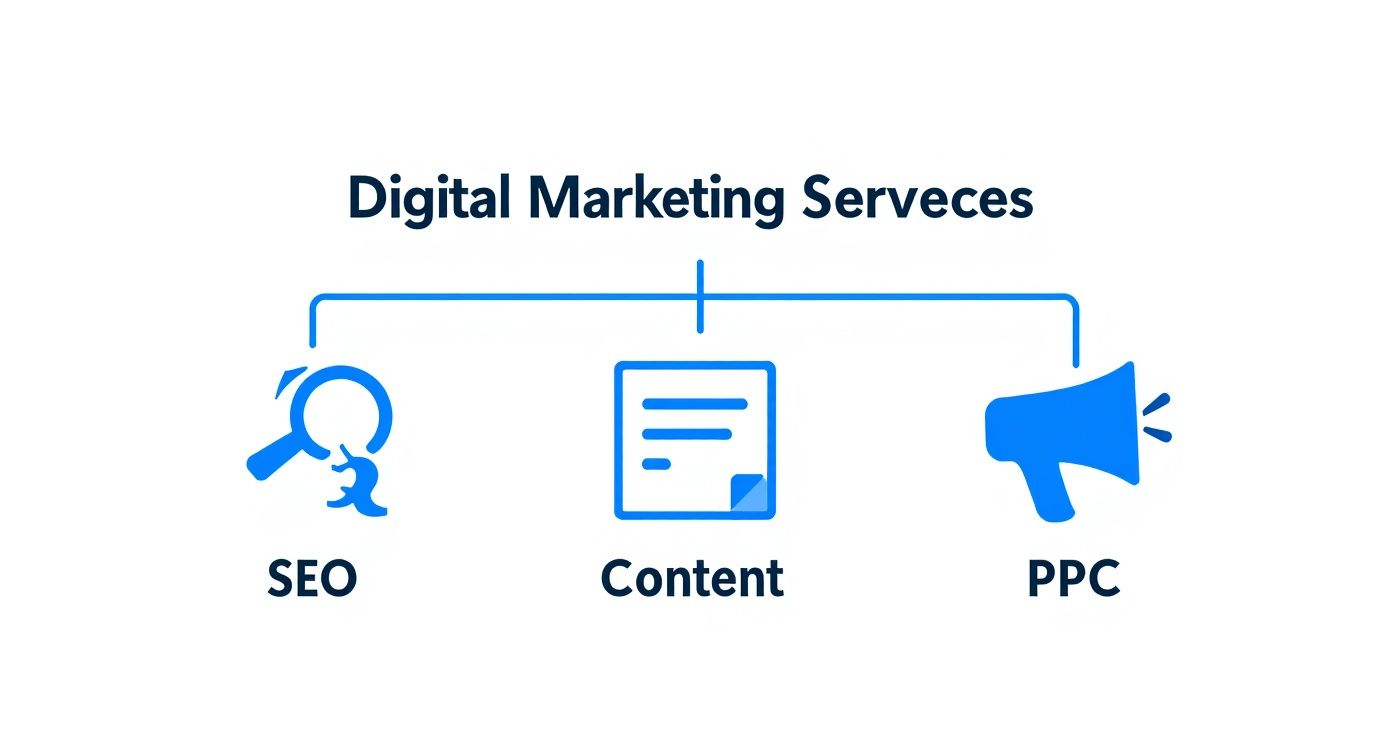
As you can see, these foundational pillars support a complete digital strategy, each with its own unique job. Getting a handle on how these pieces connect is the first step toward building a seriously powerful marketing engine for your business.
Search Engine Optimisation (SEO): The Foundation for Visibility
Search Engine Optimisation, or SEO, is the art and science of making your website more appealing to search engines like Google. Think of it like securing the best retail spot in a bustling city. The better your location (your ranking on Google), the more organic foot traffic (website visitors) you'll get without having to pay for every single person who walks in.
SEO isn’t a one-and-done task; it’s an ongoing process of fine-tuning your website’s structure, content, and authority. The main goal is to send strong signals to Google that your site is the most relevant, trustworthy answer to what someone is searching for. A solid SEO strategy ensures a steady stream of high-intent customers find you at the exact moment they need you.
This sustained visibility is a game-changer. Our detailed guide on SEO for small businesses offers a practical roadmap for getting started and achieving long-term growth, allowing smaller players to compete with the big dogs.
Pay-Per-Click (PPC) Advertising: For Immediate Impact
If SEO is about earning that prime real estate over time, Pay-Per-Click (PPC) advertising is like buying a massive, impossible-to-miss billboard right at the entrance of the city’s biggest event. It gets you immediate visibility in front of a very specific audience. Just as the name suggests, you pay a fee each time someone clicks on your ad.
PPC is an incredibly powerful tool for businesses that need to generate traffic and leads, fast. It's highly measurable and lets you get super specific with your targeting, zeroing in on people based on their demographics, interests, and online behaviour.
PPC gives you speed and control. You can switch campaigns on or off, adjust your budget on the fly, and test different ad copy to see what your audience responds to. This makes it perfect for product launches, special promotions, or capturing leads who are ready to buy.
The sheer scale of online advertising in Australia highlights just how important it is. The industry is on track to hit AU$17.1 billion in 2025, with search advertising leading the charge. That growth is fuelled by its cost-efficiency and the simple reality that most Aussies turn to search engines every single day.
Content Marketing: The Engine of Trust and Authority
Content marketing is all about creating and sharing valuable, relevant, and consistent content to attract and keep a specific audience. It’s not the hard sell; it’s about positioning yourself as the trusted expert—the go-to source for information in your industry.
Put it this way: SEO and PPC get people to your front door. Great content is what invites them inside, builds a relationship, and convinces them to stick around.
This can take many forms, including:
- Blog Posts: Answering common customer questions and showcasing your expertise.
- Case Studies: Proving your value with real-world success stories.
- Videos and Webinars: Engaging your audience with visual and interactive formats.
- eBooks and Whitepapers: Offering deep knowledge in exchange for a potential customer's contact details.
By consistently delivering value, you build trust and authority. This not only fuels your SEO efforts by creating content that can rank on Google but also nurtures potential customers along their buying journey, making them far more likely to choose you when they're ready to make a move. Each of these services plays a distinct but complementary role in a winning strategy.
To make this even clearer, here's a quick summary of how these core services stack up.
Overview of Core Digital Marketing Services
This table summarises the main types of digital marketing services, their primary goals, and the key performance indicators (KPIs) you'd use to measure success.
| Service Type | Primary Goal | Common KPIs |
|---|---|---|
| SEO | Increase organic visibility and attract high-intent traffic from search engines. | Organic Traffic, Keyword Rankings, Backlinks, Conversion Rate |
| PPC | Drive immediate, targeted traffic and generate leads or sales quickly. | Click-Through Rate (CTR), Cost Per Click (CPC), Conversion Rate, Return on Ad Spend (ROAS) |
| Content Marketing | Build trust, establish authority, and nurture leads through the sales funnel. | Engagement Rate, Time on Page, Lead Generation, Social Shares |
Ultimately, understanding what each service does and how they support one another is the key to building a digital marketing plan that actually delivers results.
Mastering Paid and Social Media Advertising
While SEO is your long game for building brand authority, sometimes you just need to get in front of people right now. This is where paid advertising and social media marketing come in, acting like a high-powered megaphone to get your message straight to your ideal audience, instantly. These channels are all about speed, precision, and results you can actually measure.
Think of it like renting a prime spot in a digital shopping centre. Instead of waiting for people to wander past your store, you’re setting up shop directly in their path, making sure they can’t miss you. This lets you jump the queue of organic rankings and put your offers in front of motivated buyers from day one.
The real magic, though, is in the targeting. You can zero in on specific demographics, interests, and behaviours, making sure every dollar of your budget is spent reaching people who are most likely to convert.
The World of Pay Per Click Advertising
Pay-Per-Click (PPC) is a cornerstone of most digital marketing services, and platforms like Google Ads are the undisputed leaders. The model is refreshingly simple: you create an ad and only pay a small fee when someone actually clicks on it. This makes it perfect for businesses looking to drive targeted traffic and generate leads without delay.
Here’s a look at the Google Ads interface, which is the command centre for creating and managing these campaigns.
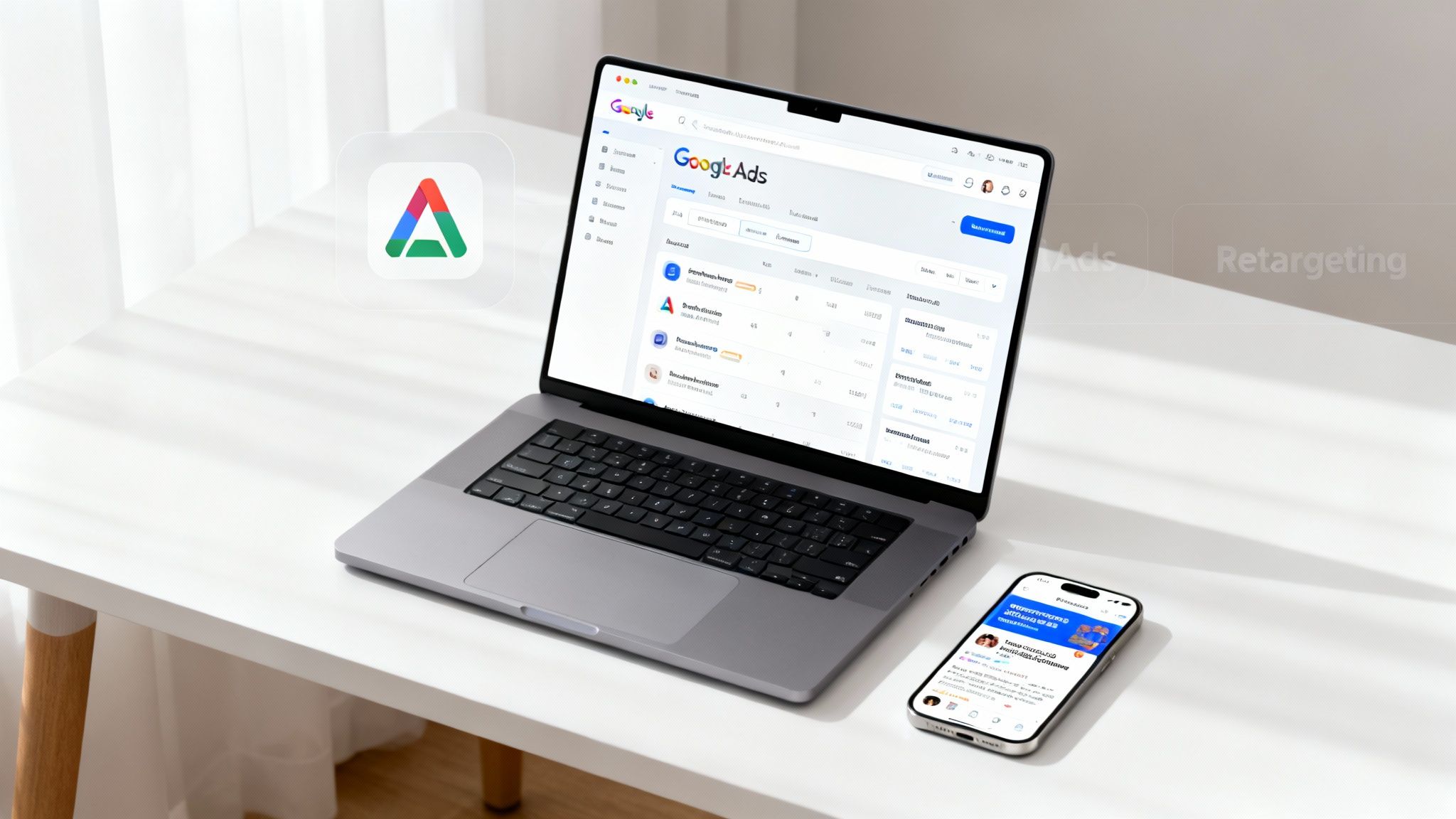
As you can see, the dashboard is built around driving tangible business outcomes like calls, website visits, or foot traffic. For businesses that need immediate results, expert PPC management services can fine-tune these campaigns to squeeze the maximum return out of every click.
One of the cleverest PPC strategies is remarketing. Picture this: a customer browses your online store, adds something to their cart, but then gets distracted and leaves. Remarketing is like a helpful salesperson gently reminding them about that item as they browse other websites later, giving them a nudge to come back and finish the purchase.
Leveraging Social Media for Business Growth
Social media advertising takes this precision to a whole new level, letting you connect with people in a more personal, engaging space. Platforms like Meta (which owns Facebook and Instagram) have become non-negotiable for brands wanting to build communities and drive sales.
And in Australia, social media's role is massive. Spending on social ads is tipped to hit US$4.73 billion (that's about AU$7.5 billion) in 2025, making up 29% of all digital ad spending in the country. That figure alone shows just how crucial these platforms are for reaching modern consumers.
The beauty of social media advertising is its ability to weave your brand into the daily fabric of your audience's lives. It’s less about a hard sales pitch and more about building a genuine connection through compelling content that actually resonates with them.
Connecting with Professionals on LinkedIn
For B2B companies, advertising on LinkedIn is an absolute goldmine. It's the digital equivalent of attending an exclusive industry conference where every single person is a potential client. You can target users based on incredibly specific professional criteria, such as:
- Job Title: Want to reach CEOs, Marketing Managers, or IT Directors? No problem.
- Company Size: Focus your efforts on startups, mid-sized businesses, or huge enterprises.
- Industry: Pinpoint professionals in finance, healthcare, technology, you name it.
This level of detail makes LinkedIn a powerhouse for generating high-quality B2B leads. It allows you to bypass gatekeepers and start conversations directly with the decision-makers you need to reach, making your marketing far more efficient.
Ultimately, both paid search and social advertising are vital tools in the modern digital marketing kit, each offering a fast track to growth and brand awareness.
Matching Services to Your Business Needs
Choosing the right digital marketing services isn't about chasing the most popular trends. It's about building a strategy that actually fits your business. A local jeweller has wildly different needs from a B2B software firm targeting enterprise clients, and your marketing mix should reflect that.
Think of it like assembling a toolkit. A carpenter needs a hammer and saw, while an electrician needs pliers and wire strippers. Both are pros, but their success hinges on using the right tools for the job. Your business is no different. Aligning your marketing with your unique goals is the only way to get real results.
E-commerce Stores Driving Online Sales
If you're running an e-commerce store, your mission is simple: drive direct sales. Every marketing dollar should guide customers from discovering your products to hitting that "buy now" button. You need channels that capture high-purchase intent and make the buying process dead simple.
For most e-commerce brands, the non-negotiable services are:
- Google Shopping Ads: These are an absolute powerhouse. They put your products right in front of shoppers actively searching for what you sell, complete with an image and price. It doesn't get more direct than that.
- Conversion-Focused SEO: This is about optimising your product and category pages to rank for specific buying keywords like "women's linen dress Melbourne." It’s how you attract a steady stream of organic traffic that’s ready to purchase.
- Social Media Advertising: Platforms like Instagram and Facebook are visual playgrounds, perfect for showcasing products and targeting users based on their shopping habits and interests.
Imagine an online fashion boutique. They'd lean on Instagram ads to create desire, use Google Shopping to snag immediate sales, and build their SEO to ensure long-term visibility for their key product lines.
B2B Companies Generating Quality Leads
For Business-to-Business (B2B) companies, the game changes completely. The sales cycle is longer, decisions involve multiple people, and the goal isn't an instant online purchase—it's about generating qualified leads for the sales team. The focus shifts from quick wins to building trust and demonstrating expertise over time.
A winning B2B strategy is built on authority and credibility. You need to prove you understand your client's challenges and can solve them, long before you ever ask for the sale.
This means you need services that are all about relationship-building and education.
- LinkedIn Advertising: This is the B2B gold standard. You can target decision-makers by their exact job title, company size, or industry. It's ideal for promoting valuable assets like whitepapers, case studies, or webinar sign-ups.
- Content Marketing: Creating detailed case studies, insightful blog posts, and comprehensive eBooks is how you establish your company as a thought leader. This is what nurtures leads through a complex buying journey.
- Email Marketing: A smart email nurturing sequence keeps your brand top-of-mind, delivering value-packed content to prospects until they’re finally ready to talk to sales.
Local Businesses and Startups Gaining Traction
Small and medium-sized businesses (SMBs) and startups usually work with leaner budgets, so every marketing dollar has to pull its weight. For a local business, the goal is simple: dominate a specific geographic area. For a startup, it’s all about gaining early traction and proving the business model.
A local plumber, for example, doesn't need a sprawling national content strategy. They just need to show up when someone in their suburb frantically searches "emergency plumber near me." This calls for a laser focus on local SEO, which means optimising their Google Business Profile and collecting a ton of positive local reviews.
Startups, on the other hand, need to be agile. A nimble mix of PPC advertising to quickly test market demand and a targeted content strategy to build an initial audience is often the most effective way to gain that crucial early momentum.
To make this even clearer, let's break down how marketing priorities shift depending on the type of business you're running. Each model has a unique objective, which in turn dictates which services and metrics matter most.
Digital Marketing Priorities by Business Type
| Business Type | Primary Objective | Top Priority Services | Key Metrics |
|---|---|---|---|
| E-commerce | Drive direct online sales | Google Shopping, Conversion SEO, Social Ads | Return on Ad Spend (ROAS), Conversion Rate, Average Order Value (AOV) |
| B2B | Generate qualified leads | LinkedIn Ads, Content Marketing, SEO, Email Nurturing | Marketing Qualified Leads (MQLs), Cost Per Lead (CPL), Pipeline Value |
| SMB (Local) | Attract local customers | Local SEO, Google Business Profile, Local Service Ads | Phone Calls, Form Submissions, Foot Traffic, Local Rankings |
| Startup | Gain traction & validate model | PPC (for testing), Content/SEO (for audience), Social Ads | Customer Acquisition Cost (CAC), Lead Velocity, Early User Growth |
As you can see, there's no "one-size-fits-all" answer. The best digital marketing strategy is the one that’s built specifically for your business model, your customers, and your goals. By focusing on the right channels, you're not just spending money on marketing—you're making a strategic investment in growth.
How AI Is Reshaping Digital Marketing

It’s easy to write off Artificial Intelligence (AI) as just the latest industry buzzword, but its impact on digital marketing is very real. Far from being some far-off concept, AI is already changing how Australian businesses connect with their audiences, making marketing smarter, faster, and much more effective.
Think of AI as a super-powered analyst working for you 24/7. It can tear through massive datasets in seconds, spotting patterns and predicting what customers will do next in ways that were simply impossible before. This is shifting marketing from a game of educated guesses to one of data-driven precision.
This shift allows for hyper-personalised campaigns that actually feel relevant to each individual. Instead of blasting everyone with the same message, AI helps deliver the right offer to the right person at the perfect moment. The result? Much better engagement and higher conversion rates.
Automating for Efficiency and Optimising for ROI
One of the first places you’ll feel the benefit of AI is in automation. All those repetitive, time-sucking tasks—like sifting through data, tweaking ad campaigns, and even drafting initial content—can now be handled by intelligent systems. This frees up marketers to focus on what humans do best: strategy, creative thinking, and building real customer relationships.
For example, AI-powered tools can automatically optimise your ad budgets in real-time. They constantly analyse campaign performance, pulling money away from underperforming ads and pushing it toward the ones delivering the highest return on investment (ROI). This ensures your marketing spend is always working as hard as it possibly can.
Beyond just managing budgets, AI also offers deep insights into what your customers are thinking. It can analyse social media trends, customer reviews, and website behaviour to reveal what your audience truly wants, often before they even know it themselves. That kind of foresight gives any business a powerful edge.
The Power of Personalisation at Scale
The true game-changer, though, is AI-driven personalisation. New tech is making it possible to create highly individualised customer experiences, and it’s quickly becoming a go-to strategy for Australian businesses.
By analysing data points like interests and purchase history, AI can serve up personalised content and product recommendations that just click. This approach has been shown to slash customer acquisition costs by nearly 50%—a massive saving for any business. You can explore more about AI's impact on marketing to see just how this trend is shaping the industry.
AI isn't here to replace marketers; it's here to empower them. It provides the tools to understand customers on a deeper level and deliver value in a way that feels personal, not programmatic. This builds stronger connections and drives sustainable growth.
From crafting more effective ad copy to predicting future sales trends, AI is touching every single part of digital marketing. The businesses that embrace these tools will be the ones that connect with their audiences in more meaningful ways, making their marketing not just more efficient, but far more effective.
Choosing the Right Australian Marketing Partner
Picking the right agency to handle your digital marketing is easily one of the most important calls you'll make for your business. This isn't just about hiring another supplier; it’s about finding a genuine partner who’s as invested in your growth as you are. The right choice can put you on the fast track, while the wrong one can burn through your budget and leave you chasing missed opportunities.
Think of it like choosing a co-pilot for a long-haul flight. You need someone with a proven track record, a clear flight plan (your strategy), and the ability to communicate clearly and honestly, especially when you hit a bit of turbulence. Your marketing partner should feel like a true extension of your team, someone who gets your vision and is committed to the entire journey.
Vetting Potential Partners
Before you even think about signing a contract, you need to do your homework. A slick sales pitch is one thing, but you're looking for concrete proof that they can actually deliver on their promises. Results are what count here.
Here are the key areas to dig into:
- Proven Case Studies: Ask to see real-world examples of their work with businesses like yours, whether that's similar in size or industry. You're looking for measurable outcomes—things like a jump in qualified leads, more sales, or a lower cost to acquire a customer.
- Transparent Communication: How do they plan on keeping you in the loop? Look for a commitment to regular, straightforward reporting and a willingness to explain what they're doing (and why) in plain English.
- Industry Expertise: A partner who already understands the nuances of your market—be it e-commerce, B2B, or a local service—is going to be far more effective right from the get-go.
This initial research is all about filtering out the agencies that talk a good game but don't have the substance to back it up.
Critical Questions to Ask
Once you’ve got a shortlist, it's time to go deeper. The answers you get to these questions will tell you a lot about an agency's process and whether they're the right cultural fit for your business.
- What is your strategic process? Get them to walk you through how they'd build a strategy for your business, from the initial research phase right through to campaign execution and ongoing optimisation.
- How do you measure success? Their answer should go way beyond vague metrics like "more traffic." You want to hear them talking about business outcomes that matter, like return on ad spend (ROAS), cost per lead (CPL), or customer lifetime value.
- Who will be working on my account? It’s important to know who your day-to-day contact will be and the experience level of the people who will have their hands on your campaigns.
A great partner will welcome these questions. Their answers should be confident, backed by data, and laser-focused on how their work will directly impact your bottom line. If you get evasive answers or a lot of confusing jargon, that's a massive red flag.
Finally, be very wary of anyone offering you the world, like "guaranteed number one rankings on Google." Real, effective digital marketing is a dynamic process, not a magic trick. You want to choose a partner who sets realistic expectations and is completely transparent about the path to getting there.
Common Questions About Digital Marketing Services
Stepping into the world of digital marketing always brings up a few practical questions. It’s completely normal. You’re thinking about costs, timelines, and whether you can tackle it yourself. Getting your head around these key areas is the first step to making smart decisions and setting the right expectations for your business.
Let’s clear up some of the most common queries we hear.
How Much Should My Business Budget for Digital Marketing?
Honestly, there's no one-size-fits-all answer here. The right budget really comes down to your industry, how fierce the competition is, and what you’re trying to achieve. A small local business, for instance, might invest between $1,500 and $3,500 per month on the essentials like local SEO and social media to get nearby customers through the door.
On the other hand, a national e-commerce brand gunning for aggressive growth could be looking at $10,000 or more each month for a full-scale strategy involving PPC, content marketing, and advanced SEO. The best way to figure it out is to define a clear business goal—say, generating 30 qualified leads a month—and then build a budget backwards from there to make it happen.
How Long Until I See a Return on My Investment?
This is another classic "it depends" situation, but the timeline really hinges on which service you go for.
- Paid Advertising (PPC): This is your fast track. A well-run Google Ads campaign can start sending traffic and leads your way within just a few days of going live.
- Search Engine Optimisation (SEO): Think of this as a long-term play. You're building your brand's authority from the ground up, and that takes time. Typically, you’ll start seeing real movement in organic search rankings and traffic in about 4-6 months.
- Content & Social Media: These are all about creating compounding value. Your results will grow steadily as your audience gets bigger and your online presence becomes more established.
Here’s a good way to think about it: PPC is like sprinting to grab immediate opportunities. SEO is marathon training—you’re building the sustainable, long-term strength that keeps your business visible for years to come.
Should I Hire an Agency or Do Marketing In-House?
Going the DIY route can work if you’ve got a tight budget but plenty of time to learn the ropes. The catch is that the digital marketing world is incredibly complex and moves at a breakneck pace. Just keeping up can feel like a full-time job in itself.
Bringing a professional agency on board gives you instant access to a team of specialists, sophisticated tools, and strategies that have already been proven to work. More often than not, this leads to faster, more effective, and ultimately more profitable results. It also frees you up to do what you do best: run your business, while the experts handle your online growth.
Ready to get answers tailored specifically to your business? Click Click Bang Bang delivers precision-driven PPC and SEO services designed for one thing: measurable results.
Read NeXt
Or Read Our Latest
- Manual vs Automated Bidding for PPC Success
- Conversion Tracking Setup: A Complete AU Guide
- Instagram Advertising Australia: Complete 2026 Guide
- Pay Per Click: A Beginner’s Guide for Australian Marketers
- Display Advertising on Google: The Complete Australian Guide
- Stakeholder Communication Plan How to Build One That Works
Click. CLick. Subscribe.
Get our best PPC insights, industry updates, and power moves delivered straight to your inbox. No fluff, just high-caliber strategies that actually work.
Don’t Leave Just Yet
Try Us For 30-Days,
Risk Free!!
We guarantee that you’ll love our work within the first 30 days, if not you’ll get your money back.
What have you got to lose?