

What Is Brand Positioning and Why It Drives Growth
Last Updated

Brand positioning is the process of defining the distinct place a brand occupies in a target buyer's mind relative to competitors, encoded in a positioning statement that guides messaging, pricing, and proof points. In Australia, that matters because brand equity is already a material business asset, with Brand Finance's Australia 100 2025 ranking the country's most valuable brands at a combined value measured in the tens of billions of dollars. It also matters because digital advertising in Australia sits in a crowded, measurable environment, where clear differentiation can affect visibility and recall, and the IAB Australia / PwC Online Advertising Expenditure Report has repeatedly shown spending in the multi-billion-dollar range.
A lot of campaigns fail for a simple reason. The ads are live, the media buyer is optimising, the landing pages look fine, and yet the brand still feels interchangeable. That's usually not a media problem first, it's a positioning problem.
The Hidden Reason Your Campaigns Underperform
A marketing manager can stare at a dashboard for weeks and still not get a clean answer. Clicks are steady, spend is stable, but conversions don't break out of the plateau and branded search stays flat. The team starts arguing about creative, audience settings, or bid strategy, when the issue is often that the market can't tell why this brand deserves a place in memory.
That's the part some teams miss. Brand positioning is the strategic layer that defines what a brand means relative to alternatives, and that meaning has to exist before scale makes sense. In Australia's dense retail, B2B, and services markets, the competition for attention happens inside a very active digital ecosystem, so a vague offer gets compared, not remembered.
Practical rule: if a buyer can swap your ad copy into a competitor's website without noticing, the position is too soft.
A lot of managers try to compensate with more spend. That can lift traffic, but it doesn't automatically create a sharper market meaning. The better sequence is to define the position, then let media reinforce it through repeated message match across search, social, landing pages, and remarketing.
When teams skip that work, they usually build campaigns around generic promises. Those promises may be accurate, but they're not distinctive. If you're still aligning on who you're for, that's the right place to start, and this guide on defining your target customer is the right companion piece.
The commercial point is simple. Australia's brand leaders are not just winning on awareness, they're building durable meaning in markets where buyers have options. In that environment, positioning isn't abstract branding language. It's the input that makes downstream execution clearer, from SEO page titles to PPC ad groups to what your sales team repeats on calls.
Core Components of Effective Brand Positioning
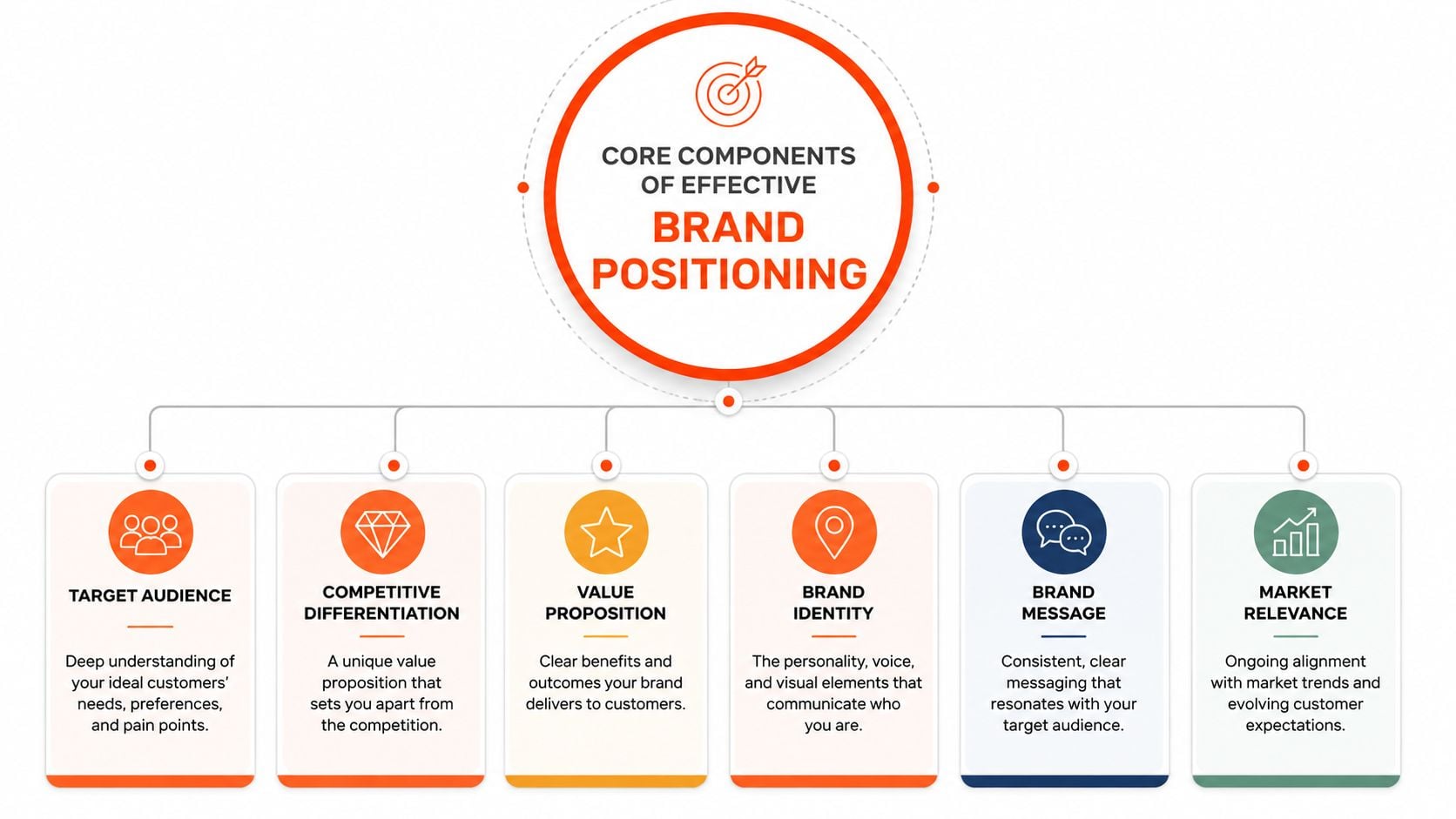
A positioning statement works because it filters information. It tells the market who the offer is for, what it solves, and why that promise is believable. Qualtrics' AU guide frames the positioning statement as a short strategic document that synthesises the value a brand brings to a specific segment, not a visual treatment or slogan, and that distinction matters because search and social can only reinforce a clear position once the architecture already exists Qualtrics positioning guide.
Audience, benefit, reason to believe
The first component is audience definition. That controls targeting, because if the audience is too broad, the media plan starts talking to everyone and convincing no one. Audience clarity also shapes how you phrase the problem, which matters for click relevance.
The second component is the unique benefit statement. That is the core promise, the reason the customer should care. It should be concrete enough that a buyer can compare it to other options without having to decode brand language.
The third component is the reason to believe. That's the proof layer, the evidence that makes the promise feel real. It can be operational detail, product specificity, service design, category expertise, or a measurable process, but it can't just be a confidence statement.
If the benefit sounds attractive but the proof sounds thin, the market treats the offer as a claim, not a position.
How each piece affects campaigns
Audience definition controls ad-group themes and the shape of your keyword clusters. Benefit controls the headline hierarchy on the landing page, because that's what determines whether the visitor sees an instant fit. Reason to believe controls credibility in the first screen, the offer box, the testimonial block, and even the claims you choose for remarketing.
If you want a clean internal comparison between positioning and offer framing, the value proposition breakdown is useful, because those two ideas are related but not identical. The value proposition explains why someone should buy. Positioning explains where the brand fits in the buyer's mind relative to alternatives.
Consistency matters here too. If your site says one thing, your ads say another, and your sales deck says something else again, the buyer has to do the stitching work. For a useful lens on that problem, the importance of brand consistency for growth is worth reading alongside positioning work.
The practical standard is tight message match. The clearer the position, the easier it becomes to build landing pages, ad copy, and structured claims that all repeat the same promise with less semantic drift.
How to Build a Defensible Positioning Statement
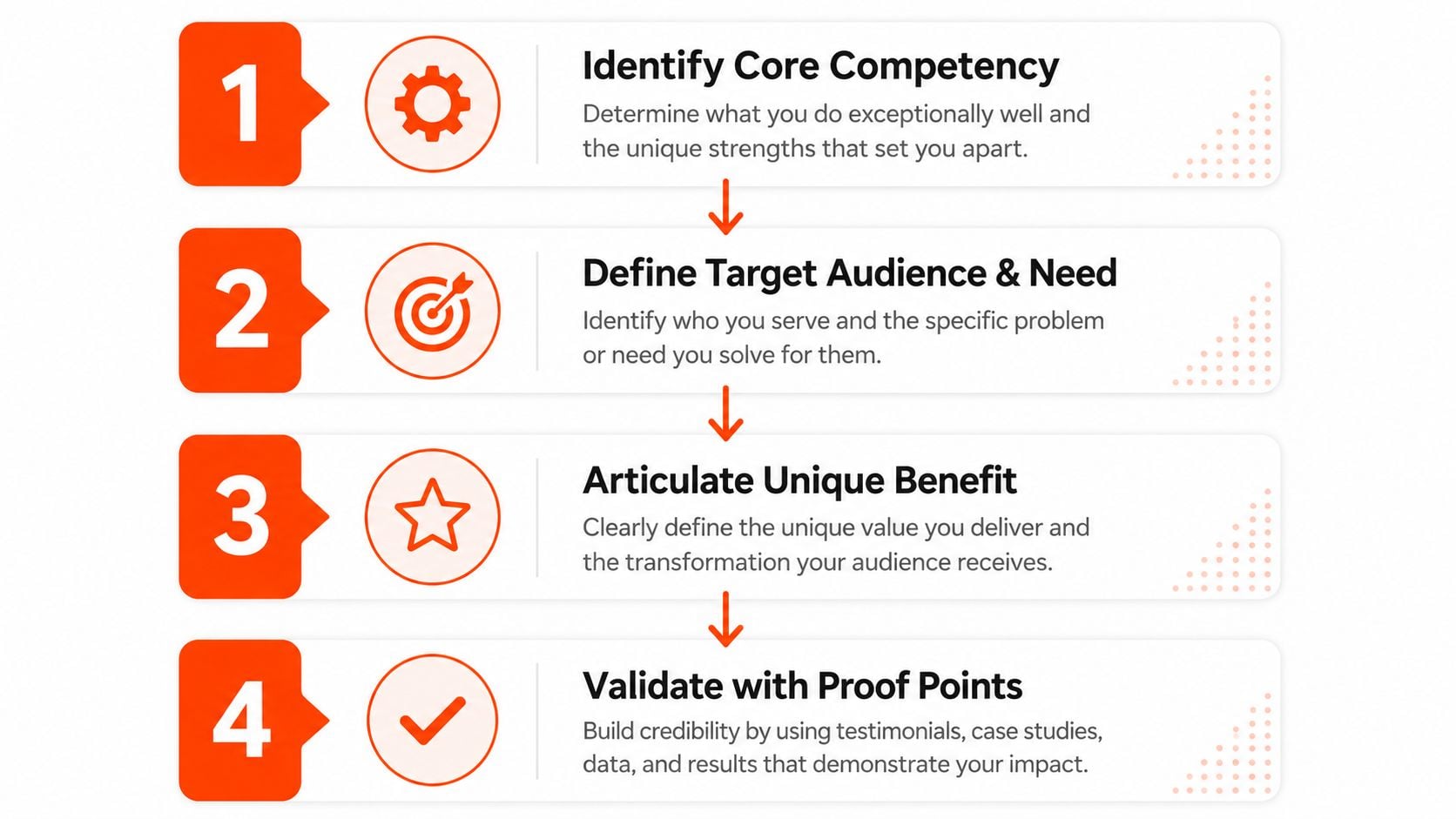
A defensible positioning statement starts by narrowing the field. Exclusion isn't a side effect, it's part of the mechanism. If you try to serve every buyer, your message becomes so broad that competitors can borrow it without changing much.
Build from the inside out
Start with the capability you can own. That might be faster onboarding, better category expertise, stronger reporting, a product fit for a specific use case, or a sharper price-to-value story. Then map that capability to a segment that feels the pain most clearly.
Next, name the context of the problem. A buyer doesn't just buy “better service”, they buy lower risk, less friction, fewer delays, or less cognitive load in a specific situation. The more precisely you describe the context, the easier it is to sound relevant without sounding generic.
Then write the benefit in plain language. Keep it short enough that a media buyer can use it in an ad group, a designer can use it on a landing page, and a sales rep can repeat it without interpretation. The proof point should sit underneath it and answer the inevitable question, “Why should I believe you?”
Use a template that forces specificity
A simple working structure looks like this.
- For [specific audience],
who need [specific job or outcome],
[brand] offers [clear benefit]
because [proof point].
That template works because it makes lazy phrasing obvious. “We help businesses grow” becomes unusable fast, while “We help B2B teams generate qualified LinkedIn leads through transparent reporting and category-specific account setup” gives the market something concrete to compare.
A good positioning statement also tells you what to leave out. If your offer is built for mid-market retailers, don't keep writing for every possible buyer persona. If your proof is operational excellence, don't dilute it with broad lifestyle language. The job is to filter the market, not to flatter it.
A hard editing pass removes adjectives that don't change the decision. Keep the claims that can be defended in search, ads, review platforms, and sales conversations. When the statement holds up in all four places, it's usually strong enough to scale.
Real-World Positioning Examples That Work
Strong positioning usually sounds narrower than teams expect. Weak positioning tries to sound broadly appealing and ends up sounding like everyone else. The difference shows up immediately in ad copy, where one version creates a mental category and the other just adds noise.
Specific beats universal
An e-commerce brand that positions around a particular use case, such as travel, recovery, or skin sensitivity, gives buyers a fast self-selection signal. A vague claim like “premium quality” may be true, but it doesn't tell the shopper why this product is the right one for them. The strongest e-commerce positions usually connect a product to a moment of use, a buyer type, or a problem state.
B2B works the same way, only the proof burden is heavier. “Full-service” and “data-driven” are easy to say and hard to believe because nearly every agency says them. A stronger position focuses on something verifiable, like onboarding process clarity, live reporting, no lock-in contracts, or deep expertise in one category.
Compare the message, not just the offer
A strong position sounds like a choice. A weak position sounds like a brochure.
- Strong: built for a defined audience, with a named benefit and a proof point that can be checked.
- Weak: broad, safe, and easy to copy.
That contrast matters across the whole funnel. In search ads, a strong position creates tighter query match and better relevance. On the landing page, it reduces friction because the headline, subhead, and proof all point in the same direction. In content, it makes topic selection easier because you know which questions your brand should own.
The best positions usually exclude more than they include.
That doesn't mean the brand becomes smaller in market impact. It means the market understands it faster. Once buyers can place the brand mentally, they're more likely to recall it when the buying moment arrives, especially in crowded categories where many offers look interchangeable.
If your current copy feels like it could belong to three other businesses, it's not positioning yet. It's category language. Real positioning gives the buyer a reason to remember one brand and discount the rest.
Positioning for AI-First Search and PPC Campaigns
AI-mediated discovery changes how positioning gets consumed. Brands are no longer only positioning for people scanning a search results page, they're also positioning for systems that summarise, compare, and recombine information from multiple sources. That makes machine-readable differentiation a practical requirement, not a theoretical one.
Make the position easy to extract
A clear position should show up in the same language across search ads, landing pages, review profiles, and comparison content. If your ads claim one benefit and your site buries it behind generic brand language, AI summaries and human readers both get a noisy signal. The better pattern is simple, repeated phrasing around category, audience, benefit, and proof.
That matters especially in Australia, where Google remains the dominant search engine and AI search behaviour is changing how buyers compare options. If you want a deeper view on that shift, improving brand presence in AI is a useful read because it focuses on visibility in AI-influenced discovery rather than traditional blue-link SEO alone.
Translate strategy into channel assets
For PPC, the position needs to become ad-group logic. One theme per intent cluster works better than trying to squeeze every promise into one generic campaign. The headline should mirror the position, the description should carry the proof, and the landing page should remove ambiguity quickly.
For SEO, the position should shape page titles, H1s, supporting copy, and schema-rich content structures. If a brand wants to be known for a specific use case or service standard, that claim should appear consistently in the pages most likely to be summarised or cited. Review ecosystems matter too, because AI systems often pick up patterns from third-party language, not just owned media.
Treat the position as structured data for humans and machines
The strongest AU positions today are readable in two ways. Humans read them as a fast promise. Machines read them as a stable relationship between category, audience, and proof. That's why long, poetic brand statements often underperform in AI-first environments, they're memorable in a workshop and muddy everywhere else.
You don't need to strip out personality. You do need to make the differentiation legible. The cleaner the hierarchy of claims, the easier it is for search systems, ad platforms, and buyers to identify what the brand stands for.
Common Positioning Mistakes and How to Avoid Them
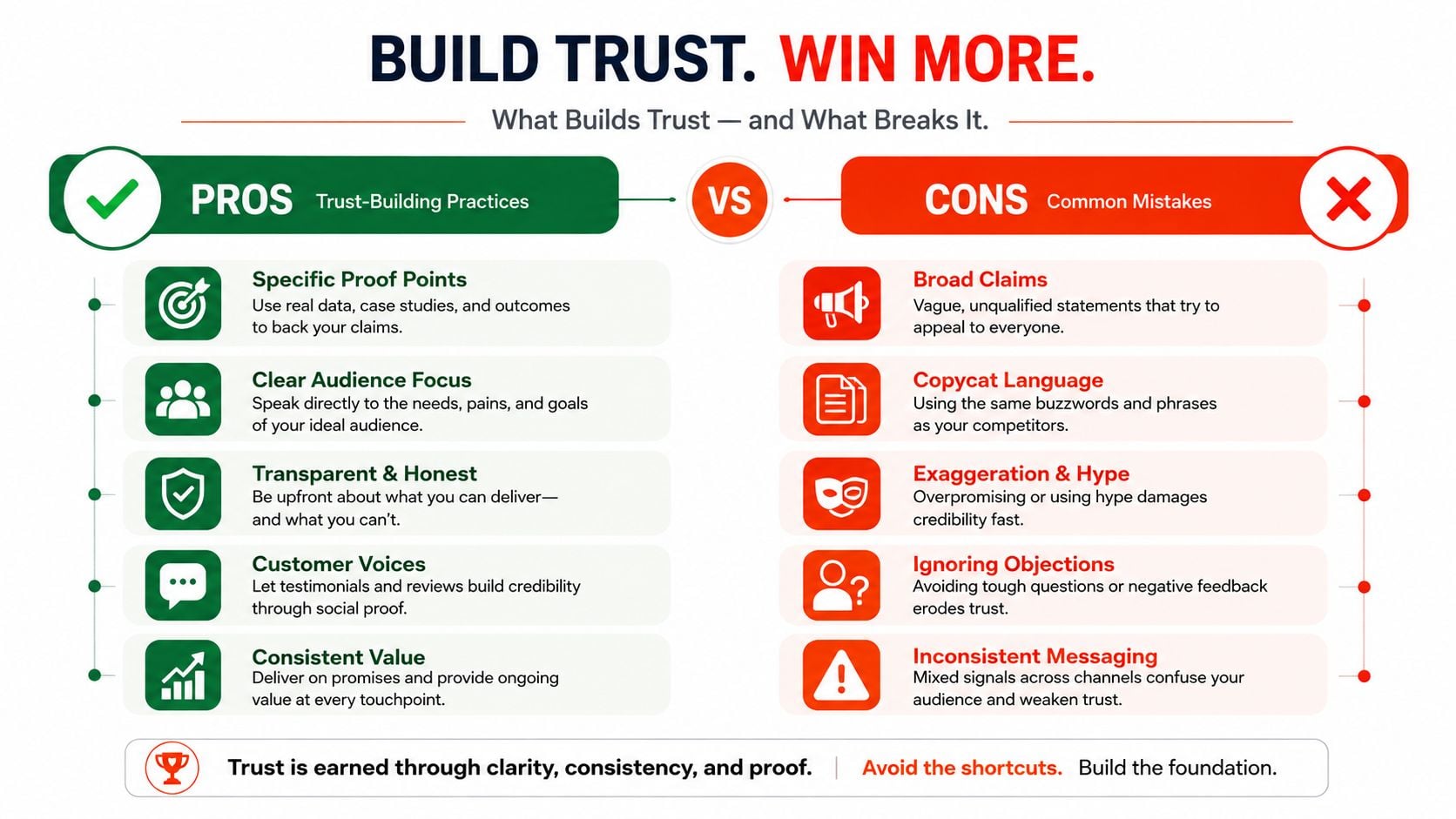
The most common positioning mistake is trying to sound safe. Safe positioning usually produces broad claims, bland language, and a brand that disappears into the category. In crowded Australian service markets, that's a bad trade because buyers are already scanning for signs of transparency and reliability.
Replace generic claims with proof
“Full-service” is not a position. “Data-driven” is not a position either. They're table stakes phrases that every competitor can repeat without changing their business.
A stronger approach is to anchor the brand on proof buyers can use. That could be onboarding speed, live reporting, no lock-in contracts, category-specific expertise, or a clearly defined service process. Those signals reduce perceived risk, which matters when the decision is about trust as much as novelty.
Audit the language for copycat habits
Look at your website, your paid ads, your proposal templates, and your review prompts. If the same vague phrases keep appearing, the market is probably hearing a diluted version of your offer. Broad claims create semantic fog, and fog is where substitutable brands live.
A quick audit helps.
- Keep: claims that describe a specific audience, a specific outcome, or a specific proof point.
- Cut: claims that could sit on any competitor's homepage.
- Rewrite: broad promises into operational evidence.
That's especially relevant in mature digital markets, where buyers compare agencies and vendors on transparency, reporting, and reliability rather than broad brand claims. If your brand is one of many that promises “strategy”, the buyer still has to decide based on confidence. If your brand shows how it works, the decision gets easier.
Don't confuse confidence with clarity
Many teams think a stronger tone will solve a weak position. It won't. Confidence without specificity just creates louder generic language. The fix is sharper segmentation and a proof stack that's hard to copy.
Recent small-business and consumer research points to the same direction, buyers care about clear value, transparency, and reliability. That means your positioning should make the risk reduction obvious. Once you frame the offer around proof instead of puffery, the brand feels more credible and more distinct.
Measuring and Testing Your Positioning Strategy
Positioning should be treated like a hypothesis. If it's doing its job, you'll see the market respond in how it searches, clicks, converts, and remembers the brand. If those signals don't move, the position may be too vague, too broad, or too close to a competitor's language.
Watch the right signals
Branded search is one of the clearest indicators that people are remembering the brand by name. Direct traffic can also be a useful sign that the position is sticking, especially when it rises alongside stronger conversion performance by segment. Message-match scores, share of voice in target categories, and conversion rate by audience group all help show whether the promise is landing.
Testing should be practical. Run A/B tests on headline positioning, ad copy variants, landing page above-the-fold language, and audience segments. If one version attracts clicks but not conversions, the position may be interesting but not credible. If another version converts better but gets weak click-through, the market may not be seeing the promise quickly enough.
Refine before you overhaul
A position doesn't need to be rebuilt every time performance dips. Sometimes the problem is one weak claim, one missing proof point, or one audience mismatch. Use message audits to check whether your ads, pages, and sales collateral are still saying the same thing.
For more advanced experimentation, multivariate testing can help isolate which combination of audience, message, and proof is doing the work. That's especially useful when you're deciding whether the issue is the core position or just the way it's being expressed.
If the market keeps misunderstanding the brand, don't add more words. Tighten the claim.
If the position is consistently underperforming across channels, then a deeper rewrite may be justified. But if one channel is drifting and the others are fine, start with consistency before strategy surgery. The best positioning systems are testable, repeatable, and easy to translate into campaign assets without losing the original meaning.
Click Click Bang Bang builds PPC and AI-first SEO campaigns around clear positioning, message match, and proof-led differentiation. If you want help turning your brand position into ad copy, landing pages, and search visibility that line up, visit Click Click Bang Bang and start with a conversation about your market, your audience, and the claims you want to own.
Read NeXt
Or Read Our Latest
- What Is Brand Positioning and Why It Drives Growth
- Push vs Pull Marketing: A 2026 Decision Guide
- Ad Relevance Score Explained: How It Impacts PPC Performance
- Best ROI Digital Marketing: 10 Channels Ranked for 2026
- Localization Strategy: How to Win in Any Market
- Phone Call Tracking: Methods, Metrics, and Best Practices
Click. CLick. Subscribe.
Get our best PPC insights, industry updates, and power moves delivered straight to your inbox. No fluff, just high-caliber strategies that actually work.
Don’t Leave Just Yet
Try Us For 30-Days,
Risk Free!!
We guarantee that you’ll love our work within the first 30 days, if not you’ll get your money back.
What have you got to lose?