

User Generated Content Strategies That Actually Convert
Last Updated

You can have a healthy traffic week and still feel stuck. Paid social is sending clicks, the product page has reviews, the landing page looks polished, and yet buyers hesitate at the exact moment they need proof. That's usually where user generated content starts earning its keep, not as a social nice-to-have, but as the asset that gives people a reason to believe the claim, compare the offer, and move.
In Australia, that matters because the audience is already there. The ABS recorded 96.8% of households with internet access in 2021–22, 96.6% with a computer, 84.6% with home broadband, and only 2.1% with no internet access at all (ABS data referenced in Billo's summary). At the same time, the ACCC's Digital Platforms Inquiry in July 2019 treated major platforms as central to how Australians access and share content, which is exactly why customer posts, reviews and comments now sit inside the commercial decision path, not outside it (ACCC inquiry summary).
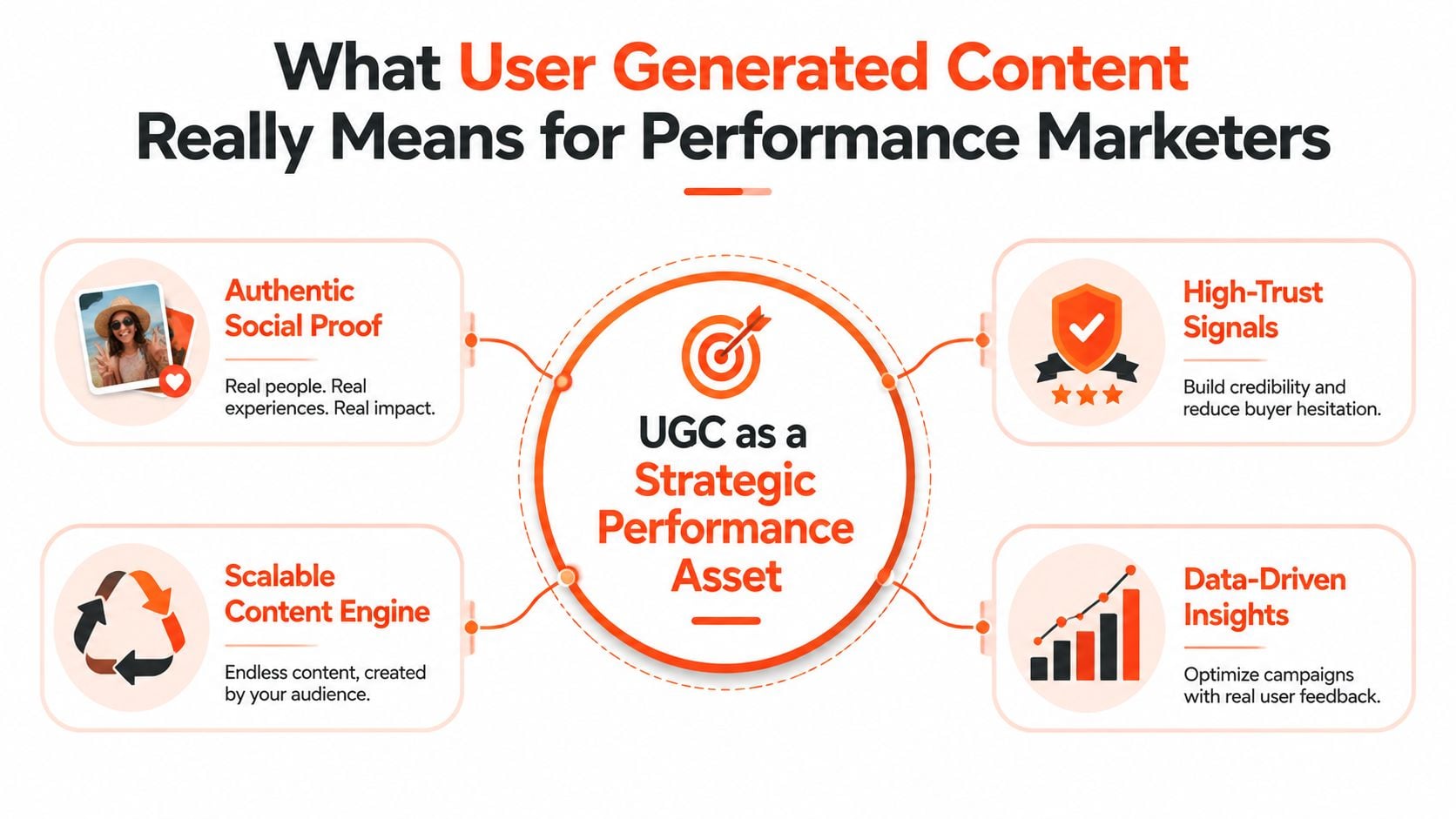
What User Generated Content Really Means for Performance Marketers
A lot of teams say they “do UGC” when they mean they repost a customer photo now and then. That's too narrow for a performance budget. For marketers, user generated content is any customer, user, employee or creator content that changes buying behaviour, whether it appears in a Meta ad, a Google Shopping asset, a LinkedIn testimonial, a product page gallery or a review module.
Why the definition matters in a paid media stack
When you define UGC commercially, attribution becomes cleaner. A customer video in a prospecting ad is pre-click social proof. A review block on a product detail page is post-click reassurance. A forum thread or a Q&A answer can be a persistent trust signal that continues to capture search demand long after the campaign flight ends. Those are different jobs, so they should be measured differently.
Practical rule: if a piece of content reduces hesitation, it belongs in performance planning, even if it was created by a customer rather than your brand team.
That shift matters on busy teams because creative testing is no longer limited to polished ad variants. UGC gives you a broader set of proof assets to test against offers, hooks and landing pages. It also gives SEO teams more natural language, more real objections and more buyer phrasing to index.
What UGC is not
UGC is not just “authentic content” in the abstract. A creator clip that looks native but doesn't answer a buying objection is still just decoration. A five-star review with no detail is weaker than a specific customer note that explains fit, speed, service or setup friction. For performance marketers, the useful content is the content that helps a buyer make a decision sooner.
That's why UGC belongs in the same conversation as bid strategy and CRO. It changes relevance, it changes trust, and it changes the quality of the traffic you're already paying for. If a team can't explain which step in the funnel the asset influences, it probably isn't ready for paid activation.
The Main Types of User Generated Content and Where They Work Best
Different formats solve different problems. Treating a product review, an employee quote and a creator video as interchangeable is one of the fastest ways to waste time and dilute signal. The right format is the one that matches the buyer's hesitation point and the platform surface that carries the most trust at that moment.
Match the format to the objection
Reviews are strongest when the buyer is close to purchase and needs confidence on quality, fit, service or durability. They belong on product pages, comparison pages and checkout-adjacent modules, where the question is usually, “Will this work for me?” Customer photos work well in galleries and carousels because they show context, not just claims. They're especially useful when colour, scale, styling or use case matters.
Short-form creator videos do a different job. They interrupt scroll, explain the product in motion and feel native in paid social. They're useful at the top and middle of funnel because they can deliver both attention and proof in one asset. Discussion threads and Q&A style content are better for SEO because they surface real buyer language and long-tail intent. Employee or expert quotes are especially useful in B2B because they give a service or SaaS page a human point of view without sounding scripted.
| UGC format | Funnel stage | Best channel | Primary trust signal |
|---|---|---|---|
| Written reviews | Decision | Product pages, comparison pages | Peer endorsement |
| Customer photos | Consideration, decision | PDP galleries, email, social | Visual proof |
| Short-form creator video | Awareness, consideration | Meta, TikTok-style placements, remarketing | Native familiarity |
| Discussion threads, Q&A | Discovery, consideration | SEO pages, help content, community pages | Practical answers |
| Employee or expert quotes | Consideration, evaluation | B2B landing pages, LinkedIn ads | Subject-matter credibility |
The useful test is simple. If the buyer is asking “Does this look real?”, use a photo or video. If they're asking “Does this hold up?”, use a review. If they're asking “Can I trust this company?”, use an expert or employee voice.
A few formats are often overrated. Generic meme-style reposts tend to create engagement without moving intent. So do overly polished “UGC-style” ads that remove the rough edges buyers trust. The closer the content feels to a real decision aid, the more likely it is to influence the click or the conversion.
How to Solicit, Curate and Repurpose UGC Across Your Channels
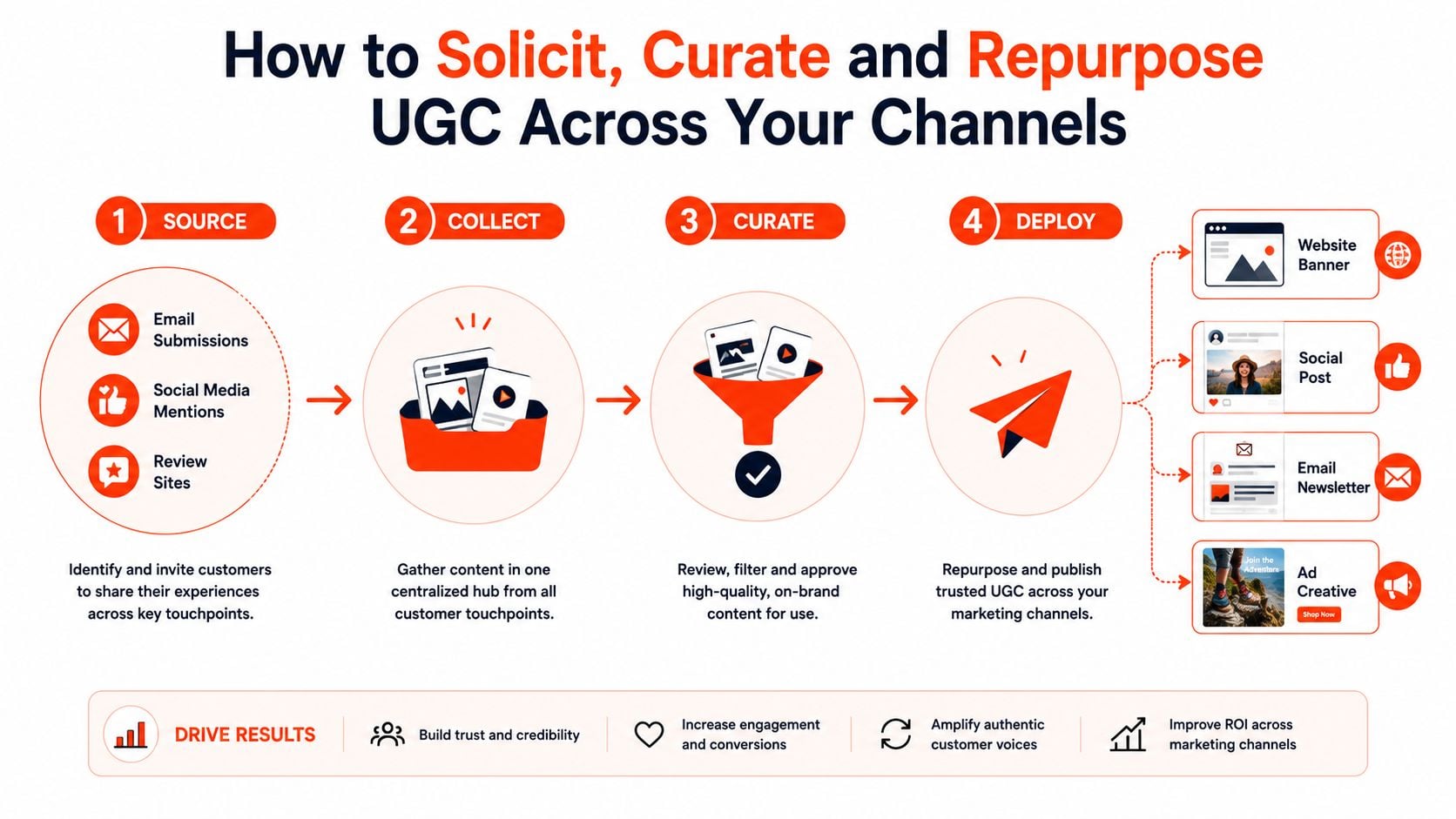
The best UGC programs don't rely on luck. They run on a boring, repeatable workflow that a performance team can operate without creating a second content department. The goal is to collect usable assets, clear rights fast, and route them into the channels where proof changes behaviour.
Build the source layer first
Start where buyers already talk. Post-purchase email is the cleanest place to ask for a review, a photo or a short clip because the experience is fresh. Review prompts should be tight and specific, not “tell us what you think.” Ask about fit, setup, speed, service or outcome. Creator partnerships and employee submissions are useful when you need a controlled narrative, while social listening helps you find accidental advocates already posting about the brand.
Curate for quality and rights, not volume
A large library of risky assets is worse than a smaller library you can use. Create a single triage process that checks image quality, factual accuracy, rights, and brand safety before anything is repurposed. The fastest way to kill a UGC programme is to let weak assets and vague permission habits spread across channels.
A simple operating model works well:
- Source deliberately: pull content from reviews, post-purchase asks, creator collaboration and social mentions.
- Collect centrally: use one inbox or asset folder so the team can find originals quickly.
- Curate tightly: approve only assets with clear rights, strong proof and obvious audience fit.
- Deploy by use case: cut one asset into different formats for Meta, LinkedIn, email, PDPs and remarketing.
Repurpose for the job, not the ego
One customer video can become a six-second hook, a longer LinkedIn testimonial, a Google Ads extension and a gallery tile on a product page. The trick is to track every derivative asset back to the source so you know what created the lift. That's where a clear asset naming system matters more than another brainstorm session.
If you want examples of how testimonial assets are cut for paid channels, this collection of testimonial ad examples is a useful reference point. It helps teams see how proof can be adapted without losing the original voice.
Why UGC Earns a Place in SEO, PPC and CRO
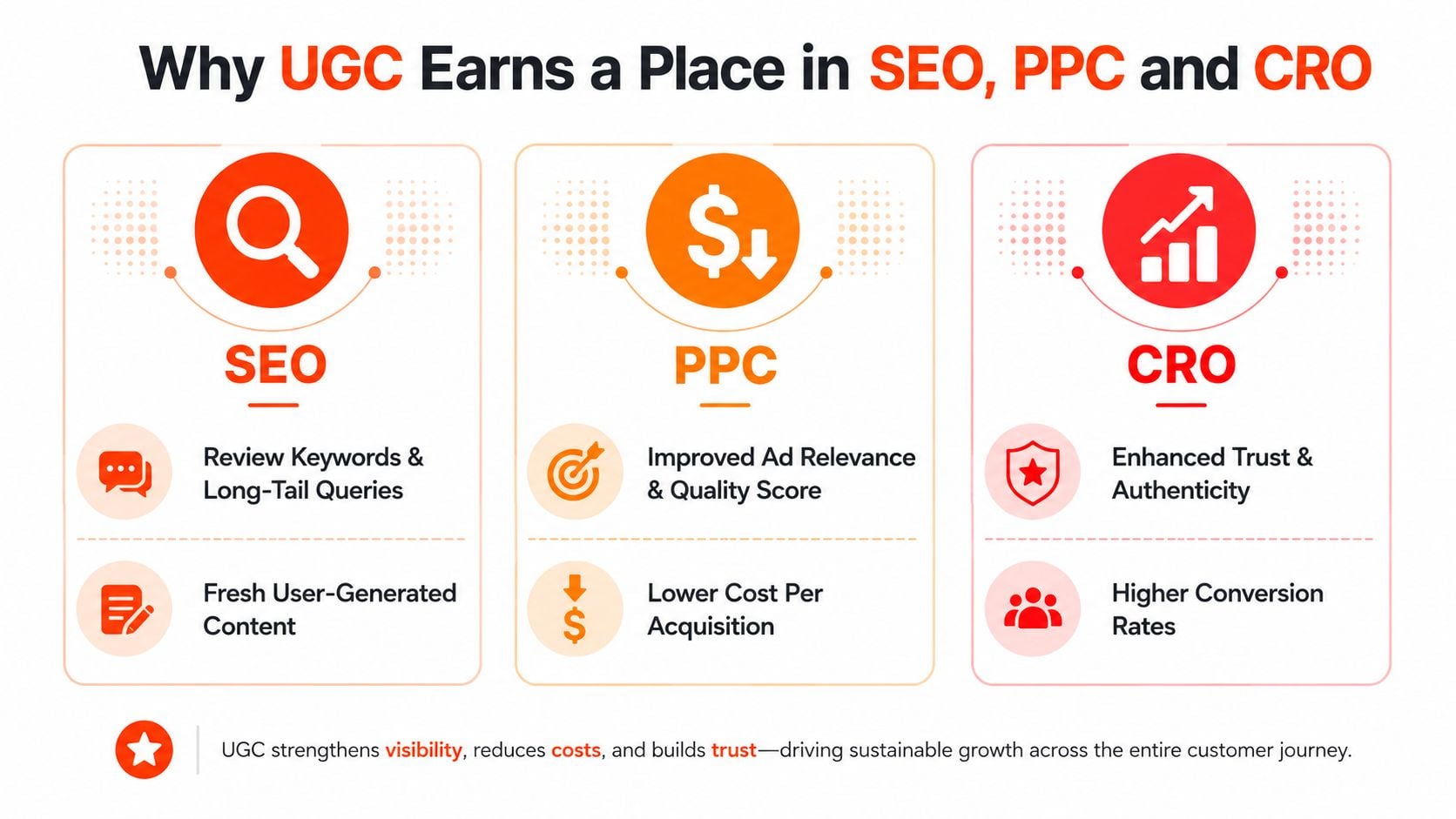
UGC works because each channel rewards a slightly different kind of proof. SEO wants language and relevance. PPC wants attention and ad fit. CRO wants confidence at the point of hesitation. If you separate those jobs, UGC becomes much easier to justify inside a monthly report.
SEO gets the language buyers actually use
Review content, Q&A threads and community answers are useful because they mirror the phrases buyers type when they're researching. That gives search teams more natural language to work with and more on-page material that answers objections without sounding like brand copy. The value isn't just keyword coverage, it's relevance density. More buyer language on the page usually means fewer unanswered questions for the searcher.
PPC gets native proof inside the ad unit
In paid social, UGC tends to outperform stock-style creative because it feels like part of the feed rather than an interruption. That doesn't mean every phone-shot clip is good. It means the asset can stop the thumb, show the product in use and lower the mental effort required to click. For search and shopping, proof-led creative helps bridge the gap between query intent and the landing page promise.
CRO gets proof at the point of doubt
CRO is where UGC often pays back fastest, because that's where the buyer is already considering the offer. Put proof near price, near shipping, near returns and near checkout. A review or photo placed in the right spot often does more work than a redesign. It answers the exact question that causes abandonment.
Decision rule: use UGC first where hesitation is highest, not where the homepage has the most empty space.
When budget is tight, I'd usually prioritise the landing page and product page first, then feed the strongest assets into paid social. That sequence gives you a cleaner read on what the content changes. Once the proof works on-site, it becomes much easier to scale it into ad creative and organic search support.
Real-World UGC Plays for E-commerce, B2B and SMB Marketers
Different businesses need different proof. A fashion retailer doesn't use the same asset mix as a SaaS company, and a local service business doesn't need the same production overhead as either of them. The play is to match the content to the buying pattern, then keep the test narrow enough that the result is readable.
E-commerce needs product confidence
For an AU fashion or beauty brand, the strongest combination is usually review-led product pages plus creator-led video ads. Reviews answer fit and feel, while short video shows texture, application or styling in context. The likely KPI movement is better add-to-cart behaviour and fewer post-purchase surprises, especially when the proof sits close to size guides, shade guidance or returns information.
B2B needs credibility and specificity
A SaaS firm or professional services brand gets more value from customer quotes, mini case-study snippets and comparison-page proof than from broad social applause. LinkedIn lead gen ads are a good place to run that content because the audience is already in evaluation mode. On the landing page, the quote should do one job, remove uncertainty about relevance, implementation or outcomes. If you need a practical reference for how creator or advocate assets are assembled into campaigns, the mechanics on influencer collaboration are closely related, even when the final asset feels more like UGC than a paid endorsement.
SMBs need a tight review loop
For a local service business, the simple system is often the best one. Ask for a review after the job, surface that proof on Google Business Profile, reuse the strongest lines in Meta creative, and put a small selection on one landing page. The business doesn't need a massive library, it needs fresh, specific evidence that it does what it says it does.
The common thread is control. You're not trying to produce more content for the sake of it. You're trying to produce the kind of proof that makes a buyer act with less doubt. The smaller the team, the more important that discipline becomes.
Legal, Rights and Moderation Risks Most UGC Advice Ignores
A lot of UGC advice assumes permission is a quick message and a thumbs-up. In practice, rights, moderation and compliance are where programs either scale safely or get messy fast. If you plan to use customer content in paid media, you need a stronger process than “they tagged us, so it's fine.”
Treat organic reposts and paid usage differently
There's a big difference between resharing a post on your own organic channel and using that same asset in an ad. Paid usage should be covered by clear rights, creator agreement language and a record of consent. If the content includes identifiable people, product claims, locations or personal details, the risk rises again. A clean asset library is worth more than a crowded folder of maybe-usable content.
For a plain-English overview of licence categories, AI image licence types explained is a useful primer, especially when teams are trying to separate commercial use from casual reuse.
Use a moderation triage rule
A practical moderation rule keeps the team moving without making every decision a committee event:
- Approve: content is on-brand, factually safe, and rights are clear.
- Request edit: the asset is useful, but the wording, crop or claim needs correction.
- Escalate: the content raises legal, privacy or brand-safety questions.
- Remove: the content is misleading, harmful or unusable.
That process matters even more when AI-assisted curation enters the workflow. If a team turns real customer content into synthetic variants, governance needs to cover both the source asset and the derivative. The more you edit, the more important it becomes to know who owns what and what was approved.
Put privacy and consumer law in the workflow
A compliant UGC programme needs a clear path for takedown requests, a way to store approvals, and a review step for claims that might create ACCC or ACL issues. If you're collecting personal information or moving customer content across systems, align the workflow with your broader data privacy compliance process rather than treating it as a separate problem.
A smaller, properly licensed asset library usually outperforms a bigger one that legal can't clear in time.
The core trade-off is speed versus safety. Teams that ignore the legal layer can move quickly for a while, then spend that speed on cleanup later. Teams that build a simple rights process early can scale UGC with much less friction.
KPIs and a Measurement Framework You Can Report On
If UGC can't be measured, it gets cut. The reporting view has to be simple enough for a monthly meeting and specific enough to defend the spend. I'd keep it to one baseline, one test, and one comparison per channel.
Track the numbers that tie to revenue
The four metrics that matter most are direct and assisted conversion rate, cost per acquisition delta on UGC creative versus control, return or refund rate change when proof sits near product detail, and on-page engagement signals like time on page and scroll depth on review-rich pages. Those numbers map cleanly to the jobs UGC is doing, which makes the story easier to tell without overclaiming.
Report it by placement, not just by asset
A review on a PDP and the same review in a remarketing ad are not the same test. One is a conversion aid, the other is a creative variable. Keep a basic table of asset source, placement, audience, launch date and primary KPI. That lets you see whether the proof worked because of the format, the channel or the timing.
A sensible cadence is monthly for executive reporting and weekly for asset-level decisions. Keep the monthly view focused on what changed versus the control. Keep the weekly view focused on what to duplicate, what to cut and what to request next. If your UGC programme is healthy, the conversation should sound like media optimisation, not a brand workshop.
If you want a team that can turn customer proof into measurable SEO, PPC and CRO gains without bloating the workflow, Click Click Bang Bang builds campaigns around performance assets, reporting and conversion tracking rather than vanity content. Visit Click Click Bang Bang if you want help structuring UGC into a practical paid and organic system that your next review meeting can defend.
Read NeXt
Or Read Our Latest
- User Generated Content Strategies That Actually Convert
- Copyright and Infringement Guide for Business Marketers 2026
- What Is Brand Positioning and Why It Drives Growth
- Push vs Pull Marketing: A 2026 Decision Guide
- Ad Relevance Score Explained: How It Impacts PPC Performance
- Best ROI Digital Marketing: 10 Channels Ranked for 2026
Click. CLick. Subscribe.
Get our best PPC insights, industry updates, and power moves delivered straight to your inbox. No fluff, just high-caliber strategies that actually work.
Don’t Leave Just Yet
Try Us For 30-Days,
Risk Free!!
We guarantee that you’ll love our work within the first 30 days, if not you’ll get your money back.
What have you got to lose?