

Copyright and Infringement Guide for Business Marketers 2026
Last Updated

You've probably got a campaign live right now where someone pulled a product image from a supplier site, used a competitor-style caption as “inspiration”, and sent the creative to paid social before legal even saw it. That's where copyright and infringement usually shows up for Australian marketers, not in headline-grabbing piracy disputes, but in fast, low-friction reuse inside performance workflows and AI-assisted production. The risk isn't theoretical, it's baked into the way modern teams move.
The practical problem is simple. A marketer sees usable content, a platform rewards speed, and nobody stops to ask who owns the expression, who licensed it, or whether the new version still tracks back to the original work. In Australia, infringement still turns on unauthorised use of protected expression, with some temporary or technical copies treated differently under specific exceptions, which makes workflow design just as important as legal theory ALRC on incidental or technical use.
The Marketers Quiet Copyright Risk
A busy e-commerce manager doesn't usually sit down and think, “I'm about to create liability.” They think, “We need this Meta ad approved by lunch.” So they grab a stock-style image from a blog, paste it into a carousel, or ask an AI tool for product copy that sounds close to the top-ranking competitor page because the brief says “make it sharper”.
That's the quiet risk. It's not a dramatic pirate operation, it's a chain of normal marketing shortcuts that can add up to unauthorised reproduction or communication of protected material. Australian policy material on the digital environment recognises that infringement gets harder to trace when it's fast, cross-platform, and wrapped inside platform intermediaries, which is exactly why the everyday cases matter more than many admit Copyright Enforcement Review issues paper.
Why routine reuse is the real exposure
The teams that get burned are usually not the ones trying to sell bootleg films. They're the ones moving too fast to notice that a caption has been lifted, a user-generated clip has been repurposed without permission, or a design brief has turned into an imitation of another brand's protected look and feel. In AI-first workflows, that risk becomes harder to spot because provenance gets blurred between prompt, output, edit, and final approval.
Practical rule: if a junior marketer can't explain where each asset came from, you don't have a creative workflow, you have an infringement guess.
That matters because the legal question is often less about “did the brand mean to steal?” and more about “did the business copy protected expression without authority?”. For Australian businesses, especially those running always-on paid media and SEO content production, the safest mindset is to treat copyright as an operational control, not a last-minute legal hurdle. If you can govern asset sourcing, review, and record-keeping, you lower the odds that speed turns into an avoidable rights problem.
Core Concepts of Copyright and Infringement
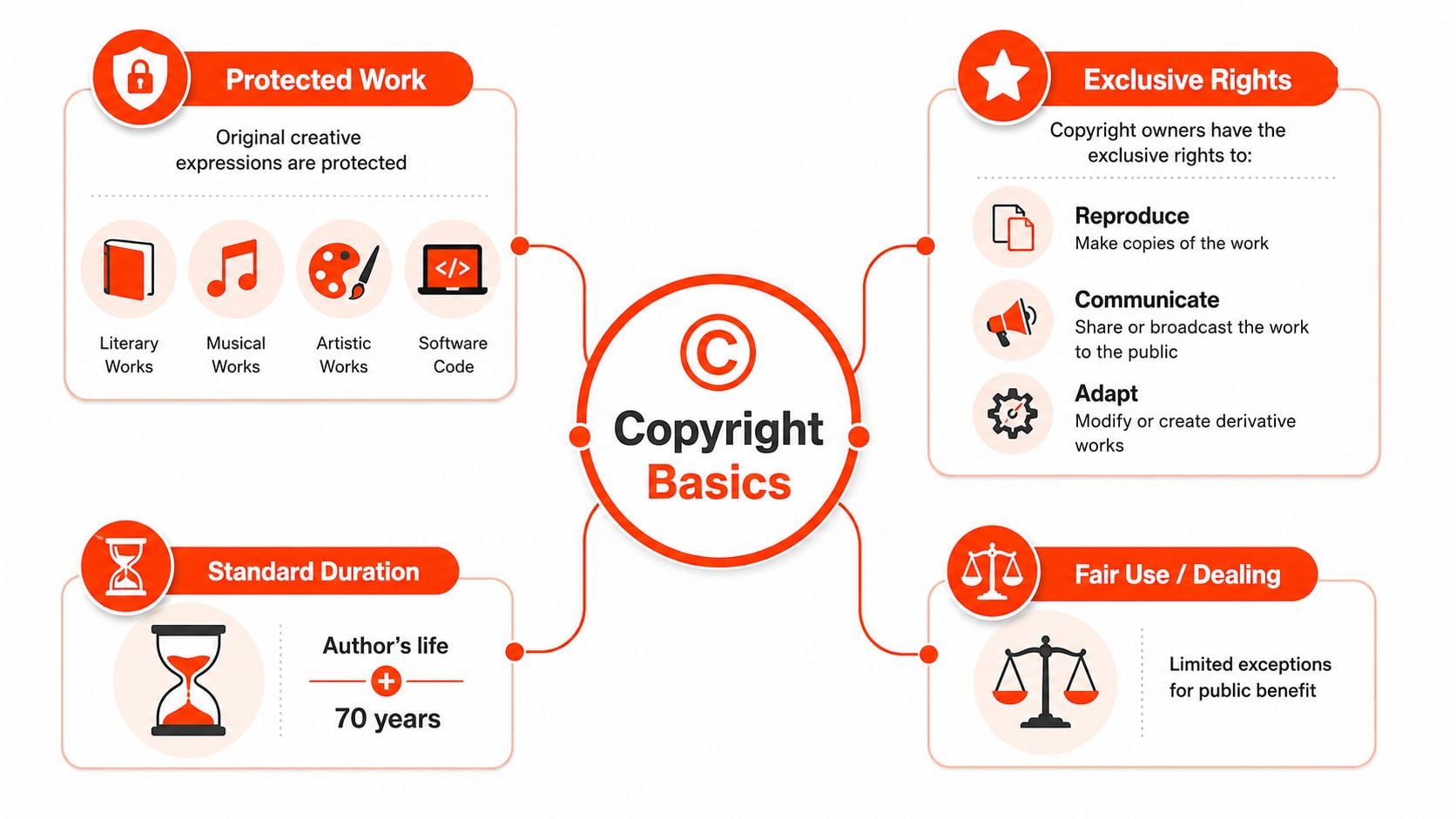
Copyright protects original creative expression. That means the text, image, video, music, software, or design isn't protected because it exists, it's protected because someone created it in a form the law recognises as expression. Facts by themselves are a different question, which is why a rewritten article can still infringe if it keeps the original expressive structure too closely, even when individual facts are common knowledge.
Renting a venue is a good analogy. You can host a party in the space you've rented, but you can't sublet the venue, repaint the walls as if they were yours, and then pretend the original owner gave up control. Copyright works the same way; it gives the creator a bundle of exclusive rights, and permission has to match the use you're making.
What triggers the rights
In Australian law, infringement is triggered when a protected work is reproduced or communicated to the public without authorisation, unless an exception applies. This includes the kind of reuse marketers do every day, from copying images into ads to posting another creator's clip into a branded social campaign. The Australian Law Reform Commission also notes that temporary copying made as part of the technical process of making or receiving a communication can fall into a distinct exempt category in some contexts, which is why routing, caching, and transient server copies need careful analysis rather than guesswork ALRC on incidental or technical use.
The key is to match the right to the act. If you crop an image, that can still be reproduction or adaptation. If you upload a clip to a campaign landing page, that's a communication issue. If you rewrite copy in a way that keeps the same original structure and selling points, the risk doesn't disappear just because the words changed.
Duration and exceptions
Copyright doesn't last forever. In general terms, the standard duration is the author's life plus 70 years, which is why rights clearance isn't just a one-off project, it's part of long-term content governance. Fair use and fair dealing aren't free passes, they're limited exceptions that depend on purpose and context. The point is not “can I use it because I changed it”, the point is “does this particular use fall within an exception or permission I can prove?”
If you can't point to the licence, permission, or exception on paper, you're already behind.
For marketers, that means the checklist is more useful than the theory. Ask four questions before launch, is the work protected, do we have a right to use it, what right are we exercising, and can we show the basis for that decision later? If the answer is vague, the asset should stay out of the build until someone fixes the provenance.
If you want a practical content process that keeps this discipline inside your SEO workflow, the operational side of publishing is covered well in this SEO web content guide, especially if your team is mixing human drafting with AI-supported production.
How Big Infringement Really Is
The scale matters because it tells you this isn't a fringe compliance issue. The EUIPO's 2020 status report estimated counterfeit goods imported from outside the bloc at EUR 121 billion in annual value, equal to 6.8% of the EU's imports from the rest of the world EUIPO status report. The same report said IPR infringement in international trade could reach 3.3% of world trade EUIPO status report.
That's not just a customs problem. It's a signal that copyright and broader IP infringement operate as a cross-border market distortion, the kind of issue that touches legitimate rights-holders, trade-exposed industries, and enforcement systems all at once. For Australian businesses, that's relevant because local teams buy into global creative supply chains, global ad platforms, and global content libraries.
The market moves when conditions change
The data also shows that infringement is not fixed. The EUIPO reported that the share of internet users in Europe who accessed content illegally fell between 2014 and 2017 EUIPO and UK tracker summary. In the UK's 12th-wave Online Copyright Infringement Tracker survey, overall infringement across all content categories rose from 25% to 32% EUIPO and UK tracker summary. Those are movement signals, not trivia.
What matters to marketers is the pattern behind the numbers. Infringement responds to access, platform design, price, and enforcement intensity. When legal alternatives get easier to use and enforcement gets tighter, behaviour changes. When the environment makes reuse frictionless, the risk spreads into ordinary commercial workflows.
Why AU businesses should care
Australia is closely tied to global trade and rights enforcement systems, so European and UK enforcement patterns are often useful reference points for understanding how copyright scales in advanced digital economies. The practical read is blunt: if infringement can shift quickly in mature markets, then local teams shouldn't assume their own workflows are immune just because they're not running pirate sites.
The real lesson isn't that everyone is infringing. It's that infringement is structurally resilient whenever teams can copy faster than they can clear rights.
That's why the biggest risk for marketers sits in the middle of the workflow, not the edge cases. A single reused image, a republished snippet, or AI-drafted copy that mirrors a rival can look minor in isolation. In volume, it becomes an exposure pattern.
Common Infringement in Marketing Assets
The fastest way to spot risk is to look at what marketers reuse under deadline pressure. Unlicensed imagery is the classic one, especially in PPC display ads where a team sees a clean image in a blog post and assumes the internet has made it fair game. It hasn't. If the creator didn't license it to you, dropping it into ad creative can be unauthorised reproduction, and if the platform amplifies it, the business is also communicating the work publicly.
Text is just as risky. SEO teams sometimes scrape blog passages, product descriptions, or comparison copy and “freshen them up” for new pages. If the work keeps the original expression, structure, or wording too closely, the business hasn't created safe originality, it's just changed the surface. That's where AI tools can make things worse, because they can generate output that feels new while still tracking too closely to the source inputs.
Video, UGC and branding
Short-form video creates a different kind of trap. Teams edit competitor clips into reels, remix creator footage, or pull snippets from webinars and assume transformation is enough. It isn't automatically enough. The question stays the same, was the protected element used without permission, and can the business prove authority for the new use?
User-generated content is another common failure point. Reposting a customer photo, testimonial video, or social caption without a clear permission trail looks harmless until the original creator objects. If the campaign uses it commercially, the business should not rely on implied consent, because implied consent is exactly the kind of assumption that collapses when the post is amplified into paid media.
For a useful look at how visual production is being reshaped by AI in commercial fashion workflows, the ai fashion photography example shows why provenance and image rights need to be documented before output gets used at scale. The technology can be efficient, but efficiency doesn't answer ownership.
The operating rule for marketing teams
Brand-adjacent infringement is the subtle one. That's when ad creative mirrors another brand's protected visual identity, layout, or descriptive voice closely enough to create rights and confusion problems. It doesn't always look like copying at first glance, which is why it slips through internal review.
If you need a shared language for campaigns that rely on creators and partners, the governance around influencer collaboration is where rights, permissions, and usage scope should be clarified before the asset enters paid media.
Practical rule: if the asset came from another business, creator, or platform user, the campaign file should show the permission chain, not just the final export.
The pattern is consistent. Image, text, video, UGC, and brand mimicry all become infringement risks when the team confuses “available online” with “available for commercial reuse”.
Impact on SEO PPC and Ecommerce
Infringement rarely stays confined to one channel. In ecommerce, a disputed asset can force a product detail page off sale, strip a shopping feed, or trigger a rights complaint that slows the whole launch schedule. In paid media, a strike or takedown can pause a creative set, waste spend on ads that no longer run, and force last-minute substitutions that usually perform worse because they weren't planned.
Search is affected too, but in a slower, less visible way. Duplicate or unlicensed content weakens trust signals because the page is no longer clearly original, and originality matters when the business wants to rank, convert, and retain users. If your site becomes known for recycled text and borrowed media, the user experience gets thinner even before any formal complaint arrives.
Why digital proof matters
Australian enforcement is increasingly digital in practice. WIPO's enforcement materials identify DNS blocking, IP blocking, and URL blocking as technical measures used against online infringement, and they also show that Australia's Federal Court has accepted technology-based evidence to prove infringement WIPO enforcement materials. That matters because the old habit of treating copyright as a purely manual comparison exercise is outdated.
Once a dispute becomes technical, attribution matters. Who uploaded the file, where it came from, what version was approved, and what licence was attached all become evidence questions. If the team can't reconstruct the path from source to publication, the business is left defending itself with guesswork.
The commercial trade-off
The trade-off is speed versus control. A campaign team that pushes assets out quickly can launch sooner, but if those assets are unlicensed or too close to another work, the business risks delays that are much more expensive than a proper review upfront. By the time legal, media, and design have all remediated the issue, the original opportunity is usually gone.
That's why prevention should be prioritised by channel risk. Paid social and ecommerce pages deserve the strictest gatekeeping because they carry immediate commercial consequences. SEO content needs provenance discipline because it compounds over time. And the teams using AI-assisted production need documented review, because “the tool made it” is not a defence.
Prevent and Respond to Infringement
Start with source control. Every asset should have a visible licence record, a named owner, and a clear note on where it came from. If the team bought it, keep the licence file. If it was commissioned, keep the contract language that assigns the rights. If it came from a creator, store the permission and the usage scope, not just the screenshot of a DM.
Attribution is the next layer. When a licence requires credit, give the credit exactly as granted. When the licence doesn't require credit but does limit commercial use, respect that limit. The most common mistake I see is teams treating attribution as a courtesy instead of a condition of use. It's not a branding flourish, it's part of the permission chain.
Track reuse before it becomes a complaint
Use reverse-image search, text similarity checks, and periodic content audits to find material that has drifted outside its original permission. The point isn't surveillance for its own sake, it's catching campaign assets before a rights-holder does. If a landing page, ad, or social post has been live for months without a clean provenance trail, flag it for review immediately.
When infringement is alleged against your business, move fast and stay factual. A valid notice should identify the work, the location of the material, the contact details of the claimant, and a good-faith statement that the use is unauthorised. Keep your reply short and document-based. If you have a licence, send it. If you don't, take the asset down first and sort the rights question second.
Practical rule: remove questionable content quickly, then preserve the file history, approval notes, and licence records before anyone overwrites the evidence.
If you're the party making the complaint, a formal takedown request should be specific and calm. If the other side responds with a counter-notice, review whether your claim is about ownership, scope of permission, or fair dealing rather than simple copying. For teams handling privacy-sensitive records alongside rights clearance, the record-keeping discipline should line up with your broader data privacy compliance process so approvals, permissions, and audit trails don't live in separate silos.
Keep the response workflow simple
A useful internal playbook is short:
- Identify the work: Name the asset, URL, campaign, and owner.
- Check the right: Confirm licence, permission, exception, or ownership.
- Act on the risk: Pause, replace, or remove the asset.
- Record the decision: Save the evidence trail for future disputes.
The businesses that stay out of trouble aren't perfect, they're disciplined. They know which assets are cleared, which ones are borrowed, and which ones should never have reached production in the first place.
Agency Checklist for Safe Content
AI-assisted production needs a different level of discipline because the content path is no longer linear. A prompt, a model output, a human edit, and a final export can all carry different provenance. If no one records those steps, the business can't later explain where the material came from or whether it was safely transformed.
Start with prompt provenance. Store the brief, the prompt, and any source references used to generate the asset. That doesn't make the output safe by itself, but it gives you a record of what shaped the result. If a later review shows that the output tracked too closely to a source, you'll at least know what inputs created the problem.
Build human review into the workflow
No AI-generated asset should go live without human review sign-off. That review should ask a practical question, does this look and read like a lawful original, or does it resemble something we didn't have the right to copy? The reviewer should not just check grammar and tone, they should check rights risk.
Store license records in the same place as creative files, not buried in email threads. If an image, font, stock clip, or quote was licensed, the record should be attached to the asset version that went live. That makes audits easier and stops teams from reusing a file long after its rights expired or shifted.
Make legal review selective, not random
A useful policy is to send higher-risk assets for legal review before launch, especially when the creative is derived from competitor material, creator content, or AI-assisted output that echoes a known source. You don't need every Instagram story reviewed by counsel, but you do need a clear trigger list for anything that could create an ownership dispute later.
A lean checklist helps:
- Prompt provenance logged.
- Human approval recorded.
- Licence or permission attached.
- High-risk assets flagged for legal review.
That's enough to reduce hidden infringement risk without slowing the whole pipeline. It also gives agency teams a clean handoff when clients ask how a particular asset was cleared, because the answer lives in the file history, not in someone's memory.
FAQ on Copyright and Infringement
How much transformation makes a repost low-risk? There isn't a magic percentage. If the original protected expression is still recognisable, you're still in risk territory, even if the format changes. The ALRC's note on temporary technical copying is useful for digital systems, but it doesn't turn ordinary commercial reposts into free use.
Who is liable when an AI tool produces similar material? Usually the business that publishes it still carries the practical risk, because the legal focus stays on ownership and unauthorised copying of protected expression. The hard part is documenting the workflow so you can show the output was reviewed, sourced, and approved, not blindly shipped.
What should SMEs document for screenshots, captions, and short snippets? Keep the source, the permission basis, the intended channel, and the expiry or limitation of the right to use it. If you can't explain those four points quickly, the asset probably isn't ready for a paid campaign.
If your team's content engine is moving faster than your rights clearance, Click Click Bang Bang can help you build a cleaner process around SEO, PPC, and AI-first content production. Visit Click Click Bang Bang if you want campaigns that are designed to launch fast without creating hidden copyright and infringement risk.
Read NeXt
Or Read Our Latest
- Copyright and Infringement Guide for Business Marketers 2026
- What Is Brand Positioning and Why It Drives Growth
- Push vs Pull Marketing: A 2026 Decision Guide
- Ad Relevance Score Explained: How It Impacts PPC Performance
- Best ROI Digital Marketing: 10 Channels Ranked for 2026
- Localization Strategy: How to Win in Any Market
Click. CLick. Subscribe.
Get our best PPC insights, industry updates, and power moves delivered straight to your inbox. No fluff, just high-caliber strategies that actually work.
Don’t Leave Just Yet
Try Us For 30-Days,
Risk Free!!
We guarantee that you’ll love our work within the first 30 days, if not you’ll get your money back.
What have you got to lose?