

Artificial Intelligence Ads That Drive Results in 2026
Last Updated
At its core, artificial intelligence in advertising is about using smart algorithms to make your campaigns faster, sharper, and far more effective. It’s the engine that automates the critical decisions around targeting, bidding, and even the creative you show, swapping out broad, manual guesswork for data-driven predictions.
The goal is simple: reach the right person, with the right ad, at the exact moment they’re ready to act. Get that right, and your return on investment will speak for itself.
The Shift to AI-Powered Advertising
Think of traditional advertising like casting a huge net into the ocean. You’ll probably catch something, but you’ll also pull in a lot of unwanted bycatch. Artificial intelligence ads are the complete opposite. It’s like having advanced sonar that pinpoints exactly where your target fish are, what bait they prefer, and when they're most likely to bite.
This isn't just about letting a machine run your campaigns. It's about making better decisions at a speed and scale no human team could ever manage. We're moving away from a game of averages and into a world of individual precision. For both e-commerce brands and B2B marketers, this means you can finally stop shouting at crowds and start having a one-on-one conversation with each potential customer, tailored to their immediate needs.
To see just how different the approach is, here’s a quick comparison:
Traditional Advertising vs Artificial Intelligence Ads
| Aspect | Traditional Advertising | Artificial Intelligence Ads |
|---|---|---|
| Audience Targeting | Manual, based on broad demographics and interests. | Dynamic, based on real-time user behaviour and predictive signals. |
| Bidding Strategy | Manual or basic rule-based bidding. | Automated bidding optimised in real-time for conversions or ROAS. |
| Ad Creative | Static, with limited A/B testing of a few variations. | Dynamic creative that automatically assembles the best assets for each user. |
| Optimisation | Periodic manual adjustments based on past performance reports. | Continuous, real-time optimisation based on thousands of data points. |
| Scale | Limited by human capacity to manage campaigns. | Nearly infinite, managing millions of variables simultaneously. |
This table really highlights the fundamental shift. We’re moving from a static, reactive process to one that is dynamic, predictive, and always learning.
From Manual Effort to Intelligent Automation
The biggest change you’ll feel is the move away from the daily grind of setting bids, tweaking rigid audience lists, and manually A/B testing a handful of ad variations. AI takes over these tactical jobs, freeing you up to focus on what really matters: strategy, creative direction, and understanding the insights the machine uncovers.
Instead of spending your day in the weeds of campaign settings, your time is better spent asking bigger questions based on the performance data the AI gives you.
This is all powered by machine learning models that analyse thousands of signals in real-time. These signals include things like:
- Past purchases and browsing history
- The time of day and the user's location
- The device they’re using
- The specific content they’re looking at right now
By crunching all this data, the AI can predict who is most likely to convert and then instantly adjust the ad experience to make it happen. It’s a fundamental change from just showing ads to providing solutions.
The Impact on Business Outcomes
The real-world benefit of using artificial intelligence in your ads is tangible and hits the bottom line directly. Businesses that get this right are seeing massive improvements in their most important KPIs. The focus is no longer on vanity metrics like clicks or impressions, but on measurable business growth.
The real power of AI in advertising is its ability to turn data directly into revenue. By optimising every single ad dollar, it allows businesses to achieve higher return on ad spend (ROAS), lower their customer acquisition cost (CAC), and ultimately bring in better quality leads that drive long-term growth.
This capability isn’t confined to just one part of the marketing ecosystem. To see how this trend is playing out elsewhere, you only have to look at the evolution of Artificial Intelligence Affiliate Marketing, which shows how these same principles are optimising performance-based models across the board. The mission is always the same: use data to get more efficient and profitable results, whether it’s for a direct ad campaign or a partner program. This is the new standard for what it means to run a successful campaign.
How AI Advertising Technology Actually Works
To really get what makes artificial intelligence ads tick, we need to pop the bonnet and look at the core technologies driving them. It isn't just one magic bullet; it's a combination of four powerful pillars working in sync. Each one plays a specific part, turning mountains of raw data into smarter, faster, and more profitable advertising decisions.
This combination is what separates modern AI advertising from the basic automation tools of the past. It’s a system built to predict, act, and even create with mind-boggling speed and precision.
This concept map shows how it all fits together, with AI at the centre driving smarter decisions, faster execution, and laser-focused targeting.
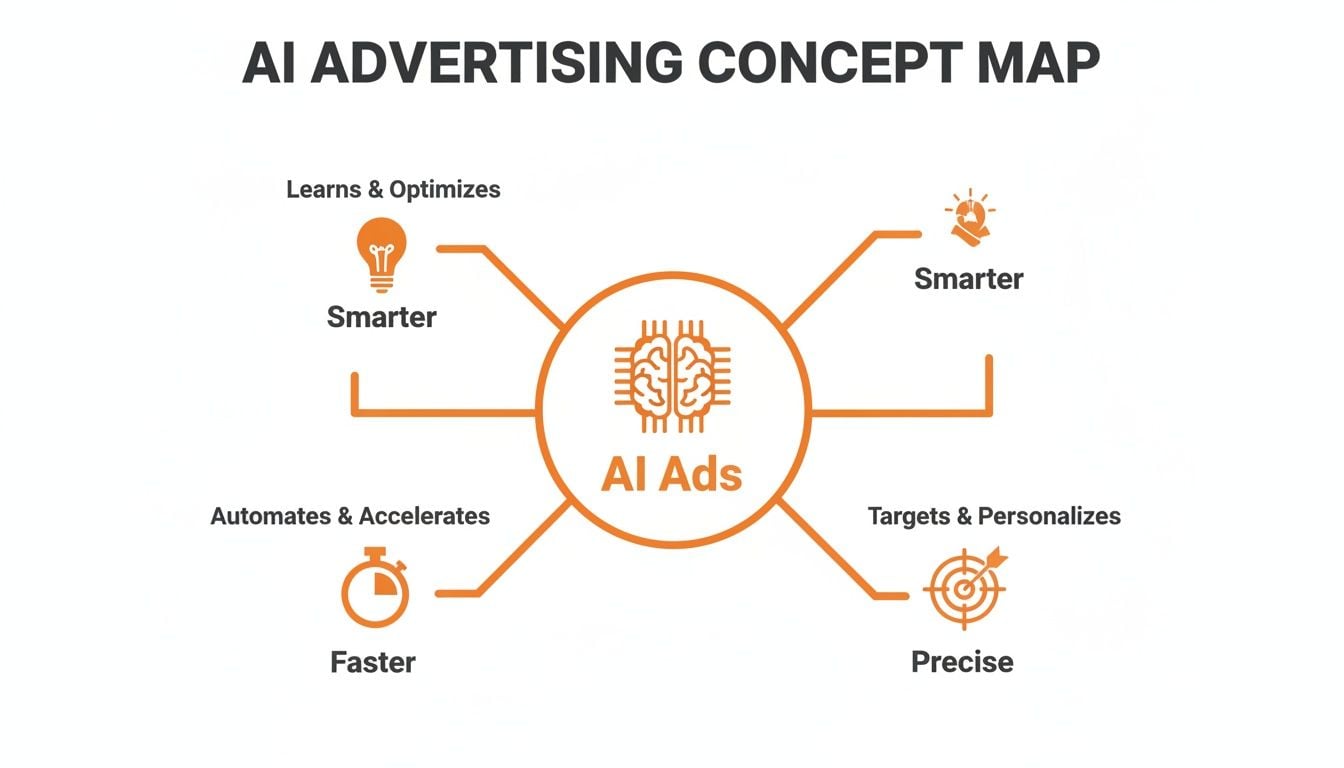
Let's break down the four technologies that make these results possible.
Predictive Targeting
Think of predictive targeting as your own digital crystal ball. Instead of just reacting to what a user has done (like visiting a product page), it analyses thousands of behavioural signals to forecast who is most likely to become your next best customer.
It’s basically lookalike audiences on steroids. The AI studies your existing high-value customers—what they read, when they browse, what they buy—to find subtle patterns. It then scours the digital world for new users who share these powerful predictive traits, even if they’ve never heard of your brand.
- For e-commerce: An AI might learn that people who buy your high-end running shoes also tend to research nutrition plans on weekends. It then proactively targets this new segment with ads for your premium running gear.
- For B2B: The algorithm could spot that decision-makers who download a specific whitepaper are 80% more likely to request a demo within 14 days. It will then prioritise ad spend on similar professionals who are just starting their research.
Programmatic Bidding
Imagine a stock trader executing millions of perfect trades a second, always buying low and selling high. That’s programmatic bidding in a nutshell. It’s a fully automated, real-time auction system where AI algorithms bid on ad impressions for you.
Every time a user loads a webpage with ad space, an auction happens in milliseconds. The AI analyses the user's potential value to your business and decides the optimal price to bid for that single impression. This ensures you never overpay and your budget goes exactly where it needs to.
This means you automatically bid more for a user the AI predicts is about to convert, and less for someone who's just window shopping. Your budget is instantly maximised by focusing spend where it delivers the most impact.
Dynamic Creative Optimisation (DCO)
Dynamic Creative Optimisation (DCO) is like having a master chef with an infinite pantry. You give the AI a library of creative “ingredients”—different headlines, descriptions, images, videos, and calls-to-action. The AI then instantly assembles the perfect ad combination for every single person who sees it.
Someone who previously looked at a blue dress might see an ad featuring that exact item. Another person might get an ad with a "Free Shipping" headline because the AI knows they respond to value-based offers. This intense level of personalisation happens automatically, at scale.
Generative AI for Creative
The newest and arguably most exciting pillar is generative AI. This technology acts as a creative partner, capable of producing entirely new ad assets from a simple text prompt. It's completely changing how quickly brands can create and test ad variations.
For example, AI-powered tools can now take simple product photos and turn them into stunning, on-brand lifestyle visuals. This is done by leveraging advanced algorithms to create realistic models from product shots, a process often called product to model AI. Suddenly, e-commerce stores can generate a huge range of diverse lifestyle images without the time and expense of photoshoots.
In Australia, the adoption of this tech is accelerating. A recent study found that 61% of all social media content from Aussie companies is projected to be AI-generated by 2026. A massive 91% of these firms report significant time savings, proving AI is far from a gimmick—it’s a core productivity tool. You can find out more in Capterra’s 2024 GenAI survey findings.
Using AI Features on Major Ad Platforms
Knowing the theory behind AI-driven advertising is one thing. Putting it into practice is where you actually start seeing results. The good news is the ad platforms you’re already using are loaded with powerful AI features that can transform your campaigns.
Getting a handle on these tools is the key to unlocking better performance, whether you’re running an e-commerce store or generating high-value B2B leads. Each platform has its own take on AI, but they’re no longer optional extras—they are the new baseline for effective advertising. Let’s break down how to use them.
Master the Google Network with Performance Max
Google’s flagship AI campaign type is Performance Max (PMax). Think of it as an all-access pass to every corner of Google’s ad inventory—Search, Display, YouTube, Discover, Gmail, and Maps—all managed from a single campaign.
Instead of juggling separate campaigns for each channel, you just give PMax your business goals (like a target cost per acquisition) and a library of creative assets. From there, the AI takes over, automatically finding the perfect mix of targeting, bidding, and ad formats to reach your customers wherever they are. It’s goal-based advertising in its purest form, powered entirely by machine learning.
PMax is built to find converting customers you didn’t even know you had. By analysing real-time signals across its massive network, it looks beyond simple keywords to find users showing strong purchase intent, often before they even start searching for your product.
This requires a different mindset. Success with PMax isn’t about micromanaging placements; it's about feeding the algorithm high-quality data and a diverse set of creative assets, then trusting it to find the most efficient path to your goal. Your job shifts from manual tweaker to strategic director.
Drive Sales on Meta with Advantage+
Over on Facebook and Instagram, Meta’s answer to AI-driven advertising is the Advantage+ suite. These tools are designed to automate the heavy lifting in campaign creation, from audience building to creative delivery.
The star of the show for e-commerce brands is Advantage+ Shopping Campaigns. This campaign type fully automates targeting and placements to hunt down the most likely buyers across Meta’s platforms. It blends your first-party customer data with Meta’s enormous pool of user signals, pushing your reach far beyond what you could achieve with traditional interest or demographic targeting. For many advertisers, the result is a serious drop in customer acquisition costs.
Other key features in the Advantage+ toolkit include:
- Advantage+ Audience: This feature automatically expands your manually selected audience if the AI spots a cheaper or better opportunity elsewhere. It’s a smart way to let the algorithm find new pockets of customers without completely handing over the reins.
- Advantage+ Creative: This tool makes small, automated tweaks to your ads on the fly—like brightening an image or testing different call-to-action buttons—to boost performance for each individual user.
Secure B2B Leads with LinkedIn AI
LinkedIn is the undisputed heavyweight for B2B marketing, and its AI features are precision-engineered to identify and engage high-value professional audiences. While AI underpins the entire platform, a couple of features really stand out for B2B advertisers.
The first is Predictive Audiences. By plugging in your CRM data, LinkedIn’s AI gets to work analysing your existing customer base. It identifies shared traits—like company size, industry, job seniority, and skills—and then builds a fresh target audience of LinkedIn members who look just like your best customers. It's an incredibly powerful tool for any account-based marketing strategy.
The second is LinkedIn's automated bidding strategies, which are tuned for specific B2B objectives like website visits, lead generation, or event sign-ups. The algorithms analyse each user's professional context to set the optimal bid, making sure your ad spend is focused squarely on the decision-makers that matter to your business. If generating high-quality leads is your main goal, getting your campaign management right is critical, and you can learn more by exploring professional PPC ads management.
Reach Niche Audiences with Programmatic DSPs
Moving beyond the walled gardens of Google and Meta, programmatic Demand-Side Platforms (DSPs) use seriously advanced AI to buy ad space across the open web. Platforms like The Trade Desk or DV360 give advertisers access to millions of websites, apps, and connected TV services.
Their AI algorithms churn through trillions of data points in real time to make split-second bidding decisions. This enables unbelievably granular targeting based on countless behavioural and contextual signals, giving you the power to reach extremely niche audiences with surgical precision.
This is especially relevant as digital advertising continues to dominate in Australia. Projections show digital channels will make up 74.4% of total ad spend in 2025. This growth is being fuelled by platforms like Instagram, which is expected to expand its ad reach by another 1.2 million users by October 2025. You can dig into more data on Australia's digital ad trends in DataReportal's latest analysis.
Your Launch Checklist for AI Ad Campaigns
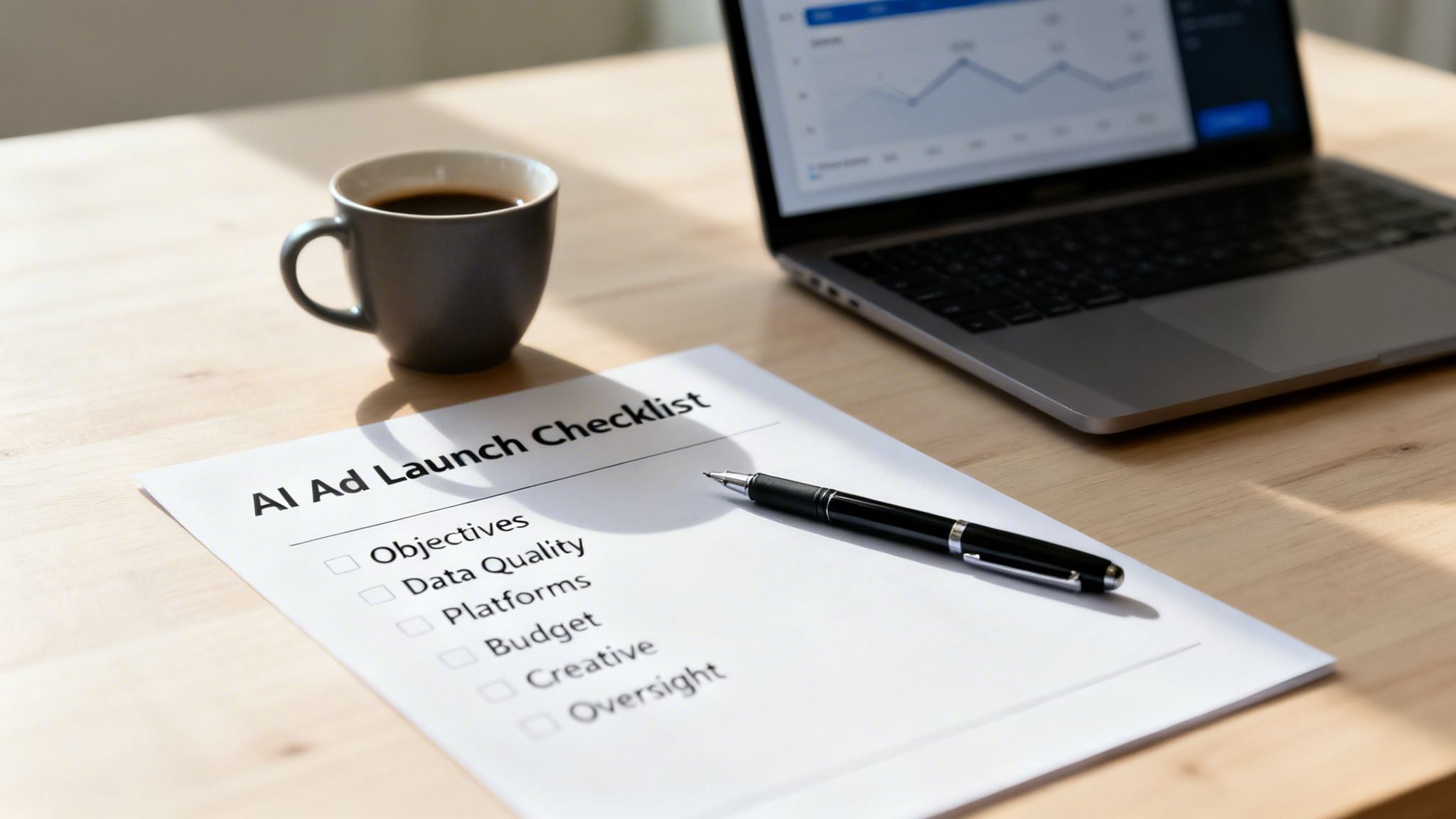
Jumping into AI-powered advertising isn't about flipping a switch and hoping for the best. Real success comes from a solid foundation, and a structured checklist is your best friend here. It ensures you give the algorithms the right inputs to deliver the results you need.
Think of it like giving a pilot a detailed flight plan before takeoff. The clearer the plan, the smoother the journey. This checklist breaks down the critical steps for preparing and launching your AI ad campaigns with confidence.
Define Crystal-Clear Objectives
Before a single dollar is spent, you absolutely must know what you're trying to achieve. AI algorithms are powerful, but they need a specific destination. A vague goal like "get more traffic" is a recipe for wasted ad spend.
Your objectives have to be specific, measurable, and tied directly to real business outcomes. This gives the AI a clear success metric to optimise towards.
Actionable goals look like this:
- Achieving a target Return On Ad Spend (ROAS) of 4:1 for an e-commerce brand.
- Generating 50 qualified sales leads per month at a Cost Per Acquisition (CPA) under $150.
- Driving software trial sign-ups with a specific conversion rate target in mind.
Ensure High-Quality Data
Data is the fuel for your AI engine. Without clean, reliable data, even the most advanced algorithms will sputter and fail. Your most valuable asset is your first-party data—the information you collect directly from your website and customer interactions.
This process starts with bulletproof conversion tracking. The AI needs to know with 100% accuracy what a "win" looks like on your site, whether it's a purchase, a form submission, or a key page view. Inaccurate data sends the algorithm chasing the wrong signals, burning through your budget.
Choose the Right Platforms
Not all AI ad platforms are built the same. Each has unique strengths that align with different business goals, so the key is matching the platform’s capabilities to your objectives.
Australia's B2B marketing scene, for example, is undergoing a seismic shift. Over 78% of Australian B2B organisations now embrace AI in their strategies, highlighting how AI-first approaches are becoming the standard for lead generation. You can explore more about these Australian AI market trends and insights on vegavid.com.
Your platform choice is a strategic decision. An e-commerce brand selling fashion might find its best results with Meta's Advantage+ Shopping, while a B2B tech company will almost certainly get higher-quality leads from LinkedIn's Predictive Audiences.
Set an Agile Budget
AI algorithms go through a "learning phase" where they test different audiences, creatives, and bidding strategies to figure out what works. This process requires a budget that’s large enough to gather sufficient data. Setting your budget too low is a common mistake that starves the algorithm before it can find its footing.
Be prepared for an initial period where performance might fluctuate. This is normal. The goal is to provide enough runway for the AI to move from exploration to profitable optimisation.
Provide Diverse Creative Assets
Think of it this way: your job is to supply the ingredients, and the AI's job is to cook the perfect meal for each user. To do that, it needs a rich library of creative assets to test.
Make sure you provide a wide variety of:
- Headlines: Short, long, question-based, and benefit-driven.
- Images & Videos: Product shots, lifestyle images, user-generated content, and short video clips.
- Descriptions: Focus on different features, pain points, and solutions.
This diversity gives the AI the flexibility to run thousands of micro-experiments and discover which combinations resonate most powerfully with different audience segments.
Establish Human Oversight
Finally, remember that AI advertising is not a "set and forget" solution. It absolutely requires human oversight. An experienced strategist is critical for setting the initial strategy, interpreting the results, and making sure the AI’s actions align with your brand’s values and long-term goals.
The human steers the ship; the AI manages the engine room.
How to Measure Real Success with AI Ads
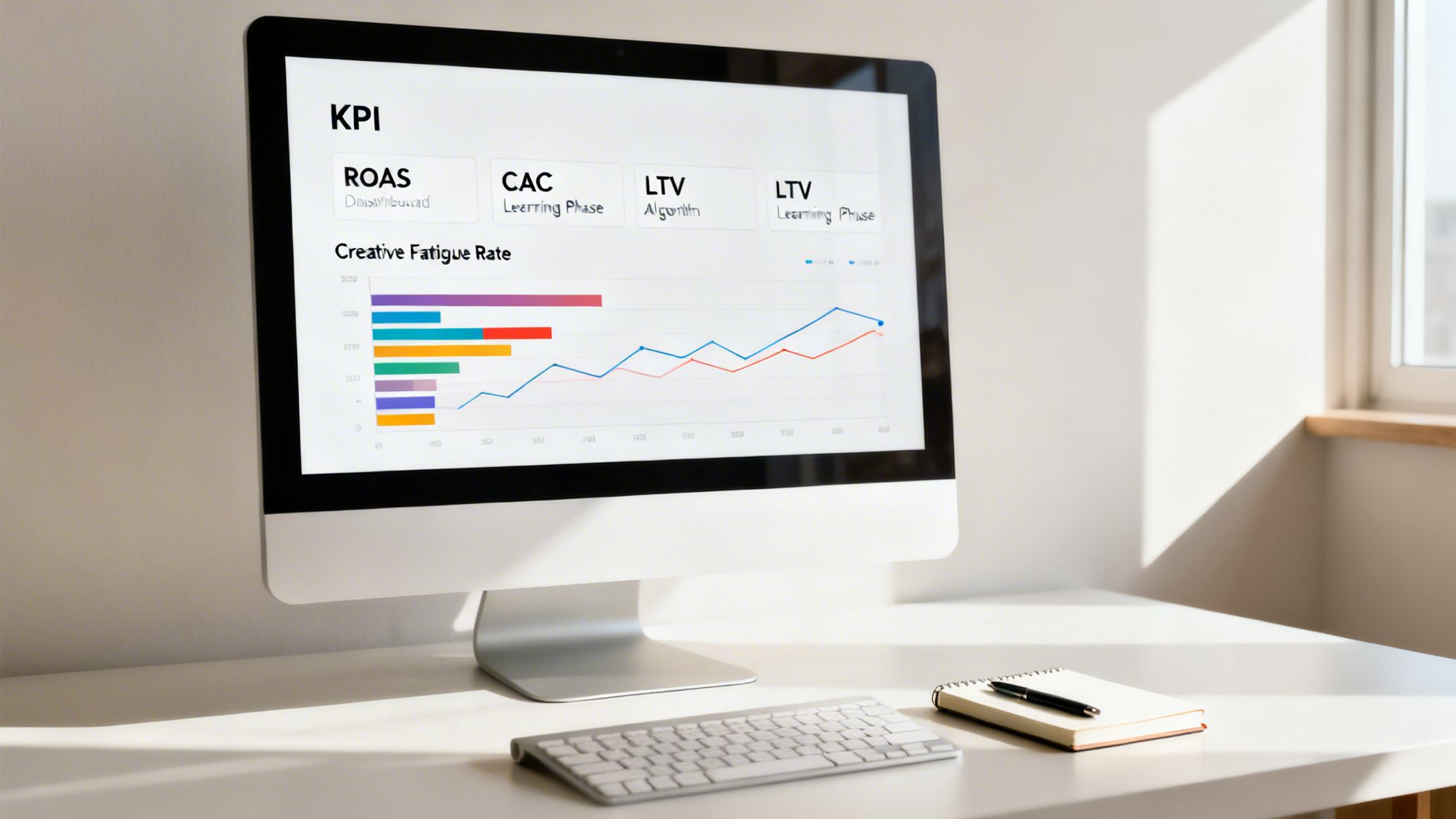
AI ads run on data, but true business growth comes from tracking the right numbers. It's easy to get sidetracked by vanity metrics like impressions or clicks, but to really understand the impact of your campaigns—and justify the investment—you have to look deeper.
The most effective AI ad strategies are measured against core business key performance indicators (KPIs). These are the figures that connect directly to profitability and growth, giving you a clear, honest picture of what’s actually working.
Focusing on Business-Impact KPIs
To prove the value of your AI-driven strategies, your reporting must centre on the metrics that stakeholders truly care about. These are the numbers that draw a straight line from ad spend to revenue and customer value, creating a powerful story of success.
The three most important business-impact KPIs are:
-
Return On Ad Spend (ROAS): This is the bottom line. For every dollar you pump into your AI campaigns, how many dollars in revenue are you getting back? A high ROAS is a clear signal that the AI is effectively turning your ad budget into sales.
-
Customer Acquisition Cost (CAC): How much does it really cost to land a new paying customer? A well-tuned AI advertising strategy should steadily drive this number down by finding more efficient paths to conversion. A falling CAC means your marketing is getting smarter and more cost-effective.
-
Customer Lifetime Value (LTV): This metric forecasts the total revenue a single customer is likely to generate over their entire relationship with your brand. AI is brilliant at boosting LTV because it helps identify and attract higher-value customers who are more likely to stick around and make repeat purchases.
An LTV that is significantly higher than your CAC is the hallmark of a healthy, scalable business. As a rule of thumb, a 3:1 LTV to CAC ratio is a common benchmark for success, showing that your customers are worth three times what you spent to acquire them. Of course, getting your tracking right is the crucial first step. You can learn more about setting up accurate measurement in our detailed guide to Google Ads conversion tracking.
Monitoring AI-Specific Performance Indicators
Beyond standard business metrics, running successful AI campaigns means keeping an eye on indicators that reveal how well the algorithm itself is performing. These metrics offer a deeper look into the health and efficiency of the machine you're operating.
Think of these as the AI’s vital signs. They tell you if the algorithm has enough quality data to learn, if your creative is going stale, and whether the system is firing on all cylinders.
Key AI performance indicators to watch include:
-
Algorithm Learning Phase Duration: How long does it take for the AI to move past its initial "learning phase" and start delivering stable, optimised results? A shorter duration often points to high-quality data and clear conversion signals.
-
Creative Fatigue Rate: At what point do your ad assets—images, videos, headlines—start to see a drop in performance? AI platforms can track this automatically, flagging when it’s time to feed the system fresh creative to keep engagement high.
By blending these business-focused and AI-specific metrics, you create a complete, 360-degree view of your campaign performance. This approach not only helps you sharpen your strategy but also delivers the transparent, data-driven proof needed to demonstrate the undeniable value of AI advertising.
Common Pitfalls and Best Practices
Getting AI advertising right isn't just about flicking a switch on the latest tech; it's about shifting your mindset and process. While the potential is huge, a few common mistakes can easily derail your efforts and burn through your ad spend.
By understanding these traps and embracing a few key best practices, you can steer your AI campaigns toward genuine, long-term success. Think of this as your practical guide to avoiding the costly errors so many others make.
Best Practices for AI Ad Success
To get the most out of your AI campaigns, you need to work with the algorithm, not against it. That means trusting the process, giving it the right fuel, and actually using what it learns to inform your wider marketing strategy.
Here are the key practices to adopt:
-
Trust the Learning Phase: Every AI ad platform has an initial "learning phase" where performance can be all over the place. You have to resist the temptation to jump in and make drastic changes. The algorithm is running experiments to figure out what works, and interrupting it just resets the clock and delays profitability.
-
Feed It Fresh Creative: AI needs a steady diet of new creative assets to find the winning combinations. Continuously supply your campaigns with fresh headlines, different images, and new video clips. This not only prevents creative fatigue—where your audience gets tired of seeing the same ad—but it gives the algorithm more ingredients to cook with. For a deeper dive, check out our guide on ad copy best practices.
-
Integrate AI Insights: The data your AI campaigns produce is a goldmine. Pay close attention to which audience segments, creative angles, and messaging are hitting the mark. Use these insights to guide your organic content, email marketing, and even your product development. Don't let that data sit in a silo.
Common Pitfalls to Avoid
Many advertisers stumble by treating AI campaigns just like their old manual ones. This almost always leads to frustration and mediocre results. Avoiding these common mistakes is just as important as following the best practices.
The biggest error we see is a misunderstanding of the relationship between human and machine. AI is an incredibly powerful tool, but it's not a substitute for strategic thinking. Neglecting human oversight for brand safety, messaging, and goal alignment is a fast track to campaign failure.
Make sure you sidestep these frequent missteps:
-
Setting Budgets Too Low: AI needs a sufficient budget to gather data and learn effectively. A budget that's too small essentially starves the algorithm. It can't run enough tests to exit the learning phase and start optimising properly.
-
Using Poor-Quality Data: Your campaign’s success is built entirely on the data you feed it. If you have inaccurate conversion tracking or a messy customer list, you're sending the AI chasing the wrong signals. Clean, reliable data isn't a "nice-to-have"; it's non-negotiable.
-
Over-Restricting the Algorithm: The real power of AI lies in its ability to discover new, high-performing audiences you never would have thought of. If you layer on too many manual targeting restrictions, you're tying the algorithm's hands and severely limiting its potential to find your next best customers.
Frequently Asked Questions About AI Ads
Stepping into AI-driven advertising can feel like a leap of faith. It’s natural to have questions about giving up control, the costs involved, and how long it all takes. We hear the same concerns from businesses all the time, so let's clear the air and give you some straight answers.
How Much Control Do I Really Lose?
This is the big one. There’s a common misconception that using AI in your advertising means you just hand the keys over to a black box and hope for the best. The reality is much more of a partnership, often called the "human-in-the-loop" model.
You're still the strategist. You set the business goals, you define the budget, and you have the final say on the creative direction. The AI's job is to execute the relentless, tactical work—like running thousands of bid adjustments or audience tests—at a speed and scale no human team ever could. Think of yourself as the pilot who sets the destination; the AI is just the hyper-efficient engine getting you there. Your oversight isn’t just an option; it's essential.
Is AI Advertising Too Expensive for a Small Business?
Not at all. While the tech behind it is complex, AI advertising is surprisingly accessible, even for small and medium-sized businesses. In fact, its entire purpose is to drive efficiency. By automatically sniffing out the most profitable ad placements and audiences, the algorithm cuts down on wasted spend and improves your Return On Ad Spend (ROAS).
This ruthless optimisation makes your budget work much harder, turning it into a powerful tool for growth. You don't need a massive enterprise-level budget to get started. You just need a clear objective and enough data for the algorithms to start learning.
How Long Does It Take for AI Ads to Start Working?
Patience is crucial, especially right at the beginning. When you launch a new AI-powered campaign, it enters what's known as the "learning phase". During this time, the algorithm needs data to figure out what actually works. It runs countless micro-experiments to identify the winning ad combinations and audience segments.
This learning period can last anywhere from a few days to a couple of weeks, depending on your daily budget and the number of conversions you’re getting. Once it’s over, you’ll start seeing the stable, optimised performance you were hoping for as the AI begins to hit its stride.
Ready to see how precision-driven AI advertising can scale your business? Click Click Bang Bang specialises in crafting data-focused campaigns that deliver real results. Explore our services at https://clickclickbangbang.com.au and start your risk-free trial today.
Read NeXt
Or Read Our Latest
- Manual vs Automated Bidding for PPC Success
- Conversion Tracking Setup: A Complete AU Guide
- Instagram Advertising Australia: Complete 2026 Guide
- Pay Per Click: A Beginner’s Guide for Australian Marketers
- Display Advertising on Google: The Complete Australian Guide
- Stakeholder Communication Plan How to Build One That Works
Click. CLick. Subscribe.
Get our best PPC insights, industry updates, and power moves delivered straight to your inbox. No fluff, just high-caliber strategies that actually work.
Don’t Leave Just Yet
Try Us For 30-Days,
Risk Free!!
We guarantee that you’ll love our work within the first 30 days, if not you’ll get your money back.
What have you got to lose?