

What Is a Good ROI for Digital Marketing? the 2026 AU Guide
Last Updated

A good digital marketing ROI usually starts around 5:1, with 3:1 to 5:1 widely used as the healthy range, 2:1 often treated as the minimum profitability line, and 10:1 seen as exceptional. But that 5:1 benchmark is a baseline, not a verdict, because the right target depends on your margins, sales cycle, and how your channels work together.
If you're asking this question, you're probably in one of two positions. You're either spending enough on marketing that every month feels like an accountability meeting, or you're about to increase spend and want to avoid buying traffic that looks busy but doesn't improve the business.
That pressure is fair. Business owners don't need another report full of clicks, impressions, and vague “brand uplift”. They need to know whether marketing is generating profitable growth, how long it should take, and whether the return they're seeing is good for their kind of business.
The short answer is useful because it gives you a reference point. The longer answer matters more because a retailer selling low-margin products should judge ROI differently from a B2B firm that closes high-value deals over a long sales cycle. Add AI-driven search behaviour into the mix, and even the way you measure “good” return is starting to change.
The Elusive Quest for a Good Marketing ROI
Most businesses want a clean answer. They want one number they can hand to their team or agency and say, “That's the benchmark.” The problem is that ROI only looks simple from a distance.
A campaign can hit a healthy return on paper and still hurt cash flow. Another can look underwhelming in-platform while helping sales close faster through branded search, remarketing, and email follow-up. That's why the question isn't just what is a good ROI for digital marketing. It's good for whom, over what time frame, and measured how?
Why the headline number misleads people
The commonly accepted benchmark is useful because it gives you a starting line. In Australian marketing discussions, 3:1 to 5:1 is still the widely used healthy range, with 5:1 treated as a strong target, below 2:1 often seen as weak or barely profitable, and 10:1 considered exceptional according to this digital marketing ROI benchmark overview.
That doesn't mean every campaign should be forced to hit 5:1 immediately.
Paid search often works faster but at a tighter margin. SEO usually takes longer, then compounds. A prospecting campaign on Meta might not close the sale directly, but it can still support branded search and remarketing performance later. If you judge every channel with the same stopwatch and the same success line, you'll cut the campaigns that are building future revenue.
Practical rule: Use 5:1 as a baseline target for a mature program, not as a universal pass-fail rule for every campaign, channel, and month.
The better question to ask
Instead of asking whether your marketing is “good”, ask these:
- Is it profitable after real business costs? Revenue alone doesn't pay wages, fulfilment, software, or sales time.
- Is it improving over time? New campaigns usually need testing, data, and landing page fixes.
- Is it attracting the right customers? More leads don't help if sales keeps rejecting them.
- Is it strengthening the whole funnel? Search, SEO, remarketing, CRM, and email often work as a system.
Business owners get into trouble when they chase a single ratio without context. They pause channels too early, scale channels too late, or pour more budget into traffic before fixing conversion problems.
A good ROI isn't just a number on a dashboard. It's a return that fits your business model and keeps producing profit as you grow.
Going Beyond ROI The Metrics That Truly Matter
ROI matters, but it isn't the only number you need to manage. If you only look at final return, you can miss where the problem lies. Sometimes the ads are fine and the landing page is weak. Sometimes lead volume looks strong but customer value is too low. Sometimes ROAS looks healthy while profit isn't.
Think of a bakery. If the bakery spends money promoting cupcakes and sells more boxes, revenue goes up. That sounds good. But if ingredient costs, staff time, delivery fees, and discounting eat the margin, the owner hasn't built a healthy campaign. They've built expensive activity.
ROI and ROAS aren't the same thing
ROAS measures revenue against ad spend. It's useful for judging ad efficiency.
ROI is the broader business outcome. It asks whether the overall investment created profit.
That distinction matters because ROAS can flatter a campaign. A campaign might generate revenue but still fail once you factor in margin, overhead, agency fees, and fulfilment. In practice, ROAS is a channel metric. ROI is the business metric.
CAC and CLV tell you whether growth is sustainable
Two other numbers change the conversation fast.
- Customer Acquisition Cost (CAC) tells you what it costs to win a customer.
- Customer Lifetime Value (CLV) tells you what that customer is worth over the full relationship.
If your bakery spends heavily to acquire one customer who only buys once, the campaign has less room for error. If that same customer reorders every month, refers others, and buys catering later, the first sale doesn't need to carry the whole return.
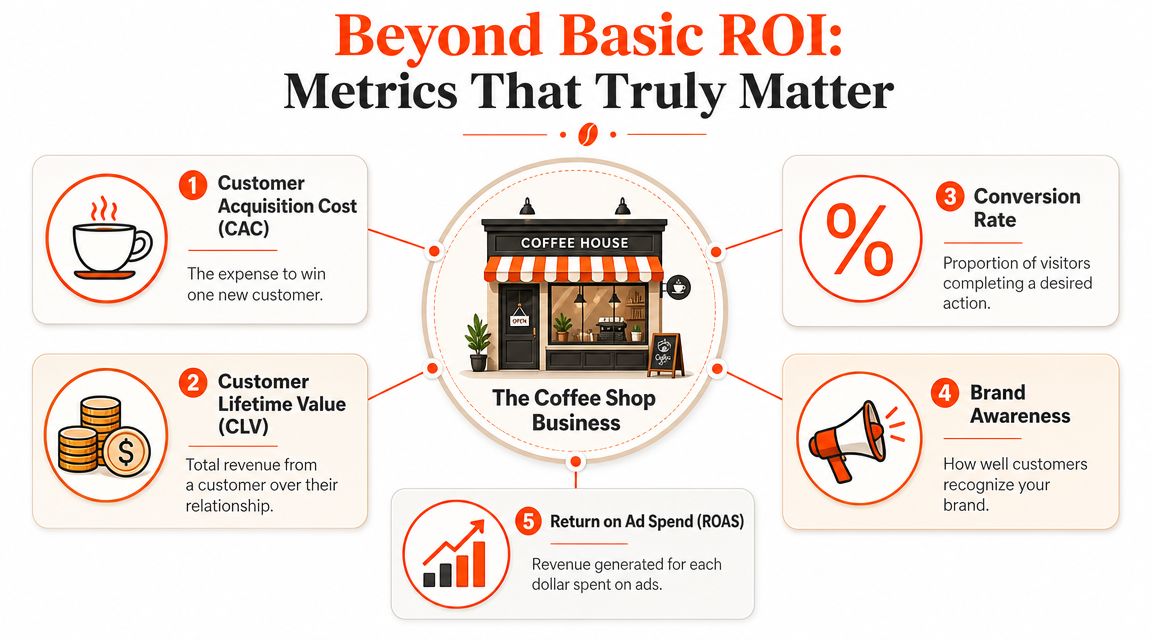
The four metrics that work together
Here's the simplest way to read them as a set:
| Metric | What it tells you | Common mistake |
|---|---|---|
| ROAS | Revenue returned from ad spend | Treating revenue as profit |
| ROI | Whether the investment produced profit | Ignoring time lag and overhead |
| CAC | Cost to win one customer | Looking at lead cost instead of customer cost |
| CLV | Long-term value of the customer | Judging everything on first purchase only |
If your team needs a stronger measurement framework, this guide to digital marketing performance metrics is a useful companion to ROI reporting.
A healthy account rarely has one magic metric. It has a set of numbers that agree with each other.
What busy owners should watch first
If you're not deep in the weeds every day, focus on the relationships between metrics:
- High ROAS but weak profit usually means margin or fulfilment issues.
- Low CAC with weak CLV can mean you're buying cheap, low-quality customers.
- Strong traffic with poor ROI often points to landing page or offer problems.
- Good first-sale economics with repeat purchase potential can justify more aggressive acquisition.
Many agencies and in-house teams often find themselves stuck. They report channel success without connecting it to actual business health. The better approach is simpler. Use ROAS to manage media. Use ROI, CAC, and CLV to decide whether growth is worth scaling.
Digital Marketing ROI Benchmarks for 2026
A benchmark helps at the budgeting stage. It becomes dangerous when it turns into a blanket target for every channel, product line, and sales model.
For 2026, the broad reference point many teams still use is the familiar range outlined in this ROI benchmark reference for 2026. It places 3:1 to 5:1 in the healthy zone, treats 2:1 as a rough minimum for profitability, and views 10:1 as exceptional. That gives you a starting line. It does not tell you what your account should produce after margin, fulfilment, sales labour, and time-to-close are factored in.
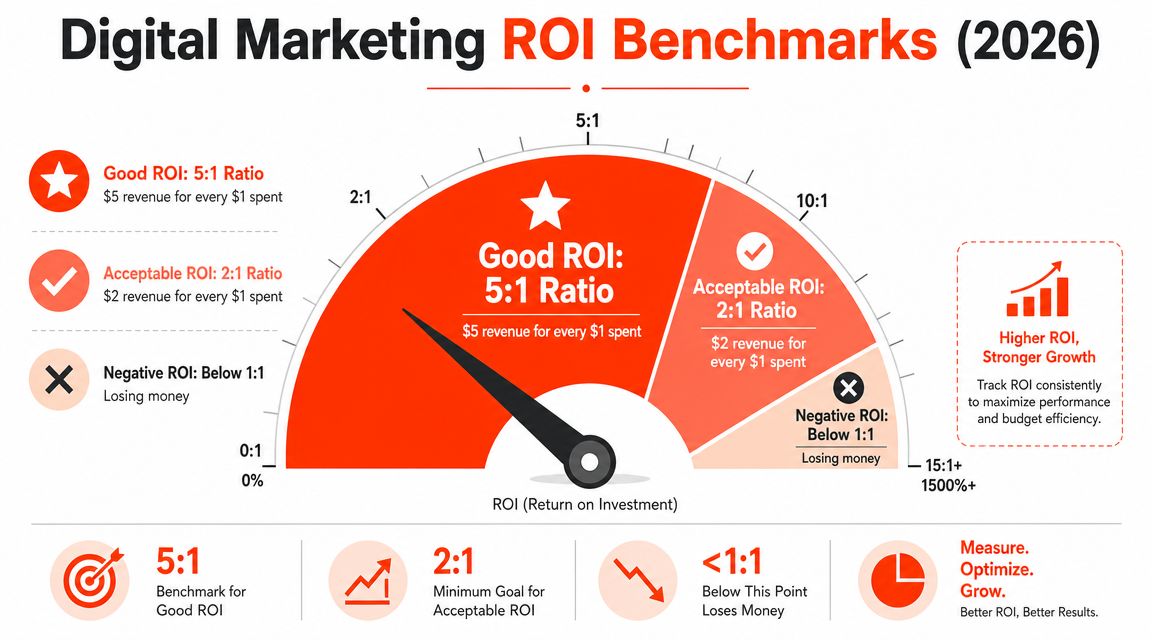
How to read a benchmark without misusing it
A 5:1 ratio can be excellent in one account and too weak in another.
An e-commerce brand with healthy repeat purchase rates may accept lower first-purchase efficiency if paid traffic brings customers back through email, SMS, and remarketing. A B2B firm selling a high-value service may look inefficient in-platform for weeks, then produce strong real ROI once deals close in the CRM. Australian businesses are also dealing with a messier attribution picture as AI-generated search answers reduce some clicks and shift more value to branded search, direct traffic, and assisted conversions.
That is why I treat benchmarks as operating ranges, not scorecards.
| Benchmark range | What it usually suggests |
|---|---|
| Below 2:1 | Margin pressure, weak conversion paths, or poor lead quality |
| Around 3:1 | Viable in some models, but usually needs tighter cost control or stronger backend value |
| Around 5:1 | Often strong enough to scale if fulfilment and overhead stay in line |
| Near 10:1 | Rare at scale. Sometimes a sign budget is too conservative or tracking is missing spend impact |
Channel benchmarks only make sense in context
Google Ads usually gives the fastest feedback because it captures existing intent. That speed makes it useful for testing offers, pricing, and landing pages. It also means inefficiencies show up fast. Broad match waste, weak search term control, and poor form design can drag return down within days, not months.
Paid social often sits earlier in the buying process. It can still drive strong revenue, especially in e-commerce and remarketing, but the click does not carry the same intent as a search for "emergency electrician Sydney" or "buy standing desk Australia." Judging Meta against branded search is how businesses end up cutting a channel that was assisting conversion.
SEO works on a longer clock. Early returns can look poor because the primary investment is content production, technical fixes, and link authority. Once rankings settle, the economics often improve because each additional click is not bought one by one. For many service businesses, SEO also picks up high-intent queries that become more valuable as CPCs rise in paid search.
For channel-level reference points, these Google Ads benchmarks by industry are useful for checking whether media performance is in a reasonable range before you judge total business ROI.
What "good" looks like in 2026
In practice, a good ROI target is becoming more conditional, not less.
Search behaviour is fragmenting. Buyers still use Google, but they also get answers from AI summaries, compare brands across multiple touchpoints, and return later through direct or branded searches that make attribution look cleaner than the original discovery was. For Australian businesses, especially those with longer consideration cycles, that means last-click ROI will often understate the value of SEO content, non-brand PPC, and upper-funnel paid social.
The better question is narrower and more useful. Does the channel produce profitable growth for this business model, at this margin, with this sales cycle, without choking cash flow?
That is the benchmark that matters.
Factors That Redefine Your ROI Target
A 5:1 return can be excellent for one business and disappointing for another. That's not spin. It's just how unit economics work.
The right target changes when your margins are thin, when your sales process needs follow-up, or when customers buy repeatedly after the first sale. This is why experienced operators don't ask for one universal number. They ask what kind of return the business needs to grow without choking cash flow.
Margin changes everything
If you sell a low-margin product, you don't have much room for sloppy acquisition. Broad targeting, weak landing pages, and generic creative can eat profitability fast. In those accounts, “good” ROI often depends on tighter segmentation, stronger remarketing, and ruthless control of wasted spend.
If you sell a high-margin service, you can sometimes tolerate a less aggressive first-touch return because each conversion carries more profit. That gives you room to compete harder in paid channels or invest more in SEO content that compounds later.
Sales cycle changes how you judge success
An e-commerce brand usually sees the transaction quickly. The time from click to revenue is short, which makes return easier to read.
A B2B company doesn't get that luxury. The ad may generate a form fill today, a sales conversation next week, and revenue months later. If you judge the whole campaign on immediate platform-reported ROAS, you'll under-value its full contribution.
Here the key issue isn't just return. It's payback period. How long does it take for the investment to come back as real revenue?
Conversion gains often beat traffic gains
One of the most important ROI truths is that small conversion improvements can outperform traffic growth. Industry guidance cited in this digital marketing ROI analysis notes that a 1% increase in conversion rate can produce about a 10% increase in profit, which is why stronger conversion economics often matter more than buying more visits.
That has a practical consequence. If your traffic is stable but more of that traffic converts, your acquisition economics improve without having to win more clicks.
Businesses often try to solve an efficiency problem with more traffic when the real fix is better conversion.
CLV changes what “good” looks like
The same source also argues that CLV-adjusted ROI is the only way to distinguish short-term efficiency from sustainable growth, and that the strongest Australian benchmarking logic is to treat 5:1 as a baseline target, then validate it against margin, payback period, and attribution quality. It also notes that if CLV is high, a lower initial ROAS may still be optimal in some cases.
That matters most in these scenarios:
- Repeat-purchase retail where the first sale may break even but later orders carry the profit
- Subscription or service models where the relationship matters more than the first invoice
- Lead generation businesses where one customer can produce revenue over a long period
- Higher-consideration purchases where buyers need several touches before deciding
A practical way to set your own target
Use this decision lens:
- Short sales cycle, low margin. Push for tighter efficiency and cleaner attribution.
- Short sales cycle, high repeat purchase. You can be more flexible on first purchase return.
- Long sales cycle, high deal value. Judge campaigns with CRM revenue, not platform metrics alone.
- Mixed-channel growth. Set targets by role, not by forcing every channel to close the sale directly.
Once you look at ROI through margin, sales cycle, and customer value, the benchmark stops being a generic industry number and becomes an operating target you can manage.
How to Accurately Measure and Attribute Campaign ROI
A “good” ROI is meaningless if the measurement is broken. A lot of reporting goes off the rails for this reason. The ads platform says one thing, analytics says another, the CRM says something else, and no one is sure which number belongs in the board report.
Reliable ROI measurement starts with plumbing. Not creative. Not bidding. Not dashboards. Plumbing first.
Build the tracking stack before judging performance
For most businesses, the core stack includes Google Analytics 4, Google Tag Manager, ad platform pixels such as the Meta Pixel, and a CRM that records what happened after the lead came in. E-commerce brands need purchase tracking, revenue mapping, and clean attribution into checkout. B2B companies need to track meaningful form submissions, qualified leads, and eventual sales outcomes.
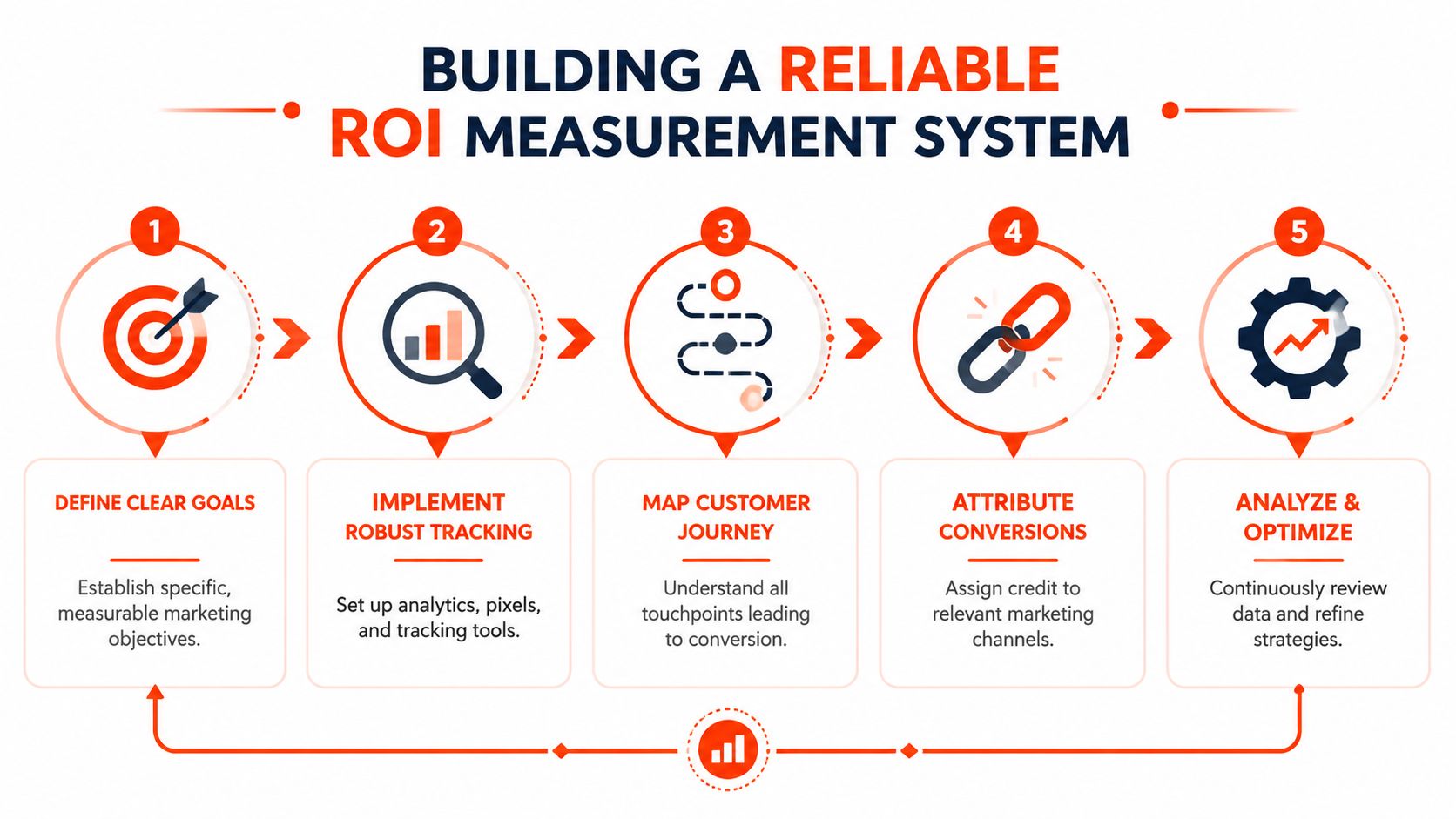
A practical setup usually looks like this:
- Define the conversion properly. A checkout purchase, booked consultation, or qualified lead is not the same thing as a page view or button click.
- Implement tracking through Tag Manager and platform pixels. This keeps measurement more consistent and easier to maintain.
- Validate the data. Test forms, thank-you pages, event firing, and CRM handoff.
- Connect leads to revenue. Especially important for B2B, where the deal closes after the click.
- Review attribution before making budget decisions. Last-click reporting can distort channel value.
If you want a practical overview of how teams structure this, how to measure advertising effectiveness is a useful reference.
Last-click is often too blunt
Last-click attribution gives all the credit to the final touchpoint before conversion. It's simple, but it often punishes awareness, education, and remarketing activity that helped create the sale.
That matters more now because search behaviour is shifting. According to this analysis of digital marketing ROI measurement and AI-driven search, Google's Search Generative Experience-style results and broader AI answer engines are shifting clicks away from traditional blue links. That can make a campaign look worse on last-click ROI while still improving total pipeline. The same source argues that AU advertisers may increasingly need to judge blended ROI across paid search, organic search, and CRM-attributed revenue, rather than rating each channel in isolation.
Some campaigns don't close the sale. They create the conditions that make the sale easier to close later.
What good attribution looks like in the real world
For e-commerce, good attribution means you can trust revenue reporting enough to answer basic questions fast. Which campaigns are driving first purchases? Which ones are supporting repeat purchases? Which traffic sources bring buyers who stick?
For lead generation, good attribution means you can connect four stages cleanly:
| Stage | What to track |
|---|---|
| Marketing response | Form fills, calls, booked meetings |
| Lead quality | Qualified vs unqualified enquiries |
| Sales progression | Pipeline movement inside the CRM |
| Revenue outcome | Closed deals and customer value |
If you're building a lead gen model from scratch, this ROI guide for lead generation is a practical companion because it helps frame the commercial side of measuring lead quality and return.
One option businesses use for this work is Click Click Bang Bang, which handles PPC, AI-first SEO, analytics setup, and conversion tracking as part of campaign delivery. The important point isn't the provider. It's that measurement needs to be owned by someone who can connect media data to actual commercial outcomes.
Actionable Strategies to Dramatically Improve Your ROI
Improving ROI usually doesn't start with adding more budget. It starts with removing waste, tightening conversion paths, and giving each channel a clear job.
That sounds obvious, but many accounts are still built backwards. They scale traffic first, then try to fix economics later. That's expensive. The better sequence is measurement, conversion, targeting, and then scale.

Fix the landing page before buying more clicks
If the campaign is driving relevant traffic but conversions are weak, more spend just multiplies the inefficiency. Tighten the page first.
Focus on the points that usually block action:
- Message match. The ad promise and page headline should feel like the same conversation.
- Offer clarity. Buyers should understand the value quickly without hunting through the page.
- Friction reduction. Simplify forms, remove unnecessary fields, and make mobile completion easy.
- Trust cues. Use proof, guarantees, service details, and clear contact paths.
Here, ROI can move fastest because you improve the output from traffic you already paid for.
Cut waste before chasing scale
A lot of bad ROI comes from leakage, not because the channel itself is bad.
Look for these issues:
- Loose targeting that attracts curiosity instead of buying intent
- Broad keyword coverage without enough query control
- Weak exclusions in search and audience builds
- Creative fatigue in paid social
- Under-segmented remarketing that treats all visitors the same
When teams skip this work, they often blame the platform. Usually the platform isn't the first problem. The setup is.
Operator mindset: Protect budget from low-intent clicks first. Expansion comes after efficiency.
Use remarketing with intent, not just because it's available
Remarketing works best when it's segmented by behaviour. Someone who viewed a pricing page is different from someone who bounced off a blog post. Someone who started checkout is different again.
Good remarketing usually means:
- Different messages for different stages
- Creative that answers objections
- Frequency control so the campaign doesn't become background noise
- A clear destination such as product page, quote form, or booking page
This helps lower effective acquisition cost because you're not paying to restart the entire conversation every time.
A practical video walkthrough on ROI thinking and campaign improvement is worth watching before your next account review:
Balance short-term PPC with long-term SEO
PPC and SEO shouldn't be treated like rival budget lines. In healthy accounts, they do different jobs.
PPC captures demand now, tests offers, and gives fast feedback on commercial intent.
SEO builds durable visibility, reduces dependence on paid clicks over time, and supports branded demand across the funnel.
Businesses usually hurt ROI when they over-rely on one side. All paid means the engine stops when spend stops. All organic can mean waiting too long for traction. The stronger approach is coordinated. Use paid to capture and learn. Use SEO to compound and lower reliance on purchased traffic over time.
Improve the economics, not just the reporting
If you want a tighter working checklist, prioritise actions in this order:
- Repair tracking so decisions come from trustworthy data.
- Improve conversion rate before trying to scale traffic.
- Refine targeting and exclusions to cut obvious waste.
- Segment remarketing around buyer intent.
- Judge performance on blended business outcomes instead of platform vanity metrics.
That last point matters more now than it used to. As search behaviour changes, some of the value won't show up neatly in one channel report. Good operators adapt. They stop asking which single campaign “won” and start asking whether the whole marketing system is generating profitable growth.
If you want help turning ROI from a vague reporting metric into a working growth model, Click Click Bang Bang works across PPC, AI-first SEO, conversion tracking, and reporting so businesses can tie campaign spend back to real commercial outcomes.
Read NeXt
Or Read Our Latest
- How to Set Up Google Ads in Australia: Complete 2026 Guide
- Google Merchant Center Setup: The Complete 2026 Guide
- Business Manager Setup Facebook: The Complete 2026 Guide
- Google Ads Account Setup: Expert Guide for 2026
- Search Ads Optimisation: A Practical Guide for 2026
- Manual vs Automated Bidding for PPC Success
Click. CLick. Subscribe.
Get our best PPC insights, industry updates, and power moves delivered straight to your inbox. No fluff, just high-caliber strategies that actually work.
Don’t Leave Just Yet
Try Us For 30-Days,
Risk Free!!
We guarantee that you’ll love our work within the first 30 days, if not you’ll get your money back.
What have you got to lose?