

Unlocking Growth with SEM in SEO A 2026 Strategy Guide
Last Updated

Let's clear up one of the most common points of confusion in digital marketing: the whole SEM vs. SEO debate. The truth is, it's not a "versus" situation at all. Thinking of them as separate or competing is a mistake many businesses make.
The real key is understanding that Search Engine Optimisation (SEO) is actually a part of Search Engine Marketing (SEM). They’re two sides of the same coin, working together to dominate the search results page.
How SEM and SEO Create a Winning Team

If you're navigating digital marketing, you've probably noticed it's an industry swimming in acronyms. SEM and SEO are two of the biggest, and because they're so often used interchangeably, a lot of people are left scratching their heads. Getting their roles straight is the first step to building a search strategy that actually works.
Search Engine Marketing (SEM) is the big picture. It’s the umbrella term that covers every activity you undertake to get your website seen on search engine results pages (SERPs). This includes both paid ads and organic rankings, which is where the confusion usually starts.
The Two Pillars of SEM
Search Engine Optimisation (SEO) is the first pillar of SEM. It’s all about earning traffic organically—that means without paying Google directly for each click. This involves a long-term strategy of optimising your website’s content, technical structure, and online authority so that Google sees you as the best answer and ranks you highly in its natural search results.
Paid search advertising, most commonly known as Pay-Per-Click (PPC), is the second pillar. This is where you pay to play, placing ads at the very top of the SERPs for specific keywords. It’s the fastest way to get in front of potential customers, delivering immediate and guaranteed visibility. If you want to go deeper on this, our guide on what Search Engine Marketing is is a great next step.
The most successful strategies realise it’s never a question of “SEO vs. PPC.” Instead, it’s about creating a unified approach where the speed and data from paid ads inform the long-term, sustainable growth of organic search.
This is exactly what this guide is all about: showing you how to integrate these two powerhouses into a single, cohesive strategy. When you combine the instant impact of PPC with the lasting authority of SEO, you create a marketing engine that’s far more powerful than the sum of its parts.
A truly integrated approach means your SEM in SEO efforts work in perfect harmony. The insights from your paid campaigns directly fuel the performance of your organic strategy, creating a potent feedback loop that drives sustainable, scalable growth for years to come.
Understanding the Players: SEO and PPC Explained
To build a search strategy that actually drives results, you need to know your two star players: Search Engine Optimisation (SEO) and Pay-Per-Click (PPC) advertising. While they both fall under the umbrella of Search Engine Marketing (SEM), they operate in completely different ways. Getting your head around these differences is the first step to making them work together for your business.
Think of SEO as building the best, most reputable bookshop in town. It’s a long-term project. You invest time and effort into creating a fantastic experience, stocking high-quality content that people trust, and making sure your shop is easy to navigate. Over time, people find you organically because they know you have the best information, earning you a steady stream of visitors without paying for each one.
PPC, on the other hand, is like renting a massive, flashing billboard on the busiest highway leading into town. You pay for that prime real estate, and in return, you get immediate and guaranteed visibility. It’s a direct, fast, and highly targeted way to grab attention right now.
SEO: The Art of Earning Traffic
SEO is the entire practice of optimising your website to rank higher in a search engine’s organic results. This is what we call "earned" traffic—you don't pay Google for every click. The goal is to signal to search engines that your content is the most relevant, authoritative, and helpful answer for what someone is searching for.
This process breaks down into a few core activities:
- On-page SEO: Crafting high-quality content, weaving in relevant keywords, and optimising page titles and meta descriptions.
- Off-page SEO: Building your site's authority through backlinks from other reputable websites, which act like votes of confidence.
- Technical SEO: Ensuring your website is fast, secure, mobile-friendly, and easy for search engines to crawl and understand.
The payoff for solid SEO is huge and it compounds over time. Organic search is often seen as more trustworthy by users, which leads to better engagement. In fact, some studies show organic search can be 5.66 times more effective than paid ads simply because users have more trust in earned rankings. To really dig into the fundamentals, you can explore a great resource like the Small Business Owners Guide to Search Engine Marketing.
PPC: The Science of Buying Traffic
PPC is the paid side of SEM, where you bid to have your ads show up at the top of the search results for specific keywords. The most common platform for this is Google Ads, where you only pay when someone actually clicks on your ad. This gives you an incredible amount of control and speed.
PPC provides immediate feedback and data. You can launch a campaign in the morning and see traffic and conversions by the afternoon, making it perfect for testing new offers, promoting a sale, or generating leads quickly.
If you’re just getting started with paid search, our detailed guide on PPC for beginners will get you up to speed fast. This speed and precision also let you target users based on their demographics, location, and even what they’ve done online in the past.
SEO vs PPC: A Head-to-Head Comparison
To make the distinctions even clearer, let's put these two channels side-by-side and look at how they stack up across the factors that matter most to a business.
| Factor | SEO (Organic Search) | PPC (Paid Search) |
|---|---|---|
| Speed | Slow and steady; results can take months to build. | Immediate; traffic can start within hours of launch. |
| Cost | No direct cost per click, but requires investment in time, content, and expertise. | You pay for every single click, and costs can add up quickly. |
| Longevity | Results are long-lasting and can grow and compound over time. | Traffic stops the moment you stop paying for your ads. |
| Targeting | Broad targeting based on search queries and content relevance. | Highly specific targeting by keywords, demographics, location, and more. |
| ROI | Generally higher over the long term due to its compounding nature. | Easier to measure in the short term, but can be lower than SEO over time. |
Understanding these two players is the first crucial step. The real power, though, doesn’t come from choosing one over the other. It comes from making them work together in a smart, unified search strategy.
When to Focus on SEO vs When to Use PPC
Figuring out where to put your marketing dollars—into the long-term grind of SEO or the instant gratification of PPC—is a classic fork in the road for any business. It’s not about picking one and sticking with it forever. The smartest search marketers know it’s about choosing the right tool for the job at hand.
Think of it this way: SEO is like pouring the concrete foundation and building the frame for your dream home. It’s slow, messy work that nobody sees at first, but it’s what gives your property lasting, unshakeable value. PPC, on the other hand, is like getting a fully assembled, prefabricated module dropped onto the block. You have a structure, with lights on and doors open, overnight.
This simple flowchart nails the core decision. If you need results now, PPC is your answer.
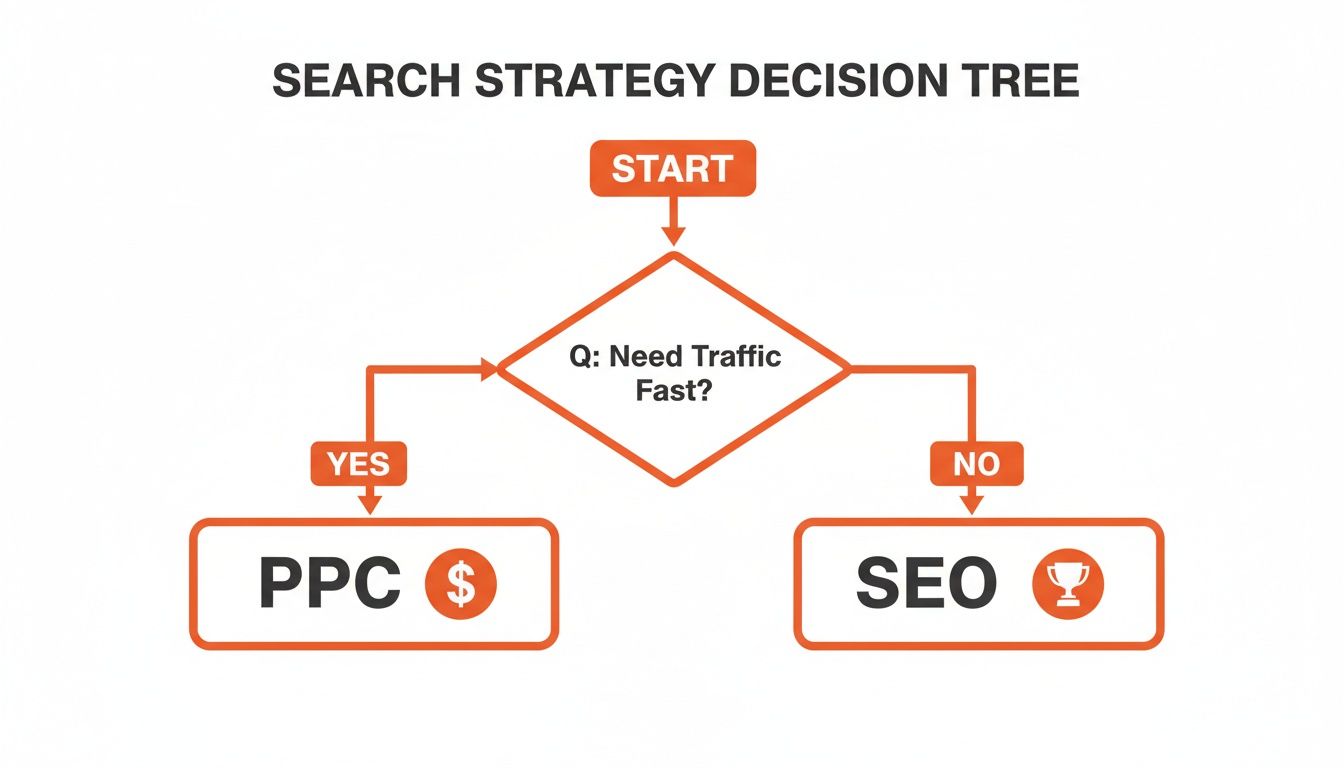
If you're in it for the long haul and want to build a sustainable digital asset, then SEO is where your focus should be. Let's break down when to lean into each one.
When to Prioritise SEO
SEO is your long game. It’s the strategy for building a powerhouse brand that generates organic traffic and leads month after month, without you having to pay for every single click. You’ll want to double down on SEO when:
- You need to build brand authority and trust. Becoming the go-to expert in your field doesn’t happen through ads. Ranking on page one for meaty, informational keywords shows Google—and your customers—that you know your stuff. That’s credibility you simply can’t buy.
- You’re targeting people at the top of the funnel. When someone is just starting their research, they’re craving information, not a sales pitch. Creating genuinely helpful blog posts and guides that answer their questions is how you get on their radar long before they’re ready to pull out their credit card. We explore this in our guide on the process of consumer decision making.
- You have a limited long-term budget. SEO demands investment upfront, but the payoff is incredible. Once you secure those top rankings, your cost per acquisition plummets, delivering a far higher ROI over time than the constant cash injection that PPC requires to stay visible.
When to Unleash PPC
PPC is all about speed, surgical precision, and total control. It's the right move when you need to make things happen immediately and get hard data back fast.
PPC is your launch button. It gets eyeballs on a new product instantly, drives leads for a flash sale, and tells you in real-time which messages are hitting the mark with your audience.
Here’s when you should hit the "go" button on a paid search campaign:
- You're launching a new product or running a promotion. Got a new offer or a limited-time sale you need to shout about? PPC puts you right in front of eager buyers from the moment you flip the switch. You can go from zero to a flood of traffic in just a few hours.
- You're targeting bottom-of-funnel buyers. When someone types "buy [your product name] online" into Google, they're not messing around. PPC lets you own those high-intent keywords, capturing customers at the exact moment they’ve decided to make a purchase.
- You need to test the market or gather data quickly. Not sure which headline grabs more attention or which feature people care about most? Run a few PPC ad variations. You'll get real-world data on what works, which you can then feed back into all your marketing efforts, including your long-term SEO strategy.
Creating Synergy: How SEO and PPC Boost Each Other
Thinking of SEO and PPC as separate channels is a massive missed opportunity. The real magic happens when you treat them as two halves of a single, integrated search strategy. When you build a feedback loop between your paid and organic efforts, you create a powerful system where each channel makes the other stronger, more efficient, and ultimately more profitable.
This isn’t just about showing up in two places at once. It’s about forging a strategic partnership where the instant, data-rich nature of PPC fuels the slow, compounding growth of SEO. This synergy is the very foundation of a modern sem in seo strategy.
Use PPC Data as a Crystal Ball for SEO
PPC campaigns are essentially a real-time laboratory for your marketing. Because you get immediate traffic and data, you can quickly find out which keywords, headlines, and ad copy truly resonate with your audience and drive conversions. This information is pure gold for your SEO strategy.
Imagine pouring months of effort into ranking for a keyword, only to find out it drives traffic that never converts. PPC helps you sidestep that expensive guesswork entirely.
-
Pinpoint High-Converting Keywords: Your Google Ads account will show you exactly which search terms are bringing in sales or leads. You can then confidently prioritise these proven, money-making keywords in your SEO content plan, knowing your efforts will deliver a return.
-
Test-Drive Titles and Descriptions: Not sure which headline will earn the most clicks for your next blog post? Run a few ad variations in a PPC campaign. The ad copy with the highest click-through rate (CTR) is an excellent candidate for your page’s SEO title tag and meta description.
This approach lets you de-risk your long-term SEO investment by validating your strategy with real-world paid data first. It’s like having a crystal ball that tells you where to focus your organic efforts for maximum impact.
Improve Ad Performance with Strong SEO
The synergy flows both ways. A strong organic presence doesn't just bring in "free" traffic; it can actively make your paid campaigns cheaper and more effective. Google’s goal is to give users the best possible experience, and that extends to the ads it shows.
A key factor in your Google Ads performance is your Quality Score. Think of it as Google’s rating of the quality and relevance of your keywords, ads, and landing pages. A higher Quality Score signals to Google that you’re a great answer for the user's query, which can lead to:
- Lower cost-per-click (CPC)
- Better ad positions
A website with solid SEO—fast page speed, intuitive navigation, and relevant, high-quality content—naturally delivers a better landing page experience. This directly boosts your Quality Score, meaning your strong SEO foundation actually helps you pay less for your ads.
This integration is more critical than ever in the current search environment. Recent data from 2026 reveals that Australian businesses clinging to outdated 2022 SEO tactics are seeing organic traffic plummet by 20-40%. In contrast, those adapting to new AI-driven strategies are staying competitive, especially as 69% of all Google queries in Australia now result in no click at all. To get up to speed, you can explore the insights on the 2026 SEO essentials in Australia.
Dominate the SERP for Maximum Trust and Clicks
Appearing in both the paid and organic sections of the search results for the same keyword is a powerful display of authority. This tactic, often called SERP domination, significantly boosts brand credibility and your overall click-through rates.
When users see your brand listed multiple times on page one, it creates an impression of market leadership and trustworthiness. They are far more likely to click on one of your listings—paid or organic—because your brand appears to be the most relevant and authoritative option.
This dual presence acts as a powerful brand signal. Studies have shown that when a brand appears in both paid and organic results, the total number of clicks it receives is significantly higher than the sum of the clicks it would get from each listing on its own.
Essentially, you occupy more digital real estate, pushing competitors further down the page and stacking the odds that a user will click on your link. This unified approach transforms your sem in seo efforts from two separate tactics into one dominant search marketing engine.
Seeing It in Action: Integrated Search Strategies
Theory is great, but the real lightbulb moment comes when you see an integrated sem in seo strategy play out in the wild. Let's move beyond the concepts and dig into how real businesses combine paid and organic search to hit their targets.
We’ll look at two classic business models: an e-commerce brand chasing direct sales and a B2B company hunting for high-value leads. Each scenario shows how blending these tactics solves different problems at different points in the customer journey.
E-commerce Driving Holiday Sales
Picture an Australian online store that sells artisanal homewares. The holiday rush is just around the corner, and they have two big goals: get immediate sales for a new product line and attract early-bird shoppers who are just starting to research gift ideas. Running separate SEO and PPC campaigns would be a massive missed opportunity.
So, they build an integrated plan.
The PPC Play (For Immediate Impact):
- Tactic: They launch laser-focused Google Shopping ads and Meta campaigns (on Facebook and Instagram). The ads show off their beautiful new ceramic dinner sets and linen tablecloths with eye-catching photos and clear pricing.
- Keywords: They bid on high-intent, bottom-of-funnel keywords like "buy ceramic dinner set Australia," "handmade tablecloth online," and "luxury homewares sale."
- Goal: This is all about direct response. They want to capture shoppers who are ready to buy right now. Success is measured in cold, hard cash: immediate revenue and Return On Ad Spend (ROAS).
The SEO Play (For Long-Term Value):
- Tactic: At the same time, their content team rolls out a series of SEO-optimised blog posts. Think comprehensive gift guides like "Top 10 Christmas Gift Ideas for Home Cooks" or "Sustainable and Chic Gifts for Interior Lovers."
- Keywords: Here, they target broader, top-of-funnel informational keywords such as "unique christmas gift ideas" and "eco friendly presents Australia."
- Goal: The aim is to build brand awareness and pull in organic traffic from people who are still in the research phase. It establishes the brand as a helpful expert, guiding those researchers toward their product pages over time.
This two-pronged attack makes sure they're connecting with customers at every stage. PPC brings in the immediate holiday sales, while SEO builds a sustainable pipeline of traffic that will pay dividends long after the tinsel comes down.
B2B Generating High-Value Leads
Now, let's switch gears to a B2B software company selling a project management tool. Their main objective isn't a quick online sale; it’s generating qualified leads from decision-makers—think C-level execs and department heads. Relying on cold calls or generic email blasts just won't cut it.
An integrated search strategy allows B2B firms to attract problem-aware prospects with organic content while precisely targeting decision-makers with paid ads for high-value offers like webinars or demos.
The PPC Play (For Surgical Targeting):
- Tactic: They set up a highly targeted LinkedIn Ads campaign. The ad promotes a free webinar with a compelling title: "How to Boost Team Productivity by 30% in 90 Days." Critically, the campaign is set to only target users with job titles like "Chief Technology Officer," "Head of Operations," and "Project Director" within their key industries.
- Goal: The focus is razor-sharp: generate high-quality leads (webinar sign-ups) from a very specific, high-value audience.
The SEO Play (For Problem-Aware Attraction):
- Tactic: Their blog is packed with in-depth articles engineered to rank for the exact problems their target audience is trying to solve.
- Keywords: They work to rank organically for terms like "how to improve team productivity," "best tools for remote collaboration," and "project management software comparison."
- Goal: This content acts like a magnet for managers and executives who are actively looking for solutions. It positions the company as a thought leader and nurtures prospects through the sales funnel by offering genuine, expert advice.
By combining the broad net of SEO with the surgical strike of PPC, they create a powerful lead generation system that works for them 24/7.
Measuring the Success of Your Unified Campaign
A brilliant strategy is only as good as its measurement. To truly understand the impact of your integrated sem in seo efforts, you need to look beyond surface-level metrics like clicks and impressions. These numbers might look good on a report, but they don’t tell you if your search presence is actually growing the business.
Instead, a unified campaign demands unified measurement. This means tracking key performance indicators (KPIs) that connect directly to business outcomes and show how your paid and organic channels are working together to drive real, tangible results.
Key Metrics for a Unified Search Strategy
To get a complete view of your performance, you need to focus on metrics that blend insights from both SEO and PPC. This approach paints a full picture of your performance on the search engine results page (SERP), helping you make smarter, data-driven decisions about where to invest your time and money.
Here are the essential KPIs you should be tracking:
-
Total Search-Driven Revenue: This is the ultimate metric. You need to combine the revenue generated from both your organic and paid search traffic to understand the total financial impact of your entire search marketing engine.
-
Blended Customer Acquisition Cost (CAC): Stop calculating CAC for SEO and PPC separately. Instead, blend them. Divide your total search marketing spend (including ad spend and any SEO costs) by the total number of new customers acquired from both channels. This gives you a true cost per customer from your overall search efforts.
-
Overall Share of Voice (SOV): How much of the SERP real estate do you actually own for your most important keywords? Track how often your brand appears in both paid and organic results compared to your competitors. A dominant SOV is a strong indicator of market leadership.
Moving Beyond Last-Click Attribution
One of the biggest mistakes marketers make when measuring a unified campaign is blindly relying on the default last-click attribution model in their analytics. This model gives 100% of the credit for a conversion to the very last touchpoint a user had before converting.
Last-click attribution is like giving all the credit for a championship win to the person who scored the final goal, ignoring the assists, defensive plays, and coaching that made the victory possible. It completely overlooks the complex journey a customer takes.
Imagine a user first discovers your brand through an SEO-optimised blog post. A week later, they see one of your retargeting ads on social media. Finally, they click a branded PPC ad and make a purchase. With last-click attribution, PPC gets all the glory, and your valuable SEO content is completely ignored.
To fix this, it's time to explore other attribution models in Google Analytics that better reflect the customer journey:
- Linear Model: This model distributes credit evenly across all the touchpoints in the journey.
- Time-Decay Model: This gives more credit to touchpoints that happened closer to the conversion.
- Data-Driven Model: This is the smartest of the bunch. It uses machine learning to assign credit based on how each touchpoint actually influenced the conversion.
By adopting a more sophisticated attribution model, you can accurately see how your SEO and PPC efforts influence each other. This allows you to prove the true value of your integrated approach and justify continued investment in both channels.
Your Questions on SEM in SEO Answered
Even with a solid game plan, you're bound to have questions when you start blending your paid and organic search efforts. As you begin to merge these two powerful channels, practical concerns about budgets, timelines, and how one really affects the other will crop up.
Let's cut through the noise. This section gives you straight answers to those common questions, so you can move forward with confidence and build a unified search strategy that actually works.
Can I Just Do SEO and Ignore PPC?
You absolutely can. For plenty of businesses, focusing solely on SEO is the right move—it's the foundation for sustainable, long-term growth. Think of it as building a valuable asset that pays you back over time.
But here’s the catch: ignoring PPC means you’re knowingly leaving a ton of opportunity on the table. You're giving up on immediate traffic, rapid market insights, and high-intent customers who are ready to buy right now. Your competitors will be more than happy to scoop them up.
A combined approach is almost always the smarter play. PPC gets you instant visibility when you're launching a new business or product, and the data it spits out—like which keywords convert best—is pure gold for fast-tracking your SEO strategy. It’s the difference between navigating with a paper map versus a map with a real-time GPS.
How Long Until I See Results?
This is where an integrated strategy really proves its worth. With your PPC campaigns, the results can be almost instant. It’s not unusual to see traffic and leads start rolling in within hours of launching a well-built campaign.
SEO, on the other hand, is a marathon, not a sprint. You can typically expect to see some positive movement in the search rankings within 3-6 months. But to get the kind of significant, business-changing results you're really after, you're usually looking at a 6-12 month timeline of consistent, focused effort.
An integrated strategy gives you the best of both worlds. You get the instant wins and short-term buzz from PPC to keep the business moving, all while your long-term, compounding SEO value builds a rock-solid foundation in the background.
Which Should I Budget More For: SEO or PPC?
There's no magic formula here. Your budget split shouldn't be set in stone; it needs to be fluid and tied directly to where your business is at and what you’re trying to achieve right now.
- New Businesses: If you’re just starting out or launching a new product, you might put 60-70% of your search budget into PPC. This front-loads your efforts to get quick traction, build brand awareness, and gather that crucial data you need to refine your long-term SEO game plan.
- Established Brands: A well-known brand with strong organic rankings might flip that ratio. They'll likely invest more heavily in SEO to defend and grow their organic territory, using PPC surgically for specific promotions, breaking into new markets, or targeting competitor keywords.
The key is to stay flexible. Let your performance data be your guide. Be ready to shift funds to whichever channel is delivering the best return at any given time.
Do Google Ads Directly Improve My SEO Rankings?
Let's be crystal clear: no, running Google Ads does not directly boost your organic rankings. Google has stated many times that there is no direct ranking signal from your ad spend.
However, the indirect benefits are undeniable—and powerful. A strong PPC campaign drives brand awareness, which leads to more people searching for your brand name directly. That’s a very positive signal for SEO.
More importantly, the data you get from your ad campaigns is a roadmap for your organic strategy. You’ll see which keywords perform best and what ad copy resonates most with customers. You can then use those insights to optimise your organic content, leading to faster and far more effective SEO growth.
Ready to create a powerful feedback loop between your paid and organic search efforts? Click Click Bang Bang specialises in building integrated PPC and SEO strategies that drive measurable growth. Our data-first approach ensures every dollar you spend is working to deliver a powerful return. Start your journey with us today!
Read NeXt
Or Read Our Latest
- Manual vs Automated Bidding for PPC Success
- Conversion Tracking Setup: A Complete AU Guide
- Instagram Advertising Australia: Complete 2026 Guide
- Pay Per Click: A Beginner’s Guide for Australian Marketers
- Display Advertising on Google: The Complete Australian Guide
- Stakeholder Communication Plan How to Build One That Works
Click. CLick. Subscribe.
Get our best PPC insights, industry updates, and power moves delivered straight to your inbox. No fluff, just high-caliber strategies that actually work.
Don’t Leave Just Yet
Try Us For 30-Days,
Risk Free!!
We guarantee that you’ll love our work within the first 30 days, if not you’ll get your money back.
What have you got to lose?