

Your Ultimate Guide to PPC Ads Management in Australia
Last Updated

PPC ads management is the hands-on, strategic process of running a company's pay-per-click advertising campaigns. It's much more than just "buying clicks." It involves constant keyword research, audience targeting, bid management, and data analysis to get the best possible return on your investment and hit your business goals.
What PPC Ads Management Really Means for Your Business

Let's cut through the jargon. Think of running PPC ads without management like shouting your sales pitch into a crowded stadium and hoping the right person hears you. It’s loud, expensive, and mostly ineffective.
In contrast, professional PPC ads management is like having a skilled negotiator who finds the exact people looking for what you sell, gets their attention, and delivers a tailored message right when they’re ready to buy.
This isn't about setting up a campaign and walking away. It’s a dynamic, hands-on system designed to turn your advertising budget from a simple expense into a powerful and predictable revenue engine. By handling every detail—from the keywords you target to how well your landing page converts—a managed approach ensures your money works smarter, not just harder.
The Real Cost of Neglecting Management
The digital advertising space in Australia is both lucrative and fiercely competitive. Australia's digital ad market, driven heavily by channels like Google Ads and Meta platforms, skyrocketed to AUD $16.4 billion in 2024, marking an impressive 11.1% year-over-year growth.
But here’s the kicker: many businesses still squander up to 61% of their ad budgets on poorly chosen keywords and irrelevant clicks. That’s a huge hole in the bucket, and it highlights just how critical expert PPC management is. You can learn more about Australia's paid advertising landscape and see how your own strategy stacks up.
Without active oversight, businesses often fall into common traps that drain their resources. These pitfalls include:
- Wasted Ad Spend: Paying for clicks from irrelevant search terms or unqualified audiences who were never going to convert anyway.
- Missed Opportunities: Failing to adapt to market changes, competitor moves, or new platform features that could have boosted your results.
- Poor Data Interpretation: Making decisions based on vanity metrics like clicks instead of bottom-line results like cost per acquisition (CPA) or return on ad spend (ROAS).
Effective PPC ads management transforms this chaos into a structured, data-driven process. It's the difference between gambling on clicks and investing in calculated growth, ensuring every dollar spent has a clear purpose and a measurable outcome.
When you see it this way, it's clear that professional management isn't just a "nice-to-have." It’s what separates campaigns that merely exist from those that drive significant, sustainable business growth. It ensures your ads are not just seen, but seen by the right people, at the right time, with the right message.
This precision is the key to thriving in today's crowded digital marketplace.
Unmanaged vs Managed PPC: A Quick Comparison
To put it in perspective, let's look at the typical outcomes when you go it alone versus bringing in a professional. The difference is stark.
| Aspect | Unmanaged PPC (DIY Approach) | Managed PPC (Professional Agency) |
|---|---|---|
| Strategy | Often ad-hoc, reactive, and lacking clear goals. "Let's just get some clicks." | Strategic and proactive, built around business objectives like leads, sales, and ROAS. |
| Budget Use | High risk of wasted spend on irrelevant clicks and poor targeting. Budget drains quickly. | Optimised for efficiency. Budgets are actively managed to maximise return on every dollar. |
| Optimisation | Infrequent or based on guesswork. Campaigns are often "set and forget." | Continuous, data-driven optimisation. A/B testing, bid adjustments, and keyword refinement. |
| Results | Inconsistent performance, low conversion rates, and unclear ROI. Frustration is common. | Predictable growth, improved conversion rates, and clear, measurable ROI. |
| Time Investment | A significant time sink for business owners or internal staff who aren't specialists. | Frees up your internal team to focus on core business activities while experts handle the ads. |
As you can see, the DIY approach might seem cheaper upfront, but it often leads to wasted money and missed opportunities. Professional management is an investment in expertise that pays for itself through better performance, higher ROI, and peace of mind.
Choosing the Right Advertising Platform for Your Goals
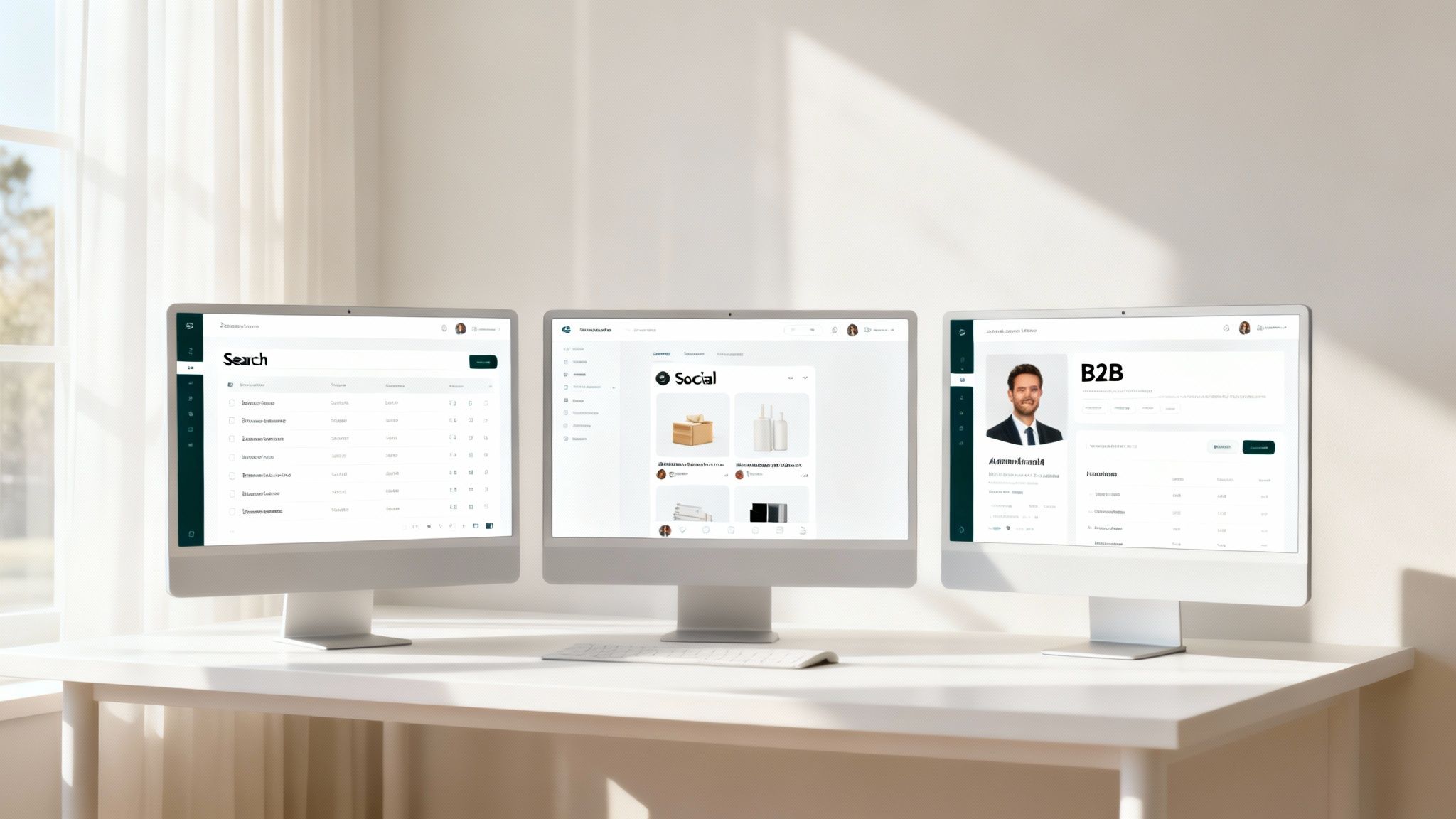
Smart PPC ads management starts long before you write a single headline or set a daily budget. It begins with a fundamental question: where are you going to spend your money? Not all ad platforms are created equal, and picking the right one for your business goals is often the difference between a killer campaign and a costly mistake.
Think of it like fishing. You wouldn't take a deep-sea trawler into a shallow creek, and you wouldn’t use a simple fishing rod in the middle of the ocean. Each tool is built for a specific environment and a specific type of catch. In PPC, your platforms are the tools, and your customers are the catch.
For most Aussie businesses, the choice boils down to three major players: Google, Meta (Facebook and Instagram), and LinkedIn. Each platform serves a completely different purpose, targeting users with unique mindsets and intentions. Getting your head around these differences is the first real step toward building an ad strategy that actually works.
Let's break down where each one shines.
Google Ads: The Intent Catcher
Google Ads is the undisputed king of search intent. It’s where you connect with potential customers at the exact moment they’re actively looking for what you sell. They’re typing things like "emergency plumber Sydney" or "buy women's running shoes online" into the search bar, basically raising their hand and telling the world they have a problem that needs solving. Now.
This makes Google Ads unbelievably powerful for capturing immediate demand. Your ad shows up as the direct answer to their question, putting your business forward as the perfect solution. It’s less about convincing someone they have a problem and more about proving you’re the best one to fix it.
Google Ads is a no-brainer in these situations:
- Urgent Services: A homeowner whose hot water system just died isn't scrolling through social media. They're on Google, searching for a fast, reliable repair service.
- High-Consideration Purchases: Someone researching specific software for their business will use Google to compare features, pricing, and reviews.
- Local Businesses: When someone searches "best coffee near me," Google serves up immediate, location-based results, making it essential for cafes, retail shops, and local tradies.
Google Ads is your digital storefront on the busiest street in the world—Main Street, Internet. People walk in already knowing what they want; your job is to make sure your store is the first one they see.
Meta Ads: The Audience Builder
While Google is fantastic at capturing existing demand, Meta—which covers Facebook and Instagram—is brilliant at creating it. People on these platforms aren't usually searching for products. They're catching up with friends, watching videos, and scrolling through their interests. This is where demographic and psychographic targeting becomes your secret weapon.
Meta’s real power is its deep understanding of its users. It knows their age, location, hobbies, life events, and online behaviour. This lets you build incredibly specific audiences and introduce your brand to people who perfectly match your ideal customer profile but might not even know you exist yet. It’s gold for businesses with visually appealing products or services that thrive on impulse buys.
For a deeper dive into how these platforms stack up, check out our detailed comparison of Facebook Ads vs Google Ads.
Meta is the perfect choice for:
- E-commerce Brands: Show off your products with stunning images and video ads, targeting users based on their shopping habits and interests (like fashion, home decor, or fitness).
- Building Brand Awareness: If you're launching a new product, you can create a huge buzz by reaching a broad but relevant audience, building familiarity long before they think to search for you.
- Event Promotion: Targeting users in a specific city who have shown interest in similar events (like concerts, workshops, or local festivals) is ridiculously effective.
LinkedIn Ads: The B2B Connector
LinkedIn is the professional powerhouse of the PPC world. Think of it as the digital version of a high-stakes industry conference. Here, the focus shifts from personal interests to professional titles, skills, and company details. This makes it an absolutely unparalleled platform for Business-to-Business (B2B) marketing.
The targeting options on LinkedIn are tailor-made for the corporate world. You can get in front of decision-makers using precise criteria that other platforms just can't touch.
LinkedIn is your go-to when you need to connect with professionals based on:
- Job Title: Target CEOs, Marketing Managers, or IT Directors directly.
- Company Size: Focus your ads on startups, mid-sized businesses, or huge enterprise corporations.
- Industry: Reach potential clients in specific sectors like finance, healthcare, or technology.
- Skills and Seniority: Pinpoint individuals with particular expertise or levels of influence within their organisation.
If you sell high-value software, offer corporate consulting, or recruit for specialised roles, LinkedIn is your most direct path to the people who sign the cheques. Choosing the right platform isn't about picking the most popular one; it's about matching the platform's strengths with your unique business goals.
The Step-By-Step PPC Management Process Revealed
Proper PPC ads management isn't a one-and-done task; it’s a living, breathing cycle of strategy, execution, and constant refinement. Think of it like building and racing a high-performance car. You don’t just slap it together and hope for the best. You meticulously design it, build it, test it on the track, pore over the data, and then tune it relentlessly for better performance.
This structured process ensures every dollar of your ad spend is pulling its weight towards a clear goal. It turns campaigns from a shot in the dark into a predictable system for growth. Each phase builds on the last, creating a powerful feedback loop that drives real, sustainable results.
Let’s pull back the curtain and walk through the five critical phases that turn a business goal into a high-performing PPC campaign.
Phase 1: Discovery and Goal Setting
Before we even think about a single keyword, we need to get under the hood of your business. This initial phase is all about deep immersion. We don’t just ask what you sell; we need to understand who your ideal customers are, what problems you solve for them, and what truly sets you apart from the competition.
It all starts with understanding your key business objectives. Are you chasing leads, driving e-commerce sales, or just getting your brand name out there? Knowing the destination is the only way to map the journey.
Key activities in this phase include:
- Stakeholder Interviews: Sitting down with you and your team to really grasp your vision, your sales process, and what a customer is actually worth to you over their lifetime.
- Competitor Analysis: Figuring out who your main rivals are in the paid search arena and dissecting their strategies to find opportunities.
- Audience Persona Development: Creating detailed profiles of your target customers. This isn't fluff—it guides every single message and targeting decision we make.
Phase 2: Strategic Blueprinting
Once we have a crystal-clear understanding of your goals, we move to the blueprinting stage. This is where we translate those business objectives into a tangible PPC strategy. We map out the entire campaign structure, from the audiences we'll target to the creative messaging that will stop them in their tracks.
Think of this as the architectural plan for your campaign. A builder wouldn’t start laying bricks without a detailed blueprint, and we don't launch ads without a clear, data-informed plan of attack.
This strategic plan typically outlines:
- Keyword & Audience Selection: Digging deep to find high-intent keywords and defining laser-focused audience segments on platforms like Meta or LinkedIn.
- Budget Allocation: Recommending how to slice up the budget across different platforms and campaigns to get the biggest bang for your buck.
- Ad Creative & Copy Direction: Crafting compelling ad copy and visual concepts designed to resonate with those target personas we built.
- Landing Page Strategy: Making sure the page people land on after clicking your ad is perfectly optimised to turn them from visitors into customers.
Phase 3: Technical Setup and Tracking
A brilliant strategy is completely useless without flawless execution and, most importantly, accurate measurement. This phase is all about building the technical foundation of your campaign, and the absolute cornerstone is conversion tracking. Without it, we're flying blind.
Conversion tracking is the nervous system of your PPC campaign. It tells you exactly which ads, keywords, and audiences are driving valuable actions like sales, form submissions, or phone calls, allowing for data-driven optimisation.
We make sure every critical action is tracked, giving us the insights needed to measure your true return on investment (ROI). This setup involves placing tracking pixels and configuring analytics tools to capture the entire customer journey, from that very first click to the final sale.
Phase 4: Launch and Initial Monitoring
With the strategy locked in and tracking in place, it’s go-time. The campaigns go live, and our focus immediately pivots to intensive monitoring. Those first few weeks are crucial for gathering initial performance data and setting a baseline.
This is not a "set it and forget it" moment. We’re watching the data like hawks, looking for early trends, quick wins, and any potential red flags that need immediate attention. This period helps us validate our initial strategic hunches and gears us up for the most important phase of all.
Phase 5: Ongoing Optimisation and Reporting
This is where the real magic of PPC management happens. Campaigns aren't static; they're dynamic ecosystems that need constant care and attention to thrive. Ongoing optimisation is a continuous cycle of testing, learning, and refining.
This process involves a huge range of activities, from adjusting bids and pausing underperforming keywords to A/B testing ad copy and funnelling budget to the most profitable campaigns. For anyone looking to get better at this continuous improvement cycle, exploring resources like comprehensive revenue optimization courses can provide deeper insights into squeezing every last drop of value out of your spend.
This iterative approach is what ensures your campaigns adapt to market shifts and consistently improve over time. It’s how we transform good results into great ones and deliver long-term, profitable growth for your business.
How to Measure PPC Success Beyond Just Clicks
It’s easy to get lost in the sea of numbers that PPC platforms throw at you. Clicks, impressions, charts going up and to the right… it can all feel very exciting. But here's the hard truth: clicks don't pay the bills.
Focusing on the wrong metrics is like trying to navigate a ship by watching the waves instead of the compass. True success is measured by what happens after the click. We need to look past the vanity numbers and focus on the key performance indicators (KPIs) that actually move the needle for your business.
Once you know what to look for, you can read performance reports with confidence and have much smarter conversations about what’s really driving growth. The entire PPC management process is a cycle, and measurement is the engine that powers its continuous improvement.
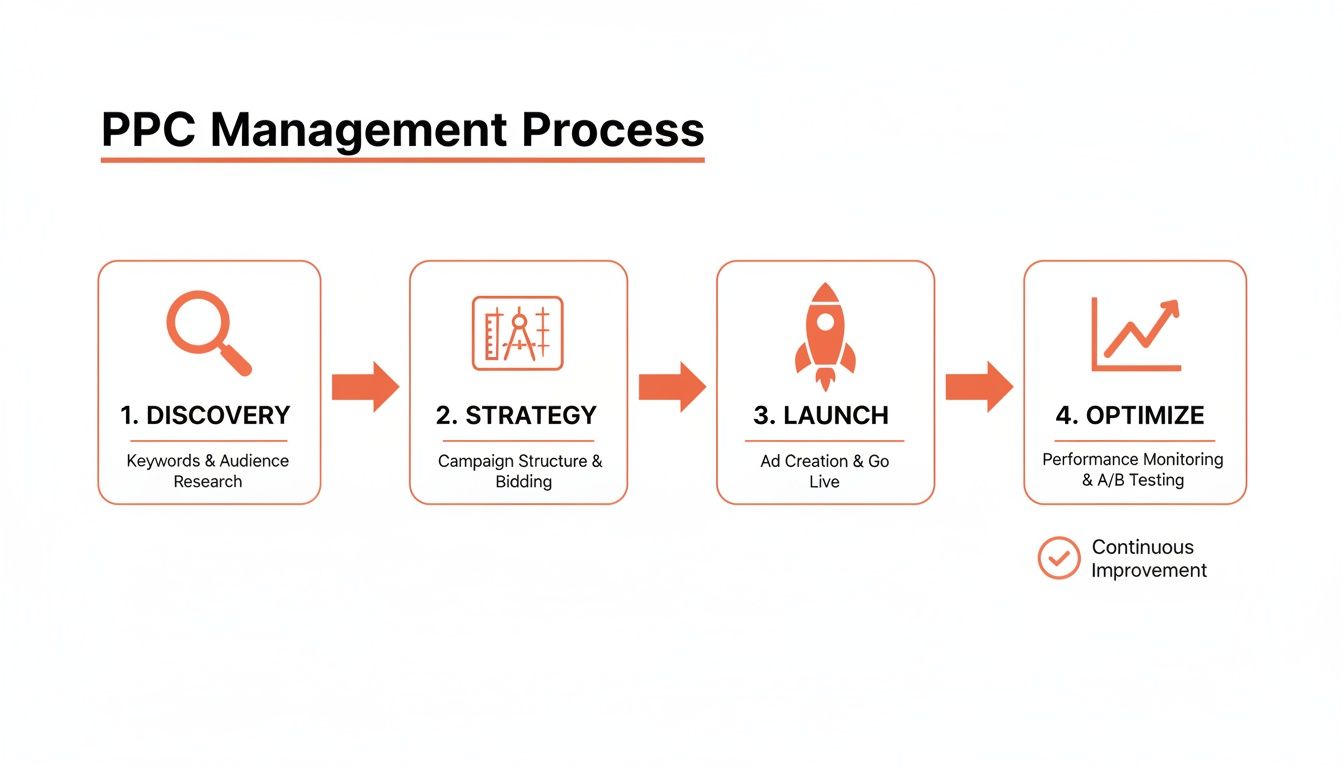
As you can see, launching a campaign is just the beginning. The real work—and the real results—come from measuring performance and optimising based on solid data. Let’s break down the metrics that matter.
Core Campaign Health Metrics
Before we get to the big-picture financial numbers, we have to check the engine room. These core metrics tell us how efficiently your ads are running and whether they’re actually connecting with your target audience. Think of them as the vital signs of your campaigns.
- Click-Through Rate (CTR): This is the percentage of people who see your ad (impressions) and then actually click on it. A high CTR is a fantastic sign that your ad copy and targeting are hitting the mark.
- Cost Per Click (CPC): Simple enough—this is the average amount you pay every time someone clicks your ad. A lower CPC is generally better, but it has to be balanced with quality. A cheap click that never converts is worthless.
- Conversion Rate (CVR): This is where things get interesting. It’s the percentage of clicks that lead to a desired action, like a sale, a form submission, or a phone call. CVR directly measures how good your landing page is at turning traffic into results.
A low CTR often points to weak ad copy. A low Conversion Rate usually means there’s a problem with your landing page or your offer. Monitoring these three metrics together helps you diagnose problems before they get out of hand.
The Bottom-Line Metrics That Actually Matter
While those core stats are crucial for day-to-day tweaks, business owners ultimately care about one thing: return. These next metrics connect your ad spend directly to revenue and profitability. They are the final verdict on your campaign’s success. It's also important to understand how different ad formats contribute, including knowing the status of display ads and their role in the mix.
Cost Per Acquisition (CPA)
Also known as Cost Per Conversion, CPA tells you exactly how much you spend, on average, to get one new customer or lead. If you sell a product for $200 and your CPA is $50, you’re in great shape. But if your CPA is $250, you're losing money on every single sale. It's that simple.
Return On Ad Spend (ROAS)
This is the holy grail for e-commerce businesses. ROAS measures the total revenue you generate for every dollar you spend on ads. A ROAS of 4:1 means you’re making $4 in revenue for every $1 of ad spend. It’s a powerful, crystal-clear indicator of profitability.
Return On Investment (ROI)
ROI takes things a step further than ROAS by factoring in all your costs, not just the ad spend. This includes the cost of your goods, management fees, and other overheads. While ROAS looks at revenue, ROI measures true profit, giving you the most accurate picture of your financial success.
Essential PPC Metrics and What They Mean for Your Business
To put it all together, here's a quick reference table breaking down the most important metrics you should be tracking. Understanding these is the first step toward having a meaningful conversation about your ad performance.
| Metric | What It Measures | Why It Matters |
|---|---|---|
| Click-Through Rate (CTR) | The percentage of ad impressions that result in a click. | Indicates how relevant and compelling your ad is to your audience. A low CTR suggests poor targeting or weak ad copy. |
| Cost Per Click (CPC) | The average price you pay each time someone clicks your ad. | A key indicator of ad auction competitiveness and Quality Score. It directly impacts your overall campaign cost. |
| Conversion Rate (CVR) | The percentage of clicks that result in a desired action (e.g., sale, lead). | Measures the effectiveness of your landing page and offer. It shows how well you turn traffic into business. |
| Cost Per Acquisition (CPA) | The total cost to acquire one new customer or lead through your ads. | Directly measures the cost-effectiveness of your campaigns. Your CPA must be lower than your customer lifetime value to be profitable. |
| Return On Ad Spend (ROAS) | The total revenue generated for every dollar spent on advertising. | The primary measure of profitability for e-commerce or direct-sale campaigns. A high ROAS means your ads are generating strong returns. |
| Return On Investment (ROI) | The total profit generated from your ads after accounting for all costs. | The ultimate measure of financial success, showing the true net profit from your advertising investment. |
By focusing on this mix of metrics, you can get a complete, 360-degree view of your campaign performance—from initial ad engagement right through to the final impact on your bottom line.
For a more detailed breakdown, our guide on how to measure advertising effectiveness dives even deeper into these concepts. Mastering these numbers is what transforms your advertising from a simple expense into a powerful, strategic investment.
Avoiding Common and Costly PPC Management Mistakes
Even the best-funded PPC campaigns can bleed money if they fall victim to a few common, yet devastating, mistakes. Proper PPC ads management isn't just about launching campaigns; it’s about actively steering them away from these costly icebergs that quietly drain your budget click by click.
Think of it this way: launching a PPC campaign without plugging these holes is like trying to fill a bucket with a massive leak. No matter how much water (or money) you pour in, you’ll never see it fill up. By spotting and fixing these issues, you ensure every dollar spent is actually working towards your growth.
The Silent Budget Killer: Neglecting Negative Keywords
One of the most frequent and expensive mistakes we see is the failure to use negative keywords. These are simply terms you tell Google not to show your ads for. Without them, you end up paying for completely irrelevant clicks that have absolutely zero chance of converting.
Imagine you're a high-end interior designer advertising for "luxury kitchen renovations." Without a solid negative keyword list, your ad could easily show up for searches like "free kitchen design software" or "DIY kitchen cabinet repair." A person looking for a free tool is not your ideal customer, yet you’ll pay for their click every single time.
This isn't just a minor oversight; it's a direct and preventable drain on your budget. Proactive PPC management means continuously researching and adding negative keywords. This simple act works like a filter, ensuring your ads are only seen by people with genuine buying intent, which dramatically improves your Return On Ad Spend (ROAS).
The Conversion Killer: Mismatched Ads and Landing Pages
You've written a brilliant ad promising a "50% Off Flash Sale on Running Shoes." A user gets excited, clicks the ad, and lands… on your generic homepage. They can't find the sale, get frustrated, and leave. You just paid for a click that led directly to a bad user experience and a lost sale.
This disconnect between your ad's promise and your landing page's content is a massive, and all-too-common, conversion killer.
A great ad is only half the battle. The landing page must fulfill the ad's promise immediately and seamlessly. If the user has to hunt for the information they were promised, you've already lost them.
Effective management ensures every ad campaign directs traffic to a dedicated, optimised landing page. This page should always feature:
- A consistent message: The headline on the page should match the headline in the ad.
- A clear call-to-action (CTA): The user should know exactly what to do next, whether it's "Buy Now" or "Download a Free Guide."
- Minimal distractions: The page should be focused on a single conversion goal, without confusing navigation or competing offers.
The 'Set It and Forget It' Mindset
Perhaps the most damaging mistake of all is treating PPC like a slow cooker. You can't just set it up, walk away, and expect a perfect result hours later. The digital advertising environment changes daily, with competitor bids, consumer trends, and platform algorithms all in constant flux.
A campaign that was a top performer last week could be losing money hand over fist today. This "set it and forget it" approach is a surefire recipe for wasted spend and missed opportunities. Real PPC ads management is an active, ongoing process of analysis and optimisation. It involves constantly asking questions, testing hypotheses, and making data-driven adjustments to keep the campaign performing at its peak.
How to Choose the Right PPC Management Partner
Choosing a partner to manage your ad budget is a massive decision. Get it right, and you’ve found a true growth partner who acts like an extension of your own team. Get it wrong, and you can burn through a lot of cash with very little to show for it.
Making the right choice isn't just about finding someone who knows the platforms. It’s about finding a partner whose whole approach, values, and definition of success line up perfectly with yours. It all comes down to knowing what to look for and what questions to ask.
Look for Transparent Reporting and Communication
The first absolute non-negotiable is transparency. A top-tier agency will never hide behind confusing jargon or vanity metrics that look good but don't mean anything for your bottom line.
They should give you clear, easy-to-digest reports that connect ad performance directly to your business goals. That means focusing on metrics that actually matter, like Cost Per Acquisition (CPA) and Return on Ad Spend (ROAS).
You should expect:
- A Live Reporting Dashboard: You should have access to real-time data whenever you want it. You should never be left in the dark about how your campaigns are performing.
- Regular, Proactive Updates: This means scheduled calls and simple summaries that explain the "what," the "why," and the "what's next" in plain English.
- Honesty About Results: A good partner celebrates the wins, but they're also upfront about what isn’t working. More importantly, they’ll come to you with a clear plan to fix it.
Vague answers and infrequent updates are massive red flags. Your PPC management partner should make you feel more informed and in control, not less. If you feel like they're gatekeeping your own data, it's time to walk away.
Ask Tough Questions About Their Strategic Process
Every agency will tell you they have a great strategy. You need to dig deeper than the sales pitch and ask them to walk you through their actual process, step-by-step.
This is where you'll find out whether they just use a one-size-fits-all template or if they develop a genuinely customised plan for each client.
Here are some critical questions to ask a potential partner:
- How will you define and measure success specifically for my business goals?
- Can you show me examples of your work with businesses similar to mine? What were the results?
- What is your process for keyword research, audience targeting, and A/B testing?
- What do you do when a campaign is underperforming? Can you walk me through your troubleshooting process?
Their answers will tell you everything you need to know about their expertise and whether they have a data-obsessed approach to optimisation. For more guidance on what to look for, checking out a list of top PPC marketing agencies can give you a solid benchmark for comparison.
Evaluate Their Expertise and Flexibility
Finally, make sure the agency has proven, hands-on expertise on the platforms that matter most to you. An agency that crushes it with Google Search might not be the best fit if your main goal is B2B lead generation on LinkedIn. Look for specific case studies and results that prove their capabilities where it counts.
Flexibility is another key factor. Be wary of agencies that try to lock you into long, restrictive contracts. A confident agency will be happy to earn your business month after month. Look for flexible terms, a clear onboarding process, and a quick turnaround to get campaigns live—these are all signs of an efficient and client-focused operation.
By focusing on transparency, strategic depth, and proven expertise, you can confidently choose a PPC ads management partner who won’t just run your campaigns, but will genuinely help drive your business forward.
Got Questions About PPC Management? We’ve Got Answers.
Stepping into the world of PPC ads can feel like learning a new language, and it’s completely normal to have questions. To cut through the noise, we’ve put together straight-shooting answers to the most common queries we get from Australian business owners.
Let's clear things up so you can move forward with confidence.
How Much Should I Spend On PPC Ads?
There’s no magic number here. Your ideal PPC budget really depends on your industry, how fierce the competition is, and what you’re trying to achieve. For instance, a real estate agent in a hot Sydney market will need a much bigger war chest than a niche local service in a smaller town.
A smart way to start is by figuring out your target Cost Per Acquisition (CPA) – basically, how much you’re willing to spend to land one new customer. From there, you can work backwards. An experienced agency can run a competitive analysis to suggest a starting budget that’s aggressive enough to gather solid data and get those first results rolling in.
How Long Does It Take To See Results From PPC?
You’ll see website traffic almost as soon as you flick the switch on a new campaign. But real, meaningful business results—like a steady stream of leads or sales—typically take one to three months to start showing up consistently.
Think of the first month or so as a data-gathering mission. It's a learning phase where we test, tweak, and let the algorithms figure out what resonates with your audience. True, scalable growth and a healthy return on your investment are built over the long haul through relentless refinement.
Can I Do PPC Management Myself?
You absolutely can, but be prepared for a steep learning curve. The biggest perk of going the DIY route is saving on management fees. The catch? That saving is often wiped out by wasted ad spend from mistakes in keyword strategy, navigating the platforms' endless complexities, or failing to optimise effectively.
Bringing in professional PPC ads management means you’re paying for expertise that almost always leads to a much higher return on your investment over time. It also frees you up to do what you do best: run your business, while specialists make sure every dollar of your ad budget is working as hard as it possibly can.
Ready to turn your ad spend into predictable revenue with expert management? Click Click Bang Bang crafts precision-driven PPC campaigns that deliver results. Get your free proposal today and see how we can help you grow.
Read NeXt
Or Read Our Latest
- Manual vs Automated Bidding for PPC Success
- Conversion Tracking Setup: A Complete AU Guide
- Instagram Advertising Australia: Complete 2026 Guide
- Pay Per Click: A Beginner’s Guide for Australian Marketers
- Display Advertising on Google: The Complete Australian Guide
- Stakeholder Communication Plan How to Build One That Works
Click. CLick. Subscribe.
Get our best PPC insights, industry updates, and power moves delivered straight to your inbox. No fluff, just high-caliber strategies that actually work.
Don’t Leave Just Yet
Try Us For 30-Days,
Risk Free!!
We guarantee that you’ll love our work within the first 30 days, if not you’ll get your money back.
What have you got to lose?