

Broad Match vs Phrase Match: A 2026 PPC Guide
Last Updated

You're probably dealing with one of two problems right now. Your search campaign is spending easily, but too much of that traffic feels loose, noisy, or only half relevant. Or the opposite: the campaign is tidy, query quality looks solid, and volume has stalled.
That's the fundamental broad match vs phrase match decision in 2026. It isn't a vocabulary test. It's a control problem.
For years, advertisers could treat match types as fairly rigid settings. That mental model doesn't hold up anymore. Google's semantic matching, close variants, and AI-led interpretation have blurred the boundary between “tight” and “loose” keyword targeting. You still choose a match type, but what you're really choosing is how much freedom you're giving Google to interpret intent.
The practical question is simple: when should you let the system stretch, and when should you narrow the lane?
The Modern PPC Match Type Dilemma
A lot of accounts sit in an awkward middle ground. Teams want growth, but they also want clean search terms, stable lead quality, and spend they can justify. That's why the broad match versus phrase match debate keeps resurfacing. It isn't academic. It affects daily budget allocation, search term quality, and how much manual intervention the account needs.
Google Ads still draws a clear product distinction between the two. Broad match is the default keyword setting and is built to reach the widest set of searches, while phrase match reaches more searches than exact match but fewer than broad match, and only shows ads on searches that include the meaning of the keyword, according to Google Ads keyword match types documentation.
That distinction matters more in Australian accounts than many advertisers realise. If you're running national coverage, expanding categories, or trying to feed Smart Bidding more conversion opportunities, broad match can open doors quickly. If your budget is tight, your service area is narrow, or your sales team complains about poor-fit leads, phrase match usually gives you the tighter operating range you need.
The actual trade-off
The cleanest way to think about it is this:
- Broad match scales reach: You don't need to build out endless keyword lists to appear on a wider set of relevant and related searches.
- Phrase match protects relevance: You get stronger control over which query patterns are allowed to trigger the ad.
- Both now rely on meaning: The old “just match the words” mindset doesn't explain modern behaviour well enough.
Practical rule: Broad match is a scale lever. Phrase match is a precision lever.
That's the foundational takeaway for AU search advertisers. Your choice changes both traffic volume and the odds that spend stays concentrated on higher-intent searches.
If you've noticed that Google keeps pushing automation, consolidation, and broader targeting, that isn't accidental. It fits the broader shift described in these PPC trends for 2025, where machine learning takes a larger role in how campaigns find demand.
Why advertisers get confused
The confusion comes from the overlap. Broad match can now surface searches you'd once have expected from phrase or exact. Phrase match can also stretch further than many legacy account builds were designed for. So people look at a report, see both match types touching similar traffic, and assume one of them has become pointless.
That's the wrong conclusion.
The smarter conclusion is that match types now work less like hard boundaries and more like different levels of interpretive freedom.
Understanding Broad and Phrase Match in 2026
Phrase match in 2026 is not the phrase match many advertisers learned a few years ago. The old rule was simple. Keep the words in the same order, allow extra words before or after, and expect fairly tight query control. That rule is no longer a reliable way to predict traffic.
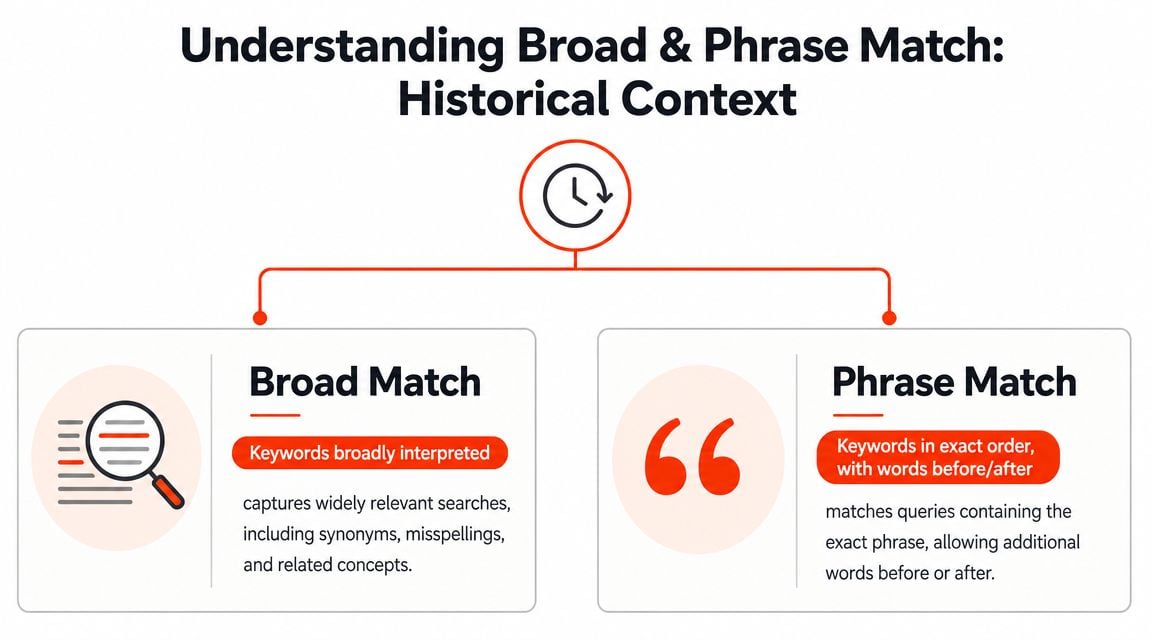
Google now matches more heavily on intent, context, and close meaning. That shift has blurred the practical gap between broad and phrase. The match type still matters, but the old syntax-first definitions do not explain current behaviour well enough.
The old model versus the current one
Under the legacy model, the keyword itself did most of the filtering.
With "office cleaning services" in phrase match, you would usually expect queries such as:
- office cleaning services near me
- affordable office cleaning services
- office cleaning services sydney
You would also expect Google to stay close to that wording.
In 2026, Google evaluates meaning more aggressively. Phrase match still holds a tighter line than broad match, but it no longer works as a strict word-order setting. Broad match gives the system more room to connect your keyword to related intent, adjacent wording, and alternative ways of expressing the same need.
That is the key update many account structures still miss.
What semantic matching changes in practice
The biggest mistake I still see is building campaigns as though each keyword owns a clean, isolated traffic bucket. That assumption breaks fast once close variants, inferred intent, and Smart Bidding start working together.
A broad match keyword such as office cleaning services can reach queries tied to adjacent service language, problem-based searches, or commercial variations you did not add manually. Phrase match on the same keyword usually stays closer to the core intent, but it can still expand beyond the literal phrase.
That changes how control works inside the account. Control now comes less from writing endless keyword lists and more from search term review, negatives, ad relevance, landing page alignment, and conversion data quality.
Two practical shifts follow:
-
Large keyword builds have less defensive value
Adding every close variation by hand does not give the same control it once did. In many accounts, it adds clutter faster than it adds useful precision. -
Intent grouping beats wording grouping
Ad groups built around commercial intent tend to hold up better than ad groups built around tiny wording differences. That is especially true once broad match and phrase match start pulling in overlapping themes.
Broad match gives Google more room to interpret intent. Phrase match gives Google a narrower frame for that interpretation.
A better mental model for 2026
A useful way to evaluate match types now is by how much semantic freedom each one gives the system.
- Broad match: maximum interpretive freedom
- Phrase match: narrower meaning alignment, with less room for drift
- Exact match: the tightest option, though still not purely literal
That framing leads to better decisions than the old word-order explanation. The practical question is not just which query contains your keyword. The better question is how much ambiguity the campaign, budget, and CPA target can absorb before efficiency starts to slip.
Broad Match vs Phrase Match A Direct Comparison
Broad match and phrase match used to be easier to separate. In 2026, the gap is still real, but it shows up less in syntax and more in how much freedom Google gets to interpret intent.
That is the comparison that matters in live accounts.
| Criterion | Broad Match | Phrase Match |
|---|---|---|
| Reach | Widest reach across related searches | Broader than exact, narrower than broad |
| Query control | Lower control over triggering queries | Tighter control over query meaning |
| Relevance alignment | Depends heavily on signals, negatives, and landing page fit | Usually stronger baseline relevance |
| Budget efficiency | Can drift if weak queries are not filtered fast | Easier to contain around proven intent |
| Search term discovery | Strong for finding new themes and adjacent demand | Better for validating and scaling known demand |
| Operational workload | Higher search term review burden | Easier to manage in smaller or tighter accounts |
| Best fit | Scale, exploration, mature conversion data | Precision, limited budgets, narrower intent windows |
Reach and volume
Broad match gives Google more room to connect your keyword to related searches, adjacent commercial language, and intent signals that do not closely mirror the keyword itself. Phrase match still expands beyond the literal phrase, but it usually stays closer to the commercial meaning you had in mind.
For office cleaning services, broad match might pull searches like:
- commercial janitorial prices
- workspace sanitisation company
- business cleaners near me
Phrase match is more likely to concentrate on searches such as:
- office cleaning services melbourne
- office cleaning services for small business
- office cleaning services quote
The practical trade-off is simple. Broad gets more shots on goal. Phrase filters more of the noise before the click happens.
Query control and intent alignment
Phrase match usually gives the cleaner starting point, especially in lead generation accounts where a bad click is expensive long before it becomes a bad lead.
Broad match can still produce excellent traffic. It also tends to mix high-intent queries with weaker adjacent intent inside the same keyword. That overlap matters because keyword-level reports can make broad look stronger than it really is if it is capturing searches that phrase or exact would have won anyway. Search term analysis is the only reliable way to judge that.
A useful rule is to compare match types at the query-cluster level, not the keyword label. Group search terms by intent, then check conversion rate, lead quality, and cost per qualified action inside each cluster.
If broad and phrase both attract the same profitable query theme, the match type is not the deciding factor. The account structure and bidding logic are.
CPC and return quality
Average CPC is rarely the deciding metric here. Return quality is.
Broad match often brings a wider spread of intent. Some queries outperform your core keyword set. Others look relevant enough to earn the click but weak enough to miss your real conversion goal. That middle layer is where broad match wastes budget in under-controlled accounts.
Phrase match usually produces a tighter average because it excludes more ambiguous searches up front. In service businesses, local lead gen, and B2B campaigns, that tighter filter often matters more than raw click cost.
If sales quality varies a lot after the form fill, phrase match usually protects budget better. If tracking reaches deeper into pipeline quality or revenue, broad match has more room to work.
Learning speed with automation
Broad match tends to benefit more from strong automation inputs. That means accurate conversion tracking, enough volume, useful offline conversion imports, and landing pages that match a wider range of commercial intent.
Without those signals, broad match often scales confusion. It can spend into semantic lookalikes that seem plausible to the system but do not produce useful business outcomes.
Phrase match is usually easier to stabilize first. The traffic pool is narrower, the search term patterns are easier to read, and bid strategy decisions get cleaner feedback.
What usually works and what usually fails
Broad match tends to work when
- the account has reliable conversion data, ideally tied to qualified outcomes
- search term reviews happen often enough to cut drift early
- negatives are actively maintained
- landing pages can serve a broader intent cluster without breaking relevance
- the goal is expansion into new demand, not just protecting efficiency
Phrase match tends to work when
- budget is tight and wasted clicks hurt fast
- lead quality matters as much as lead volume
- the business serves a narrow set of customer types or locations
- the account needs a stable control group before broader testing
- reporting is still maturing and query ambiguity would hide problems
The short version is this. Broad match is better for exploration when the account can support it. Phrase match is better for control when precision still drives the economics. In 2026, that choice depends less on keyword wording and more on how much semantic variance your budget, bidding, and conversion data can handle.
Strategic Use Cases When to Use Each Match Type
Two businesses can sell through Google Ads and need completely different match type logic.
The e-commerce retailer that needs scale
An online retailer selling home office furniture often has a wider acceptable intent range. Someone searching for ergonomic desk setup ideas, standing desk options, or office chair alternatives may all be commercially useful. That's where broad match can earn its place.
If the retailer already has reliable purchase tracking, consistent product margins, and a catalogue that covers broad intent clusters, broad match becomes a discovery tool. It helps uncover adjacent demand that the original keyword list didn't explicitly include.
In that environment, phrase match still matters, but usually as the stabiliser. It gives the team a cleaner baseline on proven categories, branded terms, and high-intent non-brand themes. Broad match sits beside it to widen the net.
A practical setup often looks like this:
- Use phrase match on proven product-category terms where intent is already clear.
- Use broad match on expansion themes where buyers may search in more varied language.
- Promote winning search terms from broad into dedicated ad groups or campaigns when they deserve customized ads and landing pages.
The B2B service provider that needs fit
Now take a B2B commercial cleaning company. A lead isn't automatically valuable because a form was submitted. The business may only want office sites in specific suburbs, certain contract sizes, or industries with recurring service needs.
Phrase match usually suits this situation better at the start. It lets the advertiser stay closer to direct service intent and reduce exposure to adjacent but unqualified interest. Searches about jobs, DIY cleaning tips, residential services, or general advice can drain budget quickly if control is weak.
Broad match can still help, but only after the account has tighter guardrails. It's useful when the business wants to explore related commercial language it may not have included in research, such as facility maintenance phrasing, janitorial terminology, or procurement-led query patterns.
Phrase match is often the better opening move when every lead needs to justify sales time.
A simple decision framework
Use broad match when the campaign needs:
- More discovery: You want to find new query patterns and adjacent demand.
- More scale: Existing campaigns are constrained by keyword coverage.
- More algorithmic freedom: Smart Bidding has enough quality data to make good decisions.
Use phrase match when the campaign needs:
- More control: Relevance matters more than maximum reach.
- More predictable spend: You can't afford broad exploration across weak-fit queries.
- More message discipline: The ad and landing page need close alignment to the searcher's wording and intent.
The mistake is forcing one answer across every campaign. Match type choice should follow business model, conversion quality, and budget tolerance.
Bidding and Budgeting Strategies for Each Type
A common 2026 failure pattern looks like this: broad match gets paired with Smart Bidding, spend climbs fast, conversion volume looks healthy, and the sales team still says lead quality slipped. The issue usually is not the match type alone. It is the combination of match type, bidding model, conversion signal quality, and how much budget the account can afford to spend on exploration.
That matters more now because broad and phrase no longer sit as far apart as legacy guides suggest. Google's semantic matching and close variants give both types more interpretive range than they had years ago. The practical difference in bidding is no longer just reach versus control. It is how much freedom you give the system to find adjacent intent, and how expensive mistakes become when your signals are weak.
Broad match needs cleaner inputs and a separate test budget
Broad match can work well with automated bidding, but it is far less forgiving of messy setup. If primary conversions include low-value actions, if offline sales feedback is missing, or if one campaign mixes high-intent and low-intent landing pages, broad match will scale the noise along with the opportunity.
Use bidding based on what the account can teach the system:
- Maximise Conversions fits discovery campaigns where the goal is query expansion and the conversion action reflects genuine business value.
- Target CPA helps contain spend, but only when the CPA target is based on closed-won economics or qualified lead rates, not a target picked to satisfy a dashboard.
- Target ROAS works best where revenue values are reliable and passed back consistently.
Budget broad match like a test, not like core demand capture. Give it its own budget line so exploration does not crowd out proven phrase campaigns. In lead gen, that often means funding broad at a smaller share first, then increasing only after search terms, qualification rates, and downstream conversion data hold up.
Phrase match is usually the steadier budgeting base
Phrase match is still the easier place to set expectations around spend, especially in accounts where every lead has real handling cost. It gives Smart Bidding enough room to match close intent while keeping the traffic pool tighter than broad.
That makes phrase match a strong base for budget planning. Core service terms, high-intent commercial queries, and campaigns tied to strict CPA goals usually belong here first. Phrase also gives cleaner benchmark data. Once those campaigns establish stable conversion rates, CPC ranges, and sales quality, broad match tests become easier to judge.
If query control matters, phrase match also works well alongside negative keyword management in Google Ads. The combination gives enough reach for modern matching without opening the door too wide.
A practical budgeting framework
| Scenario | Match type bias | Budget posture |
|---|---|---|
| New account with limited conversion history | Phrase match | Put most spend into intent capture and keep testing budget small |
| Mature e-commerce account with reliable value tracking | Mix, with selective broad match | Split budget between efficient revenue terms and controlled expansion |
| Lead gen account with inconsistent lead quality | Phrase match first | Protect sales capacity and scale only after qualification data improves |
| Established campaign that has plateaued on query coverage | Broad match test | Assign a separate exploration budget and judge it on downstream performance |
Operator's view: Broad match should earn more budget. Phrase match usually earns trust faster.
Advanced Control with Negative Keywords and Structure
Broad match without negative keywords is not a growth strategy. It's a leak.
That sounds blunt because it needs to be. If you give Google broader interpretive freedom, you also need active exclusions to tell the system where not to go. Phrase match benefits from negatives too, but broad match depends on them far more heavily.
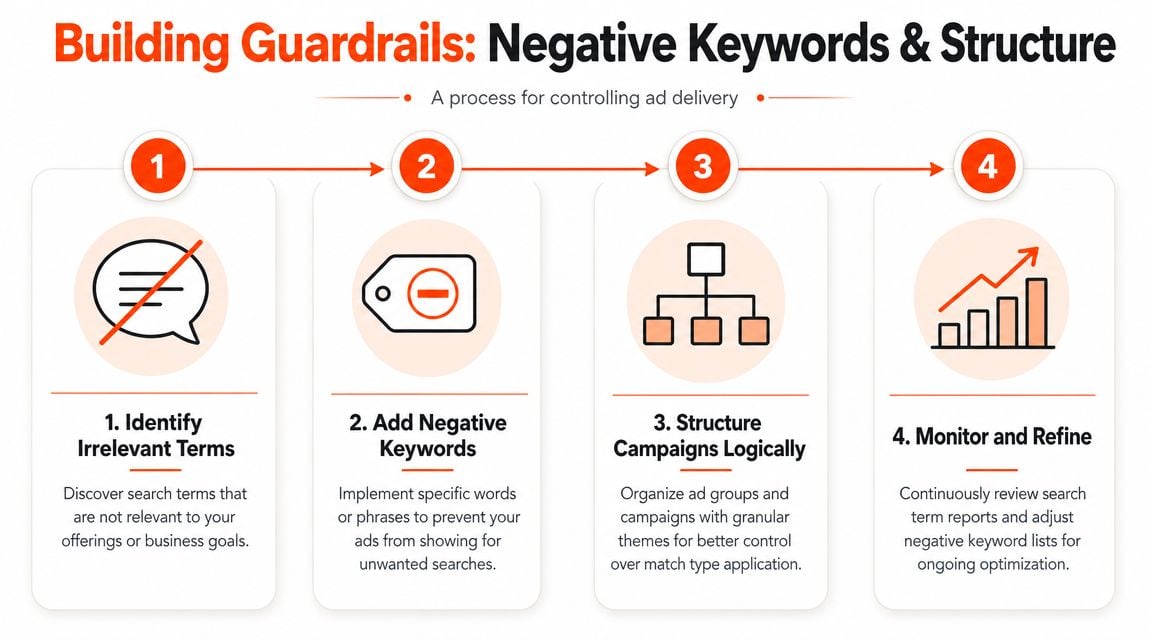
Negative keywords are the guardrails
A disciplined workflow matters more than a giant static negative list.
Use the Search Terms Report to review actual query behaviour. Then add exclusions based on clear patterns:
- Low-intent research terms that attract curiosity but not commercial action
- Wrong audience terms such as jobs, training, free, templates, or definitions where they don't fit
- Wrong service or product categories that sit adjacent to your offer but don't convert
- Geographic mismatches if the campaign should only serve certain areas
If you need a refresher on how different negative match types work, this guide to negative keywords in Google Ads is directly relevant because negative broad, negative phrase, and negative exact all behave differently.
Structure around themes, not match types
A lot of old-school account structures were built around the idea that control came from splitting match types into hyper-segmented ad groups. That logic has aged badly.
Single Keyword Ad Groups can still have niche uses, but they're not a default structure for modern AI-led search. Today, cleaner performance usually comes from theme-based grouping:
- one ad group for a clear commercial intent cluster
- ad copy that reflects that cluster
- landing pages that match the dominant need behind it
- match types used as control settings within the theme, not as the structure itself
Semantic matching already blurs keyword boundaries. As a result, a highly fragmented structure causes noisier reporting and slows down optimisation.
A practical operating rhythm
Run broad match with a weekly search term review habit. Run phrase match with a lighter but still consistent review cadence. In both cases, look for recurring query themes rather than isolated one-offs.
One option for teams that want outside support is Click Click Bang Bang, which works across Google Ads and related PPC channels with campaign setup, tracking, and reporting. That's useful if the challenge isn't just keyword choice, but maintaining the ongoing discipline broad match requires.
Broad match needs freedom inside the lane, not freedom to leave the road.
Your Guide to Testing and Migrating Match Types
Most match type changes fail because advertisers change too much at once. They swap keyword types, shift bids, rewrite ads, and move budget in the same week. Then they can't tell what caused the result.
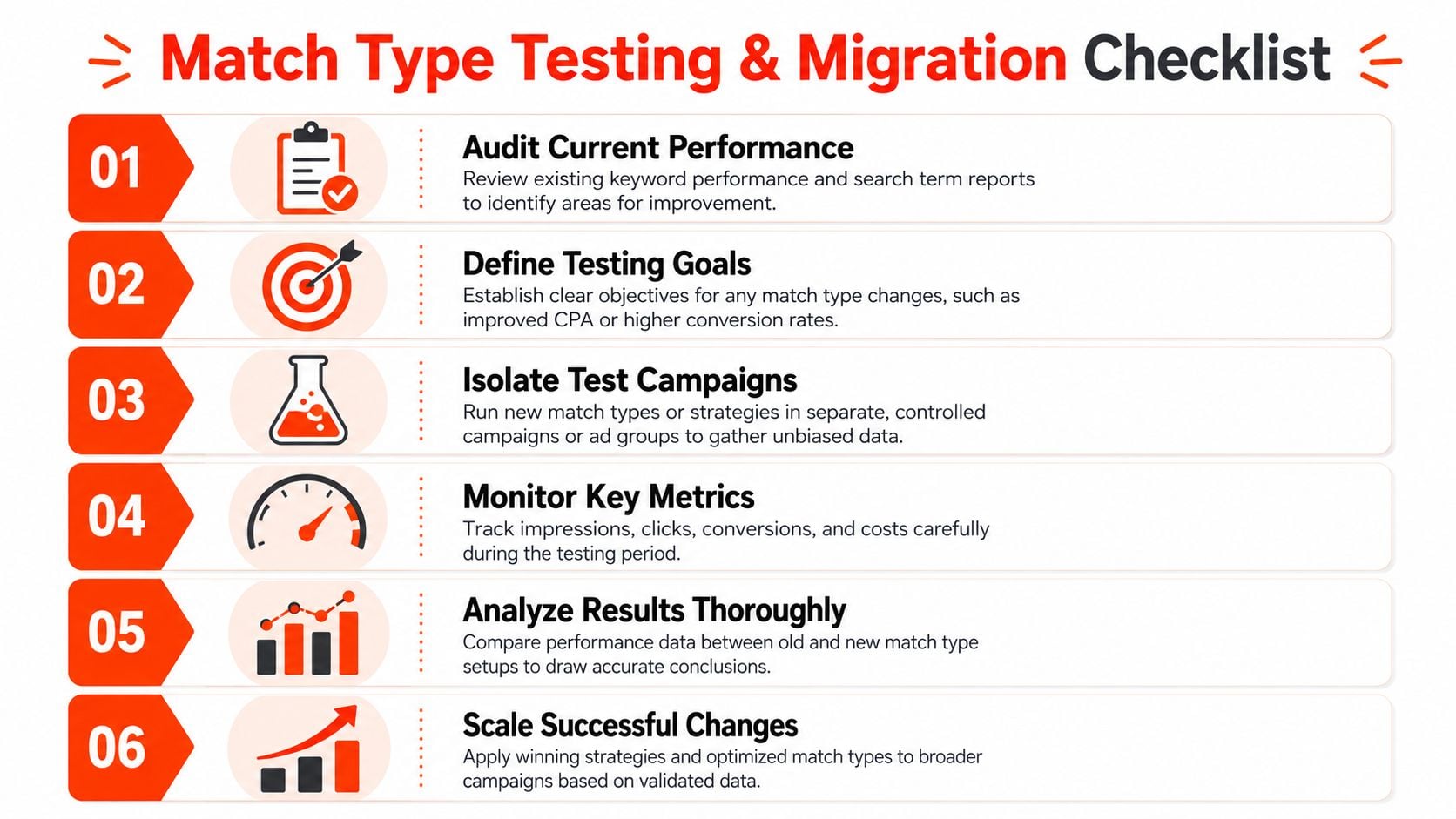
A safe testing checklist
-
Audit the current baseline
Pull search term reports, conversion quality signals, and spend by campaign theme. Know what “good” currently looks like. -
Choose one test goal
Don't test for everything at once. Pick one primary objective such as more qualified volume, broader query discovery, or stronger efficiency. -
Isolate the variable
Use a separate campaign, duplicated ad group, or controlled experiment. Keep ads, landing pages, geography, and conversion actions as stable as possible. -
Review search terms early
Broad match tests can drift quickly if negatives aren't updated. Phrase match migrations still need monitoring because semantic matching can surprise you.
How to migrate budget without shocking performance
If you're moving from phrase match to broad match, don't switch the whole campaign in one pass.
A steadier process works better:
- keep the original phrase campaign live
- launch the broad version in parallel
- assign a defined share of budget to the test
- review query quality before increasing spend
- promote useful discoveries into tighter themes where needed
If you're moving the other direction, from broad to phrase, preserve the search term learnings you've already paid for. Build phrase match around the proven commercial themes broad uncovered, then trim the exploratory budget rather than cutting it blindly.
For teams rebuilding campaign logic during this process, a Google Ads campaign structure template can help standardise the migration and reduce account clutter.
The goal isn't to prove one match type is universally superior. It's to build a repeatable system where broad match explores, phrase match stabilises, and the account keeps learning without wasting budget.
If you want a second set of eyes on your Google Ads structure, search terms, or match type strategy, Click Click Bang Bang offers PPC support across Google Search and other paid channels with a data-led approach to campaign setup, tracking, and optimisation.
Read NeXt
Or Read Our Latest
- Data Privacy Compliance: 2026 Guide for Marketers
- Your 2026 Remarketing Campaign Strategy Blueprint
- Customer Lifetime Value: Calculate & Increase It in 2026
- Contextual Targeting Advertising: A Guide for 2026
- Best Seo Agency Australia Guide 2026
- Cross Domain Tracking: A Practical Guide for GA4 in 2026
Click. CLick. Subscribe.
Get our best PPC insights, industry updates, and power moves delivered straight to your inbox. No fluff, just high-caliber strategies that actually work.
Don’t Leave Just Yet
Try Us For 30-Days,
Risk Free!!
We guarantee that you’ll love our work within the first 30 days, if not you’ll get your money back.
What have you got to lose?