

Contextual Targeting Advertising: A Guide for 2026
Last Updated

Your retargeting audiences are thinning out. Match rates aren't as reliable. Campaigns that used to coast on third-party data now need more manual intervention, tighter exclusions, and better creative just to hold steady.
That's where a lot of advertisers are sitting right now.
The mistake is treating contextual targeting advertising like a fallback. It isn't. Done properly, it's a stronger planning model for a privacy-first market because it targets the environment a buyer is in right now, not a stitched-together record of what they did last week. For Australian e-commerce and B2B teams, that shift matters because it improves compliance, tightens message relevance, and reduces dependence on signals you no longer control.
The Future of Advertising in a Post-Cookie World
A lot of campaign problems that look like platform issues are really signal issues. Audience pools shrink, frequency becomes harder to manage cleanly, and prospecting quality slips because the data underneath the campaign is less stable than it used to be.
That changes how smart media buyers plan.
Contextual targeting advertising places ads based on the content surrounding the impression. Instead of asking, “Who is this user based on past behaviour?”, it asks, “What is this person engaging with right now, and is this a suitable moment for our offer?” That's a better fit for the current environment because it doesn't depend on third-party cookies or personal identifiers to make the targeting decision.
Why this shift is practical, not theoretical
Privacy pressure isn't going away. Buyers are more aware of tracking, regulators are stricter, and the platforms themselves are moving toward environments where identity signals are less portable. If your acquisition model relies too heavily on behavioural profiling, your costs and your reporting confidence can both become less predictable.
Contextual buys solve a different problem. They let you align the ad to the page, the topic, and increasingly the meaning and tone of the content. That makes the placement decision more resilient.
Practical rule: If your current targeting strategy breaks when user-level tracking weakens, it isn't future-proof.
This also pairs well with owned data. First-party data still matters for CRM, customer segmentation, suppression, and retention. But prospecting doesn't have to start with identity. A cleaner model is to use contextual for discovery, then strengthen your owned-data strategy through first-party data activation.
What advertisers gain
The upside isn't just compliance.
You gain more control over where ads appear, how they connect to the surrounding content, and how you shape creative for the moment. For an online retailer, that can mean showing category-specific offers beside high-intent editorial content. For a B2B brand, it can mean appearing inside industry coverage, thought leadership, and solution-focused articles where the buyer is already in research mode.
The advertisers getting better results here aren't using contextual as a blunt topic filter. They're using it as a relevance engine.
Understanding Contextual Targeting vs Behavioral Targeting
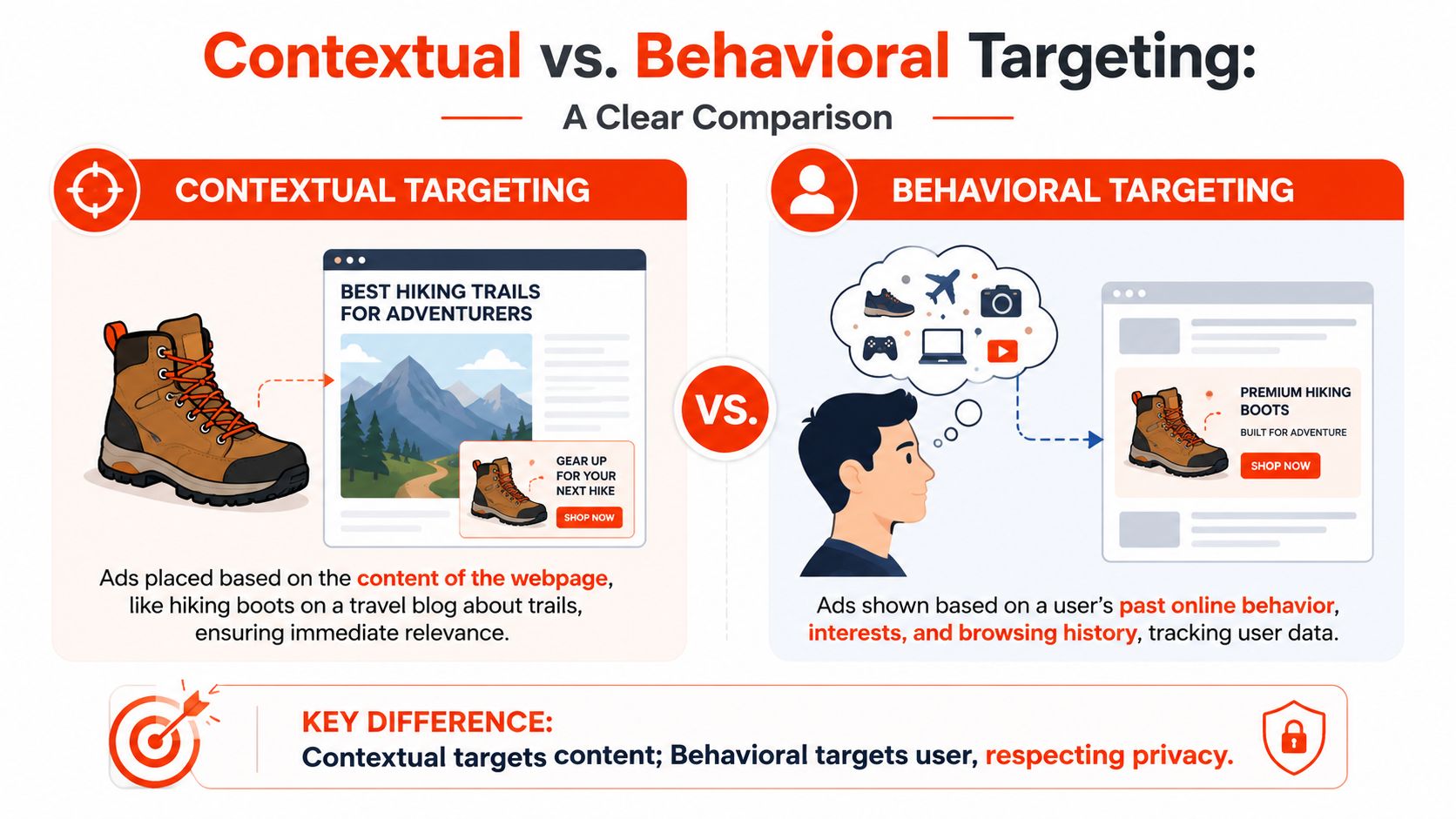
A simple way to think about it is this. If someone is reading an article about trail gear and mountain hikes, a contextual campaign places a hiking boot ad on that page because the content signals immediate relevance. A behavioural campaign follows a person around the web because they previously looked at boots, whether or not the current page has anything to do with that intent.
That difference sounds small until you plan media around it.
Here's the visual version first.
The core distinction
Contextual targeting is content-led. Behavioural targeting is user-led.
One focuses on the page, video, article, or content environment. The other focuses on the person's prior actions, browsing history, or audience membership. In practice, that changes not only privacy exposure, but also how you judge intent.
| Attribute | Contextual Targeting | Behavioral Targeting |
|---|---|---|
| Data source | Real-time page content, topic, sentiment, and surrounding environment | Historical user activity, browsing behaviour, audience data, and past interactions |
| Primary signal | What the person is consuming now | What the person has done before |
| Privacy profile | Lower dependence on cookies and identifiers | Higher dependence on user-level tracking and consent-sensitive data use |
| Intent timing | Captures in-the-moment interest | Uses inferred intent from past actions |
| Brand safety control | Stronger control through content and suitability rules | Can place ads in less suitable environments if the user qualifies |
| Best fit | Privacy-safe prospecting, relevance, premium placement strategy | Retargeting, lifecycle messaging, known-user follow-up |
Where behavioural still has a role
Behavioural targeting isn't useless. It can still work well in remarketing, customer re-engagement, and lower-funnel sequences where you have legitimate first-party signals. The issue is overreliance. Many accounts still use behavioural audience logic for jobs that contextual can now handle more cleanly.
A lot of wasted spend comes from using a user signal when a content signal would have been more accurate.
Contextual targets the content. Behavioural targets the user. That's the strategic split that matters most.
Later in the planning process, it helps to see how platforms explain the distinction in practice. This video is a useful primer before you start building exclusions and category lists.
What this means for day-to-day campaign planning
If you're managing e-commerce, contextual gives you a prospecting route that doesn't depend on identity persistence. If you're in B2B, it lets you buy into professional relevance without needing aggressive tracking logic. If you're running campaigns for a regulated or reputation-sensitive brand, it gives you better environmental control from the start.
That's why contextual targeting advertising has moved from “nice to test” to “necessary to understand.”
From Simple Keywords to Semantic AI Analysis
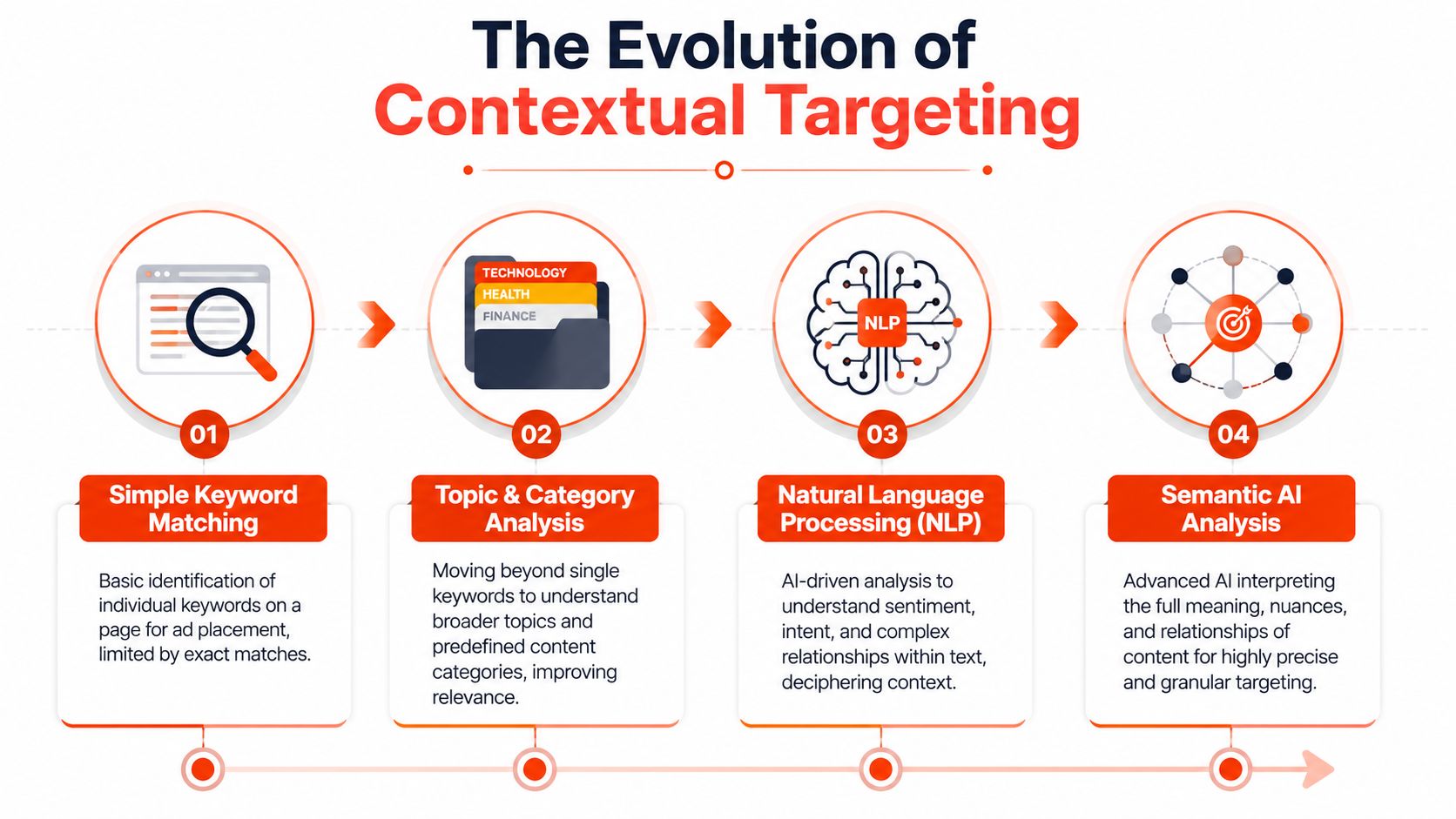
Many guides still describe contextual targeting as little more than keyword matching. That's outdated. The technology has moved well beyond scanning a page for obvious terms and dropping in an ad that shares the same words.
The significant leap is from matching text to understanding meaning.
Stage one and stage two
The early version of contextual was straightforward.
A platform looked for selected keywords on a page, or it mapped the page into a category such as sport, finance, parenting, or travel. That was useful, but blunt. Keyword matching often got trapped by ambiguity. A word might appear in a negative story, an unrelated metaphor, or a piece of content that technically matched but didn't fit buyer intent.
Category targeting improved scale, but not precision. It gave buyers broader reach inside relevant content buckets, yet still missed nuance.
Here's where those older methods usually fall short:
- Keyword traps often place ads against content that includes the right term but the wrong meaning.
- Broad categories can blend research content, news coverage, reviews, and low-intent articles into one targeting bucket.
- No real tone analysis means the system may not distinguish between positive, neutral, and unsuitable environments.
- Weak page-level relevance leads to creative that feels generic instead of tightly matched.
Stage three and stage four
Modern contextual systems use natural language processing and AI to assess the page more like a strategist would. They extract keywords, determine the main topic, assess content tone, and assign relevance based on semantic fit rather than keyword density alone. That means the platform is looking at relationships between terms and the actual subject of the page, not just isolated triggers.
Some Australian neuro-contextual platforms go further by using AI trained on intent-labelled datasets for real-time sentiment and emotion analysis, then optimising against KPIs such as Cost per Quality Visit and Cost per Lead. That architecture uses algorithms and natural language processing to identify keywords, topics, and tone, then scores ad relevance based on semantic matches rather than simple text overlap, as described in BandT's overview of neuro-contextual advertising.
Better contextual performance usually comes from better interpretation, not from a longer keyword list.
Why semantic matters more for Australian advertisers
This is the part most local articles miss. The Australian discussion around contextual still leans heavily on categories and keywords, but semantic analysis is where the performance gap opens up.
For Australian retail, semantic AI drives a 23% higher conversion lift than keyword matching in the privacy-compliant ad market, according to the IAB Australia contextual targeting guide. That matters because it confirms the newer approach isn't just cleaner from a privacy standpoint. It performs better where ROI pressure is highest.
For e-commerce, semantic targeting is valuable when products sit inside nuanced buying journeys. A shopper reading “best office chair for back support” isn't the same as someone skimming general office news. Semantic systems are better at separating those moments.
For B2B, the same logic applies. A page discussing software implementation challenges signals something very different from a casual mention of software inside a broad business article. Semantic analysis catches that difference more effectively.
If you want to see how AI is reshaping paid media more broadly, this breakdown of artificial intelligence ads is worth a read.
Why Contextual Targeting Drives Better Campaign ROI
The strongest argument for contextual targeting advertising isn't ideological. It's commercial. Relevant ads in suitable environments tend to produce better buying conditions than ads that chase a user based on old behaviour.
In Australia, that advantage is measurable. Contextual targeting shows a 63% increase in purchase intent compared to audience or channel-level targeting, and a 40% lift in overall brand favourability among consumers served contextual ads, according to the IAB Australia Handbook on contextual targeting. The same source notes that this alignment with the user's immediate browsing environment generates 43% more neural engagements than behavioural targeting, which helps reduce post-cookie cost per conversion by relying on semantic relevance instead of historical user data.

Why these gains show up in real accounts
For e-commerce teams, contextual works because message and moment line up. If the buyer is consuming content that relates directly to the product category, the ad feels timely rather than intrusive. That improves the chance of a click that is meaningful.
For B2B, the ROI case often comes from quality rather than volume. A software company doesn't need broad attention from loosely qualified traffic. It needs decision-makers consuming relevant content in the right mindset. Contextual buys help narrow the field without relying on invasive tracking.
A few advantages matter more than most:
- Privacy compliance by design because the targeting decision can be made without cookies or identifiers.
- Brand suitability control because placement logic can consider page topic and tone before the bid.
- Stronger prospecting resilience because the strategy isn't tied to the health of third-party audience data.
- More useful creative matching because ads can be matched to content clusters rather than generic audiences.
Where advertisers get this wrong
Not every contextual campaign performs well. Poor setup can flatten the upside quickly.
The common failures are predictable:
- Using only broad categories and calling it a strategy.
- Ignoring exclusions, which allows unsuitable or low-quality pages into the mix.
- Running generic creative that doesn't reflect the context you bought.
- Treating all placements equally instead of reviewing where quality originates.
A contextual campaign only earns its keep when targeting, exclusions, and creative all point in the same direction.
The trade-offs to accept
Contextual isn't magic. In very niche markets, reach can tighten if you apply suitability rules too aggressively. Some product categories also need stronger creative strategy because context alone won't carry a weak offer.
There's also less of the “follow them everywhere” effect that some advertisers have grown used to. That's not always a downside, but it does mean you need better planning across prospecting, remarketing, and landing-page alignment.
Used properly, contextual targeting doesn't replace every other channel tactic. It replaces brittle targeting logic with a cleaner acquisition layer.
Your Step-by-Step Implementation Checklist
Most weak contextual campaigns fail before launch. The media buyer picks a few topical categories, uploads standard display creative, and hopes the platform figures out the rest.
That usually produces mediocre relevance.
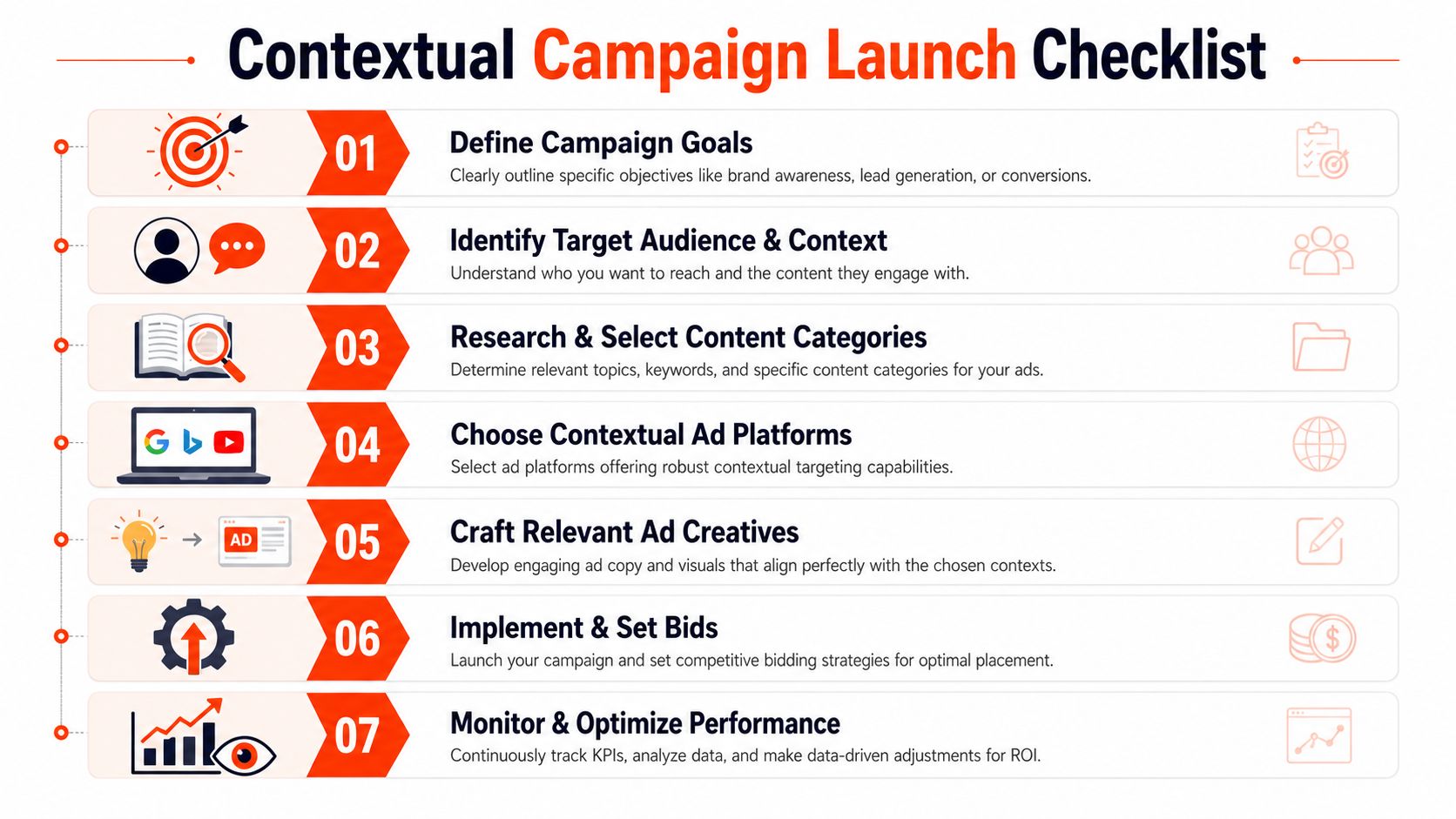
A better rollout is structured, selective, and built around what the page is telling you about likely intent.
Start with the commercial outcome
Pick the job first. Brand awareness, product discovery, lead generation, pipeline support, or direct conversion all require different context choices. An e-commerce campaign pushing a high-margin product line should target purchase-adjacent content. A B2B lead campaign may do better in educational or solution-comparison environments.
Watch out for soft goals. “Traffic” isn't enough unless you're clear on what kind of traffic matters.
Build context segments, not random keyword lists
Create groups of pages and environments based on buyer intent. Think in clusters such as product reviews, how-to content, comparison content, category education, and industry commentary. This is more useful than stuffing an ad group with disconnected terms.
Try working from these inputs:
- Search term reports from Google Ads to identify language buyers already use near conversion.
- Merchant Centre feed data for e-commerce category and product themes.
- Sales call notes for B2B pain-point language.
- Publisher lists where your buyers already spend time.
- Competitor messaging that reveals adjacent topics and content territories.
Choose platforms with stronger analysis
Not all contextual inventory is equal. Some systems still lean on rough keyword matching. Others use page-level and semantic analysis that can better interpret suitability and intent.
Australian neuro-contextual platforms use AI trained on intent-labelled datasets to perform real-time sentiment and emotion analysis, helping optimise metrics such as Cost per Quality Visit and Cost per Lead by targeting action-ready consumers in moments of stronger emotional connection. They analyse keywords, main topics, and content tone, then assign relevance scores based on semantic matching, which improves ad recall, brand favourability, and conversion efficiency compared with behaviour-based data alone, as outlined in this BandT article on neuro-contextual platforms.
The platform matters. If it can't tell the difference between page meaning and simple keyword density, you're buying a weaker version of contextual.
Match creative to the environment
Here, many teams opt for complacency.
If you're targeting content about running recovery, don't serve a generic sportswear banner. Serve creative that speaks directly to recovery, comfort, support, or post-run use cases. If your B2B ad sits beside implementation content, the headline should reflect rollout, integration, or operational outcomes.
A few practical checks help:
- Align the promise with the content theme, not just the product category.
- Use landing pages that continue the same conversation as the ad and placement.
- Separate creatives by context cluster so reporting can show message-to-environment fit.
- Keep offers realistic because context improves relevance, but it won't rescue a weak proposition.
Protect budget with exclusions
Good contextual strategy includes what you won't buy. Build negative placement lists, unsuitable topics, and brand-safety exclusions before spend ramps. If your product shouldn't appear near controversy, sensationalism, or low-quality MFA-style inventory, make that explicit.
For B2B, exclude student content, low-intent glossary pages, and broad news inventory if it muddies lead quality. For e-commerce, exclude pages that attract curiosity clicks without commercial relevance.
Structure for optimisation from day one
Don't dump everything into one campaign.
Split by content theme, funnel stage, or product family. That gives you cleaner placement reporting, clearer creative tests, and better bid control. When you later optimise, you'll know whether the issue sits with the context, the message, or the offer.
Measuring Success and Optimising for Performance
The first reporting mistake with contextual campaigns is judging them only by surface metrics. Click-through rate has value, but it doesn't tell you whether the context is attracting the right visitor. The essential work happens at placement level.
Look at standard KPIs such as conversion rate, CPA, lead quality, revenue contribution, and assisted conversions. Then break performance down by context cluster, publisher, placement, creative, and landing page. That's where you find the combinations worth scaling.
What to review every week
Placement reports should be mandatory reading. They show which sites, pages, or environments are producing useful engagement and which are spending money.
Focus your review on:
- Placement quality by looking for publishers or page types that attract low-value clicks.
- Context-theme performance to see which topics generate stronger downstream actions.
- Creative fit by comparing ad variants across different content environments.
- Post-click behaviour in analytics so you can separate curiosity traffic from serious intent.
If you need a shortlist of tools for this kind of reporting stack, these top marketing analytics platforms are a useful reference point for comparing dashboards, attribution options, and data workflows.
What to change when results stall
If a contextual campaign underperforms, don't default to raising bids first. Start by narrowing or reshaping the context. Remove weak placements, tighten suitability settings, and break broad topic groups into more specific intent clusters.
Then test the message. A strong contextual placement with bland creative often underdelivers because the ad fails to reflect why the page was relevant in the first place.
You should also review how you define success. A campaign aimed at B2B lead quality may not produce the cheapest front-end conversion, but it can still be the better commercial source once sales feedback is included. This guide to how to measure advertising effectiveness is a practical reference if your reporting still overweights vanity metrics.
Optimisation gets easier when you stop asking which ad had the highest CTR and start asking which context produced the best business outcome.
The feedback loop that improves ROI
Strong contextual programmes improve through repetition. You identify the environments that produce quality, cut the ones that don't, refine the creative, and keep tightening the match between content and commercial intent.
That's why contextual targeting advertising works best when it's treated as an operating system, not a one-off campaign setting.
If your paid media strategy needs to perform in a privacy-first market, Click Click Bang Bang can help you build contextual, search, shopping, and paid social campaigns that focus on measurable outcomes instead of fading data signals.
Read NeXt
Or Read Our Latest
- Customer Lifetime Value: Calculate & Increase It in 2026
- Contextual Targeting Advertising: A Guide for 2026
- Best Seo Agency Australia Guide 2026
- Cross Domain Tracking: A Practical Guide for GA4 in 2026
- Performance Max Campaigns: An AU Business Guide for 2026
- Pay for Advertisement: A Guide to Costs & ROI in 2026
Click. CLick. Subscribe.
Get our best PPC insights, industry updates, and power moves delivered straight to your inbox. No fluff, just high-caliber strategies that actually work.
Don’t Leave Just Yet
Try Us For 30-Days,
Risk Free!!
We guarantee that you’ll love our work within the first 30 days, if not you’ll get your money back.
What have you got to lose?