

Customer Lifetime Value: Calculate & Increase It in 2026
Last Updated

You're probably looking at campaign dashboards that say acquisition is “working” because CPA is under control, conversions are up, and branded search is holding steady. Then finance asks a harder question: which of these customers are actually profitable after the first order, the first month, or the first sales cycle?
This reveals a common blind spot in reporting. It's built around the first click, the last click, or the initial conversion, but not around the value of the customer that conversion produced. A cheap customer who buys once on discount can look better in-platform than a more expensive customer who stays, buys again, and refers others.
Customer lifetime value changes that. It pushes PPC and SEO teams to stop chasing volume for its own sake and start measuring who they're bringing into the business. In practice, that means budget allocation gets sharper, bidding decisions get more rational, and retention stops sitting in a different silo from acquisition.
Beyond the First Click Understanding True Profitability
A lot of Australian marketers still optimise as if the job ends at the first sale. They push cost per acquisition down, celebrate a strong return on ad spend in-platform, and keep feeding budget into whatever channel converts fastest. That works until you realise the lowest-cost customers are often the least valuable ones.
Customer lifetime value is the metric that fixes that blind spot. It asks a better question: what is a customer worth across the full relationship, not just on day one? That shift matters because the first purchase rarely tells the whole commercial story. In e-commerce, especially, some buyers return at full price, some only come back for promotions, and some disappear immediately.
In the Australian e-commerce sector, customer lifetime value typically ranges between AUD $100 and AUD $300, and brands that extend the average customer lifespan from 1 to 3 years can achieve CLV multiples of 3x to 5x their initial customer value according to Uncommon Insights' CLV calculator guidance. That's the difference between running a campaign that looks efficient and building a business that's durable.
The practical implication is simple. You can't judge a campaign only by the first conversion. You need to know which keywords, audiences, landing pages, and channels bring in customers who stay.
Practical rule: If your reporting stops at acquisition, you're measuring activity, not profitability.
That also changes how you think about attribution. Multi-touch reporting still matters, but it needs to be tied to customer quality, not just conversion credit. If your team is still wrestling with channel influence versus channel value, a strong starting point is this guide to multi-touch attribution.
What good teams do differently
The strongest teams don't ask only, “What did it cost to get the sale?” They ask:
- Which channel acquired the customer: Not every source delivers the same downstream value.
- What happened after purchase: Repeat purchase, expansion, support load, churn risk, and loyalty all matter.
- Whether margin holds up: Revenue without margin discipline can make CLV look healthier than it is.
When CLV becomes the operating metric, media buying improves. SEO prioritisation improves. Even retention conversations improve because acquisition and lifecycle finally use the same commercial language.
What Is Customer Lifetime Value Really
The easiest way to understand customer lifetime value is to stop treating it like a spreadsheet term.
Think about a neighbourhood café. One customer walks in once, buys a coffee, and never comes back. Another comes in regularly, orders coffee and food, brings a colleague, and sticks with the café over time. Both count as customers. They are not equally valuable.
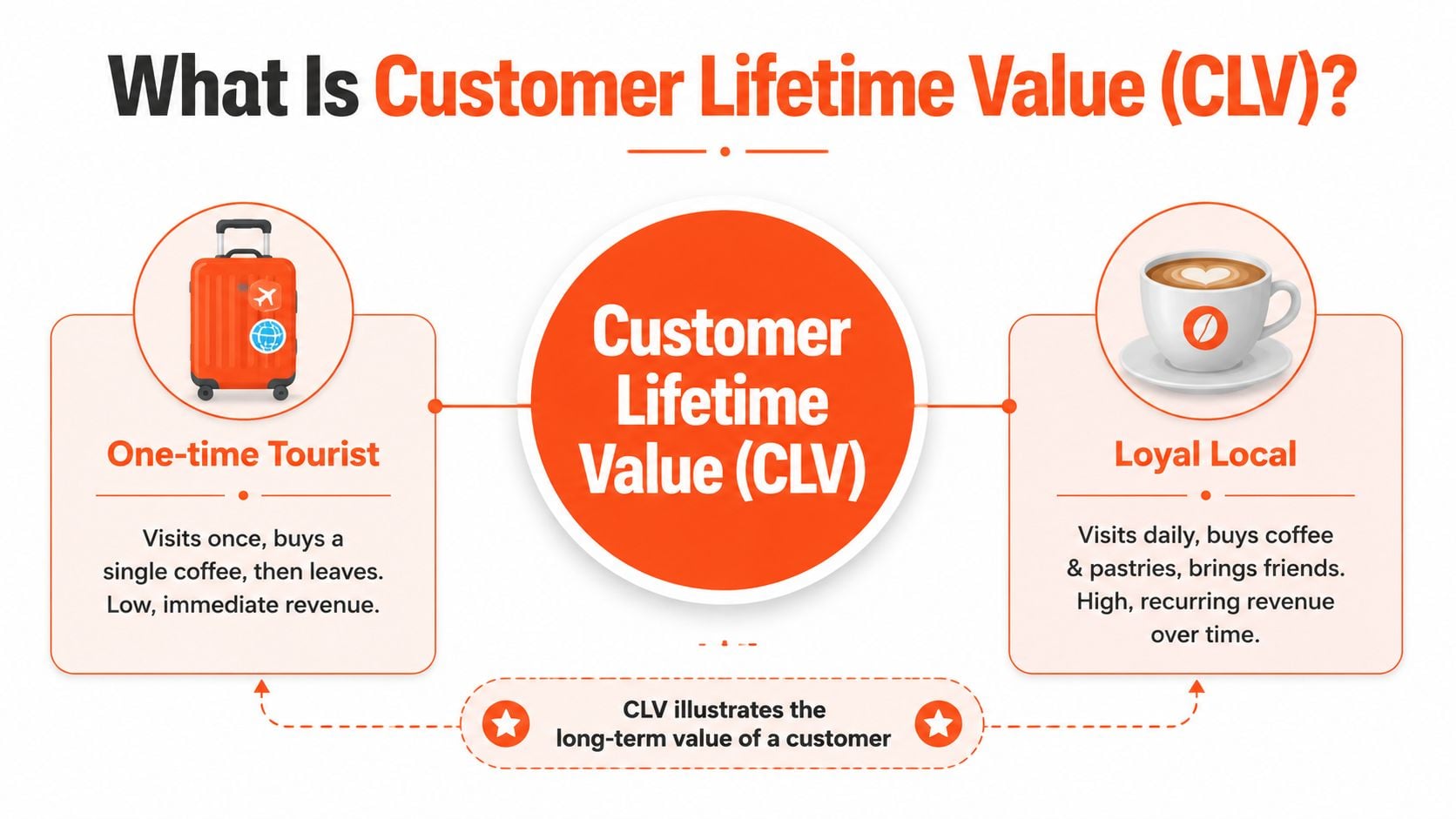
That's what customer lifetime value captures. It's the total net profit a business expects to earn from a customer across the full relationship. Not the first basket. Not the first signed contract. The relationship.
Why this metric changes decisions
Once you look at customers this way, several things become clearer.
First, not all conversions deserve the same bid. A buyer from a generic discount term may convert cheaply and still be a poor long-term customer. A lead from a narrower, higher-intent search may cost more and produce far better commercial value over time.
Second, CLV sharpens segmentation. It helps you separate low-value one-off buyers from people who are likely to become loyal customers. That has direct consequences for audience building, email flows, offer design, and sales follow-up.
Third, it gives you a way to decide where to invest beyond acquisition. Better onboarding, stronger support, more relevant upsell paths, and loyalty mechanics stop looking like “brand” work and start looking like profit leallocation.
A business that knows its customer lifetime value can afford to be more aggressive where quality is high and more disciplined where churn is high.
What CLV is not
CLV isn't a vanity total that sits in a board deck. It's also not a single average you calculate once and forget. Used badly, it becomes a comforting number that hides channel quality differences. Used properly, it becomes a filter for daily decisions.
That's why I prefer to treat CLV as an operational metric with strategic consequences. PPC managers use it to decide what traffic is worth buying. SEO strategists use it to judge what demand is worth attracting. CRM teams use it to identify who deserves more effort. Sales teams use it to spot accounts worth protecting.
If you want a plain-language external explainer that complements this view, the CartBoss blog on customer value is a useful reference because it frames CLV in a way that's easy to translate into marketing action.
How to Calculate Customer Lifetime Value Three Core Methods
There isn't one universal CLV model that fits every business. The right method depends on how much data you have, how mature your reporting is, and whether you need a quick directional number or a more defensible profit view.
Method one using the simple CLV formula
The foundational formula is:
CLV = (Average Sale Value × Purchase Frequency) × Customer Lifespan
This framework was formalised in Australian consulting guidance for local businesses as a standard unit economics measure, with the added recommendation that businesses multiply by gross margin when they need a profit-based figure rather than a revenue-only one, as outlined in Salesforce Australia's customer lifetime value guide.
This method is useful because it's fast. It gives you a baseline even if your data stack is still messy.
A simple example from Australian retail makes the concept easy to follow. A Brisbane café with an average purchase value of $20 and a purchase frequency of 5 times per year generates $100 annually per customer. If that customer stays for 3 years, the CLV reaches $300, according to Uncommon Insights' customer lifetime value calculator example.
When to use it
Use this model when:
- You need a baseline quickly: Good for a first pass in Shopify, WooCommerce, or CRM exports.
- Your team is early in CLV adoption: It creates alignment before you move to deeper modelling.
- You want a directional benchmark: Useful for rough budget decisions and internal education.
Where it falls short
It can overstate value if you ignore margin, retention volatility, or channel-level differences. It tells you the average relationship value, but not which acquisition sources are creating better customers.
Method two using cohort analysis
Cohort CLV looks at groups of customers acquired in the same period or through the same channel, then compares how they behave over time.
For PPC and SEO teams, CLV becomes operational. Instead of asking for one average number across the business, you ask whether customers from Google Ads in one month outperform customers from organic search in another, or whether customers whose first purchase came through a category page behave differently from customers who entered through a sale page.
The Australian guidance referenced earlier also points to cohort-based modelling as a way to compare acquisition channels and first-purchase periods more precisely in Salesforce Australia's article.
When to use it
Cohort analysis is best when:
- You're comparing channels: Paid search, Meta, SEO, email, affiliates, LinkedIn.
- You're testing landing pages or offers: First-purchase context often predicts later value.
- You need historical truth: It's stronger than a blended average for budget allocation.
What it gives you
You start to see patterns such as:
- Full-price first purchasers often behave differently from discount-led buyers.
- Some channels drive faster second purchases.
- Some landing pages create more churn-prone customers.
Working rule: If you manage paid media and don't have CLV by cohort, you're probably overfunding at least one channel.
Method three using predictive or technical CLV
For repeat-purchase and subscription models, a more technical formula is available:
CLV = Gross Margin × (Retention Rate / [1 + Discount Rate – Retention Rate])
For Australian PPC and SEO use cases, this matters because the underlying retention assumptions can radically change what a customer is worth. Uncommon Insights' CLV modelling guide notes that applying a 10% annual discount rate and 60% retention yields a 1.5x multiplier on gross margin, while 40% retention reduces that to 0.67x.
This is the point where weak retention stops being an abstract concern and starts changing what you can afford to spend to acquire customers.
When to use it
This model fits when:
- You sell on subscription or repeat cycles: Beauty, food, software, memberships, replenishment.
- You have retention data: Not guesses. Actual observed behaviour.
- You need profit-aware planning: Especially useful for forecasting and bid ceilings.
Comparison of CLV Calculation Methods
| Method | Formula Concept | Best For | Pros | Cons |
|---|---|---|---|---|
| Simple CLV | Average sale value × purchase frequency × lifespan | Early-stage businesses and quick estimates | Fast, easy to explain, low data requirement | Can overstate value if margin and churn aren't accounted for |
| Cohort Analysis | Compare revenue or profit by customer group over time | Channel analysis and historical budget decisions | Shows quality differences by source, offer, or period | Requires cleaner data and stronger reporting discipline |
| Predictive or Technical CLV | Gross margin adjusted by retention and discounting | Subscription and repeat-purchase forecasting | More financially grounded, useful for planning | Sensitive to retention assumptions and data quality |
The right move is usually sequential. Start simple, move into cohorts, then add predictive logic once the business can support it.
Setting Up Your Business to Measure CLV
Most CLV problems aren't formula problems. They're data problems.
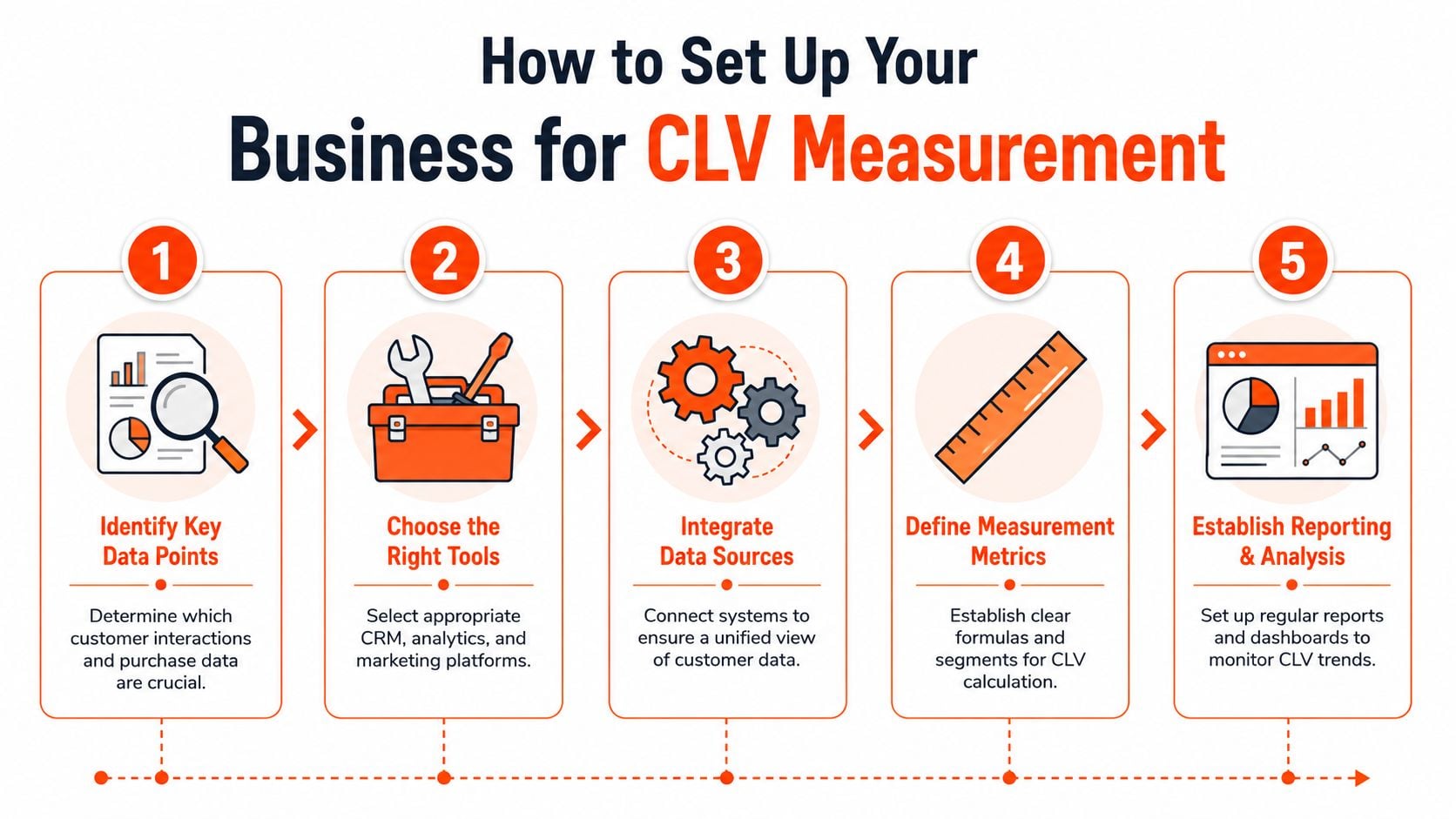
Teams say they want customer lifetime value, but their data lives in different places. The e-commerce platform has orders. The CRM has account history. Google Analytics has sessions and conversion paths. Paid platforms have campaign metadata. Support tools hold churn signals. None of it is stitched together cleanly enough to answer a basic question: which acquisition source brought in the customer, and what happened after that?
The minimum stack that actually works
You don't need a perfect enterprise setup to get started. You do need consistency.
- E-commerce or sales platform: Shopify, WooCommerce, HubSpot, Salesforce, or your order management system should hold transaction history.
- CRM or customer record: Repeat purchases, account ownership, and customer status require visibility.
- Analytics platform: Google Analytics can help with acquisition path context, provided the tagging is clean.
- Ad platform metadata: Google Ads, Meta Ads, and LinkedIn need campaign naming conventions that map back to meaningful cohorts.
- Retention signals: Refunds, cancellations, repeat order timing, and inactivity should be captured somewhere usable.
What to track from day one
The core fields are straightforward:
- Customer identifier: One record per customer, not one record per order.
- Acquisition source: First known channel, campaign, or landing page.
- Purchase history: Order dates, order values, and repeat behaviour.
- Margin view: If possible, track gross margin rather than revenue alone.
- Churn indicators: Cancellations, inactivity, discount-only behaviour, and support friction.
If your systems don't talk to each other yet, a customer data platform often becomes the practical answer because it creates a usable customer-level record across acquisition and retention systems.
The metric that keeps CLV honest
A high CLV number means very little if acquisition cost is out of control. That's why the LTV-to-CAC ratio matters so much. Australian e-commerce businesses are aiming for at least 3:1 according to Salesforce Australia's benchmark discussion. That ratio keeps marketing focused on profitability, not just top-line growth.
When CLV rises but CAC rises faster, the business hasn't improved. It has just become more expensive.
A practical implementation order
Don't try to build everything at once.
- Fix naming conventions first: Campaign and channel labels need to be consistent.
- Unify customer IDs: If one customer appears as three records, CLV breaks immediately.
- Build a basic cohort report: Channel, first purchase date, repeat purchases, revenue.
- Layer in margin if available: This turns revenue CLV into something commercially useful.
- Review monthly: Not for vanity reporting, but for spend decisions.
If you need a tactical walk-through of the mechanics, this guide on tracking customer lifetime value is a helpful operational reference.
Data-Driven Strategies to Increase Your CLV
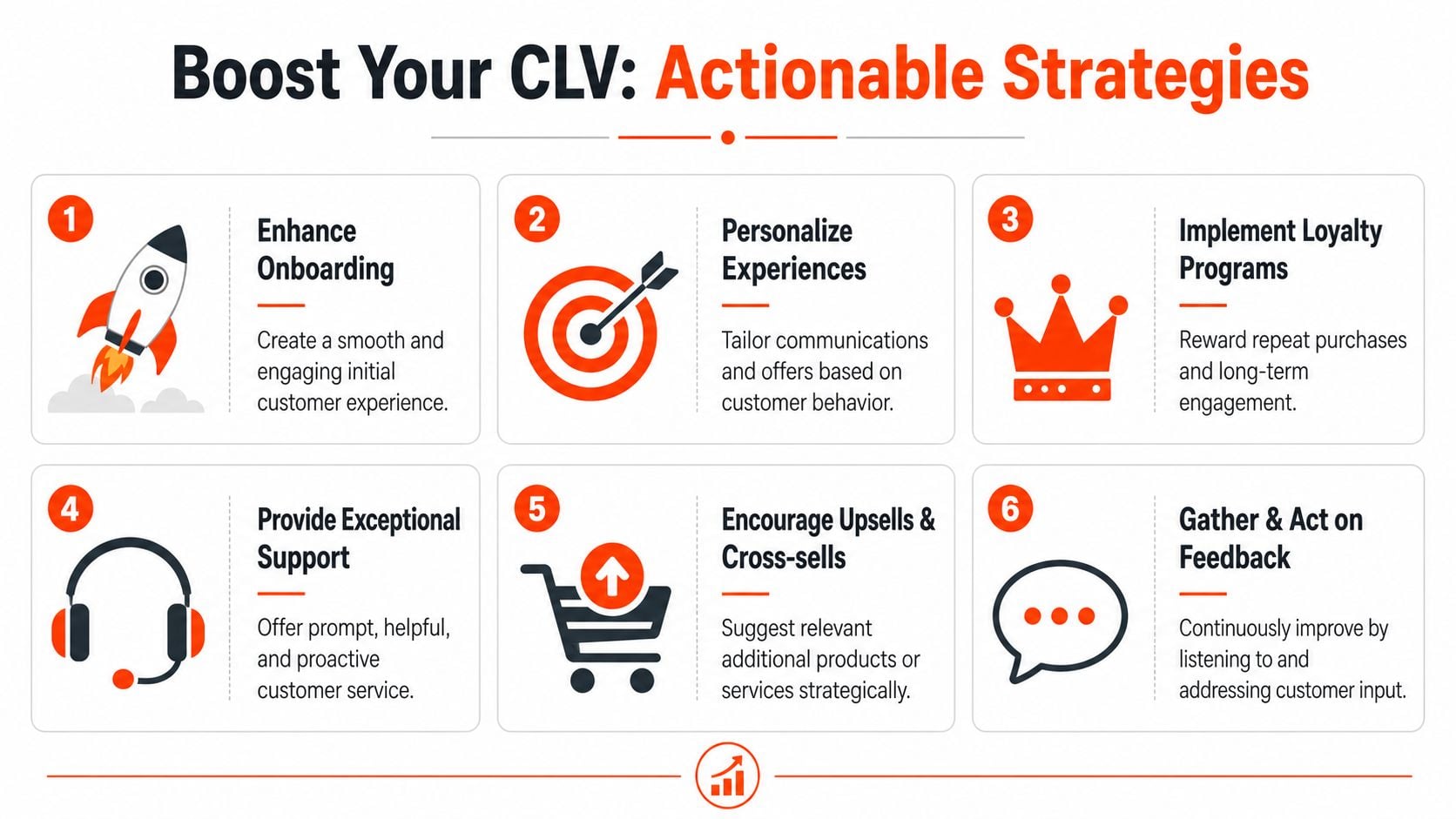
Once CLV is measurable, the work shifts from reporting to intervention. Most businesses don't have a customer acquisition problem in isolation. They have a post-acquisition value problem. Customers convert, then disappear, stall, or come back only when there's a discount.
That challenge is more obvious in Australia because churn pressure is real. Bain's analysis of customer loyalty in Australia reports that ‘promoters' generate 2.5x higher lifetime value than ‘detractors’, yet only 15% of retailers segment customers on that loyalty economics framework. That gap matters because it shows how many brands still treat all repeat customers as equal when they aren't.
For e-commerce teams
The fastest CLV gains usually come from reducing the drop-off after the first order.
- Tighten the post-purchase sequence: Confirmation, shipping, education, usage, and reorder prompts should feel connected. Generic batch emails won't do much.
- Build offers around behaviour, not assumptions: A first-time buyer of a replenishable product needs a different message from someone who bought a gift item.
- Use loyalty carefully: Points, perks, bundles, and early access can work well, but only if they encourage profitable repeat behaviour rather than training people to wait for a deal.
- Protect margin on second purchase: The second order is often where bad discounting habits get locked in.
For B2B teams
In B2B, CLV is usually won or lost after the lead becomes a customer.
Onboarding quality matters more than lead volume
If the handover from paid media or SEO to sales is sloppy, the wrong accounts close and the right ones stall. Structured onboarding, expectation setting, and early value delivery have a direct impact on account longevity.
Customer success should not be reactive
High-value accounts often show disengagement before they churn. Product usage drops. Stakeholder involvement narrows. Support becomes more transactional. Teams that act on those signals retain better customers for longer.
Expansion should feel like fit, not pressure
Cross-sell and upsell work when the offer solves the next problem in the customer's journey. They fail when sales teams push irrelevant add-ons to hit quarterly targets.
The easiest way to damage CLV is to squeeze short-term revenue out of accounts that aren't ready for expansion.
Loyalty segmentation is the underused lever
The Bain loyalty framing is useful because it forces marketers to separate customers by relationship quality, not just spend. Some customers buy often and still erode profitability through churn risk, support burden, or discount dependency. Others advocate for the brand, repurchase reliably, and create indirect value through referrals and stronger retention behaviour.
That's why win-back activity should also be selective. Not every lost customer is worth recovering. For teams thinking through that problem, this guide for SaaS founders on win-backs is useful because it treats reactivation as a strategic filter, not just an automated email sequence.
Applying CLV in Your PPC and SEO Campaigns
At this point, customer lifetime value stops being an executive metric and starts becoming a daily optimisation tool.

For AU-based PPC and SEO campaigns, acquisition channels with a retention rate above 45% generate a 3.2x higher gross margin CLV than channels below 30%, according to Uncommon Insights' customer lifetime value modelling. That single insight changes how you should treat channel performance. A campaign that looks average on first-sale ROAS can be one of your best investments if it consistently attracts higher-retention customers.
How PPC managers should use CLV
The first application is bid logic. If one campaign, audience, or keyword group brings in higher-value customers over time, you can justify a higher acquisition cost there. If another segment converts cheaply but churns fast, the bid should come down even if platform reporting looks healthy.
A practical workflow looks like this:
- Pull cohort performance by source: Group customers by campaign, keyword theme, audience, or ad set.
- Compare retention quality: Don't stop at first-sale revenue.
- Adjust bid targets: More budget toward high-value cohorts, less toward low-value ones.
- Feed the learning back into automation: A smarter version of target CPA bidding starts with knowing which conversions deserve the same target and which don't.
That also affects creative strategy. Value-led audiences often respond differently from discount-led audiences. The ad copy, offer framing, and landing page should reflect that difference.
How SEO teams should use CLV
SEO teams often get trapped by search volume. High-volume terms can drive traffic and still produce weak customers. CLV forces a more commercial prioritisation model.
Look at:
- Which entry pages attract repeat purchasers: Category pages, comparison content, solution pages, and branded education often perform differently.
- Which content themes attract better-fit buyers: Some topics produce researchers. Others produce buyers who stay.
- Which search intent aligns with retention: The best keyword isn't always the one with the most clicks. It's often the one that brings in the right customer.
A content program built around CLV usually becomes narrower and more profitable. You publish less for vanity traffic and more for durable demand.
Here's a useful explainer if your team needs a quick walkthrough before applying the model inside channel reporting:
Where teams usually get it wrong
The common mistake is treating CLV as a finance metric that gets reviewed after the campaign is done. By then, the money has already been spent.
The better approach is to use CLV as a filter before scaling. Ask which campaigns are producing customers worth keeping, then scale those. Cut spend where the first conversion looks fine but downstream value keeps collapsing.
Frequently Asked Questions About CLV
What is a good customer lifetime value
There isn't one universal “good” figure because it depends on the business model, margin structure, and buying pattern. In Australian e-commerce, the range often cited is broad, so the better benchmark is whether your CLV supports profitable acquisition and healthy retention.
How often should I calculate CLV
Review it regularly enough to affect decisions. Typically, this involves a recurring reporting cadence tied to campaign, cohort, and retention reviews. If you're actively testing channels or offers, monitor the leading indicators more closely.
Can customer lifetime value be negative
Yes. It can happen when acquisition and servicing costs outweigh the value generated by the customer. When that shows up, it usually points to one of three issues: poor-fit acquisition, weak retention, or a margin problem.
Should PPC and SEO teams use the same CLV number
Usually not. They should work from the same commercial framework, but channel-level cohort views are more useful than one blended average. A single sitewide number can hide major differences in customer quality.
Is CLV more important than ROAS
For strategic decisions, often yes. ROAS shows short-term efficiency. CLV shows whether the customer is worth acquiring in the first place. The strongest teams use both, but they don't let short-term ROAS overrule long-term profitability.
Conclusion From Metric to Mindset
Customer lifetime value works best when it stops being a retrospective KPI and starts shaping how the business acquires, serves, and retains customers. It changes what you count as a good conversion. It changes what traffic is worth paying for. It changes how SEO, PPC, CRM, and sales talk to each other.
Teams that use CLV well don't just report better. They make better trade-offs. That's how marketing becomes more profitable, more resilient, and much harder to misread.
If you want help turning customer lifetime value into a usable PPC and SEO decision framework, Click Click Bang Bang can help connect your acquisition data, bidding strategy, and retention signals so you can scale on profit, not just volume.
Read NeXt
Or Read Our Latest
- Customer Lifetime Value: Calculate & Increase It in 2026
- Contextual Targeting Advertising: A Guide for 2026
- Best Seo Agency Australia Guide 2026
- Cross Domain Tracking: A Practical Guide for GA4 in 2026
- Performance Max Campaigns: An AU Business Guide for 2026
- Pay for Advertisement: A Guide to Costs & ROI in 2026
Click. CLick. Subscribe.
Get our best PPC insights, industry updates, and power moves delivered straight to your inbox. No fluff, just high-caliber strategies that actually work.
Don’t Leave Just Yet
Try Us For 30-Days,
Risk Free!!
We guarantee that you’ll love our work within the first 30 days, if not you’ll get your money back.
What have you got to lose?