

Data Driven Attribution
Last Updated

You can usually spot the problem before you open the report. Prospecting campaigns are bringing in traffic. Remarketing is warming people up. Brand search closes the sale. Then the dashboard hands nearly all the credit to the final branded click and makes your upper-funnel spend look optional.
That's how good channels get cut.
If you're managing paid media across Google, Meta, LinkedIn, Shopping, remarketing, and email-assisted journeys, last-click reporting gives you a distorted view of what's driving revenue and leads. Data Driven Attribution fixes that by spreading credit across the interactions that helped create the outcome, instead of pretending the last touch did all the work.
Why Last-Click Thinking Is Costing You Money
Most marketing managers have lived through the same budget meeting. The brand campaign looks brilliant. Generic search looks acceptable. Prospecting social looks weak. You trim the awareness budget, keep the brand budget untouched, and a few weeks later total performance softens even though the “best” campaigns stayed funded.
The issue isn't always the campaigns. It's the model judging them.
Last-click hides the channels doing the heavy lifting
Last-click attribution rewards the final interaction before conversion. In simple journeys, that can be good enough. In real accounts, it usually isn't. A customer sees a Meta video, comes back via Google Search, compares products through Shopping, gets retargeted, then converts on a branded search ad. Last-click tells you brand search won the sale. It ignores the rest of the journey.
That creates two expensive mistakes:
- You overfund closers: Brand, remarketing, and bottom-funnel campaigns absorb more budget because they sit nearest the finish line.
- You underfund creators of demand: Prospecting campaigns look weaker than they are, so they get cut first.
- You misread ROI: Channel reports become less useful because they measure who collected the final click, not who influenced the outcome.
If you're trying to explain channel efficiency to leadership, a more commercial lens proves helpful. The breakdown in how SaaS teams use ROAS and ROI is useful because it shows why a narrow return metric can push teams toward the wrong decisions.
The practical cost shows up in budget decisions
When attribution is skewed, optimisation is skewed. Bids rise on campaigns that capture intent late. Creative testing slows at the top of funnel because those ads “don't convert”. Mid-funnel campaigns get treated like nice-to-haves even when they're moving buyers toward the sale.
Practical rule: If a channel consistently assists conversions but rarely gets last-click credit, cutting it may lower overall performance while making your reports look cleaner.
A better starting point is understanding how to measure advertising effectiveness across the full funnel, not just the final click. That's the shift Data Driven Attribution enables. It doesn't make every campaign equal. It makes the credit fairer.
What Is Data Driven Attribution Really
Data Driven Attribution is a machine-learning approach to assigning conversion credit. Instead of applying a fixed rule like “give all credit to the last click” or “split it evenly”, it looks at the paths users take and estimates which touchpoints contributed.
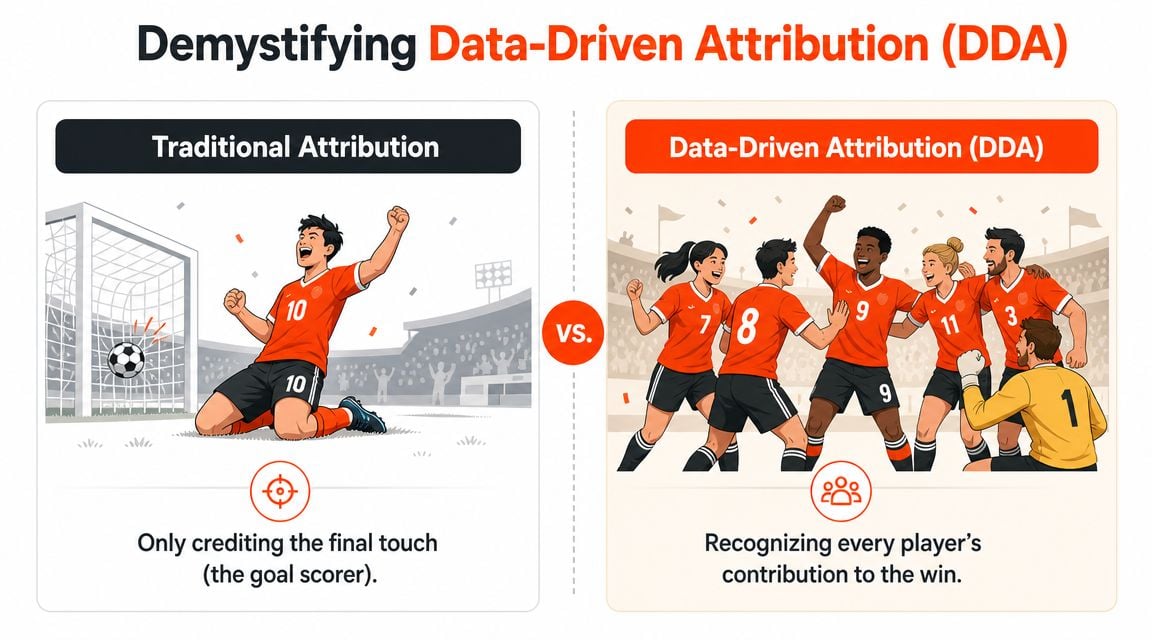
Think about a football match. The striker scores the winning goal, but the full-back started the move, the midfielder played the through ball, and the keeper made two saves that kept the team in it. Last-click gives the trophy to the goal scorer alone. Data Driven Attribution gives credit to the team.
How DDA differs from rule-based models
Rule-based models are easy to understand because the logic is fixed. That's also their weakness. They don't adapt to how customers behave in your account.
Here's the simplest contrast:
| Model | How it treats a journey | Main problem |
|---|---|---|
| Last-click | Final touch gets all credit | Undervalues awareness and consideration |
| First-click | First touch gets all credit | Overstates the opener and ignores closers |
| Linear | Every touch gets equal credit | Assumes all interactions matter equally |
| Data Driven Attribution | Credit is weighted by measured contribution | Requires trustworthy data and interpretation |
A journey might look like this:
- User clicks a non-brand search ad
- Later watches a YouTube ad
- Returns through Shopping
- Converts after a branded search
A rule-based model picks a pre-set answer. DDA asks a better question: in journeys like this, which touches tend to matter when people convert, and which appear in paths that don't convert?
What the machine learning is actually doing
Marketers frequently disengage because the concept appears opaque. It doesn't need to.
Google describes DDA as using machine learning to evaluate user paths and compare converting and non-converting journeys. Its models outperform rule-based alternatives by 18% to 25% in conversion prediction accuracy, and advanced attribution capabilities are associated with 15% to 20% higher marketing ROI, according to marketing attribution statistics collected here.
That doesn't mean the platform is reading your mind. It means it's looking for patterns in your conversion paths and adjusting credit based on observed contribution rather than a fixed rule.
A useful way to think about DDA is weighted influence, not perfect truth. It gives you a stronger decision model, not a magical answer sheet.
For teams trying to connect attribution to merchandising and spend efficiency, this guide on optimizing ad spend for eCommerce is a helpful companion read because it frames attribution as a budget control tool, not just a reporting feature.
Data Requirements and Key Limitations
DDA works best when your tracking is clean, your conversion definitions are sensible, and your account has enough journey variation for the model to learn from. If any of those are weak, the output gets much harder to trust.

What DDA needs before you switch
Google states that advertisers who switch to data-driven attribution typically see a 6% average increase in conversions, and that DDA evaluates both converting and non-converting paths using each property's own conversion data in GA4, where it is the default for new properties, as explained in Google's GA4 attribution documentation.
That upside only matters if the inputs are right. Before switching, check these foundations:
- Primary conversions are defined properly: Don't feed every micro action into your main bidding and attribution setup. Separate real business outcomes from softer engagement events.
- Tagging is consistent across channels: Campaign naming, UTMs, and platform integrations need to line up or your reports will fragment the path.
- First-party data collection is organised: A strong overview of first-party data helps here because attribution quality depends on the quality of what you capture directly.
- Enough channel diversity exists: DDA is most useful when users move across multiple touchpoints before converting.
Where DDA struggles
There are limits, and ignoring them is where teams lose confidence.
First, it's still partly a black box. You can see the outcome of the model more easily than the full internal weighting logic. That's manageable if you treat DDA as a decision support system, not an oracle.
Second, bad tracking poisons the model fast. If purchases fire twice, lead forms break, or offline sales never get reconciled, DDA can only redistribute flawed signals.
Third, some accounts won't gain much from it:
- Single-channel accounts: If nearly all conversions happen through one source, there isn't much attribution complexity to solve.
- Very short journeys: If buyers click once and purchase immediately, last-click and DDA may not differ much.
- Low-volume accounts: Sparse conversion data can make interpretation less stable.
Watch for this: A move to DDA won't rescue a weak measurement setup. It usually exposes one.
How to Implement DDA on Major Ad Platforms
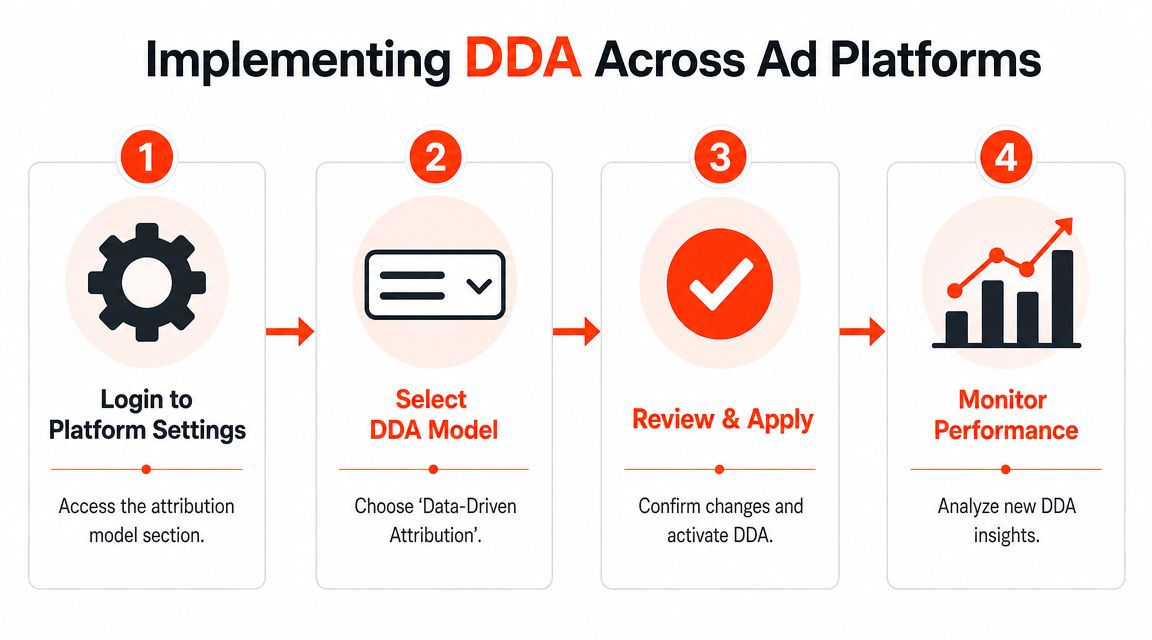
The mechanics of turning on Data Driven Attribution are straightforward. The harder part is making sure the setting change is matched by reporting discipline and bidding logic. If you flip the model and keep reading the account the old way, you'll create confusion instead of clarity.
Google Ads
Google Ads is where DDA usually has the most direct operational impact because attribution feeds bidding signals. Google says DDA in Google Ads is a machine-learning model that compares converting and non-converting paths and reallocates credit toward upper- and mid-funnel touchpoints such as Search, Shopping, YouTube, Display, and Demand Gen, improving bid optimisation inputs, as outlined in Google Ads attribution guidance.
The workflow is simple:
- Open conversion actions in Google Ads.
- Select the conversion action that matters for bidding.
- Review the attribution model setting.
- Change it to Data-Driven Attribution where available.
- Save, then monitor reporting shifts before making large budget changes.
Your setup matters just as much as the model. If Google Ads imports broken events from analytics, DDA won't help. This is why a clean Google Ads conversion tracking setup should come before any attribution change.
GA4
GA4 is useful when you want a broader view across channels, especially when you're comparing paid media with other traffic sources. In Admin, attribution settings let you choose the reporting attribution model and key event lookback window.
For the first month, focus on two reports:
- Model comparison: This shows how channel credit shifts against a rule-based view.
- Conversion paths: This helps you see whether assist-heavy channels appear earlier or repeatedly in journeys.
GA4 is usually where teams first notice that their “weak” channels are supporting branded search and direct traffic.
Meta Ads
Meta doesn't function like GA4 or Google Ads in a cross-channel sense. Its attribution is platform-specific, which means it can be useful for in-platform optimisation but limited for broader budget governance.
Use Meta's reporting to answer creative and audience questions, not to settle cross-channel credit arguments. In practice:
- Keep campaign objectives aligned to the event that matters.
- Review assisted role qualitatively against GA4 and CRM outcomes.
- Don't expect Meta to give you a neutral picture of what Google, email, or direct traffic did.
What to expect in the first 30 days
The first month is mostly about recalibration.
| Week | What usually happens | What you should do |
|---|---|---|
| Week 1 | Credit shifts across campaigns | Don't make immediate cuts |
| Week 2 | Smart bidding starts reacting to new signals | Watch spend distribution and search term quality |
| Week 3 | Assisted campaigns begin to look stronger | Review creative and audience fit |
| Week 4 | Patterns become more usable | Test measured budget moves, not wholesale reallocations |
Teams get into trouble when they treat a reporting change like a guaranteed performance change. Give the model enough time to settle, then act on repeated patterns, not one surprising screenshot.
Strategic Use Cases for Ecommerce and B2B
Attribution only becomes useful when it changes what you do next. The best way to judge DDA isn't whether the report looks smarter. It's whether it helps you make cleaner budget and creative decisions in the kind of sales journey you operate.
Ecommerce journeys
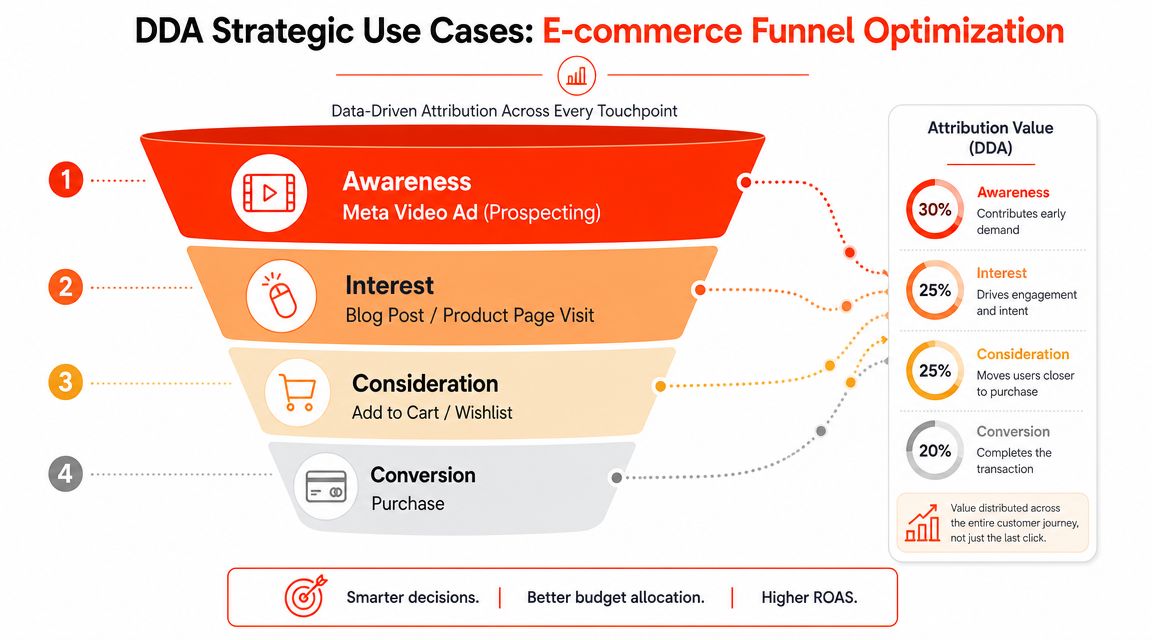
In ecommerce, last-click often over-rewards branded search, Shopping retargeting, and cart recovery. Those channels matter, but they often harvest demand created elsewhere.
A common path looks like this:
- A prospect sees a Meta video ad for a product category
- They visit the site and browse without buying
- Later they return through a generic Google search
- They compare products through Shopping
- They convert after a brand search or remarketing click
Last-click makes the closer look like the hero. DDA usually gives more weight to the touches that introduced the shopper and kept the product in consideration.
That changes two practical decisions.
First, budget. If prospecting campaigns keep showing up as contributors, you can justify protecting them instead of trimming them whenever blended efficiency tightens.
Second, creative. If video and broad-interest ads are generating assisted value, the brief should focus on category education, product differentiation, and objection handling rather than expecting every ad to close immediately.
In ecommerce, DDA is often the difference between funding demand capture only and funding demand creation plus capture.
B2B journeys
B2B is where last-click gets especially misleading because the path is longer and the conversion often isn't the sale. The paid media goal might be a whitepaper download, webinar registration, demo request, or qualified lead. The actual commercial outcome can happen much later in the CRM.
A typical path might involve:
- A LinkedIn ad promotes an industry guide
- The prospect visits several pages over time
- They click a branded search ad weeks later
- A demo request comes in after remarketing or direct return
If you rely on last-click, LinkedIn can look expensive and low-yield while branded search looks brilliant. DDA gives you a more balanced read of who started and shaped the opportunity.
For B2B teams, this usually changes:
- Audience strategy: Top-funnel thought leadership becomes easier to defend.
- Lead scoring conversations: Marketing can argue for quality pathways, not just cheapest form fills.
- Creative sequencing: Ads can be built to move someone from education to evaluation, rather than asking for a demo too early.
The strongest B2B use of DDA is not blind trust in platform credit. It's aligning channel influence with CRM reality so the media mix reflects how buying committees move.
Common Pitfalls and Optimisation Workflows
Switching to DDA is the easy part. Using it well takes restraint.
The most common mistake is panic. A campaign that looked average under last-click suddenly looks important, or a long-favoured closer loses some credit, and the team starts rewriting budgets in a day. That's rarely smart.
Mistakes that weaken the rollout
These are the issues I see most often in practice:
- Comparing unlike-for-like periods: Teams compare DDA this week against last-click from a different window and call it insight.
- Keeping old optimisation habits: They switch the model but still judge upper-funnel campaigns only by direct conversions.
- Using poor conversion inputs: Newsletter sign-ups, page views, and low-intent actions muddy the picture if they're treated like core outcomes.
- Ignoring creative implications: Attribution shifts aren't just budget signals. They often show that your messaging is doing more educational work than closing work.
A safer workflow that actually helps
You don't need a dramatic restructure. A controlled test is better.
Start with a review cycle built around three actions:
-
Read model comparison reports carefully
Look for campaigns and channels that consistently gain credit under DDA. Those are your likely undervalued assists. -
Make a modest budget move
Shift a small share of spend from pure closers toward those assist-heavy campaigns. Keep the move contained so you can judge impact without destabilising the account. -
Match creative to the role in the journey
If a campaign assists more than it closes, give it creative built for attention, education, proof, or category framing rather than direct-response pressure. -
Measure business outcomes, not just platform applause
Watch total conversion quality, lead progression, blended efficiency, and whether branded search starts holding up because upstream demand stayed funded.
Operational advice: DDA works best when you treat it as a weekly optimisation workflow, not a one-off settings change.
This is also where human judgement still matters. If DDA says a campaign assists conversions but the traffic quality is poor, don't scale it blindly. Attribution informs strategy. It doesn't replace strategy.
The Future of Measurement Is Here
Marketing measurement has changed. Privacy constraints have reduced easy tracking. Customer journeys have become less linear. Paid media platforms now optimise with machine learning whether advertisers are ready for that shift or not.
That's why Data Driven Attribution isn't a niche reporting option anymore. It's the more practical way to understand how multiple touchpoints contribute to revenue and leads, especially when your mix spans Google, Meta, Shopping, remarketing, and LinkedIn.
Last-click still has one use. It tells you what happened at the end. It does a poor job of telling you what made the end possible.
The teams that get more from DDA are usually the ones that stay grounded. They clean up tracking, give the model time, compare patterns instead of snapshots, and turn attribution insights into budget, bid, and creative changes. That's how reporting becomes optimisation.
If you want help setting up attribution properly, cleaning up conversion tracking, and turning the data into smarter PPC decisions, Click Click Bang Bang can help you move beyond last-click and manage your campaigns with clearer measurement and sharper optimisation.
Read NeXt
Or Read Our Latest
- Data Privacy Compliance: 2026 Guide for Marketers
- Your 2026 Remarketing Campaign Strategy Blueprint
- Customer Lifetime Value: Calculate & Increase It in 2026
- Contextual Targeting Advertising: A Guide for 2026
- Best Seo Agency Australia Guide 2026
- Cross Domain Tracking: A Practical Guide for GA4 in 2026
Click. CLick. Subscribe.
Get our best PPC insights, industry updates, and power moves delivered straight to your inbox. No fluff, just high-caliber strategies that actually work.
Don’t Leave Just Yet
Try Us For 30-Days,
Risk Free!!
We guarantee that you’ll love our work within the first 30 days, if not you’ll get your money back.
What have you got to lose?