

Find the Best Facebook Ads Agency Sydney for 2026 ROAS
Last Updated

You're probably in one of two situations right now. Either you've run Facebook campaigns before and got a pile of leads that never turned into sales, or you're talking to agencies in Sydney and every proposal sounds the same. Better targeting. Better creatives. Better ROI.
That's the problem with most searches for a Facebook Ads agency Sydney. The market is mature, the language is familiar, and the promises are cheap. The hard part isn't finding someone who can launch ads. It's finding a partner who can prove those ads produce qualified opportunities, clean attribution, and actual revenue.
Facebook still matters in Australia because the audience is large and the buying infrastructure is established. Australian benchmarks cited for Sydney show the platform reaches 17+ million Australian users, with average cost-per-click at AUD 0.80 to 1.50, and many businesses spending AUD 1,000 to AUD 10,000 per month on ad spend alone, according to Craze for Marketing's Facebook advertising benchmarks. But scale on its own doesn't protect you from bad strategy. Plenty of accounts waste budget by optimising for form fills, not profitable customers.
A good agency should be able to tell you what works, what usually fails, and what has to be in place before you spend another dollar. That starts before the agency shortlist.
First Steps Defining Your Facebook Ads Goals
Most agency relationships go wrong before the first meeting. The business wants “more leads”. The agency hears “volume”. The campaigns launch, forms come in, sales complains, and everyone starts blaming the platform.
That's avoidable if you define success properly before you speak to anyone.

Start with the business outcome
Don't brief an agency with channel language. Brief them with commercial language.
Instead of saying:
- “We need more leads”
- “We want better brand awareness”
- “We want to scale Facebook”
Say:
- We need more booked consultations from inner-Sydney suburbs
- We need higher-value online purchases from returning customers
- We need leads our sales team can close
- We need to reopen a stalled pipeline without flooding the CRM with junk
That shift changes everything. It affects campaign objectives, creative angle, landing page design, follow-up speed, and reporting.
Practical rule: If your goal can't be tied to revenue, your agency will default to platform metrics.
Define your acceptable acquisition economics
You don't need a giant planning document. You need a few grounded answers.
Write these down before the first call:
-
What is a new customer worth?
Not in theory. In your actual business. -
What can you afford to spend to acquire one?
If you don't know this, you can't judge whether agency recommendations make sense. -
What happens after the lead comes in?
If the sales process is slow, manual, or inconsistent, the ad account will get blamed for a downstream problem. -
Which offer converts best today?
Agencies can improve packaging and messaging, but they can't rescue an offer the market doesn't want.
A serious Facebook Ads agency in Sydney will ask these questions early. If they don't, they're likely building around media buying mechanics instead of your economics.
Clarify who you actually want
A lot of wasted spend comes from broad targeting paired with vague messaging. Sydney is not one audience. The person buying legal services in the CBD isn't the same as the homeowner comparing renovation quotes in the Hills District, and neither behaves like an e-commerce buyer browsing late at night on mobile.
Build a basic ideal customer profile around:
- Location intent such as service suburbs, delivery zones, or NSW-wide reach
- Problem awareness including whether buyers know they need you yet
- Buying friction like price sensitivity, long sales cycles, or multiple decision-makers
- Proof requirements such as testimonials, offers, before-and-afters, or trust signals
The clearer your ICP is, the easier it becomes to spot whether an agency understands your market or is recycling the same playbook across every client.
Nail the message before the media
If your value proposition is weak, better targeting only makes failure more efficient.
A useful test is simple. Ask yourself: why should a Sydney buyer choose you instead of delaying the purchase, doing it in-house, or picking the cheaper alternative? Your agency should be able to turn that answer into ad hooks, landing page copy, and qualification steps.
Businesses often rush to ask what budget they need. The more useful question is whether the message, offer, and follow-up process deserve paid traffic yet.
How to Shortlist and Properly Vet Sydney Agencies
Most businesses still vet agencies the wrong way. They ask for case studies, ask about industry experience, ask how many leads the agency can generate, then compare fees. None of that gets to the central issue.
The central issue is whether the agency can prove commercial impact in your business, under your sales process, with your data quality.
The standard vetting process is too shallow
An agency can generate cheap leads and still damage your pipeline. That's common in B2B, high-ticket services, property-related campaigns, and any account where the sale happens after several steps. The market gap in Sydney isn't lead generation in general. It's lead quality, and whether the agency uses first-party tracking, CRM feedback loops, and offline conversion signals to separate qualified prospects from low-value enquiries.
That's why “Can you get us leads?” is a poor question.
A better question is: How will you prove the leads become revenue?
If the answer stays inside Ads Manager, you don't have enough.
Questions that reveal how an agency really works
Use this shortlist table in discovery calls. It forces the conversation away from surface claims and into operational detail.
| Area of Focus | Question to Ask |
|---|---|
| Lead quality | How do you distinguish qualified leads from low-intent form fills? |
| CRM integration | How do you use CRM stages or sales outcomes to improve campaign optimisation? |
| Attribution | How do you validate performance when platform reporting and actual sales don't fully match? |
| Offline conversions | Can you feed closed deals, booked appointments, or verified sales back into Meta? |
| Landing pages | What do you check on the page before increasing spend? |
| Creative testing | How often do you refresh offers, hooks, and formats when response quality drops? |
| Sales alignment | What do you need from our sales team to improve targeting and reporting? |
| Reporting | Will reports show lead volume only, or pipeline and revenue quality as well? |
| Account access | Who owns the ad account, pixel assets, and historical campaign data? |
| Trial structure | What should we expect you to diagnose, fix, and test in the first phase? |
An experienced operator won't rush these answers. They'll ask follow-up questions because proper attribution depends on how your business handles enquiries after the click.
What good answers sound like
Good answers usually include specifics around systems and process. Not chest-beating.
Look for mentions of:
- CRM status mapping so sales outcomes can shape optimisation decisions
- Offline event feedback where closed outcomes are pushed back into the platform
- Qualification design such as tighter forms, conditional questions, or page-level pre-framing
- Revenue reconciliation between Meta, analytics, and internal sales records
- Creative iteration based on lead quality, not just click-through rate
Weak agencies keep circling back to reach, clicks, and cheap CPL. That's useful data, but it's not the whole business.
If an agency can't explain how it handles the gap between ad platform numbers and actual sales outcomes, it probably hasn't solved that gap.
Look beyond paid social in your evaluation
A strong paid social partner also understands how Facebook fits into the wider acquisition system. That matters if your pipeline depends on search demand, retargeting, or content that warms buyers before they convert. For SaaS teams in particular, there's useful crossover thinking in Algomizer on SEO for SaaS, especially around aligning traffic quality with revenue outcomes rather than chasing top-of-funnel vanity metrics.
If you want a broader view of the Sydney market before making calls, it also helps to compare social media advertising firms in Australia so you can see how different agencies position their services and where the generic language starts repeating.
Evaluating an Agency's Strategic and Creative Approach
A Sydney business can generate a steady flow of Meta leads and still have a sales team complaining that none of them are qualified. That gap usually comes back to strategy. The agency built campaigns to produce platform conversions, not revenue.
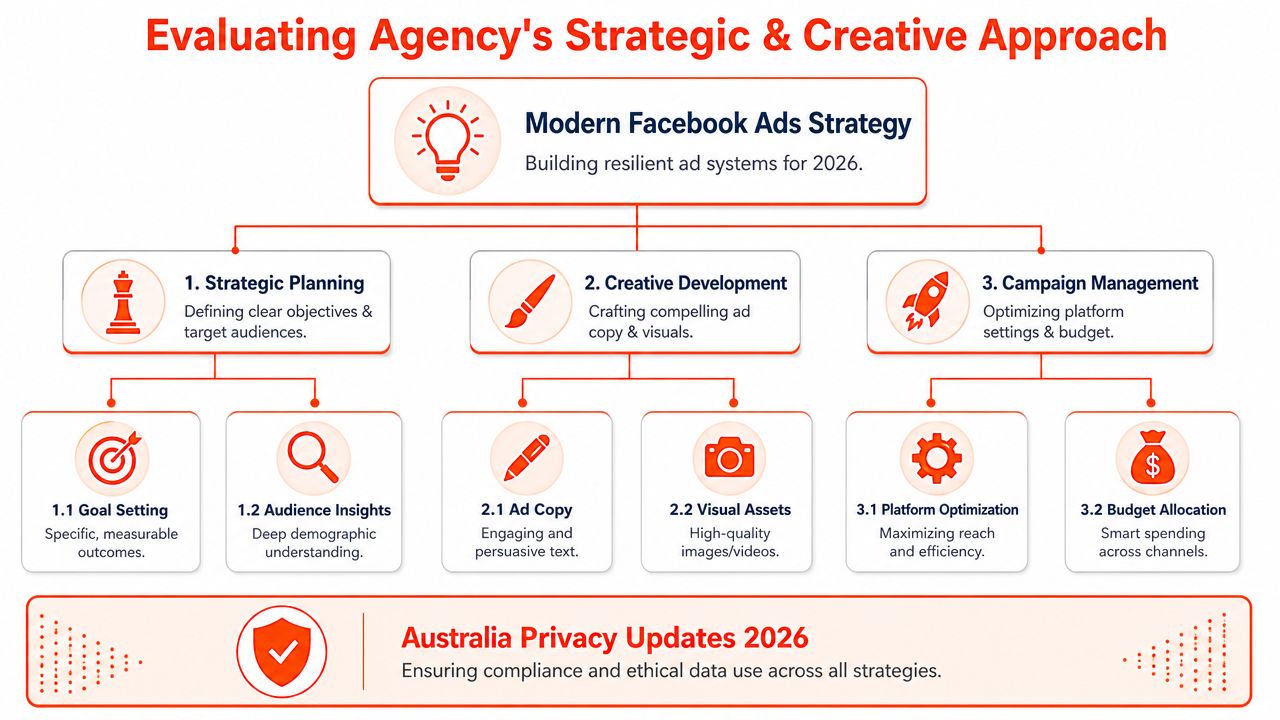
A capable Meta partner should be able to explain how its strategy connects audience inputs, creative testing, landing page experience, CRM feedback, and sales outcomes. If those pieces are handled separately, performance drifts fast, especially in accounts dealing with weaker attribution and AI-driven delivery.
What strategy should look like now
Privacy changes and automated campaign delivery have changed how Meta accounts need to be managed. Agencies that still pitch interest stacks as the main edge are relying on an older playbook. In many Sydney accounts, the key edge comes from stronger inputs: cleaner conversion signals, better creative, sharper qualification, and tighter feedback from the sales team.
Ask direct questions about how the agency works in that environment.
They should be able to explain:
- How they use first-party data from leads, customers, CRM stages, or closed-won records
- How they feed lead quality back into optimisation instead of treating every form fill the same
- How they structure creative testing across hooks, offers, formats, and buyer awareness levels
- How they read performance when Meta reporting, analytics, and internal sales numbers do not match perfectly
- How they use broad and AI-assisted delivery without giving up control of offer quality, exclusions, and conversion intent
The best answers are specific. Vague language usually means the agency is leaning on platform defaults and hoping the algorithm sorts it out.
Creative is where many accounts win or lose
A lot of underperforming campaigns are failing because the message is off, the offer is weak, or the ad promises one thing and the landing page asks for something else.
Good agencies have a repeatable creative process. They test different angles, qualify users before the click where possible, and review results against sales feedback, not just thumb-stopping rate or click-through rate. In lead generation accounts, that matters more than another round of audience tinkering.
Ask to see how they approach:
- Buying angles tied to real customer pain points
- Offer framing that filters low-intent enquiries
- Objection handling inside the ad, not only on the landing page
- Creative formats matched to the stage of awareness
- Ad-to-page continuity so the click has a clear next step
If every monthly update sounds like budget shuffles and one fresh image, the account is probably not learning much. Strong agencies have a testing roadmap. They can tell you what they are trying to learn, why it matters, and how that learning affects pipeline quality.
For local context on media economics, it helps to understand typical Facebook ad costs in Australia before judging whether an agency's testing plan is realistic for your budget.
Here's a quick visual summary of what a resilient approach should include.
What outdated thinking sounds like
Be cautious if you hear any of these in a pitch:
-
“We've got secret audiences.”
Durable performance rarely comes from hidden targeting tricks. It comes from better data, better offers, and better creative decisions. -
“We just let Meta handle everything.”
Automation can improve delivery, but someone still has to set conversion priorities, control lead quality, and fix weak inputs. -
“We can judge success from CPL.”
Cost per lead is only one signal. Cheap leads that never book, never qualify, or never close are expensive. -
“Reporting is all inside Ads Manager.”
That answer misses the real question. A serious agency should care about what happened after the lead hit your CRM.
The standard to use is simple. The agency should be able to show how strategy decisions improve lead quality, protect measurement where privacy has reduced visibility, and tie campaign activity back to actual commercial outcomes.
Comparing Agency Pricing and Setting a Realistic Budget
A Sydney business signs with an agency on a low monthly fee, spends hard for 90 days, and celebrates cheap leads. Then sales reviews the pipeline. Half the leads never answer. A chunk sit outside the service area. A few were duplicate enquiries already in the CRM. The agency did what the pricing model rewarded.
That is the actual budget conversation.
Agency pricing does not just affect what you pay. It affects how the account is managed, what gets prioritised, and whether anyone is accountable for revenue quality after the form fill.
The common pricing models
Each model creates different behaviour. Judge the commercial incentive first, then the fee level.
| Pricing model | How it works | Best fit | Main risk |
|---|---|---|---|
| Monthly retainer | Fixed management fee each month | Businesses that want predictable fees and steady service | Work can become maintenance-heavy if scope, testing volume, and reporting expectations are vague |
| Percentage of ad spend | Fee rises as spend rises | Brands increasing budget with a clear scaling plan | The agency has a financial reason to push spend higher, even when lead quality or margin is softening |
| Performance-based | Fee tied to outcomes | Businesses with reliable CRM data and agreed lead stages | Arguments start quickly if attribution is unclear or the sales team handles follow-up inconsistently |
| Hybrid | Base retainer plus performance component | Businesses that want strategic coverage plus outcome alignment | Contracts get messy if the definitions behind qualified lead, opportunity, or revenue are not nailed down |
No model is automatically better.
For Sydney lead generation accounts, the question is simple. Does the fee structure reward the agency for producing leads your sales team wants, or just more platform conversions?
Build the full budget, not just the ad spend line
Many businesses budget for media and ignore the costs that determine whether the media performs. That usually shows up later as weak creative, thin reporting, poor CRM feedback loops, or tracking gaps that make Meta look better than the business result.
A realistic budget usually needs four lines:
- Ad spend
- Agency management
- Creative production
- Landing page, CRM, or tracking work
If one line is underfunded, the whole account feels it. Cheap management often means slower testing, less scrutiny on lead quality, and generic reporting built around CPL. Overspending on media with poor creative usually drives frequency up before revenue improves.
If you need a practical reference point before signing, this breakdown of Facebook advertisements cost in Australia is useful for sense-checking how costs shift by objective and account type.
Match the model to your stage and data quality
Early-stage accounts usually benefit from a clear retainer and a defined test budget. At that point, the value is in diagnosis, setup discipline, offer testing, and fast feedback from sales. A performance deal sounds attractive, but it often creates noise when the account still has unresolved tracking issues.
Established e-commerce brands can make spend-linked or hybrid pricing work if attribution is reasonably clean and creative output is consistent. Even then, the agency should still be judged on margin, new customer quality, and blended performance, not just platform return.
Lead generation is where pricing mistakes get expensive. Sydney businesses with long sales cycles, call-based enquiries, or offline closes should be careful with pure cost-per-lead deals. They often reward volume over fit. If the agency cannot connect campaigns to qualified opportunities, booked jobs, or closed revenue, the pricing model is hiding risk rather than sharing it.
Privacy changes and AI-driven optimisation have made this sharper, not easier. Meta can optimise hard toward the signal it receives. If the only signal is a form completion, the platform will chase more form completions. If the signal includes qualified leads, offline conversions, or revenue-linked events, campaign behaviour improves. That takes setup work, CRM access, and agreement on what counts.
What to ask before you sign
Ask these questions in plain language:
- What result does your fee model reward you for improving?
- How do you separate cheap leads from qualified leads?
- What happens if sales says the lead quality is poor but Ads Manager says performance is strong?
- Can you report on pipeline contribution or revenue, not just CPL and ROAS?
- Who handles tracking fixes, offline conversion imports, and CRM feedback loops if attribution is incomplete?
Good agencies answer directly. Weak ones return to platform metrics because platform metrics are easier to defend.
One factual option in the Sydney market is Click Click Bang Bang, which offers Meta management alongside tracking setup, reporting, and a trial structure as part of its PPC service mix. That matters for businesses that want one team handling both campaign execution and measurement, rather than an agency that stops at ad buying.
Price matters. Incentives, measurement, and lead quality matter more.
What a Good Onboarding and Trial Period Looks Like
You sign the agreement on Friday. By Wednesday, ads are live, leads are coming in, and the agency says the account is "learning." Two weeks later, sales says the leads are junk, reporting is vague, and nobody can explain which conversions matter. That is poor onboarding dressed up as speed.
A good start is more deliberate. The agency should slow down the parts that affect lead quality, attribution, and decision-making later. In Sydney, that usually means getting clear on how your sales process works, where lead quality breaks down, and what data can be pushed back into Meta so the platform is not optimising toward the cheapest form fills.
What should happen before launch
The kickoff should involve the people who own revenue, not only the person who approved the proposal. For lead generation accounts, that often means marketing, sales, and whoever manages the CRM.
Early conversations need to answer a few practical questions:
- What counts as a qualified lead, not just a submitted lead
- Which conversion event should Meta optimise toward first
- How long does it take to know whether a lead had real sales potential
- Which offers are worth paid spend
- Who approves copy, creative, budget changes, and landing page edits
This stage also sorts out access and ownership. Business Manager permissions, pixel and dataset control, event priorities, CRM visibility, call tracking, and historical notes all need to be in place before campaigns go live.
A quick launch means very little if the account cannot tell the difference between a bad lead and a saleable one.
What setup quality looks like
Good onboarding includes technical checks that match how Meta operates under current privacy constraints. If attribution is weak, the platform will still optimise. It will just optimise against a weak signal.
Expect the agency to review:
- Event tracking across the actions that matter most
- Landing page continuity between the ad promise and the page experience
- CRM field hygiene so leads can be matched to outcomes later
- Offline conversion paths such as calls, booked appointments, or closed deals
- Creative inventory to confirm there is enough variation to test properly
This is also where a strong agency will explain trade-offs. In some accounts, instant forms produce cheaper lead volume but weaker downstream quality. In others, website conversions are the right choice, but only if the page loads fast, the form is usable on mobile, and tracking is configured properly. If the agency cannot explain that trade-off, they are still working at the level of platform mechanics, not business outcomes.
For ecommerce accounts, onboarding should also clarify how the business will judge return. If the team uses ROAS to measure ad profitability, everyone needs the same definition from day one, especially where repeat purchases, discounts, or assisted conversions distort the picture.
How to judge a trial period
A trial period should answer one question. Is this agency finding the truth fast enough to improve results?
The first few weeks will not tell you everything about long-term scale. They will tell you how the agency thinks. Strong teams identify broken pages, weak offers, messy tracking, and poor lead handling early. Weak teams stay inside Ads Manager and hope the numbers look good enough to avoid hard conversations.
Green flags during a trial:
- They pressure-test your definition of a good lead
- They show what is being tested, what has been ruled out, and why
- They ask for sales feedback and use it
- They separate early indicators from confirmed performance
- They explain attribution gaps instead of pretending they do not exist
Red flags are usually obvious once you know where to look:
- Lead volume is celebrated before lead quality is checked
- Spend allocation changes without a clear reason
- Sales feedback is treated as anecdotal and ignored
- Reports are full of Meta metrics but thin on business interpretation
- Nobody can say how closed revenue will be tied back to campaigns
What should be delivered early
The first phase should produce working assets, not just meetings and reassurance.
A capable agency usually delivers:
- A baseline audit with the main risks and opportunities
- A measurement map covering platform, website, CRM, and offline signals
- A testing plan for offers, audiences, and creative
- A documented KPI framework tied to qualified leads or revenue
- A regular review cadence with clear decisions and owners
Click Click Bang Bang is one Sydney example worth noting here because its PPC service includes both campaign management and tracking setup. That matters during onboarding. One team can own execution and measurement together, which reduces the usual handoff problems between media buying and analytics.
The trial period does not need perfect results. It needs evidence that the agency can diagnose problems accurately, set up measurement properly, and improve toward revenue, not just lead count.
Setting KPIs and a Reporting Cadence for Accountability
A Sydney business can spend for three months, see the lead count rise, and still have no clear answer to a simple question from the owner or CFO. Which campaigns produced revenue, and which ones just filled the pipeline with poor-fit enquiries?
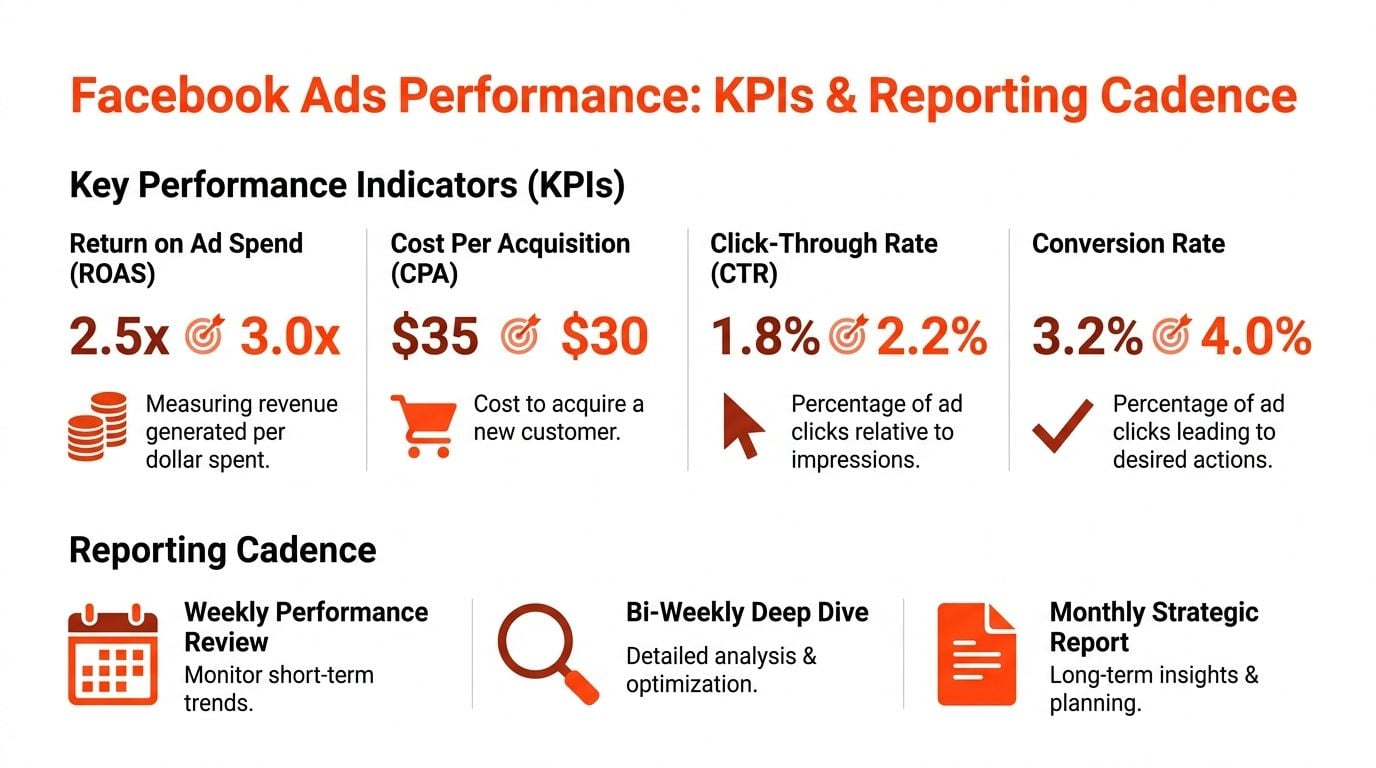
That usually happens because reporting is built around whatever Meta surfaces quickly, not around how the business makes money. Privacy restrictions, delayed attribution, offline sales steps, and AI-driven campaign automation have made that gap wider. If an agency cannot connect platform performance to sales reality, the report is only half useful.
Choose KPIs that connect to money
A workable KPI framework has three layers, and each one answers a different question.
| KPI layer | What it answers | Why it matters |
|---|---|---|
| Efficiency | Are we buying attention at a sensible cost? | Flags creative fatigue, weak click-through, or auction pressure early |
| Conversion | Are people taking the next step after the click? | Shows whether the offer, form, and landing page are doing their job |
| Commercial outcome | Are these leads or sales turning into profit? | Keeps the agency focused on qualified demand, not just cheap volume |
The mistake I see often is treating top-of-funnel numbers as proof of success. Click-through rate, cost per click, and on-platform leads matter, but only as leading indicators. They help diagnose what is happening inside the account. They do not tell you whether the sales team is getting the right enquiries, whether those leads are progressing in the CRM, or whether the business can scale spend without hurting margin.
If your internal team uses ROAS in reviews, agree on the definition before the first monthly meeting. A practical guide to what ROAS means for paid media reporting helps avoid the usual mismatch between marketing, finance, and sales. Some teams mean platform-attributed revenue. Others mean invoiced revenue. Those are different numbers, and they lead to different decisions.
Reporting should support decisions
A useful report gives context, not a screenshot export from Ads Manager.
It should answer five questions:
- What changed
- Why it likely changed
- What the agency tested
- What sales or CRM feedback says about lead quality
- What decision gets made next
That fourth point is where weak reporting usually falls apart. If the agency cannot tell you which campaigns produce booked jobs, sales-qualified leads, or opportunities that progress past first contact, accountability stays shallow. Sydney service businesses, education providers, clinics, and B2B firms all feel this differently, but the pattern is the same. High lead volume can hide poor commercial performance for weeks.
Set a cadence that matches your sales cycle
Weekly reporting should cover spend pacing, delivery problems, broken forms, tracking issues, and any sudden efficiency changes. Keep it operational.
Fortnightly reviews are a better place for creative analysis, audience quality, and sales feedback. By then, patterns start to appear. You can compare lead sources, check call outcomes, and spot whether Meta's optimisation is drifting toward easier but weaker conversions.
Monthly reviews should tie media performance to pipeline and revenue where possible. That includes attributed sales, qualified lead rates, conversion lag, and any gap between Meta-reported results and CRM reality. A good agency will not hide that gap. It will explain where privacy limitations, offline conversions, consent settings, or delayed sales stages are affecting visibility.
Hold the agency accountable for what it can influence
The agency should own media buying, testing discipline, tracking within scope, and honest interpretation. It should also raise issues fast if poor lead handling, slow follow-up, or CRM problems are dragging results down.
That distinction matters. A media team cannot fix a sales desk that calls web leads two days late. It can show you the commercial cost of that delay and adjust optimisation around the actual constraints.
Click Click Bang Bang is one Sydney example worth noting here because its PPC service includes tracking and reporting alongside campaign management. That setup makes accountability cleaner. The same team can trace how spend, lead quality, and recorded outcomes line up, instead of passing measurement problems between separate media and analytics providers.
The standard is simple. Ask for reporting that shows lead quality, revenue signal quality, attribution limits, and next actions in plain language. If an agency cannot explain how Meta performance connects to closed business in a privacy-constrained market, it is not giving you enough to manage spend confidently.
Read NeXt
Or Read Our Latest
- Data Privacy Compliance: 2026 Guide for Marketers
- Your 2026 Remarketing Campaign Strategy Blueprint
- Customer Lifetime Value: Calculate & Increase It in 2026
- Contextual Targeting Advertising: A Guide for 2026
- Best Seo Agency Australia Guide 2026
- Cross Domain Tracking: A Practical Guide for GA4 in 2026
Click. CLick. Subscribe.
Get our best PPC insights, industry updates, and power moves delivered straight to your inbox. No fluff, just high-caliber strategies that actually work.
Don’t Leave Just Yet
Try Us For 30-Days,
Risk Free!!
We guarantee that you’ll love our work within the first 30 days, if not you’ll get your money back.
What have you got to lose?