

Choosing Digital Marketing Agencies That Deliver Growth
Last Updated

Think of your business as a ship, ready to set sail. The digital ocean is vast, its currents are always changing, and your destination is a market full of ideal customers. A digital marketing agency is your expert crew and seasoned captain, specialising in charting that course. They're the ones who turn clicks into conversations and prospects into loyal advocates.
Your Strategic Growth Partner Online
At its heart, a digital marketing agency is much more than a service provider—it’s a strategic partner in your growth. Their whole mission is to bridge the gap between your business and the people who need you most. It's about making sure you're not just visible online, but that you're genuinely connecting with your audience.
Imagine trying to shout your message from a street corner versus having a powerful, targeted broadcast system that reaches exactly the right homes. That broadcast system is what a good agency builds. They don't just make noise; they craft precise messages and deliver them through the most effective channels to get you real, measurable results.
Moving Beyond Simple Tasks
It's a common mistake to think agencies just handle simple tasks, like posting on social media or running a few ads. And while those things are part of the job, their real value is in the strategy that drives every single action.
They act as an extension of your own team, bringing a wealth of specialised knowledge that's incredibly difficult and expensive to build in-house. It’s a partnership. They start by understanding your unique business goals and then design a custom plan to hit them.
The best agency relationships are true partnerships. They succeed when there's shared accountability, clear communication, and a mutual commitment to hitting specific business outcomes—not just ticking off a checklist of marketing activities.
The industry's explosive growth shows just how much businesses value this kind of expert guidance. The Australian digital marketing agency market has ballooned to an estimated USD $13.03 billion. A big driver of this is the smart use of technology like AI, which can help slash customer acquisition costs by nearly 50%. This makes agencies an increasingly vital partner for getting the best possible return on your investment. You can find more insights on this growth over at Expert Market Research.
The Core Functions of an Agency
When you boil it all down, these agencies serve a few critical functions that most businesses need to thrive. They work to:
- Increase Your Online Visibility: Making sure your brand shows up right when potential customers are searching for the solutions you offer.
- Generate Qualified Leads: Attracting people who are genuinely interested in what you sell, not just random website traffic.
- Drive Sales and Revenue: Turning those leads into paying customers and proving a clear return on your marketing spend.
- Build Brand Authority: Establishing your business as a trusted, credible voice in your industry.
By handling these complex tasks, they free you up to focus on what you do best—running your business. This partnership sets the stage for sustainable growth, giving you a skilled crew to navigate the digital world.
A Look Inside the Agency Toolkit
A top-tier digital marketing agency doesn’t just offer a list of services; they wield a versatile toolkit where each tool has a specific job in building your brand. These aren’t standalone tactics you can just pick and choose from. Instead, think of them as interconnected parts of a well-oiled machine, all working together to drive growth.
Getting your head around these core functions is the first step to seeing how a powerful, cohesive strategy actually comes to life.
This infographic gives you a bird's-eye view of the role an agency plays, acting as the strategic bridge between your business goals and your future customers.
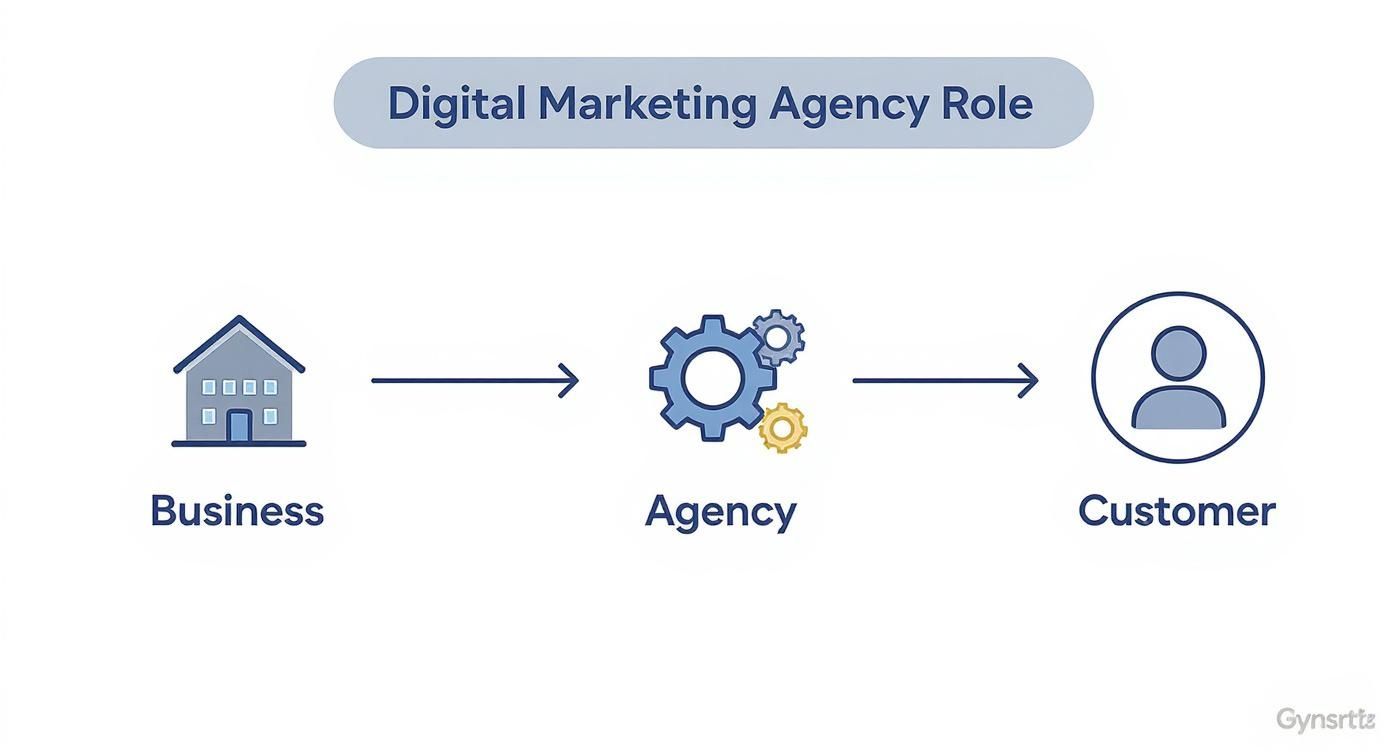
What it really shows is how an agency translates your objectives into actions that customers respond to, turning your ambitions into measurable results. It’s in this translation process that their specialised tools become absolutely essential.
To give you a clearer picture, let's break down the most common tools in an agency’s arsenal. The table below outlines what each service is, what it’s trying to achieve, and how success is typically measured.
A Look Inside the Agency Toolkit
| Service | Primary Goal | Key Performance Indicators (KPIs) |
|---|---|---|
| Search Engine Optimisation (SEO) | Improve organic visibility in search results and attract high-intent traffic over the long term. | Keyword Rankings, Organic Traffic, Click-Through Rate (CTR), Backlink Quality |
| Pay-Per-Click (PPC) Advertising | Drive immediate, targeted traffic to a website and generate leads or sales quickly. | Cost Per Click (CPC), Conversion Rate, Return on Ad Spend (ROAS), Cost Per Acquisition (CPA) |
| Social Media Marketing (SMM) | Build a community, increase brand awareness, and engage directly with the target audience. | Engagement Rate (Likes, Comments, Shares), Follower Growth, Reach, Social Referrals |
| Content & Email Marketing | Nurture leads, build trust and authority, and maintain a direct line of communication with customers. | Email Open Rate, Click-Through Rate (CTR), Content Downloads, Time on Page, Lead Nurturing Conversions |
Each of these disciplines plays a unique role, but their real power is unlocked when they work in concert. Now, let’s explore what each of these services actually involves.
Search Engine Optimisation (SEO): The Foundation for Visibility
Think of SEO as building the best-looking, most accessible storefront on the busiest high street in the digital world—the Google search results page. It’s the long game, a strategy designed to make sure you show up the moment a potential customer starts looking for exactly what you offer. This isn’t about quick tricks or shortcuts; it’s about earning trust with search engines.
A digital marketing agency will break SEO down into a few key areas to build this foundation:
- On-Page SEO: This is all about optimising the bits and pieces on your actual website—your content, keywords, headlines, and site structure—to make it crystal clear to search engines what you're all about.
- Off-Page SEO: This focuses on building your website's authority and reputation across the web. The main currency here is earning high-quality backlinks from other reputable sites, which act like votes of confidence.
- Technical SEO: This is the nuts and bolts stuff. It’s about ensuring your site is fast, secure, mobile-friendly, and easy for search engine crawlers to read and index. It removes any technical roadblocks that could hold you back.
The commitment to this discipline is surging. Australian businesses are on track to spend an estimated $1.5 billion on SEO services, a number that screams just how vital it has become. Even small businesses are dedicating serious resources, with average monthly spends hovering around $1,200, proving that strong organic visibility is no longer a nice-to-have. You can dig into more of these local market trends on localdigital.com.au.
Pay-Per-Click (PPC) Advertising: The Engine for Immediate Traffic
While SEO is the long-haul marathon, Pay-Per-Click (PPC) advertising is the sprint. It’s the engine you fire up to generate immediate traffic and leads by placing targeted ads right at the top of search results and across other online platforms. You bid on specific keywords, and you only pay your toll when someone actually clicks your ad.
This direct approach allows an agency to be incredibly precise. They can target people based on what they search for, where they live, their age, and even their recent browsing habits. It's the digital equivalent of putting up a billboard right in front of someone the exact moment they think, "I really need a new pair of running shoes."
A well-managed PPC campaign isn't about having the biggest budget. It's about spending your budget the smartest way—by reaching the right people with the right message at the right time to get them to take action.
To make every dollar work harder, many agencies use advanced tools and strategies like marketing automation for agencies to manage their Google Ads campaigns. This helps with better targeting, automated bidding, and more effective lead management, ensuring your ad spend is always pulling its weight.
Social Media Marketing: The Megaphone for Community Engagement
If SEO builds your storefront and PPC drives traffic to it, Social Media Marketing (SMM) is the town square. It’s where you build a community, join conversations, and give your brand a human voice. This is so much more than just posting company updates; it’s about creating real, authentic connections.
An agency’s SMM playbook usually includes:
- Platform Selection: Figuring out which platforms your target audience actually uses. There's no point shouting into the void on Meta if your customers are all on LinkedIn.
- Content Creation: Developing engaging content that people want to see—from videos and articles to interactive polls—that genuinely resonates with your community.
- Community Management: Actively responding to comments, messages, and reviews. This is how you foster a loyal following that feels heard.
- Paid Social Advertising: Using the powerful targeting tools on social platforms to run ads that drive awareness, generate leads, or make sales.
This discipline requires a deep feel for audience behaviour and what's trending to turn passive followers into genuine advocates for your brand.
Content and Email Marketing: The Nurturing System
Finally, we have content and email marketing. These are the nurturing systems that gently guide potential customers along their journey with you. Let’s be real: not everyone who lands on your website is ready to buy on the spot. Content marketing is about providing value upfront to establish your brand as a helpful, trusted authority.
Think of valuable blog posts, how-to guides, or insightful videos. This is the stuff that attracts people to your brand and builds trust long before they pull out their credit card.
Email marketing then takes the baton, allowing you to maintain that connection directly. By sending personalised, relevant messages to different segments of your audience, you can nurture leads over time, guiding them from casual interest to a final purchase and, hopefully, repeat business. It’s the one-to-one conversation that keeps your brand top-of-mind.
Together, these services form a powerful, integrated system designed for one thing: growth.
The Real Business Case for Hiring an Agency

Sooner or later, most business owners ask the big question: "Why not just do all this marketing stuff myself?" It's a fair point. But the real value of a digital marketing agency goes way beyond just getting tasks done.
Partnering with an agency isn’t about outsourcing work—it’s about importing a battle-tested team, gaining access to powerful resources, and securing a strategic advantage that would be incredibly expensive and time-consuming to build from the ground up.
Think of it this way: you could learn to build a house yourself. You could study foundations, framing, plumbing, and electrical wiring. But imagine the time, the cost of specialised tools, and the very real risk of making a catastrophic mistake. An agency is your team of master builders. They're the specialised plumbers, electricians, and carpenters who already have the best gear and years of experience building things that don't fall over.
Instant Access to Specialised Skills and Tools
When you bring an agency on board, you instantly get a full crew of specialists. You’re not just hiring a “social media person.” You’re getting a strategist, a copywriter, a designer, and a data analyst who live and breathe this work, day in and day out. Trying to hire that level of talent individually is often out of reach for most businesses.
This team also comes equipped with an arsenal of professional-grade tools. We’re talking about the heavy-duty analytics platforms, competitor research software, and automation systems that give you a serious edge. Subscriptions for these tools alone can run into thousands of dollars every month.
Partnering with an agency allows you to effectively rent an entire team of seasoned experts and their high-powered toolkit for less than the cost of hiring a single senior-level marketing manager.
It’s a smart financial move that turns a massive potential capital outlay into a predictable, manageable operational cost.
Uncovering Blind Spots with an Objective Viewpoint
It’s incredibly easy to get tunnel vision when you’re deep in the day-to-day of your own business. You know your products and services inside and out, but that closeness can create major blind spots.
You might be overlooking a huge market opportunity or sticking with a tired strategy just because "it's how we've always done it."
An external agency brings a fresh, objective pair of eyes. They aren’t tangled up in internal politics or held back by old habits. Their analysis is driven by one thing: data. This allows them to spot weaknesses and uncover opportunities that an internal team, no matter how dedicated, might completely miss.
Scalability and Focus for Business Growth
As your business grows, your needs change. A sudden market opportunity might demand you ramp up your ad spend overnight. A new product launch could require a massive content push. An in-house team often struggles to keep up with these sudden shifts.
Digital marketing agencies, on the other hand, are built for this. They can allocate more resources to your account whenever needed, letting you pivot and pounce on opportunities without the slow, painful process of hiring.
Ultimately, this frees you and your core team up to focus on what you do best: running and growing your business. For new businesses, understanding the sheer scope of digital marketing for small business often makes the value of a scalable, expert team crystal clear.
Finding the Right Agency for Your Business

Choosing a digital marketing agency is a massive decision, not just another line item in your budget. Think of it as finding a partner to help steer your ship, not just a vendor you hire to hoist the sails. The right partnership can ignite serious growth, while a bad one will burn through your time and money with little to show for it.
The whole process demands a methodical approach. You have to look past the flashy sales decks and get to the core of what an agency can actually deliver. And it all starts with getting crystal-clear on your own business before you even think about sending that first email.
Define Your Goals and Budget First
Before you can find the right partner, you need to know your own destination. What does success really look like for you? Vague goals like "get more traffic" just won't cut it. You need to get specific.
Are you trying to boost online sales by 20% in the next six months? Do you need to generate 50 qualified leads per month for your hungry sales team? Or maybe the goal is to carve out brand authority in a completely new market?
Your specific, measurable goals are the compass for your entire search. They will help you identify which types of digital marketing agencies have the right expertise and will form the basis of how you measure their success down the line.
Your budget is just as crucial. Knowing what you can realistically invest helps narrow down the field from the get-go. Be ready with a clear monthly figure, as it’s one of the first questions any reputable agency will ask.
Vet Potential Partners Like a Pro
Once you've got a shortlist of agencies, it's time to start digging. This is the vetting process, where you separate the genuine experts from the slick talkers. Don't be afraid to ask the tough questions and demand concrete proof of their chops.
Start by examining their past work with a critical eye.
- Analyse Case Studies: Look for examples of work they've done for businesses similar to yours—in industry, size, and goals. A solid case study won't just look pretty; it will clearly outline the problem, the strategy they implemented, and the measurable results (e.g., "increased organic traffic by 150%").
- Speak with Current Clients: Ask for references and actually call them. This is non-negotiable. Ask about the agency's communication, their transparency, and their ability to deliver on promises. A great question to ask is, "What's been the most challenging part of working with them?"
- Understand Their Reporting Process: How do they measure success, and how will they show it to you? Ask to see a sample report. It should be clear, easy to understand, and focused on the metrics that actually matter to your business goals—not vanity metrics like impressions or likes.
Ask the Tough Questions During Consultations
Think of your initial consultations as an interview—you're interviewing them just as much as they're qualifying you. This is your chance to gauge their strategic depth and see if they're a good cultural fit. The goal is to find a team that feels like a genuine extension of your own.
To make sure you cover all the important bases, here are the key questions and criteria to have ready when you're evaluating potential agencies.
Your Agency Vetting Checklist
| Evaluation Area | What to Look For | Red Flags to Avoid |
|---|---|---|
| Strategic Approach | They ask deep questions about your business, customers, and profit margins. | They jump straight to tactics without understanding your business goals. |
| Team & Expertise | You know who will be working on your account and their level of experience. | Vague answers about who will be doing the actual work or a high staff turnover rate. |
| Communication & Transparency | They propose a clear communication schedule (e.g., weekly updates, monthly reports). | Unclear reporting, jargon-filled explanations, or an unwillingness to share data. |
| Contracts & Pricing | Clear, straightforward pricing with no hidden fees. Flexible, performance-based terms. | Long, inescapable lock-in contracts and vague pricing structures. |
| Cultural Fit | They seem genuinely invested in your success and communicate in a way that works for you. | They feel like a disconnected vendor who just wants to check boxes. |
The right agency will be able to answer these questions with confidence and clarity. They'll show a genuine interest in your business and be totally transparent about their processes and pricing.
For certain specialisations, like paid advertising, a focused vetting process is even more critical. Learning how to choose a PPC agency that won’t waste your budget can give you a great framework for evaluating any specialist partner you're considering.
Ultimately, trust your gut. The data, case studies, and references are all essential, but a strong partnership also relies on good chemistry. You're looking for a team you can collaborate with, trust, and grow alongside for years to come.
What’s Next for Digital Marketing Agencies?
https://www.youtube.com/embed/yYOtMdRPwLE
The relationship between a business and its marketing agency is always evolving, pushed along by shifts in technology and how we all behave online. To get lasting value from a partnership, you need an agency that isn't just keeping up with these changes, but is already skating to where the puck is going.
Right now, three big forces are shaping the future of our industry: the practical, everyday use of Artificial Intelligence; the necessary pivot to privacy-first marketing; and a growing hunger for content that feels real. The best agencies are already building their strategies around these pillars, making sure their clients don't just survive, but thrive.
AI Gets Down to Business
Artificial Intelligence has finally moved out of the "buzzword" phase and into the trenches. It’s now a core tool that lets agencies deliver incredibly personalised customer experiences at a scale we could only dream of a few years ago. It’s not about replacing human creativity; it’s about giving it a massive data-fuelled upgrade.
When we talk about the future, conversations around how AI is redefining advertising for marketing agencies are front and centre. AI helps us predict what a customer might do next, automates the tedious parts of optimising a campaign, and pulls out hidden gems of insight from mountains of performance data. This lets us be proactive instead of just reacting to last week's numbers.
The real magic of AI in an agency is its ability to sift through enormous datasets to find the quickest, most effective path to a customer. Think of it as giving your strategist a super-powered compass that points directly to the biggest opportunities.
This shift means agencies can now craft campaigns that feel less like a sales pitch and more like a helpful, timely piece of advice. It transforms marketing from a loud, one-to-many broadcast into a series of precise, one-on-one conversations that build real customer relationships.
Thriving in a Privacy-First World
The slow fade-out of third-party cookies is forcing everyone to fundamentally rethink how brands connect with people online. Agencies that once leaned heavily on cookie-based tracking are now shifting gears, building new strategies founded on consent and the data customers give them directly. This privacy-first approach isn't just a box-ticking exercise anymore—it's essential for building trust.
This new reality means prioritising a few key areas:
- First-Party Data Collection: Building direct relationships with customers to ethically gather data through things like email sign-ups, loyalty programs, and interactive website content.
- Contextual Advertising: Placing ads based on what’s on the webpage itself, not a user’s creepy-feeling browser history. This keeps ads relevant without crossing a privacy line.
- Community Building: Creating engaged communities on social platforms where people willingly share their interests because they feel part of something.
The continued strength of social media in Australia underscores just how important these owned channels are. For instance, X (the platform formerly known as Twitter) still has a significant footprint, with an advertising reach hitting 19.6% of the population—that's about 5.25 million users. With 24.6% of Australian adults on the platform, it remains a vital space for agencies to build that direct community engagement.
The Unstoppable Demand for Authenticity
At the end of the day, people are just plain tired of polished, impersonal corporate jargon. The future belongs to brands that speak like real humans and offer content that's genuinely valuable or immersive. This means stepping away from the hard-sell tactics and leaning into storytelling that creates a real emotional connection.
Modern agencies are becoming experts in this kind of authentic content. They're focusing on user-generated posts, sharing behind-the-scenes glimpses, and partnering with creators who actually align with a brand's values. The goal isn't just to make a sale, but to build a brand that people not only buy from but truly believe in. An agency that gets this is an agency that's ready for what's next.
Common Questions About Working With an Agency
Deciding to partner with a digital marketing agency is a big move, and it's completely normal to have questions. Getting straight answers is the only way to move forward with confidence and make sure everyone’s on the same page from day one.
Below, we’re tackling some of the most common queries business owners have, breaking down the practical details of pricing, timelines, and what a genuinely successful client-agency relationship should feel like.
How Much Should I Expect to Pay?
This is always the first question, and the honest answer is: it really depends. Agency costs are tied directly to the scope of work you need. For a single service like SEO or social media management, a small business in Australia might invest somewhere between $1,500 and $5,000 per month.
If you're looking for a more comprehensive, multi-channel strategy involving PPC, SEO, and content marketing, a mid-sized company could see costs ranging from $5,000 to $20,000+ monthly.
The crucial thing is to shift your mindset from pure cost to value and return on investment (ROI). A great agency won't shy away from the money talk; they’ll be completely transparent about their pricing and will tie their fees directly to the business results they plan to deliver.
How Long Until I See a Return on My Investment?
The timeline for seeing results hangs entirely on the strategy being used. Some tactics give you almost instant feedback, while others are a slow burn, building momentum over time.
-
Short-Term Wins: With Pay-Per-Click (PPC) advertising, you can see new traffic and leads hitting your site almost immediately after a campaign goes live. You're essentially paying for premium placement, so the results are fast.
-
Long-Term Growth: Foundational strategies like Search Engine Optimisation (SEO) and content marketing are about building a sustainable asset for your business. It typically takes a good 4-6 months to see significant, measurable gains in organic search rankings and traffic.
A trustworthy agency will manage your expectations right out of the gate. They'll give you a realistic roadmap that outlines both the quick wins to get the ball rolling and the long-term goals that will drive sustainable growth.
What Information Should I Have Ready Before I Talk to an Agency?
To make that first conversation as productive as possible, it helps to come prepared. The more clarity you can provide, the faster an agency can figure out if they're the right fit and how they can best help you.
Having a clear picture of your goals, audience, and budget allows an agency to skip the guesswork and start building a strategy that is tailored, effective, and perfectly aligned with your business objectives from the very first call.
Before your meeting, try to get a handle on the following:
- Your Core Business Goals: Be specific. Instead of "more sales," think "increase online revenue by 20% in the next quarter."
- Your Ideal Customer Profile: Who are you actually trying to reach? The more detail, the better.
- A Realistic Marketing Budget: Know what you're prepared to invest on a monthly basis.
- Past Performance Data: If you have access to website analytics or previous campaign reports, have them handy.
Doing this homework allows digital marketing agencies to quickly get up to speed and propose a strategy with a much higher chance of hitting the mark.
What Does a Good Agency Partnership Look Like?
A strong, productive partnership is always built on transparency, open communication, and shared goals. Your agency should feel less like an outside vendor and more like a dedicated extension of your own team.
You should expect regular reporting that's easy to understand and focuses on the Key Performance Indicators (KPIs) that actually matter to your business growth. A great partner doesn't just send reports; they provide proactive communication and strategic insights that go beyond the numbers. This includes a deep understanding of how to measure advertising effectiveness in a way that connects campaign data directly to your bottom line.
Ultimately, it’s a team effort. A good partnership isn't just about getting a PDF in your inbox each month; it's about working together to solve business challenges and achieve measurable, meaningful success.
Ready to see what a data-driven, results-focused agency can do for you? At Click Click Bang Bang, we specialise in precision PPC and AI-first SEO campaigns that deliver real growth. Explore our services and start your risk-free trial today!
Read NeXt
Or Read Our Latest
- Manual vs Automated Bidding for PPC Success
- Conversion Tracking Setup: A Complete AU Guide
- Instagram Advertising Australia: Complete 2026 Guide
- Pay Per Click: A Beginner’s Guide for Australian Marketers
- Display Advertising on Google: The Complete Australian Guide
- Stakeholder Communication Plan How to Build One That Works
Click. CLick. Subscribe.
Get our best PPC insights, industry updates, and power moves delivered straight to your inbox. No fluff, just high-caliber strategies that actually work.
Don’t Leave Just Yet
Try Us For 30-Days,
Risk Free!!
We guarantee that you’ll love our work within the first 30 days, if not you’ll get your money back.
What have you got to lose?