

Boost Your Store with an ecommerce seo agency
Last Updated

An ecommerce SEO agency isn't just another vendor; they're a specialist partner laser-focused on one thing: driving qualified, organic traffic to your online store to increase revenue. They eat, sleep, and breathe the unique technical headaches of ecommerce platforms, from optimising thousands of product pages to making sure your site shows up when customers are actually ready to buy.
The right agency acts as a strategic growth engine for your business, connecting SEO performance directly to sales.
Why Your Store Needs a Specialist Agency

Let's be blunt: the Australian ecommerce market is crowded. It's exploded in recent years, making it fiercely competitive. Generic, one-size-fits-all SEO strategies just don't cut it anymore. Online stores have too many unique complexities, which is why hiring an expert ecommerce SEO agency has become a necessity for survival and growth, not a luxury.
The numbers don't lie. The Australian eCommerce sector has seen incredible growth, with 17.08 million Australian shoppers hitting up online stores every month in 2024. That’s a massive 45% jump from the 11.78 million we saw back in 2020, and it's fundamentally changed the game for local businesses.
Navigating Unique Ecommerce Challenges
An online store is a different beast to a simple brochure website. It's a complex beast, often with hundreds or even thousands of product pages, category pages, and filtered navigation (facets) that can quickly spiral into a technical SEO nightmare if you don't know what you're doing. A specialist agency lives and breathes these specific issues.
Here's where a specialist really earns their keep:
- Taming Site Architecture: They know how to structure your site logically to dodge common traps like duplicate content and keyword cannibalisation. This ensures search engines can crawl and index your most important pages without getting confused.
- Perfecting Product Schema: Properly implementing advanced structured data (schema markup) for products is non-negotiable. This is what gets you those eye-catching rich snippets in search results—the ones showing prices, stock levels, and star ratings—that can seriously boost click-through rates.
- Mastering Mobile-First Indexing: With most shoppers browsing on their phones, a flawless mobile experience is everything. An expert agency obsessively optimises your site for mobile users, from page speed to navigation, because they know Google does too.
The real value of an ecommerce-focused agency is their ability to connect SEO efforts directly to your bottom line. They think beyond rankings and traffic, focusing on attracting qualified visitors who are ready to convert into paying customers.
A Partner Focused on Revenue Growth
At the end of the day, you're not just trying to get more visitors; you're trying to get more sales. A generalist agency might pop the champagne over a traffic spike, but an ecommerce specialist knows that if that traffic isn't converting, the strategy has failed.
They dig deep into your analytics to understand user behaviour, optimise conversion pathways, and track the metrics that actually matter—like organic revenue and return on investment. The best https://clickclickbangbang.com.au/ecommerce-seo-services/ become an extension of your team, dedicated to driving tangible financial results.
A specialist agency also keeps you ahead of the curve. They're not just up on current best practices; they understand how emerging trends like AI's impact on online shopping will shape future strategies, making sure your store stays competitive for the long haul.
How to Vet an Agency's Ecommerce Expertise
Just because a company has "SEO agency" in its name doesn't mean they know the first thing about the messy, complex world of online retail. A true ecommerce SEO agency has a very specific set of skills that go way beyond general search optimisation. Your job is to cut through the sales pitch and see if they have the battle-tested experience your store needs.
Kick things off by digging into their case studies. Don't just settle for glossy testimonials on their website. Ask for concrete examples of stores they've worked with that are similar to yours. Are they on the same platform, like Shopify or Magento? Do they sell in a similar product niche? Proven success in a related field is one of the strongest signals you'll get.
Look for Specific Technical Skills
An agency's real expertise shows up when you start talking about the technical headaches unique to ecommerce. These aren't just buzzwords; they're the critical functions that can make or break your store’s performance in search results.
When you're talking to them, probe their knowledge on these specific points:
- Faceted Navigation Management: Ask them how they stop the thousands of filtered URLs (e.g., by size, colour, brand) from creating a massive duplicate content issue that tanks your rankings. A competent agency will start talking about canonical tags,
robots.txtdirectives, or strategically usingnofollowattributes. If they look confused, that's a red flag. - Advanced Structured Data: Go beyond basic product schema. Ask if they have experience implementing more advanced markup like
OfferShippingDetailsfor delivery times orReviewschema to pull those valuable star ratings into the search results. This is the stuff that makes your listings pop. - International SEO Execution: This is completely non-negotiable if you sell globally. Quiz them on their approach to
hreflangtags, ccTLDs versus subdirectories, and how they manage currency and language variations without cannibalising their own rankings across different regions.
A genuine ecommerce specialist won't just talk about "optimising pages." They'll speak the language of inventory feeds, crawl budget management for massive sites, and optimising category pages for transactional intent. Their entire focus will be on driving revenue, not just traffic.
Analyse Their Strategic Approach
Beyond the technical nitty-gritty, you need a partner who thinks strategically about your business goals. A top-tier ecommerce SEO agency will want to know about your profit margins, best-selling products, and customer lifetime value. This commercial awareness is what separates a technician from a true growth partner.
They should be able to lay out a clear strategy that connects their proposed SEO activities directly to your revenue targets. For instance, they might suggest focusing on high-intent, long-tail keywords for your niche products first. Why? Because those often have higher conversion rates, delivering quick wins while they build authority for your more competitive, high-volume terms. That kind of prioritisation shows they get how to generate a positive return on your investment.
Ultimately, vetting an agency is all about finding proof of deep, practical experience. To get a better sense of what modern strategies look like, you can explore comprehensive guides on search engine optimisation that cover today's best practices. Your goal is to find a partner whose expertise is obvious in both their past results and their forward-thinking strategy for your brand.
What to Expect From Your SEO Partnership
So, you’ve decided to bring an eCommerce SEO agency on board. What happens next? What do they actually do? This isn't just a transaction where you get a monthly report; it's a dynamic partnership that zeroes in on three core pillars: your site's technical health, its on-page relevance, and its off-page authority.
Right out of the gate, expect your new partners to do a deep dive into the technical guts of your store. This isn't a quick once-over; it’s a full-blown audit designed to uncover every single issue holding you back from ranking higher. They'll be looking at everything from optimising your site speed and ensuring flawless mobile performance to building a clean XML sitemap. The goal is to make it incredibly easy for search engines to crawl and index every valuable product and category page you have.
On-Page Optimisation and Authority Building
Once the technical foundation is solid, the focus shifts to what your customers see and experience. Your agency will roll up its sleeves and get stuck into extensive keyword research, figuring out the exact phrases and questions your ideal customers are typing into Google.
From there, they'll meticulously optimise your most important pages—your categories and products. This involves rewriting titles to be more compelling, crafting product descriptions that both sell and satisfy search engines, and structuring your content in a way that perfectly matches what the user is looking for.
At the same time, they'll be working on building your store's authority in the eyes of Google. This is probably the most misunderstood part of SEO. It’s all about earning high-quality backlinks from reputable, relevant websites in your niche. Think of each link as a powerful vote of confidence. A single great link from an influential blog can do more than just boost your rankings; it can drive real referral traffic and, more importantly, sales.
If you're curious about how a top-tier agency organises this kind of work behind the scenes, you can get a glimpse into a comprehensive agency workflow for digital marketing to understand the operational side of things.
Moving Beyond Vanity Metrics
A crucial part of any good SEO partnership is learning to separate the signal from the noise. An experienced eCommerce SEO agency will guide you away from distracting "vanity metrics" and get you focused on the Key Performance Indicators (KPIs) that actually move the needle for an online store. It's easy to get excited about a jump in raw traffic, but that’s not the whole story.
Don't get distracted by a spike in overall traffic. The real goal is attracting visitors with commercial intent—people who are actively looking to make a purchase. Success isn't just more visitors; it's more customers.
Your reports and strategic conversations should be laser-focused on tangible business outcomes that directly impact your bottom line.
To help clarify this, here’s a quick breakdown of what you should be tracking versus what you should be wary of.
Essential KPIs vs Vanity Metrics for eCommerce SEO
| Metric Type | Example Metric | Why It Matters (or Doesn't) |
|---|---|---|
| Essential KPI | Organic Revenue | The ultimate scoreboard. This is the actual dollar amount generated directly from your SEO efforts. If this isn't growing, nothing else matters. |
| Vanity Metric | Overall Traffic | A big number can feel good, but if it's not qualified traffic with buying intent, it doesn't contribute to sales and can be misleading. |
| Essential KPI | Organic Conversion Rate | Shows if you're attracting the right kind of traffic. A healthy conversion rate means your SEO is bringing in people ready to buy. |
| Vanity Metric | Total Keyword Rankings | Ranking for thousands of keywords is useless if they're irrelevant or have no commercial value. Quality over quantity is key here. |
| Essential KPI | Rankings for "Money" Keywords | Tracking your position for high-intent terms like "buy [product]" is far more valuable. These are the keywords that drive sales. |
Focusing on these essential KPIs creates a partnership built on genuine accountability. By setting clear, revenue-focused goals from the start, you ensure your agency's success is directly tied to your store's financial growth. It keeps everyone aligned and working towards what truly counts: driving real, bottom-line results.
Decoding Australian Agency Pricing Models
Figuring out the financial side of hiring an ecommerce SEO agency can feel a bit like cracking a code. Prices and models are all over the map, but if you get your head around the common structures here in Australia, you'll be in a much better position to find a partner that fits your budget and goals.
Most agencies you'll talk to work on one of a few core models.
The most common by far is the monthly retainer. You pay a fixed fee each month for a set scope of ongoing work—think technical audits, content creation, and link building. This is perfect for long-term, sustained growth, because SEO really is a marathon, not a sprint. A retainer gives you stability and lets the agency properly embed themselves in your team.
Then there's project-based pricing. This model is your go-to for specific, one-off jobs with a clear start and finish, like a complex website migration or a massive technical SEO audit. You just pay a single, upfront fee for that defined piece of work. Simple.
Understanding the Investment
The Australian SEO market is healthy and growing, which tells you businesses really believe in its value. It's now worth AU$1.5 billion with 12% year-over-year growth, and ecommerce businesses make up a huge 35% of that spend. With small businesses now investing an average of AU$1,350 a month, there’s clear confidence in the return. You can discover more about Australian ecommerce trends and statistics to get a sense of how these investments are shaping the market.
Just be wary of any offer that seems too good to be true. Proper SEO takes serious expertise, time, and resources. An agency charging a few hundred dollars a month is almost certainly cutting corners somewhere, which often leads to risky tactics and long-term Google penalties that are a nightmare to fix.
A low price often signals a lack of depth. True ecommerce SEO involves complex technical work, strategic content, and relationship-based link building—activities that cannot be done effectively on a shoestring budget. Investing a bit more upfront often saves you from expensive clean-ups down the line.
Finally, some agencies will offer performance-based models, where their fee is tied directly to results, like a percentage of your organic revenue growth. While this sounds great in theory, these deals often come with higher base fees and pretty complex contracts. For a transparent breakdown of what to expect, check out our guide to SEO pricing.
Ultimately, the right model really depends on what you need. A retainer is built for consistent growth, project fees are for sorting out specific problems, and performance models align incentives. Your job is to choose the structure that gives you clarity and supports a long-term, results-focused partnership.
Crucial Interview Questions and Red Flags
Alright, let's get down to the sharp end of the hiring process. Making the right hire really comes down to asking the right questions. When you’re interviewing a potential ecommerce SEO agency, you need to move beyond the usual softball questions about their process.
Your goal is to probe their strategic thinking and see how they handle the unique, messy challenges that only online stores face. The right questions will quickly separate a true specialist from a generalist who just happens to have a few ecommerce clients. You’re looking for detailed, confident answers that show they've been in the trenches and solved these exact problems before.
Strategic and Technical Questions to Ask
Forget asking "What's your process?" Instead, get specific with real-world scenarios that reveal their depth of experience. These questions are designed to test their strategic approach and technical know-how in an ecommerce context.
Here are a few sharp questions to add to your interview script:
- "How do you approach keyword cannibalisation across thousands of product and category pages?" This is a classic ecommerce headache. A good answer will involve discussing site architecture, internal linking strategies, and the proper use of canonical tags to signal the most important page to Google. They shouldn't just give you a textbook definition; they should talk about how they'd prioritise and execute.
- "What’s your strategy for earning high-authority links to commercial pages, not just blog posts?" Building links to product and category pages is notoriously difficult. A top-tier agency will talk about digital PR, leveraging supplier relationships, creating unique buying guides, or using data-driven content that naturally attracts links to "money" pages. If they only talk about guest posting on blogs, that's a warning sign.
- "Walk me through your process for a technical SEO audit on a 10,000-product Shopify (or Magento) store." Their answer should go way beyond "we'll use a crawling tool." They should mention specifics like crawl budget optimisation, managing faceted navigation (filters), schema markup validation for products, and checking for index bloat caused by tagged URLs.
The quality of their answers is more important than the answers themselves. You’re looking for thoughtful, nuanced responses that demonstrate a deep understanding of ecommerce challenges, not just textbook SEO theory.
Critical Red Flags to Watch Out For
Just as important as asking the right questions is knowing how to spot the warning signs. Some agencies make bold promises that sound great in a sales call but are immediate red flags for anyone who understands how SEO actually works.
Keep an eye out for these deal-breakers.
Be extremely wary of any agency that:
- Guarantees #1 Rankings: This is the oldest trick in the book and an absolute impossibility. No one can guarantee specific rankings on Google because the algorithm is constantly changing and completely outside of their control. A reputable agency will focus on driving measurable growth in organic traffic and revenue, not promising a specific number on a results page.
- Has a "Secret Sauce" or Black-Box Strategy: If an agency is unwilling to be transparent about their methods, run. A true partner will be open about their strategy, explaining the "why" behind their actions. Secrecy often hides outdated or risky tactics that could get your site penalised. You should feel like they're an extension of your team, not a mysterious vendor.
- Focuses Solely on Link Quantity: An agency that boasts about building "50 links per month" is a major red flag. In modern SEO, the quality and relevance of links are infinitely more important than the sheer number. You want an agency that focuses on earning authoritative links from relevant sites, not just churning out spammy ones for the sake of hitting a metric.
Your interview process is your best defence against a bad hire. By asking tough, specific questions and watching for these red flags, you can confidently filter out the pretenders and find a true ecommerce SEO partner that will help you grow.
Your First 90 Days with a New Agency
So, you’ve signed the contract. Pop the champagne, right? Well, almost. The real work starts now. The first three months with your new ecommerce SEO agency will pretty much define the entire relationship. A strong, organised start is everything, and it all hinges on a well-structured onboarding process.
Expect a proper kickoff meeting where both teams get on the same page. This isn't just a quick "hello"—it's a deep dive to align on communication channels (Slack? Email? Carrier pigeon?), reporting schedules, and what success actually looks like for the first quarter. Straight after that, the agency should be getting their hands dirty with a full technical audit of your store to find those foundational gremlins that need fixing ASAP.
Setting the Stage for Success
Those initial weeks are all about discovery and groundwork. The agency will be poring over your competitors, digging deep into keyword research that actually matches your products, and setting baseline KPIs so you can measure progress. This isn't a one-way street, though. You need to be a great client, which means giving prompt feedback and sharing crucial business insights. Tell them which products have the juiciest profit margins or what’s sitting in the warehouse gathering dust—that’s gold for them. It helps them prioritise what matters most to your bottom line.
This visual flow captures the essence of that early evaluation phase—asking the right questions, aligning on strategy, and spotting risks before you're locked in.
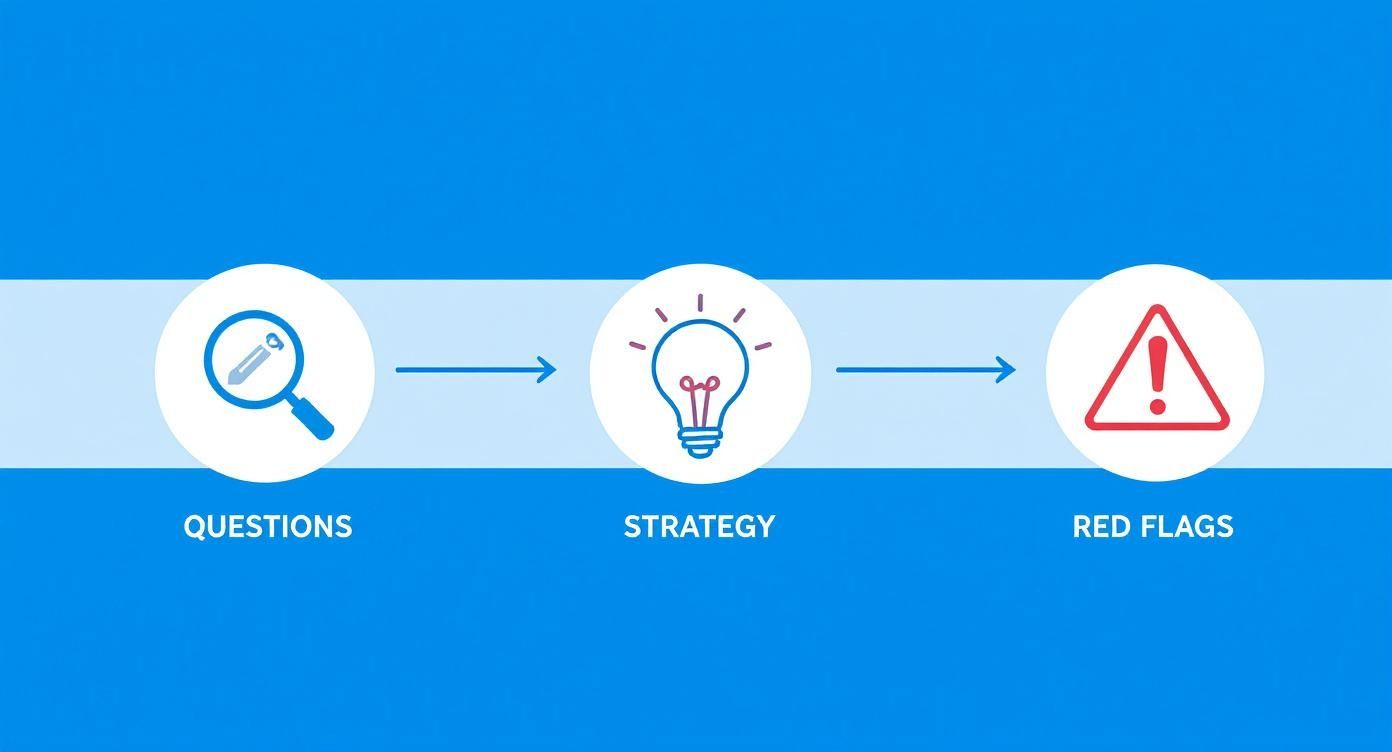
As the infographic shows, a solid partnership begins long before the kickoff call. It's built on a rigorous vetting process that clarifies the game plan and heads off problems down the track.
Let’s be clear: by the end of the first 90 days, you won’t be dominating page one for every keyword. That’s not how SEO works. What you should have is a crystal-clear roadmap, the first round of technical fixes already done, and a collaborative relationship that feels like a true partnership. This foundational work is what paves the way for serious growth.
Common Questions About Hiring an SEO Agency
Even after all the research and vetting, a few nagging questions usually pop up right before you sign on the dotted line. Let's tackle some of the most common ones to give you that last bit of clarity.
One of the biggest is always, "How long until we see results?" Look, for an online store, SEO isn't an overnight fix. Anyone who promises that is selling you snake oil.
You should expect to see early indicators within 3-6 months. Think improved rankings for some of your long-tail keywords or a nice uptick in organic traffic to key product categories. But the significant, revenue-driving results for highly competitive terms? That often takes between 6-12 months of consistent, focused work.
Agency vs Freelancer: What Is Better?
Another frequent dilemma is whether to go with a dedicated ecommerce SEO agency or a solo freelancer. A freelancer can be a great, cost-effective option for smaller stores or for tackling very specific, one-off tasks. No doubt about it.
But an agency brings a full team to the table. You get specialists—your technical SEO nerds, your content writers, your link-building strategists—all under one roof. That depth of expertise and sheer manpower is what you need to properly scale a growing business. Your role becomes more strategic, giving business insights and approving content, while the agency handles the day-to-day grind.
This is especially true here in Australia, where we're a mobile-first market. Mobile commerce is the main game now, with a staggering 95% of Australians shopping on their phones in 2024.
Last quarter alone, smartphones generated 77% of all site visits and 68% of orders. Your agency absolutely must have deep expertise in mobile optimisation. If they don't, you're leaving a huge chunk of revenue on the table. You can read the full research on Australia's mobile shift for more insights on that.
Ready to see how a specialist agency can drive real growth for your store? Click Click Bang Bang offers AI-first SEO and PPC strategies that deliver measurable results. Get in touch with us today!
Read NeXt
Or Read Our Latest
- Manual vs Automated Bidding for PPC Success
- Conversion Tracking Setup: A Complete AU Guide
- Instagram Advertising Australia: Complete 2026 Guide
- Pay Per Click: A Beginner’s Guide for Australian Marketers
- Display Advertising on Google: The Complete Australian Guide
- Stakeholder Communication Plan How to Build One That Works
Click. CLick. Subscribe.
Get our best PPC insights, industry updates, and power moves delivered straight to your inbox. No fluff, just high-caliber strategies that actually work.
Don’t Leave Just Yet
Try Us For 30-Days,
Risk Free!!
We guarantee that you’ll love our work within the first 30 days, if not you’ll get your money back.
What have you got to lose?