

Mastering Search Engine Optimisation for Your Site
Last Updated
So, what exactly is search engine optimisation (SEO)? At its core, SEO is the art and science of improving your website so it shows up more often—and higher up—when people search for your products or services on Google.
It’s all about making your website more appealing to search engines, which in turn drives more organic (meaning, unpaid) traffic your way. More traffic means more chances to turn curious searchers into loyal customers.
Understanding the Core of Search Engine Optimisation
Think of the internet as a gigantic, ever-expanding library. Your website is one of the millions of books on its shelves, and Google is the world’s most efficient librarian.
The whole point of search engine optimisation is to make sure your book is so well-organised, clearly labelled, and packed with useful information that the librarian confidently recommends it to anyone asking the right questions. When someone performs a search, you want your site to be the first result they see.
This isn't just about vanity metrics; it’s a crucial process that connects your business with people who are actively looking for what you offer. Unlike old-school advertising that interrupts someone's day, SEO puts you right in front of them the very moment they need a solution. This is what makes it such a powerful cornerstone of any real digital marketing strategy for small businesses.
How Search Engines Find and Rank Your Content
Search engines like Google don't "see" your website the way a person does. Instead, they send out automated programs, often called "crawlers" or "spiders," to do three main jobs. This diagram breaks down how the whole process works, step by step.
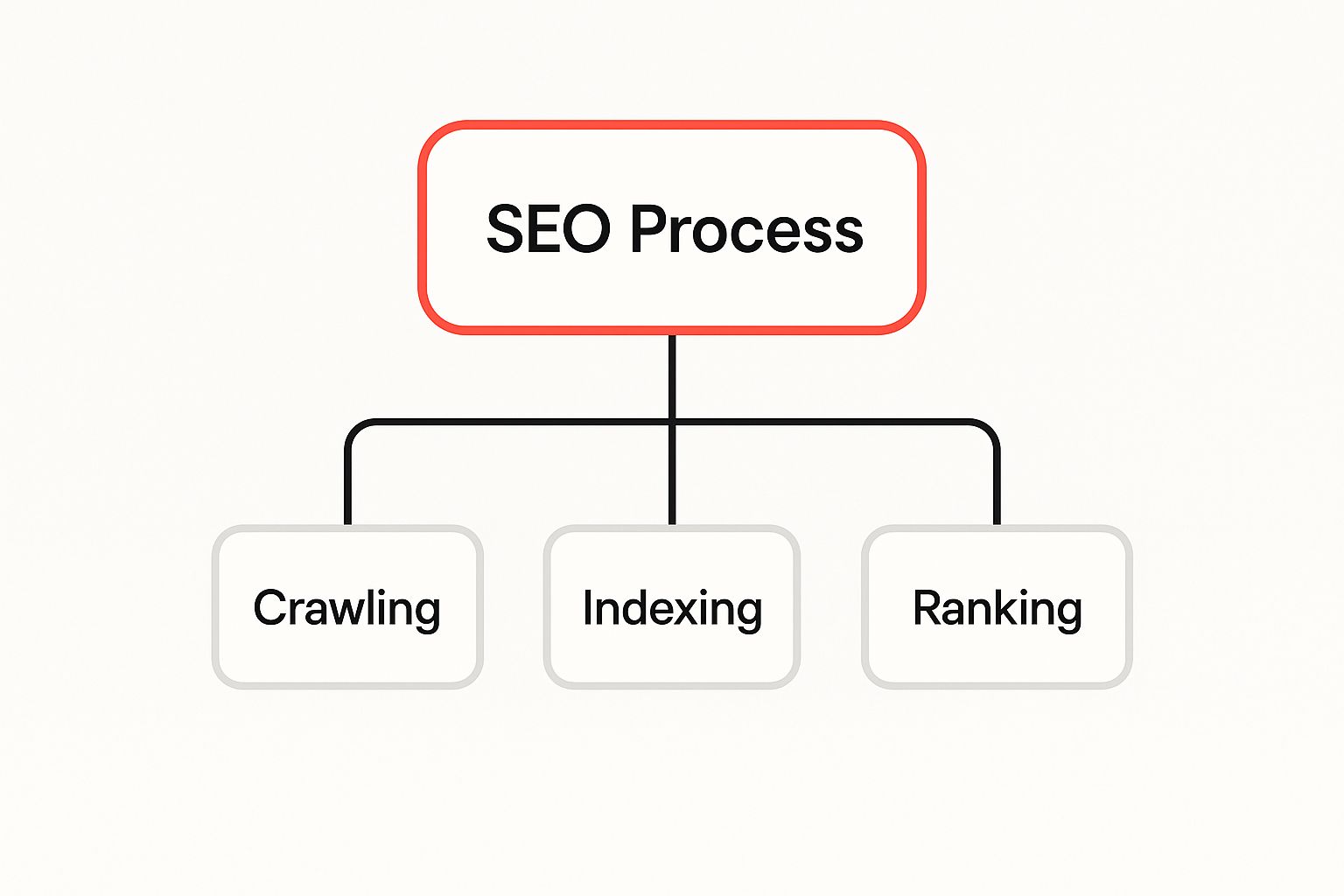
As you can see, for your site to even have a chance at ranking, it first needs to be found (Crawling), then understood and stored (Indexing), and finally, judged against all the other options (Ranking).
These three steps are always in that order, and each one depends on the last:
- Crawling: First, the search engine bots discover your pages. They do this by following links from other websites they already know about or by reading a sitemap file you provide.
- Indexing: Once they’ve crawled a page, they analyse its content—the text, images, videos, and everything else. They then store this information in a colossal database called an index. If your page isn’t in the index, it simply can’t be shown to anyone. It's invisible.
- Ranking: Finally, when someone types in a search query, the engine dives into its index to find the most relevant results. It then ranks them based on hundreds of different factors, like relevance, authority, and the overall user experience of the page.
The core mission of SEO is simple: to optimise your digital assets so that they rank highly for the keywords and phrases your target audience is using. Success here means more visibility, traffic, and growth.
In Australia, getting this right is non-negotiable. As of January 2025, there are 26.1 million internet users in the country—that’s a massive 97.1% of the population.
These aren't casual users, either. They're online for an average of 6 hours and 5 minutes every single day. And with Google absolutely dominating the search market with over 91% share, being visible there isn't just a good idea; it's essential for survival.
The Three Pillars of Modern SEO

A solid SEO strategy is a lot like building a sturdy house. You can't just focus on the paint colour and ignore the plumbing; every part has to work together. In the same way, great SEO isn't about a single trick but a careful balance of three core components, often called the “three pillars”.
These pillars are On-Page SEO, Off-Page SEO, and Technical SEO. Understanding how they all connect is the secret to building a digital presence that doesn't just look good but can also handle the constant shifts in search engine algorithms. If you neglect one pillar, the entire structure can get wobbly, no matter how strong the others are.
Seeing SEO this way helps you move beyond a simple to-do list and start thinking like a real strategist, creating a complete plan for long-term growth.
Technical SEO: The Foundation of Your Website
Before you start decorating rooms or inviting people over, you need a rock-solid foundation. In the world of search engine optimisation, that foundation is Technical SEO. It covers all the behind-the-scenes work that makes your site a breeze for search engines to crawl and index.
If your foundation is cracked—meaning your site is slow, insecure, or confusing for search engine bots—everything else you do will be far less effective. Think of it as the invisible engine that powers your entire strategy.
Key activities in Technical SEO include:
- Improving Site Speed: Making sure your pages load fast. Page speed is a confirmed ranking factor, and a site that takes longer than three seconds to load loses almost half of its visitors.
- Mobile-Friendliness: Ensuring your website works perfectly on smartphones and tablets. Google now primarily uses the mobile version of a site for indexing and ranking, so this is non-negotiable.
- Site Architecture: Organising your site's structure logically so that both people and crawlers can find their way around easily.
- Security: Using HTTPS to encrypt the connection between your site and its visitors. This builds trust and is a minor ranking signal.
Technical SEO ensures your digital "building" has clear hallways, fast elevators, and logical signposts. It creates a seamless experience for both users and search engine crawlers, making it possible for your great content to be discovered.
On-Page SEO: The Quality of Your Content
With a strong foundation poured, the next pillar is On-Page SEO. This is all about everything on your actual web pages that you have direct control over. It’s about creating high-quality, relevant content that genuinely answers a searcher's question.
Think of this as the interior design and the quality of the rooms in your house. Are the signs on the doors clear? Is everything laid out logically for your visitors? High-quality content is what satisfies user intent and signals to Google that your page is a valuable search result.
On-page optimisation involves:
- Keyword Research: Finding the exact terms and phrases your audience is typing into search engines.
- High-Quality Content: Creating genuinely valuable articles, videos, and guides that thoroughly address those search terms.
- Title Tags and Meta Descriptions: Crafting compelling headlines and summaries that show up in search results and make people want to click.
- Internal Linking: Connecting your pages to guide users and search engines to other relevant content on your site, keeping them engaged for longer.
Off-Page SEO: Your Reputation on the Web
Finally, Off-Page SEO is about building your website's reputation and authority across the wider internet. It involves all the actions taken outside of your own website to boost your rankings in search results.
This is your reputation in the neighbourhood. A brand-new house, no matter how well-built, doesn't have the same credibility as one that’s been recommended by respected architects and neighbours. In SEO, these recommendations are backlinks—links from other websites pointing to yours.
Off-page optimisation is mostly about earning these "votes of confidence" from other reputable sites. Google sees high-quality backlinks as a powerful signal that your content is trustworthy and authoritative. But it's not just about link building; it also includes brand mentions and social media activity that contribute to your overall digital footprint. Neglecting your off-page presence is like building a brilliant house but telling no one it exists.
To help you see how these pillars work together, here’s a quick breakdown of their distinct roles and activities.
Comparing the Three Pillars of SEO
| Pillar | Primary Goal | Key Activities |
|---|---|---|
| Technical SEO | Ensure search engines can easily crawl, index, and understand the website. | Site speed optimisation, mobile-friendliness, XML sitemaps, robots.txt, HTTPS security, structured data. |
| On-Page SEO | Create high-quality, relevant content that answers user search intent. | Keyword research, content creation, title tags, meta descriptions, header tags, internal linking, image optimisation. |
| Off-Page SEO | Build the website's authority, credibility, and reputation across the web. | Earning backlinks from reputable sites, managing online reviews, brand mentions, social media marketing, influencer outreach. |
Each pillar supports the others. You can have the best content in the world (On-Page), but it won't matter if search engines can't find it (Technical). Likewise, a technically perfect site with a ton of backlinks (Off-Page) won't rank if its content is thin and unhelpful. True SEO success comes from balancing all three.
Mastering Your On-Page SEO Strategy
If technical SEO is the foundation of your house and off-page SEO is your street cred, then on-page SEO is how you furnish and decorate the inside. This is where you have the most direct control, refining the individual elements on your web pages to make them more valuable for both people and search engines. It’s where theory gets put into practice.
Think of it this way: your website is a physical shop. On-page SEO is everything you do to create a brilliant customer experience—the clear aisle signs, the helpful product descriptions, and the logical layout that makes it a breeze to find what you’re looking for. Get this right, and you’re sending strong signals to Google that your content is high-quality and nails exactly what a searcher wants.
Uncovering What Your Audience Wants with Keyword Research
The starting point for any good on-page search engine optimisation strategy is keyword research. This isn't about plucking ideas out of thin air; it’s about using data to find the exact words and phrases your potential customers are punching into Google.
By getting a handle on these search terms, you can build content that directly solves their problems, answers their questions, and soothes their pain points. A plumber in Sydney, for example, might find that while "plumber Sydney" is a tough keyword to rank for, phrases like "emergency hot water repair Chatswood" or "how to fix a leaking tap" represent real, specific needs they can target.
Good keyword research lets you:
- Understand User Intent: Figure out if someone is looking for information, comparing their options, or ready to buy.
- Spot Content Gaps: Find topics your competitors are overlooking, giving you a chance to swoop in and stand out.
- Speak Your Customer's Language: Use the same words your audience does, which builds trust and boosts your relevance.
Keyword research is basically market research for the digital age. It’s a direct line into your audience’s mind, showing you not just what they’re searching for, but why.
Crafting Content That Satisfies Searchers
Once you’ve got your target keywords, it's time to create genuinely helpful content. In today's SEO world, the name of the game is being the absolute best answer to a searcher's query. This means leaving outdated tactics like "keyword stuffing" firmly in the past. Unnaturally cramming keywords into your text is a surefire way to get penalised by Google.
Instead, your focus should be on creating content that’s comprehensive, well-structured, and actually engaging to read. A quality piece of content is far more likely to get clicks, keep people on the page, and attract valuable backlinks from other websites. This focus on user experience is exactly what search engines are built to reward.
A landing page, for instance, needs a lot more than just the right keywords to do its job. A solid landing page optimization checklist will walk you through all the elements needed to build trust and guide visitors towards conversion.
Optimising Your Digital Storefront Window
Your title tag (the headline you see in search results) and your meta description (that little summary underneath) are your first, and sometimes only, chance to make an impression. They're like the window display of your digital shop, tempting people to click on your result instead of the one above or below it.
A killer title tag needs to be clear, concise (aim for under 60 characters), and include your main keyword. While your meta description isn't a direct ranking factor, it's your secret weapon for boosting your click-through rate (CTR). It should accurately sum up the page and ideally include a call to action.
Structuring Content for Readability and SEO
Let's be honest, no one enjoys staring at a giant wall of text. Using logical headings (H1, H2, H3) to structure your content doesn’t just make it easier for people to read; it also helps search engines understand the hierarchy and main topics of your page.
Your H1 tag should be your main headline, with H2s and H3s used to break the content down into logical sub-sections. This simple organisation makes your content scannable, helping users quickly find what they're looking for and encouraging them to stick around longer—a great signal to send to Google.
And don't forget about your images. Every image on your site needs descriptive alt text. This text serves two critical purposes: it helps visually impaired users understand what the image is about via screen readers, and it gives search engines context, helping your images show up in image searches. It’s a small step that makes a big difference for both accessibility and visibility.
Building Authority with Off-Page SEO
While on-page SEO is all about getting your own house in order, off-page SEO is about building your reputation out on the wild web. Think of it as your digital street cred. You can have the most beautifully designed, perfectly optimised website in the world, but if no one else is talking about you, search engines might not take you seriously.
Off-page search engine optimisation covers all the activities you do away from your website to boost your rankings. At its core, it’s about proving to search engines that your site is credible, trustworthy, and a genuine authority in its field. When other reputable sites link to you, it sends a massive signal to Google that your content is worth paying attention to.
The Power of Backlinks as Votes of Confidence
The absolute cornerstone of off-page SEO is backlinks. A backlink is just a link from one website to another. Simple, right? But in the eyes of search engines like Google, these are seen as votes of confidence. The more high-quality "votes" your website collects from respected sources, the more authoritative it appears.
Now, it's crucial to understand that not all backlinks are created equal. A link from a major industry news site is worth exponentially more than a link from some random, low-quality blog. The name of the game is earning links from sites that are relevant to your industry and already have a strong reputation. Quality over quantity is the golden rule here.
Think of it this way: a single recommendation from a respected expert in your field carries far more weight than a hundred shout-outs from strangers on the street. Backlinks work on the exact same principle of transferred authority.
So, how do you earn these valuable endorsements? Forget about quick tricks or shady schemes. It’s all about creating genuine value that people want to share.
Here are a few sustainable strategies for earning quality backlinks:
- Create Remarkable Content: This is the bedrock of any good link-building effort. When you produce unique research, killer guides, or compelling infographics that are genuinely useful, other sites will naturally want to link to them as a resource for their own audience.
- Strategic Guest Blogging: Writing an article for another well-regarded website in your industry is a fantastic way to get your expertise in front of a new, relevant audience. It also typically earns you a backlink in your author bio, building both authority and referral traffic.
- Digital Public Relations (PR): This involves getting your brand's stories, data, and expert insights in front of journalists and bloggers. When they feature your business in their articles, you gain powerful backlinks and some serious brand exposure.
Beyond Backlinks: Other Off-Page Signals
While backlinks are definitely the star of the show, they aren't the only off-page factor that matters. Search engines are smart, and they look at a whole range of signals that collectively paint a picture of your brand's trustworthiness and authority online.
These other important signals include:
- Brand Mentions: Even when another site mentions your brand name without actually linking to you (an "unlinked mention"), Google is clever enough to make the connection and see it as a positive signal.
- Social Media Engagement: An active, engaging presence on social media helps amplify your content's reach. The more people who see your stuff, the more likely it is that someone with a website will discover it and link to it.
- Online Reviews: A stream of positive reviews on platforms like Google Business Profile, industry-specific directories, and customer review sites sends a clear message to users and search engines that you run a reputable business people trust.
This growing need to build a solid digital reputation is why Australian businesses are investing more heavily in search engine optimisation. In fact, the Australian SEO services industry is projected to hit a market value of $1.5 billion in 2025, with small businesses now spending over $1,200 per month on average just to stay competitive. You can dig deeper into this growth in these Australian marketing trends.
A Critical Warning Against Black-Hat Tactics
In the race to get more backlinks, some people are tempted by shortcuts. These "black-hat" tactics, like buying links or participating in spammy link schemes, are a direct violation of search engine guidelines. They might offer a fleeting boost, but the long-term consequences can be devastating.
Google's algorithms are incredibly sophisticated and getting better every day at sniffing out unnatural link patterns. If you're caught, you risk a manual penalty that can cause your rankings to tank overnight, or even get your site booted from the search results entirely.
Building a strong off-page presence takes time and consistent effort, but doing it the right way ensures you build a sustainable foundation for long-term success.
Ensuring a Solid Foundation with Technical SEO
Technical search engine optimisation is the invisible engine that powers your entire strategy. It’s all the behind-the-scenes work that makes your site easy for search engines to find, crawl, and understand. Even the most brilliant content will fall flat if Google can't access it properly. Think of it as the essential groundwork that makes everything else possible.
Imagine your website is a brand-new, multi-storey building. Technical SEO is the process of making sure it has clear hallways, fast elevators, and logical signposts. Without these, both your visitors (users) and the building inspectors (search engine crawlers) will get lost, frustrated, and quickly leave.
A solid technical setup creates a seamless experience, signalling to Google that your site is a high-quality, reliable destination. It’s the difference between a website that works for you and one that constantly works against you.
Boosting Performance with Site Speed and Core Web Vitals
In our fast-paced world, speed is everything. We’ve all been there: a page takes too long to load, and we hit the "back" button before the content even appears. A slow website is a major roadblock for both users and search engines.
To help website owners measure this, Google introduced Core Web Vitals. These are a specific set of metrics that analyse a page's real-world performance, focusing on three key aspects of user experience:
- Largest Contentful Paint (LCP): How long does it take for the most important stuff on the page to load?
- First Input Delay (FID): How quickly does your page respond when a user tries to click something?
- Cumulative Layout Shift (CLS): Does the page layout jump around unexpectedly as it loads? (We all hate that).
Getting these factors right doesn't just improve your search rankings; it creates a smoother, more enjoyable experience for your visitors, which should always be the ultimate goal.
The Non-Negotiable Need for Mobile-Friendliness
It's no secret that more searches now happen on mobile devices than on desktops. This shift is so significant that Google primarily uses the mobile version of a site for indexing and ranking—a practice known as mobile-first indexing.
If your website is clunky, hard to read, or difficult to navigate on a smartphone, your visibility is going to suffer. Dramatically.
This trend is also being shaped by new tech. Voice search, for instance, is changing how people find local info, with about 33% of Australians using it daily. These searches are often longer, more conversational questions asked on a mobile device, which really highlights why a mobile-optimised site is crucial for capturing modern search behaviour. You can explore more about local SEO trends in Australia.
A responsive, mobile-friendly design is no longer a "nice-to-have" feature. It is an absolute must for any business serious about succeeding online.
Guiding Search Engines with Sitemaps and Robots.txt
To make sure search engines can explore your website efficiently, you need to give them clear directions. Two simple but vital files handle this job: the XML sitemap and robots.txt.
An XML sitemap is basically a roadmap of your website, listing all your important pages. Submitting this file to Google helps its crawlers discover and index your content more effectively, especially if you have a large site or pages that aren't well-linked internally.
On the flip side, the robots.txt file tells search engine crawlers which parts of your site they shouldn't access. This is useful for blocking private areas, duplicate content, or sections that offer no value to search users, helping you focus the crawlers' limited time and attention on your most important pages.
Enhancing Visibility with Structured Data
Structured data, often called schema markup, is a special type of code you add to your website to help search engines understand your content's context. Think of it as translating your human-readable content into a language that machines can easily process.
When you use structured data, you can unlock "rich results" in search—those eye-catching listings with star ratings, event dates, FAQs, or product prices. This added detail makes your search result pop, helping it stand out from the competition. This can significantly improve your click-through rate and drive more qualified traffic to your site.
How to Measure Your SEO Success
Search engine optimisation isn't a "set and forget" task. It's a continuous process of testing, learning, and refining. But how do you know if all that effort is actually moving the needle? You track your progress.
Measuring your success is the only way to know if your strategy is working. It helps you justify your investment, spot what needs fixing, and make smart, data-driven decisions to keep growing.
Think of your website like a physical shop. You wouldn't just guess how many people walked through the door; you'd count them. SEO metrics are your digital foot traffic counters, sales reports, and customer feedback forms all rolled into one. They tell you what’s working and what isn’t.
Essential Tools for Tracking SEO
The good news is you don't need a hefty budget to get started. Google gives you two incredibly powerful (and free) tools that provide a goldmine of information.
- Google Analytics 4 (GA4): This is your window into how people behave on your website. It shows you exactly how many visitors are coming from organic search, which pages they land on, and what they do once they're there.
- Google Search Console (GSC): This tool is all about how your site performs in Google's search results. It tells you which keywords are actually bringing people to your site, how many people are clicking, and flags any technical hiccups Google is having with your pages.
Using these two in tandem gives you the complete picture of your SEO performance.
Key Performance Indicators to Watch
It's easy to get lost in a sea of data. Instead of drowning in spreadsheets, focus on a handful of key performance indicators (KPIs) that truly signal search engine optimisation success.
SEO isn't just about rankings; it's about driving meaningful business results. The right KPIs connect your SEO activities directly to your bottom-line goals, such as generating leads or increasing sales.
These are the metrics that really tell the story of your progress:
-
Organic Traffic: This is the total number of people finding your website through unpaid search results. A steady, consistent increase here is the clearest sign that what you're doing is working.
-
Keyword Rankings: Keeping an eye on where you rank for your target keywords shows you how much more visible you're becoming. Just moving from page two to the bottom of page one can cause a massive jump in traffic.
-
Click-Through Rate (CTR): This is the percentage of people who see your website in the search results and actually click on it. A strong CTR tells you that your page titles and descriptions are compelling enough to grab attention.
-
Conversions: This is the ultimate test. A conversion is any valuable action someone takes on your site—making a purchase, filling out a contact form, or picking up the phone to call. Getting your website conversion tracking right is how you prove the real-world business impact of your SEO work.
Common Questions About Search Engine Optimisation
As you start to get your head around search engine optimisation, a few practical questions always come up. It's one thing to understand the theory, but knowing what to expect in terms of timeframes and resources is just as important.
Let’s tackle some of the most common queries to help you set realistic expectations and make smart decisions for your business.
How Long Does SEO Take to Work?
This is the big one, and the honest answer is: it depends, but it's not an overnight fix. While you might see a small bump from fixing technical glitches within a few weeks, real, lasting growth takes a bit of patience.
For the kind of results that come from building authority with great content and earning quality links, you’re typically looking at a timeframe of four to twelve months. Think of SEO as a long-term investment that builds on itself over time. It’s a marathon, not a sprint, and consistency is what will get you across the finish line with meaningful returns.
Can I Do Search Engine Optimisation Myself?
Absolutely. Plenty of business owners successfully handle the basics of on-page and technical SEO. With so many brilliant guides online and free tools like Google Analytics and Google Search Console, the fundamentals are more accessible than ever.
The DIY approach, however, can hit a ceiling, especially if you’re in a crowded or highly competitive industry. Bringing in an expert or a dedicated agency can seriously speed things up, particularly when you get into the more complex stuff like advanced technical fixes or large-scale link-building campaigns.
Key takeaway: The right path really hinges on your goals, your resources, and how tough your market is. Start with what you can manage, but don’t hesitate to call in the pros when you’re ready to scale up.
What Is the Difference Between SEO and SEM?
It’s easy to get these two mixed up because they're so closely related, but the distinction is pretty simple.
- SEO (Search Engine Optimisation): This is all about earning unpaid, organic traffic from search engines. It's the art and science of getting your website to rank naturally.
- SEM (Search Engine Marketing): This is the bigger picture. It's an umbrella term that covers both SEO and paid advertising, like running Google Ads.
In short, SEO is a vital piece of a complete SEM strategy. Most strong digital marketing plans use a mix of both organic and paid tactics to get as much visibility as possible on the search results page.
Ready to stop guessing and start growing? At Click Click Bang Bang, we build data-driven search engine optimisation strategies that deliver real results. Explore our services and book your free consultation today at https://clickclickbangbang.com.au.
Read NeXt
Or Read Our Latest
- How to Set Up Google Ads in Australia: Complete 2026 Guide
- Google Merchant Center Setup: The Complete 2026 Guide
- Business Manager Setup Facebook: The Complete 2026 Guide
- Google Ads Account Setup: Expert Guide for 2026
- Search Ads Optimisation: A Practical Guide for 2026
- Manual vs Automated Bidding for PPC Success
Click. CLick. Subscribe.
Get our best PPC insights, industry updates, and power moves delivered straight to your inbox. No fluff, just high-caliber strategies that actually work.
Don’t Leave Just Yet
Try Us For 30-Days,
Risk Free!!
We guarantee that you’ll love our work within the first 30 days, if not you’ll get your money back.
What have you got to lose?