

Ecommerce SEO Services That Drive Real Growth
Last Updated
Think of eCommerce SEO services as a specialised game plan to get your online store noticed by search engines like Google. The goal is simple: make sure that when people are looking for the products you sell, your website is one of the first things they see. This brings more of the right people to your store, which means more traffic and, ultimately, more sales.
Why Ecommerce SEO Services Are a Game Changer
Imagine you’ve just opened the most amazing boutique, stocked with incredible products. The only problem? It’s tucked away in a back alley with no signs pointing the way. No one will ever find it, no matter how great it is. That’s what an online store without SEO is like. Ecommerce SEO services are what move your digital shop from that quiet alley to the busiest high street on the internet.
This isn't just about getting random clicks. It's about attracting shoppers who are already in the mood to buy. When someone in Australia searches for "women's running shoes," a solid SEO strategy ensures your shoe store pops up, not just a blog post about marathon training. This laser focus on what we call "transactional keywords" is what really separates a generic SEO approach from one built specifically for online stores.
Attracting Qualified Buyers, Not Just Browsers
At its core, eCommerce SEO is about matching your store's language to the exact words and phrases your ideal customers are typing into Google. It involves fine-tuning everything from your product descriptions and category pages to the technical guts of your site.
The payoff? A consistent stream of qualified traffic. These aren't just window shoppers; they're people who have already decided they want something and are actively searching for a place to buy it.
By focusing on commercial-intent keywords, ecommerce SEO drives visitors who are much further down the buying funnel, significantly increasing the likelihood of a conversion.
Building a Sustainable Growth Engine
Paid ads are great for a quick traffic boost, but they stop the second you turn off the tap. SEO, on the other hand, builds a long-term asset for your business. Once you earn strong organic rankings, you get a steady flow of "free" traffic, day in and day out, which reduces your reliance on a hefty ad budget over time.
It creates a powerful snowball effect: more visibility leads to more sales, which builds your brand's authority and helps your rankings climb even higher.
This organic foundation also makes your other marketing efforts work better. A well-optimised site, for instance, can lead to better results from your paid ad campaigns. If you're interested in how these two channels can work together, checking out some Google Shopping ads best practices will show you how powerful the combination can be.
At the end of the day, investing in professional eCommerce SEO services isn't just a technical cost—it's a foundational strategy for creating predictable, long-term growth in a crowded online world.
The Pillars of a Powerful Ecommerce SEO Strategy
A winning ecommerce SEO strategy isn’t built on a single magic bullet. It’s more like building a house – you need a solid foundation, a sturdy frame, and great curb appeal to attract people inside. Get any of these wrong, and the whole thing can fall flat.
Think about it this way: each part of your SEO plan has a specific job, but they all need to work together. You could have the most beautifully written product descriptions in the world, but if Google’s bots can’t find or read your site properly, no one will ever see them. It’s all about creating a cohesive system where every element supports the others to drive real, measurable growth.
Technical SEO: The Foundation
First things first, we need to get the "under the hood" stuff right. This is Technical SEO, and it’s the absolute bedrock of your online store. It’s all about making sure your website is built in a way that search engines can easily crawl, understand, and index. You can’t build a skyscraper on a shaky foundation, and you can’t build a successful online store without solid technical SEO.
It’s the invisible work that makes everything else possible. Key tasks here include:
- Site Speed Optimisation: Making sure your pages load in a snap. A slow site is a conversion killer.
- Mobile-Friendliness: Your store must look and work flawlessly on a phone. No exceptions.
- Secure Browsing (HTTPS): This protects your customers' data and is a non-negotiable trust signal for both shoppers and Google.
- A Clean URL Structure: Your web addresses should be simple and logical, not a jumble of numbers and symbols.
On-Page SEO: The Framework and Content
Once the foundation is solid, it's time to build the structure. On-Page SEO is everything you and your customers can actually see and interact with on your website – your category pages, product descriptions, blog posts, and images. This is where you make it incredibly clear to both search engines and people what you’re selling.
This is your chance to match your products with what people are actively searching for. It's about using the right keywords in the right places, writing compelling copy that sells, and organising your content logically.
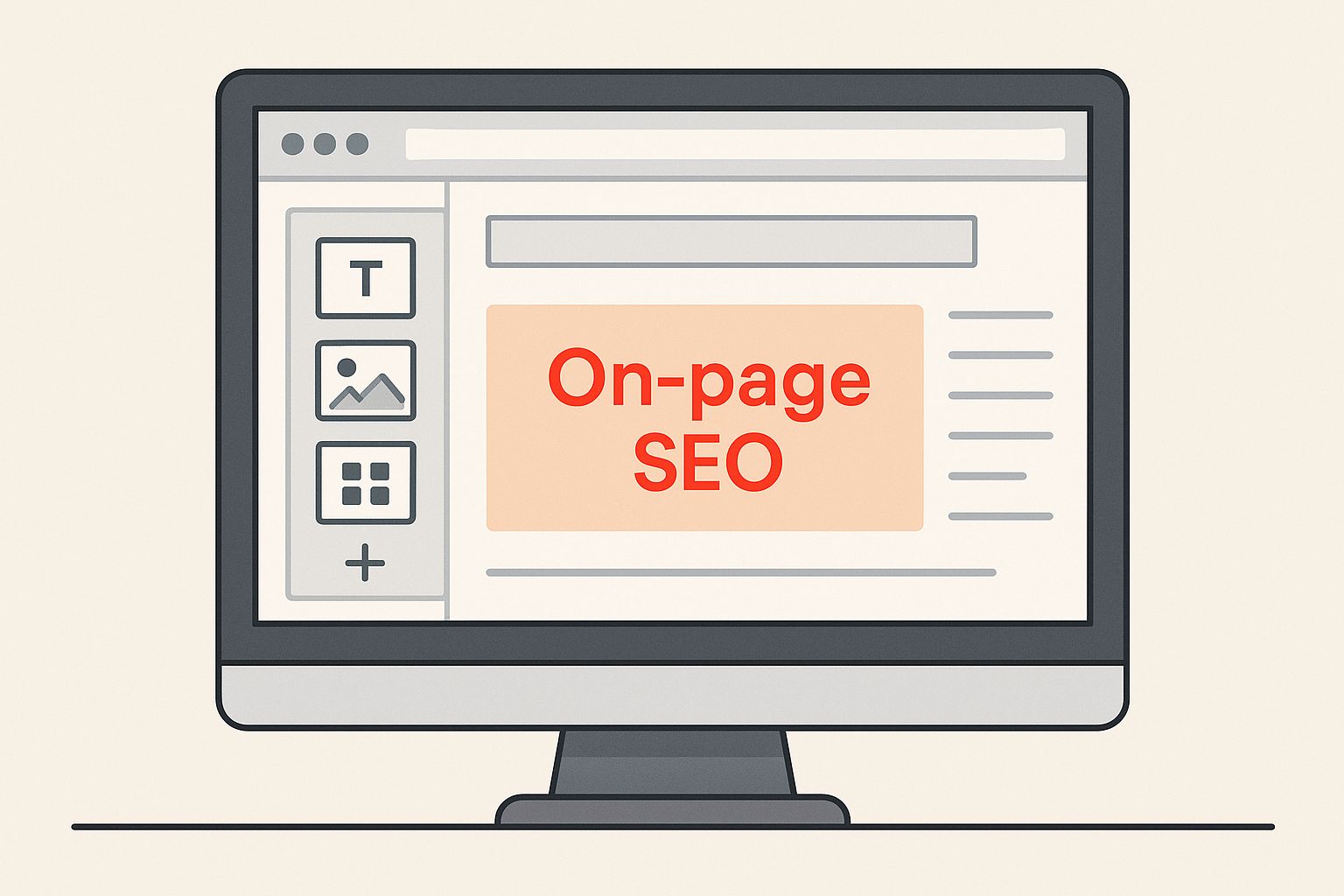
As you can see, on-page SEO covers the tangible parts of your site that you can directly edit and improve. To keep ahead of the competition, it's always smart to explore a variety of SEO optimization strategies and find what works best for your specific store.
Off-Page SEO: Building Authority and Reputation
Finally, we have Off-Page SEO. This covers all the things you do away from your website to build its reputation and authority. The biggest piece of this puzzle is link building – earning high-quality links from other respected websites back to your store.
Think of every backlink as a vote of confidence. When another site links to you, they're essentially telling their audience (and Google), "Hey, these guys are legitimate and worth checking out."
A strong backlink profile signals to Google that other websites vouch for your content and products, which is one of the most powerful ranking factors in SEO.
To put it all together, let's look at a simple breakdown.
Key Pillars of Ecommerce SEO Services
| SEO Pillar | Primary Goal | Key Activities for Ecommerce |
|---|---|---|
| Technical SEO | Make the site easy for search engines to crawl and index. | Site speed optimisation, mobile-friendliness, schema markup, XML sitemaps, fixing crawl errors. |
| On-Page SEO | Match site content with user search queries. | Keyword research, product & category page optimisation, writing unique descriptions, internal linking. |
| Off-Page SEO | Build trust and authority for the website. | Earning backlinks from relevant blogs/sites, digital PR, managing online reviews, brand mentions. |
Getting these three pillars right is what separates the stores that thrive from those that just get by.
In Australia, the stakes are high. Google completely dominates the search market with a 93% share. And with 68% of online searches happening on a mobile device, a "mobile-first" mindset isn't just a good idea—it's essential for survival. Your technical, on-page, and off-page efforts need to be perfectly in sync to capture this huge audience.
Remember, getting traffic is only half the battle. Once visitors land on your site, you need to turn them into customers. A great SEO strategy brings qualified buyers to your digital doorstep, but you also need to know how to improve conversion rates to seal the deal.
Mastering Technical SEO for Online Stores
If content and links are the shiny paint job and sleek design of your marketing car, then technical SEO is the high-performance engine humming under the bonnet. It’s the behind-the-scenes framework that makes sure your entire ecommerce site runs smoothly for both search engines and actual shoppers. A dodgy engine means even the most beautiful car isn't getting very far.
Picture your online store as a massive library with thousands of books—your products. Without a logical cataloguing system, finding a specific book would be a nightmare for your customers and the librarian (Google). Technical SEO is that system. It organises your site so everything is easy to find, quick to load, and simple for search engines to understand.
This isn't about minor tweaks. It’s about building a logical website architecture, ensuring lightning-fast page speeds, and making your site secure and mobile-friendly. These are the foundations that directly affect user experience and signal to Google that your store is a high-quality, reliable place to send traffic.
Building a Logical Site Architecture
A clean site architecture is non-negotiable, especially when you’re dealing with hundreds or thousands of products. It helps spread ranking power (often called "link equity") throughout your site and makes it dead simple for customers to find what they're looking for. A good rule of thumb? Any product should be reachable within just a few clicks from the homepage.
How you achieve this often depends on your platform. For a Shopify store, it’s all about organising your collections properly. If you're on WooCommerce or Magento, it means correctly setting up parent and child categories to create that clean, logical hierarchy.
Using Structured Data to Stand Out
One of the most powerful tools in your technical SEO arsenal is structured data, also known as schema markup. This is basically a special code you add to your site that gives search engines a much deeper understanding of your content.
Think of schema markup as giving Google a detailed spec sheet for each of your products. You’re explicitly telling it the product name, price, stock availability, and customer reviews.
When you do this, Google can reward you by showing this information as "rich snippets" right there in the search results. You've seen them—the listings with star ratings, pricing, and stock status. These grab a searcher's attention, can seriously boost your click-through rates, and give you a clear advantage over the competition.
The importance of getting these technical details right can't be overstated, particularly in the booming Australian market. Australian ecommerce SEO services are crucial in a sector now valued at around AUD 42.2 billion, which serves over 17 million online shoppers every month. For stores with thousands of product pages, things like managing your crawl budget and implementing structured data become absolutely key. To dig deeper, check out this complete Australian ecommerce marketing growth guide on hawkdigital.au.
Ultimately, a solid technical SEO foundation ensures all the hard work you pour into creating great content and building quality links actually pays off. It’s the critical, unseen work that allows your store to truly perform and deliver the results you're after.
How to Measure Your SEO Investment and ROI
Pouring money into ecommerce SEO services without knowing what you're getting back is like driving with your eyes closed. It’s easy to get distracted by "vanity metrics" like a spike in website visitors or a few more social media likes. While those numbers might look good on a report, they don't actually put money in the bank.
The real question is, are your SEO efforts actually turning into sales? We need to move past the fluffy numbers and connect the dots between your search engine traffic and your revenue. This is how you calculate your return on investment (ROI) and see if your SEO strategy is genuinely growing your business.
Key Metrics That Truly Matter
To get a clear picture, you need to look at the ecommerce metrics that tell the full story. These numbers reveal exactly how much organic search is contributing to your sales.
Here are the metrics you should be watching like a hawk:
- Organic Conversion Rate: This is pure gold. It’s the percentage of visitors who found you on Google and then actually bought something. A high conversion rate means you're attracting the right people—those ready to buy.
- Average Order Value (AOV) from Organic Traffic: This tells you the average spend of a customer who comes from an organic search. If this number is climbing, it's a great sign that you're attracting higher-value shoppers.
- Organic Revenue: This is the big one—the total dollar amount of sales generated directly from your organic search traffic. Ultimately, this is the clearest measure of your SEO success.
- Keyword Ranking Improvements: Don't just track any keyword. Focus on the rankings for your most profitable, high-intent product keywords. Jumping from page two to the top of page one for a "money" keyword can completely change your sales figures.
It's one thing to track these numbers, but it's another to understand what they mean for your business. To really grasp the impact of your work, you need to know how to measure SEO performance effectively. This helps you shift from simply wanting more traffic to wanting more profitable traffic.
Interpreting Your Results with Australian Benchmarks
Your data doesn't exist in a vacuum. To really know if you're doing well, you need to see how your numbers compare to others in the Australian ecommerce scene. Local benchmarks give you the context you need to set realistic goals and judge your performance fairly.
For example, recent data for the Australian market paints an interesting picture. While overall ecommerce traffic has grown by 4% year-over-year, the average conversion rate is around 1.60%, with an average order value of AUD 161. Even with the usual seasonal ups and downs, the market is on a steady growth path. You can dig into these stats in the February 2025 ecommerce trends and insights on au.pattern.com.
By stacking your organic conversion rate and AOV against these benchmarks, you can quickly see if you’re ahead of the curve or have some ground to make up. Getting this right starts with a solid analytics setup. Our guide on website conversion tracking will walk you through setting up the fundamentals. This is how you turn SEO from a cost into a measurable, profit-driving investment.
Choosing the Right Ecommerce SEO Agency in Australia
Picking a partner to manage your ecommerce SEO is a huge decision. Think of it like bringing on a co-pilot for your online store's growth journey; get the right one, and you’ll soar, but the wrong one could easily steer you off course. The key isn't to get swayed by slick sales presentations but to ask the right questions and know exactly what you’re looking for.
Your first move should be to treat this whole process like a job interview, because that’s exactly what it is. You're about to hand over a vital piece of your business to an outside team, so you need to be confident they have the chops, the experience, and the right game plan to deliver real results in the tough Australian market.
This means you’ve got to go deeper than just surface-level chats and really dig into the specifics of their process and track record.
Essential Questions to Ask Potential Agencies
Before you even think about signing a contract, you need clear answers on how an agency works. Their responses will tell you a lot about their expertise, how transparent they are, and whether they're a good cultural fit. A genuinely good provider of ecommerce SEO services will be happy to answer detailed questions.
Here’s a checklist to get you started:
- Have you worked with my ecommerce platform before? SEO for a Shopify site is worlds away from optimising a store on Magento or WooCommerce. You need a team that knows the technical quirks of your specific platform inside and out.
- Can you show me some relevant case studies? Ask to see their work with businesses similar to yours—in both size and industry. You're looking for proof of tangible results, like a solid increase in organic revenue and conversion rates, not just a vague jump in traffic.
- What’s your communication and reporting process? Will you have a dedicated account manager? How often can you expect reports, and what key metrics will they actually cover? Clear, regular communication is the bedrock of any healthy partnership.
- How do you approach link building? This one is massive. Get them to explain their process for earning backlinks. You want to hear them talking about quality, authority, and relevance—not just chasing big numbers.
A great agency won't just tell you what they do; they will explain why they do it. Their ability to connect their strategies directly to your business goals is a clear sign of a true partner.
Red Flags to Watch Out For
Just as important as knowing what to look for is knowing what to run from. Some agencies rely on shady tactics that can cause more harm than good down the track.
Keep your guard up if you come across any of these red flags:
- Guarantees of #1 rankings: Seriously, no one can guarantee a specific ranking on Google. It’s an impossible promise and a classic tell-tale sign of an agency you can't trust.
- Secretive or vague methods: If an agency is cagey about their process or calls it their "secret sauce," it's time to walk away. Real SEO experts are open and transparent about their strategies.
- An exclusive focus on link quantity: A strategy built on grabbing hundreds of cheap, low-quality links is a one-way ticket to a Google penalty. The focus must always be on quality over quantity.
Choosing the right agency is a long-term investment in your store’s future. Take your time, do your homework, and find a partner who is genuinely invested in your growth. It’s the difference between spinning your wheels and building a powerful, sustainable engine for organic sales.
Common Questions About Ecommerce SEO Services
Diving into the world of ecommerce SEO services can feel a bit overwhelming, and it's completely normal to have a bunch of questions. Business owners are always asking us about the nuts and bolts—how long does this all take, what's a reasonable budget, and where does SEO fit in with everything else I'm doing? Getting straight answers is the first step to setting realistic goals and making smart decisions for your store.
Let's tackle some of the most common questions we get from Australian ecommerce businesses. Getting your head around these will give you the confidence to move forward with a plan that’s actually going to work.
How Long Does It Take to See Results From Ecommerce SEO?
This is the big one, isn't it? The honest answer is that real, lasting results take time. While you might see a few quick wins from technical fixes in the first few weeks, you'll typically need to wait 4 to 6 months to see a meaningful impact on your traffic and sales.
Think of it like getting fit. You don't walk out of your first gym session with a six-pack. The first couple of months of SEO are all about building the foundation—auditing your site, digging into keyword research, and sorting out your on-page optimisation. You won't see dramatic changes, but crucial groundwork is being laid. After about three months, you'll start to notice the early signs of progress, like climbing a few spots in the rankings for certain keywords.
By the six-month mark and beyond, that's when the real magic happens. You should be seeing a noticeable, measurable lift in organic traffic and, more importantly, revenue. Of course, this timeline depends on things like how competitive your industry is, the state of your website when you start, and the resources you put in.
What Do Ecommerce SEO Services Cost in Australia?
The cost of professional ecommerce SEO in Australia really depends on the scope of work. It’s not a one-price-fits-all situation; it’s a service customised to your store's size, your product count, and how tough your market is.
For a small business or a startup finding its feet, a monthly retainer with a good agency usually starts somewhere between $1,500 to $3,000. For medium to large online stores with heaps of products and ambitious growth targets, a more comprehensive strategy will likely be in the $3,000 to $10,000+ per month range.
It's crucial to see this as an investment in a long-term asset for your business, not just another monthly bill. Be cautious of offers that seem too good to be true. Rock-bottom prices often mean cutting corners on vital things like quality content and link building, which can deliver poor results or even get your site penalised down the track.
Should I Use SEO or Paid Ads for My Online Store?
This is a classic question, but it’s not really an "either/or" scenario. The smartest marketing strategies use SEO and paid ads together, creating a powerful combination where each channel plays to its strengths.
- SEO is your long game. It’s the slow and steady engine that builds sustainable organic traffic and cements your brand's authority. Once you rank well, every click you earn is essentially free, which is fantastic for your long-term cost of acquiring a customer.
- Paid ads deliver results right now. They're brilliant for getting targeted eyeballs on your products immediately. This makes them perfect for new product launches, seasonal sales, or just getting some momentum while your SEO efforts are warming up.
A great approach is to use paid ads for those quick wins and to gather valuable data on what converts, all while your long-term SEO strategy is building in the background. As your organic presence grows stronger over time, you can often pull back on your ad spend, creating a more profitable and stable marketing engine for your business.
At Click Click Bang Bang, we specialise in crafting precision-driven paid advertising campaigns that work hand-in-hand with your SEO efforts to maximise growth. Discover how our data-focused approach can drive immediate, targeted traffic to your store by visiting https://clickclickbangbang.com.au.
Read NeXt
Or Read Our Latest
- Manual vs Automated Bidding for PPC Success
- Conversion Tracking Setup: A Complete AU Guide
- Instagram Advertising Australia: Complete 2026 Guide
- Pay Per Click: A Beginner’s Guide for Australian Marketers
- Display Advertising on Google: The Complete Australian Guide
- Stakeholder Communication Plan How to Build One That Works
Click. CLick. Subscribe.
Get our best PPC insights, industry updates, and power moves delivered straight to your inbox. No fluff, just high-caliber strategies that actually work.
Don’t Leave Just Yet
Try Us For 30-Days,
Risk Free!!
We guarantee that you’ll love our work within the first 30 days, if not you’ll get your money back.
What have you got to lose?