

Your Guide to a High-ROI PPC Management Service
Last Updated
So, what exactly is a PPC management service? In simple terms, it's when you hand over the keys to your pay-per-click advertising campaigns to a specialised agency. These experts then plan, execute, and fine-tune your ad spend to hit your specific business goals. The whole point is to make sure your budget brings in maximum returns instead of getting torched on useless clicks.
It’s all about driving targeted traffic and boosting your overall return on investment (ROI).
What a PPC Management Service Actually Does
Don't think of a PPC management service as just someone who "runs ads." A better way to see them is as an expert financial advisor for your advertising budget. You wouldn't give your life savings to a novice investor, right? Your ad spend deserves the same strategic, expert handling to ensure it grows your business, rather than just vanishing.
Their core job is to turn your marketing dollars into a predictable engine for growth. This goes way beyond just "boosting" a post or flipping the switch on a basic campaign. A dedicated service gets into the nitty-gritty of what makes paid advertising profitable. They don't just spend your money—they invest it intelligently.
The Core Responsibilities
A professional team takes care of every single detail of your campaigns, which frees you up to focus on running your business. Their work covers everything from high-level strategy to daily execution and constant improvement.
Here’s what that typically looks like:
- Deep-Dive Keyword Research: They hunt down the exact search terms your ideal customers are typing into Google, focusing on the ones that signal they're ready to buy. This stops you from wasting money on broad, irrelevant keywords that get you clicks but no customers.
- Creating Ads That Convert: Writing persuasive ad copy and designing eye-catching visuals is an art form. They craft ads that speak directly to what your audience needs, making them want to click and see what you’re all about.
- Smart Bid Management: This is where the financial advisor analogy really clicks. They strategically set and adjust bids for keywords to get you the best possible ad placement for the lowest cost, making sure you never overspend.
- Performance Tracking and Reporting: Constant monitoring is non-negotiable. They track key metrics like click-through rates, conversion rates, and cost per acquisition to see what’s working and what isn’t, using that data to make smart adjustments.
One of the biggest mistakes we see is treating PPC as a "set and forget" channel. A real PPC management service knows that campaigns need constant attention and tweaking to stay ahead of competitors and adapt to whatever the market throws at them.
Beyond the Technical Tasks
At the end of the day, a PPC management service gives you two things you can't buy more of: time and expertise. Running effective PPC campaigns is a full-time gig that demands specialised knowledge of complicated platforms like Google Ads and Meta Ads.
By bringing in the experts, you avoid the kind of costly mistakes that can drain your budget in a matter of hours. For example, an electrician in Melbourne could easily blow their budget on clicks from people in Sydney looking for jobs if they forget to add negative keywords. A professional service catches those critical details, ensuring every dollar is spent with purpose.
This strategic oversight is what transforms your advertising from a gamble into a reliable investment that delivers real, tangible business growth.
The Building Blocks of a Winning PPC Campaign

A high-performing pay-per-click campaign isn’t magic. It's a carefully constructed machine, built from several essential parts that have to work together perfectly. A professional PPC management service acts as both the architect and the engineer, putting each piece in its place to make sure the whole system runs profitably.
If you neglect even one of these building blocks, the entire structure can wobble and underperform. It all starts with the foundation: knowing exactly who you're trying to reach and what they're typing into that search bar. Without that, you're just advertising in the dark.
The Foundation of Research
Before a single dollar of your ad budget gets spent, a proper agency invests heavily in research. This isn’t a quick Google search; it’s a deep dive into your market, your competitors, and your potential customers to unearth the insights that give you an edge.
This foundational stage breaks down into two critical parts:
- In-Depth Audience Analysis: This goes way beyond basic demographics like age and location. A PPC expert wants to understand the motivations, pain points, and online habits of your ideal customer. They build a crystal-clear picture of who is most likely to convert, which shapes every single decision that follows.
- Strategic Keyword Research: This is all about finding the exact search terms your audience uses when they're looking for what you sell. It involves pinpointing high-intent keywords that signal someone is ready to buy, weeding out irrelevant terms that waste money, and snooping on your competitors' keyword strategies to find gaps you can exploit.
Think of keyword research like a treasure map. The right keywords lead you straight to customers who are actively looking for you. The wrong ones lead to dead ends and wasted ad spend.
Crafting Compelling Ads and Landing Pages
Once we know who we’re talking to and what they’re searching for, the focus shifts to creating the actual ad experience. This involves two elements that must work in perfect harmony: the ad that grabs their attention, and the landing page that seals the deal.
A brilliant ad that leads to a confusing or clunky landing page is a classic recipe for failure. An experienced PPC management service ensures these two are perfectly aligned, treating the user’s journey from click to conversion as one seamless motion.
A professional service will nail down:
- Writing Persuasive Ad Copy: Crafting clear, compelling ad text that speaks directly to the user's search and gives them a strong reason to click.
- Designing High-Converting Landing Pages: Creating dedicated landing pages that deliver on the ad's promise, are dead simple to navigate, and make it effortless for visitors to take the next step—whether that's buying a product or filling out a form.
Structuring Campaigns for Success
Finally, all these pieces are organised into a logical and efficient campaign structure. This isn't as simple as just dumping all your keywords into one big ad group. Smart campaign architecture is what gives you precise control over your budget, targeting, and messaging.
A well-structured campaign lets an agency put your budget where it will work hardest, funnelling more funds towards the keywords and audiences that are bringing in the best results. This means creating tightly themed ad groups where the keywords, ad copy, and landing pages are all hyper-relevant to each other.
For example, a furniture store would never lump "leather sofas" and "dining tables" into the same ad group. Each product category gets its own dedicated focus, ensuring the ads and landing pages match the searcher's intent perfectly.
This meticulous organisation is a hallmark of a professional PPC management service. It turns a loose collection of ads into a powerful, results-driven marketing engine, where every component is fine-tuned to boost your business's bottom line.
How PPC Management Services Are Priced
Figuring out the cost of a PPC management service can feel like trying to crack a secret code. There are a few different models and fee structures out there, so understanding what you’re paying for is the first step toward a smart investment. The right pricing model for your business will line up with your budget, your goals, and the scale of your ad campaigns.
Let's break down the most common pricing structures you'll come across in Australia. Each has its own logic, benefits, and potential downsides. Knowing the difference is key to picking a partner that fits your needs perfectly, as there’s no single “best” option—only the one that makes the most sense for you.
This infographic gives a high-level view of what a productive partnership looks like when you find the right agency for your PPC needs.
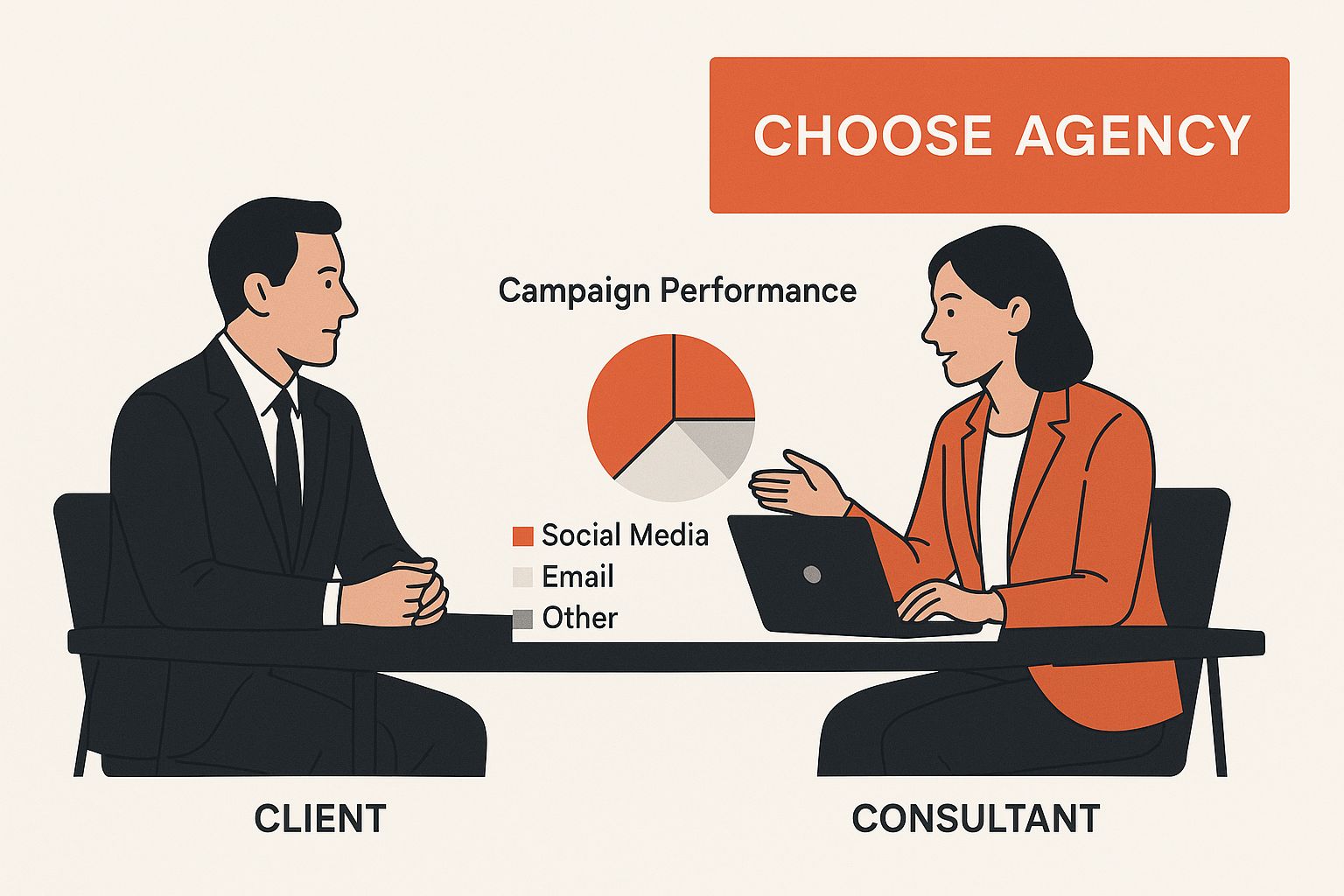
As the image shows, the process is a collaboration where your business goals and the agency's expertise come together to create a winning campaign plan.
Here's a quick comparison of the most common pricing models you'll encounter.
Comparing Common PPC Management Pricing Models
| Pricing Model | How It Works | Best For | Potential Drawback |
|---|---|---|---|
| Percentage of Ad Spend | Agency fee is a set percentage of your total monthly ad budget. | Businesses with larger, established ad spends that are likely to scale. | Can create an incentive to simply increase spend rather than focus on efficiency. |
| Flat-Rate Monthly Retainer | You pay a fixed, predictable fee each month, regardless of ad spend. | Small to medium-sized businesses or those needing budget certainty and consistency. | The fee may need to be renegotiated if the scope of work grows significantly. |
| Performance-Based | The agency's fee is tied directly to specific results, like leads or sales. | Businesses with a very clear, measurable conversion funnel and high confidence in their offer. | Requires complex tracking and clear definitions; not all agencies offer this model. |
Each of these structures has a place, depending on a company's unique situation. Let's dig a little deeper into how each one works in the real world.
Percentage of Ad Spend
This is one of the most widespread models in the industry. The agency charges a management fee that's a set percentage of your total monthly advertising budget. For example, if your ad spend is $10,000 per month and the agency’s fee is 15%, you'd pay them $1,500 for their services.
This model is popular because it scales directly with your marketing efforts. As your ad spend grows, so does the agency’s fee, which incentivises them to effectively manage larger, more complex campaigns. It’s often best suited for businesses with established, substantial budgets.
The potential catch? It can create a conflict of interest if not handled transparently. An agency might be tempted to simply increase your spend rather than focusing purely on efficiency and return on investment (ROI). A trustworthy partner will always prioritise your profitability, regardless of the model.
Flat-Rate Monthly Retainer
Simplicity is the biggest draw of the flat-rate model. You pay a fixed, predictable fee every month, no matter how much you spend on ads. This amount is usually based on the agreed scope of work, the complexity of your campaigns, and the resources needed to manage your account.
This model is ideal for businesses that need budget certainty. You know exactly what your management costs will be each month, making financial planning a whole lot easier. It's particularly well-suited for small to medium-sized businesses or those with consistent, stable ad budgets.
The key is to make sure the retainer accurately reflects the work involved. If your campaigns become significantly more complex over time, the agency may need to renegotiate the fee to match the increased workload. You can learn more about the different PPC pricing models and how they compare to find the right fit.
Performance-Based Pricing
This is perhaps the most results-driven option out there. Performance-based pricing ties the agency's fee directly to specific outcomes. Instead of paying for time or effort, you pay for results—like a set amount per lead generated (cost-per-lead) or per sale completed (cost-per-acquisition).
This model creates the ultimate alignment between your business and your PPC management service. The agency only gets paid when they deliver the tangible results that directly contribute to your bottom line.
This structure is highly attractive because it minimises your upfront risk. However, it requires incredibly precise tracking and a crystal-clear agreement on what counts as a "qualified" lead or sale. It's often reserved for businesses with a well-defined, measurable conversion funnel and a solid understanding of their customer lifetime value. Not every agency offers this model due to its complexity.
Key Metrics That Truly Measure PPC Success
When you hire a PPC management service, how do you actually know if they're delivering the goods? It's all too easy to drown in a sea of data, but real success isn't about chasing every number that moves. It's about focusing on the key performance indicators (KPIs) that directly fatten your bottom line.
Think of it like a car's dashboard. Sure, the odometer is interesting, but it's the fuel gauge and engine temperature that tell you if you'll actually make it to your destination. In the same way, some PPC metrics are nice to know, while others are absolutely critical for measuring the health of your investment. Let's cut through the noise and look at the gauges that really matter.
Moving Beyond Vanity Metrics
Impressions (how many times your ad was shown) and clicks are usually the first numbers people fixate on. While they prove your campaign is doing something, they don't tell you if it's doing anything useful. A million impressions are worthless if they don't lead to a single sale.
A professional PPC management service will steer you away from these surface-level stats. Their job is to focus on the data that answers the only question that truly matters: "Is my advertising making me money?"
This means zeroing in on a handful of crucial KPIs that reveal the efficiency, effectiveness, and profitability of every single dollar you spend.
The Four Pillars of PPC Performance
To get a crystal-clear picture of your campaign's health, a skilled agency will analyse four core metrics. Each one provides a different piece of the puzzle, and together, they paint a complete picture of your return on investment.
- Click-Through Rate (CTR): This is the percentage of people who saw your ad and were compelled enough to actually click on it. A high CTR is a fantastic sign that your ad copy and targeting are hitting the mark with the right audience.
- Conversion Rate: This metric tracks the percentage of clicks that result in a desired action—whether that’s a sale, a form submission, or a phone call. It’s the ultimate test of whether your landing page is doing its job and turning visitors into customers.
- Cost Per Acquisition (CPA): Also known as Cost Per Conversion, this tells you exactly how much you're paying to land one new customer or lead. A low CPA is the hallmark of a highly efficient and profitable campaign.
- Return On Ad Spend (ROAS): This is the big one. ROAS calculates the total revenue you generate for every dollar you spend on ads. A ROAS of 5:1, for example, means you’re making $5 in revenue for every $1 of ad spend. It's the ultimate measure of profitability.
A high CTR with a low conversion rate might mean your ad is great but your landing page is failing. A great conversion rate with a high CPA could mean you’re paying too much for each click. These metrics must be analysed together.
Putting the Numbers into Context
Understanding these metrics is one thing; knowing what "good" looks like is another. Benchmarks vary wildly between industries and platforms. For instance, recent Australian data gives us a handy snapshot of social media ad costs. While it's clear that costs can add up, a well-managed campaign is the key to keeping them efficient.
A seasoned PPC management service uses these industry benchmarks as a starting point, but their real focus is on improving your specific numbers, month after month. They are constantly testing and refining your campaigns to drive down your CPA and push up your ROAS, making sure your investment is always working harder for you.
This relentless optimisation is what separates a passive ad manager from a true growth partner. For those looking to get a handle on their own reporting, our guide on creating a solid PPC reporting template can give you the structure you need.
Emerging PPC Trends Shaping the Future

The world of digital advertising never stands still. To stay ahead, a forward-thinking PPC management service has to do more than just manage today’s campaigns; they need to prepare for tomorrow's opportunities. The landscape is constantly being reshaped by new tech, shifting user habits, and a growing focus on data privacy.
Understanding these shifts is the key to maintaining a competitive edge. The strategies that worked last year might be less effective next year. A modern agency doesn't just react to change—it anticipates it, ensuring your ad spend is always invested in the most effective, future-proof tactics available.
The Rise of AI and Automation
Artificial intelligence (AI) is no longer a futuristic buzzword; it's a powerful tool actively reshaping PPC. Think of it as giving your campaign a super-smart co-pilot. AI algorithms can analyse millions of data points in real-time to make smarter decisions, faster than any human ever could.
This technology is powering several key advancements:
- Predictive Bidding: AI can predict the likelihood of a click leading to a conversion, adjusting bids automatically to prioritise users who are most likely to buy.
- Automated Ad Creation: Platforms can now generate and test hundreds of ad variations, identifying the most effective headlines and descriptions without manual effort.
- Smarter Audience Targeting: Machine learning helps discover new, high-value audience segments you might have missed, expanding your reach to more profitable customers.
As we look ahead, understanding trends like AI's transformative role in marketing will be crucial for staying competitive.
Voice Search and First-Party Data
The way people search is also changing. The increasing popularity of smart speakers and voice assistants means more people are speaking their search queries instead of typing them. This requires a shift in keyword strategy, moving towards more natural, conversational phrases and long-tail questions.
At the same time, increasing privacy regulations are changing how advertisers can use data. With the decline of third-party cookies, the focus has shifted squarely onto first-party data—the information you collect directly from your customers.
A modern PPC management service helps you build and use your own data ethically. This not only respects user privacy but also gives you a unique competitive advantage, as this is data that your rivals can't access.
The Australian pay-per-click advertising scene is transforming due to these tech and regulatory shifts. In 2025, the use of AI and machine learning to automate bid adjustments, predict campaign outcomes, and personalise ad delivery is making PPC management far more efficient. At the same time, Australian marketers are optimising campaigns for voice search by focusing on conversational keywords to capture the growing number of voice-activated device users.
Integrating PPC with SEO
Finally, the wall between PPC and SEO is crumbling. The most successful strategies now treat them as two parts of a unified search strategy. Insights from one channel can directly benefit the other, creating a powerful feedback loop.
- PPC data can identify high-converting keywords that your SEO team should target for long-term organic rankings.
- SEO insights can reveal user intent and popular content topics, which can then inform more relevant and engaging ad copy.
By aligning both efforts, a business can dominate the search results page, capturing traffic from both paid and organic listings. This integrated approach ensures maximum visibility and creates a more cohesive and authoritative brand presence online.
Choosing the Right PPC Partner for Your Business
Picking an agency to run your paid advertising is one of the most important marketing decisions you’ll make. This isn't just about hiring another supplier; you're trusting a team of experts with a slice of your business's future. The right PPC management service doesn't just manage your ads—they become a genuine extension of your team, dedicated to driving growth and making every dollar in your budget count.
But making that choice requires more than just sitting through a few flashy sales pitches. You need a clear way to evaluate who you're talking to, digging into their actual experience, how they communicate, and the way they think strategically. This is how you find a partner who is truly invested in your success.
Evaluate Their Real-World Experience
An agency’s track record is the best crystal ball you have for predicting future success. Don't just take their word for it—ask for hard proof that they’ve delivered real results for businesses like yours. A portfolio full of projects in completely different industries won’t tell you if they can solve your specific challenges.
When you're looking at their past work, zero in on these areas:
- Relevant Case Studies: Look for examples from your industry or with similar business goals. A wildly successful e-commerce campaign for a fashion brand requires a different skillset than a lead generation campaign for a B2B software company.
- Measurable Results: Vague claims like “we increased their traffic” just don’t cut it. You need to see specific metrics like Return On Ad Spend (ROAS), Cost Per Acquisition (CPA), and improvements in conversion rates.
- Strategic Approach: Ask them to talk you through a past campaign. How did they spot opportunities? What challenges came up, and how did they adapt their strategy based on the data?
Demand Transparency in Strategy and Reporting
A PPC partner you can trust operates with total transparency. You should never feel like you're in the dark about where your money is going or how your campaigns are actually performing. From the very first chat, they should be upfront about their methods, pricing, and how they report back to you.
A great agency won't just flick you a report and call it a day; they'll help you actually understand it. They’ll explain the "why" behind the numbers, connecting the campaign data to your business goals and outlining the next clear steps for improvement.
This kind of clarity is the hallmark of a healthy, collaborative partnership. For a deeper dive, our guide on how to choose a PPC agency that won't waste your budget has a bunch more crucial questions you should be asking.
Assess Communication and Cultural Fit
Finally, never underestimate the importance of a good working relationship. You can have the most skilled agency in the world, but if they're a nightmare to communicate with, it’ll just create friction and slow everything down. You need a partner who is responsive, proactive, and speaks your language.
The Australian market is a serious player in the digital ad space. The Asia Pacific PPC market is on track to hit USD 640.005 million by 2025, and Australia makes up a huge chunk of that. This growth means there's a bigger demand for skilled local agencies who know how to navigate this complex environment.
Choosing a partner who understands the local market dynamics and is ready to grow with you is vital. You want a team that gets the nuances of doing business here and can scale their efforts as you do.
Your PPC Management Questions, Answered
Diving into paid advertising can feel like a big leap, and it’s smart to have questions. If you’re thinking about bringing in a PPC management service, you want to know exactly what you’re signing up for. We get it.
Let's cut through the noise and tackle the most common questions business owners ask. Our goal is to give you the clarity you need to make a confident, well-informed decision for your business.
How Long Until I See Results?
This is the big one, and the honest answer is this: while you can see traffic and clicks almost immediately, real business results—like a steady stream of leads and sales—typically take three to six months to build up. This isn't just a waiting game; this period is essential for gathering enough data to make your campaigns truly effective.
Think of the first month as a discovery phase. Your agency is busy testing different bidding strategies, figuring out which ad copy connects with your audience, and identifying the most profitable customer segments. From there, it's all about strategic refinement and scaling up what works to get you the best possible return on your investment.
What Is the Difference Between PPC and SEO?
PPC (Pay-Per-Click) and SEO (Search Engine Optimisation) are two sides of the same coin: getting seen on search engines. They work best in tandem but get there in very different ways.
- PPC is all about speed. You pay for ad placements to get your business to the top of the search results, driving traffic instantly. The moment you stop paying, your ads disappear.
- SEO is the long game. It’s the organic process of fine-tuning your website to rank higher naturally over time. It takes longer, but it builds lasting authority without paying for every single click.
A smart digital strategy often uses both. PPC delivers the immediate wins while SEO builds a valuable long-term asset.
Can I Just Manage My Own PPC Campaigns?
You absolutely can. Many business owners start out managing their own PPC campaigns. The catch is that doing it well demands a huge amount of time, a commitment to constant learning, and a deep level of expertise. Platforms like Google and Meta are incredibly complex, and small mistakes can get very expensive, very fast.
A professional PPC management service doesn't just save you time; they bring specialised knowledge, advanced tools, and a dedicated focus on maximising your budget. They know how to sidestep the costly pitfalls and are geared to achieve a far higher return on ad spend than most business owners can manage on their own.
Ready to stop guessing and start getting real, measurable growth from your advertising? The team at Click Click Bang Bang is here to build a precision-driven PPC strategy that works. Check out our services and book a consultation today.
Read NeXt
Or Read Our Latest
- Manual vs Automated Bidding for PPC Success
- Conversion Tracking Setup: A Complete AU Guide
- Instagram Advertising Australia: Complete 2026 Guide
- Pay Per Click: A Beginner’s Guide for Australian Marketers
- Display Advertising on Google: The Complete Australian Guide
- Stakeholder Communication Plan How to Build One That Works
Click. CLick. Subscribe.
Get our best PPC insights, industry updates, and power moves delivered straight to your inbox. No fluff, just high-caliber strategies that actually work.
Don’t Leave Just Yet
Try Us For 30-Days,
Risk Free!!
We guarantee that you’ll love our work within the first 30 days, if not you’ll get your money back.
What have you got to lose?