

Enterprise SEO Optimization Company: How to Choose the Right Partner
Last Updated

An enterprise SEO optimisation company isn't just a regular agency with bigger clients. It's a specialised partner for businesses dealing with websites that have thousands, or even millions, of pages. Their world revolves around complex technical architecture, coordinating across global markets, and weaving SEO data into the very fabric of business intelligence.
This isn't just standard SEO scaled up; it's a discipline built for complexity, designed to align organic search performance with core corporate goals. You need a partner who gets that enterprise SEO is a fundamentally different ball game from small business SEO.
What Sets an Enterprise SEO Company Apart

Before you can pick the right partner, you have to grasp that enterprise SEO isn’t just ‘more SEO’. It operates on a completely different playing field. The rules, the tools, and the end goals are all magnified. We're not talking about optimising a few dozen pages; we're talking about strategically managing massive digital assets.
This distinction is crucial because it directly impacts the kind of agency you need. A firm that gets incredible results for small businesses could be completely swamped by the sheer complexity of an enterprise-level website.
Beyond Page Count: The Real Differentiators
The challenges unique to large organisations are what truly define the need for a specialised enterprise SEO optimisation company. These hurdles go way beyond just having a big website.
Think about these common enterprise scenarios:
- Managing Millions of URLs: Navigating intricate site structures, multiple subdomains, and international domains requires serious technical chops. It's about managing crawl budgets and stopping widespread indexation problems before they start.
- Cross-Departmental Coordination: SEO initiatives have to align with IT, legal, marketing, and product teams, often spread across different regions. A true enterprise partner knows how to navigate corporate politics and communicate value to stakeholders who don't speak "SEO."
- Global and Multilingual SEO: Optimising for different countries and languages involves complex hreflang implementations, content localisation, and a deep understanding of regional search engine behaviour.
These factors turn what would be simple SEO tasks into major strategic projects. For example, keyword research is no longer just about finding high-volume terms. It becomes an exercise in market segmentation, competitive intelligence, and aligning keyword sets with the specific goals of different business units. A key differentiator here is an agency's ability to implement sophisticated effective SEO lead generation strategies that consistently bring in high-quality organic leads.
The Strategic Shift from Tactics to Business Integration
The growing complexity of this field is mirrored in market trends. In Australia alone, the SEO software market pulled in USD 2.1 billion in revenue, a figure expected to climb to USD 5.2 billion by 2030. This growth is fuelled by large businesses needing advanced tools to manage their sprawling digital footprints.
At the enterprise level, SEO is not a siloed marketing function. It is a source of business intelligence that informs product development, market expansion, and competitive strategy. The right partner acts less like a vendor and more like a strategic consultant.
Understanding this is your best defence against hiring the wrong agency. It helps you ask the right questions, spot the genuine experts, and steer clear of partners who are just trying to apply a small-business playbook to an enterprise-level challenge.
To make this distinction crystal clear, here’s a quick comparison of where standard SEO ends and enterprise SEO begins.
Standard SEO vs Enterprise SEO: A Quick Comparison
| Aspect | Standard SEO | Enterprise SEO |
|---|---|---|
| Primary Goal | Increase rankings & traffic | Drive business growth & market share |
| Website Scale | Hundreds of pages | Thousands to millions of pages |
| Technical Focus | On-page basics, site speed | Crawl budget, indexation, JavaScript rendering |
| Team Structure | Generalists | Specialists (technical, content, international) |
| Reporting | Keyword rankings, traffic | Share of voice, organic revenue, ROI |
Recognising this divide is the first step toward finding a partner who can actually navigate the high-stakes world of enterprise search and deliver results that matter to the bottom line.
Building Your Agency Shortlist Like a Pro
Finding the right enterprise SEO company isn't about casting a wide net and hoping for the best. Forget endless Google searches. A methodical, evidence-based vetting process is what separates the true strategic partners from the slick sales pitches. It all starts with building a targeted shortlist.

Your first filter should be simple: find agencies with a proven history of working with clients of your size and complexity. Look for case studies that go beyond vanity metrics. You want to see how they've tackled challenges like international SEO, massive technical audits, or managing websites with millions of pages.
This is where you move past generic claims and hunt for tangible proof. A genuine enterprise SEO optimization company will have no problem showcasing its experience with recognisable brands and complex digital ecosystems.
Where to Find Potential Partners
Starting your search in the right places will save you a world of pain. Instead of just looking at who ranks #1 (which can be easily influenced), expand your search to more credible sources.
- Industry Reports & Awards: Publications from firms like Forrester or Gartner often review top digital marketing agencies. SEO-specific awards can also be a good place to find high-performers.
- Peer Recommendations: This is often the gold standard. Reach out to contacts in your network who work at similar-sized companies. A referral from a trusted peer is one of the most reliable signals you can get.
- Conference Speaker Lists: The people speaking at major digital marketing and SEO conferences are typically leaders in the field. Skimming these lists can introduce you to reputable agencies you might not have found otherwise.
Using these avenues gives you a curated pool of candidates who are already recognised for their expertise. From there, you can start digging into their specific capabilities and approach.
Evaluating Thought Leadership and Cultural Fit
Once you have a preliminary list, it's time to assess their thought leadership. Do they publish insightful articles, whitepapers, or case studies? Their content should show a deep, nuanced understanding of the enterprise-level challenges you're facing—not just rehashed SEO 101 guides. A truly expert agency contributes to the industry conversation.
Beyond technical skills, the most successful partnerships are built on strong cultural alignment and communication. An agency can have the best SEOs in the world, but if their communication style clashes with your internal processes, the engagement is destined for friction and failure.
Pay close attention to their communication style during your initial interactions. Are they transparent and direct? Do they ask smart questions about your business goals, or do they jump straight into a generic service pitch? An agency that takes the time to actually understand your business is far more likely to become a valuable extension of your team. This focus on tailored communication is often what separates the good from the great, a key differentiator you can learn more about by exploring high-quality search engine optimisation consulting services.
Ultimately, you want to narrow your list down to 3-5 agencies. These should be the ones that not only have the technical chops but also demonstrate the strategic mindset and collaborative spirit you need for a long-term enterprise partnership. This sets the stage for a much more productive proposal and interview process.
Asking Questions That Reveal True Expertise
Once you have a shortlist of agencies, the real work begins. Polished presentations and a few impressive client logos are just table stakes. You need to dig deeper to find out if they’ve got the strategic chops and real-world problem-solving skills to back it up.
If you ask generic questions, you’ll get generic, rehearsed answers. The trick is to ask pointed, scenario-based questions that force an agency to show their work, not just talk about it.
This is your chance to get past the sales pitch and see how a potential enterprise SEO optimisation company really thinks. The goal is to understand their approach to complexity, their processes, and whether they can truly handle an organisation of your scale.
Probing Their Technical SEO Methodology
For an enterprise business, technical SEO isn’t just a checklist item; it’s the bedrock of your entire organic strategy. One small mistake can ripple across millions of pages, so you absolutely need a partner with a deep, battle-tested grasp of large-scale technical challenges.
Start by getting specific about how they’d audit a website the size of yours.
- "Walk us through your process for conducting a technical audit on a site with over one million pages. What tools do you use for the initial crawl, and how do you handle crawl budget limitations?" This question immediately tests their knowledge of core enterprise constraints and reveals their technical toolkit.
- "Describe a time you diagnosed and resolved a complex indexation issue caused by JavaScript rendering. What was your methodology for identifying the root cause?" This gets to the heart of a common headache for large companies using modern web frameworks.
Questions like these separate the agencies that just run an automated report from the ones capable of deep, diagnostic analysis. You're looking for answers that show a clear, logical process, not just a list of software they subscribe to.
Gauging Strategic and International Acumen
At the enterprise level, SEO is fundamentally a strategic discipline. It has to account for global markets, internal politics, and overarching business goals. An agency that only thinks about keywords and rankings will never deliver real business value.
A great enterprise SEO partner doesn’t just optimise a website; they understand how organic search fits into the broader business ecosystem. Their strategy should reflect your market position, competitive pressures, and internal objectives.
To see if they have this strategic mindset, ask about their experience with global expansion and stakeholder management.
- "Our company is expanding into three new European markets next year. How would you approach developing and implementing an international SEO strategy, including hreflang implementation and content localisation at scale?" A strong answer should cover technical signals, content strategy, and market-specific keyword research.
- "How do you typically communicate SEO recommendations to non-SEO stakeholders, such as IT or legal teams? Can you provide an example of how you secured buy-in for a major technical change?" This uncovers their communication skills and ability to navigate corporate environments—skills that are absolutely critical for getting anything done.
Understanding Their Team and Workflow
Let’s be honest: the senior people who pitch you aren’t always the ones doing the day-to-day work on your account. It's vital to pull back the curtain on the team structure and make sure you’re getting the senior-level expertise you're paying for.
Don't be shy; ask direct questions about who will actually be doing the work:
- Who will be our primary point of contact, and what is their seniority level?
- What percentage of the work on our account will be handled by senior strategists versus junior analysts?
- How does your team integrate AI and data science into its workflow for analysis and forecasting?
This line of questioning ensures you're buying genuine expertise, not just a big agency name. It’s also crucial to understand how they plan to measure success. When assessing potential partners, it's also vital to ask detailed questions about their approach to monitoring progress, including their essential tips and tools for tracking SEO performance.
This clarifies their commitment to transparent, data-driven results and shows you how they define a win. Asking the right questions will cut through the noise and reveal the true calibre of the enterprise SEO optimisation company you're considering, helping you find a partner truly capable of driving meaningful growth.
How to Decode Proposals and Pricing Models
Getting a stack of proposals from potential enterprise SEO partners can be a bit overwhelming. At first glance, they can all start to look the same, making it tough to tell which one offers real strategic depth versus a nicely polished sales doc. The secret is to look past the total price and dig into the substance behind the numbers.
To do this right, you need a methodical approach. You've got to compare them apples-to-apples, focusing on the actual scope of work, how tangible the deliverables are, and the level of strategic support you’re actually getting. A low price tag is always tempting, but it can easily hide a shallow strategy that won’t move the needle for a complex business like yours.
Understanding Common Pricing Structures
In the enterprise SEO world, you'll generally come across a few main pricing models. Each has its pros and cons, and the best fit really depends on your company's needs, budget cycles, and what you’re trying to achieve. Getting your head around these is the first step to making a smart financial decision.
Here are the most common models you’ll see:
- Monthly Retainer: This is the go-to model for an enterprise SEO optimisation company. You pay a set fee each month for an agreed-upon scope of ongoing work, like technical monitoring, content strategy, and high-level consulting. This model is built for a long-term partnership and lets the agency really embed themselves in your team.
- Project-Based Fees: This is for specific, one-off jobs with a clear beginning and end. Think a massive technical audit, a complex website migration, or a huge content overhaul. It’s perfect when you have a well-defined project scope.
- Hybrid Models: Some agencies will mix and match. For example, they might offer a smaller monthly retainer paired with performance bonuses tied to hitting specific KPIs, like a jump in organic revenue or gaining market share.
There’s no single "best" model; it all comes down to what you need. If you're after continuous, deep strategic guidance, a retainer is almost always the most effective way to go.
Don't just look at the price; evaluate the value. A $15,000 monthly retainer that delivers a clear roadmap, senior-level expertise, and measurable business impact is a far better investment than a $7,000 plan that only provides basic reports and junior-level support.
This is a serious investment, and it reflects the complexity and potential payoff of enterprise-level work. In fact, Australian businesses are projected to spend over $1.5 billion on SEO services in the next year, with enterprise spend often topping $90,000 annually. When you remember that 85-90% of clicks go to organic results, that investment starts to make a lot of sense.
Red Flags to Watch For in a Proposal
While figuring out what's in a proposal is vital, it’s just as important to spot what’s missing—or what shouldn't be there in the first place. A few key red flags can signal an agency that doesn't have true enterprise experience or is just telling you what you want to hear.
Keep an eye out for proposals that include:
- "Guaranteed Rankings": No reputable agency can ever guarantee rankings on Google. The algorithms are just too complex and unpredictable. This is a classic sign of inexperience or, even worse, a willingness to use risky "black hat" tactics that could get you penalised.
- Vague Deliverables: If the proposal is full of fluffy phrases like "ongoing optimisation" or "strategic support" without spelling out exactly what that means, push back. A solid proposal will detail the specific reports, audits, and strategy sessions you’ll get.
- A One-Size-Fits-All Approach: Does the proposal feel generic, like it could have been sent to any company? That’s a major red flag. A true enterprise partner will have taken the time to understand your business and tailor their proposal to your specific challenges and goals.
For a deeper dive into what goes into these costs, our guide on understanding search engine optimisation costs provides some great context. At the end of the day, a strong proposal is a clear, customised, and transparent document that outlines a strategic partnership, not just a shopping list of services.
Setting Your New Partnership Up for Success
You’ve signed on the dotted line and picked your enterprise SEO optimisation company. That’s a huge milestone, but it’s really just the starting line. A great partnership doesn't just happen; it’s built through a structured, transparent, and collaborative onboarding process. This initial phase sets the tone for everything that follows.
Getting this right from day one is absolutely critical.
A chaotic start can quickly lead to mismatched expectations, blown timelines, and a frustrating loss of momentum. On the other hand, a smooth, well-planned onboarding gets your internal team and your new agency partner perfectly in sync from the very first meeting.
The Kick-Off Meeting Blueprint
That first official interaction—the kick-off meeting—is more than just a formality. It’s where the promises made in the proposal get translated into a concrete action plan. A solid kick-off agenda is your best tool for establishing clarity and building trust right away.
Your kick-off should nail down:
- Key Points of Contact: Who is the main day-to-day contact on both sides? Who needs to be in the loop for big strategic decisions or escalations? Get this clearly defined.
- Communication Protocols: Settle on the rhythm of communication. Will you have weekly check-in calls? Are major updates shared via email, a project tool like Asana, or a shared Slack channel? Setting these ground rules now prevents headaches later.
- Access to Critical Systems: Your new partner will need secure access to essentials like Google Analytics, Google Search Console, your CMS, and any relevant business intelligence platforms. Have a plan ready to grant these permissions quickly and securely.
This meeting isn't just about logistics. It’s about reaffirming shared goals and making sure everyone understands the immediate priorities and the long-term vision. It’s the moment your new partner officially becomes an extension of your team.
A successful onboarding isn't just about handing over logins. It's about a mutual transfer of knowledge. Your agency needs to deeply understand your business goals, and your team needs to understand the agency's methodology and workflow.
Creating a Clear 90-Day Roadmap
To cut through any uncertainty, a top-tier enterprise SEO optimisation company will come to the table with a clear roadmap for the first 90 days. This timeline should be broken down into distinct phases with specific, tangible deliverables, moving from foundational analysis to strategic execution. This gives your internal stakeholders transparency and lets them see progress, even before the big ranking shifts happen.
The visual below shows a simplified timeline for the evaluation phase, which flows directly into this crucial onboarding period.
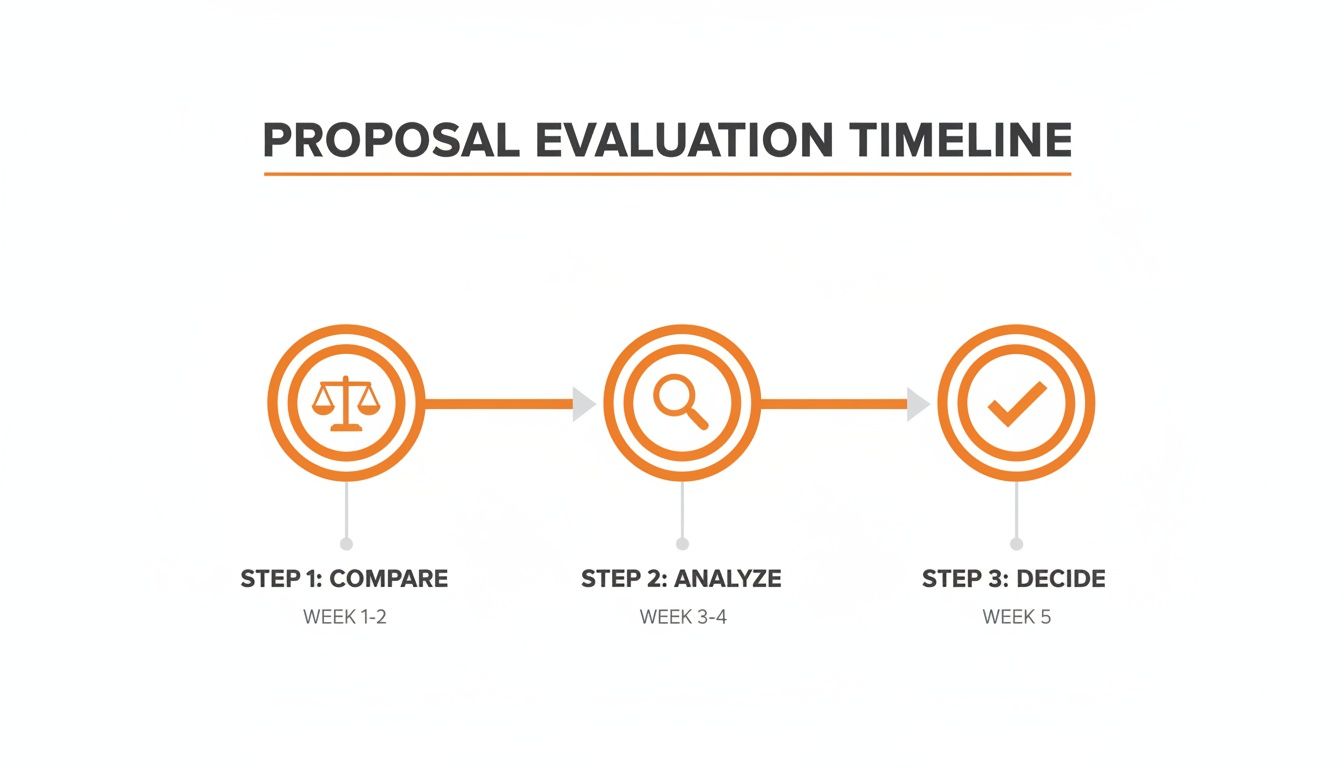
This structured approach to decision-making really sets the stage for a similarly organised, goal-oriented onboarding process, ensuring a seamless transition from selection to partnership.
So, what should this roadmap actually look like? Here’s a breakdown of what you should expect from your new partner during this crucial window.
Sample 90-Day Onboarding Deliverables
A great agency will have a clear plan to deliver value from the get-go. This table outlines the key milestones and deliverables you should expect during the crucial first three months of your partnership. It provides a transparent framework that moves from deep analysis to actionable strategy.
| Timeframe | Key Deliverable | Purpose |
|---|---|---|
| First 30 Days | Comprehensive Technical Audit | To identify and prioritise all foundational technical issues that could be hindering performance, from crawl budget to indexation problems. |
| First 30 Days | Competitor & Keyword Gap Analysis | To benchmark your current performance against key competitors and identify immediate opportunities for strategic content and keyword targeting. |
| Days 30-60 | Strategic SEO Roadmap (12-Month) | To outline the long-term strategic initiatives, resource requirements, and expected outcomes, aligning SEO with broader business goals. |
| Days 60-90 | Identification of 'Quick Wins' | To implement low-effort, high-impact changes that can demonstrate early momentum and build internal confidence in the partnership. |
| Days 60-90 | Initial Content & Backlink Plan | To begin executing on the strategic roadmap, starting with foundational content creation and targeted outreach for authority building. |
This structured plan ensures the first three months are packed with meaningful work, not just meetings. One of the most critical early deliverables is that technical audit. For enterprise sites with millions of pages, this is no small undertaking. You can get a better sense of what this involves by checking out our guide to professional technical SEO auditing.
Ultimately, this audit will form the bedrock of much of the strategic work to come. By setting these clear expectations and milestones, you and your new partner can build a strong, collaborative, and results-driven relationship right from the start.
Got Questions About Hiring an Enterprise SEO Partner? We’ve Got Answers
Stepping into the world of enterprise SEO can feel like navigating a minefield. Even after you’ve done your research, a few nagging questions always seem to stick around. We get it. These aren’t just abstract queries; they’re the real-world hurdles that marketing leaders face before signing on the dotted line.
Let's clear the air and tackle some of the most common questions we hear, so you can move forward and find the right enterprise SEO optimisation company with total confidence.
What's the Real Difference Between Standard and Enterprise SEO?
At its core, the difference is all about scale and complexity. A standard SEO agency is great for getting smaller websites to rank. An enterprise SEO company, on the other hand, is built from the ground up to wrestle with massive digital beasts—think websites with millions of pages, intricate JavaScript frameworks, and layers of corporate process.
An enterprise partner doesn't just "do SEO." They integrate with your business intelligence tools, untangle gnarly site architectures, and act as the connective tissue between multiple departments—from IT and legal to product and marketing. Your average agency simply doesn't have the senior team, specialised tools, or battle-tested processes needed for that kind of environment.
The real value of an enterprise SEO firm isn't just their ability to handle more pages. It's their capacity to turn SEO into a predictive, scalable channel for business growth by managing complexity that would overwhelm a standard agency.
This is why you can't just throw a small business strategy at an enterprise-level problem and expect it to work. It's a fundamentally different game.
How Long Until We See Meaningful Results?
Let's be upfront: enterprise SEO is a long game, not a quick fix. You’ll likely see some positive movement from technical ‘quick wins’ within the first one to three months, which is great for building momentum.
But the kind of results that really move the needle—like sustained ranking growth for hyper-competitive head terms and a measurable lift in organic revenue—typically start to show up within 6 to 12 months.
Why the wait? It comes down to a few realities of the enterprise world:
- Sheer Scale: It takes time for search engines to crawl, process, and make sense of large-scale changes across millions of URLs.
- Implementation Lag: Getting technical fixes pushed live often means getting in line with internal IT queues and navigating complex development cycles.
- Competitive Inertia: Unseating entrenched competitors from the top spots for high-value keywords is a marathon, not a sprint. It takes sustained, strategic effort.
A credible agency will be completely transparent about these timelines from day one. They’ll give you a clear roadmap with leading indicators of success, so you can see progress long before the final revenue numbers roll in.
Which KPIs Should We Actually Track for Success?
It’s time to move beyond vanity metrics. Keyword rankings are nice, but they don't pay the bills. Your success metrics need to tell a clear story about organic growth and how it's contributing to the bottom line.
A top-tier enterprise partner will steer you towards the KPIs that truly matter. Here’s what should be on your dashboard:
- Organic Revenue or Lead Value: This is the ultimate proof point. It directly measures the financial impact of your SEO investment.
- Non-Branded Clicks and Impressions: This is your growth engine. It shows how well you’re reaching new audiences who aren’t already searching for your brand by name.
- Share of Voice (SoV): This is a true competitive benchmark. It measures your organic visibility against key competitors for a critical set of keywords, showing your actual market dominance.
- Crawl Efficiency: For massive websites, this technical KPI is non-negotiable. It confirms that search engine bots are finding and indexing your most important pages without getting lost or wasting resources.
Focusing on these KPIs ensures your reporting is all about genuine ROI, not just superficial activity.
At Click Click Bang Bang, we build data-driven SEO strategies that deliver measurable business growth for complex organisations. If you're ready to partner with an enterprise SEO optimisation company that gets your challenges, let's talk. Explore our AI-first SEO services and see how we can help you dominate the search results.
Read NeXt
Or Read Our Latest
- Manual vs Automated Bidding for PPC Success
- Conversion Tracking Setup: A Complete AU Guide
- Instagram Advertising Australia: Complete 2026 Guide
- Pay Per Click: A Beginner’s Guide for Australian Marketers
- Display Advertising on Google: The Complete Australian Guide
- Stakeholder Communication Plan How to Build One That Works
Click. CLick. Subscribe.
Get our best PPC insights, industry updates, and power moves delivered straight to your inbox. No fluff, just high-caliber strategies that actually work.
Don’t Leave Just Yet
Try Us For 30-Days,
Risk Free!!
We guarantee that you’ll love our work within the first 30 days, if not you’ll get your money back.
What have you got to lose?