

How Much Does Search Engine Optimisation Cost? Key Insights
Last Updated

Right, let's get straight to the big question: how much does search engine optimisation cost? In Australia, you're generally looking at a starting point of around $1,200 a month for a small local business. For a large national company, that figure can easily climb past $10,000.
Where you land on that spectrum comes down to your goals, your industry, and the current state of your website.
Your Guide to SEO Investment in Australia

Trying to figure out what you should be paying for SEO can feel a bit like navigating a maze. But when you break it down by business size and what you're trying to achieve, it all starts to make sense.
Think of it this way: you wouldn't hire a small delivery van to move the contents of an entire office block. Likewise, you wouldn't apply a startup’s SEO budget to a multinational corporation. Each requires a completely different level of resources, strategic thinking, and sheer grunt work.
The investment simply reflects the scale of the job. Small businesses usually sit in the $1,200 to $2,500 per month range, focusing on foundational work like on-page SEO and getting their technical basics sorted to build some initial momentum. As a business grows, so do the complexities. Medium-sized companies often invest between $2,500 and $5,000 monthly for more comprehensive strategies, while big enterprises can budget upwards of $10,000 for sprawling national campaigns.
To see how SEO fits into a wider strategy, have a look at our guide on digital marketing for small business.
Typical Monthly SEO Investment in Australia by Business Size
To give you a clearer picture, here’s a quick breakdown of the average monthly costs in Australia and the kind of services you can generally expect for your investment.
| Business Size | Average Monthly Cost (AUD) | Common Services Included |
|---|---|---|
| Small/Local Business | $1,200 – $2,500 | Foundational keyword research, on-page optimisation, Google Business Profile management, basic link building, and monthly reporting. |
| Medium Business | $2,500 – $5,000 | Comprehensive keyword strategy, advanced on-page SEO, content creation (e.g., blog posts), technical SEO audits, and more robust link building campaigns. |
| Large/Enterprise | $5,000 – $10,000+ | In-depth competitive analysis, large-scale content strategy, advanced technical SEO (e.g., site speed, schema), national/e-commerce SEO, and detailed analytics. |
This table should help set some realistic expectations. It’s not about finding the cheapest option, but about matching the investment to the intensity and scope of work needed to actually move the needle for a business of your size.
Understanding Common SEO Pricing Models

When you start digging into how much search engine optimisation costs, you'll quickly discover that not every provider bills the same way. The pricing model an agency or consultant uses tells you a lot about the kind of partnership they’re offering. Getting your head around these structures is the first step to finding a fit that lines up with your budget and business goals.
Think of it like picking a mobile phone plan. You could sign up for a monthly contract with included data for ongoing use, buy a phone outright for a specific need, or just top up your data when you run low. SEO pricing works in a similar way, usually falling into one of three buckets.
Monthly Retainer
By far the most common model you'll see is the monthly retainer. It's a simple, fixed fee you pay each month for ongoing SEO services. This approach turns an agency into a dedicated partner, continuously working to improve your site's performance. It’s like having an SEO team on subscription.
This model is the go-to for businesses serious about long-term, sustainable growth. It gives the agency the runway to build momentum through consistent effort, from technical tune-ups and content creation to link building and performance analysis. Real SEO results compound over time, and a retainer makes that possible.
Key Takeaway: A monthly retainer is all about a strategic partnership. It provides the stability and consistency needed for an SEO strategy to gather steam and deliver significant, lasting results. This is the best fit for businesses that see SEO as a core part of their marketing engine.
Project-Based Fees
Another popular option is project-based pricing. This is a one-time fee for a specific, well-defined task with clear deliverables. Think of things like a comprehensive technical SEO audit, a keyword research and content strategy package, or a targeted link-building campaign.
This model is perfect if you have a specific SEO fire to put out, or if you want to test the waters with an agency before committing to a long-term relationship. It’s a targeted solution for a specific problem.
Hourly Consulting
Finally, you have hourly consulting. Just as it sounds, you pay an SEO expert for their time, usually at a set hourly rate. This is the "pay-as-you-go" option, and it’s best suited for businesses that already have an in-house team but need some specialised guidance on a tricky challenge or high-level strategy.
It's an excellent way to tap into senior expertise for team training, strategic planning, or troubleshooting a nagging issue, all without the commitment of a full-blown campaign.
Each of these models serves a different purpose. The right one for you comes down to your business goals, what resources you have in-house, and your budget. Choosing the right structure means you’re not just paying for services; you’re investing in a plan that truly matches your ambition.
What Truly Influences Your SEO Cost
Ever received two SEO quotes for what looks like the same service, but the prices are worlds apart? It’s a common scenario. One proposal seems almost too cheap to be true, while the other feels like a massive investment. The reality is, good SEO pricing isn't just a number pulled out of thin air; it’s a direct reflection of the complexity, effort, and expertise needed to get you where you want to go.
Think of it like building a house. A small, single-storey home on a flat, easy block of land has a completely different budget than a custom-designed mansion clinging to a steep, challenging hillside. Both are houses, sure, but the scope, materials, and sheer hours of labour involved are in different leagues. SEO works on the exact same principle.
Industry and Keyword Competition
First off, your industry is a huge factor. If you're trying to rank for something like "women's activewear," you're stepping into the ring with global giants and brands that have been building their authority for years. This is the SEO equivalent of a heavyweight title fight, and it demands a serious budget for top-tier content, powerful link building, and flawless technical work just to have a fighting chance.
On the other hand, a local business targeting "emergency plumber in Ballarat" is in a much different boat. Here, the competition is smaller and geographically contained. The fight is more of a local club match than a global showdown, which means the resources—and therefore the cost—required to win are significantly lower.
Your Website's Starting Point
Another critical piece of the puzzle is your website's current state of health. Are we working with a brand-new site that has zero authority? Or is it an older domain, perhaps weighed down by penalties from past "cheap" SEO efforts that cut corners? A new site is a blank slate, meaning everything—authority, content, links—needs to be built from the ground up, which takes consistent time and effort.
An older site might look okay at first glance, but a deep technical audit could uncover a mess of foundational problems. We're talking slow page speeds, a clunky mobile experience, or a confusing site structure that both users and Google hate. Fixing these core issues is non-negotiable before any real progress can be made, which naturally adds to the initial workload and overall cost.
This diagram breaks down the main drivers that shape your final investment.
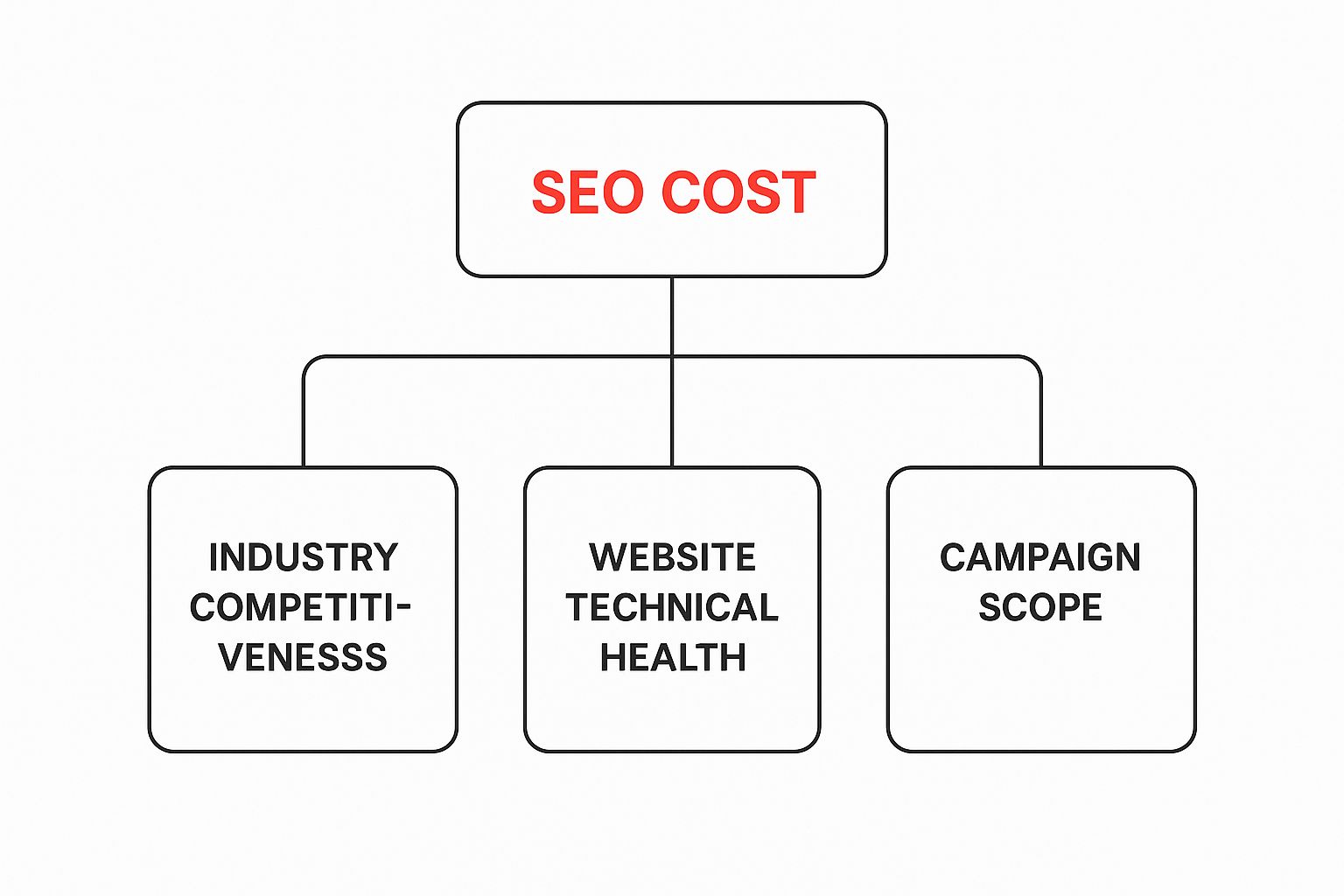
As you can see, the final cost is really a balancing act between these three core elements.
The Scope of Your Ambition
Finally, what are you actually trying to achieve? Your goals are what shape the strategy and, ultimately, the price tag. The scope of work can vary dramatically:
- Local SEO: This is all about dominating a single city or even a specific suburb.
- National SEO: Here, the goal is to target an entire country, which is common for e-commerce stores or national service businesses.
- E-commerce SEO: This involves managing potentially thousands of product pages, complex categories, and a host of technical SEO challenges unique to online stores.
Each of these ambitions requires a completely different level of intensity and expertise. The Australian market is particularly dynamic, and an agency's experience also plays into the final figure. As a guide, hourly rates can range anywhere from $75 to over $250, with monthly retainers scaling up or down based on the scope of work. You can find more detailed insights on typical SEO costs in Australia at WebApex.
The bottom line: An SEO quote isn’t just an arbitrary number. It’s a strategic calculation based on your competitive landscape, your website’s current health, and the scale of your business goals. Understanding these drivers is the key to seeing why, in SEO, one size never fits all.
Inside a Typical SEO Service Package
So, when you sign up for a monthly SEO retainer, what are you actually paying for? The monthly cost isn't just a random fee; it's an investment that fuels a whole series of interconnected activities designed to build your online visibility. Getting your head around these core components helps you see the real value behind the price tag.
Think of it like hiring a personal trainer. You’re not just paying for access to the gym. You're paying for their expertise in crafting a personalised plan, coaching your technique, tracking your progress, and tweaking the strategy as you get stronger. An SEO package works the same way, combining technical skill with strategic execution.
Foundational SEO Activities
Every solid SEO strategy is built on a bedrock of essential tasks. These are the non-negotiables that every single campaign, no matter the size, needs to get right.
- Technical Website Audit: This is always step one. We do a deep dive into your website's overall health, hunting for issues like slow page speed, broken links, and mobile-friendliness problems that could be holding you back in the search results.
- Keyword Research: This is all about identifying the specific search terms your target audience is punching into Google. It's not just about chasing high-volume keywords; it's also about uncovering valuable, less competitive phrases that bring in ready-to-buy customers. For a deeper look, you can explore detailed guides on long-tail keyword research methodologies.
- On-Page Optimisation: This is the art of fine-tuning your website’s content and structure to perfectly align with your target keywords. It involves optimising things like page titles, meta descriptions, headings, and internal links to make your site crystal clear to search engines.
These foundational elements set the stage for all future growth. You can learn more about how these activities fit into a broader strategy in our detailed overview of search engine optimisation.
Advanced Growth Services
Once the foundation is solid, a comprehensive SEO package will start layering on more advanced services. These are designed for aggressive growth, especially in competitive markets.
A common mistake is getting stuck on on-page tweaks. True SEO success comes from a balanced strategy that combines a healthy website, great content, and strong external authority signals.
This is where activities that build your website's authority and relevance come into play.
- Strategic Link Building: This is the process of earning high-quality backlinks from other reputable websites. These links act like "votes of confidence" in the eyes of Google, and they can significantly boost your site's authority.
- Content Creation: This means producing genuinely valuable content like blog posts, articles, and guides. The goal is to answer your audience's questions and establish your business as a trusted expert in your field.
- Performance Reporting: A crucial piece of the puzzle is transparent, regular reporting. This involves tracking key metrics like organic traffic, keyword rankings, and conversions to measure progress and show a clear return on your investment.
To make the difference clearer, here's a breakdown of what you might find in different types of SEO packages.
Core vs. Advanced SEO Services Breakdown
| Service Component | Foundational Package | Advanced/Comprehensive Package |
|---|---|---|
| Technical SEO | Initial site audit & fixing critical errors | Ongoing monitoring, speed optimisation, schema markup |
| Keyword Research | Core commercial and informational keywords | Expanded long-tail research, competitor gap analysis |
| On-Page SEO | Title tags, meta descriptions, header optimisation | Content depth analysis, internal linking strategy |
| Content | Optimisation of existing pages | Regular blog creation, guide & resource development |
| Link Building | Basic local citations & directory listings | Strategic outreach, guest posting, digital PR |
| Reporting | Monthly ranking & traffic overview | Custom dashboards, conversion tracking, ROI analysis |
Ultimately, the blend of these core and advanced services is often what separates a basic package from a comprehensive one, and it directly influences the final cost of a campaign.
How to Spot and Avoid Cheap SEO Traps

When you start looking into how much SEO costs, you’re bound to come across offers that seem way too good to be true. A rock-bottom price can be seriously tempting, but in the world of SEO, an unbelievably low quote is often the biggest red flag of all.
Think of it like building a new deck. A cheap quote might use untreated pine instead of durable hardwood. It’ll look fine for a few months, sure, but it won’t be long before it starts to rot. You’re then left with a bigger, more expensive problem than you started with. Cheap SEO works the same way, often causing long-term damage that’s a nightmare to fix.
These cut-price providers usually lean on outdated and dangerous "black-hat" tactics. They might use dodgy software to build thousands of low-quality links or stuff your pages with keywords that don't even make sense. While these tricks can sometimes give you a short-lived spike in rankings, Google is more than smart enough to catch on. The end result? A severe penalty that can make your website practically invisible online.
Telltale Signs of a Bad SEO Deal
Protecting your investment means learning to recognise the warning signs of an ineffective or outright harmful SEO provider. If you see any of the following promises or behaviours, it’s time to hit the brakes and proceed with extreme caution.
Keep an eye out for these classic red flags:
- Guaranteed #1 Rankings: This is the oldest trick in the book. No one, and I mean no one, can guarantee a specific ranking on Google. The algorithm is a complex, ever-changing beast. Reputable agencies talk about strategy and sustainable growth, not impossible promises.
- A Secret or Vague Strategy: If a provider is cagey about their methods, they're probably hiding something you don’t want to know about. A real SEO partner will be completely transparent, explaining exactly what they plan to do and why it will work.
- Lack of Clear Reporting: You should be getting regular, easy-to-understand reports that track key metrics like organic traffic, keyword rankings, and conversions. If reporting is non-existent or confusing, you have no way to actually measure success.
- Focus on Quantity Over Quality: Watch out for big, empty promises like "we'll build 500 links per month." Proper SEO is about earning relevant, authoritative links from trusted sites, not just racking up a high volume of spammy ones.
The real cost of cheap SEO isn't the low monthly fee; it's the expense of recovering from a Google penalty and rebuilding your brand's online reputation from scratch.
At the end of the day, a low price almost always signals a lack of resources, expertise, or ethical standards. A solid SEO campaign requires serious time for research, content creation, technical analysis, and strategic outreach. When the price is too low, corners are definitely being cut, putting your business at huge risk. Choosing a reputable partner focused on sustainable, ethical growth is always the smarter long-term investment.
How to Measure Your SEO Return on Investment
Figuring out what you'll spend on SEO is only one piece of the puzzle. To really know if your budget is working for you, the conversation has to shift from cost to value. Think of your SEO strategy as an investment, not just another expense on the books. The whole point is to prove it’s worth every cent through real, tangible results.
This means you need to look past the superficial "vanity metrics." Sure, it’s a buzz to see website traffic spike, but that excitement doesn't pay the bills. The true measure of success comes from tracking the numbers that directly impact your business's bottom line.
Key Performance Indicators That Actually Matter
To calculate your SEO return on investment (ROI), you have to zero in on the Key Performance Indicators (KPIs) that tell a story of real business growth. These are the numbers that connect the dots between your SEO activities and your revenue.
Here are the essential KPIs you should be tracking:
- Organic Conversion Rate: This isn't about traffic; it's about what that traffic does. It measures the percentage of visitors arriving from search engines who take a meaningful action, like buying a product or filling out a contact form.
- Organic Lead Generation: Track the number of solid, qualified leads that come straight from your organic search traffic. These are the potential customers who found you on their own terms.
- Keyword Rankings for High-Value Terms: Don't just track any keyword. Monitor your position for "commercial intent" keywords—the specific phrases people type into Google when they’ve got their wallets out and are ready to buy.
- Customer Acquisition Cost (CAC) from SEO: This is a big one. It tells you exactly how much you're spending to bring in a new customer through organic search. A low CAC is a powerful sign of a highly efficient marketing engine. To dig deeper, check out this detailed guide on how to calculate customer acquisition cost.
By focusing on these specific KPIs, you build an undeniable link between your SEO efforts and your revenue. This completely changes the conversation from "How much are we paying for SEO?" to "How much value is our SEO creating?"
If you're looking for a broader view on measuring the impact of all your marketing efforts, it's also worth learning how to calculate marketing ROI.
Ultimately, tracking these metrics gives you the hard data needed to show just how much of a business impact a smart SEO strategy can have. It’s the proof that shows SEO is one of the best investments you can make.
Burning Questions About SEO Costs
Stepping into the world of search engine optimisation often comes with a few big questions about cost, timing, and what to expect. Getting straight answers is key to setting the right budget and knowing what you're in for.
Here are the answers to the questions we hear most often.
How Long Does It Take to See SEO Results?
While you can often spot small, positive signs within 3 to 6 months—like a few keywords starting to climb the ranks—it typically takes 6 to 12 months to see the kind of significant results that actually move the needle for your business. SEO is a long game, not an overnight sensation.
The exact timeline really depends on a few things: how competitive your industry is, the state of your website when you start, and how consistently you work at it. Think of it like planting a tree. The initial effort gets the roots in the ground, but real, visible growth needs time and ongoing attention.
A key takeaway here is to see SEO as an investment that compounds over time. The momentum you build in the first year lays the foundation for much bigger, faster wins down the track, delivering a powerful long-term return.
Is Local SEO Cheaper Than National SEO?
Yes, as a general rule, local SEO campaigns are more affordable than national or international ones. The reason is simple: the scope is smaller. You're competing in a specific geographic area, which naturally takes fewer resources to make an impact.
For instance, a campaign targeting a "dentist in Perth" is a whole lot less complex—and therefore less costly—than one trying to rank for an "online clothing store in Australia." The smaller the battleground, the more targeted and cost-effective the strategy can be.
Are Long-Term SEO Contracts Required?
This really varies from one agency to the next, but most reputable providers will suggest an initial 3-6 month commitment. This timeframe gives them enough runway to get the foundational work done and start building momentum for your campaign. After that initial period, many will switch you over to a more flexible monthly retainer.
Be a little wary of anyone demanding a rigid 12-month contract right out of the gate without a solid reason. A confident SEO partner believes in the value they provide and isn't afraid to earn your business month after month.
Ready to invest in an SEO strategy that delivers real, measurable results? Click Click Bang Bang builds data-driven campaigns designed for growth. Start your journey to the top of the search results today.
Read NeXt
Or Read Our Latest
- Copyright and Infringement Guide for Business Marketers 2026
- What Is Brand Positioning and Why It Drives Growth
- Push vs Pull Marketing: A 2026 Decision Guide
- Ad Relevance Score Explained: How It Impacts PPC Performance
- Best ROI Digital Marketing: 10 Channels Ranked for 2026
- Localization Strategy: How to Win in Any Market
Click. CLick. Subscribe.
Get our best PPC insights, industry updates, and power moves delivered straight to your inbox. No fluff, just high-caliber strategies that actually work.
Don’t Leave Just Yet
Try Us For 30-Days,
Risk Free!!
We guarantee that you’ll love our work within the first 30 days, if not you’ll get your money back.
What have you got to lose?