

A Practical Guide to Google Remarketing Services
Last Updated

Google Remarketing Services are your brand's digital memory, giving you a second chance to turn missed connections into loyal customers. It’s a way to reconnect with high-intent people who have already shown an interest in what you offer.
The idea is simple: you show targeted ads to users after they've left your website, gently nudging them back as they browse other sites, watch videos, or use apps. The whole thing is powered by a small piece of code that keeps track of these past visitors, creating a powerful audience you can speak to directly.
How Do Google Remarketing Services Actually Work?
Picture this: someone lands on your online store, finds the perfect pair of runners, and adds them to their cart. But then, life happens. A phone call distracts them, and they close the tab. Without remarketing, that sale is probably gone for good.
With remarketing, it’s just a temporary pause in the conversation. Think of it as a helpful shop assistant who remembers what the customer was looking at and subtly brings those runners to their attention again later.
This "digital memory" is created by something called the Google Tag. When you work with a Google remarketing services provider, we place this snippet of code on your website. It operates quietly in the background, anonymously adding visitors to different audience lists based on what they did on your site.

Building Your Audience Lists
This is where remarketing gets really clever. Instead of blasting the same message to every past visitor, you can slice and dice your audience into specific groups. This lets you deliver ads that are incredibly relevant to where each person is in their decision-making process.
Some of the most valuable lists include:
- All Website Visitors: A great starting point for general brand awareness ads.
- Specific Page Viewers: People who checked out a key service page or a particular product category. You know exactly what they're interested in.
- Shopping Cart Abandoners: This is your goldmine. These people were seconds away from buying but didn't cross the finish line.
- Past Converters: Don't forget about your existing customers! You can use remarketing to introduce them to new products or encourage repeat business.
Once you've built these lists, the magic begins. As these past visitors go about their day online—reading the news, watching YouTube, or using their favourite apps—your ads can pop up, serving as a perfectly timed reminder of what they were looking for.
This is why it’s so powerful. The average click-through rate for a standard display ad is a tiny 0.46%. But remarketing ads perform far better because you’re not talking to strangers; you’re re-engaging people who are already familiar with your brand and have shown genuine interest.
The Customer's Journey After They Leave
So, what happens behind the scenes? When someone from your remarketing list lands on a site in the Google Display Network, an instantaneous, real-time auction happens. Google Ads decides which ad gets shown.
Because your ad is hyper-relevant to that person's recent online behaviour, it has a massive advantage in the auction. This means your ad is more likely to be displayed, and you’re not wasting money on cold audiences.
Ultimately, this process makes sure your marketing budget is spent talking to your warmest leads. It’s one of the most effective strategies for turning that initial curiosity into a final sale, maximising your return on every ad dollar spent.
Why Remarketing is a Game Changer for SMEs
For a long time, many small and medium-sized businesses wrote off powerful remarketing campaigns as something only the big players could afford. The barrier to entry was steep: you needed an audience list of at least 1,000 active users before Google would even let you get started.
This created a frustrating catch-22. To grow, you needed smart advertising like remarketing, but to use remarketing, you first needed the kind of website traffic only larger, more established businesses could pull in. Niche e-commerce stores, local service providers, and startups often found themselves on the outside looking in, unable to tap into this high-ROI strategy.
The Old Hurdle for Smaller Businesses
Imagine you run a boutique online shop in Australia that sells custom-made leather goods. You might have a few hundred dedicated visitors a month who absolutely love your products, but hitting that 1,000-user minimum could take ages.
While you waited, every single person who visited your site and left was a lost opportunity. You couldn't re-engage them, remind them of that beautiful wallet they almost bought, or tempt them back with a special offer. This limitation effectively locked smaller businesses out of one of the most efficient forms of digital advertising.
The old system forced SMEs to rely on broader, less efficient advertising methods because they couldn't target smaller, highly specific audience segments. This often led to wasted ad spend and a much lower return on investment.
It was a system that favoured scale over precision, leaving businesses with smaller, yet highly qualified, audiences at a serious disadvantage. Thankfully, the rules of the game have changed—dramatically.
A Critical Update Levels the Playing Field
Google recognised this challenge and rolled out an update that has completely democratised access to remarketing. In a massive shift, Google slashed the minimum audience size from 1,000 active users down to just 100 across its Search, Display, and YouTube networks. For Australian SMEs working with limited traffic and budgets, this update is huge. You can read more about this update and what it means for smaller ad spends.
This isn’t just a numbers game; it’s an open invitation for thousands of smaller businesses to finally compete on a more equal footing. That 100-user threshold is now a realistic and achievable target for pretty much any business with a functioning website.
Below is an example of the Google Ads interface, where these powerful campaigns are built and managed.
This platform is now more accessible than ever, allowing agencies to create hyper-targeted remarketing campaigns for businesses of all sizes.
What This Means for Your Business Today
This newfound accessibility opens up a world of strategic possibilities that were previously out of reach. The impact is immediate and practical, paving a much faster path to a positive return on your ad spend.
Here’s how different businesses can now benefit:
- Niche E-commerce Stores: You can now build a remarketing list for visitors who viewed a specific, low-traffic product. If 120 people checked out your new line of handmade ceramic mugs, you can immediately start showing them beautiful ads for those exact mugs.
- Startups: A new tech startup can build an audience of the first 150 people who visited their pricing page. This allows them to run a targeted campaign explaining their value proposition and encouraging sign-ups while their brand is still fresh in visitors' minds.
- Local Service Businesses: A plumber who gets 200 website visits a month can now retarget those local homeowners who were actively searching for emergency services, keeping their business top-of-mind the next time a pipe bursts.
This shift empowers Google remarketing services providers to launch agile, ROI-focused campaigns much, much faster. We no longer have to wait months for an audience list to mature. Instead, we can start re-engaging valuable prospects like cart abandoners and recent visitors almost right away, driving growth from day one.
The Blueprint for a Successful Remarketing Campaign
An effective remarketing campaign isn't just a random set of ads; it's a finely tuned system with four interconnected pillars working in harmony. If you get each one right, you can turn warm leads into loyal customers. Think of it like building a high-performance engine—every single component has to be perfectly calibrated to deliver maximum power.
A strong campaign is built on a solid foundation. Let's break down the essential pillars that professional google remarketing services use to construct campaigns that consistently deliver results.
Pillar 1: Flawless Data Collection
Everything in remarketing begins and ends with data. The Google Tag is the nerve centre of your entire operation, gathering the crucial user behaviour information needed to build your audience lists. If this tag is installed incorrectly, missing from key pages, or not set up to track specific actions, your campaign is essentially flying blind.
A common mistake is a "set it and forget it" approach. A proper setup means verifying that the tag fires correctly across your entire website, from the homepage all the way to the final checkout confirmation page. Without this flawless data stream, you simply can't build the segmented audiences that make remarketing so incredibly powerful.
Pillar 2: Strategic Audience Segmentation
Once your data is flowing cleanly, the next job is to slice it into meaningful segments. Lumping all your past website visitors into one giant audience is one of the biggest missed opportunities in remarketing. It’s like a tailor trying to make one suit fit every single customer—it just doesn't work.
Effective segmentation means creating specific lists based on user intent and behaviour. This allows you to tailor your ad creative and bids with incredible precision, speaking directly to where each person is in their buying journey.
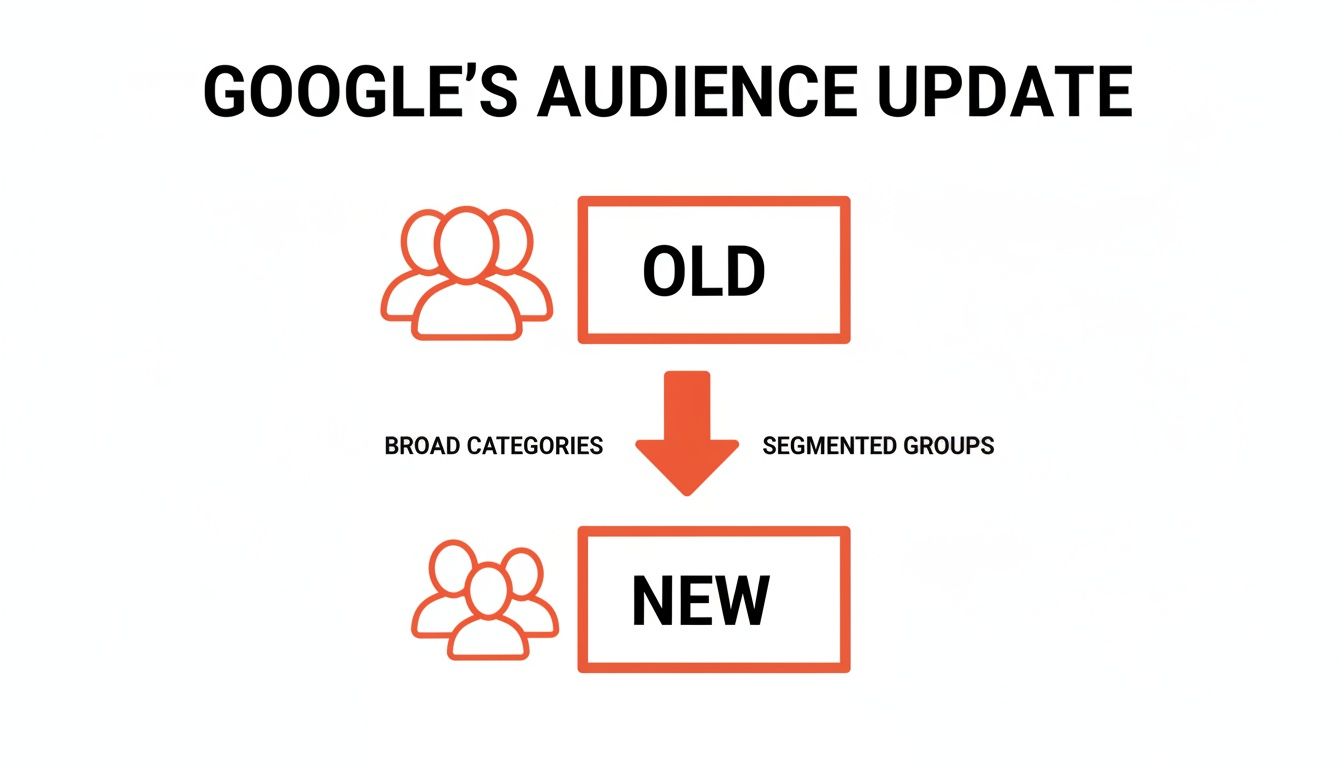
This process shows the strategic shift from targeting large, generic groups to focusing on smaller, highly specific segments. The key takeaway is that modern remarketing thrives on precision, moving away from broad audiences to engage users based on their specific actions.
Your goal is to move beyond the lazy "All Visitors" list. True ROI comes from targeting high-intent groups, like users who viewed a specific product category, spent more than three minutes on your site, or—most importantly—abandoned their shopping cart.
To illustrate how this works in practice, here are some common remarketing audience segments and the strategies you might use for each.
Key Remarketing Audience Types and Strategies
| Audience Type | Description | Strategic Goal | Example Ad Message |
|---|---|---|---|
| All Website Visitors | A broad list of anyone who has visited your site in the last 30-90 days. | Brand Awareness | "Explore Our New Autumn Collection. Free Shipping on All Orders." |
| Product Page Viewers | Users who viewed specific product pages but did not add to their cart. | Nudge Towards Consideration | "Still Thinking About Those Hiking Boots? See Why They Have 5-Star Reviews." |
| Category Page Viewers | Visitors who browsed a general category, like "women's jackets." | Showcase Variety & Offers | "Find Your Perfect Winter Jacket. Shop Our Range of Styles & Colours." |
| Shopping Cart Abandoners | High-intent users who added items to their cart but did not complete the purchase. | Overcome Final Hurdles | "Forgot Something? Your Items Are Waiting. Complete Your Purchase Now!" |
| Past Purchasers | Existing customers who have previously bought from you. | Drive Repeat Business & Loyalty | "Thanks for Your Recent Order! Here's 15% Off Your Next Purchase." |
By breaking down your visitors like this, you can deliver a message that's far more relevant and likely to bring them back.
Pillar 3: Compelling Ad Creative
Your ads are your direct line of communication to your warm audience. And since these people already know your brand, your creative needs to be more than just a generic brand message. It should be a relevant, compelling reminder that nudges them toward a specific action.
Great remarketing creative should:
- Be Contextual: If someone was looking at hiking boots, show them an ad for hiking boots—not your entire shoe collection.
- Include a Clear Call-to-Action (CTA): Tell users exactly what you want them to do next, whether it’s "Complete Your Purchase," "Shop the Sale," or "Learn More."
- Reinforce Your Value Proposition: Remind them why they were interested in the first place. This could be a message about free shipping, quality craftsmanship, or a limited-time offer.
For some real-world inspiration, exploring a variety of remarketing ads examples can give you practical ideas for crafting messages that actually resonate.
Pillar 4: Intelligent Bidding and Budgeting
The final pillar is all about making sure your ad spend is working as hard as possible to maximise your return. This involves setting intelligent bidding strategies that align with your campaign goals. For instance, a campaign focused on driving sales should absolutely use a bid strategy optimised for conversions or Return On Ad Spend (ROAS).
Budgeting isn't just about setting a daily spend limit; it's about allocating your funds strategically across your most valuable audience segments. An expert agency will constantly monitor performance, shifting budget away from underperforming audiences and doubling down on those that are driving the most conversions at the lowest cost. This dynamic management ensures not a single dollar of your ad spend is wasted, directly contributing to a healthier bottom line.
Using Advanced Remarketing and Audience Strategies
Once you’ve got a solid foundation in place, it’s time to move beyond basic remarketing and tap into some seriously powerful techniques. These advanced strategies are what transform campaigns from simply effective to exceptionally profitable by delivering hyper-personalised and timely messages.
This is where a professional Google remarketing services agency can really elevate your game, creating campaigns that drive significantly higher engagement and conversion rates. We're moving past a generic "all visitors" list to connect with users in a way that feels helpful and intuitive, not intrusive. It's all about using what you know about their behaviour to guide them back to your brand.

Unlocking Personalisation with Dynamic Remarketing
Dynamic remarketing is the ultimate personalisation tool, especially for e-commerce businesses. Instead of showing a generic ad to someone who visited your site, you can automatically show them ads featuring the exact products they viewed, added to their cart, or even previously purchased.
Think of it as a digital personal shopper. If a customer was admiring a specific blue jacket on your website, dynamic remarketing makes sure the ad they see later features that same blue jacket, complete with its price and image. It’s a direct reminder of what caught their eye.
This is all made possible by connecting your product feed from the Google Merchant Centre to your Google Ads campaign. The system then automatically creates ads on the fly, tailored to each user's unique browsing history. For businesses with hundreds or thousands of products, this automated personalisation is a game-changer that manually creating ads could never hope to match.
This level of relevance is incredibly powerful. Because the ads are so specific to the user's recent interest, dynamic remarketing campaigns often see a much higher click-through rate (CTR) and conversion rate compared to standard remarketing ads, directly improving your return on ad spend.
Telling a Story with Sequential Remarketing
Not every customer is ready to buy the moment they see your first ad. That's where sequential remarketing comes in. It's an advanced strategy that lets you guide a user along a journey by showing them a series of different ads in a specific order over time.
It’s like telling a story instead of just shouting the same message over and over again. This approach is perfect for products or services with a longer consideration phase, allowing you to build a narrative that addresses potential concerns, highlights different benefits, and builds trust before ever asking for the sale.
Here’s a simple example of a three-step sequence:
- Ad 1 (Days 1-3): Introduce the brand and the problem you solve. The focus here is on building awareness and brand recall.
- Ad 2 (Days 4-7): Showcase customer testimonials or a case study. The goal is to build social proof and credibility.
- Ad 3 (Days 8-14): Present a compelling, time-sensitive offer to create urgency and drive that final conversion.
This method prevents ad fatigue and nurtures leads far more effectively than a single, static ad ever could.
Re-engaging Your Best Leads with Customer Match
Your existing email list is one of your most valuable marketing assets. These are people who already know and trust your brand enough to have given you their contact details. Customer Match is a Google Ads feature that lets you tap into this goldmine.
You can securely upload a list of your customer emails into Google Ads. Google then matches these emails to its user accounts, allowing you to run highly targeted remarketing campaigns for your subscribers across Search, Shopping, Gmail, and YouTube.
The possibilities here are immense:
- Re-engage lapsed customers: Target past buyers who haven't made a purchase in several months with a special "we miss you" offer.
- Upsell existing clients: Show ads for premium services or complementary products to your current customer base.
- Find new customers: Create "Similar Audiences" based on your Customer Match list to find new users who share characteristics with your best customers.
By combining these advanced strategies, you move beyond simple reminders and into the realm of sophisticated, relationship-building marketing that drives sustainable growth.
How to Measure Your Remarketing Success and ROI
Launching a campaign is just the beginning; the real test is figuring out if it's actually working. Measuring the success of your google remarketing services isn't about chasing clicks and impressions. It’s about drawing a straight line from your ad spend to real business results and proving a solid return on investment (ROI).
Without proper measurement, you’re just guessing. You’re flying blind. Solid tracking lets you cut through the noise of vanity metrics and focus on the numbers that actually move the needle. It's about understanding not just how many people clicked, but what valuable actions they took next.
Key Metrics That Truly Matter
To get a real sense of performance, you need to zero in on a few key performance indicators (KPIs). These are the metrics that tell you how efficiently your campaign is turning ad dollars into revenue. If you need a refresher on the basics, here’s a great guide to help you calculate marketing ROI.
Let's break down the most important ones:
- Cost Per Acquisition (CPA): This is the average price you pay for one conversion—whether that’s a sale, a form submission, or a phone call. A low CPA is a sign of a highly efficient campaign.
- Return On Ad Spend (ROAS): ROAS tells you how much revenue you’re generating for every dollar you spend on ads. A ROAS of 5:1 means you made $5 for every $1 invested. This is the ultimate measure of profitability.
- Conversion Rate: This is simply the percentage of people who click your ad and then complete the action you want them to. Remarketing campaigns almost always have a higher conversion rate because you're talking to a warm audience that already knows you.
Of course, tracking these KPIs accurately depends on having flawless conversion tracking set up from the get-go. If you need help with that, our guide on setting up Google Ads conversion tracking is the perfect place to start.
Why Remarketing Delivers a Higher ROI
Remarketing consistently blows standard advertising out of the water for one simple reason: you're not talking to strangers. You’re re-engaging people who have already raised their hand and shown interest in what you offer, which naturally leads to better results across the board.
Think about the customer's journey. Someone who has already browsed your products is much closer to making a decision than someone seeing your brand for the first time. This high-intent audience is primed to listen, leading to much stronger engagement.
Remarketing isn't about finding new customers; it's about closing the deal with the ones who are already close to buying. This efficiency is why it often becomes the most profitable part of a company's entire digital advertising strategy.
The numbers back this up. For SMEs using Google Ads, Search ads boast an average Click-Through Rate (CTR) of 3.17%. This is more than three times higher than Display ads (0.46%) or Shopping ads (0.86%), making Search the perfect channel to remarket to high-intent users. Since a huge chunk of ad spend already goes to Search, remarketing simply amplifies its power by zeroing in on your past visitors.
This massive difference in engagement leads directly to a lower Cost Per Acquisition and a much higher Return On Ad Spend. By focusing your budget on your most qualified prospects, you slash wasted ad spend and dramatically increase your chances of landing a profitable conversion. It’s the clearest proof of the immense value a well-run remarketing campaign can bring.
Choosing the Right Google Remarketing Services Agency
Picking the right partner for your remarketing campaigns is a big deal. It can genuinely make or break your efforts. You’re not just looking for someone to run your ads; you’re looking for a strategic ally who gets your business goals and knows how to turn them into real, measurable results.
Get it wrong, and you’re looking at wasted ad spend and a heap of missed opportunities. But get it right? You’ve just plugged a powerful growth engine into your business. The trick is to see past the flashy sales pitches and zero in on what actually matters: their strategic thinking, how transparent they are, and the way they treat their clients.
Core Questions to Ask Any Potential Agency
Before you sign on the dotted line, you need to do a bit of digging. Asking the right questions will help you sort the true experts from the pretenders and find a partner that’s actually a good fit.
Here are the non-negotiables you should be asking:
- What’s your strategic process? A top-tier agency should be able to clearly walk you through how they handle audience segmentation, creative development, and bid management. If you get a vague answer, that’s a massive red flag.
- How do you measure and report on success? Look for an agency that obsesses over business metrics like Cost Per Acquisition (CPA) and Return On Ad Spend (ROAS), not just vanity stats like clicks and impressions. They should offer completely transparent, live reporting.
- What does your client communication look like? A solid partnership is built on clear, consistent communication. Ask them about their process for updates, how often you’ll meet, and how easy it is to get in touch with your dedicated strategist.
- What are your contract terms? Be wary of agencies that try to lock you into long, rigid contracts. An agency that’s confident in its ability to deliver will offer flexible, month-to-month terms, because they know they have to prove their value every single day.
Finding a True Partner, Not Just a Provider
The ideal relationship is a partnership—one built on trust and shared goals. This means finding an agency that puts your success ahead of its own bottom line. At Click Click Bang Bang, we’ve built our entire business around this client-first philosophy, getting rid of the usual friction points that drive businesses mad.
To help you vet your options, we've put together a simple checklist. Think of it as your guide to comparing apples with apples and finding an agency that truly aligns with your needs.
Agency Evaluation Checklist
| Evaluation Criteria | What to Look For | The Client-First Approach |
|---|---|---|
| Strategic Expertise | A clear, documented process for audience building, creative strategy, and campaign optimisation. | We build custom strategies based on a deep dive into your business goals, not a one-size-fits-all template. |
| Reporting & Transparency | Live, 24/7 dashboards and reports that focus on ROI and CPA, not just clicks. | You get full access to a live reporting portal, plus clear monthly summaries that explain what the data actually means for your business. |
| Communication | A dedicated point of contact and a regular, structured communication schedule. | We provide a dedicated strategist and a clear communication rhythm, so you’re never left in the dark. |
| Contract Flexibility | Month-to-month agreements that don’t lock you in. | We offer no-lock-in contracts and a 30-day risk-free trial. We earn your business every month. |
| Onboarding & Speed | A streamlined process that gets your campaigns live quickly without cutting corners. | Our detailed onboarding process ensures we understand your business inside-out. Campaigns are typically live within seven days. |
| Proven Results | Case studies, testimonials, and client references that back up their claims. | We're happy to share our track record and connect you with clients who can speak to our results. |
This checklist should give you a solid framework for making a smart decision. It’s not just about ticking boxes; it’s about finding a partner who is invested in your growth.
We believe a Google remarketing services agency should earn your business every single month. That’s why we offer flexible, no-lock-in contracts and a 30-day risk-free trial. It keeps us accountable and ensures we are always focused on delivering tangible results.
Our transparent, client-centric model is designed to create the foundation for a successful, long-term partnership. If you're looking for a team to help you navigate the complexities of paid advertising, see what a dedicated Google Ads agency can do for your business. The right partner won't just manage your campaigns—they'll help you grow.
Common Questions About Google Remarketing
Even after getting your head around the strategy, it's completely normal to have a few lingering questions before you jump in. Putting your money into any new marketing channel requires confidence, so we’ve rounded up some of the most common queries we hear from business owners about Google remarketing services. Here are the straightforward answers you’re looking for.
How Much Should I Budget for a Google Remarketing Campaign?
There’s no magic number here, but a sensible starting point for most small to medium businesses in Australia is somewhere between $500 and $2,000 per month. The goal isn’t to spend a fortune from day one; it’s to start with a budget that’s big enough to gather meaningful data, then scale up once you see what’s working.
A good agency won’t just ask for more money. They’ll be laser-focused on your Cost Per Acquisition (CPA) to make sure every dollar you spend is profitable. This approach lets your budget grow naturally alongside your returns, keeping the risk low while you chase that high ROI.
Will Remarketing Ads Annoy My Potential Customers?
This is a big one, and a valid concern. Nobody wants to be that brand. But when done right, remarketing is helpful, not intrusive. A professional agency manages this by using frequency caps, which are basically rules that limit how many times any one person can see your ad in a day or week.
We also focus on relevance. Showing someone an ad for the exact product they were just looking at isn't a random interruption—it’s a useful reminder.
Good remarketing doesn't cause ad fatigue; it provides timely, helpful nudges that guide people back to something they already showed interest in. It strengthens brand recall and helps them make a final decision.
This careful management ensures your brand feels like a welcome presence, not an unwelcome pest.
How Long Does It Take to See Results from Remarketing?
Because you're targeting a 'warm' audience—people who have already visited your site—results from remarketing tend to show up much faster than with other types of advertising. You can usually expect to see initial data and even some early conversions within the first 30 days.
Of course, the time it takes to get a consistent, positive ROI will depend on things like your website traffic and how long your sales cycle is. But the early performance trends are almost always visible right away, which lets us fine-tune the strategy and optimise quickly.
Can I Do Remarketing Myself or Do I Need an Agency?
Technically, a savvy business owner could set up a basic remarketing campaign. The tools are all there. But getting a truly great return on your investment is a whole other ball game that requires deep expertise. A specialised agency brings that advanced knowledge to the table.
Here’s where that expertise really makes a difference:
- Audience Segmentation: Moving beyond a simple "all visitors" list to create laser-focused audiences based on high-intent actions.
- Creative Testing: Constantly running A/B tests to figure out which ad copy, images, and offers actually get people to click.
- Bid Management: Using advanced strategies to get the most value from every single dollar in your budget.
- Conversion Tracking: Making sure every lead and every sale is tracked perfectly and attributed to the right campaign.
Partnering with an expert frees you up to do what you do best—run your business—while being confident that your ad spend is being managed efficiently for the best possible results.
Ready to turn those missed opportunities into loyal customers? The team at Click Click Bang Bang specialises in creating data-driven Google Remarketing campaigns that deliver a measurable ROI. Get started with our risk-free 30-day trial today!
Read NeXt
Or Read Our Latest
- Manual vs Automated Bidding for PPC Success
- Conversion Tracking Setup: A Complete AU Guide
- Instagram Advertising Australia: Complete 2026 Guide
- Pay Per Click: A Beginner’s Guide for Australian Marketers
- Display Advertising on Google: The Complete Australian Guide
- Stakeholder Communication Plan How to Build One That Works
Click. CLick. Subscribe.
Get our best PPC insights, industry updates, and power moves delivered straight to your inbox. No fluff, just high-caliber strategies that actually work.
Don’t Leave Just Yet
Try Us For 30-Days,
Risk Free!!
We guarantee that you’ll love our work within the first 30 days, if not you’ll get your money back.
What have you got to lose?