

Google Ads for Lead Generation: A 2026 Playbook
Last Updated

Clicks are easy to buy. Sales-ready leads aren't.
A lot of Google Ads accounts look healthy on the surface. Impressions are coming in, search terms look relevant, the click-through rate is fine, and form submissions are happening. Then the sales team steps in and says the leads are weak, unreachable, outside the service area, or nowhere near ready to buy. That's where most lead generation programs break. They optimise for activity instead of commercial outcome.
Good Google Ads for lead generation works more like a system than a campaign. You need intent capture, clean structure, tight targeting, persuasive ad-to-page alignment, proper tracking, and a feedback loop from your CRM. Miss one of those pieces and Google will still spend your budget. It just won't spend it well.
In Australia, that matters even more because Google remains the obvious starting point for search-led acquisition. As of 2024, Google held 91.7% of the search engine market in Australia, far ahead of Bing at 3.76%, which is why Google Ads remains the primary paid search channel for reaching in-market Australian searchers. If you want to capture people searching with service, quote, comparison, or near-me intent, this is usually where the work starts.
Beyond Clicks to True Business Leads
The usual complaint sounds like this: “We're getting traffic, but the leads are rubbish.” That problem rarely starts with ad copy alone. It usually starts with the wrong success metric.
If you optimise for cheap clicks, Google will find you cheap clicks. If you optimise for raw lead volume, it will often find people willing to fill in a form with very little buying intent. That's why lead generation needs a harder standard. A lead should be someone your sales team wants to speak with.
What a real lead looks like
A real lead isn't just a completed action. It's a completed action from someone who fits your business.
That means qualification criteria need to exist before the campaign launches. For some advertisers, that's location and service fit. For others, it's budget, urgency, property type, company size, job role, or whether the enquiry matches the sales process you can support. If you work in a category where qualification is complex, this guide to real estate lead qualification is a useful example of how lead handling gets sharper when teams define quality before they chase volume.
Practical rule: If your form counts every submission equally, your bidding strategy will eventually learn the wrong lesson.
Why Google Ads is the foundation
Google Ads is powerful for lead generation because it captures people at the moment they declare intent. They aren't passively scrolling. They're asking for a provider, a solution, a quote, or a comparison.
That distinction matters. Search traffic usually gives you a better shot at commercial relevance than awareness channels, especially for local services, B2B, and considered purchases. The account's job isn't to “get seen”. It's to sort high-intent searchers from low-fit traffic and turn that into pipeline.
Choosing Your Campaign and Structuring for Control
Campaign choice isn't a feature comparison exercise. It's a control decision.
For lead generation, the first question is simple. Are you trying to capture existing demand, create demand, or re-engage people who already know you? Most businesses should start by capturing existing demand because that's where buying intent is clearest.
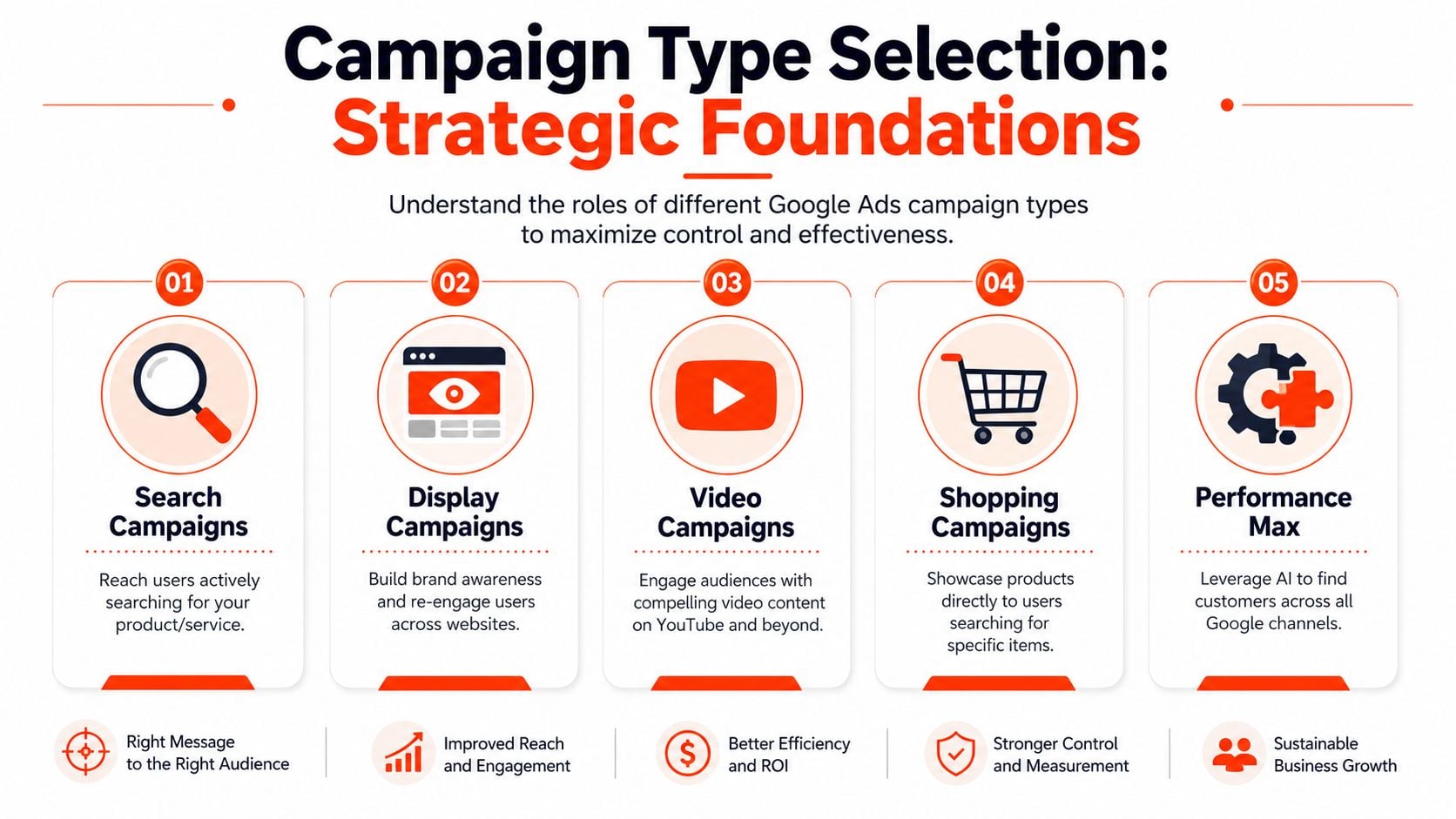
Which campaign type does what
| Campaign type | Best role in lead generation | Main trade-off |
|---|---|---|
| Search | Capture active intent from people already looking | Limited to existing demand |
| Display | Support remarketing and brand re-engagement | Lower intent, easier to waste spend |
| Video | Build consideration and educate buyers | Harder to judge on lead volume alone |
| Shopping | Relevant for product-led enquiries | Not the core play for service lead gen |
| Performance Max | Expand reach once conversion signals are reliable | Less visibility and less control |
Search should usually be your starting point. It gives you the cleanest line between keyword, ad, landing page, and lead. That makes it easier to diagnose what's working and what isn't.
Display and Video can help, but they're supporting channels in most lead-gen accounts. They're useful for remarketing, branded reinforcement, and warming up longer buying journeys. They're not where you want to solve lead quality first.
Performance Max can work once your account already has good conversion signals. It's rarely the place to begin if your lead quality is unstable, your CRM feedback loop doesn't exist, or your geographic targeting is messy.
The structure that protects budget
In Australian lead gen, the highest-control setup starts with high-intent Search using phrase and exact match for core services, then segments campaigns by service and by location. Broad match should come later, after exact and phrase data is consistently profitable, as outlined in this Australian lead generation strategy guide.
That recommendation matters because campaign structure determines what you can control. If you mix every service and every location into one campaign, your budget drifts toward whatever generates the most easy traffic. That's rarely the same as what generates the most profit.
A practical structure often looks like this:
- Separate by service line: Keep high-value services in their own campaigns so they don't compete with lower-priority offers.
- Separate by geography: Metro, regional, and service-area differences can distort results quickly if they share one budget.
- Separate by intent level: Quote and emergency terms behave differently from broader research terms.
- Separate branded from non-branded: Branded traffic can inflate performance and hide problems elsewhere.
Search is where most lead-gen accounts earn the right to expand. If Search isn't controlled, expansion usually multiplies noise.
If you need a starting framework, this Google Ads campaign structure template is useful for mapping campaigns around service categories, location splits, and intent tiers before spend goes live.
What usually doesn't work
A few patterns repeatedly create bad lead-gen accounts:
- One campaign for everything: Budget control disappears.
- Broad match from day one: Query quality becomes harder to manage.
- Too many goals in one campaign: Calls, form fills, awareness, and remarketing all compete for the same signal.
- Expansion before proof: Performance Max and Display get added before Search fundamentals are stable.
Control isn't glamorous, but it's what gives you clean data. Clean data is what lets you scale.
Targeting That Attracts Quality Prospects
Targeting is a filtering exercise. The point isn't to reach the largest possible audience. The point is to keep removing the people who shouldn't click.
That starts with keywords, then moves into geography, audience layering, devices, and exclusions. Most accounts underperform because they treat targeting as audience expansion. Strong lead-gen accounts treat it as traffic qualification.

Start with keyword intent, not keyword volume
High-intent keywords usually contain commercial signals. Think service names, problem-solution phrasing, quote terms, comparison terms, location modifiers, and urgency language.
Low-intent traffic often enters through broad informational language. That traffic can look relevant in a report and still produce weak sales conversations. The fix isn't just “better keywords”. It's tighter intent grouping.
A useful way to think about keyword sets:
- Core service terms: Direct searches for the thing you sell.
- High-commercial modifiers: “Quote”, “pricing”, “company”, “service”, “near me”.
- Problem-led searches: Strong when the problem is tightly linked to your service.
- Research terms: Sometimes useful, but they need separate treatment and lower expectations.
Match types are a control lever
Phrase and exact match give you stronger control early because they limit how quickly the account drifts into irrelevant variations. They also make search term analysis cleaner.
Broad match has a place, but only after you know what profitable intent looks like in your account. Used too early, it often opens the door to low-fit traffic that looks similar to buying intent but isn't.
That's why negative keywords matter so much. They stop your budget leaking into job seekers, DIY searches, education queries, freebie hunters, unrelated locations, and service variants you don't want.
If the search term shows curiosity but not purchase intent, it shouldn't get the same bid as someone asking for a quote.
The Australian geo-targeting trap
For local and service-area advertisers, location settings can degrade lead quality. Google's broader location option can include users who show interest in a place rather than physically located there. For Australian campaigns, that often means metro spillover, interstate traffic, or clicks from outside the true service zone.
Google's Presence or Interest setting can inflate clicks from users outside your service area. For local lead generation in Australia, selecting Presence is essential if you only want people physically in your target locations, as explained in this guide to effective lead generation using Google Ads.
That setting matters more than many advertisers realise. A campaign can appear efficient on paper while sending the sales team leads from suburbs, cities, or states the business doesn't serve.
Audience layers that sharpen traffic
Audience targeting is most useful when it refines search, not when it replaces intent.
Try using audience signals to observe patterns first. In-market segments, customer lists, and remarketing pools can all help, but they should support the core intent model. If you already know certain audiences produce better-qualified opportunities, use that insight to adjust bids, tailor messaging, or split campaigns where needed.
A simple quality filter checklist helps:
- Location fit: Are they physically inside the service zone?
- Service fit: Does the query match a profitable offer?
- Buyer fit: Are they the kind of prospect your team can close?
- Urgency fit: Are they looking now, or just browsing?
The more of those filters you can satisfy before the click, the less junk your sales team has to clean up later.
Converting Clicks with Persuasive Ads and Landing Pages
A high-intent search doesn't guarantee a lead. It only gives you a chance to earn one.
Australia's internet advertising revenue reached A$16.4 billion in the 2023–24 financial year, with search advertising at A$7.1 billion, which means advertisers are competing in a mature auction where expensive clicks have to be converted properly, not just won, as noted in this overview of Google Ads for lead generation.
The ad has one job
The ad needs to continue the intent of the search, not rewrite it.
If someone searches for a specific service, the headline should reflect that service clearly. If the search implies urgency, the ad should reduce friction. If the user is comparing providers, the ad should give them a reason to choose your next step.
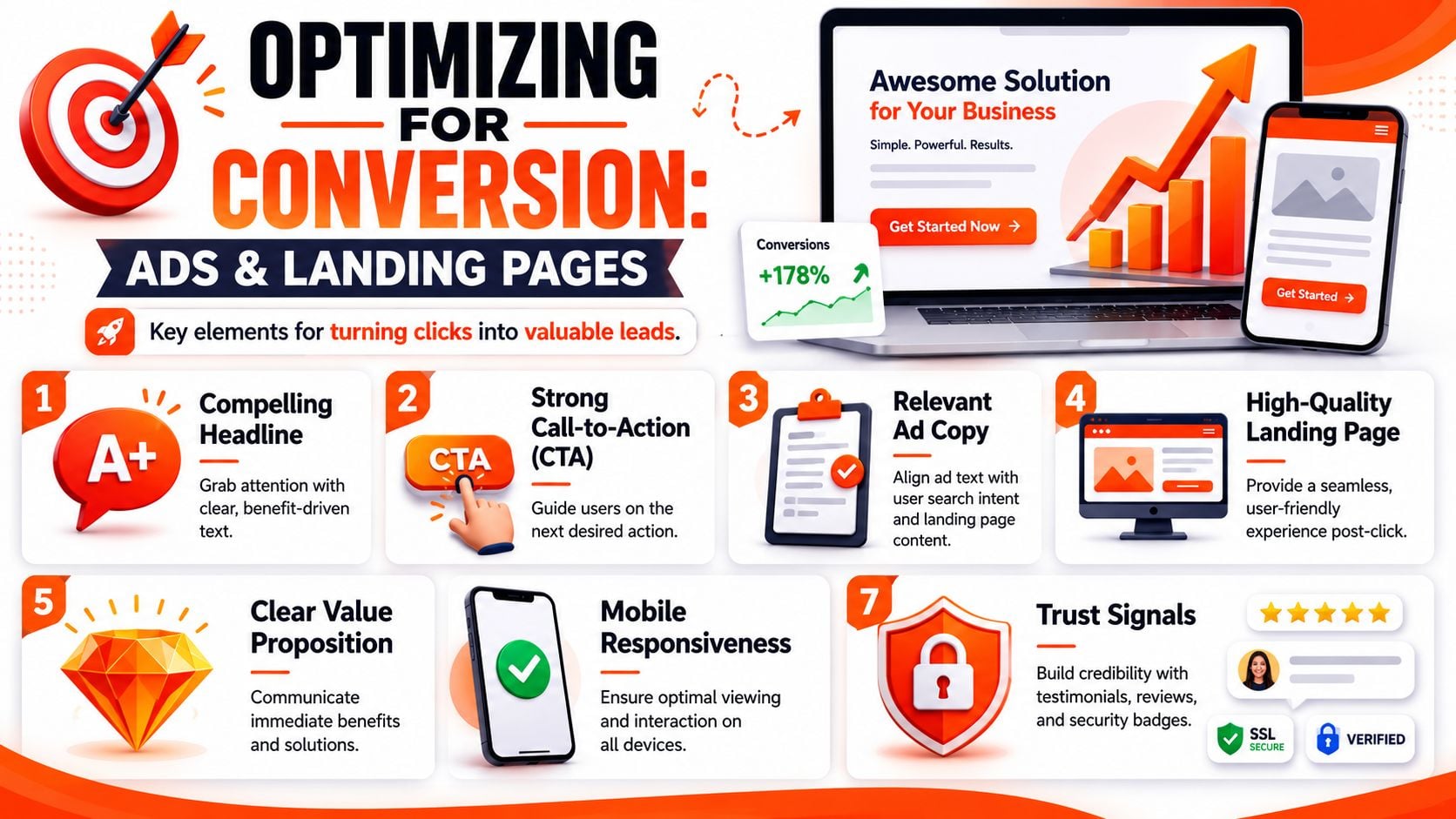
Good ad copy usually does three things well:
- Matches the query: Mirror the service or problem language the user searched.
- States the offer clearly: Quote, consult, inspection, callback, booking, demo.
- Removes doubt: Mention service area, turnaround, specialisation, or process fit.
Lead form assets can help when speed matters, but they need qualification built in. Lower friction often increases submission volume. It can also lower intent if the form asks too little or hands the user off poorly.
Landing pages close the gap
The landing page should feel like the natural continuation of the ad, not a separate marketing asset.
That means the page headline should match the offer, the page should focus on one action, and the form should ask for enough information to help qualification without creating unnecessary resistance. Most weak landing pages fail because they try to say everything at once.
A strong page usually includes:
- Message match: The same service promise the ad introduced.
- A visible CTA: No hunting around for the next step.
- Useful proof: Reviews, accreditations, case examples, or process clarity.
- A form built for sales relevance: Enough fields to help the team prioritise.
If you're producing ad variants at scale, tools like the ShortGenius AI ad creative tool can help generate and test creative concepts faster, especially for Video and Display support assets, but the strategic work still sits in the messaging and qualification logic.
For businesses building campaign-specific pages, this landing page creation guide covers the practical alignment between offer, form design, and ad intent.
A short walkthrough helps illustrate how the pieces should connect:
What usually breaks conversion
| Breakdown point | What happens |
|---|---|
| Generic ad copy | The click comes from curiosity, not fit |
| Weak CTA | The user doesn't know the next step |
| Mismatched landing page | Intent drops after the click |
| Overlong form | Good prospects abandon |
| Underqualified form | Sales team gets low-intent submissions |
Strong lead generation keeps momentum intact from keyword to ad to landing page to thank-you page.
Measuring What Matters From Conversions to CRM
A campaign can look healthy in Google Ads and still fail the business. The report shows form fills. Sales sees spam, poor-fit enquiries, and people who never reply. That gap is where lead-gen accounts drift off course.
Tracking needs to be accurate from day one
If conversion tracking is wrong, every later decision gets weaker. Bids optimise to noise. Good keywords get paused. Bad traffic gets more budget than it deserves.
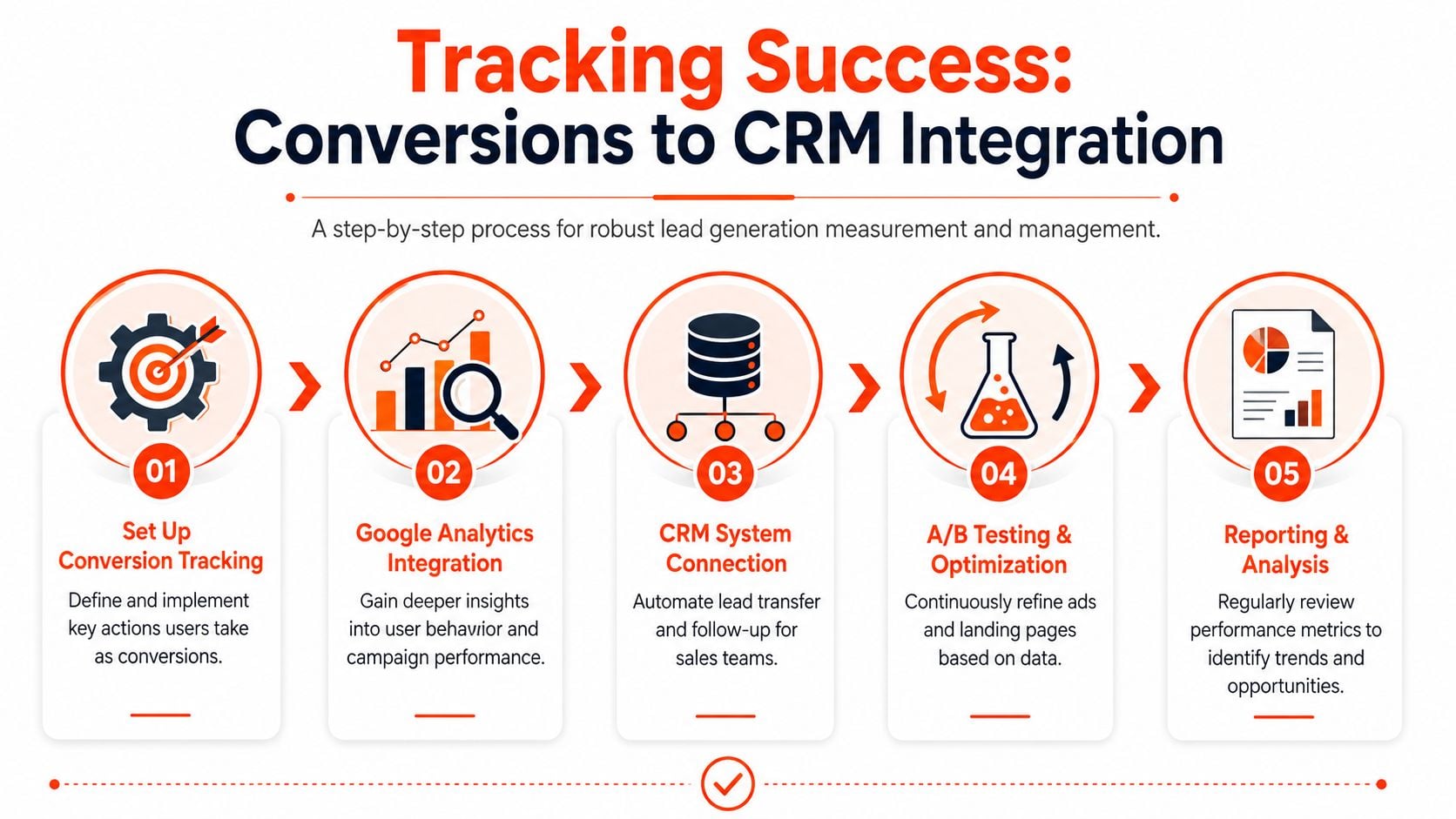
For lead generation, the baseline is simple. Track the actions that represent real enquiries, then make sure each one is recorded consistently enough to match back to the CRM later. That usually means:
- Form submissions: Preferably tied to a thank-you page or a confirmed event.
- Phone call tracking: Important for service businesses where calls often convert better than forms.
- Lead form submissions: If you use native lead forms inside Google Ads.
- Source consistency: So ad platform data can be reconciled with CRM records.
For a practical setup reference, Otter A/B's conversion tracking guide covers the analytics side well. If you need the Google Ads implementation itself, this guide to Google Ads conversion tracking setup is a useful operational reference.
Form fills are only the first signal
A submitted form has limited value on its own. It confirms that someone converted. It does not confirm that the person is qualified, in-market, inside your service area, or likely to close.
That distinction matters more in B2B, high-ticket services, and any account with a sales cycle longer than a day or two. In those cases, optimising to raw lead count usually pushes the platform toward the easiest conversions, not the best ones.
A cheap lead that never reaches pipeline costs more than a higher-CPL lead your sales team actually wants.
CRM feedback changes how the account learns
Google Ads gets much smarter when you pass back what happened after the enquiry. At that point, campaigns are no longer judged only by front-end conversion volume. They can be evaluated by sales qualification, opportunity creation, and closed revenue.
I look for four questions first:
- Which campaigns produce sales-accepted leads, not just submissions?
- Which keywords create qualified pipeline?
- Which locations bring in the right-fit enquiries?
- Which devices, audiences, or hours tend to create junk leads?
That is the shift from lead tracking to lead quality measurement. Platforms and services such as Click Click Bang Bang's Google Ads conversion tracking setup can help connect lead actions to a more reliable reporting framework, but the primary requirement is process discipline. Sales stages need to flow back into media decisions.
What to send back into Google Ads
You do not need a perfect CRM before you start importing offline outcomes. You need clear status definitions that separate weak leads from valuable ones.
| CRM signal | Why it matters for optimisation |
|---|---|
| Invalid or junk lead | Helps identify low-quality queries, placements, or audiences |
| Qualified lead | Separates fit from simple form completion |
| Opportunity created | Connects spend to pipeline, not just enquiries |
| Sale or closed customer | Lets bidding optimise toward commercial value |
Once that feedback loop is in place, account management gets sharper. Budget shifts toward sources that create revenue. Sales and PPC start using the same definition of success. That is how lead generation becomes profitable, not just busy.
Optimising for Profit Not Just Lead Volume
The easiest way to wreck a lead-gen account is to worship cost per lead.
Cheap leads often look efficient in a report. Then sales follow-up starts and the picture changes. The cheap campaign sends low-fit enquiries. The expensive one sends fewer leads, but they close. If you only optimise to form volume, you'll eventually scale the wrong thing.
The better model is value-based optimisation. A major weakness in most lead generation content is that it ignores lead quality. The stronger approach is to assign value to leads and import offline CRM outcomes so campaigns don't scale low-quality submissions that merely look productive on the surface. That's the core argument in Google's lead generation resource for businesses.
What changes when you optimise for value
You stop treating every conversion as equal.
That affects bidding, budget allocation, and performance reviews. Campaigns with higher front-end cost can become the obvious winners if they produce stronger downstream value. Campaigns with attractive headline metrics can get cut if they keep filling the pipeline with weak leads.
A practical optimisation rhythm looks like this:
- Cut what generates junk: Even if the CPL looks good.
- Protect what brings qualified demand: Even if volume is lower.
- Review by service and geography: Profitability often sits in pockets.
- Shift bidding logic over time: When lead values are reliable, value-focused bidding becomes far more useful than chasing raw conversion count.
The goal isn't more leads. The goal is more leads worth selling to.
What profitable Google Ads for lead generation looks like
A profitable account has a clear pattern. Search captures strong intent. Structure preserves control. Targeting removes low-fit traffic. Ads and landing pages carry the same promise. Tracking captures the lead. CRM feedback grades the lead. Optimisation follows revenue signals, not vanity metrics.
That's when Google Ads stops behaving like a traffic source and starts behaving like a measurable acquisition system.
If your account is generating activity but not enough qualified pipeline, Click Click Bang Bang helps businesses build Google Ads programs around tracking, landing page alignment, campaign structure, and downstream lead quality so optimisation decisions are based on what sales teams can close.
Read NeXt
Or Read Our Latest
Click. CLick. Subscribe.
Get our best PPC insights, industry updates, and power moves delivered straight to your inbox. No fluff, just high-caliber strategies that actually work.
Don’t Leave Just Yet
Try Us For 30-Days,
Risk Free!!
We guarantee that you’ll love our work within the first 30 days, if not you’ll get your money back.
What have you got to lose?