

Multi Touch Attribution
Last Updated

Your dashboard says branded search is your hero. Your SEO team says content started the journey. Paid social insists it warmed the audience. Email claims it closed the deal. All of them can point to a conversion path and say, with some justification, “that was us”.
That's the practical problem multi touch attribution solves.
If you're an Australian marketing manager deciding whether the next dollar goes into Google Ads, SEO content, branded search defence, retargeting, or LinkedIn, single-touch reporting won't give you a reliable answer. It gives you a neat answer. Those are not the same thing. In most accounts, the journey is messy, staggered, and spread across devices. Budget decisions made on a tidy fiction usually create expensive blind spots.
What Is Multi Touch Attribution and Why It Matters Now
Multi touch attribution is a way of assigning conversion credit across the touchpoints that contributed to a sale or lead, rather than handing all the value to one interaction.
A typical path might look familiar. Someone sees a paid social ad, comes back later through an organic search result, reads a service page, clicks a remarketing ad, then converts from an email. Last-click reporting gives all the credit to the final step. Multi touch attribution asks a better question: which of these interactions helped move the buyer forward?
That distinction matters because most journeys aren't linear anymore. If you need a quick refresher on the current situation, this overview of marketing attribution models is useful for comparing the main ways marketers assign credit.
What MTA does in practical terms
At a practical level, MTA changes the conversation from “what closed?” to “what contributed?”
That sounds small, but it shifts how you judge channel performance:
- SEO stops looking invisible when it introduces or educates buyers who later convert through paid search.
- Google Ads reporting gets more honest because branded and remarketing campaigns no longer absorb all the glory.
- Upper-funnel spend becomes easier to defend when you can see assist value instead of only final-click value.
Practical rule: If several channels consistently appear before conversion, giving one of them all the credit will distort your budget.
Why marketers care now
The reason this has become urgent is simple. Buyers move across platforms, sessions, and devices before they act. Attribution isn't just a reporting exercise anymore. It's a budgeting discipline.
When teams ignore that, they often end up overfunding channels that harvest demand and underfunding channels that create it. That's why multi touch attribution matters most when you're trying to answer the question every marketing manager eventually faces: where should the next dollar go?
The Problem with Last Click Attribution
Last-click attribution is popular because it's simple. It's also one of the fastest ways to misread channel performance.
In football, the striker taps in from two metres out and gets credited with the goal. Fine. But if the midfield split the defence, the winger created the cross, and the fullback started the move, pretending only the final touch mattered would be absurd. That's what last-click does to your marketing.
If you want a concise breakdown of how the model works before moving past it, this guide to understanding last touch attribution is a solid primer.
Where last-click goes wrong
In most accounts, last-click tends to over-credit channels near conversion and under-credit channels that introduced the prospect or shaped consideration.
That usually means:
- Branded search looks stronger than it really is because it often captures people who already decided.
- SEO content looks weaker than it is because educational pages rarely get the final click.
- Paid social and display get cut too early because they assist more often than they close.
- Email nurture gets reduced to a closing tool even when it's doing real persuasion across the journey.
The business risk isn't theoretical. You start reallocating budget toward closers and away from creators of demand. Over time, the pipeline gets thinner and growth stalls, even though bottom-funnel metrics still look efficient for a while.
Why this is especially misleading in Australia
In Australia, buyer behaviour already points to a multi-step journey. Google has said 64% of consumers use the internet to find information about products and services before buying, and 3 in 4 Australians use multiple devices during the shopping journey, which makes single-click credit structurally weak for decision-making (Salesforce summary of Google ANZ research).
That matters because last-click assumes a clean path. Real journeys aren't clean.
Last-click is fine for a narrow operational view. It is poor as a budgeting truth.
What it does to channel planning
Here's where I see the damage most often. A team reviews channel reports and notices branded search has the strongest return. They increase spend there, reduce top-of-funnel activity, and trim SEO content because it “doesn't convert”. Months later, non-brand demand softens and branded search volume plateaus.
The problem wasn't the branded campaign. The problem was the model.
| What last-click rewards | What it tends to hide |
|---|---|
| Final conversion actions | Earlier discovery touchpoints |
| Brand capture activity | Education and trust-building |
| Retargeting closers | Content and awareness work |
| Short-term efficiency | Total channel contribution |
Last-click doesn't just miss nuance. It can train a team to make the wrong cuts.
Common Multi Touch Attribution Models Explained
A marketing manager rarely asks, “Which attribution model is academically correct?” The practical question is simpler and more commercial. “If I pull $20,000 from SEO and put it into Google Ads, what am I likely to gain, and what am I likely to break?”
That is why attribution models matter. Each model distributes credit differently, and that changes how channels look in budget conversations. The model is not the answer. It is the scoring system behind the answer.
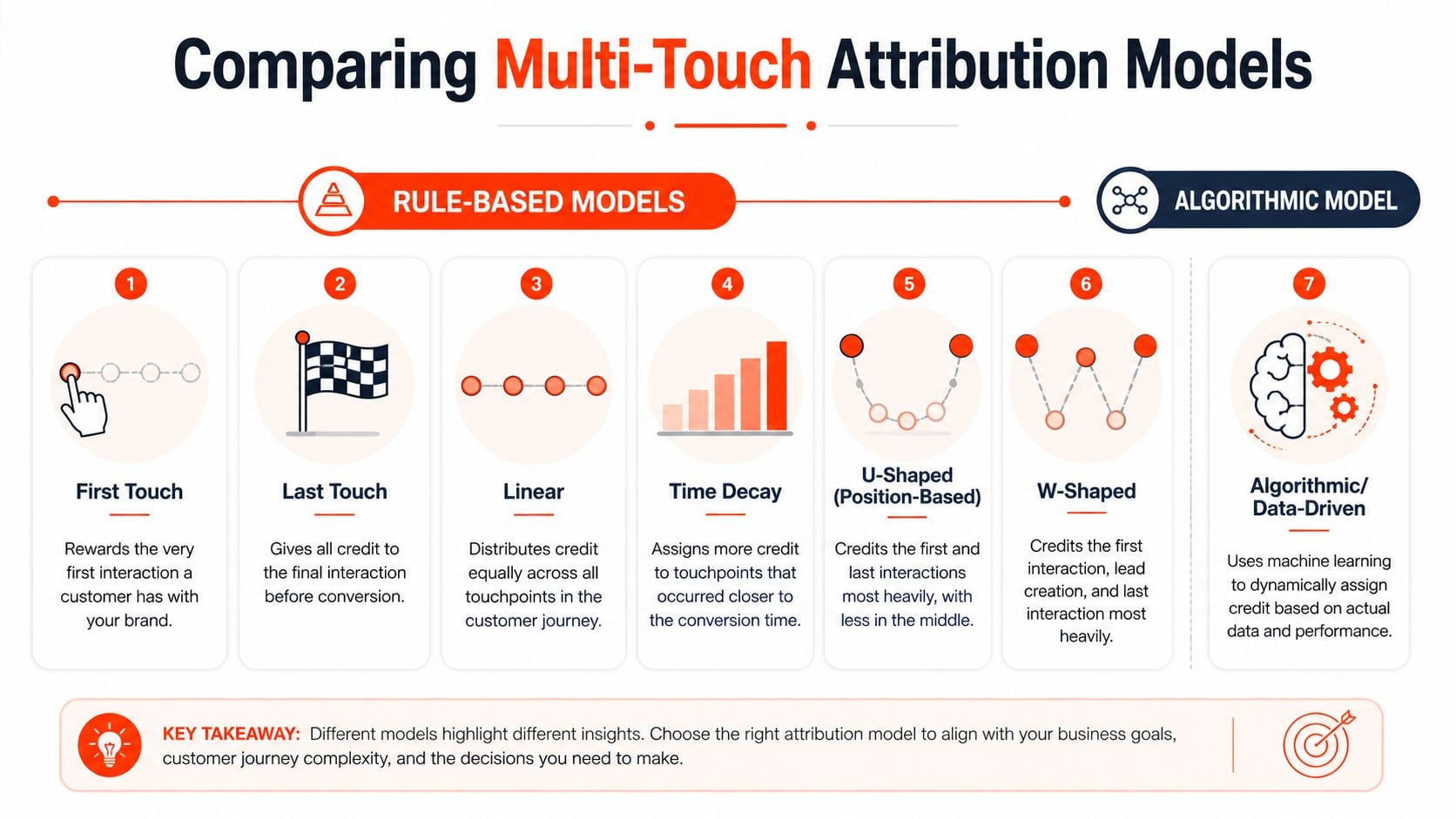
Rule-based models are a common starting point
Rule-based models are often the first useful step because they are easy to explain and audit. If a finance lead asks why paid search received more credit than organic content, the logic is visible. That matters when you need alignment across marketing, leadership, and agencies.
Linear
Linear attribution gives equal credit to every touchpoint in the path.
It is a clean baseline. If a buyer found you through non-brand search, returned via remarketing, then converted through branded search, each interaction gets the same share of credit. The trade-off is obvious. Equal weighting is tidy for reporting but blunt for decision-making, because buyer intent is rarely equal across every step.
Best fit: businesses replacing last-click with a simple model that is easy to defend internally.
Time decay
Time decay gives more credit to touches that happened closer to conversion.
This model tends to suit short buying cycles, retail offers, and lead gen campaigns where recent interactions carry more buying intent. It is less useful if your growth depends on channels that create demand early, such as SEO content, YouTube, or upper-funnel paid social. In those cases, the model can make closing channels look stronger than they really are.
Best fit: campaigns with short consideration periods and frequent conversion activity.
U-shaped
A common U-shaped setup gives heavier weight to the first and last touch, with the remaining credit shared across the middle interactions.
This is often practical for businesses balancing channel discovery and channel capture. It recognises that the first interaction created the opportunity and the last interaction converted it. For many Australian businesses deciding between investing in content or increasing search spend, that is a better reflection of reality than linear or last-click. The weakness is that mid-funnel touches can get compressed even when they do real work, such as email nurture, case-study content, or remarketing.
Best fit: businesses that want a fairer comparison between acquisition channels and conversion channels.
Models for more structured buying journeys
Some funnels have clear commercial stages. A software company may care about first visit, lead creation, sales-qualified lead, and closed deal. A service business may care about first click, enquiry, consultation booked, and signed proposal. In those cases, structured models are often more useful because they reflect how revenue moves through the funnel.
W-shaped
The W-shaped model places more credit on three key milestones: first touch, lead creation, and conversion. The rest is spread across the remaining interactions.
For B2B programs, this is often more actionable than a U-shape. It gives proper weight to the moment someone shifts from anonymous visitor to real lead. If your team reports on MQLs, booked demos, or qualified enquiries, this model usually gives a clearer view of which channels are creating pipeline versus which ones are only helping close it.
Best fit: B2B and considered-purchase funnels with a clearly defined lead stage.
Position-based variants
Position-based models are broader versions of the same idea. They give extra weight to selected milestones and distribute the remainder across other touches.
These models work well when the business needs a practical reporting framework, not perfect statistical precision. I often see them used when channels have very different jobs. SEO may introduce the buyer, Google Ads may capture high-intent demand, and email may keep the opportunity alive. A position-based model can reflect that better than a flat weighting system.
A useful attribution model improves budget judgement. It does not replace it.
Data-driven attribution
Data-driven attribution uses observed path behaviour to estimate how much each touchpoint contributed to conversion. In the right setup, this is more customized than any fixed rule.
It also has stricter requirements. A recent guide published in early 2026 described practical readiness markers such as healthy conversion volume, multiple touchpoints per journey, and strong identity resolution across channels. That framing is helpful because it keeps businesses from adopting advanced modelling before the tracking setup can support it.
For an in-house team or agency, the commercial question is straightforward. If identity stitching is weak and conversion volume is thin, data-driven attribution can look impressive while producing unstable conclusions. In that situation, a transparent rule-based model is often more reliable for budget allocation. This is also why first-party data collection and identity quality matter so much before you trust any model output.
Quick comparison
| Model | Strength | Weakness | Best use |
|---|---|---|---|
| Linear | Easy to explain and benchmark | Overvalues minor touches | Early-stage MTA setup |
| Time decay | Reflects recent purchase intent | Can under-credit awareness channels | Short buying cycles |
| U-shaped | Balances discovery and conversion | Understates middle-funnel influence | Mixed channel programs |
| W-shaped | Mirrors lead-based funnels well | Depends on clear funnel stages | B2B lead generation |
| Data-driven | Adapts to actual path behaviour | Needs strong tracking and enough volume | Mature programs |
The right model is the one that helps you make better spend decisions between channels with different roles. If it gives too much credit to the channel that closes demand and too little to the channel that creates it, your budget will drift in the wrong direction.
Data and Tracking Your Foundation for Accurate Attribution
Attribution models get the attention. Tracking is what makes them believable.
If the underlying data is patchy, multi touch attribution becomes a decorative report. You might still get charts. You just won't get truth. The core technical requirement is an identity graph that stitches user-level events across channels, supported by first-party web or app events, UTM parameters, and platform identifiers unified in a central data store before any model assigns credit (Improvado on multi-touch attribution).
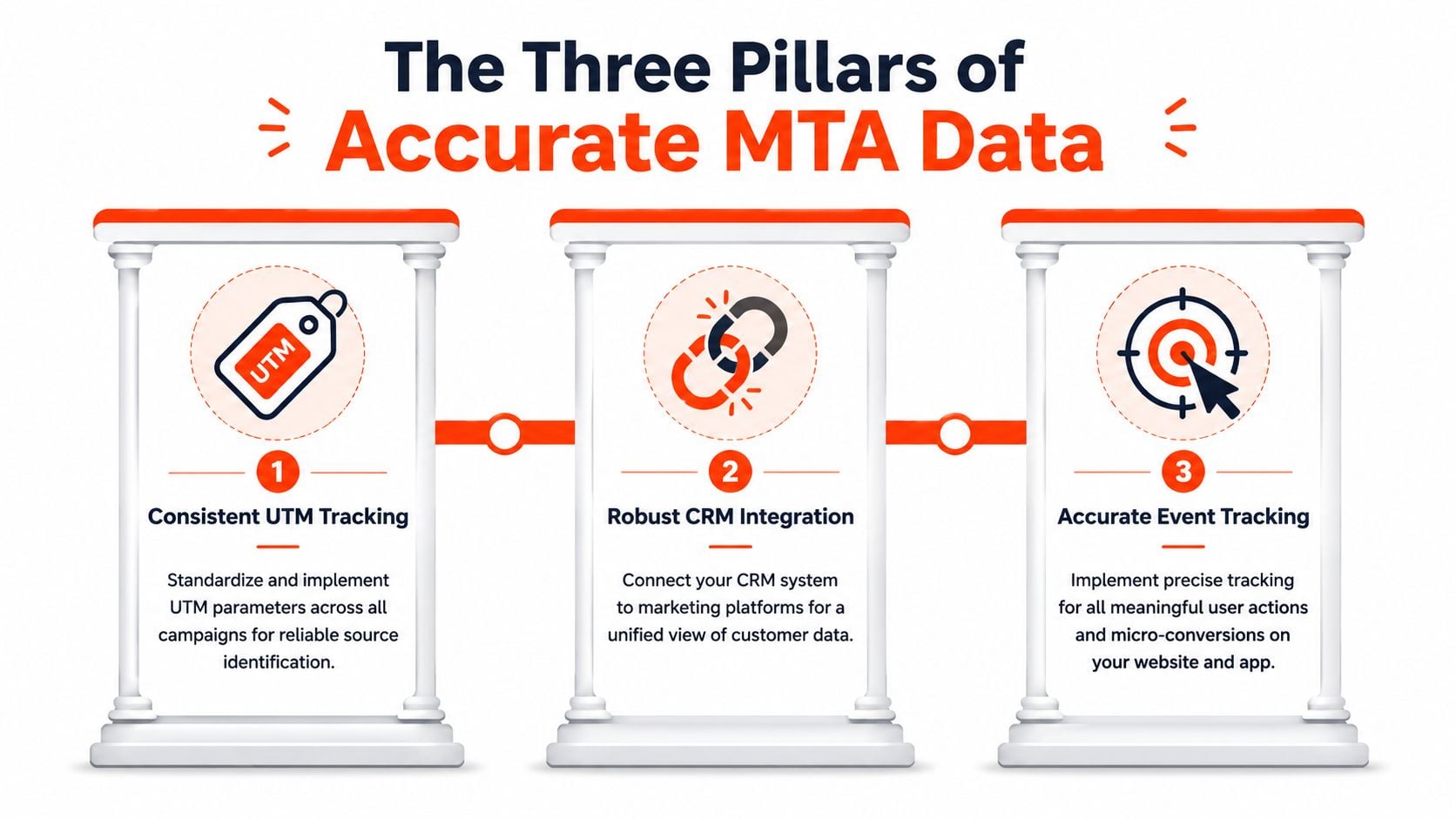
Think of the setup like a recipe
If you leave out flour, baking powder, or eggs, the cake won't work. MTA is similar. It needs a few essential ingredients.
-
Consistent UTMs
If your campaign naming is loose, source data becomes unreliable fast. “Meta”, “Facebook-paid”, and “fb_cpc” shouldn't all mean the same thing in different reports. -
Event tracking that reflects real intent
Page views aren't enough. You need meaningful events such as product views, form starts, form submits, purchases, calls, and qualified leads. -
Identity stitching
This is the hard part. Someone clicks on mobile, returns on desktop, and converts after an email. If your stack can't connect those actions to the same person, credit assignment falls apart.
The practical checklist
A workable MTA setup usually includes:
- A tag management layer such as Google Tag Manager to control and QA event deployment.
- Analytics capture for first-party website or app interactions.
- CRM integration so leads and revenue events don't stop at the browser.
- A central store or attribution layer where raw events can be unified before modelling.
- Disciplined governance around naming conventions, source definitions, and conversion logic.
For marketers dealing with privacy shifts and browser limitations, first-party collection matters more than ever. This explainer on first-party data strategy is worth reviewing if your tracking still depends too heavily on rented platform signals.
The model only distributes the credit you captured. It cannot rescue the touchpoints you failed to track.
What usually breaks
Most attribution problems aren't caused by the model. They're caused by messy implementation.
Common failure points include:
- Duplicate conversions from overlapping tags.
- Missing UTMs on email, LinkedIn, partner, or QR-based campaigns.
- No CRM feedback loop for lead status and actual sales outcomes.
- Fragmented identities where each device looks like a new user.
- Overreliance on platform dashboards that report inside their own walls.
If you want cleaner budget decisions, start with cleaner tracking. MTA is downstream of instrumentation. Always.
How to Choose the Right Attribution Model for Your Business
The best attribution model depends less on theory and more on how your business sells.
A local e-commerce brand with repeat purchasers, Shopping campaigns, and quick purchase decisions doesn't need the same model as a B2B software company running LinkedIn, webinars, sales calls, and long follow-up cycles. Treating them the same is how teams end up with elegant reports and poor decisions.
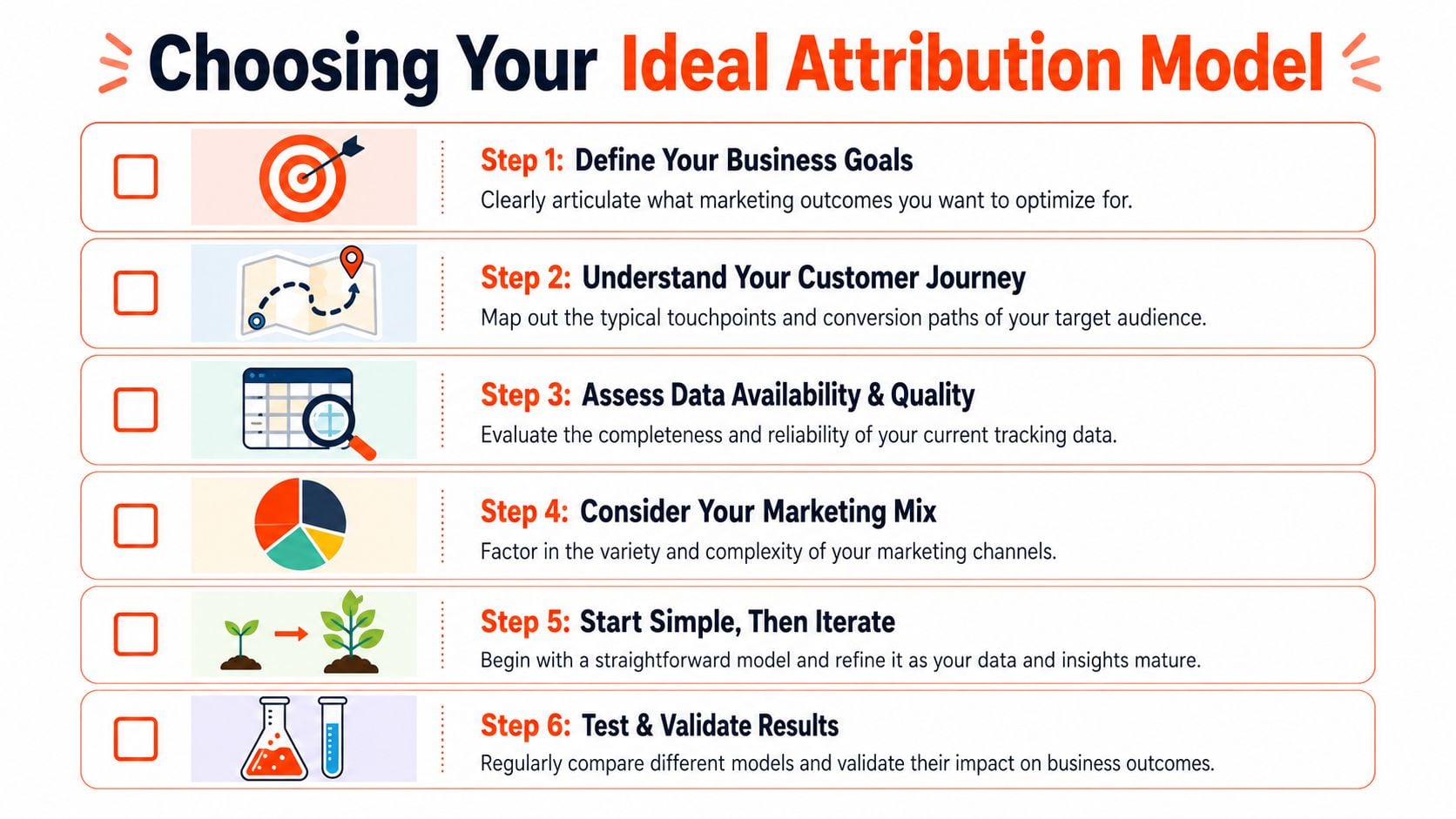
Start with the shape of the journey
The first question isn't “which model is best?” It's “what does your path to conversion look like?”
If the path is short and transactional, a model that gives more weight to later interactions can be useful. If the path is long and consultative, you need a model that protects discovery and lead creation from disappearing in the reporting.
A practical way to frame it:
| Business context | Strong starting point | Why it fits |
|---|---|---|
| Short e-commerce journey | Time decay or linear | Recent touches often drive the final action |
| Mixed paid search and SEO lead gen | U-shaped | Values both entry and close |
| B2B with MQL or demo milestone | W-shaped | Reflects lead creation as a meaningful event |
| Mature account with strong data quality | Data-driven | Lets actual path data influence weighting |
Use business questions, not platform defaults
The appropriate choice hinges on the decision that needs to be made.
- Trying to protect top-of-funnel investment? Use a model that gives visible credit to first touch.
- Trying to understand lead generation quality? Use a model that highlights the conversion into lead, not just sale.
- Trying to optimise a short purchase path? Use a model that respects recency without going all the way back to last-click.
Here's a useful way to pressure-test the choice:
If the model's output would cause you to cut a channel you know starts valuable journeys, the model probably doesn't fit your business.
A short walkthrough can help if you want to see how practitioners frame model selection in simpler terms:
Start simple, then compare
I rarely recommend starting with the most complex option. A rule-based model you can explain and challenge is often more useful than an advanced model nobody trusts.
A sensible rollout often looks like this:
- Map the actual path using your existing CRM and analytics data.
- Choose one primary model for regular reporting.
- Run a second model alongside it as a sense check.
- Compare channel movement rather than staring at one report in isolation.
- Adjust only after you've seen repeated patterns, not one month of noise.
That approach keeps attribution tied to business judgement. Which is where it belongs.
Using MTA Insights to Optimise PPC and SEO
A familiar budgeting call looks like this. Branded search is hitting target CPA. Generic search looks expensive. SEO content rarely gets the last click. Paid social shows up early, then disappears from the conversion report. If you only look at the closer, the obvious move is to cut discovery activity and put more money into brand.
That decision often hurts growth.
Multi-touch attribution is useful because it separates demand creation from demand capture. In practice, that matters most when an Australian marketing manager has to decide whether the next dollar should go into Google Ads, SEO content, or both. Branded search and retargeting often finish the job. Category terms, informational content, YouTube, display, and paid social often start or support the journey.
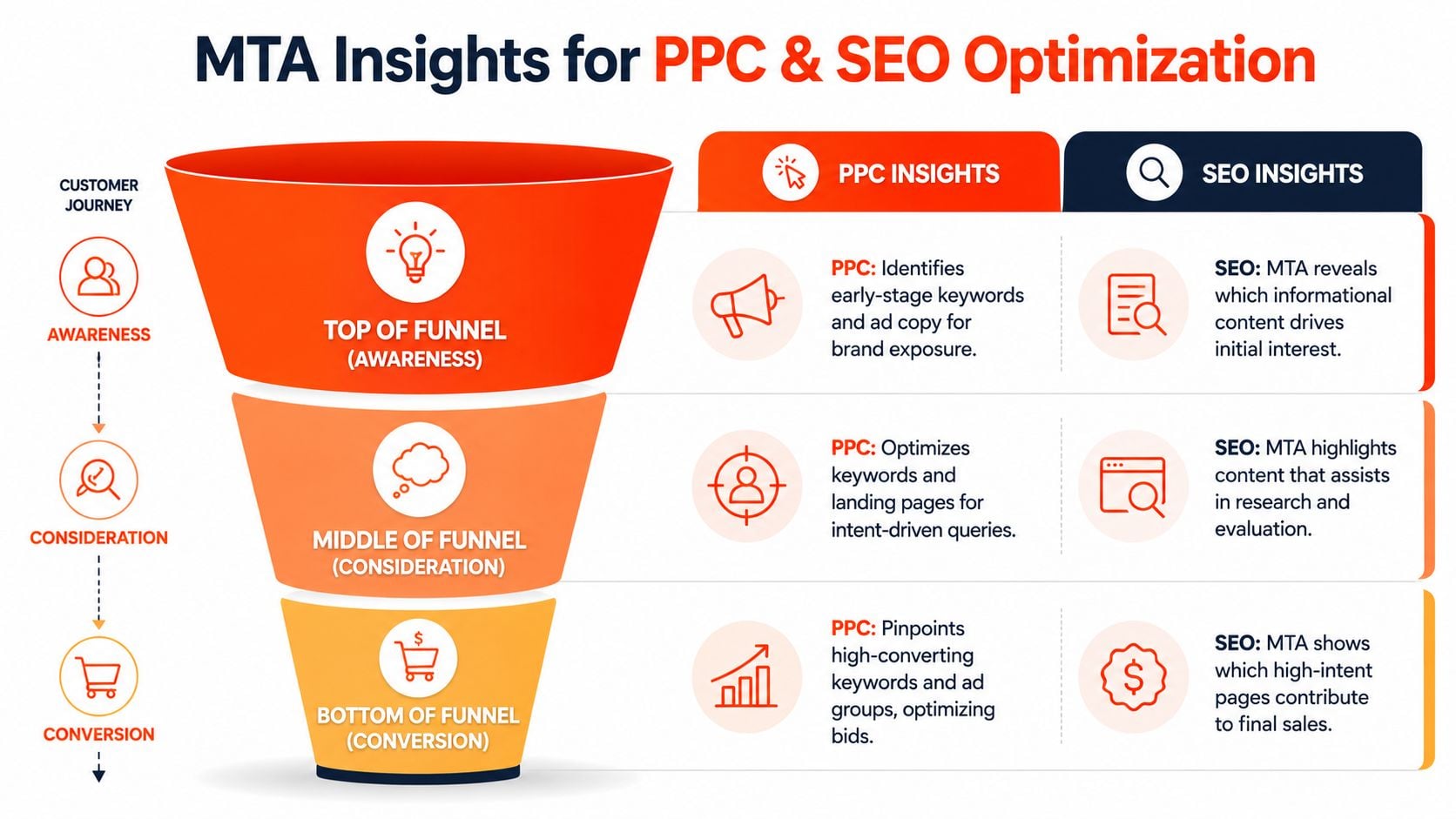
A position-based model is one practical way to stop early touches from disappearing. A common version gives more weight to the first and last interaction, with the remaining credit shared across the middle. That will not suit every business, but it is often a useful budgeting lens when upper-funnel channels introduce buyers and branded search closes them.
What this changes in PPC
For PPC, MTA helps answer a budget question that last-click handles badly. Which campaigns generate demand, and which ones collect it after another channel has done the hard work?
That changes how paid search should be managed:
- Protect non-brand acquisition campaigns when they repeatedly appear early in paths that later convert through brand.
- Treat retargeting as a closing tactic and judge it accordingly, instead of letting it absorb all the credit.
- Review generic and informational keywords by assist value as well as direct conversion value.
- Separate prospecting from capture budgets so efficient brand traffic does not distort the whole account.
Keyword strategy matters here. If your search program is expanding into broader or emerging query behaviour, this guide to keywords for AI search is a useful complement because attribution only helps if the keyword plan matches how people research.
What this changes in SEO
SEO usually loses credit in simple reporting because much of its value happens before the sale. Blog content introduces the problem. Category and comparison pages help people narrow options. Product and service pages validate the decision. Another channel may still get the conversion click.
MTA gives those roles a clearer commercial context:
- Informational pages can be judged by whether they start qualified journeys, not whether they close them.
- Comparison and category pages often work as validators that move users closer to enquiry or purchase.
- High-intent pages may share conversion credit with paid search instead of being hidden behind direct or branded visits.
Budgetary discipline is essential. Some content assists revenue. Some content just attracts traffic. MTA does not rescue weak pages. It helps separate useful early-stage SEO from content that looks busy but contributes little to pipeline or sales.
Good attribution shows how PPC and SEO work together across the path to conversion, so budget decisions reflect contribution rather than just the final click.
How to act on the report
A usable MTA report should lead to budget actions, not another dashboard. Start with decisions that affect spend allocation:
- Identify channels and campaigns with strong assist rates but weak last-click visibility.
- Pull branded search out from broader PPC reporting so you can see what is creating demand versus harvesting it.
- Group SEO landing pages by journey role such as discovery, evaluation, and conversion support.
- Review paid and organic together for the same topic or intent set because they often influence the same sale.
- Check attribution findings against wider business measures using a framework for measuring advertising effectiveness across channels.
The practical goal is simple. Keep funding the activity that starts and supports profitable journeys, even when another channel gets the final click.
Implementation Paths and Common Pitfalls
There are two common ways teams start with multi touch attribution.
The first is to use built-in analytics and ad-platform reporting. The second is to build or buy a more dedicated attribution setup with warehouse logic, CRM integration, and custom modelling. Both can work. Neither is self-managing.
The practical implementation paths
Built-in tools are often fine for getting started. They're accessible, familiar, and quick to activate. The trade-off is that they may be constrained by platform-specific visibility, modelling assumptions, and whatever data you haven't integrated properly.
A more customised setup gives you greater control over identity stitching, CRM data, offline outcomes, and model logic. It also requires stronger operational discipline. More flexibility means more responsibility.
For teams looking at platform-specific attribution ecosystems, this overview of Salesforce marketing attribution approaches helps frame what a more integrated path can look like.
Where implementations usually fail
The biggest mistake is treating MTA like a switch you turn on.
It's closer to account hygiene. It needs maintenance, governance, QA, and periodic review. The common pitfalls are boring, which is why they're dangerous.
-
Incomplete tracking
If email, CRM stages, phone calls, or offline sales aren't in the picture, the model can only score the fragment you captured. -
Wrong model for the buying cycle
A short-path e-commerce model usually won't suit a long, multi-stakeholder B2B process. -
Platform silo thinking
Meta, Google Ads, GA4, and your CRM will each tell a partial story. None of them is the whole map on its own. -
Too much faith in precision
Attribution is directional. It sharpens decision-making. It doesn't produce divine truth.
What works better
The strongest MTA programs usually share a few habits:
- They define one source of truth for conversions instead of letting every tool count differently.
- They compare models before changing budget rather than reacting to one view.
- They include sales feedback so lead quality and closed revenue inform the analysis.
- They revisit the setup regularly because channels, privacy settings, and customer paths change.
The point of multi touch attribution isn't to eliminate uncertainty. It's to reduce avoidable mistakes.
If you approach MTA as an ongoing measurement discipline, it becomes very useful. If you approach it as a one-off dashboard project, it usually disappoints.
If you need help turning attribution data into better PPC and SEO budget decisions, Click Click Bang Bang works with Australian brands that want cleaner tracking, sharper reporting, and a more practical view of what's driving leads and sales.
Read NeXt
Or Read Our Latest
Click. CLick. Subscribe.
Get our best PPC insights, industry updates, and power moves delivered straight to your inbox. No fluff, just high-caliber strategies that actually work.
Don’t Leave Just Yet
Try Us For 30-Days,
Risk Free!!
We guarantee that you’ll love our work within the first 30 days, if not you’ll get your money back.
What have you got to lose?