

Local SEO for Business: local seo for business tips and tactics
Last Updated
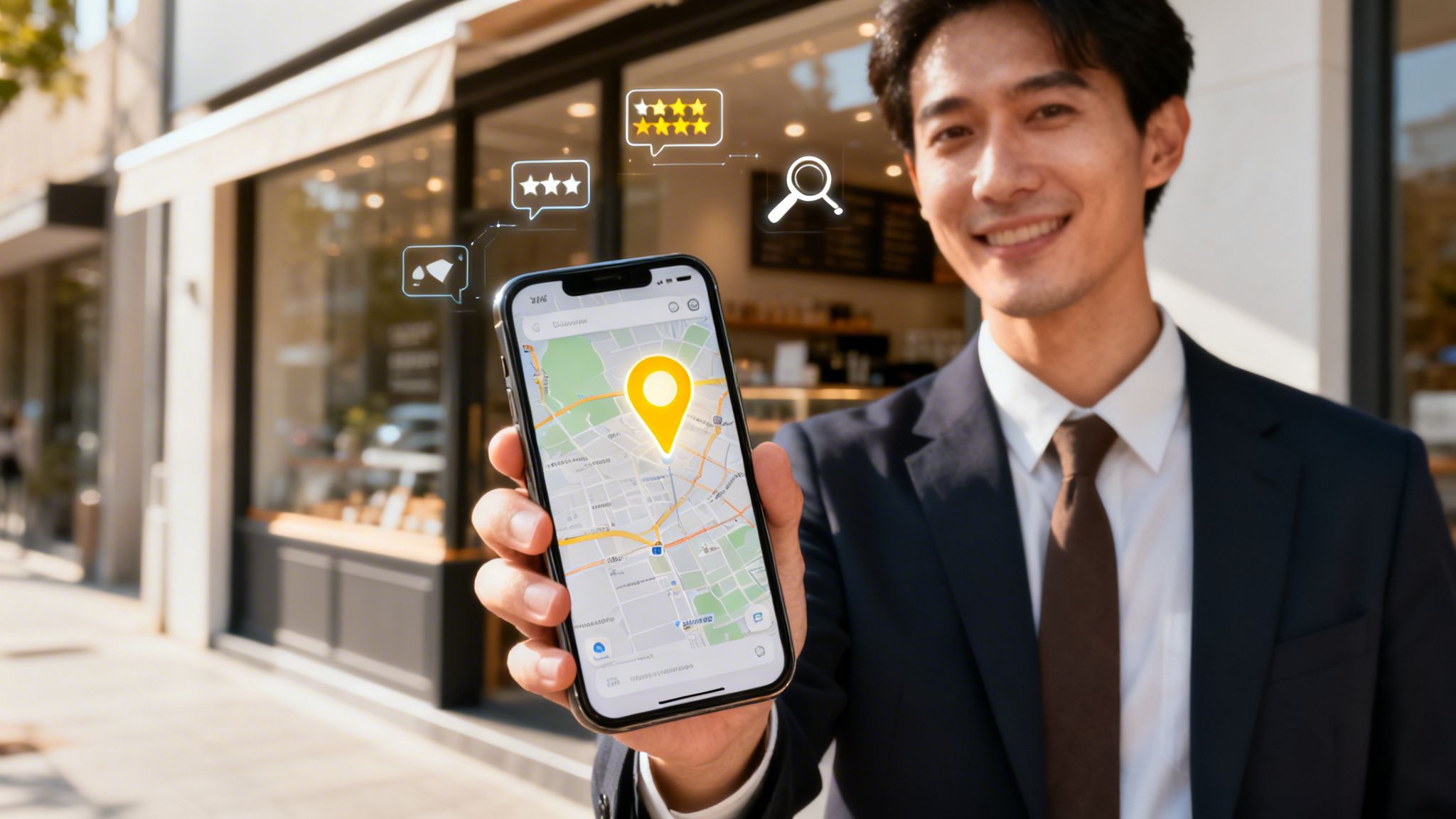
At its core, local SEO is all about making your business impossible to miss when people nearby search for what you offer on Google. It’s about being the first name they see. This process turns your business into a local authority, driving real-world results like more foot traffic, phone calls, and website clicks.
Why Local SEO Is Your Strongest Advantage

Think about it: your ideal customer is just around the corner, phone in hand, searching for exactly what you sell. Will they find you, or will they find your competitor down the street? A solid local SEO strategy is what makes the difference.
This is non-negotiable for any Australian business, whether you're a cafe in Melbourne that lives on foot traffic or a B2B consultancy targeting clients across Sydney.
The modern customer journey almost always kicks off with an online search before someone makes a local purchase. This is especially true here in Australia, where research shows a massive 60% of users search online for local services before committing to anything. Those quick "near me" searches are what turn browsers into loyal customers.
Mastering the Core Pillars of Local Search
To get to the top of those local search results, you need to focus on what Google actually cares about. We're not going to get bogged down in technical jargon here—just actionable strategies that have a direct impact on your bottom line.
These are the foundational elements you absolutely have to get right:
- Google Business Profile (GBP) Optimisation: This is your digital storefront. Honestly, it's the single most important piece of the local SEO puzzle.
- Local Keyword Research: You need to get inside your customers' heads and figure out the exact phrases they’re typing into Google to find businesses like yours.
- Review Generation and Management: A steady stream of positive customer feedback is a massive trust signal for both people and search engines.
- NAP and Citation Consistency: This just means making sure your business Name, Address, and Phone number are identical everywhere they appear online.
By mastering these areas, you transform your online presence from a passive listing into an active engine for generating real-world results: more phone calls, more website visits, and more customers walking through your door.
From Strategy to Action
This guide will walk you through each of these pillars with practical, real-world steps. For those looking to truly dominate their service area, this detailed local SEO for contractors guide offers some brilliant insights. The principles apply to pretty much any local business that wants to capture nearby demand and build an unbeatable community presence.
Optimising Your Google Business Profile
If there’s one thing you absolutely must get right in local SEO, it’s your Google Business Profile (GBP). This is the undisputed heavyweight champion of your local presence. It’s often the first, and sometimes only, interaction a potential customer has with your brand online.
Think of it less like a simple listing and more like your digital storefront. It’s packed with opportunities to stand out, and getting it right goes far beyond just plugging in your business name and address. A fully optimised profile sends powerful signals to Google that you're a legitimate, active, and highly relevant choice for people searching nearby.
Choosing Your Business Categories
This is where it all begins, and it's one of the most critical steps. Your categories are how you tell Google exactly what you do. You get one primary category and can add several secondary ones.
Your primary category needs to be the most specific option available that describes your main service. For example, a cafe shouldn't just choose "Restaurant." A much better choice would be "Cafe," "Coffee Shop," or "Breakfast Restaurant." It’s a small detail that makes a huge difference.
Then, use secondary categories to cover everything else you offer. That cafe might add "Sandwich Shop" or "Takeaway Food" to capture a wider net of relevant searches. Nailing this immediately puts you in the right conversation for customer queries.
Crafting a Compelling Business Description
You’ve got 750 characters for your business description—make them count. This is your elevator pitch, your chance to tell your story and weave in the kinds of keywords your customers are actually using.
Don't just rattle off a list of services. Talk about your connection to the local community, your years of experience, or what makes your customer service stand out. A great description helps someone decide if you’re the right fit for them before they even think about clicking through to your website. You can find more tips on connecting with your local audience in our deep dive into local SEO strategies for Australian businesses.
Pro Tip: Google definitely uses the info in your description to understand your business better, so keep it clear, concise, and focused on what you do best. Resist the urge to stuff it with keywords; a natural, customer-first tone always wins.
Maximising Every Available Feature
A half-finished profile is a massive missed opportunity. If you want to really own the local search results, you need to use every single feature Google gives you. It shows a high level of engagement, and Google absolutely rewards that.
Here are some of the most impactful features to fill out:
- Services and Products: Get granular here. Detail every single service or product you offer. You can add descriptions and even pricing, essentially creating a mini-catalogue right inside your profile. This is how you start ranking for specific searches like "emergency hot water repairs" instead of just "plumber."
- Attributes: These are quick, searchable tags that highlight key features of your business. Think "wheelchair accessible," "free Wi-Fi," "outdoor seating," or "women-led." Customers use these to filter results, and an attribute can easily be the deciding factor.
- Photos and Videos: It’s a cliché because it’s true: a picture is worth a thousand words. Upload high-quality, real images of your storefront, your team, your products in action, and happy customers. This builds instant trust and gives people a genuine feel for your business.
- Q&A Section: Get ahead of customer questions by populating this section yourself. Think about what people always ask and post the questions and answers. It’s not only helpful for users but also gives you another spot to include relevant keywords naturally.
The Power of Google Posts
Think of Google Posts as mini-blog updates or social media announcements that appear directly on your profile and in map results. They're perfect for promoting a special offer, announcing a new product, sharing event details, or linking to a recent blog article.
Posts only last for about seven days, so the key is consistency. This regular activity signals to Google that your business is alive and kicking. For businesses balancing paid ads and organic search, this level of optimisation is a game-changer. In fact, a fully optimised GBP can boost local search rankings by up to +30%, often in just a few weeks.
When you start treating your Google Business Profile as a dynamic marketing tool instead of a static listing, you turn it into a powerful engine for bringing customers through your door.
Building Trust with Local Citations and Links
Once your Google Business Profile is humming along, it’s time to look beyond your own assets. A huge part of local SEO is building trust, and that comes from what other websites say about you. This is where local citations and links come into play.
Think of them as third-party endorsements. They signal to Google—and to potential customers—that you’re a legitimate, recognised business in the local community.
A local citation is simply any online mention of your business's Name, Address, and Phone number (NAP). You'll find them on business directories like TrueLocal and Yellow Pages, on websites specific to your industry, and on local community hubs.
Here's the critical part: consistency is everything. Every single citation must be identical, right down to the last comma. Having "St." in one directory and "Street" in another, or "Pty Ltd" on one site and "Pty. Ltd." on the next, creates confusion. These tiny slip-ups send mixed signals to Google's algorithms and can slowly chip away at the trust you're trying to build.
Conducting a Citation Audit
First things first, you need to know where you stand. A citation audit is the process of digging up all your existing business listings across the web to spot any inconsistencies. It can feel a bit tedious, but it's a foundational step for cleaning up your digital footprint.
You can start by manually searching for your business name and any variations of it. To speed things up, specialised tools can do the heavy lifting. The end goal is a master list of every citation out there, with any incorrect or outdated NAP details flagged for fixing. Then, you can start the process of reaching out to each site to claim and correct your listings.
Key Takeaway: Your NAP is like your business’s digital fingerprint. If it's smudged or inconsistent across different platforms, it’s harder for Google to confidently identify and recommend you. A clean, consistent NAP is an absolute cornerstone of effective local SEO.
The Art of Local Link Building
Citations are about getting your details right. Local link building, on the other hand, is about earning genuine endorsements from other respected local websites. These links are like powerful votes of confidence that give your website’s authority a serious boost. This isn’t about spammy, low-quality tactics; it's about forging real relationships within your community.
To give you a clearer picture of how these efforts fit into a broader strategy, the timeline below shows how local optimisation activities build on each other over time.

This visual shows how the work flows—from optimising your core profile, to adding fresh content, and finally to ongoing engagement that builds trust and authority.
Effective local link building is all about having a proactive, community-first mindset. Here are a few proven strategies I've seen work time and time again:
- Sponsor a Local Event: Getting involved with a local charity run, a school fete, or a community festival is a brilliant way to get your name out there. These events almost always have a website and will happily link back to their sponsors' sites.
- Join Local Business Associations: Organisations like your local Chamber of Commerce usually have member directories that include a link back to your website. In Google’s eyes, these are highly trusted, authoritative sources.
- Partner with Complementary Businesses: Team up with a non-competing local business for a joint promotion. A real estate agent could partner with a local mortgage broker, for instance. You can cross-promote each other's services and link to one another’s websites.
- Create a Local Resource: Develop a genuinely helpful piece of content for your community. Think "The Ultimate Guide to Dog-Friendly Cafes in Brisbane" or "A Calendar of Family Events in Perth." Local bloggers and news outlets are far more likely to link to a valuable resource than a standard service page. Our guide on advanced link-building strategies offers more ideas for creating these kinds of link-worthy assets.
How Quickly Can You Expect Results?
Prioritising your efforts is key, as some activities deliver results faster than others. For marketing managers needing to report on progress, it helps to know what to expect and when.
Here's a quick-reference table outlining the typical timeframes for various local SEO activities.
| Activity | Typical Time to See Impact | Potential Ranking Boost |
|---|---|---|
| GBP Primary Category Optimisation | 1-2 weeks | High |
| New GBP Photos & Videos | 2-4 weeks | Medium |
| Generating New Google Reviews | 4-8 weeks | High |
| Citation Cleanup & Building | 6-12 weeks | Medium |
| Localised On-Page SEO | 8-16 weeks | High |
| Local Link Building | 12-24 weeks | Very High |
| Creating Local Content (Blog Posts) | 12+ weeks | Medium-High |
As you can see, some actions like optimising your GBP category can provide a quick lift, while earning high-quality local links is more of a long-term play with a bigger payoff. By combining consistent citations with authentic local links, you build a powerful moat around your business in the local search results.
Using Reviews and Reputation to Win Customers

When it comes to local search, your online reputation isn't just a minor detail—it's pretty much everything. Positive reviews send some of the strongest signals you can to both Google and your potential customers, acting as a direct reflection of the real-world experience you offer.
A steady flow of recent, positive feedback tells Google you’re a relevant, trustworthy, and active business. This has a direct impact on your visibility in that all-important Google Maps "local pack." For customers, it’s the social proof that makes them choose you over a competitor with a lower rating or a handful of old reviews.
How to Encourage More Customer Reviews
Let's get the big rule out of the way first: never offer incentives for reviews. It's a fast track to getting penalised by Google and it just isn't worth it. Instead, your entire focus should be on making it ridiculously easy for happy customers to share their good experiences.
Most of the time, customers are more than willing to leave a review but they simply forget or don't know the easiest way to do it. The trick is to ask at the perfect moment, usually right after a successful purchase or a great conversation. A simple, no-pressure ask is always the way to go.
Here are a few methods I’ve seen work wonders:
- Get Your Direct Review Link: Your Google Business Profile has a unique, shareable link that opens the review pop-up instantly. Find it, save it, and have it ready to share at a moment's notice.
- Send a Follow-Up Email or SMS: A day or two after providing a service, send a personalised message. Thank them for their business and gently ask if they’d be willing to share their feedback. Make sure you pop that direct review link in there to remove any friction.
- Use QR Codes In-Store: If you have a physical location, this is a no-brainer. A small sign or card at your counter with a QR code linking straight to your GBP review page can be incredibly effective.
The real-world impact for Aussie retailers and service businesses is massive. A focused strategy on getting more reviews can deliver a staggering +40% improvement in review volume and ratings, quickly making you the obvious choice in local searches. This is especially vital in Australia, where 80% of users read the first ten online reviews before making a decision. You can find more insights on these Australian trends and how to respond to them in this 2026 local SEO guide.
The Art of Responding to Every Review
Getting reviews is only half the job. How you manage them is just as critical. You should aim to respond to every single one—the good, the bad, and the neutral. It shows both Google and future customers that you're engaged, you value feedback, and you're serious about customer service.
Responding to Positive Reviews
It’s tempting to just hit them with a quick "Thanks!", but you can get so much more out of it. A great response to a glowing review reinforces the positive experience and can even give you a tiny SEO boost.
- Make it personal: Use the reviewer's name.
- Be specific: Refer to something they mentioned in their review (e.g., "We're so glad you enjoyed the flat white!").
- Subtly include a keyword: If it feels natural, mention the service or product (e.g., "Thanks for choosing us for your bathroom renovation in Newtown.").
Turning Negative Reviews into Opportunities
Look, no business is perfect. Negative reviews are going to happen. The way you handle them can transform a bad situation into a powerful demonstration of excellent customer service. The golden rule is to respond quickly, professionally, and publicly before taking the conversation offline.
- Acknowledge and Apologise: Start by thanking them for taking the time to leave feedback and offer a sincere apology for their poor experience.
- Don't Get Defensive: Avoid making excuses or arguing. Show empathy and a genuine desire to fix the problem.
- Offer a Solution: Provide a direct contact, like an email address or phone number, so you can discuss the issue privately and work towards a resolution.
This approach shows every potential customer reading your reviews that even when things don’t go to plan, you’re a business that takes responsibility and makes things right. That kind of trust is priceless.
Creating On-Page SEO for Local Audiences

While your Google Business Profile is your digital welcome mat, your website is your headquarters. It’s where you turn curiosity into customers. To do that, every single page needs to speak directly to your local audience and, just as importantly, to Google.
This is the very heart of on-page local SEO.
It’s all about carefully shaping your website’s content and structure to signal exactly where you operate. When you get this right, you’re telling search engines that you are the best local answer for someone searching for your services.
And it all starts with figuring out what your local customers are actually looking for.
Finding Your Local Keywords
Local keyword research is about uncovering the exact phrases people are typing into Google when they need what you offer, right here, right now. You have to think beyond broad industry terms and get specific about geography.
Put yourself in your customer's shoes. They aren't just searching for "plumber"; they're searching for "plumber in Parramatta" or "emergency plumber near me." These phrases show clear local intent, and that makes them gold.
A great way to start is by brainstorming every suburb, city, and region you serve. Then, combine those locations with your core services to build out a foundational list of keyword variations.
- Primary Service + Location:
roof repairs Newtown - Adjective + Service + Location:
best coffee shop Carlton - "Near Me" Variation:
takeaway food near me
As you dig into your keyword selection, it’s also a smart move to explore strategies for choosing keywords by location/language filters. This ensures your content truly hits home with local phrasing and search habits.
Key Insight: Don't obsess over cramming every possible keyword onto one page. The goal is to choose one primary keyword and a few related secondary phrases for each page. This creates focused, natural-sounding content that actually helps people.
Weaving Keywords into Your Website
Once you’ve got your target keywords, it’s time to place them strategically where they’ll have the most impact. This is how you signal to search engines what each page is about, directly connecting it to what people are searching for.
Focus on these crucial on-page elements first:
- Title Tags: This is the clickable headline in the search results. It should always include your primary local keyword, ideally right near the start. For example, "Expert Roof Repairs in Newtown | Sydney Slate Roofing."
- Meta Descriptions: While not a direct ranking factor, a great meta description convinces users to click. Mention your location and a key benefit to stand out from the crowd.
- Headers (H1, H2, etc.): Your H1 tag is your page's main headline and must contain your primary keyword. Use H2s and H3s to break up your content and naturally sprinkle in secondary keywords and related phrases.
- Body Content: Weave your keywords and location mentions throughout your page copy. The key is to make it sound natural and helpful, not forced or robotic. Remember: write for humans first, search engines second.
Building Location-Specific Pages
If your business serves multiple suburbs or distinct areas, creating dedicated "city pages" or "location pages" is a genuine powerhouse strategy. Each page is optimised for a specific geographic area, giving you a powerful shot at ranking for searches in that exact location.
Imagine a cleaning company based in Sydney that serves the North Shore. Instead of one generic "Services" page, they could create separate, highly targeted pages like "House Cleaning Chatswood," "Office Cleaning Hornsby," and "End of Lease Cleaning Mosman."
Each of these pages should feature unique content relevant to that specific area. Mention local landmarks, include testimonials from clients in that suburb, and embed a map of the service area. This laser-focused approach shows Google you're a serious player in each community you serve. If you need a hand identifying these customer segments, our guide can help you precisely define your target customer.
Creating Content That Connects Locally
Going beyond your core service pages, local content marketing is your chance to become a true community resource. Think about creating blog posts, guides, or articles that are genuinely useful to people in your area. This is how you establish your brand as part of the local fabric.
This approach not only attracts links from other local businesses but builds incredible brand loyalty.
Consider ideas like:
- A guide to the best local parks for a family picnic.
- A blog post featuring an interview with another local business owner.
- A case study showcasing a successful project you completed for a well-known local client.
For startups, blending this type of on-page SEO with precision PPC can really accelerate growth. For example, a risk-free trial could include live ads and SEO tweaks within seven days, boosting organic traffic by +25% through targeted keyword research. Since reputation is key, with 80% of users reading the first ten reviews, actively managing them can lift review volume and ratings by +40% ongoing. This integrated approach ensures you get both immediate visibility and build long-term organic authority.
Measuring Your Local SEO Success
There’s an old saying: you can't improve what you don't measure. Kicking off a local SEO strategy is a fantastic first step, but without tracking your performance, you’re basically flying blind. Figuring out which numbers actually matter is the key to proving your return on investment and making smarter, data-driven decisions down the line.
The good news? You don’t need to splash out on fancy, complex software to get started. Google gives you a suite of powerful, free tools that offer a direct window into how your efforts are paying off. Your main dashboard for this is going to be your Google Business Profile, specifically its performance reports.
Key Metrics to Monitor in Your GBP
Once you’re in your Google Business Profile dashboard, head straight for the "Performance" report. This is where you’ll find the data that translates directly into real business.
Here are the essential metrics to keep an eye on:
- Queries: This shows you the exact search terms people are using to find your profile. It's an absolute goldmine for uncovering new local keywords you might have missed.
- Website Clicks: A straightforward count of how many people clicked from your profile through to your website. This is a direct measure of lead generation.
- Phone Calls: This tracks the number of clicks on your phone number. It’s a direct line to how many potential customers are ready to have a conversation.
- Direction Requests: For any business with a physical storefront, this is a crystal-clear indicator of foot traffic and genuine purchase intent.
Keeping a close watch on these interactions is non-negotiable. A steady, consistent increase in calls, clicks, and direction requests over time is the clearest sign that your local SEO strategy is actually working and driving real-world results.
When to Consider Paid Advertising
While organic local SEO is all about building long-term authority and trust, sometimes you just need to capture demand right now. This is where paid advertising, like Google’s Local Services Ads, can be an incredibly powerful supplement to your strategy.
These ads pop up at the very top of the search results, even above the local map pack, and they’re specifically designed for service-area businesses. They run on a pay-per-lead basis, making them a very direct and efficient way to get your phone ringing. It’s a smart move to add them to your marketing mix when you're trying to dominate a highly competitive market or need to drive a surge of leads during your busy season.
Partnering with a Specialist Agency
If you find yourself spending more time trying to make sense of analytics reports than actually running your business, it might be time to call in some help. The biggest sign you need support is when you start feeling overwhelmed by the constant demands of optimisation, content creation, link building, and reporting.
A specialist agency can take the entire process off your hands, providing clear, concise reports that connect their day-to-day activities directly to your business goals. This frees you up to focus on what you do best: serving all the new customers your local SEO efforts are bringing through the door.
Your Local SEO Questions, Answered
If you're diving into local SEO, you probably have a few questions. That's a good thing. It means you're thinking about the right stuff. Here are some of the most common queries we get from business owners, with straight-up answers to give you some clarity.
How Long Does Local SEO Take to Work?
This is the big one, isn't it? While you can see a little pop from quick fixes like a Google Business Profile optimisation in as little as a week or two, real, sustainable local SEO is a long game.
You should expect to see significant, lasting improvements in your rankings and website traffic within 3 to 6 months. This isn't just a random number; it's the time it takes for all the pieces—building citations, earning reviews, publishing local content—to start working together and build momentum. Consistency is what separates the winners from the rest.
Do I Need Local SEO if I Don’t Have a Physical Storefront?
Absolutely. In fact, for service-area businesses (SABs), it’s non-negotiable. Think plumbers, mobile dog groomers, or IT consultants who travel to their customers. Instead of showing a physical address on the map, you simply tell Google the specific areas you serve.
This is how you show up when someone in a suburb you cover searches for your service, even if your home base is somewhere else. You're not tied to one pin on a map.
The goal is to signal to Google where you operate, not just where your van is parked at night. This lets you capture those valuable "near me" searches from customers across every location you cover.
What’s the Difference Between Local and Regular SEO?
It's all about geography. Traditional SEO is about casting a wide net, aiming to rank for broad keywords on a national or even global scale. A software company, for example, might want to rank for "project management tool" for anyone, anywhere.
Local SEO, on the other hand, is hyper-focused. It always has a geographical hook. You're optimising your entire online presence to attract customers in a specific local market. It uses a whole different set of signals that aren't nearly as important for national SEO, like:
- Your Google Business Profile optimisation
- Local citation building and NAP consistency
- Keywords with a location attached (e.g., "accountant in Brisbane")
At the end of the day, local SEO is all about winning the customers right in your neighbourhood.
Ready to stop wondering and start ranking? The team at Click Click Bang Bang specialises in creating data-driven SEO strategies that connect you with local customers. Explore our SEO services and let's get your business noticed.
Read NeXt
Or Read Our Latest
- Manual vs Automated Bidding for PPC Success
- Conversion Tracking Setup: A Complete AU Guide
- Instagram Advertising Australia: Complete 2026 Guide
- Pay Per Click: A Beginner’s Guide for Australian Marketers
- Display Advertising on Google: The Complete Australian Guide
- Stakeholder Communication Plan How to Build One That Works
Click. CLick. Subscribe.
Get our best PPC insights, industry updates, and power moves delivered straight to your inbox. No fluff, just high-caliber strategies that actually work.
Don’t Leave Just Yet
Try Us For 30-Days,
Risk Free!!
We guarantee that you’ll love our work within the first 30 days, if not you’ll get your money back.
What have you got to lose?