

Local seo australia: Dominate Local Search for Australian Businesses
Last Updated

Local SEO in Australia is all about making your business impossible to miss for nearby customers, right when they're looking for you. It’s about ensuring that when someone searches for a 'plumber in Perth' or 'cafe in Fitzroy', your business pops up front and centre in Google's local results and on Maps. Done right, this strategy turns those online searches into real-world customers walking through your door.
Why Local SEO Is a Game Changer for Aussie Businesses
Picture this: a potential customer is standing just around the corner, phone in hand, searching for exactly what you sell. Will they find you, or your competitor down the road? This is the moment where mastering local SEO stops being a marketing nice-to-have and becomes a fundamental part of doing business in Australia. Think of it as the digital equivalent of having the brightest, most inviting sign on the busiest street.
Unlike broad SEO that casts a wide net nationally or globally, local SEO is hyper-focused. It's about connecting with your local community and becoming the go-to choice for people actively hunting for services or products nearby. The ultimate prize is landing in the coveted "Map Pack"—that little box with a map and three business listings that sits right at the top of Google's search results.
The Pillars of Local Search Success
To truly own your neighbourhood online, you need to build your strategy on a solid foundation. This is where the core components of local visibility come into play.
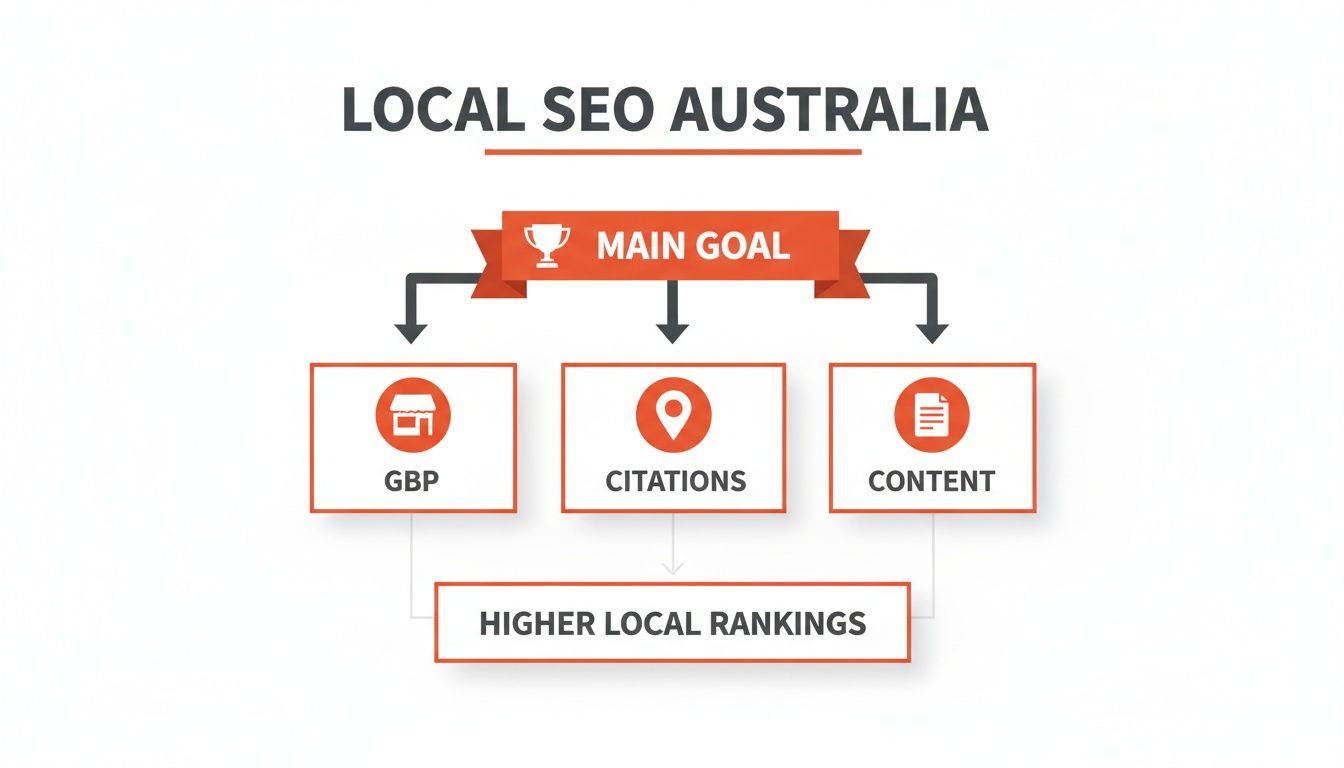
As you can see, a well-optimised Google Business Profile is your starting point. When you back that up with consistent local citations and genuinely helpful local content, you’re on the direct path to claiming those top local rankings.
The impact of a well-executed strategy is enormous. We've seen that in the competitive Aussie market, businesses that target multiple locations are driving a whopping 557% more traffic on average compared to their single-location counterparts.
Local SEO isn’t just about being found; it’s about being chosen. It builds trust and credibility with your local audience, making you the obvious choice before a customer even sets foot in your store or clicks to your website.
Here's a quick breakdown of what you need to focus on.
Key Pillars of Australian Local SEO Success
This table summarises the essential elements you need to get right to succeed in local search across Australia.
| Pillar | Why It Matters for Your Business | Quick Win |
|---|---|---|
| Google Business Profile (GBP) | This is your digital storefront on Google. It's often the first interaction a customer has with your business, so it needs to be accurate, complete, and active. | Fully complete every section of your GBP, including services, products, and photos. Enable messaging to engage directly with customers. |
| Consistent NAP Citations | Your Name, Address, and Phone number (NAP) need to be identical across the web. Inconsistencies confuse Google and hurt your credibility and rankings. | Audit your top 10 local business directory listings (like Yellow Pages, TrueLocal) and correct any inconsistencies in your business details. |
| Localised On-Page SEO | Your website content must signal to Google that you are relevant to a specific geographic area. This includes location-specific keywords and content. | Create a dedicated "service area" page on your website that details the suburbs and regions you serve. Mention local landmarks or projects. |
| Online Reviews & Reputation | Reviews are a huge trust signal for both customers and Google. A steady stream of positive reviews on Google and other platforms is critical for standing out. | Set up a simple, automated email or SMS campaign to ask satisfied customers for a Google review shortly after a purchase or service. |
| Local Link Building | Getting links from other reputable local businesses, community sites, or local news outlets powerfully signals your local authority to search engines. | Sponsor a local sports team or community event in exchange for a link back to your website from their sponsors page. |
Getting these pillars right will set you miles ahead of the competition.
To explore broader Australian SEO strategies and keep your knowledge sharp, there are plenty of great resources out there. For now, this guide will give you the blueprint for turning your business into a digital landmark for your community.
Getting Your Google Business Profile into Fighting Shape
Think of your Google Business Profile (GBP) as the digital front door to your Aussie business. For a lot of your local customers, it's the very first thing they'll see when they search for you online. It pops up right there in Google Search and on Maps, giving them a snapshot of who you are.
Neglecting your GBP is like having a fantastic shop but keeping the doors locked during business hours. You're basically invisible to potential customers who are nearby and ready to buy.
A fully fleshed-out GBP is the absolute bedrock of any decent local SEO Australia strategy. It's more than just a listing; it's a dynamic, living profile that tells both Google and your customers everything they need to know. Getting the details complete and accurate is your first, non-negotiable step to winning the local search game.
Claiming and Verifying Your Digital Real Estate
First things first: you can't optimise what you don't own. The initial step is to claim and verify your GBP listing. This is how you prove to Google that you're the legitimate owner, which then gives you the keys to control all the information people see.
Verification is usually straightforward. Google might send a postcard with a code to your physical address, or sometimes you can do it via a phone call or email.
Once that's done, you unlock the ability to manage your profile. This is where the real work of building a rich, informative online presence begins. Don't skip this—it's absolutely critical for anyone serious about showing up in local searches.
Filling Out Every Single Section
An incomplete profile is a huge missed opportunity. Your goal is to paint a complete picture of your business, leaving no field blank. This isn't just for your customers; it gives Google heaps more data to work with, making it easier for the algorithm to match you with relevant local searches.
Here’s what to focus on:
- Business Categories: This one's massive. Choose a primary category that perfectly describes your core business (e.g., a plumber should choose "Plumber," not something vague like "Home Services"). After that, add every relevant secondary category you can think of. A cafe in Fitzroy might have "Cafe" as its primary, but should also add "Coffee Shop," "Restaurant," and "Breakfast Restaurant" to cast a wider net.
- Services and Products: Get specific and list out everything you offer. You can even add descriptions and prices. For instance, a mechanic in Brisbane could list "Logbook Servicing," "Brake Repairs," and "Air Conditioning Regas" to show up for those exact searches.
- Business Description: You've got 750 characters here, so make them count. Write a compelling summary that naturally includes local keywords like your suburb or city, along with your main services. Tell people what makes you different and why they should choose you over the competition down the road.
A complete and detailed Google Business Profile can significantly increase your chances of appearing in the coveted "Map Pack." This prime real estate at the top of search results is where the majority of local clicks happen.
Using Dynamic Features to Engage Customers
A static, set-and-forget profile gets ignored. Google actually rewards businesses that actively manage their GBP, seeing it as a sign that you're an active and engaged part of the local community. If you really want to get into the weeds, our guide on SEO for local businesses covers some more advanced tactics.
Try to make these features part of your weekly routine:
- Google Posts: Think of these like mini-ads right on your profile. Share updates, special offers, events, or new products. A boutique in Bondi, for instance, could create a post about its "End of Season Sale" with a link straight to their website. They're a brilliant way to grab a searcher's attention.
- Photos and Videos: Keep a steady stream of high-quality, recent photos flowing. Upload pictures of your storefront, your team, your products, and even happy customers (with their permission, of course!). A mix of professional shots and authentic, behind-the-scenes content shows your business is alive and kicking.
- Q&A Section: Don't wait for customers to ask questions—get in there first. You can proactively populate this section by asking and answering common questions yourself. This lets you control the narrative, provide helpful info upfront, and tackle potential customer worries before they even have to ask.
Building Authority with Local Citations and Reviews
Beyond your Google Business Profile, two other elements form the bedrock of trust for local SEO in Australia: consistent business information and a killer online reputation.
Think of it like this: if your GBP is your digital shopfront, local citations are the signposts all over town pointing people to your door. Reviews are the word-of-mouth recommendations from happy customers convincing new ones to step inside.
Nailing both of these sends a powerful signal to Google that you are a legitimate, active, and trustworthy local business. It's a combo that directly influences how high you appear in local search results and that all-important Map Pack.
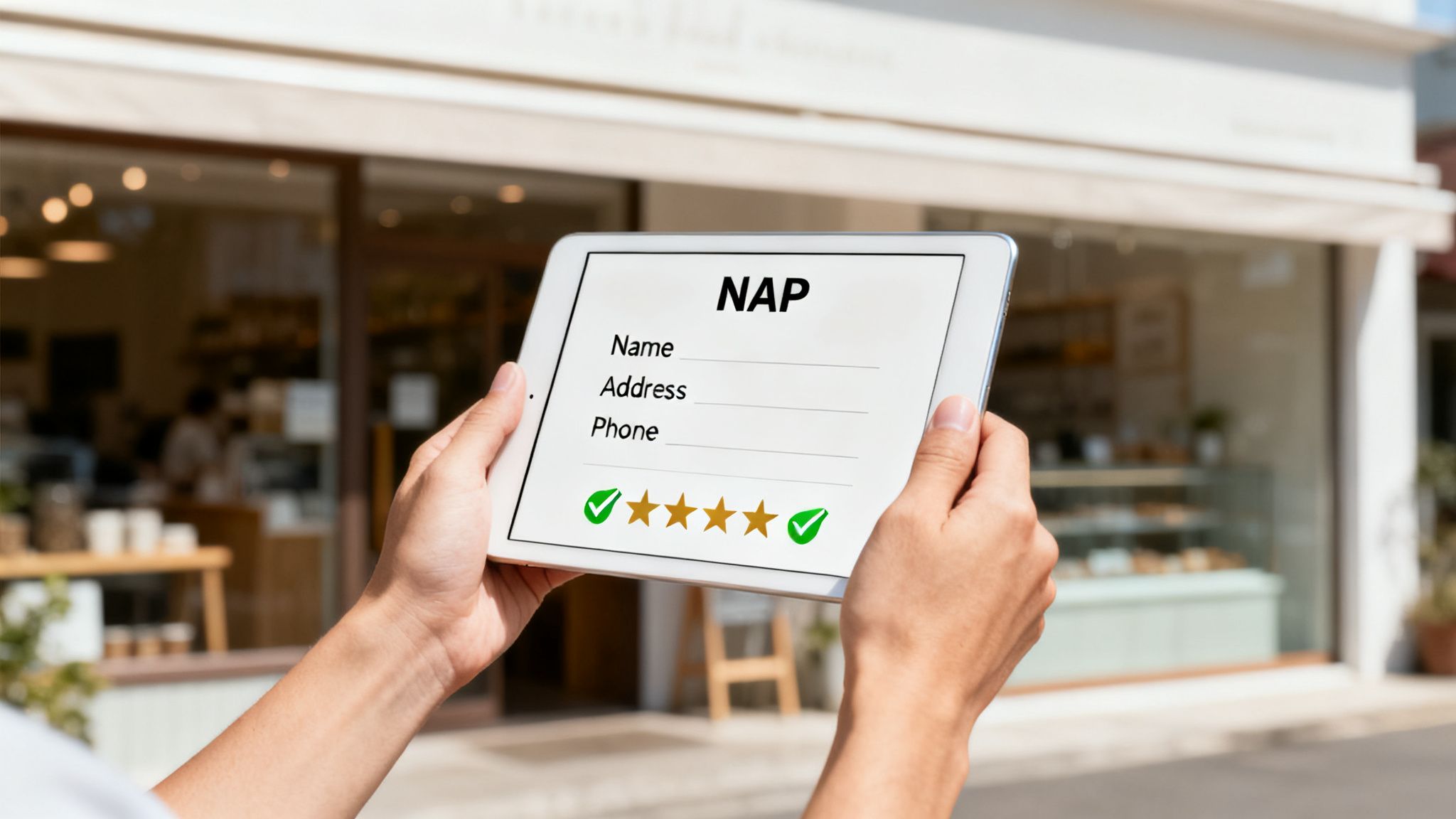
This two-pronged approach builds the authority and social proof you need to not just get found, but to get chosen by customers in your community.
Mastering Your Digital Footprint with Local Citations
A local citation is any online mention of your business's Name, Address, and Phone number (NAP). These are the digital fingerprints you leave across the web on business directories, social media profiles, and industry-specific websites.
For Google, consistency is king. When it sees your exact NAP details repeated accurately across multiple reputable sources, it gains confidence that your business information is correct. This reinforces your location and builds the trust needed to rank you for local queries.
Inconsistencies, on the other hand, create chaos. Using "St." on one site and "Street" on another, or having an old phone number floating around, erodes Google's trust and can seriously hamstring your local rankings.
Think of inconsistent NAP data as sending a search engine mixed signals. It's like having multiple, slightly different addresses on official documents—it creates doubt and undermines your credibility.
To build a strong foundation for your local SEO Australia efforts, focus on getting your business listed correctly on key Australian directories.
- Yellow Pages Australia: Still a highly trusted directory that many Aussies use.
- TrueLocal: A popular platform for finding local businesses and services.
- StartLocal: Another important Australian-centric business directory.
- Hotfrog: A well-established directory that helps validate your business details.
Ensuring your NAP is identical across these platforms is a non-negotiable step in building a coherent and trustworthy digital presence.
Turning Customer Feedback into a Ranking Asset
Your online reputation is your most powerful marketing tool. In the world of local search, online reviews are the new word-of-mouth, and they are a massive ranking factor. Google wants to recommend the best local businesses, and a steady stream of positive reviews is the clearest sign of quality and customer satisfaction.
But it’s not just about collecting five-star ratings. The quantity, velocity (how frequently you get them), and diversity of your reviews all matter. Responding to feedback is just as crucial, as it shows both customers and Google that you are engaged and value what people have to say.
A proactive approach to managing your reputation can transform customer feedback from a passive outcome into an active driver of business growth.
How to Encourage and Manage Reviews
Actively seeking reviews is essential, but you have to do it right. The key is to make it dead simple for happy customers to share their experiences.
- Ask at the Right Time: The best moment to ask for a review is right after a positive experience—a successful purchase, a completed service, or when a customer gives you direct positive feedback.
- Make It Simple: Provide a direct link to your Google review page via email, SMS, or even a QR code in-store. The fewer steps a customer has to take, the more likely they are to leave a review.
- Respond to Every Review: This is non-negotiable. Thank customers for positive reviews and address negative feedback professionally and constructively. A thoughtful response to a bad review can often win over more future customers than a dozen five-star ratings, as it proves you're accountable and committed to great service.
Just remember to never offer incentives for reviews, as this violates Google's policies. The goal is to encourage genuine feedback that helps build an authentic and trustworthy online reputation for your Australian business.
Creating Hyper-Local Content and On-Page Signals
While your Google Business Profile is like your digital shopfront, your website is your home base. To really dominate local SEO in Australia, your website has to scream local relevance to Google. It needs to send unmistakable signals that you’re the go-to expert right here, on your patch. This is where creating hyper-local content and nailing your on-page signals becomes a total game-changer.
Think of it like this: broad SEO is a billboard on the Hume Highway, hoping the right car drives past. Hyper-local content is a detailed, genuinely helpful sign at the entrance to a specific suburb, speaking directly to that community’s needs. It's about proving you're relevant not just to your industry, but to a precise postcode.
Uncovering Local Search Intent
Before you write a single word, you need to get inside the heads of your local customers. What are they actually typing into Google? It’s rarely just "plumber Sydney." People use specific, intent-driven phrases that often name-drop suburbs, local landmarks, or even use a bit of local slang.
The goal is to find keyword combinations that signal an immediate, local need. These usually look like:
- Service + Suburb/City: Think "emergency electrician Brisbane" or "cosmetic dentist Bondi."
- "Near Me" Modifiers: You don't target the phrase "near me" itself. Instead, you optimise your site with such strong local signals that Google naturally shows you for these searches.
- Local Questions: Things like "best coffee in Fitzroy" or "where to fix a cracked iPhone screen in Parramatta."
You can start digging these up with free tools, like Google’s own search suggestions. Just start typing your service and a city into the search bar and see what pops up—it’s a goldmine of real-world queries people are using right now.
Building Your Local Content Hub
Once you know what people are searching for, you can create content that gives them exactly what they want. The absolute cornerstone of this strategy is building out dedicated pages for your key locations and services.
Location-Specific Landing Pages are non-negotiable for any business serving multiple areas. Don't just have one generic "Contact Us" page. If you're a vet clinic with locations in South Brisbane and Chermside, each one needs its own unique page.
Each of these pages should be loaded with local flavour:
- The specific suburb name in the page title, headings, and throughout the content.
- The full NAP (Name, Address, Phone number) for that exact location.
- An embedded Google Map showing the spot.
- Unique content that makes the page feel real, like bios of the local staff, testimonials from local clients, or photos of your actual shop or office.
"Near Me" Optimised Service Pages need to go beyond just explaining what you do. A page on "Logbook Servicing" shouldn't be a dry, technical explanation. It should mention that you provide logbook servicing to car owners in and around your specific area, maybe even listing a few neighbouring suburbs to strengthen that geographic signal.
By creating content that's deeply rooted in a specific location, you're not just feeding the search engines. You're building trust with local customers by showing them you understand their community and are an active part of it.
Demystifying Local Business Schema
Now for the behind-the-scenes magic. You can give Google an even clearer roadmap to your business using something called Local Business schema markup. Think of schema as a secret language spoken directly between your website and search engines. It’s a bit of code you add to your site that explicitly labels all your key business information.
This code tells Google things like:
- "This is our official business name."
- "This is our exact street address."
- "These are our opening hours."
- "This is our primary phone number."
It might sound a bit technical, but adding basic schema markup is surprisingly straightforward and it completely removes any guesswork for Google. It’s the best way to ensure the information it shows users in search results is perfectly accurate. You can learn more about how on-page elements like this fit into the bigger picture in our detailed guide to on-page and off-page SEO.
For example, the schema for a dentist in Melbourne makes it crystal clear for Google to understand every little detail about that specific practice. This structured data is a powerful on-page signal that reinforces all your other local SEO efforts, making your website a beacon for local searches.
Earning Powerful Local Links and Partnerships
While your on-page signals tell Google what your website is about, off-page signals—especially backlinks—show Google how much authority and trust you have in the real world.
Think of a backlink from another reputable local website as a strong vote of confidence. It’s a digital endorsement, like a local business owner vouching for you. For any successful local SEO Australia campaign, building these digital handshakes is non-negotiable.
This isn't about chasing dodgy, low-quality links. It's about building genuine relationships right here in your Australian community that naturally lead to high-quality links. These connections don't just boost your website’s authority; they also drive real referral traffic from people who are already engaged in your neighbourhood.

Every local link you get reinforces your connection to your community, signalling your importance to Google and helping you climb the local search rankings.
Strategies for Genuine Local Link Building
The best local links come from getting stuck into your local community. Instead of just thinking about links, think about creating partnerships and getting involved. Often, the most valuable backlinks are a natural byproduct of these real-world activities.
Here are a few proven strategies to get you started:
- Sponsor a Local Team or Event: Whether it's the local footy club, a school fete, or a community fun run, sponsorships almost always come with a thank-you and a link from their sponsors' page. It’s a brilliant way to gain visibility and a powerful local backlink.
- Partner with Neighbouring Businesses: Team up with a non-competing business in your area for a joint promotion. A florist could partner with a nearby gift shop, for example. You can both promote the partnership on your websites and link to each other, sharing audiences and SEO value.
- Host a Community Workshop or Event: Position yourself as a local expert by hosting a free workshop. A hardware store could run a DIY seminar, or a cafe could host a coffee-tasting event. Promote it through local community groups and calendars, which often link back to the host's website.
The most effective local link-building strategies are rooted in authentic community involvement. When you genuinely contribute to your local area, the digital endorsements—in the form of backlinks—will follow.
Tapping into Local Media and Influencers
Your local community is full of people and organisations with established audiences. Getting a mention from them can give your credibility and your backlink profile a massive boost.
Get Featured in Local News Outlets
Local newspapers, radio stations, and community blogs are always on the hunt for a good story. Do you have a unique business story, an upcoming event, or a new milestone to share?
- Create a press release: Write a short, newsworthy summary of what's happening.
- Find local journalists: Identify reporters who cover local business or community news.
- Send a personalised pitch: Briefly explain why your story would be interesting to their readers. A feature story will almost certainly include a link back to your website.
Collaborate with Local Bloggers and Influencers
Find bloggers or social media influencers in your suburb or city who align with your brand. A restaurant in Newcastle, for instance, could invite a local food blogger for a complimentary meal in exchange for an honest review and a blog post that links to their booking page. This approach builds social proof and earns a highly relevant local link at the same time.
Measuring Your Success and Avoiding Common Mistakes
A local SEO campaign without data is just guesswork. To know if your efforts are actually paying off, you need to measure what truly matters and steer clear of the common mistakes that can easily derail your progress in the competitive Aussie market.
Tracking your performance is all about connecting your actions to real business outcomes. Instead of just crossing your fingers and hoping for the best, you need to dive into the analytics to see what’s working and what isn’t. This is how you refine your strategy and build sustainable local growth.
Key Metrics to Monitor for Local SEO
Your Google Business Profile (GBP) Insights and Google Analytics are your two best mates for measuring local success. They give you a clear window into how local customers are finding and interacting with your business online.
You'll want to keep a close eye on these core performance indicators:
- GBP Search Impressions: This tells you how many times your profile popped up in local search results. A steady increase here is a great sign of growing visibility.
- GBP Actions: These are the high-value conversions you really care about. Track the number of direction requests, clicks-to-call, and website visits that come straight from your profile.
- Local Organic Traffic: Jump into Google Analytics and segment your traffic to see how many visitors are coming from organic search in your target city or region.
- Local Keyword Rankings: Keep tabs on your position for key local search terms like "electrician Parramatta." A crucial part of this involves tracking local keyword rankings by proximity to see how you show up in different parts of town.
These numbers tell a story about your return on investment. If you want to get better at reading that story, it’s worth exploring some essential digital marketing performance metrics.
Common Pitfalls to Sidestep in Australia
So many businesses make easily avoidable errors that hamstring their local search performance. Just being aware of these traps is the first step to making sure your local SEO Australia strategy stays on the right track.
One of the most damaging yet common mistakes is inconsistent NAP (Name, Address, Phone Number) information. Even small variations across different online directories can confuse Google and erode the trust you've worked so hard to build.
Here are a few other frequent missteps to watch out for:
- Keyword Stuffing Your GBP Name: Never, ever add keywords to your business name on GBP (e.g., "Bob's Plumbing – Best Plumber in Bondi"). This is a direct violation of Google's guidelines and a fast track to getting your profile suspended. Just stick to your actual, registered business name.
- Neglecting Online Reviews: Failing to actively seek and respond to reviews is a massive missed opportunity. Reviews are not only a powerful ranking factor but also the social proof that convinces potential customers to choose you.
- Creating Generic, Non-Local Content: Writing blog posts or service pages without any local flavour fails to signal your geographic relevance to search engines. You need to weave in local suburb names, landmarks, and community-focused information to show Google you belong.
Your Local SEO Questions Answered
Diving into local search often brings up a few common questions. To save you some guesswork, we've tackled some of the most frequent queries from Australian business owners. Getting these fundamentals right helps you point your efforts exactly where they'll make the biggest difference.
How Long Does It Take to See Results?
This is the big one, and the honest answer is: local SEO is a marathon, not a sprint. While some quick wins, like sprucing up your Google Business Profile, might show a little spark within weeks, building real, lasting authority takes patience.
For most businesses, you can expect to see noticeable improvements in your local rankings and, more importantly, customer enquiries within three to six months. Of course, this timeline shifts depending on how competitive your local market is, where you're starting from, and how consistently you're pulling in new reviews and creating local content.
Do I Need a Physical Storefront to Do Local SEO?
Not at all. In fact, local SEO is absolutely critical for what we call service-area businesses (SABs). Think of your mobile mechanics, plumbers, cleaners, or any consultant who travels to their customers. Instead of a pin on the map, you can set up your Google Business Profile to show a defined service area.
The core principles are exactly the same for businesses on the move. Building consistent business listings, earning great reviews from customers in the suburbs you serve, and creating content that targets those specific areas are all vital for showing up where you operate.
This makes sure you appear in searches for customers right in your target region, even if you don't have a traditional shopfront for them to walk into.
Is Local SEO a One-Time Job?
Definitely not. It's much better to think of local SEO as tending to a garden. The initial setup lays a strong foundation, but it needs ongoing attention to keep your visibility growing and stop the weeds (your competitors) from taking over.
To stay ahead of the game, you need to be doing a few things consistently:
- Actively manage your GBP: Keep your profile looking fresh by regularly adding new photos and publishing Google Posts.
- Encourage new reviews: A steady flow of recent, positive reviews is one of the strongest signals you can send to Google that you're relevant and trusted.
- Keep building local links: Always be on the lookout for opportunities to partner with other local businesses, charities, or community groups.
Google’s algorithms are always changing, and your competitors are always trying to get ahead. Ongoing maintenance isn't just a good idea—it's essential for protecting and improving your spot in the local SEO Australia search results.
Ready to turn your local search visibility into a powerful magnet for new customers? At Click Click Bang Bang, we specialise in creating data-driven SEO strategies that put your business on the map. Get started with a precision-focused campaign by visiting us at https://clickclickbangbang.com.au.
Read NeXt
Or Read Our Latest
- Manual vs Automated Bidding for PPC Success
- Conversion Tracking Setup: A Complete AU Guide
- Instagram Advertising Australia: Complete 2026 Guide
- Pay Per Click: A Beginner’s Guide for Australian Marketers
- Display Advertising on Google: The Complete Australian Guide
- Stakeholder Communication Plan How to Build One That Works
Click. CLick. Subscribe.
Get our best PPC insights, industry updates, and power moves delivered straight to your inbox. No fluff, just high-caliber strategies that actually work.
Don’t Leave Just Yet
Try Us For 30-Days,
Risk Free!!
We guarantee that you’ll love our work within the first 30 days, if not you’ll get your money back.
What have you got to lose?