

Marketing Digital Consulting: Your Growth Partner
Last Updated

Think of a digital marketing consultant as a personal trainer for your business's online presence. They don't just sell you a pre-packaged service or a generic workout plan. Instead, they get to know your business, diagnose its unique challenges, and then craft a completely customised growth strategy designed to get you into peak online performance.
What Is Digital Marketing Consulting?
So, what exactly is a digital marketing consultant? They’re an external strategist you bring in to provide an objective, expert perspective on your online marketing. Think of them as a high-level advisor. They use their specialised knowledge to analyse what you're currently doing, spot the opportunities you’re missing, and build a clear, actionable roadmap to get you where you want to go.
This is a key difference from a typical agency that focuses on doing the work. A consultant’s primary role is to figure out the why and the how behind your strategy.
Your in-house team is often too deep in the day-to-day grind to see the bigger picture. A consultant comes in with fresh eyes, completely unburdened by internal politics or old habits. They're the ones who can quickly pinpoint wasted ad spend, glaring gaps in your content, or new channels you haven't even thought of.
The Strategic Value of an External Expert
The real magic of a digital marketing consultant lies in their ability to translate complicated data into a straightforward, results-focused plan. They are experts at connecting the dots between all your different digital channels—SEO, social media, email, paid ads—to create one cohesive, powerful strategy.

This kind of guidance is especially vital for smaller businesses that might not have a dedicated marketing guru on staff but still need to compete effectively online. For a deeper dive, check out our guide on digital marketing for small business.
And the need for this strategic help is only growing. The Australian digital marketing market is absolutely booming, expected to hit approximately USD 13.03 billion in 2024 and projected to soar to over USD 25 billion by 2034. This explosion highlights just how much businesses are relying on the smart, data-driven strategies that consultants bring to the table.
A great consultant doesn’t just hand you a plan and walk away. They empower your team with the knowledge and direction to execute it successfully, long after the engagement ends. They build capability, not dependency.
To get a better sense of what a consultant does day-to-day, here's a breakdown of their main responsibilities.
| Core Function | Description | Business Impact |
|---|---|---|
| Strategic Planning | Develops a comprehensive digital marketing roadmap aligned with overall business goals. This includes competitor analysis, market research, and defining key performance indicators (KPIs). | Provides clear direction and ensures all marketing activities are working towards the same objectives, maximising return on investment. |
| Performance Audit & Analysis | Conducts a deep-dive audit of current marketing channels (SEO, PPC, social media, etc.) to identify strengths, weaknesses, and untapped opportunities. | Uncovers wasted spend, highlights underperforming campaigns, and provides data-backed recommendations for immediate improvement. |
| Process Optimisation | Analyses and refines internal marketing workflows, tool usage, and team structures to improve efficiency and collaboration between marketing and sales. | Streamlines operations, reduces manual effort, and helps teams get more done with the resources they have. |
| Technology & Tool Advisory | Recommends the right marketing technology stack (e.g., CRM, analytics platforms, automation tools) to support the strategy and scale operations effectively. | Ensures the business invests in the right tools for its needs, avoiding costly mistakes and improving data capabilities. |
| Training & Team Empowerment | Provides training and mentorship to the in-house team, upskilling them in new areas and fostering a culture of data-driven decision-making. | Builds long-term internal capability, making the business less reliant on external help and more self-sufficient over time. |
Ultimately, a consultant's job is to bridge the gap between your business goals and your day-to-day digital activities. They make sure every dollar you spend and every action you take is deliberately moving you closer to your desired outcome, giving you the clarity needed to succeed.
Core Services in a Consultant's Toolkit
A digital marketing consultant's value isn't just in high-level advice; it’s in their mastery of the specific channels and tactics that actually drive growth. Think of it like a master chef's kitchen—it’s not about having every gadget imaginable, but about knowing precisely which high-quality ingredients and techniques to combine to create the perfect dish. In the same way, a consultant hand-picks and integrates services to cook up a winning strategy for your business.
Each service is a crucial piece of a larger, cohesive plan. These aren't standalone tactics but interconnected gears, all working together to propel your business forward. The real expertise lies in orchestrating these different elements into a seamless system that delivers results.

Search Engine Dominance: SEO and SEM
Right at the top of the toolkit are Search Engine Optimisation (SEO) and Search Engine Marketing (SEM). These two are the absolute bedrock of visibility, laser-focused on making sure your business shows up when potential customers are actively searching for solutions you provide. SEO is the long game of earning organic traffic by optimising your website and content, while SEM uses paid ads to secure prime real estate on search results pages for immediate impact.
You can't overstate how important this is in the Australian market. Search engine marketing is the single largest segment within the digital advertising industry, with revenue projected to hit a massive $3.7 billion in 2025. On top of that, Australian companies are expected to pour a staggering $1.5 billion into SEO services alone in 2025—a clear sign of its powerful return on investment.
Building Authority with Content and Social Media
Next up, a consultant will focus on building your brand’s voice and establishing a community through content and social media marketing. This isn't just about posting random updates; it's about crafting a narrative that cements your business as a trusted authority in your field. A marketing digital consulting expert will develop a content strategy that produces valuable assets—like blog posts, in-depth guides, and videos—that both attract and educate your target audience.
This high-quality content then becomes the fuel for your social media presence. A consultant designs campaigns that go far beyond chasing vanity metrics like 'likes', aiming instead to foster genuine engagement and build a loyal community around your brand.
The goal of great content is to answer your audience’s questions before they even think to ask them. This turns your brand into the go-to resource in your industry, building a level of trust that advertising alone can never buy.
Driving Action with Email and Paid Advertising
While SEO and content are busy building your audience, email marketing and Pay-Per-Click (PPC) advertising are all about driving direct action. A consultant will design email campaigns that nurture leads and convert subscribers into paying customers by delivering personalised, timely messages that resonate.
PPC advertising isn't just about Google anymore. It extends to platforms like Meta and LinkedIn, allowing for hyper-targeted campaigns that reach specific demographics and interests, capturing attention right where your audience spends their time online. A key area where consultants add serious value is in deploying advanced strategies, like effective chat bot marketing, to automate engagement and streamline the path to conversion.
Ultimately, a good consultant doesn't just offer you a menu of services. They expertly weave these different threads together—SEO, content, social media, email, and PPC—into a strong, integrated strategy designed to achieve one thing: measurable growth for your business.
The Real Benefits of a Consulting Partnership
Bringing in a digital marketing consultant isn't just about handing off tasks; it's about unlocking real, measurable results that actually move the needle for your business. Sure, you expect your campaigns to get better, but the true return on your investment runs much deeper, changing how you compete and grow in your market.
One of the first things you'll notice is gaining access to specialist skills and high-end tools without the massive overhead. Think about it: hiring, training, and keeping a full-time expert for every single digital channel is an incredibly expensive and slow process. A consultant gives you an instant injection of senior-level strategic thinking, complete with their entire toolkit of analytics software and optimisation platforms, for a fraction of what an in-house team would cost.
That expertise translates directly into a higher ROI from your marketing budget. A good consultant is a master at sniffing out and cutting wasteful ad spend, then funnelling that money into the channels that are actually delivering the goods. They make sure every dollar is pulling its weight.
Gaining Strategic Clarity and Focus
Perhaps the single biggest benefit is the gift of time and perspective. When you hand over the reins of your digital strategy to a consultant, you and your team are suddenly free to focus on your core business—the things you’re truly brilliant at. No more getting bogged down trying to keep up with the latest algorithm change or spending hours trying to make sense of a complicated analytics report.
This is where a fresh pair of eyes becomes so valuable. An experienced consultant can walk in and immediately spot the blind spots and inefficiencies that internal teams, who are often too close to the day-to-day grind, might miss. They’re there to challenge the "we've always done it this way" mindset and introduce new, data-backed approaches to solve those stubborn problems.
A consultant’s job isn’t just to find problems; it’s to flip them into opportunities. They can take an underperforming ad campaign that’s draining your budget and turn it into a powerful engine for revenue and sustainable growth.
Staying Ahead of Market Trends
A sharp consulting partner ensures you’re not just keeping up with the curve, but staying ahead of it. They live and breathe this stuff. For example, they know the massive role social media advertising plays in Australia—a market where spending is projected to hit AU$7.5 billion in 2025. By tapping into these trends, they keep your strategy relevant and effective.
This strategic oversight is all built on a foundation of meticulous performance measurement. They don't just launch campaigns and hope for the best; they track them relentlessly. To get a feel for what this involves, it’s worth understanding the fundamentals of website conversion tracking to see how every single interaction is measured and valued.
This constant cycle of implementation, analysis, and optimisation is what separates a marketing strategy built on guesswork from one that delivers predictable growth. A consulting partnership gives you the framework to make data-driven decisions with confidence, ensuring your marketing efforts are always pointed in the right direction.
Your Journey with a Digital Marketing Consultant
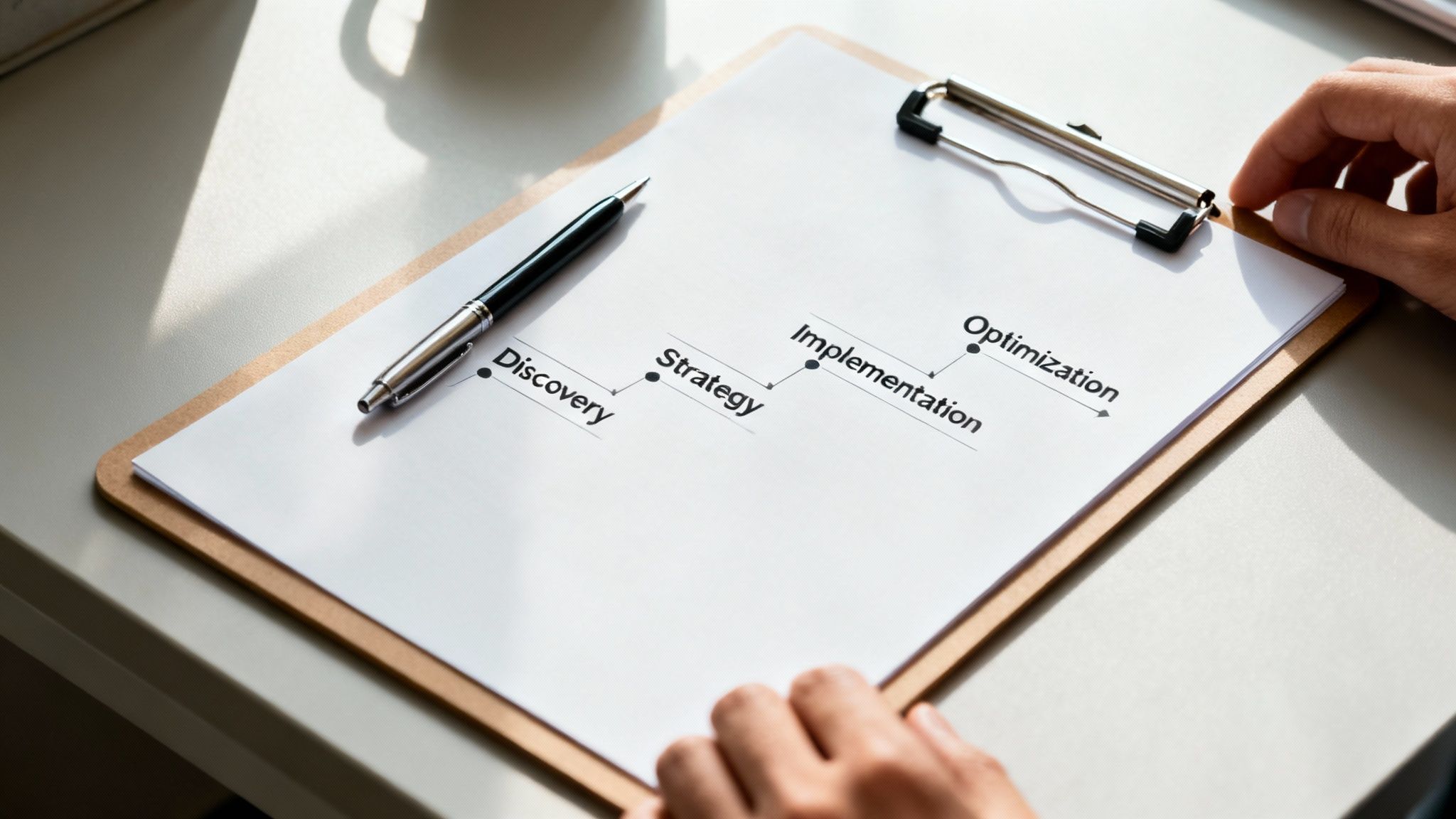
Bringing on a digital marketing consultant can feel a bit like hiring a guide for an expedition. You know where you want to go, but the path isn't always clear. A good consultant doesn't just hand you a map; they walk the path with you, using a structured, collaborative process to make sure every step is deliberate and focused.
Think of it less as a one-off project and more as a phased journey. It’s a partnership that moves from a broad, 30,000-foot view of your business down to the nitty-gritty of actionable steps, all built on data, clear strategy, and constant refinement.
Phase 1: Discovery and Audit
First things first, a great consultant needs to get under the hood of your business. This initial phase is all about deep-diving into where you are right now. It's not a quick chat; it's a comprehensive audit where they become an expert on your operations, your market, and your biggest headaches.
During this stage, the consultant will be digging into:
- Your Current Marketing Efforts: What’s actually working? What’s burning cash? And where are the obvious gaps?
- Your Competitor Landscape: Who are you up against? What are they doing well online, and where are their weaknesses we can exploit?
- Your Target Audience: A proper look at who your ideal customers are, how they behave online, and what makes them tick.
- Your Digital Assets: A full review of everything from your website and social media profiles to your existing content library.
This isn't just busywork. This meticulous information-gathering ensures the strategy that comes next is built on a solid foundation of facts, not guesswork.
Phase 2: Strategy Development
With a clear picture of the terrain, the consultant shifts from analyst to architect. This is where they build a customised, data-driven plan designed to hit your specific business goals. A generic, one-size-fits-all template just doesn't cut it here.
The strategy document will lay out the path forward, complete with clearly defined Key Performance Indicators (KPIs) to track progress. This isn't just a laundry list of tactics. It’s a cohesive roadmap that connects every single action back to a real business outcome, getting everyone aligned and pulling in the same direction.
A great consulting strategy acts like a blueprint for growth. It doesn't just tell you what to do; it explains why each step is critical and how it will contribute to your overall success.
Phase 3: Implementation and Execution
Next up, it’s time to put the plan into action. Depending on your arrangement, the consultant might roll up their sleeves and lead the execution, guide your in-house team, or help you find the right specialist agency to get the job done.
Their main role here is to make sure the strategy is rolled out correctly and efficiently, keeping everything on track.
Phase 4: Analysis and Optimisation
This final phase is arguably the most important, because it’s the one that never really ends. A true digital marketing consulting partnership is a continuous loop: act, measure, and refine.
Your consultant will constantly monitor how things are performing, dive into the data, and make agile adjustments to get better results. This commitment to continuous improvement is what turns a good strategy into a great one, ensuring your marketing only gets stronger and more effective over time.
How to Choose the Right Consulting Partner

Picking the right digital marketing consultant is one of the most important decisions you can make for your business. This isn’t just about outsourcing a task; it's about bringing a strategic partner into the fold who will become a genuine extension of your team.
The right choice can put your growth on the fast track, while the wrong one can burn through your budget, waste precious time, and leave you wondering what could have been.
Verifying Expertise and Process
Your evaluation needs to be methodical. The first step is to look past the slick sales pitch and get into the nitty-gritty of their track record. You're looking for proven experience—not just in digital marketing generally, but specifically within your industry or with businesses that have faced the same hurdles you do now. A consultant who already knows your market's quirks will get you results so much faster.
Don't just take their word for it; ask for hard proof. Any consultant worth their salt will have a portfolio of case studies and client testimonials ready to go. When you dig into these, look for the story: what was the initial problem, what strategy did they build, and what were the specific, measurable results they delivered?
Beyond what they've done, you need to understand how they do it. What's their process for a new project? A quality partner will have a structured approach that kicks off with a deep dive into your business, not some cookie-cutter solution they pulled off a shelf. That initial discovery phase is everything.
The best consultants are an open book about their methods and metrics. If a potential partner gets vague about how they measure success or what their reports look like, that's a massive red flag. Clarity and accountability are non-negotiable.
This means asking direct questions about their Key Performance Indicators (KPIs). How do they define and track success? Will you get access to a live reporting dashboard? The answers tell you everything about their commitment to data-driven results and transparent communication. For instance, if you're looking at paid ads, you need a crystal-clear picture of their PPC management services to make sure their approach lines up with your revenue goals.
Critical Questions for Potential Partners
To feel confident in your decision, you have to ask the right questions during the vetting process. These questions should be designed to probe their strategic thinking, adaptability, and how they solve real-world problems. A great marketing digital consulting partner will see this as a chance to show you what they're made of.
To help you get started, I've put together a practical checklist to guide your conversations. Think of this as your toolkit for separating the talkers from the doers.
Consultant Evaluation Checklist
| Evaluation Area | Key Questions to Ask | What to Look For |
|---|---|---|
| Industry Knowledge & Experience | Can you show us case studies from our industry or similar businesses? What were the results? | Specific, quantifiable outcomes (e.g., "increased leads by 45%"). Evidence they understand your unique market challenges. |
| Strategic Process | Walk us through your process for a new client, from kickoff to reporting. How do you develop a strategy? | A structured, multi-stage process that starts with deep discovery and analysis, not a one-size-fits-all plan. |
| Adaptability & Problem-Solving | How do you adapt to algorithm changes on platforms like Google or Meta? Give us an example. | A clear process for continuous learning and proactive strategy adjustments. Not just reacting, but anticipating change. |
| Communication & Reporting | What does your reporting look like? How often will we meet, and who will be our main point of contact? | Clear examples of reports/dashboards. A commitment to a regular communication cadence and a designated contact person. |
| Team Integration | How will you work with our in-house team? What will you need from us to be successful? | A collaborative mindset. They should have clear expectations for what they need from you (e.g., access, feedback). |
| Technical Skills & Tools | What marketing technology stack do you use? How do you leverage it for your clients? | Familiarity with industry-standard tools and an ability to explain how those tools will specifically benefit your campaigns. |
By asking these tough questions and carefully weighing their experience, process, and communication style, you can find a partner who truly clicks with your business goals, culture, and budget. That’s how you set the stage for a profitable and successful partnership.
Got Questions About Digital Marketing Consulting?
If you're exploring the idea of bringing on a digital marketing consultant, you probably have a few questions floating around. That's completely normal. To help you get some clarity, we've pulled together straight answers to the most common queries we get from business owners just like you.
Our goal here is to cut through the jargon and tackle the practical stuff so you can make a smart, informed decision.
How Much Does Digital Marketing Consulting Cost?
This is always the big question, and the honest-to-goodness answer is: it really depends. The price tag is tied directly to the scope of your project, the consultant's depth of experience, and the kind of engagement you settle on.
A one-off strategic audit, for instance, might be a few thousand dollars. On the other hand, an ongoing monthly retainer for comprehensive strategy and oversight can range anywhere from $2,000 to over $10,000.
The real key is to stop thinking about it as a cost and start seeing it as an investment. A great consultant won't just send you an invoice; they'll show you exactly how their work will generate more revenue or create significant savings, making their fee a no-brainer.
What Is the Difference Between a Consultant and an Agency?
This is a crucial distinction, and one that trips a lot of people up. Here’s a simple way to think about it: a consultant is the architect who draws up the blueprint, while an agency is the builder who constructs the house.
- A Consultant: Is all about the big picture. They focus on high-level strategy, deep-dive analysis, and expert guidance. They're the ones who create your roadmap to success.
- An Agency: Is built for execution. They are the hands-on team that runs your ad campaigns, manages your social media profiles, or produces your blog content.
Many businesses find the sweet spot is hiring a consultant to nail down the overarching strategy first. Then, they use their in-house team or a specialised agency to bring that strategy to life.
A consultant gives you the 'why' and the 'how'. They make sure every single action taken by an agency or your internal team is strategically sound and perfectly aligned with your core business goals. This partnership stops you from wasting time and money on tactics that go nowhere.
How Long Until We See Results?
While a bit of patience is always helpful in marketing, the timeline for results really hinges on the strategies being used.
If we’re talking about paid advertising like PPC campaigns, you can often see initial data, clicks, and traffic rolling in within the first few weeks. It's relatively quick feedback.
But for organic strategies like Search Engine Optimisation (SEO) and content marketing, you’re playing the long game. Building real, sustainable momentum from these efforts typically takes a good four to six months. A reputable consultant will always be upfront about this, setting clear, realistic timelines from day one so there are no nasty surprises down the track.
Ready to get the strategic clarity your business needs to grow? Click Click Bang Bang specialises in creating data-driven SEO and PPC strategies that deliver measurable results. Let's build your roadmap to success together. Explore our services today!
Read NeXt
Or Read Our Latest
Click. CLick. Subscribe.
Get our best PPC insights, industry updates, and power moves delivered straight to your inbox. No fluff, just high-caliber strategies that actually work.
Don’t Leave Just Yet
Try Us For 30-Days,
Risk Free!!
We guarantee that you’ll love our work within the first 30 days, if not you’ll get your money back.
What have you got to lose?