

Finding Top Google Shopping Agencies for Your Business
Last Updated

So, what exactly is a Google Shopping agency? Think of them as specialised firms whose entire focus is managing and optimising product-based ad campaigns on Google for e-commerce businesses. They're the experts you bring in to navigate the platform's complexities, ultimately to drive sales and maximise your return on ad spend (ROAS).
Why Partnering with a Google Shopping Agency Is a Game Changer

The Australian e-commerce market is ridiculously competitive now. For most businesses, just "running ads" isn't going to cut it anymore. This is where a dedicated Google Shopping agency gives you a serious edge.
These specialist teams do so much more than just set up a few campaigns. They live and breathe the Google ecosystem, staying on top of every algorithm update and mastering the dark art of product feed optimisation. This singular focus lets them deploy advanced bid strategies that most in-house teams—who are often juggling a dozen other marketing tasks—simply don't have the time or deep expertise to manage.
The Advantage of Specialised Expertise
Let's be honest: managing Google Shopping properly is a full-time job. It demands a very specific skill set that goes way beyond general digital marketing knowledge. An agency brings that focused expertise to your business from day one.
Take the product feed, for instance. A tiny error in a GTIN or a poorly optimised product title can make your listings practically invisible. A good agency knows exactly how to structure and enrich that data to squeeze out the maximum visibility and click-through rates.
An agency’s primary role is to turn your product data into a high-performing sales engine. They connect every technical detail—from feed attributes to bid adjustments—directly to your business's bottom line.
In-House vs Agency Management: A Quick Comparison
Deciding whether to keep management in-house or outsource can be tough. Both have their pros and cons depending on your resources, scale, and long-term goals. Here’s a quick breakdown to help you weigh up the options.
| Aspect | In-House Management | Specialised Agency |
|---|---|---|
| Expertise | Relies on the skills of current staff, who may be generalists. | Access to a team of dedicated Google Shopping specialists. |
| Cost | Includes salary, benefits, training, and software subscriptions. | Typically a monthly retainer or percentage of ad spend. |
| Resources | Limited by internal bandwidth and competing priorities. | Access to advanced tools, industry data, and a wider knowledge base. |
| Focus | Marketing staff often wear multiple hats (SEO, social, email). | 100% focused on optimising Google Shopping performance. |
| Scalability | Scaling up can be slow, requiring new hires and training. | Can scale campaigns and ad spend quickly and efficiently. |
While managing campaigns internally gives you direct control, a specialised agency often brings a level of focus and experience that’s hard to replicate. They’ve seen what works (and what doesn't) across dozens of accounts, allowing them to apply proven strategies to your business much faster.
Navigating a Crowded Digital Marketplace
The explosion in online retail has made it harder than ever to capture a customer's attention. In Australia, the number of households shopping online swelled from 8.2 million in 2019 to 9.8 million in 2024. You can read more about this growing market and its implications. This surge means way more competition for the same eyeballs.
A skilled agency uses this crowded environment to your advantage by:
- Identifying Niche Opportunities: They dig into competitor strategies to find gaps in the market you can own.
- Implementing Sophisticated Bidding: They use data to bid more aggressively for high-intent shoppers while saving your budget on less valuable clicks.
- Maximising ROAS: Every action they take is focused on one thing: generating the highest possible return and turning your ad spend into a reliable revenue stream.
What a Top Tier Google Shopping Agency Really Does
Forget the generic PPC chatter for a moment. A genuinely effective Google Shopping agency doesn't just shuffle your ad spend around; they architect an entire e-commerce sales funnel within Google’s massive, sprawling ecosystem. It’s a craft that blends data science, technical know-how, and sharp marketing strategy.
The whole game starts and ends with the product feed. This isn't just about uploading a spreadsheet. It’s a relentless process of optimisation. A top agency will obsess over every product title, description, and image, tweaking them to perfectly match high-intent search queries.
They know a well-structured feed is the single most critical factor for getting seen and getting sales. If you're curious about the nitty-gritty, our guide on how to set up a Google Shopping feed covers the fundamentals.
Mastering Advanced Campaign Types
Simple Shopping campaigns? That’s yesterday’s news. The modern Australian advertising scene demands a deep understanding of sophisticated, automated campaign types. The best google shopping agencies have moved way past manual bidding, focusing their brainpower where it truly counts.
And this shift isn't just for show. The e-commerce environment here in Australia has gotten incredibly advanced, and if you’re not using automation and AI, you’re already falling behind. Top-tier agencies are all-in on Performance Max campaigns—a powerful, unified ad type that pushes your Shopping ads across all of Google’s real estate, from Search and YouTube to Gmail and Discover.
The Hallmarks of an Elite Agency
So, what really separates the experts from the amateurs? It comes down to a few non-negotiable skills that drive a real return on your ad spend.
- Granular Data Analysis: They do more than just glance at your ROAS. They slice and dice performance by product, category, brand, and even custom labels to unearth hidden pockets of profit you never knew you had.
- Strategic Use of Audiences: They’re experts at using Customer Match lists to bring past buyers back into the fold with tailored offers, which is a game-changer for boosting lifetime value and securing repeat business.
- Creative Asset Optimisation: High-quality product photos and videos aren’t just nice-to-haves anymore; they're essential. A great agency actively tests and deploys compelling creative that stops the scroll and gets people clicking.
An expert agency doesn't just run ads for your products. They build a dominant presence for your brand wherever your ideal customer is searching, watching, or browsing. They effectively turn your product catalogue into an omnipresent sales force.
At the end of the day, a top-tier agency treats your business like it's their own. They get the importance of details like GTINs for securing prime ad placements and use AI-powered predictive bidding to make sure your budget is spent with surgical precision, capturing sales at just the right moment.
How to Vet and Choose the Right Agency Partner
https://www.youtube.com/embed/H-hwcyF-2H0
Choosing a Google Shopping agency is a big decision, and you can't just go by a flashy website. You’re looking for a genuine partner who’s in the trenches with you, not just another supplier sending an invoice. That means you need to get past the sales pitch and ask the tough questions that reveal what they’re really made of.
When you get on those initial discovery calls, it's time to dig deep. Don't just ask if they provide reports; ask to see a sample report. Is it a raw data dump, or does it actually provide clear insights and actionable recommendations? This one small request tells you volumes about their commitment to transparency and strategic thinking.
Evaluating Their Approach and Expertise
One of the biggest differences between Google Shopping agencies comes down to their team structure and how they communicate. You need to know exactly who will be working on your account day-to-day and how often you'll actually hear from them.
- Who is on the team? Get specific. Ask about the account manager who will be your main point of contact. Will you be working with a senior strategist or a junior who’s still learning the ropes?
- What’s the communication cadence? Set expectations from day one. Do they offer weekly check-ins to discuss performance, or will you just get a monthly report emailed over? A proactive partner keeps you in the loop.
- How do they handle industry specifics? Take a hard look at their case studies. Are they from businesses similar to yours in size and sector? The results they got for a fast-fashion retailer probably won't translate directly to your auto parts store.
When a proposal lands in your inbox, scan it for red flags. Any agency that "guarantees" results—like a #1 ranking or a specific ROAS—should be an immediate no. The digital advertising market is just too volatile for those kinds of promises. A confident, experienced agency will talk about projections and benchmarks, not unbreakable guarantees.
This handy decision tree can help you visualise whether you actually need agency support or if a DIY approach might work for your current ad spend and needs.
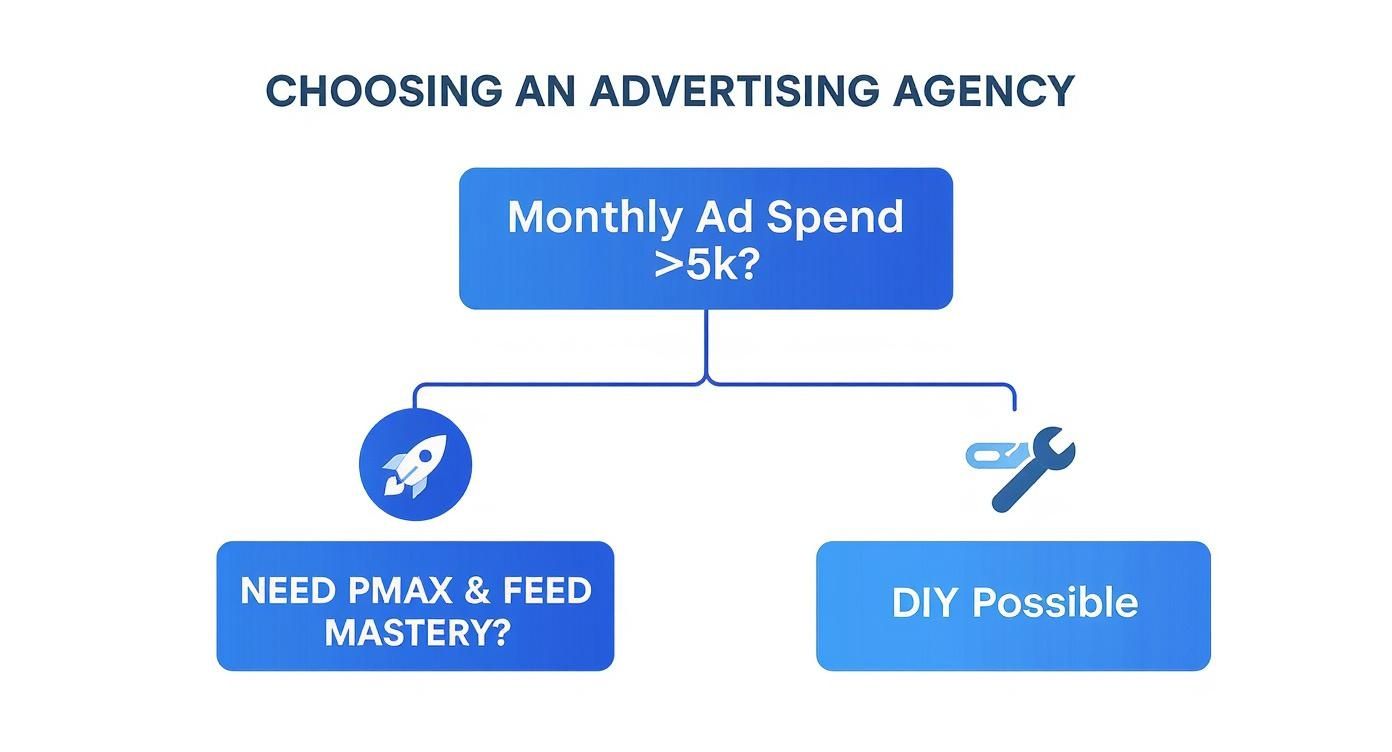
As the graphic shows, once your ad spend climbs and your campaigns get more complex, the argument for bringing in professional agency help gets a lot stronger.
Your ideal partner won’t just execute tasks. They’ll challenge your assumptions and bring fresh ideas to the table. They should feel like an extension of your own marketing team, fully invested in your growth and success.
Finally, get crystal clear on their pricing. Whether it's a percentage of ad spend, a flat monthly retainer, or a hybrid model, make sure you understand exactly what’s included. Are there extra fees for creative work or reporting dashboards? This clarity is essential for picking a partner that truly aligns with your financial goals. For a deeper dive, it can be helpful to compare different types of Adwords management companies to see which model makes the most sense for you.
Getting a Grip on Agency Costs and Realistic ROI

Alright, let's talk numbers. What does it actually cost to bring a Google Shopping agency on board here in Australia, and what kind of return can you genuinely expect?
Agency fees usually fall into one of two buckets. The most common model is a percentage of your monthly ad spend, which typically lands somewhere between 10-20%. The other option is a flat monthly retainer, which gives you predictable costs each month. For smaller businesses, a flat fee might start around $1,500 AUD per month, while bigger operations will usually get custom pricing.
What Kind of Returns Are We Talking About?
This is the million-dollar question, and the honest answer is: it depends. Your potential return is directly tied to your budget, your industry, and the margins on your products. A bigger ad spend doesn't just mean more clicks; it means more data. And more data lets an agency optimise your campaigns much faster and more effectively.
Don't just see agency fees as another line item on your expenses. Think of it as an investment in specialised expertise, high-end tools, and strategic growth you likely couldn't pull off on your own. Shifting your mindset this way is crucial for a successful partnership.
To give you a real-world idea, we often see e-commerce stores in Australia get fantastic results. For instance, a business spending around AU$4,000 a month across Google Shopping and remarketing can realistically generate over AU$26,000 in monthly revenue. That works out to a solid return on ad spend (ROAS) of roughly 6.5x to 6.7x.
Of course, getting those kinds of numbers means you have to know your own. Solid results depend on solid data, which is why proper Google Ads conversion tracking is non-negotiable. Ultimately, understanding what is a good ROAS in your specific industry will help you set achievable targets and fairly judge how well your agency is performing.
Typical Monthly Ad Spend and Agency Fees in Australia
To help you budget, here’s a rough guide to what you can expect to invest based on your business size.
| Business Size | Typical Monthly Ad Spend (AU$) | Common Agency Fee Structure |
|---|---|---|
| Small Business | $1,500 – $5,000 | Flat monthly retainer (e.g., $1,500 – $2,500) or a higher percentage of ad spend (e.g., 15-20%). |
| Medium Business | $5,000 – $20,000 | A blend of a flat retainer plus a percentage of spend, or a straightforward percentage model (e.g., 12-18%). |
| Large Business | $20,000+ | Typically a lower percentage of ad spend (e.g., 10-15%) or a custom performance-based arrangement. |
Keep in mind, these are just general figures. The right investment for you depends entirely on your growth goals and what you can comfortably afford as you scale.
Building a Successful Long-Term Agency Partnership
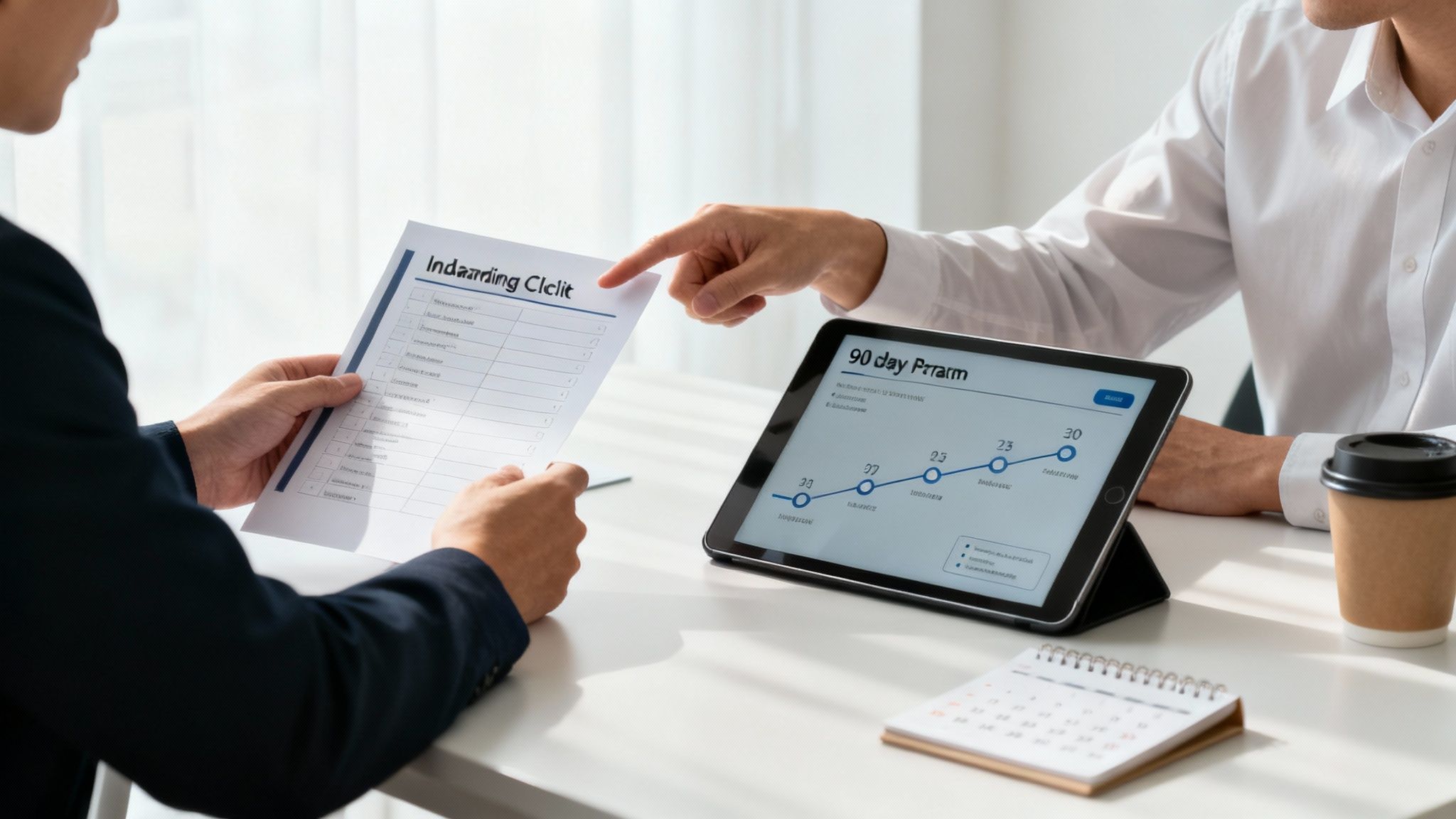
Signing the contract isn't the finish line; it's the starting pistol. The real success of your relationship with any of the top Google Shopping agencies is forged in the first 90 days. This is where you set the foundation for long-term growth.
That initial period is all about getting aligned and establishing a clear communication rhythm. A proactive agency will jump straight into a structured onboarding process, and this isn't just about getting passwords. It’s their chance to become an expert on your business, your products, and crucially, your customers.
To make this happen, they’ll need a few key things from you right at the start:
- Account Access: This means getting into your Google Ads, Google Analytics, and Google Merchant Center accounts.
- Business Context: Get ready to talk about your product margins, your best-sellers, and your big-picture business objectives. The more they know, the better they can strategise.
- Customer Insights: If you've got data on your target audience and their buying habits, share it. This stuff is gold.
Setting Expectations for the First Quarter
In return, your agency should hand over a clear strategic roadmap within the first couple of weeks. Think of this as your blueprint for the first three months. It needs to outline their initial priorities, how they plan to structure campaigns, and the key performance indicators (KPIs) they'll use to measure success.
A great agency partnership is built on mutual accountability. They need your business insights to inform their strategy, and you need their transparent reporting to understand the impact of their work on your bottom line.
Regular performance reviews are completely non-negotiable. Insist on a recurring meeting—weekly or fortnightly works best—to go over wins, challenges, and what’s next on the agenda.
This consistent dialogue is what turns a simple client-vendor arrangement into a true partnership. It ensures everyone is pulling in the same direction, focused on the shared goal of scaling your business and maximising your return. Honestly, that open line of communication is what keeps your agency genuinely invested in your growth journey.
Your Agency Selection Checklist
Right, you’ve narrowed it down. Now it’s time to make the final call, and that means a clear, methodical comparison. This isn’t about who has the slickest sales deck; it's about finding a genuine partner.
Use this checklist as your final gut check before you sign on the dotted line. A great agency will have no problem giving you straight answers to all of these.
Core Competency and Strategy
- Case Studies: Have they shown you relevant case studies with proven results in your industry or a similar one? Don't accept vague promises; look for hard numbers and tangible growth.
- Feed Management: Can they clearly explain their specific process for optimising your product feed? This is the heart and soul of Google Shopping – a generic answer won't cut it.
- Reporting Transparency: Have you seen a sample report? Is it just a wall of data, or does it provide actionable insights you can actually use to make business decisions?
Partnership and Communication
- Team Structure: Do you know exactly who your day-to-day contact will be? Crucially, what’s their level of experience? You don't want to be handed off to a junior after the pitch.
- Communication Rhythm: Have you agreed on a regular meeting schedule (e.g., weekly, fortnightly) for performance reviews? A set cadence keeps everyone accountable and on the same page.
A true partner doesn't just manage your account; they become an extension of your team, proactively bringing new ideas and strategies to the table. They should be as invested in your growth as you are.
Choosing the right partner from the many Google Shopping agencies out there is a major step. This checklist helps ensure you pick a team that's not only skilled but also aligns with how you want to work, setting you both up for long-term success.
A Few Final Questions You Might Be Asking
Even after weighing up the benefits, picking the right Google Shopping agency can feel like a big step. It’s natural to have a few last-minute questions. Let's tackle some of the most common ones we hear from business owners, so you can move forward with confidence.
How Long Does It Realistically Take to See Results?
While you might see some encouraging signs in the first 30 days, you should really give it about 90 days to see solid, repeatable results. This isn't just a random number; that three-month window is critical.
It gives an agency the time they need to gather meaningful performance data, properly test different campaign structures, and let Google's machine learning algorithms really get up to speed. Think of the first month as laying the groundwork—deep product feed optimisation, setting up tracking, and establishing your baseline performance.
Should I Go With a General PPC Agency or a Shopping Specialist?
So, what's the real difference? A general PPC agency is often a jack-of-all-trades, running campaigns across search, social, and display. A specialised Google Shopping agency, on the other hand, lives and breathes the unique world of e-commerce advertising.
Their expertise goes way beyond just bidding on keywords. They are masters of the details that make or break an e-commerce campaign:
- Product Feed Optimisation: They know exactly how to structure your product titles, descriptions, and attributes to get maximum visibility in the shopping results.
- Merchant Center Navigation: They’re pros at sorting out diagnostics, navigating tricky policy issues, and setting up promotions that actually work.
- E-commerce Campaign Strategy: They’re fluent in Performance Max and know how to use Shopping-specific tactics to drive sales, not just empty clicks.
For any online store, this kind of specialisation is what maximises your return on ad spend (ROAS) and gives you the edge over your competitors.
What Will I Need to Provide to Get Started?
To get the ball rolling, your agency will need a few key things to build a winning strategy from day one. Be ready to provide access to your Google Ads account, Google Analytics, and Google Merchant Center.
The better the inputs, the better the outputs. Providing clear, detailed information about your business from day one is the fastest way to get your agency delivering impactful results.
On top of that, they'll need your product data feed, some details on your profit margins, and a clear picture of your main business goals. Sharing insights about who your target audience is, along with any brand assets like logos and images, helps them hit the ground running.
Ready to see what a specialist Google Shopping agency can do for your business? At Click Click Bang Bang, we build data-driven campaigns that deliver real results. Explore our PPC management plans and start your risk-free trial today.
Read NeXt
Or Read Our Latest
Click. CLick. Subscribe.
Get our best PPC insights, industry updates, and power moves delivered straight to your inbox. No fluff, just high-caliber strategies that actually work.
Don’t Leave Just Yet
Try Us For 30-Days,
Risk Free!!
We guarantee that you’ll love our work within the first 30 days, if not you’ll get your money back.
What have you got to lose?