

Marketing to Dentists: Acquire High-Value Clients
Last Updated

If you're trying to break into dental as a client vertical, you already know the frustration. The market looks attractive from the outside, but once you start prospecting, every practice says they already have someone, every owner says referrals are enough, and every agency pitch starts to sound the same.
That’s why generic marketing to dentists fails. Dentists don’t buy “more traffic”. They buy a path to better patients, cleaner attribution, steadier bookings, and less wasted front-desk time. The agencies that win this category don’t just know Google Ads. They understand how a dental practice makes money, where trust is won, and which channels deserve budget for different kinds of growth.
Understanding the Modern Dental Patient Journey
Most agencies approach marketing to dentists by looking at the dentist first. That’s backwards. The ultimate advantage comes from the patient.
Today’s dental patient usually doesn’t move from awareness to booking in one step. The journey starts with a search, then review checking, then website comparison, then a decision about whether the practice feels trustworthy enough to contact. According to dental marketing statistics on patient behaviour, 71% of patients research potential dentists before booking, 81% trust online reviews as much as personal referrals, and only 26% of dental practices offer online booking.
That combination creates a clear gap. Patients are behaving like informed digital buyers, but many practices still operate with a slow, offline conversion experience.
Trust is the real product before treatment
Dental services are personal, expensive, and often anxiety-inducing. A patient isn’t just choosing a clinician. They’re choosing who gets access to their health, their appearance, and usually a meaningful amount of money.
That changes the job of the marketer.
You’re not only promoting whitening, implants, Invisalign, emergency appointments, or family dentistry. You’re building a chain of trust signals:
- Search visibility: The practice has to appear when intent is high.
- Review strength: The feedback has to reduce risk.
- Website clarity: The offer has to be obvious and credible.
- Booking ease: The next step has to feel simple.
- Follow-up speed: The practice has to respond before the lead cools.
If one of those breaks, the campaign underperforms. Not because the ads were bad, but because the patient journey was incomplete.
A dental campaign can generate demand and still fail if the front-end trust is weak or the handoff to the practice is clumsy.
Reviews and booking friction decide who wins
In most local service categories, marketers talk about traffic first. In dental, reputation often deserves equal billing.
A practice with poor review coverage, dated creative, and a hard-to-use website will struggle even with strong ad targeting. A practice with solid reviews, clear service pages, and visible booking options converts intent much more cleanly.
That’s where agencies can create immediate value. When only a minority of practices offer online booking, the operator who removes friction gains an advantage before any bidding strategy gets advanced. The fix isn’t glamorous. Add booking functionality, tighten contact forms, improve mobile usability, and make patient proof impossible to miss.
The opportunity is bigger than lead generation
This is why marketing to dentists is often misunderstood. It isn’t just lead generation for a clinic. It’s conversion architecture.
The strongest agencies in this space shape the full path:
| Patient stage | What the patient wants | What the practice must show |
|---|---|---|
| Initial search | Relevance | Clear service match and local intent |
| Comparison | Proof | Reviews, treatment pages, credentials, reassurance |
| Decision | Low friction | Easy contact, online booking, fast response |
| Post-enquiry | Confidence | Consistent follow-up and organised intake |
Dentists feel this pain every day, even if they don’t describe it in marketing language. They know they’re getting enquiries that don’t convert, calls that go unanswered, and website visits that don’t book. If you understand that operational reality, your pitch lands differently.
Crafting Your Dentist Client Acquisition Strategy
A good dental acquisition strategy starts with segmentation, not channels. If you skip that step, you end up advertising the same way for a general family practice, an implant-focused clinic, a multi-location group, and a supplier selling to practice owners. Those are different businesses with different economics.
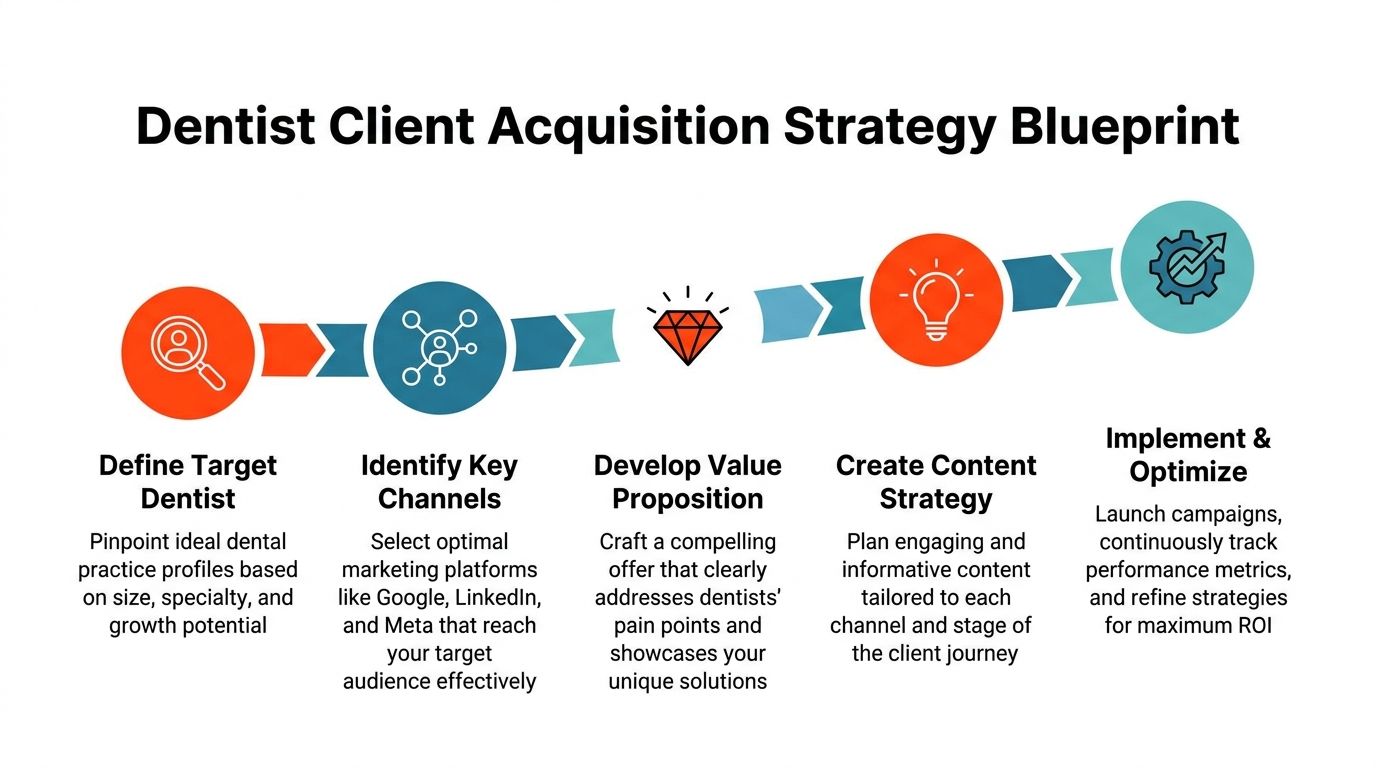
Start with service-line value
Some services are routine and volume-driven. Others are high-consideration and high-value. Your client acquisition strategy should reflect that distinction from day one.
A practical way to segment the market:
-
General dentistry practices
These clinics usually want steady patient flow across check-ups, cleans, emergency visits, and family care. The messaging has to emphasise convenience, trust, and local accessibility. -
High-value treatment practices
This includes implants, cosmetic dentistry, aligners, smile makeovers, and other premium services. These practices care more about lead quality, consultation intent, and treatment acceptance than raw lead volume. -
Growth-stage groups and multi-site operators
They need centralised reporting, budget control across locations, and consistency in brand and lead handling. -
B2B dental advertisers
Labs, software vendors, recruiters, consultants, finance providers, equipment suppliers, and specialist service firms aren’t selling to patients. They’re selling to dentists. That shifts the media mix and the message completely.
Build two personas, not one
Most agencies create a persona for the dentist they want to sign. That’s necessary, but it’s only half the work.
For marketing to dentists to work, you need two layers.
Persona one is the buyer
This is the person who hires your agency. Usually it’s the owner, principal dentist, practice manager, or group marketing lead.
They care about things like:
- Commercial outcomes: Better patients, stronger treatment mix, improved utilisation.
- Operational fit: Whether your reporting is clear and whether the practice can handle the leads.
- Risk: Whether you understand compliance, reputation sensitivity, and patient experience.
- Proof: Whether you speak in business terms instead of vague marketing language.
Persona two is their patient
This is the audience your campaigns need to influence.
For a premium cosmetic practice, the ideal patient may be comparison-shopping and highly image-conscious. For an emergency dentist, the patient is urgent and wants immediate availability. For a regional family clinic, the patient may care most about convenience, trust, and broad service coverage.
When these two personas are aligned, your offer becomes sharper. You stop selling “ads” and start selling a system that brings the right patient type into the practice.
Practical rule: If you can’t name the services your target dentist most wants to sell, you’re not ready to pitch them.
Choose channels by buying behaviour
Channel strategy gets easier once the segmentation is right. The core rule is simple. Match the platform to the kind of intent you’re trying to capture or create.
The first decision is non-negotiable. Search has to sit at the centre. Paid search drives 35% of all business traffic for dental offices, influences nearly 44% of revenue, and Google accounts for 95% of search traffic. That makes Google the primary acquisition engine for most dental campaigns.
After that, channels branch by objective:
- Google Search: Best for active patient demand and urgent service intent.
- LinkedIn: Best for B2B offers aimed at owners, group operators, recruiters, and suppliers.
- Meta: Useful for visual storytelling, remarketing, and staying visible after site visits.
- SEO: Essential for authority, local discovery, and long-term demand capture.
- Referral systems: Still powerful when formalised and supported, especially for specialist pathways.
Position your agency around business outcomes
Dentists hear broad marketing promises constantly. Most of them tune out claims about impressions, brand lift, and engagement because those don’t map cleanly to chair time.
Your value proposition should sound more like operational strategy than agency hype.
A stronger positioning angle looks like this:
| Weak positioning | Strong positioning |
|---|---|
| We help dentists grow online | We help practices attract better-fit patients and track what turns into booked treatment |
| We run PPC and social campaigns | We segment by service line, build patient-intent funnels, and improve conversion from click to call |
| We increase visibility | We improve visibility where high-intent patients actually make decisions |
That’s the difference between sounding interchangeable and sounding specialised.
A dentist doesn’t need another vendor explaining how platforms work. They need a partner who understands why one campaign should prioritise implants, another should protect emergency demand, and another should focus on recruiting or B2B outreach. That is the foundation of a credible playbook.
The Google Ads Playbook for High-Value Patients
A patient searches “All-on-4 implants Brisbane,” clicks an ad, lands on a generic homepage, and leaves in under 10 seconds. The clinic pays for the click, the agency reports traffic, and nobody can explain why implant consults are flat. That is a setup problem, not a demand problem.
Google Ads works well for dental. It also punishes lazy account structure. Agencies that treat a dental clinic like any other local lead-gen account usually mix low-value and high-value intent, send every click to broad service pages, and optimise toward form fills instead of booked treatment. That approach fills reports. It does not reliably fill chairs with profitable cases.

Structure campaigns by treatment value and intent
The cleanest dental accounts separate campaigns by service line because each treatment has a different margin profile, decision cycle, and lead-handling requirement.
A practical structure usually includes:
- Implants
- Cosmetic dentistry
- Invisalign or clear aligners
- Emergency dentist
- General or family dentistry
- Brand terms
- Competitor terms, where compliant
- Regional or rural catchment campaigns
That structure gives control over budgets, search terms, landing pages, and conversion goals. It also exposes the trade-offs. Emergency campaigns often convert fast but produce lower average case value. Implants and cosmetic work cost more per lead and need stronger follow-up, but one booked case can justify the spend for months. Grouping those services together hides that reality and leads to bad budget decisions.
Prioritise commercial-intent searches
High-value patient acquisition starts with terms that signal provider selection, urgency, or treatment readiness. Service-plus-location searches, “near me” variants, and treatment queries with suburb names usually outperform broad educational traffic because the patient is closer to action.
Broad match and top-of-funnel terms still have a place, but usually in a controlled role. Use them for search term mining, content support, or retargeting audiences. Do not let them absorb the same budget as implant or Invisalign searches with clear buying intent.
For agencies refining account architecture, this treatment-led setup is the core of effective Google Ads management.
Use negative keywords aggressively
Dental campaigns waste budget in predictable ways. Searchers looking for jobs, courses, free advice, at-home fixes, NHS-style pricing expectations, or treatments the clinic does not offer can drain spend quickly.
Common negatives often include:
- Jobs and careers
- Training and courses
- Free
- DIY
- Products or services the clinic does not provide
- Locations outside the realistic catchment
- Queries tied to low-fit payment expectations
This matters more when the client wants private, higher-value treatment rather than raw enquiry volume. A campaign with fewer clicks and better fit usually beats a cheaper CPC profile full of weak leads.
Write ad copy for anxious, high-intent buyers
Dental ads do not need clever headlines. They need to reduce hesitation.
Good copy matches the treatment, addresses risk, and gives the patient a clear next step. For emergency ads, speed and availability usually matter most. For implants or cosmetic services, trust signals matter more. Experience, consultation clarity, finance options, before-and-after proof, and clinician credibility often do more work than generic claims about quality.
I usually test copy angles around the reason someone delays treatment. Pain. Cost uncertainty. Fear of choosing the wrong clinic. The winning ads often answer one of those concerns in the first headline or description.
Strong dental ad copy shortens the trust gap between search and enquiry.
Send traffic to treatment pages, not the homepage
If someone searches for dental implants, send them to the implant page. This sounds obvious, but it is still one of the most common problems in dental PPC accounts.
The landing page should match the search, show clear proof, and make contact easy on mobile. Include prominent calls, a short form, reviews, clinician information, finance details where relevant, and a booking path that does not require extra clicks. Cosmetic and implant pages should also prepare the lead for a consultation sale, not just a general enquiry.
A useful reference on campaign thinking and patient intent is below.
Geo-target with real travel behaviour in mind
Many agencies target an entire city and call it local. That is usually too blunt for dental.
In dense metros, suburb-level targeting helps control CPC, align ad copy with actual catchments, and avoid paying for clicks from users who will never travel across the city for treatment. In regional markets, the logic changes. Patients often travel farther, competition is thinner, and a broader radius can work if the clinic fills a genuine service gap.
This is one of the better opportunities in the vertical. Rural and regional practices are often under-served by advanced campaign management, even though they may have less auction pressure and clearer intent pools. Agencies that can map travel tolerance, referral patterns, and service shortages can build efficient campaigns outside the usual metro battlegrounds.
Track booked treatment, not just leads
Dentists do not buy clicks. They buy patient acquisition.
At minimum, track calls, forms, and online bookings. Better setups connect ad conversions to practice management outcomes such as attended consults, treatment acceptance, and revenue by service line. Without that layer, it is easy to overvalue cheap general dentistry leads and undervalue higher-cost implant enquiries that convert later but generate far more revenue.
This is also where the playbook extends beyond Google. Search should feed segmented follow-up audiences, remarketing pools, and B2B growth paths for suppliers or multi-site groups. If your client also needs owner-level outreach, recruitment support, or partnerships, LinkedIn lead generation strategies can complement search demand rather than compete with it.
Tapping into LinkedIn and Meta for Niche Growth
Google captures active intent. LinkedIn and Meta serve different jobs.
Most agencies either ignore them or use them poorly. They run broad awareness campaigns, target audiences too loosely, and then conclude the platforms don’t work for dental. The issue is usually fit, not reach.

LinkedIn works when the offer is B2B
If you're marketing to dentists as buyers, not as clinicians serving patients, LinkedIn deserves serious attention.
That applies to:
- dental software
- equipment and imaging systems
- practice finance
- recruitment
- dental labs
- consulting
- group practice expansion support
- specialist B2B services
The business case is getting stronger. LinkedIn ad spend in this space is up 28% year on year, and the platform delivers 4.2x higher conversion rates for B2B suppliers targeting dental professionals compared with broader consumer-facing platforms.
That doesn’t mean every dental advertiser should shift budget there. It means LinkedIn becomes highly efficient when the offer depends on reaching owners, decision-makers, or operators inside a growing practice network.
Who to target on LinkedIn
The target list should be narrow and role-led. Think principal dentists, practice owners, regional managers, operations leads, procurement decision-makers, and founders of dental groups.
The creative also needs to act like B2B creative. Strong LinkedIn campaigns usually do better with a commercial point of view than with polished consumer-style branding.
That means messaging around:
- reducing admin burden
- improving treatment acceptance workflows
- standardising reporting across locations
- recruiting associates
- supporting expansion
- replacing underperforming suppliers
- making ROI more visible to ownership
If you want a practical outside reference for campaign design and outreach sequencing, these LinkedIn lead generation strategies are worth reviewing because they reinforce the importance of audience definition and message relevance.
For teams running this channel seriously, specialised LinkedIn Ads management matters because the margin for targeting mistakes is smaller than on broader consumer platforms.
LinkedIn is not the place to market a generic local dental offer to everyone. It is the place to put a relevant business proposition in front of the people who control budgets.
Meta plays a different role
Meta is less about explicit search intent and more about visibility, creative persuasion, and re-engagement.
For dental practices, that usually makes it useful in three situations.
First, remarketing. If someone visited a treatment page and didn’t act, Meta helps keep the practice visible while the prospect continues comparing options.
Second, visual service categories. Cosmetic treatments respond well to before-and-after storytelling, clinician introductions, and patient reassurance content, subject to compliance and platform policy.
Third, local brand familiarity. Some practices benefit when the market keeps seeing the same name, clinicians, and community presence over time.
Don’t ask Meta to do Google’s job
A common mistake is expecting Meta to create the same kind of lead as search. That usually produces lower intent and more filtering work for the practice.
A better split looks like this:
| Channel | Best use in dental | Weak use in dental |
|---|---|---|
| B2B targeting of practice decision-makers | Broad consumer patient acquisition | |
| Meta | Remarketing, cosmetic storytelling, local familiarity | Replacing high-intent search demand |
| Bottom-funnel patient capture | Passive awareness only |
The practical takeaway is simple. Use LinkedIn when the buyer is a dentist. Use Meta when visual trust or remarketing supports the journey. Use Google when the patient already wants treatment.
That channel discipline is what keeps niche growth profitable instead of scattered.
Building Long-Term Authority with SEO and Referrals
Paid acquisition gets attention because it’s fast. Long-term authority is what keeps a practice from becoming dependent on constant media spend.
That’s why the strongest dental programmes don’t separate SEO, reputation, and referrals into different conversations. They treat them as one authority system.
According to Australian dental performance benchmarks, an integrated SEO/PPC strategy is key. The same source notes that while PPC drives 35% of initial traffic, SEO aims for a 3-5% website conversion rate and supports long-term authority, with strong performance tied to 80-90% schedule utilisation and daily production per doctor of AUD $3,500-$5,000.
SEO should answer patient intent locally
Dental SEO works best when it’s practical and local. The job isn’t to publish vague wellness content. The job is to help the practice become the obvious answer for the searches that matter in its area.
That usually depends on three pillars.
Hyper-local visibility
The practice needs clean local signals, accurate service pages, suburb relevance, and a strong presence where map-based decisions happen. For dentists, local discovery often carries more commercial weight than broad informational visibility.
Content that supports real treatment decisions
Strong dental content answers the questions patients ask before they commit. Cost concerns, treatment comparisons, suitability questions, recovery expectations, and timing all shape whether a patient moves forward.
A useful editorial balance comes from the 70/30 rule cited in the same benchmark source. 70% educational content and 30% promotional content keeps the site useful without turning every page into a sales pitch.
Technical health and conversion readiness
A site can rank and still underperform if it’s clumsy on mobile, difficult to use, or weak at turning visits into enquiries. Technical work matters because visibility without conversion still wastes demand.
Referrals still matter when they’re organised
A lot of agencies underplay referrals because they’re harder to “own” than paid media. That’s a mistake.
Dental referrals remain powerful, but they shouldn’t be treated as passive luck. Practices can systemise them through specialist relationships, internal follow-up, and better review generation.
That might include:
- Professional referral pathways: Build ties with orthodontists, oral surgeons, GPs, physios, cosmetic clinics, or nearby health providers where patient overlap makes sense.
- Patient referral prompts: Ask at the right moment, after a good experience, with a process that feels natural rather than forced.
- Review generation: Help the practice turn happy patients into visible public proof. A structured approach to earning more social proof can strengthen both conversion and local SEO. For teams improving this piece, a focused process around a 5-star Google review strategy is often more valuable than another round of generic content.
A practice becomes harder to displace when paid traffic, organic visibility, reviews, and referrals all reinforce each other.
The real asset is authority, not traffic
This is the part many short-term campaign plans miss. Dentists don’t just need leads this month. They need a market position that gets easier to defend over time.
SEO and referrals do that in different ways. SEO makes the practice easier to discover and trust. Referral systems make it easier to choose. Together, they reduce dependence on any single acquisition source.
For an agency, that changes the client relationship too. You stop being the team that “runs ads” and become the team that helps build durable demand.
Measuring ROI and Scaling Your Dental Marketing
A dental campaign can look healthy in Google Ads and still fail at the practice level.
I have seen this happen with implant and Invisalign campaigns that generated plenty of leads on paper, but the clinic was missing calls, quoting weakly, or filling the schedule with low-value check-up demand instead of the treatments that drove margin. Dentists do not keep agencies because CTR improved. They keep agencies because the chair is filled with the right patients and revenue rises in a controlled way.
That changes how ROI should be measured. The scorecard needs to connect channel performance to treatment value, booking quality, and capacity.
Track the numbers that change budget decisions
Start with business outcomes first, then work back to channels.
A practical reporting stack for dentists includes:
- Cost per new patient
- New patients by service line
- Lead source by channel
- Call answer rate
- Booking rate from enquiry
- Show rate
- Case acceptance
- Schedule utilisation
- Return on investment
Those numbers matter because they show where the primary constraint sits. Sometimes media is the problem. Often it is not. A practice can have strong lead volume and weak economics because the front desk misses after-hours calls, because cosmetic consults are not followed up fast enough, or because the campaign is attracting the wrong patient segment.
For agencies, segmentation matters here. General new-patient reporting hides too much. Break results out by high-value treatments such as implants, Invisalign, veneers, or full-mouth rehabilitation. Then split by geography and channel. Rural catchments, affluent suburban areas, and CBD markets behave differently, and they should not be judged on one blended CPA target.
Use a benchmark table in every client review
A simple benchmark table keeps reviews commercial and clear.
Dental Marketing KPI & Budget Benchmarks
| Metric | Solo Practice Target | Multi-Location Group Target |
|---|---|---|
| Cost per new patient | Track against service mix, margin, and local competition | Usually higher tolerance if central operations and close rates are stronger |
| New patients per month | Set target based on chair capacity and preferred case mix | Set target by location, then aggregate at group level |
| Monthly budget approach | Tie budget to available capacity and treatment priorities | Allocate by location maturity, service demand, and management capability |
| ROI expectation | Judge by booked and accepted treatment, not lead count alone | Review by location and service line before increasing spend |
| Operational target | Reliable phones, fast follow-up, accurate source tracking | Central reporting, location accountability, and consistent call handling |
This format helps agencies avoid vague reporting. It also helps the client see whether the next decision is to increase spend, tighten targeting, improve call handling, or shift budget toward a better service line.
Do not scale demand the clinic cannot absorb
Scaling a dental account too early is one of the fastest ways to burn trust.
Before increasing budget, check four areas:
-
Phone coverage and follow-up speed
If the practice misses consult calls, more spend increases waste. -
Service-line priority
If the growth target is implants or cosmetic work, budget should reflect that instead of drifting into broad, lower-value demand. -
Tracking accuracy
Source data has to be clean enough to show which channel produced the booked patient, not just the lead. -
Capacity by provider and location
A multi-location group might have room to grow in one clinic and no room in another. Budget should follow capacity, not assumptions.
This is also where underserved channels become useful. LinkedIn will not replace Google Ads for most dentists, but it can support B2B growth for specialist referrals, corporate dental partnerships, and high-value professional audiences. Rural practice targeting can also outperform crowded metro auctions when the clinic has a genuine geographic advantage and weaker local competition. Scaling is easier when the agency is not trapped in one channel and one audience type.
Review weekly. Scale monthly.
The operating rhythm should stay simple.
Weekly, check search terms, lead quality, wasted geography, booking quality, and treatment-level performance. Cut irrelevant traffic. Protect budget. Keep the campaign pointed at the services the practice wants more of.
Monthly, review the commercial picture with the client. Which channels produced booked patients. Which treatments converted into accepted cases. Which locations can absorb more demand without hurting patient experience.
If one service line is producing strong economics, increase budget there first. If one location is underperforming because calls are unanswered, fix operations first. If LinkedIn is generating referral relationships for a specialist clinic, keep that channel in the mix even if lead volume is lower, because the downstream value can be stronger.
The same principle shows up in other service industries. This guide on how to scale a service business effectively is useful because acquisition only works when delivery capacity, systems, and follow-up keep pace.
What dentists want from reporting
Dentists usually ask five practical questions:
- Are we attracting the right patients?
- Which treatments are driving revenue growth?
- What are we paying to acquire those patients?
- Which channel deserves more budget?
- Can the practice handle more demand without service slipping?
Answer those clearly and the relationship becomes harder to replace.
Weak reporting stays stuck at platform metrics. Strong reporting shows where profit comes from, where operational friction is hurting return, and where the next dollar should go. That is what turns dental marketing from campaign management into a client acquisition system agencies can scale across metro, specialist, and rural practices.
Read NeXt
Or Read Our Latest
- Manual vs Automated Bidding for PPC Success
- Conversion Tracking Setup: A Complete AU Guide
- Instagram Advertising Australia: Complete 2026 Guide
- Pay Per Click: A Beginner’s Guide for Australian Marketers
- Display Advertising on Google: The Complete Australian Guide
- Stakeholder Communication Plan How to Build One That Works
Click. CLick. Subscribe.
Get our best PPC insights, industry updates, and power moves delivered straight to your inbox. No fluff, just high-caliber strategies that actually work.
Don’t Leave Just Yet
Try Us For 30-Days,
Risk Free!!
We guarantee that you’ll love our work within the first 30 days, if not you’ll get your money back.
What have you got to lose?