

How to Hire the Best SEM Advertising Agency
Last Updated

Most marketing managers don’t start looking for a sem advertising agency because everything is going smoothly. They start because paid search has stalled, reporting feels shallow, lead quality is drifting, or the current agency keeps talking about clicks when the board wants revenue.
That’s the hard part of this category. Almost every agency sounds competent in a pitch. They mention Google Ads, audience targeting, automation, landing pages, attribution, AI, and optimisation. Very few explain how those pieces connect to your margin, sales cycle, or sales team reality.
The confusion gets worse because businesses often use SEM, PPC, and SEO interchangeably. In practice, most agency buying decisions come down to this. Do you need a partner to run paid search now, do you need broader search visibility across paid and organic, or do you need a specialist to fix one broken area first? If you don’t answer that clearly, you can hire a decent agency that’s the wrong fit.
In Australia, due to the market's heavy concentration, the consequences of SEM choices are considerable. Google holds 89.66% of the search engine market in the AU region as of April 2025, which is why local agencies prioritise Google Ads and why it drives over 90% of paid search ROI for many businesses according to Agency Handy’s summary of search engine marketing statistics. When one platform dominates that much, a weak account structure, poor tracking, or sloppy bidding strategy gets expensive fast.
A good agency isn’t just a traffic supplier. It’s a decision-making partner that can explain trade-offs, defend budget allocation, and show its working. That’s what you’re really hiring.
Finding Your SEM Partner in a Crowded Market
Most businesses don’t need more agency jargon. They need clarity.
A credible sem advertising agency should be able to explain, in plain language, what it will manage, what success looks like, and what has to happen inside your business for campaigns to work. If the explanation sounds polished but vague, treat that as a warning.
What you’re actually buying
At its simplest, SEM covers visibility on search engines. That usually includes paid search management and, depending on the provider, may also involve SEO strategy, landing page advice, feed management for shopping campaigns, remarketing, and attribution setup.
That’s why agency selection gets messy. Some providers sell “SEM” but really mean Google Ads management only. Others package paid search with SEO, paid social, and reporting. Neither model is automatically right or wrong. The issue is fit.
If your business needs leads next month, a pure SEO consultant won’t solve the immediate commercial problem. If your paid search account already performs well but your site can’t convert traffic, more media buying won’t fix the bottleneck either.
Why the wrong partner costs more than the fee
The cost of a weak agency rarely shows up as a dramatic failure. It shows up in slower learning, muddier attribution, wasted search terms, and delayed decisions.
Practical rule: If an agency can’t explain how it will connect keywords, ads, landing pages, tracking, and sales outcomes, it probably manages channels in silos.
The strongest agencies don’t just promise growth. They show they understand your buying journey, your sales constraints, and the difference between activity and progress. That’s the standard to use throughout the rest of your evaluation.
Decoding Agency Models and Pricing Structures
Before comparing proposals, figure out which type of provider you’re considering. A lot of “bad agency experiences” were really bad fit decisions.
Three common provider models
Full-service SEM agency
This model suits businesses that want one team to coordinate paid search with adjacent channels and supporting assets. That might include landing pages, shopping feeds, remarketing, creative testing, analytics, and sometimes SEO. The upside is cohesion. The downside is that some agencies spread themselves too broadly and become average at everything.
Specialist PPC firm
A specialist PPC shop usually goes deeper into Google Ads, Microsoft Advertising, shopping campaign structure, bidding strategy, search query refinement, and conversion tracking. If your main problem is paid media performance, this can be the right choice. The trade-off is that broader search strategy or organic collaboration may sit outside scope.
Dedicated SEO consultant or SEO agency
This option fits businesses focused on organic visibility, technical fixes, and content architecture. It’s useful when your paid account is stable but your long-term acquisition costs need support from non-paid search. It’s usually not enough on its own if the immediate commercial brief is lead volume or ecommerce sales from ads.
Some businesses also work with hybrid delivery models. For example, an agency may handle PPC directly while using partners for execution in adjacent services. If you’re assessing that kind of setup, it helps to understand how outsourced work is coordinated. This primer on SEO white labeling is useful because it shows how agencies can extend capability behind the scenes, and what questions you should ask about ownership, accountability, and quality control.
Pricing model matters more than most buyers realise
The wrong pricing structure can create the wrong incentives.
An agency charging as a percentage of spend may have little natural reason to reduce waste if higher spend increases its fee. A low flat retainer may sound efficient but can leave you with junior support and minimal optimisation time. Performance-based pricing sounds attractive, but only if conversion tracking and lead quality definitions are airtight.
Here’s a practical comparison.
| Pricing Model | How It Works | Best For | Potential Pitfall |
|---|---|---|---|
| Monthly retainer | Fixed monthly management fee for agreed scope | Businesses that want predictable costs and ongoing strategic input | Scope can become vague if deliverables aren’t documented |
| Percentage of ad spend | Agency fee rises or falls with media spend | Brands scaling budget quickly across multiple campaigns | Incentive can lean toward spend growth rather than efficiency |
| Performance-based fee | Fee linked to leads, sales, or defined outcomes | Businesses with strong tracking and clear conversion definitions | Can create disputes if attribution or lead quality is unclear |
| One-off project | Fixed fee for setup, audit, restructure, or tracking work | Teams with in-house execution capability that need specialist help | Ongoing optimisation may be missing after launch |
How to read a pricing page without getting distracted
Don’t ask only, “What does it cost?” Ask, “What behaviour does this pricing encourage?”
If you’re comparing offers, check for these details:
- Scope definition: Does the proposal specify platforms, campaign types, reporting cadence, testing responsibility, and tracking ownership?
- Team access: Will you speak to the strategist running the account, or only an account manager relaying updates?
- Change process: How are landing page requests, creative revisions, and budget shifts handled?
- Commercial flexibility: Are you locked into a long contract, or can the agency earn the relationship month to month?
If you want a sense of how agencies structure these options in practice, this overview of PPC pricing models is helpful because it frames pricing around management approach rather than just headline cost.
Cheap management often becomes expensive media. Expensive management can still be bad value. The useful question is whether the fee buys better decisions.
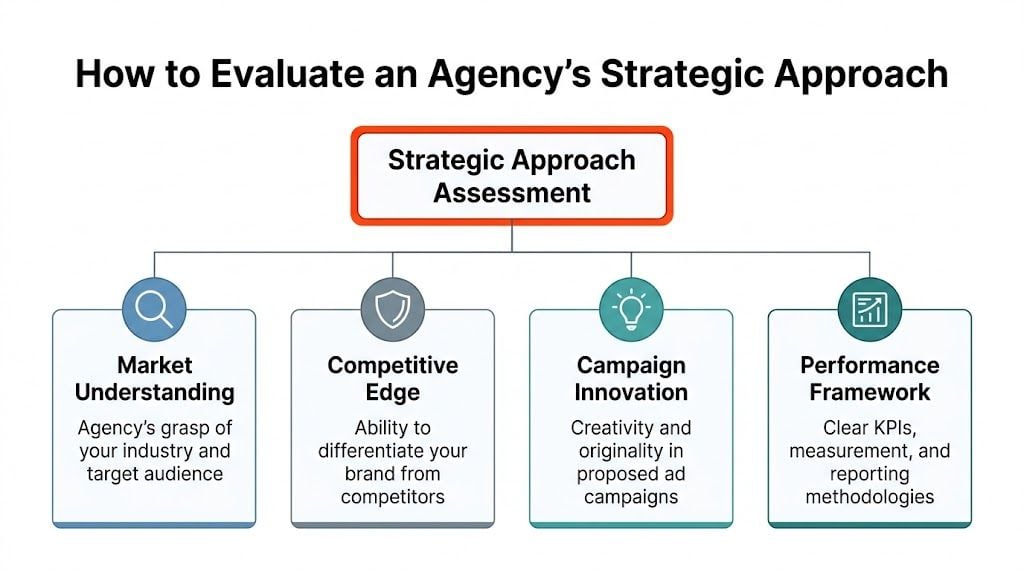
How to Evaluate an Agency’s Strategic Approach
You can spot strategic depth early, usually within the first discovery call.
Weak agencies ask about budget, target locations, and a few top keywords. Strong agencies go further. They ask how the business makes money, what a qualified lead looks like, which products carry margin, where deals get stuck, how long the sales cycle runs, and what has already been tested.
Start with the questions they ask you
The discovery process tells you how the agency thinks.
A strategic team won’t rush to campaign recommendations before understanding your commercial model. If you run ecommerce, they should ask about product margins, repeat purchase patterns, feed quality, and stock levels. If you run B2B, they should ask who closes leads, what disqualifies them, and whether sales accepts the current lead definition.
Good questions often include:
- Business economics: What’s a profitable acquisition cost by product line or service line?
- Sales reality: Which leads become pipeline, not just form fills?
- Offer strength: Why do customers choose you over alternatives?
- Measurement quality: Which conversions are tracked now, and which ones are missing?
An agency that skips those areas is usually building a media plan, not a growth plan.
Look for channel thinking, not platform silos
A narrow SEM proposal often treats Google Ads as the whole job. That can work for some accounts, but many Australian businesses need a more connected approach.
According to Search Engine Journal’s cited IAB Australia data, multi-channel campaigns combining SEM with paid social media advertising yield 2.4x better attribution accuracy for SMBs, and integrated strategies can boost ROAS by up to 30% in AU markets compared with SEM-only approaches. That matters because many buying journeys don’t begin and end on one click.
A serious agency should be able to explain where search captures demand and where other platforms support it. For example:
- Search can capture high-intent users already looking for a solution.
- Meta can support remarketing and assist return visits for ecommerce.
- LinkedIn can reinforce B2B messaging to narrow audience segments.
- Landing page testing can improve the yield from every click across channels.
That doesn’t mean every business needs every platform. It means the agency should make a deliberate case for what to include and what to leave out.
Test whether the proposal is customised or recycled
Most generic agency proposals have the same features. Competitor review. Keyword research. Campaign setup. Ongoing optimisation. Monthly reporting. None of that proves strategic thought.
What you want to see is specific interpretation.
Ask the agency to walk you through a likely structure for your account. Not the final one, but their thinking. Listen for signs of tailoring:
| Strong response | Weak response |
|---|---|
| “We’d separate branded, non-branded, and high-intent service groups because they behave differently.” | “We’ll build campaigns around your main keywords.” |
| “Your quote form is long, so we’d test call-led conversions and shorter landing experiences.” | “We’ll send traffic to your existing pages first.” |
| “Your sales team needs context, so we’d pass through campaign and keyword data into the CRM where possible.” | “We’ll track leads in the dashboard.” |
The strongest strategists also talk comfortably about exclusions. They’ll tell you which keywords they wouldn’t target yet, which products shouldn’t be scaled first, or which campaigns need tracking fixed before budget expansion. That restraint is usually a good sign.
A thoughtful agency is willing to delay launch decisions if the measurement foundation is wrong. A sales-led agency tends to rush into media because activity looks like progress.
Ask how they handle changing conditions
Strategy isn’t a one-off document. It’s a decision system.
Your market changes. Competitors shift bids. sales feedback changes the meaning of a “good” lead. Search behaviour moves. Agencies worth hiring build processes for that reality.
Ask questions like:
- What would make you change budget allocation after the first month?
- How do you respond if lead volume rises but lead quality drops?
- What signals would make you pause a campaign instead of pushing harder?
- How do paid social and search influence one another in your planning?
An agency with substance will answer in scenarios, not slogans.
Verifying Platform Expertise and Technical Skills
Strategy sounds impressive in meetings. Technical skill shows up in the details.
A sem advertising agency can have a polished pitch and still be weak inside ad platforms. You’ll usually find the gap when you ask operational questions. How do they structure campaigns? How do they manage search queries? What’s their process for conversion tracking validation? How do they use automation without giving up control?
Place the image below where you want the reader to pause and think about execution quality.

Google Ads expertise is more than a badge
A Google Partner badge isn’t meaningless, but it isn’t proof of sharp execution either. It tells you the agency is active on the platform. It doesn’t tell you whether the team can restructure a poor account, fix match-type sprawl, improve shopping feed quality, or resolve conversion duplication.
Ask direct questions:
- Campaign design: How do you separate branded, generic, competitor, shopping, and remarketing activity?
- Budget control: When do you consolidate campaigns and when do you split them?
- Search term management: How often do you review search queries and apply negatives?
- Bidding logic: What has to be true before you trust automated bidding?
- Landing page alignment: What signals tell you the page is hurting performance, not the ad?
If the answers stay abstract, keep probing. Skilled practitioners can explain process clearly.
Platform depth should match your business model
For B2B lead generation, LinkedIn knowledge matters more than many search-first agencies admit. According to Loganix’s SEM metrics page, segmenting audiences with firmographics and intent signals in Australian LinkedIn Ads campaigns can yield qualified leads at 12-18% conversion rates, versus 5% for broad targeting. That’s a significant difference in lead quality and cost efficiency.
An agency that claims B2B capability should be able to explain:
- how it defines useful firmographic segments
- when to use Lead Gen Forms versus site traffic campaigns
- how search intent and LinkedIn audience targeting work together
- how it validates whether leads are sales-ready
For ecommerce, ask different questions. Probe shopping feed hygiene, product segmentation, remarketing logic, and mobile landing page friction. Expertise is never generic. It should map to your sales model.
Tracking is the non-negotiable skill
Many agency relationships frequently fail imperceptibly.
If conversion tracking is weak, every later discussion becomes suspect. You can’t trust bidding, reporting, or channel comparison. Ask the agency to explain exactly how it handles form submissions, phone calls, ecommerce transactions, CRM feedback loops, and attribution checks. Ask who owns implementation and who verifies it after launch.
Good answers mention process. They don’t just say “we’ll set up tracking”.
One useful way to assess modern capability is to ask how the team uses automation and AI inside workflow. Not as hype, but as operating support. This guide to AI tools for marketing agencies is worth reading before vendor meetings because it helps you separate practical operational tooling from empty “AI-powered” claims.
If you want an example of a provider that explicitly frames its offer around Google PPC execution, tracking, and platform-specific management, Click Click Bang Bang’s Google PPC company page shows the sort of service scope you should expect agencies to define plainly.
Don’t ask whether an agency “does tracking”. Ask how it tests tracking, who signs off on it, and what happens when platform numbers don’t match CRM outcomes.
The Ultimate Agency Vetting Checklist
By the time you’re in final meetings, you don’t need more brochures. You need questions that force clear answers.
Use this checklist in live calls. The point isn’t to create a pass-fail exam. It’s to hear how the agency thinks under pressure, how precise it is, and whether the people in the room can translate complexity into decisions.
Questions about strategic thinking
Ask these first, then stay quiet and let them answer fully.
-
“What would you need to learn about our business before recommending campaign structure?”
A good agency will ask for commercial context, not just ad access. -
“Where do you think SEM fits in our buying journey, and where does it not?”
This reveals whether they understand demand capture versus demand creation. -
“Which campaign types would you avoid at the start, and why?”
You’re listening for restraint and sequencing. -
“If performance plateaus, what would you investigate before asking for more budget?”
This separates operators from spend-first account managers.
Questions about channel breadth
A lot of agencies say they’re full funnel. Fewer can justify channel choices well.
One useful test is Microsoft Advertising. According to PW Skills’ SEM overview, Bing holds 12% of Australia’s search market and offers 25-40% cheaper CPCs for B2B keywords, along with 15% higher conversion rates. You don’t need every agency to recommend Bing. You do need them to have a reasoned view on whether it fits your account.
Ask:
- “What would make Microsoft Advertising a good or bad fit for us?”
- “How do you decide when to expand beyond Google?”
- “If you don’t recommend Bing, what evidence would change your mind?”
If the agency dismisses alternative platforms without context, that’s shallow planning.
For broader paid media buyers, this page on marketing agency PPC services is a useful benchmark for the kinds of multi-platform capabilities agencies should be able to discuss clearly.
Questions about delivery and team structure
At this point, many good pitches fall apart.
- “Who will build the account, and who will optimise it month to month?”
- “How many accounts does that person manage?”
- “What work is done by senior staff versus junior staff?”
- “What happens if our main contact leaves?”
You’re not looking for a perfect org chart. You’re checking whether the agency has stable operating depth.
Questions about reporting and accountability
Don’t ask if they provide reports. Everyone says yes.
Ask instead:
- Can you walk me through a sample report and explain what decisions it drives?
- How do you separate platform performance from business performance?
- What will you show us weekly, and what will you review monthly?
- How do you report lead quality issues when the ad metrics still look good?
The best report isn’t the most detailed one. It’s the one that makes the next decision obvious.
Questions about contracts and commercial risk
Finish with the basics that often get glossed over.
- Notice period
- Setup ownership
- Asset access
- Who owns creative and account history
- What happens at offboarding
- Whether there are minimum commitments
A clean commercial setup usually signals confidence. A tangled one often hides churn problems.
Onboarding Timelines Red Flags and KPIs for Success
Signing the agreement doesn’t mean the hard part is over. The first weeks tell you whether the agency can turn a smart pitch into disciplined execution.
A solid onboarding process feels organised without feeling rushed. You should see clear ownership, quick access requests, tracking validation, realistic launch sequencing, and early conversations about what success means operationally.
Place this image after your opening paragraphs in this section.

What a healthy onboarding flow looks like
In the first week, you should expect practical groundwork. Access to ad accounts. Analytics review. conversion tracking checks. Audience and keyword discovery. Commercial alignment with your internal stakeholders. If an agency starts writing ads before it understands your offer and measurement setup, it’s cutting corners.
In the first month, the account should move from setup to controlled learning. That usually means campaigns are live, early search term quality is under review, landing pages are being assessed, and reporting is starting to reflect actual business questions.
By the first ninety days, the relationship should be showing a working rhythm. Not perfection. Rhythm. You should know how decisions get made, what’s improving, what still needs fixing, and where the next gains are likely to come from.
Agree on KPIs that mean something
Many agency relationships go off course because the KPI conversation was too shallow at the start.
The metrics should fit the business model, but some benchmarks are important to define clearly. According to Inboundsys’ article on common SEM mistakes, top-performing SEM campaigns in Australia maintain a Quality Score of 7+ out of 10, which can lower CPC by 40-50%. The same source notes that agreeing on KPIs such as Target CPA, with an Australian retail average of $25-45, and a benchmark ROAS of 4:1 helps hold agencies accountable.
That doesn’t mean every business should chase the same numbers. It means your agency should explain which KPIs are diagnostic, which are commercial, and which are just supporting indicators.
A practical KPI stack often looks like this:
| KPI type | What it tells you | Why it matters |
|---|---|---|
| Business KPI | Revenue, qualified leads, pipeline contribution | Shows whether SEM is helping the company grow |
| Efficiency KPI | CPA or ROAS | Keeps spend tied to commercial return |
| Platform health KPI | Quality Score, impression share trends, search term relevance | Helps diagnose why performance is moving |
| Conversion KPI | Form completion, calls, purchases, lead acceptance | Connects clicks to outcomes |
Red flags to watch in the early months
Some warning signs appear quickly.
- Tracking uncertainty: The agency can’t confidently explain discrepancies between ad platform numbers and your internal systems.
- Reporting without interpretation: You get dashboards but no clear recommendations.
- Too much comfort with vague wins: The team celebrates traffic growth when lead quality is falling.
- No challenge back to you: Strong agencies will sometimes tell the client the offer, page, or internal follow-up process is the actual problem.
Other red flags emerge more subtly. For example, repeated changes without a stated hypothesis. Or optimisation activity that sounds busy but never links back to a clear performance issue.
If an agency can’t tell you what it learned last month and what it will test next, it’s probably managing tasks, not performance.
What good accountability feels like
A strong agency relationship has a calm, evidence-led cadence. The team doesn’t panic when a week is noisy. It also doesn’t hide behind “algorithms” when the account needs sharper work.
You should be able to ask three simple questions at any time:
- What’s working right now?
- What isn’t working, and why do you think that is?
- What are you changing next?
If you don’t get direct answers, fix that early.
Your Path to a Profitable Partnership
Hiring a sem advertising agency isn’t about buying campaign management. It’s about choosing who gets to influence acquisition decisions, budget allocation, reporting confidence, and growth pace.
The best agency for your business won’t always be the biggest, cheapest, or most decorated. It will be the one that understands your economics, asks sharper questions than its competitors, and can prove it knows how to execute inside the platforms that matter to you.
That means judging more than the sales deck. Look at the logic behind the proposal. Look at how they define success. Look at whether they can explain tracking, channel choice, bidding, landing page alignment, and reporting without hiding behind jargon.
A useful test is simple. After the meeting, can you clearly describe what the agency would do, why it would do it, how it would measure success, and what risks it sees? If you can’t, the agency probably hasn’t earned your trust yet.
A profitable partnership feels less like outsourcing and more like adding experienced operators to your team. That’s the standard worth holding.
Frequently Asked Questions About SEM Agencies
How much should I budget for an SEM agency?
Start with business goals, not an arbitrary media number. Your budget needs to cover both ad spend and management, plus any landing page, feed, or tracking work required to make the campaigns viable. If an agency can’t explain where the budget goes, don’t move forward.
Should I ask for a short trial?
Yes, if the terms are clear. A short initial engagement can work well for account audits, setup, or an early test phase. The key is defining what the trial includes, what success looks like, and what happens to assets if you stop.
Can one agency handle Google, LinkedIn, and Meta well?
Sometimes, yes. But don’t assume multi-channel means deep expertise everywhere. Ask who runs each platform, how strategy is coordinated across them, and whether the reporting joins up properly.
Is project work enough, or do I need ongoing management?
Project work is fine when you need setup, restructuring, or tracking fixes and your internal team can manage the account afterward. If you need continuous optimisation, search query control, bid refinement, and reporting interpretation, ongoing management is usually the safer choice.
If you’re comparing agencies and want a provider that works across PPC and AI-first SEO with transparent reporting, flexible plans, and a clear onboarding process, Click Click Bang Bang is one option to evaluate alongside your shortlist. Use the framework above, ask hard questions, and judge the fit based on strategy, execution, and accountability.
Read NeXt
Or Read Our Latest
- Manual vs Automated Bidding for PPC Success
- Conversion Tracking Setup: A Complete AU Guide
- Instagram Advertising Australia: Complete 2026 Guide
- Pay Per Click: A Beginner’s Guide for Australian Marketers
- Display Advertising on Google: The Complete Australian Guide
- Stakeholder Communication Plan How to Build One That Works
Click. CLick. Subscribe.
Get our best PPC insights, industry updates, and power moves delivered straight to your inbox. No fluff, just high-caliber strategies that actually work.
Don’t Leave Just Yet
Try Us For 30-Days,
Risk Free!!
We guarantee that you’ll love our work within the first 30 days, if not you’ll get your money back.
What have you got to lose?