

Boost Sales with Social Media Advertising for Small Business
Last Updated

You boost a post. A few people like it. You spend a bit more. Then a bit more again. By the end of the month, the spend is easy to see and the return isn't.
That’s where most small businesses start with social media advertising for small business. Not with a strategy, but with a button. Boost post. Select audience. Enter card details. Hope for the best.
The problem isn’t that social ads don’t work. It’s that loose setup produces loose results. Social platforms make it easy to launch something, but they don’t make it easy to build a reliable acquisition system unless you know what you’re measuring, who you’re targeting, and what action you want the campaign to drive.
That matters because 75% of small businesses advertise on social media, and the same 75% rate it as their most effective marketing channel according to Intuit’s 2025 small business advertising trends report. For businesses planning to increase ad spend, 48% are directing that extra budget into social media, with Facebook used by 85% and Instagram by 74% of those advertisers in the same report.
If you’re already posting organically, a solid primer on social media marketing for small business helps frame how content and paid distribution should work together. Paid social works best when it amplifies a message that already makes sense for your audience.
Disciplined media buying beats guesswork. The small businesses that get strong returns usually aren’t louder. They’re more organised. They choose the right platform for the offer, build tracking before launch, test in a controlled way, and cut waste early. That’s the blueprint worth following.
Introduction The End of 'Wing It' Social Media Advertising
Small business owners rarely have a budget problem first. They have a decision problem first.
Should you run Facebook ads because the audience is broad? Should you use Instagram because the product looks good? Should you move budget to LinkedIn because the leads feel more qualified? Most advice online reduces those decisions to generic rules, which is why spend gets scattered across platforms without a real operating model behind it.
What changes when you stop winging it
Good social advertising starts before the first ad goes live. It starts with a plain question: what outcome matters most right now?
For an e-commerce retailer, that might be purchases from prospecting and retargeting campaigns. For a local service business, it might be inbound calls or quote requests. For a B2B company, it’s usually lead quality, not just lead volume.
Those are not the same jobs, so they shouldn’t use the same campaign setup.
Social ads punish vague thinking. If the objective is fuzzy, the targeting broadens, the creative weakens, and reporting turns into guesswork.
A proper system does four things:
- Picks one commercial objective per campaign
- Matches that objective to the right platform
- Builds conversion tracking before spend starts
- Optimises against business results, not vanity metrics
Why this channel still deserves attention
Social media isn’t optional for most small businesses anymore. The adoption data already shows that. The more important point is operational: buyers spend time on these platforms every day, and paid distribution lets you reach them without waiting for organic reach to do the heavy lifting.
That last part matters because relying on organic alone is shaky. Social reach is uneven, platform algorithms change, and attention is fragmented. Paid social gives you control. It lets you decide who sees the offer, in what format, and at what stage of the buying cycle.
The businesses that win here don’t chase virality. They build repeatable campaigns.
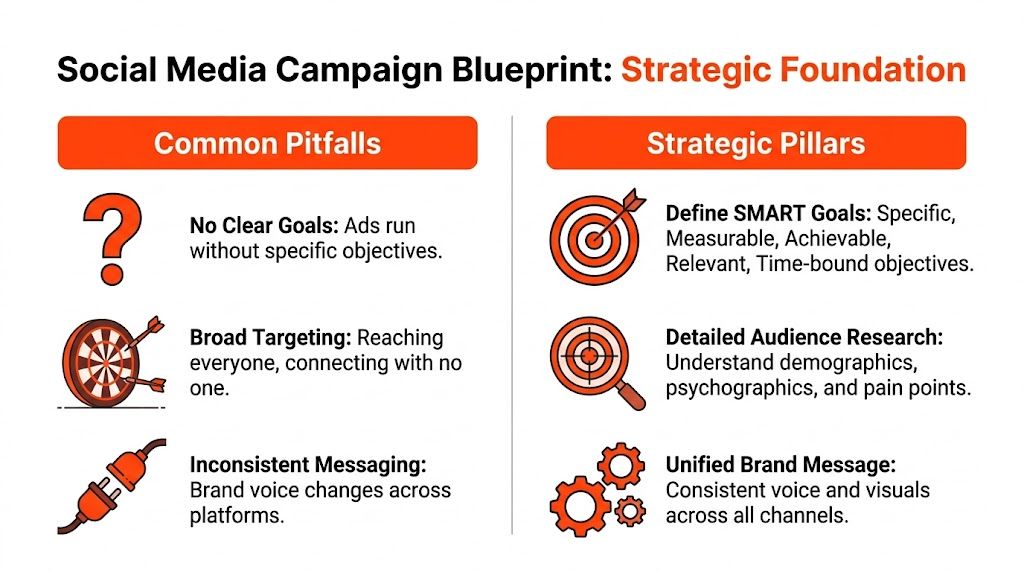
Laying the Foundation Your Campaign Blueprint
A small business launches ads for a sale, a lead offer, and a brand awareness push from the same account, with the same audience notes and no clear priority. Two weeks later, spend is gone, results are mixed, and nobody can say what worked. That failure usually starts before the first ad is built.
The blueprint needs to answer four operational questions before media buying starts. What action are you paying for. Who is most likely to take it. Which platform fits that buying context. What needs to be in place on the page or form for conversion to happen.
Start with a campaign brief your media buyer can use
One campaign should have one commercial job.
If the goal is purchases, optimise for purchases and send traffic to a product page built to close. If the goal is leads, optimise for leads and remove distractions from the form journey. If the goal is inbound calls, structure the campaign around call intent, opening hours, and device behaviour.
A usable brief includes:
- Business goal: Sales, leads, booked calls, store visits, or enquiries
- Offer: The specific product, service, promotion, or lead magnet
- Audience segment: Cold prospects, warm site visitors, customer list, or past leads
- Conversion path: Product page, service page, instant form, booking flow, or phone call
- Primary KPI: Revenue, cost per purchase, qualified leads, booked appointments, or cost per call
Audience planning falls apart when the target customer is still described in broad demographic shorthand. This guide to defining your target customer is a useful starting point if your current notes still read like platform targeting options instead of buyer profiles.
Build an ICP around buying behaviour, not audience stereotypes
“Parents aged 30 to 50” is not enough to plan media, write ads, or judge lead quality.
A working ICP needs details a strategist can act on. Start with demand stage. Then define the trigger, the friction, and the proof needed to get a click and a conversion. A local accountant targeting new business owners needs a different message from one targeting established firms switching providers. The age range may overlap. The buying context does not.
Use this framework:
| ICP input | What to define | Why it matters in campaign setup |
|---|---|---|
| Problem state | Pain point, urgency, and what triggered the search | Shapes the hook and offer angle |
| Awareness level | Unaware, problem-aware, solution-aware, or brand-aware | Decides whether creative should educate or convert |
| Decision criteria | Price, speed, trust, proof, convenience, or expertise | Informs landing page structure and ad copy |
| Friction points | Form length, delivery fees, uncertainty, low trust, or weak reviews | Highlights what must be handled before scaling |
| Expected action | Buy now, request quote, book consult, message, or download | Determines optimisation event and CTA |
This is the difference between broad targeting and campaign architecture. Broad targeting helps platforms find people. A clear ICP helps your team build ads, pages, and offers that convert those people profitably.
Match the platform to the buying moment
Platform selection should come from intent, creative fit, and sales cycle length.
A simple targeting matrix keeps that decision practical:
| Platform | Best use case | Buyer mindset | Targeting strengths | Creative requirement |
|---|---|---|---|---|
| Meta (Facebook and Instagram) | E-commerce, local services, retargeting, lead generation | Passive browsing with strong response to offers and visual proof | Interest signals, customer lists, retargeting pools, broad algorithmic delivery | Strong first-frame creative, clear offer, fast path to action |
| B2B services, software, recruiting, high-value professional offers | Active professional context, higher scrutiny before converting | Job title, seniority, industry, company attributes | Credibility-led messaging, specific pain points, lower tolerance for vague claims | |
| TikTok | Visual products, impulse purchases, founder-led brands, low-friction offers | Discovery mode, fast content consumption, low patience for polished ads | Content-led delivery, creator style, trend alignment, broad interest matching | Native short-form video, quick hooks, social proof, fast pacing |
Use one primary platform first unless there is a clear reason to split spend. Small budgets usually perform better with focus than with fragmentation. Meta is often the first choice for broad consumer demand, local lead gen, and retargeting because it covers multiple stages of the funnel. LinkedIn earns its place when deal value is high enough to absorb higher costs and the buyer can be identified by role or company type. TikTok works when the product can sell through demonstration, personality, or fast visual proof.
Pressure-test the campaign before launch
This is the step small businesses skip, and it costs them.
Before any ad goes live, check whether the offer matches the audience temperature, whether the landing destination supports the intended action, and whether the KPI reflects business value instead of easy platform metrics. A lead campaign that celebrates cheap form fills but ignores qualification rules will look efficient and still lose money. An e-commerce campaign with strong click-through rate and weak product page conversion rate has a page problem, not a media buying problem.
Our rule in client accounts is simple. If the brief cannot answer who the ad is for, why they would act now, and what event defines success, the campaign is not ready.
Smart Budgeting A Framework for Your Ad Spend
A small business with a £1,000 monthly ad budget can waste half of it in two weeks without making any obvious mistake. The usual cause is spread, not overspend. Too many audiences, too many campaigns, or too many platforms, each getting too little budget to produce a clear result.
Budgeting needs a job description. Every pound should either buy learning, buy reliable conversions, or support a short-term commercial push. If a campaign does none of those, it does not deserve spend.
Artemis makes a fair point in its review of why small businesses need a social media strategy. Affordability gets discussed far more often than budget design. That is the primary gap for small advertisers.
Split budget by function, not by platform
The cleanest structure is a three-part model:
- Testing budget. Used to validate a new audience, offer, creative angle, or landing page.
- Core budget. Used on campaigns already hitting your cost per lead, cost per sale, or return target.
- Promotional budget. Used for launches, seasonal periods, stock clearances, or event-driven demand.
This avoids a common mistake. Businesses often assign budget by channel first, then hope performance sorts itself out. The better order is objective, then function, then platform.
For a small account, that usually looks like this:
| Budget function | What it funds | Decision rule |
|---|---|---|
| Testing | New variables with uncertain performance | Cap losses early. Judge on conversion quality, not clicks |
| Core | Proven campaigns with stable economics | Protect this budget first |
| Promotional | Time-bound campaigns with a clear commercial window | Increase only if tracking is clean and fulfilment can handle demand |
Use a 70/20/10 operating rule
For ongoing spend, we use a simple allocation model in client accounts because it forces discipline.
- 70% on proven campaigns
- 20% on controlled expansion
- 10% on experiments
The trade-off is straightforward. This structure slows reckless testing, but it keeps the account stable enough to learn from. Small businesses do not need constant reinvention. They need repeatable wins and a controlled way to find the next one.
Expansion should stay close to what already works. Test a nearby audience, a new creative concept, or a different placement mix. Experiments are for higher-risk ideas such as a new platform, a new offer format, or a retargeting sequence that has not been tried before.
Match spend to buying cycle
The right split also depends on how people buy.
An emergency plumber, a dentist, or a local service business usually needs more budget in direct response campaigns because demand already exists. A founder-led product brand or visually demonstrable consumer product can justify more creative testing because ad angle and presentation affect conversion rate more heavily. A B2B firm with a long sales cycle may need less spend on volume and more on qualification, remarketing, and lead-to-opportunity tracking.
That last point matters. If you cannot connect platform conversions to qualified leads or sales outcomes, budget decisions become guesswork. A clear website conversion tracking setup for paid campaigns makes it easier to protect budget and scale the right campaigns.
How to handle multi-platform budgets without diluting results
Small budgets usually perform better with concentration. Splitting £30 a day across three platforms rarely produces enough conversion volume to judge anything with confidence.
Use this matrix:
| Business situation | Budget move |
|---|---|
| One platform is producing qualified leads or profitable sales | Keep the majority of spend there |
| Meta is working, but creative fatigue is rising | Hold core spend. Put test budget into fresh creative before adding channels |
| B2B offer with identifiable job titles and high customer value | Put primary spend into LinkedIn only if cost per qualified opportunity still works |
| Strong product demos or creator-style assets available | Test TikTok with the experimental portion, not the core budget |
| Limited traffic and weak remarketing pools | Keep remarketing spend tight until audience size supports it |
This is the practical rule. Do not diversify to look impressive. Diversify when a second platform can reach a distinct audience, with distinct creative, and enough budget to generate a useful signal.
Protect signal quality
Equal budget allocation is often the wrong move. Cold prospecting, warm remarketing, branded retargeting, and catalogue recovery campaigns do not have the same job, so they should not get the same funding.
Fund the next commercial result first. For some businesses that means lead generation to a booked call. For others it means first purchase volume. Once that engine is stable, widen the account carefully.
Good budgeting is less about spending more and more about removing waste before it compounds.
Technical Setup Connecting the Wires for Conversion Tracking
A small business can spend for weeks, see traffic rise, and still have no reliable answer to one basic question: which ads produced real enquiries or sales. That usually comes back to setup, not strategy.

Tracking exists to protect signal quality. Without it, platform results look cleaner than business results. You might see low cost per lead in Meta, then find half those leads never booked, never replied, or came from the wrong suburbs, industries, or job types.
The minimum stack that gives you usable data
Start with a setup that answers four operational questions:
- Which campaign generated the visit?
- Which visit produced the lead, sale, or call?
- Which platform event matches the business outcome?
- Which part of the funnel is failing when performance drops?
That requires five pieces working together:
- An owned ad account environment such as Meta Business Manager or LinkedIn Campaign Manager
- A site-wide tracking tag such as the Meta Pixel or LinkedIn Insight Tag
- Defined conversion events for purchases, qualified leads, calls, bookings, or quote requests
- Consistent UTM rules so campaign, ad set, audience, and creative can be identified in analytics
- A reporting layer that compares platform metrics with CRM, form, call, or sales data
For businesses tightening attribution, this guide to website conversion tracking shows how to connect the measurement layer to media decisions without guessing.
What to configure first
The order matters.
Install the platform tag first. Then map the events that represent commercial progress, not vanity actions. For a service business, that might be lead submit, booked call, and qualified opportunity. For e-commerce, it is usually view content, add to cart, initiate checkout, and purchase.
After that, fix naming conventions. A clean UTM framework saves hours in reporting and stops the usual mess where paid social traffic gets lumped into generic referral or direct buckets. We use a simple standard on client accounts: platform, campaign objective, audience, offer, and creative variant in every URL build.
Platform-specific tracking matrix
Different platforms need different event priorities. A small business should not track everything. It should track the actions that help optimisation and reporting stay aligned.
| Platform | Primary setup | Priority events | Main risk if missed |
|---|---|---|---|
| Meta | Pixel plus Events Manager checks | Lead, Purchase, Complete Registration, Schedule | Meta optimises for cheap clicks or low-value leads |
| Insight Tag plus matched audience setup | Lead, Demo Request, Key Page View | High CPL with weak visibility into lead quality | |
| TikTok | Pixel and event diagnostics | View Content, Add to Cart, Purchase, Lead | Platform gets weak post-click feedback |
| Any platform sending to landing pages | UTMs plus CRM/source capture | Qualified lead, sale, call outcome | Reporting breaks between ad platform and business result |
This is the difference between media buying and media accounting. One gets impressions. The other lets you judge profitability.
A clean implementation versus a weak one
A weak setup is common. A business runs Facebook ads to a contact page, the form submission has no event tracking, the thank-you page is missing, and the CRM records every lead as "website". The owner sees enquiries come in but cannot tell which campaign deserves more spend.
A clean setup is operational. Asset ownership sits inside the business manager. The pixel fires on page view and lead completion. UTMs follow one naming structure. The form pushes source data into the CRM. Sales status is updated after contact. Now the account can be reviewed by campaign, audience, creative, landing page, and qualified outcome rather than by click volume alone.
If the team needs a basic ad build reference before that tracking layer is in place, this walkthrough on how to create Facebook Ads covers the campaign side. Build that and the measurement side together. Splitting them usually causes reporting gaps later.
The dashboard small businesses actually need
Keep reporting simple enough to use every week. One dashboard should show:
- spend
- impressions
- clicks and landing page views
- primary conversion event
- cost per lead or purchase
- qualified lead rate or sales conversion rate
- cost per qualified lead or cost per sale
- revenue, pipeline value, or booked job value where available
That final line matters. Platforms report conversions. Businesses run on revenue and margin.
If a lead cannot be traced from ad click to sales outcome, budget decisions will rely on platform metrics instead of commercial results.
Crafting Ads That Actually Convert
Good creative doesn’t mean expensive creative. It means the ad matches the platform, the audience, and the stage of intent.
Most underperforming ads fail because they look like ads first and useful communication second. They either say too little, say too much, or ask for a conversion before trust has been earned.

What works on Meta
Meta usually rewards clear offers, strong visual hierarchy, and fast message delivery. The user is scrolling quickly, so the first job is stopping attention. The second job is making the next action feel easy.
For e-commerce, that often means:
- a product-led image or short video
- a headline built around the outcome or offer
- a landing page that matches the message exactly
For service businesses, short videos and static creatives both work when they address a pain point directly. A generic “we help businesses grow” line usually gets ignored. A sharper message tied to the buyer’s problem performs better because it creates immediate relevance.
The targeting side matters too. For Meta ads, building lookalike audiences from existing customer lists can yield 2 to 3 times higher CTRs for Australian firms, according to the Hootsuite-based methodology summary in this social media tips resource. That’s useful once you already have decent seed data. It’s not the first move for a new account with no customer list.
A practical resource on how to create Facebook Ads is worth reviewing if your team needs a platform-specific refresher on campaign assembly and creative basics.
What works on LinkedIn
LinkedIn users are in a different frame of mind. They’re not there to browse products the same way a consumer is on Instagram. They’re evaluating credibility, relevance, and business value.
That means your ad copy should usually do three things:
- Identify the business problem
- State the practical outcome
- Reduce friction on the next step
Weak LinkedIn ad:
- “We help companies scale faster. Book a demo.”
Stronger LinkedIn ad:
- “If your sales team is spending time on unqualified inbound leads, tighten lead capture before adding more budget. Get the checklist.”
That second version gives a problem, a reason to care, and a lower-friction offer.
Match creative format to buyer intent
Different formats serve different jobs.
| Format | Best use | Common mistake |
|---|---|---|
| Static image | Clear offers, local services, product promotions | Too much text, weak visual focal point |
| Video | Demonstration, founder-led explanation, trust building | Slow intros, polished but vague messaging |
| Carousel | Product ranges, before-and-after, step flows | Treating each card as unrelated |
| Lead form | Lower-friction enquiry capture | Asking for too much too early |
| Remarketing ad | Nudging warm visitors back | Repeating top-of-funnel messaging |
For teams refining message structure, this guide to ad copy best practices is useful because it focuses on how copy choices affect click quality and conversion intent.
Here’s a strong reminder for B2B teams. On LinkedIn, using Matched Audiences to retarget website visitors can increase conversion rates by up to 10x for B2B lead generation, based on the same verified Hootsuite methodology summary cited earlier. That lift comes from relevance. Warm users need a different message from cold audiences.
A short walkthrough can help if your team needs to see account mechanics and creative structure in action:
Do this, not that
Creative rule: Write the ad for the person seeing it, not for the brand approving it.
Use these swaps:
-
Instead of “Trusted solutions for growing businesses”
Try a specific problem statement tied to the buyer’s situation. -
Instead of showing the product from three angles with no context
Try showing the product in use or the service outcome in plain view. -
Instead of sending all traffic to the homepage
Try a page built for the offer in the ad. -
Instead of one generic ad for every audience
Try separate messaging for cold prospects, warm visitors, and existing customers.
One practical option for businesses that want this handled externally is Click Click Bang Bang, which offers Meta and LinkedIn campaign management with conversion tracking, business account integration, and live reporting as part of its PPC service structure.
Measuring and Optimising Your Campaign Performance
On Monday the campaign looks strong. Click-through rate is up, cost per click is down, and the platform says results are improving. By Friday, sales quality has dropped, the founder wants answers, and nobody can explain which change caused it.
That is usually a measurement problem, not a media buying problem.
Small businesses lose money here because they react to surface metrics, make three changes at once, and judge performance inside the ad platform instead of against the business outcome. The fix is a reporting system that shows what to watch, when to intervene, and what to leave alone long enough to produce a reliable signal.

Build a dashboard around decisions
A useful dashboard does not try to report everything. It helps you answer one question fast. Keep spending, cut waste, or test a new angle.
For client accounts, we use a simple decision-led structure. One tab for platform data, one tab for CRM or sales outcomes, and one tab for weekly actions taken. That last tab matters more than people expect. If you do not log changes, you cannot separate real improvement from random fluctuation.
A practical weekly dashboard can look like this:
| Campaign type | Primary KPI | Secondary metrics | Decision rule |
|---|---|---|---|
| E-commerce sales | CPA or ROAS | CTR, add-to-cart rate, checkout completion, purchase volume | Scale if margin holds and conversion rate stays stable for 7 days |
| B2B lead gen | CPL and qualified lead rate | CTR, form completion rate, meeting rate, sales feedback | Hold or cut based on lead quality, not raw lead count |
| Local services | Cost per booked enquiry | Call rate, form rate, booking rate, postcode quality | Increase budget only if enquiries turn into booked jobs |
| Awareness or top of funnel | Cost per engaged visit | Video retention, landing page engagement, remarketing pool growth | Keep only if it feeds cheaper retargeting or lower-funnel conversion later |
The trade-off is simple. The cleaner the dashboard, the easier it is to act. Add too many metrics and teams start chasing noise.
Use a platform-specific read on performance
The same numbers mean different things on different platforms. A Meta click can come from low-intent browsing. A LinkedIn click often costs more, but it may come from a narrower, higher-value audience. Judging both on CPC alone is how good campaigns get switched off.
Use this matrix as a starting point:
| Platform | Usually best for | Metrics to watch first | Common false positive |
|---|---|---|---|
| Meta | Prospecting, retargeting, lower-cost testing | CPA, CTR, landing page view rate, frequency | Cheap clicks that never become qualified leads |
| B2B lead gen, account-based targeting, high-value services | CPL, lead quality, meeting rate, job title/company fit | Low-volume campaigns that look weak before enough data comes in | |
| TikTok | Broad awareness, impulse-led products, creative testing | Hook rate, video hold rate, CPC, assisted conversions | Strong engagement with little purchase intent |
| Considered purchases, home, fashion, lifestyle, planning-led behaviour | Save rate, outbound CTR, assisted revenue | Good top-funnel traffic with poor last-click performance |
This is the operational point many small businesses miss. Platform metrics are diagnostic. They are not the final verdict.
Read patterns, not isolated numbers
Single metrics create bad decisions. Combinations create useful ones.
Here are the patterns we watch first:
- High CTR and weak conversion rate: The ad promise is stronger than the page, the offer, or the checkout experience.
- Low CTR and solid conversion rate: The traffic is qualified, but the message is too narrow, too dull, or too easy to ignore.
- Cheap leads and poor sales acceptance: The form is filtering too little, or the audience is too broad.
- Stable CPA and falling lead quality: The platform is still finding conversions, but it is drifting into weaker pockets of inventory.
- Rising frequency and falling CTR: Creative fatigue is starting. Refresh before CPA climbs further.
- Strong in-platform results and weak CRM outcomes: Attribution looks fine, but the campaign is bringing in the wrong people.
A campaign is only working if the next step in the funnel improves. For e-commerce, that means margin after ad spend. For lead gen, that means qualified pipeline, not form fills.
Test with control
A/B testing fails when the account changes faster than the learning cycle.
Test one variable at a time. Keep the rest fixed long enough to compare like with like. In practice, the highest-impact test order is usually creative angle first, offer second, audience third, and landing page refinement after that. Small businesses often reverse this and spend weeks tweaking pages for traffic that was never well matched to begin with.
Use a simple test log:
- What changed
- Why it changed
- Start date
- Spend threshold or review date
- Result
- Next action
That process keeps the account clean. It also stops teams from repeating failed tests six weeks later under a different name.
Set a review cadence that matches budget size
Daily checks are for tracking issues, broken links, rejected ads, and severe spend inefficiency. They are not for wholesale strategy changes.
For smaller accounts, a weekly optimisation rhythm is usually enough:
- validate tracking and conversion flow
- review spend pacing against target CPA or CPL
- check creative fatigue by audience and frequency
- compare platform lead numbers with CRM or sales outcomes
- pause clear underperformers
- queue the next controlled test
Monthly reviews should go deeper. Look at search lift, assisted conversions, sales quality by audience, and whether budget should move between platforms. ROI improves through these actions. Not from constant tinkering, but from better budget allocation based on what converted into revenue.
That is how campaign management becomes repeatable. Clear KPIs, controlled testing, and decisions tied to profit instead of platform optics.
Common Pitfalls and How to Scale Your Success
A common small business scenario looks like this. The first campaign starts producing leads, budget goes up, results look fine for a few days, then cost per lead rises, sales quality slips, and nobody can explain which change caused it.
That usually happens because the account was scaled before it was disciplined.
Poor performance rarely comes from one dramatic mistake. It usually comes from a stack of smaller errors. Prospecting and remarketing are mixed together. A lead form campaign is judged on click-through rate instead of pipeline value. Creative that worked for three weeks stays live for three months. LinkedIn targeting is set too broad, so seniority, function, and company fit drift away from the actual buyer.
The pattern is predictable. You pay to reach the wrong audience, send them a vague message, then increase spend before the conversion path is stable.
Mistakes that drain profit
These are the issues that show up most often in small business accounts:
- Wrong objective for the sales cycle: Using traffic or engagement campaigns when the objective is booked calls, qualified leads, or purchases
- Loose audience design: Broad targeting that brings in cheap clicks but weak commercial intent
- No remarketing structure: Warm visitors, video viewers, and lead form openers are left untouched
- Weak message match: The ad promises one thing, the landing page asks for another
- No quality filter: Low-cost leads are counted as wins even when sales rejects them
- Creative fatigue: Frequency climbs, response drops, and spend keeps going to stale ads
One fix I push early is separating scale decisions by funnel stage. Prospecting gets judged on cost to qualified visit, lead, or add to cart. Remarketing gets judged harder on conversion rate and CPA. If those are blended into one campaign view, bad traffic often hides behind good retargeting performance.
Use a simple scaling gate before increasing spend
Before any budget increase, check four things:
-
Tracking is clean
Conversions are firing correctly, CRM outcomes match platform reporting closely enough, and no recent setup change has distorted attribution. -
Sales quality is holding
Leads still meet the agreed definition of qualified. Revenue is not falling behind lead volume. -
The audience can absorb more spend
Frequency is still reasonable, reach is not saturated, and the campaign is not already hitting the same users too often. -
You have creative headroom
At least two to three fresh ads are ready before spend goes up.
If one of those fails, fix that first. Scaling a weak system usually increases waste faster than revenue.
Scale in one of two ways
Vertical scaling means increasing budget on an existing winner. Keep the changes controlled. For smaller accounts, 10 to 20 percent budget increases are usually easier to manage than a sudden jump.
Horizontal scaling means expanding sideways. That can mean a new audience segment, a different offer angle, a fresh format, or a second platform variation built for a similar buyer.
Horizontal scaling is often the safer move for small businesses because it protects the original campaign while giving you new inventory to test. A local service business might keep its strongest Meta lead campaign steady, then build a separate retargeting layer for quote-page visitors and a new prospecting set around a higher-intent pain point. A B2B firm might keep LinkedIn focused on decision-makers while testing Meta remarketing against site visitors and webinar traffic.
A practical budget expansion framework
Use a simple split when a campaign earns the right to grow:
- 60 percent to proven campaigns that are still hitting CPA or ROAS targets
- 20 percent to adjacent audience expansion such as lookalikes, new job functions, or nearby locations
- 20 percent to creative and offer testing so scale does not depend on one ad
That keeps the account stable while still creating room for growth. It also avoids the classic mistake of pushing every extra pound or dollar into the current winner until it burns out.
What to do when performance drops after scaling
Do not change six variables at once.
Return to the last stable budget level. Check frequency, CPM shifts, audience overlap, lead quality, and landing page conversion rate. Then isolate the failure point. If CTR dropped, the issue is often creative or audience fit. If CTR held but conversion rate fell, inspect the landing page, form friction, or offer strength. If lead volume stayed strong but quality fell, tighten audience filters and feed CRM feedback back into the account.
The businesses that scale well do not just spend more. They use a repeatable operating model. Clear funnel separation, a budget gate before expansion, and platform-level decisions based on qualified outcomes keep growth profitable.
Your Path to Profitable Social Advertising
Profitable social advertising rarely comes from one clever ad. It comes from a repeatable operating model.
That model is straightforward. Pick a single objective. Match it to the right platform. Build tracking before launch. Allocate budget with intent. Create ads that fit the feed they’re entering. Measure outcomes that matter to the business. Then scale only after the numbers and the lead quality justify it.
That’s the difference between random promotion and social media advertising for small business that compounds over time. You don’t need a huge budget to start. You need clean decisions, disciplined testing, and the patience to optimise against real outcomes instead of surface-level activity.
If your current setup feels messy, fix one layer today. Define the campaign objective properly. Install the tracking. Split prospecting from remarketing. Rewrite one generic ad into a sharper offer. Small improvements in the setup stage usually produce the biggest downstream gains.
If you want a second set of eyes on your campaign structure, tracking, or platform mix, Click Click Bang Bang helps businesses run data-focused PPC across Meta, LinkedIn, Google, and remarketing, with conversion tracking, live reporting, and flexible monthly plans.
Read NeXt
Or Read Our Latest
- Manual vs Automated Bidding for PPC Success
- Conversion Tracking Setup: A Complete AU Guide
- Instagram Advertising Australia: Complete 2026 Guide
- Pay Per Click: A Beginner’s Guide for Australian Marketers
- Display Advertising on Google: The Complete Australian Guide
- Stakeholder Communication Plan How to Build One That Works
Click. CLick. Subscribe.
Get our best PPC insights, industry updates, and power moves delivered straight to your inbox. No fluff, just high-caliber strategies that actually work.
Don’t Leave Just Yet
Try Us For 30-Days,
Risk Free!!
We guarantee that you’ll love our work within the first 30 days, if not you’ll get your money back.
What have you got to lose?