

How to Improve ROI in Digital Marketing: A 2026 Playbook
Last Updated

You're probably seeing one of three problems right now. Your campaigns are generating traffic but not enough sales. Your reports say performance is fine, but the bank balance says otherwise. Or your ad platforms, analytics, and CRM all disagree, so nobody trusts the numbers.
That's the reason many businesses struggle with how to improve ROI in digital marketing. The issue usually isn't effort. It's sequence. Businesses often try to optimise bids, creative, and budgets before they've fixed measurement, aligned KPIs to margin, or tightened the post-click journey.
The fix is less glamorous than most marketing advice makes it sound. Start by defining the right commercial outcome. Build measurement that survives privacy changes. Optimise campaigns for profit, not platform metrics. Then improve conversion paths and segment aggressively. The order matters.
For Australian e-commerce brands, B2B lead-gen teams, and resource-constrained SMBs, the highest-return roadmap is different. The principles are shared. The starting point isn't.
Defining Success KPIs ROI Calculation and Audits
A Brisbane e-commerce brand can show a healthy ROAS in-platform and still miss its margin target once shipping, discounts, and repeat purchase lag are included. A Sydney B2B team can celebrate low cost per lead while sales rejects half the form fills. A local SMB can keep paying for traffic that looks busy but never turns into booked jobs. ROI breaks at the point where the KPI stops matching the business model.
That is why the first job is to define success in commercial terms before touching budgets, bids, or creative.
An e-commerce retailer usually needs ROAS, cost per purchase, conversion rate, and profit by campaign. A B2B lead-gen business needs cost per qualified lead, sales acceptance rate, pipeline contribution, and lead quality by source. An SMB with a tighter budget usually needs a simpler scorecard. Which channels drive commercially useful actions at a cost the business can sustain.
Start with business maths, not channel metrics
Platform metrics help diagnose performance. They do not set the target.
For Australian e-commerce accounts, I want to know where margin survives after media cost, discounting, shipping pressure, and brand demand inflation. For B2B, lead volume is a weak KPI unless marketing and sales agree on what qualifies as a real opportunity. For SMBs, complexity usually hurts more than it helps, so one primary conversion action is enough if it reflects genuine buying intent.
Use this starting framework:
- E-commerce: Measure revenue against ad spend, but split branded and non-branded activity so existing demand does not overstate campaign impact.
- B2B lead-gen: Count leads only after they meet agreed qualification criteria. If sales would not progress the lead, marketing should not treat it as success.
- SMBs: Choose one high-intent action such as a booked call, quote request, or store visit. Make each channel earn budget against that outcome.
A benchmark can still help frame expectations. Industry guidance often points to an average 5:1 ROI, or $5 returned for every $1 spent, as noted in WebFX's guide to digital marketing ROI. Use that as context, not a target. A furniture retailer, a SaaS company, and a suburban service business do not have the same margin profile, sales cycle, or cash-flow tolerance.
Audit where the numbers break
The first audit question is simple. Which number does the business trust when reports conflict?
If Google Ads, GA4, Meta, and the CRM all report different outcomes, attribution is already affecting budget decisions. Analysts at SegMetrics in its multi-tool ROI strategy article found that custom algorithmic multi-touch attribution typically delivers 15-25% more accurate ROI measurement than simple last-click models. That gap matters because channel platforms tend to over-credit their own influence, especially across longer B2B journeys and mixed-device e-commerce paths.
Use a four-layer audit:
| Audit area | What to check | What usually goes wrong |
|---|---|---|
| Channel reporting | Conversions, CPA, ROAS by campaign | Multiple platforms claim the same sale or lead |
| Analytics | Event accuracy, landing page performance, assisted paths | Missing events, duplicate conversions, weak channel grouping |
| CRM or sales data | Lead status, qualified lead volume, revenue outcomes | Marketing reports leads that sales rejects or never contacts |
| Landing pages | Form completion, drop-off points, page intent match | Paid traffic lands on pages built for browsing, not conversion |
For a cleaner KPI setup, use a structured set of digital marketing performance metrics that separates diagnostic indicators from commercial outcomes.
What a useful audit output looks like
A good audit ends with decisions, not observations.
For e-commerce, that usually means cutting campaigns that rely too heavily on brand demand or discount-led conversion. For B2B, it often means replacing raw lead volume with qualified pipeline as the reporting standard. For SMBs, it usually means removing low-intent conversion actions that made channel performance look better than it was.
The output should answer four questions:
- What should stop receiving budget
- What needs to be measured differently
- Which conversion action becomes the source of truth
- Which campaigns already show commercial intent and deserve focused optimisation
That gives each business model a practical starting point. E-commerce teams usually start by cleaning up profit visibility. B2B teams start by aligning marketing data with sales outcomes. SMBs start by simplifying conversion tracking to one clear commercial action. Without that order, ROI work turns into reporting theatre.
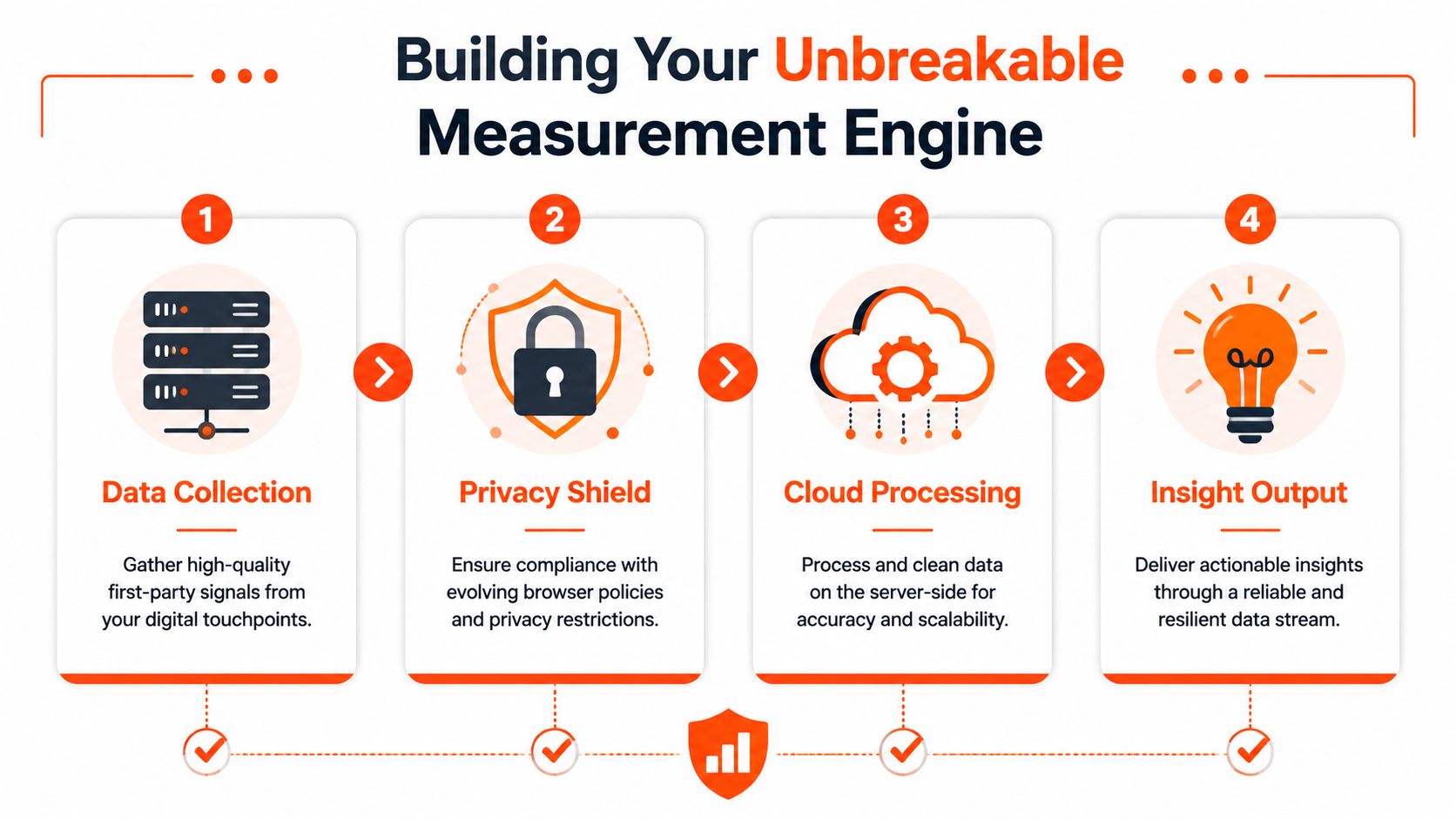
Building Your Unbreakable Measurement Engine
Browser-based tracking used to be enough. It isn't now. Privacy changes, browser restrictions, ad blockers, and patchy cookie behaviour have turned many accounts into partial-data environments. If your optimisation model runs on incomplete conversion feedback, campaign decisions deteriorate fast.
Why server-side tracking now sits at the centre
For most Australian advertisers, the most meaningful technical upgrade is moving key conversion tracking away from the browser and into a server-side setup. According to Sitetuners on server-side tracking ROI, switching to server-side tracking can lead to a 30% increase in reported conversions and a 58% lower cost per purchase. The reason is straightforward. More complete conversion data gives Google and Meta better feedback loops, which improves optimisation and attribution.
This is especially relevant in Australia, where businesses need measurement that works alongside privacy obligations and modern browser limits. A clean server-to-platform data flow is more resilient than relying on a browser pixel alone.
The implementation sequence that actually works
A lot of teams make this harder than it needs to be. The cleanest rollout follows a strict order:
-
Define your critical events
Choose the handful of actions that matter commercially. Purchase, qualified lead submission, booked call, demo request, and high-value checkout milestones are common examples. -
Map browser and server events together
Don't bolt server-side tracking on top of a messy browser setup. Align event names, parameters, and conversion priorities first so deduplication works properly. -
Connect your ad platforms
Send those server-side events into Google and Meta using their conversion frameworks. In this way, many businesses recover missing signal quality. -
Validate against your source of truth
Compare platform conversions against analytics and CRM outcomes. You're not looking for perfect matching. You're looking for consistency and fewer blind spots.
Better measurement doesn't just improve reporting. It changes how bidding systems learn.
What to avoid during rollout
The common mistakes are predictable:
- Tracking too many events: If everything is a conversion, nothing is.
- Skipping deduplication: Duplicate browser and server events will corrupt reporting.
- Leaving CRM offline: B2B teams often stop at form submissions and never close the loop on lead quality.
- Treating setup as one-and-done: Tracking needs maintenance whenever forms, checkout steps, CMS templates, or ad accounts change.
For businesses that need a practical reference point, this guide to website conversion tracking outlines the moving parts that have to align for reliable reporting.
How this differs by business model
| Business model | Priority event focus | Main measurement risk |
|---|---|---|
| E-commerce | Purchase, add to cart, begin checkout | Under-reporting purchases and misreading product-level ROI |
| B2B lead-gen | Qualified form submissions, booked meetings | Counting raw leads instead of sales-worthy leads |
| SMBs | Calls, quote requests, appointment bookings | Fragmented tracking across websites, forms, and third-party tools |
If you skip this foundation, every later optimisation becomes guesswork with nicer dashboards. If you get it right, bid strategies, audience signals, and CRO all start working with better inputs.
Optimising Campaigns and Bidding for Profit
Once measurement is stable, campaign optimisation gets sharper. This is the point where many accounts either become commercially disciplined or slide back into vanity metrics. The profitable path is simple to describe and hard to maintain. Every keyword, audience, product group, and ad variation must justify itself against a real business outcome.

PPC optimisation that protects margin
AI bidding can work well, but only when the account is feeding it trustworthy first-party signals. Used properly, it's no longer a nice extra. It's often the fastest route to efficiency in mature accounts. According to Stape's write-up on increasing marketing ROI, Google's Performance Max with AI bidding improved ROAS by 18% for Australian retailers in Q1 2026 trials, while LinkedIn AI audiences targeting high-intent B2B segments increased qualified leads by 40%.
That doesn't mean “turn on automation and walk away”. It means use automation where the machine has enough signal and the human has enough control.
A practical cadence looks like this:
- Tighten search intent first: Remove low-intent search terms aggressively. Negative keyword hygiene still matters, especially in broad match environments.
- Segment by commercial intent: Separate brand, non-brand, competitor, and remarketing activity so one area doesn't hide another.
- Match ad copy to the actual decision stage: Generic creative attracts generic clicks. High-performing ads usually answer a pain point, objection, or use case directly.
- Feed bidding systems quality conversions: If you optimise to low-value events, the platform will find more low-value users.
For Google Ads teams refining account structure and bid logic, this walkthrough on how to optimise Google Ads is a useful operational reference.
SEO work that supports ROI instead of traffic theatre
SEO becomes more profitable when it targets commercial intent rather than publishing for volume. High-traffic informational terms can have a place, but they shouldn't dominate if the business needs revenue now.
Three filters help:
| SEO filter | Strong signal | Weak signal |
|---|---|---|
| Keyword intent | Buyer, solution, comparison, service terms | Broad informational queries with vague intent |
| Page type | Service pages, product pages, high-intent collections | Thin blog posts with no path to action |
| Conversion path | Clear CTA, relevant proof, fast load, message match | Traffic lands and wanders |
What works and what usually doesn't
What works is disciplined pruning. Pause weak ad groups. Cut broad traffic that never converts. Split landing pages by offer. Use audience overlays that reflect actual behaviour.
What doesn't work is chasing lower CPCs as if cheap traffic equals efficiency. It often doesn't. A more expensive click from the right person is usually better than a cheap click from someone who was never going to buy.
One option agencies and in-house teams use for this kind of performance management is Click Click Bang Bang, which runs PPC and AI-first SEO campaigns across Google, Meta, LinkedIn, and remarketing with live reporting and conversion tracking built into delivery. The point isn't the provider. The point is the operating standard. Optimisation has to happen against profit signals, not platform comfort metrics.
Turning Clicks into Customers with CRO Tactics
A familiar pattern shows up across Australian accounts. Spend is rising, click-through rate looks healthy, and the sales team still says lead quality is patchy or revenue is flat. In e-commerce, that often means paid traffic is landing on product pages that do not build enough buying confidence. In B2B, it usually means the click reached a form page that asks for too much before the prospect sees a reason to enquire. For SMBs, the problem is often simpler. The booking or quote page makes a ready-to-buy customer work too hard.
That is why conversion rate optimisation often produces a faster ROI gain than adding budget. You are improving the return from traffic you already paid for.

Pages usually underperform because several small frictions stack up at once. One weak headline might not hurt much on its own. Add message mismatch, slow mobile load, weak proof, and a long form, and conversion rate drops quickly.
The common leaks are predictable:
- Message mismatch: The ad sells one outcome, the landing page opens on a different angle.
- Friction in the action step: Forms ask for information the sales team does not need, or checkout adds unnecessary decisions.
- Mobile usability issues: Buttons sit below the fold, sticky elements cover the CTA, or form fields are awkward on a phone.
- Weak trust signals: The page asks for a purchase or enquiry before showing reviews, client logos, delivery details, pricing context, or guarantees.
Good CRO work is usually plain. Clear offer. Clear proof. Low effort. Obvious next step.
Test what blocks revenue, not what starts design debates
Teams waste time when they test cosmetic preferences instead of buying friction. A stronger approach is to rank hypotheses by commercial impact, implementation effort, and traffic volume. That matters because an e-commerce brand with 20,000 monthly product page sessions should not spend the quarter debating homepage aesthetics, and a B2B firm with low traffic should not split-test tiny button colour changes that will never reach significance.
| Test area | Strong hypothesis example | Why it matters |
|---|---|---|
| Headline | State the offer, audience, and outcome in the first screen | Visitors judge relevance in seconds |
| CTA | Replace generic copy with action tied to the buyer's goal | Specific language reduces hesitation |
| Form | Remove fields that do not change qualification or routing | Lower effort usually lifts completion rate |
| Layout | Move proof, pricing context, or delivery information closer to the CTA | Buyers need confidence before they act |
For e-commerce teams, creative quality matters after the click as much as before it. Shopping traffic sent to weak imagery often underperforms even when targeting is solid. If your team needs a faster way to improve catalog presentation, this guide to ai product photography software is useful because it focuses on production workflow, not AI buzzwords.
A short explainer helps when teams need buy-in before redesigning key pages:
Start with the page types that carry the most revenue risk
The order of operations matters more than the length of your CRO backlog. Start where high-intent paid traffic lands and where drop-off has a direct commercial cost.
For e-commerce, begin with top-spend product pages, collection pages used in shopping and search campaigns, then cart and checkout steps. Focus first on product proof, shipping clarity, returns messaging, image quality, and mobile checkout friction. Many Australian retailers lose margin here because they keep buying more traffic before fixing the page elements that affect add-to-cart rate.
For B2B lead generation, start with demo pages, service pages, and lead forms tied to high-intent search or LinkedIn campaigns. Shorten forms if the extra fields do not improve qualification. Add proof near the CTA, such as client logos, case study snippets, turnaround times, or clear explanation of what happens after submission. In B2B, the trade-off is usually volume versus quality. The right answer is not always fewer fields. It is fewer low-value fields and better qualification through page copy, routing, or follow-up.
For SMBs, begin with quote-request pages, booking flows, and contact pages that support local service intent. Strip out distractions. Make the primary action visible without scrolling. Show service area, response time, pricing cues where appropriate, and trust markers that matter locally, such as reviews and accreditation. Small businesses often get the biggest gain from simple fixes because the starting point is usually cluttered rather than strategically complex.
Speed and certainty need to be balanced. Quick changes can remove obvious friction in days. Larger tests, such as pricing presentation, checkout structure, or lead form redesign, need tighter measurement and more patience. The practical approach is to run both tracks at once. Fix the blockers now, then build a testing queue around pages that control the most revenue.
Leveraging Audiences and AI for Scalable Growth
Once the account is measuring accurately and converting reasonably well, broad targeting starts to look expensive. That's where audience strategy takes over. Better segmentation usually outperforms more spend.
The reason is simple. Not every visitor deserves the same message, bid, or landing page. A cart abandoner, a repeat customer, and a first-time B2B visitor from LinkedIn are not the same audience. Treating them as one group pushes average performance down.
Segment by behaviour, not just demographics
According to Niteco on digital marketing ROI best practices, segmented campaigns can generate up to a 760% increase in revenue. The useful takeaway isn't the headline number on its own. It's the method behind it. Segment audiences by purchase history, browsing patterns, engagement level, and product or service affinity, then send each segment to a page built for its intent.
That leads to a more effective operating model:
- High-intent return visitors should see direct-response offers, stronger urgency, and shorter paths to purchase or enquiry.
- New cold audiences need clearer education, category framing, and proof.
- Existing customers should get upsell, cross-sell, or retention messaging instead of acquisition messaging.
- B2B account segments often need role-specific creative because a buyer, user, and approver don't care about the same details.
Where AI helps and where it can mislead
AI is most useful when it speeds up analysis, surfaces patterns, and improves execution at scale. It's less useful when teams expect it to replace strategic judgement.
A practical use case is campaign creative iteration. Teams can use AI tools to generate message variants for different audience cohorts, then validate those against actual conversion behaviour. For marketers experimenting with paid social personalisation, this guide to AI for Meta ad campaigns offers a grounded view of how AI can support testing workflows.
Broad targeting can work. Broad messaging usually doesn't.
Build retention into the ROI model
Many accounts focus only on acquisition because that's where media spend is most visible. But scalable ROI usually depends on what happens after the first conversion.
A smart audience structure includes:
| Audience type | Best use | Common mistake |
|---|---|---|
| Cart or form abandoners | Short-window remarketing with objection handling | Showing the same generic ad repeatedly |
| Past purchasers or customers | Upsell, replenishment, loyalty, referral asks | Excluding them from strategy altogether |
| Engaged non-converters | Mid-funnel proof, education, case-led messaging | Pushing hard-sale CTAs too early |
For SMBs, this doesn't need enterprise tooling to work. A modest first-party audience setup, sensible remarketing windows, and segment-specific creative already improve relevance. For larger e-commerce and B2B programmes, the same principle expands into more granular cohorts and automation.
Your Prioritised ROI Implementation Roadmap
Most businesses don't need more tactics. They need a clear order of operations. If you try to fix everything at once, the team gets busy and ROI stays flat. If you fix the most impactful constraint first, the rest of the account becomes easier to improve.
The starting point depends on your business model
| Business type | Start here first | Then do this | Avoid this early mistake |
|---|---|---|---|
| E-commerce | Fix conversion tracking and product-level attribution | Improve shopping feeds, product pages, and high-intent remarketing | Scaling spend before purchase data is reliable |
| B2B lead-gen | Align marketing and sales on what counts as a qualified lead | Build CRM feedback loops, tighten landing pages, segment by account intent | Optimising to raw form fills |
| SMB | Simplify KPIs to calls, bookings, quote requests, or purchases | Clean up landing pages, local intent targeting, and remarketing | Spreading budget too thin across too many channels |
A practical sequence for the next working cycle
Use this order if you want action, not theory:
-
Audit truth sources
Identify which platform owns the actual conversion outcome. For B2B, that's often the CRM. For e-commerce, it's usually purchase data. -
Repair tracking and attribution
Prioritise server-side event collection, deduplication, and clean conversion definitions. -
Cut waste before scaling
Remove weak queries, poor audiences, weak pages, and low-intent offers. -
Optimise the pages receiving paid traffic
Tighten message match, forms, CTAs, proof, and mobile usability. -
Segment audiences and personalise offers
Build separate treatment for new visitors, returning users, existing customers, and high-intent cohorts. -
Automate only after the account is feeding quality data
AI bidding and AI-assisted creative work best once the account has stable conversion signals.
A lean reporting template for stakeholders
A useful ROI dashboard doesn't need endless widgets. It needs five views:
- Commercial outcome: Revenue, qualified leads, booked calls, or purchases
- Efficiency: CPA, cost per qualified lead, or ROAS
- Conversion path: Landing page conversion rate and key drop-off points
- Channel view: Which platforms contribute profitably
- Audience view: Which segments deserve more or less budget
If you're an SMB owner refining positioning before pouring more money into acquisition, these actionable small business positioning strategies are a useful complement. Better positioning often lifts campaign efficiency because the offer becomes easier to understand and easier to buy.
What to do this week
If your data is messy, start with measurement.
If your measurement is fine but conversion is weak, start with CRO.
If both are solid but growth has stalled, start with audience segmentation and bidding strategy.
That's the practical answer to how to improve ROI in digital marketing. Fix the constraint that sits closest to profit. Don't chase prettier reports. Build a system that tells you where money turns into customers, then reinforce that path.
If you want a second set of eyes on tracking, campaign structure, or post-click conversion issues, Click Click Bang Bang helps Australian e-commerce, B2B, and SMB teams improve ROI through PPC, AI-first SEO, live reporting, and conversion-focused setup across Google, Meta, and LinkedIn.
Read NeXt
Or Read Our Latest
- Manual vs Automated Bidding for PPC Success
- Conversion Tracking Setup: A Complete AU Guide
- Instagram Advertising Australia: Complete 2026 Guide
- Pay Per Click: A Beginner’s Guide for Australian Marketers
- Display Advertising on Google: The Complete Australian Guide
- Stakeholder Communication Plan How to Build One That Works
Click. CLick. Subscribe.
Get our best PPC insights, industry updates, and power moves delivered straight to your inbox. No fluff, just high-caliber strategies that actually work.
Don’t Leave Just Yet
Try Us For 30-Days,
Risk Free!!
We guarantee that you’ll love our work within the first 30 days, if not you’ll get your money back.
What have you got to lose?