

Customer Data Platform Guide: Boost ROI & Meet AU Privacy
Last Updated

You can usually tell when a team has outgrown spreadsheets, platform-native audiences, and a CRM that only sales trusts. Google Ads says one thing. Meta says another. GA4 shows traffic and events, but not the customer story behind them. The ecommerce platform knows who purchased. The CRM knows who talked to sales. Your email platform knows who clicked. None of them agree on who the customer is.
That's when marketing starts making expensive guesses.
A returning buyer gets acquisition ads on Meta. A high-intent lead fills out a form, but sales doesn't see the pages they viewed before converting. SEO brings in useful traffic, yet the content team can't connect those visits to later pipeline or repeat purchases. Reporting becomes an exercise in stitching together partial truths rather than making confident decisions.
A customer data platform sits in the middle of that mess and turns disconnected records into something operational. Not a prettier dashboard. Not another storage layer for data nobody uses. A working system for unifying customer data and pushing it back into the channels that move revenue.
The Disconnected Data Problem Every Marketer Faces
A common scenario looks like this. Your Google Ads account is optimising toward conversions imported from GA4. Meta is building audiences from pixel activity and customer lists. Your CRM tracks leads and deals. Shopify, WooCommerce, or another commerce platform holds order history. Your SEO team can see landing page performance, but not whether those visitors later became customers.
Everybody has data. Nobody has the whole picture.

What fragmentation looks like in practice
The symptoms are usually easy to spot:
- Audience waste: Paid campaigns keep targeting people who already bought, already enquired, or should be excluded.
- Patchy messaging: Email says one thing, remarketing says another, and the website personalises for nobody.
- Weak attribution: Marketing can report channel activity, but struggles to prove revenue contribution cleanly.
- Slow execution: Building one audience often means exporting CSVs, cleaning records, and uploading lists by hand.
That's why a lot of teams become obsessed with platform tactics when the actual problem is infrastructure. If the underlying customer record is fragmented, campaign optimisation hits a ceiling.
The problem usually isn't that the media team lacks ideas. It's that the data foundation can't support precise activation.
For Australian marketers, this matters more now because first-party data has become far more valuable than rented audience access. The broader regional signal is strong. The Asia-Pacific CDP market is projected to grow from about USD 1.28 billion in 2024 to roughly USD 4.72 billion by 2030, which shows the category has shifted from niche martech into core infrastructure, with Australia participating in that growth corridor according to VWO's CDP market statistics overview.
Why this hits ROI first
When data is disconnected, the first casualty is efficiency. You spend more to reacquire existing customers. You miss cross-sell and upsell opportunities because behavioural and transaction data live in different systems. You also lose confidence in your own reporting, which makes budget conversations harder than they should be.
If you're under pressure to justify paid media performance, a better grasp of return on ad spend only gets you part of the way. ROAS improves fastest when the audiences, exclusions, and conversion signals behind it are clean.
A customer data platform fixes the operating model behind the campaigns. It gives Google Ads, Meta, CRM workflows, and even SEO reporting access to a more consistent customer record. That's the difference between “we have data” and “we can use data”.
What a CDP Actually Is and What It Is Not
The easiest way to explain a customer data platform is this. It acts as the central nervous system for customer data. It collects signals from different systems, resolves identities, builds a usable profile, and sends that profile to the tools that need it.
That sounds similar to a CRM or a DMP, which is why teams often buy the wrong thing for the wrong reason.
A plain-English definition
A customer data platform is designed to:
- Collect first-party customer data from sources such as your website, CRM, ecommerce platform, email system, and support tools
- Unify records so one person isn't treated as five different users across devices and channels
- Store persistent profiles that can be used over time
- Activate data in downstream platforms like Google Ads, Meta, email, and onsite personalisation tools
The key distinction is that a CDP isn't just where data sits. It's where data becomes usable for marketing and customer experience.
What it isn't
A CDP is not your CRM. A CRM is usually strongest when sales needs account, contact, and pipeline management. It's excellent for known contacts and sales workflows. It's not built to act as the real-time orchestration layer across all your marketing touchpoints.
A CDP is also not a DMP. A DMP traditionally sits closer to advertising and anonymous audience targeting. That's less useful than it once was, given that privacy changes and browser limits have reduced the reliability of third-party tracking.
It's also not just an analytics tool. GA4 can tell you what happened on-site. It doesn't automatically create durable, channel-ready customer profiles that combine web behaviour, purchase history, consent status, and CRM context in one operational record.
CDP vs CRM vs DMP At a Glance
| System | Primary Purpose | Data Type Handled | Key Use Case |
|---|---|---|---|
| CDP | Unify and activate customer data across channels | Primarily first-party, persistent customer-level data | Build unified profiles and push audiences to Google Ads, Meta, email, and onsite experiences |
| CRM | Manage sales relationships and account activity | Known contact and account data | Track leads, opportunities, customer interactions, and sales pipeline |
| DMP | Support audience targeting for advertising | Largely anonymous or third-party-style audience data | Media targeting and audience expansion for advertising use cases |
The practical test
If you're asking, “Where do we keep all our customer and lead records for sales follow-up?” that's usually CRM territory.
If you're asking, “How do we connect ad clicks, website behaviour, CRM status, order history, and consent status so we can target and suppress audiences properly?” that's CDP territory.
Practical rule: If the main job is pipeline management, buy for CRM. If the main job is identity, segmentation, and activation across marketing channels, buy for a customer data platform.
This distinction matters because many marketing managers try to stretch a CRM into doing CDP work. They end up with brittle workflows, manual exports, duplicated contacts, and audience syncs that break every time a field changes.
The best CDP projects start with a narrower view. Don't ask whether the platform can “do everything”. Ask whether it can create a trustworthy customer profile and route that profile cleanly into the systems your team already uses.
Core CDP Capabilities That Drive Marketing ROI
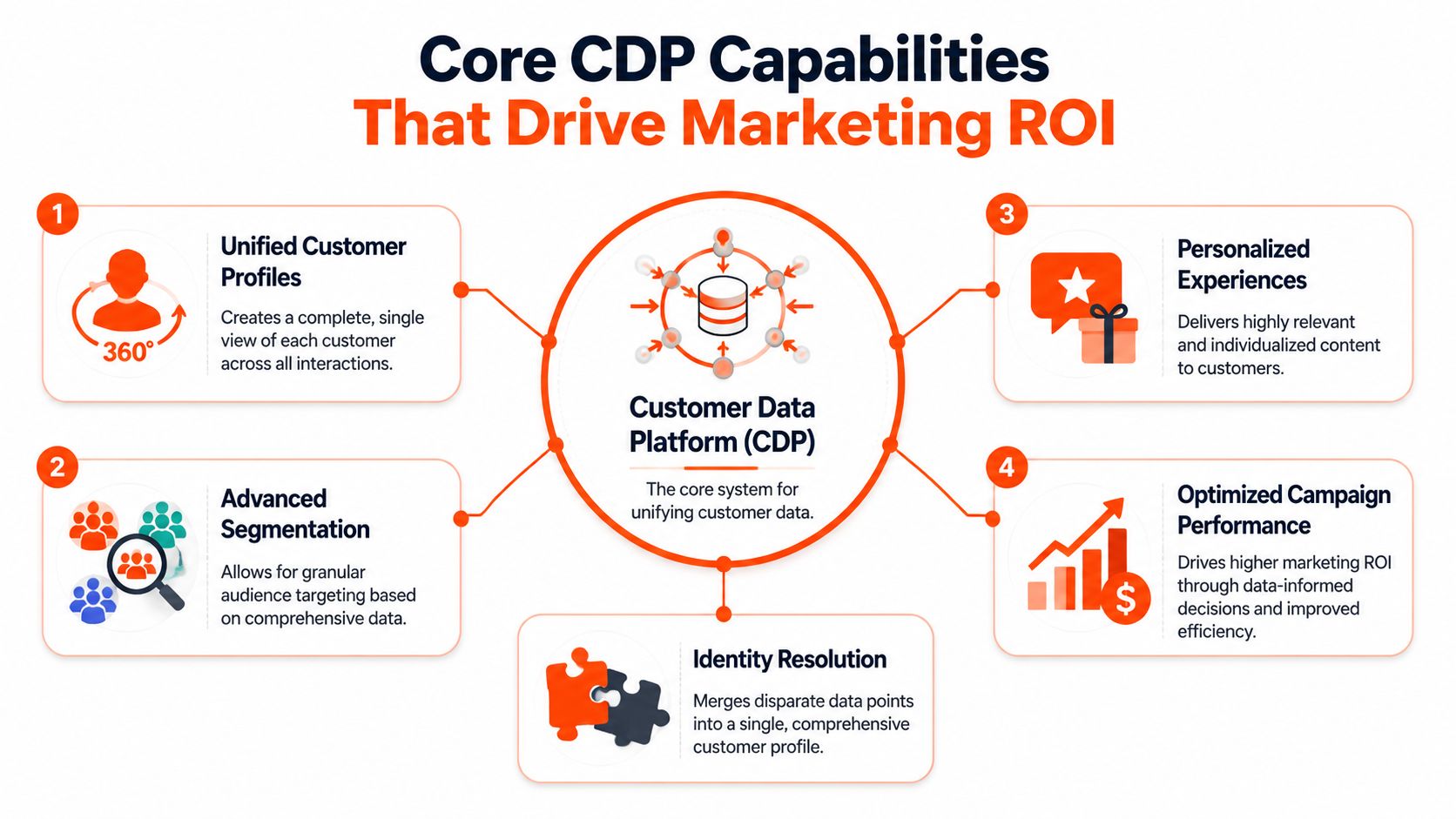
The technical language around CDPs can make them sound abstract. In day-to-day marketing, four capabilities matter most. They affect targeting, suppression, reporting, and personalisation.
Start with the visual below, which captures the operating model.
Identity resolution
Identity resolution is where a CDP decides that multiple signals belong to the same person. That might include an email address, phone number, device ID, or login event. The result is a single customer view that marketing can act on with far more confidence.
This isn't a cosmetic feature. It affects media efficiency directly. Identity resolution in a CDP operates through a hybrid algorithm to create a Single Customer View with over 95% confidence. For Australian ecommerce, where 68% of transactions have multiple touchpoints, this process is the causal factor for a 22% increase in ROAS by eliminating duplicate audience bidding. That's one of the clearest performance reasons to invest in the category.
For PPC teams, the benefit is immediate. You stop bidding against yourself for the same person in slightly different audience pools. You can also suppress recent purchasers and current customers more accurately across Meta and Google Ads.
Unified customer profiles
Once identities are resolved, the CDP builds profiles that combine behaviour, transactions, consent, and lifecycle signals. At this stage, scattered records turn into something useful.
A good profile usually includes:
- Behavioural context: Pages viewed, products browsed, content consumed, and key onsite actions
- Commercial history: Purchases, order patterns, lead status, and customer value signals
- Channel eligibility: Consent status, email subscription state, and platform sync readiness
If your team is tightening up its use of first-party data, this is the layer that makes it operational instead of theoretical.
Advanced segmentation
Segmentation is where marketers feel the value. Instead of broad lists, you can build audiences based on combinations of actions and attributes.
Examples include:
- High-intent non-buyers: Visited product pages repeatedly, added to cart, but didn't purchase
- At-risk customers: Previously engaged or purchased, but haven't returned in a meaningful period
- Sales-ready B2B prospects: Viewed pricing, downloaded a key asset, and matched to a known company or contact
This is also where customer journey work gets sharper. If you want a clearer framework for mapping how people move from discovery to conversion, Sensoriium's guide to customer journey mapping is a useful companion resource because it helps translate unified data into actual journey decisions.
A short explainer helps if you want to see the concept in motion:
Activation across channels
A profile has no commercial value if it stays trapped in the CDP. Activation is the handoff into execution systems.
That means the CDP can push customer segments into:
- Google Ads for customer match, suppression, and search audience layering
- Meta Ads for prospecting seeds, exclusions, and retention campaigns
- Email platforms for triggered journeys based on real behaviour
- Onsite experiences for personalised content, offers, or messaging
When activation is clumsy, the CDP becomes an expensive warehouse. When activation is clean, it becomes a profit lever.
What doesn't work is collecting every possible data point and hoping insight appears later. What works is defining the audiences and triggers that tie directly to campaign decisions. Recent buyers should be excluded. Product viewers should see follow-up messaging. SQLs should leave prospecting pools. Content readers should move into nurture paths based on topic interest.
That's how the technology pays for itself. Not through theoretical “360-degree views”, but through better bidding, cleaner exclusions, smarter segments, and more relevant journeys.
Real-World Use Cases for AU Businesses
The best way to understand a customer data platform is to watch what changes once the data starts behaving like a system instead of a pile of exports.
Ecommerce retail without audience overlap
An Australian retailer running Google Shopping, Meta prospecting, email, and SEO often has the same issue across channels. The paid team sees site visitors and purchasers. The email team sees subscribers and clickers. The ecommerce platform sees order history. The organic team sees category pages attracting useful traffic, but not which visitors later become repeat buyers.
Without a CDP, those teams work from adjacent truths.
With a CDP in place, the retailer can connect product views, cart events, purchases, and email engagement into one profile. That changes campaign execution in practical ways:
- Cart recovery improves: The customer who abandoned checkout can move into a triggered email flow with product context already attached.
- Paid suppression gets cleaner: Recent purchasers can be excluded from acquisition campaigns on Meta and Google Ads.
- Retention becomes more specific: Customers who bought from one product category can be shown complementary products rather than generic offers.
- SEO insights become more commercial: The team can spot which organic entry pages bring in visitors who later convert or buy again.
The biggest shift is usually in spend quality. The media budget stops leaking into obvious waste cases, and the messaging becomes more coherent across touchpoints.
A good retail CDP setup doesn't make every campaign smarter at once. It fixes the high-friction journeys first, especially cart abandonment, repeat purchase prompts, and paid audience exclusions.
B2B lead generation with better sales timing
B2B teams run into a different version of the same problem. A prospect clicks a LinkedIn ad, reads a services page, returns later from branded search, downloads a resource, and finally fills in a contact form. By the time they're in the CRM, sales sees the lead record but not the full path that created intent.
That delay matters. Sales treats the lead like a fresh enquiry when the buyer has already signalled serious interest.
A CDP helps by stitching together anonymous website behaviour with known lead data once an identifying event happens. The system can then group prospects by meaningful patterns rather than isolated form fills.
A B2B use case might look like this:
- A prospect visits from LinkedIn and reads solution pages.
- They return from Google search and view pricing or case-study content.
- They submit a form or register for a demo.
- The CDP updates the profile with known identity and prior behaviour.
- Sales receives a richer record with context for outreach and prioritisation.
That doesn't just help the sales team. It improves paid media as well. The PPC team can exclude active opportunities from top-of-funnel campaigns, build better retargeting pools around meaningful research behaviour, and align messaging with actual stage progression.
Where SEO fits into these use cases
SEO often gets left out of CDP conversations because people assume CDPs are only for paid media and email. That's a mistake.
For ecommerce, SEO pages reveal product and category intent before the user becomes known. For B2B, organic visits often expose early-stage research themes long before a prospect fills out a form. When a CDP connects those visits to later outcomes, the SEO team gets more than rankings and sessions. It gets revenue context.
That changes content planning. Instead of publishing purely for traffic, teams can focus on themes that consistently move visitors toward purchase or qualified enquiry.
Implementing a CDP Within Your Marketing Stack
A customer data platform shouldn't replace your stack. It should make the stack work together.
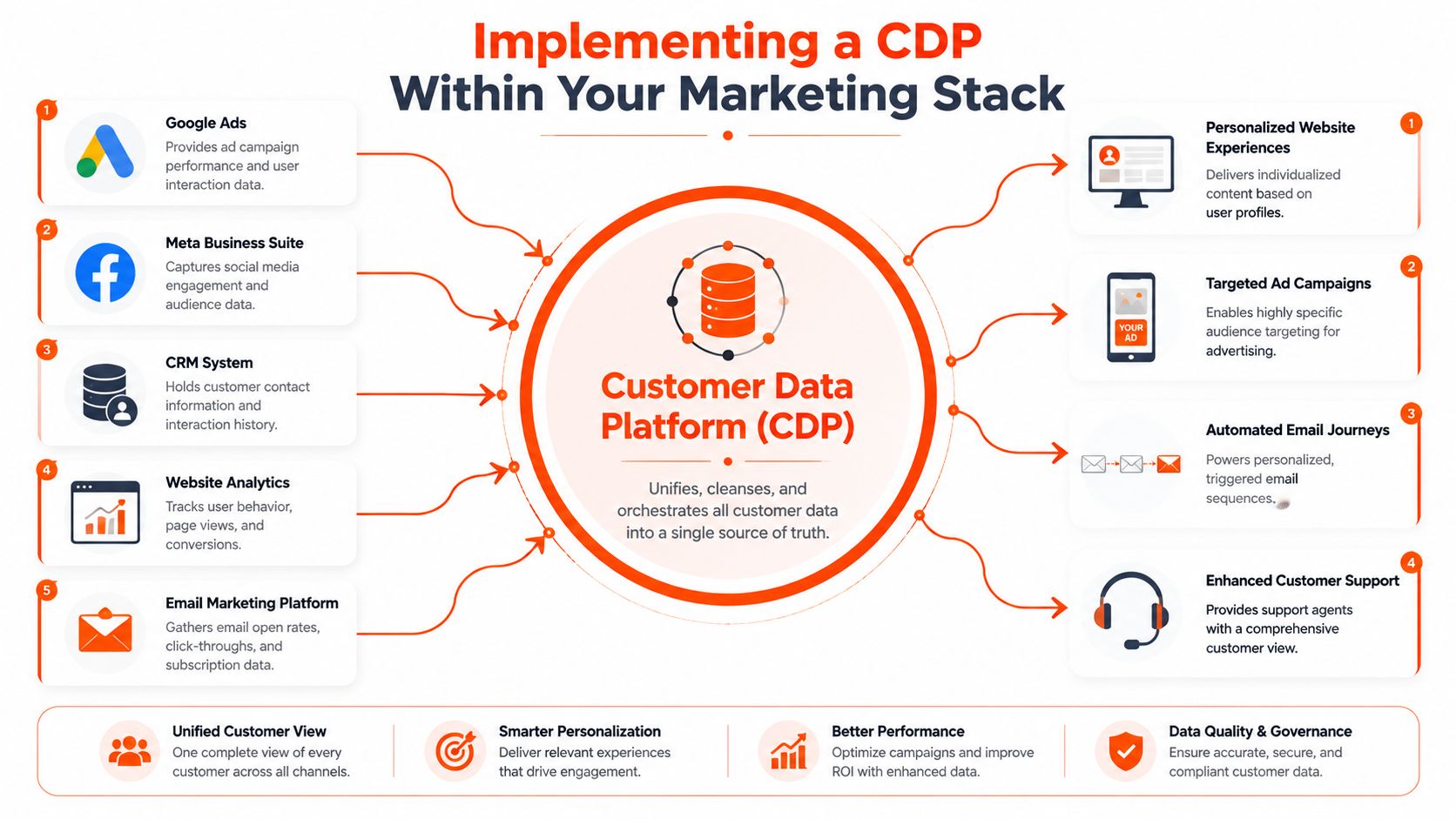
Most Australian marketing teams already have the core ingredients. GA4 tracks website behaviour. Google Ads and Meta handle paid activation. A CRM holds leads or customer records. The ecommerce platform or billing system records transactions. Email software manages communication. SEO tools help the team understand landing pages, queries, and content opportunities.
The CDP sits between those systems and turns them into a coordinated flow.
A typical data flow
A simple implementation usually works like this:
- Inputs arrive: Website events, CRM changes, purchase records, and email engagement flow into the CDP.
- Profiles are updated: The CDP resolves identities and updates customer-level records.
- Rules are applied: Segments, suppressions, consent logic, and lifecycle states are calculated.
- Outputs are sent: Audiences sync back to Google Ads, Meta, email tools, and personalisation systems.
That flow sounds straightforward, but the practical trade-offs matter. If event naming is messy, profile logic becomes unreliable. If CRM fields are inconsistent, audience syncs inherit that inconsistency. If consent handling is an afterthought, the activation layer can create compliance risk.
Monolithic versus composable
In this context, architecture becomes a real decision rather than a vendor buzzword.
A monolithic CDP usually gives you one bundled system for ingestion, storage, identity, segmentation, and activation. That can be faster to launch if your stack is simple and your internal data capability is limited. The downside is rigidity. You're often locked into the vendor's storage model, identity logic, and integration constraints.
A composable CDP separates those layers so you can use existing infrastructure such as a cloud warehouse for storage and a lighter activation layer on top. That model is often better for teams already using modern data tooling.
The performance difference can be material. A composable CDP architecture reduces identity resolution latency by 40-60% in high-volume ecommerce by leveraging cloud data warehouses. For AU agencies, this pattern leads to a 35% faster campaign deployment cycle for PPC clients, as unified profiles can be routed directly to Meta and Google Ads APIs.
What usually works and what usually fails
What works:
- Start with one or two revenue-critical use cases
- Map field logic before implementation
- Define audience ownership across marketing, data, and CRM teams
- Test suppression rules before scaling activation
What fails:
- Trying to ingest everything at once
- Treating the CDP as only an IT project
- Ignoring downstream activation requirements
- Assuming platform defaults will handle identity and consent cleanly
The best implementations aren't the biggest. They're the ones where the first synced audience is already useful to paid media, CRM, or retention.
If your current stack already includes a warehouse and strong internal data support, composable usually deserves serious consideration. If not, a more packaged option may get you to operational value faster. The right answer depends less on vendor positioning and more on how your team works.
Navigating Data Governance and Privacy in Australia
In Australia, a customer data platform isn't just a marketing system. It's part of your governance model.
That matters because local businesses often combine data from global ad platforms with local systems such as point-of-sale, ecommerce, CRM, and support tools. The technical challenge isn't only unification. It's doing that unification in a way that respects consent, access controls, deletion requirements, and data handling obligations.
Why regulation changed the value of first-party data
Australia's Privacy Act has been in force since 1988, but a more modern shift in customer data practices arrived with the Consumer Data Right, established in 2019, which first went live for banking in 2020 and later expanded into other sectors. In practical terms, this strengthened the business case for consented, governed first-party data. As noted in CDP.com's explanation of customer data platforms, organisations use CDPs to unify first-party data, create persistent profiles, and support activation, which fits directly with a privacy environment where governed customer data matters more.
For marketers, the strategic implication is clear. The less dependable third-party tracking becomes, the more valuable your own customer records become. But value without governance creates risk.
The Australian implementation problem
A recurring issue for Australian retailers is bridging external advertising platforms such as Google and Meta with internal systems like POS or local databases while staying compliant with the Privacy Act. This is not a small edge case. A key challenge for Australian retailers is bridging data from third-party ad platforms with local POS systems while complying with the Privacy Act. With 68% of AU SME breaches involving data integration errors, a CDP must be configured for AU-specific data residency and consent management to avoid liability.
That's the part many generic CDP guides skip. They explain identity resolution well enough, but they don't explain what happens when identity resolution crosses systems with different privacy obligations, storage expectations, and user permissions.
What governance looks like in a working CDP setup
A usable governance model usually includes:
- Consent-aware profiles: The platform knows whether a person can be activated in email, paid media, or both.
- Data residency decisions: Teams know where storage lives and which systems process what.
- Access controls: Not every team needs access to every field or every identity attribute.
- Deletion propagation: If a customer requests deletion, downstream systems need to reflect that decision quickly and consistently.
CDPs become operationally important rather than just conceptually useful. They centralise consented customer data and help enforce rules across activation channels instead of leaving each tool to manage privacy logic on its own.
A CDP doesn't make a business compliant by itself. It gives the business one place to apply and enforce data rules consistently.
What marketers should ask internally
Before any implementation, get answers to these:
- Which systems hold source-of-truth consent data
- Which customer attributes are allowed to sync into paid media
- How suppression and deletion requests travel across tools
- Whether ad platform audiences are aligned with local data handling rules
Those questions aren't legal theatre. They shape audience design, conversion tracking, CRM syncs, and customer trust. In the Australian market, that makes a customer data platform part of the compliance conversation from day one.
How to Choose a CDP and Measure Your Success
Most CDP buying processes go wrong for a simple reason. Teams buy the longest feature list instead of buying for the few use cases that matter.
If your main problem is paid audience duplication, choose for identity and activation. If your main problem is lifecycle messaging, choose for profile depth and event triggers. If your business depends on local system integration and privacy controls, choose for governance and implementation fit.
A practical selection checklist
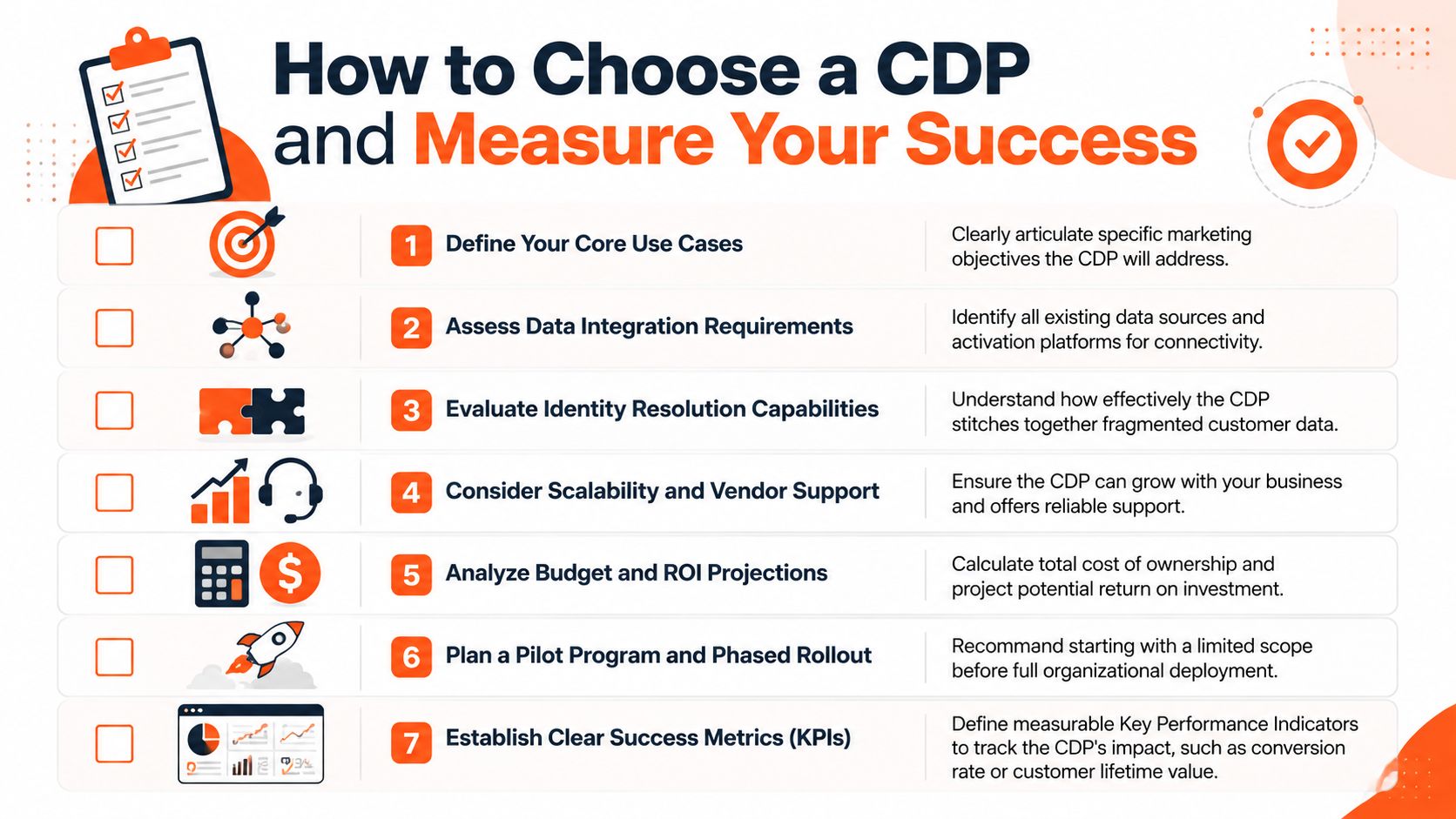
Use this as a working shortlist framework:
- Start with the commercial use case: Decide whether the first win should come from PPC suppression, lead routing, retention, onsite personalisation, or a mix of those.
- Check integration reality: Make sure the platform can connect to your real stack, not just the logos on a sales slide.
- Pressure-test identity logic: Ask how the platform handles duplicate records, anonymous-to-known stitching, and profile conflict rules.
- Review governance fit: In Australia, that includes data residency decisions, consent management, and how the platform handles sync controls.
- Pilot before rollout: A contained launch is usually better than a big-bang implementation that nobody fully trusts.
One detail matters more than many teams realise. Bridging ad platforms and local business systems can create risk as well as value. The earlier point remains critical here: with 68% of AU SME breaches involving data integration errors, a CDP must be configured for AU-specific data residency and consent management to avoid liability.
How to measure whether it's working
The right measurement framework depends on your first use case, but the core idea is simple. Don't measure the CDP as a standalone object. Measure the business outcomes it improves.
Good success signals include:
- Paid media efficiency: Are customer exclusions cleaner and audience overlap lower?
- Conversion quality: Are campaigns reaching the right people at the right stage?
- Operational speed: Can marketing launch segments and campaigns faster than before?
- Reporting confidence: Can the team trace customer actions across systems more reliably?
- Website performance visibility: Are you tracking the conversions and audience states that matter through a cleaner setup, supported by solid website conversion tracking?
What a strong rollout looks like
A strong rollout usually has a narrow first milestone. One audience sync. One suppression rule. One triggered lifecycle sequence. One sales alert tied to actual behaviour.
That's enough to prove whether the customer data platform can support your business in actual business operations.
Buy for the decision the platform helps you make next week, not the theoretical future state it promises in year three.
A CDP earns trust when the media team wastes less spend, the CRM gets better context, the SEO team sees clearer revenue pathways, and compliance stops being handled by scattered workarounds. That's when it stops feeling like martech and starts feeling like infrastructure.
If your team needs help connecting PPC, SEO, conversion tracking, and first-party data into a setup that's commercially useful, Click Click Bang Bang can help you turn disconnected marketing data into clearer audience strategy, better reporting, and more efficient campaign execution.
Read NeXt
Or Read Our Latest
- Reporting Portal Login: Access Your Client Dashboard Fast
- How to Calculate Sample Size for A/B Tests and Campaigns
- How to Fix Google Merchant Center Errors Step by Step
- What Is Pagination and Why It Matters for AU Sites
- What Is Value Proposition? PPC & SEO Guide
- How to Choose a Google Ads Agency Australia
Click. CLick. Subscribe.
Get our best PPC insights, industry updates, and power moves delivered straight to your inbox. No fluff, just high-caliber strategies that actually work.
Don’t Leave Just Yet
Try Us For 30-Days,
Risk Free!!
We guarantee that you’ll love our work within the first 30 days, if not you’ll get your money back.
What have you got to lose?