

Choosing Performance Marketing Agencies to Drive Growth
Last Updated
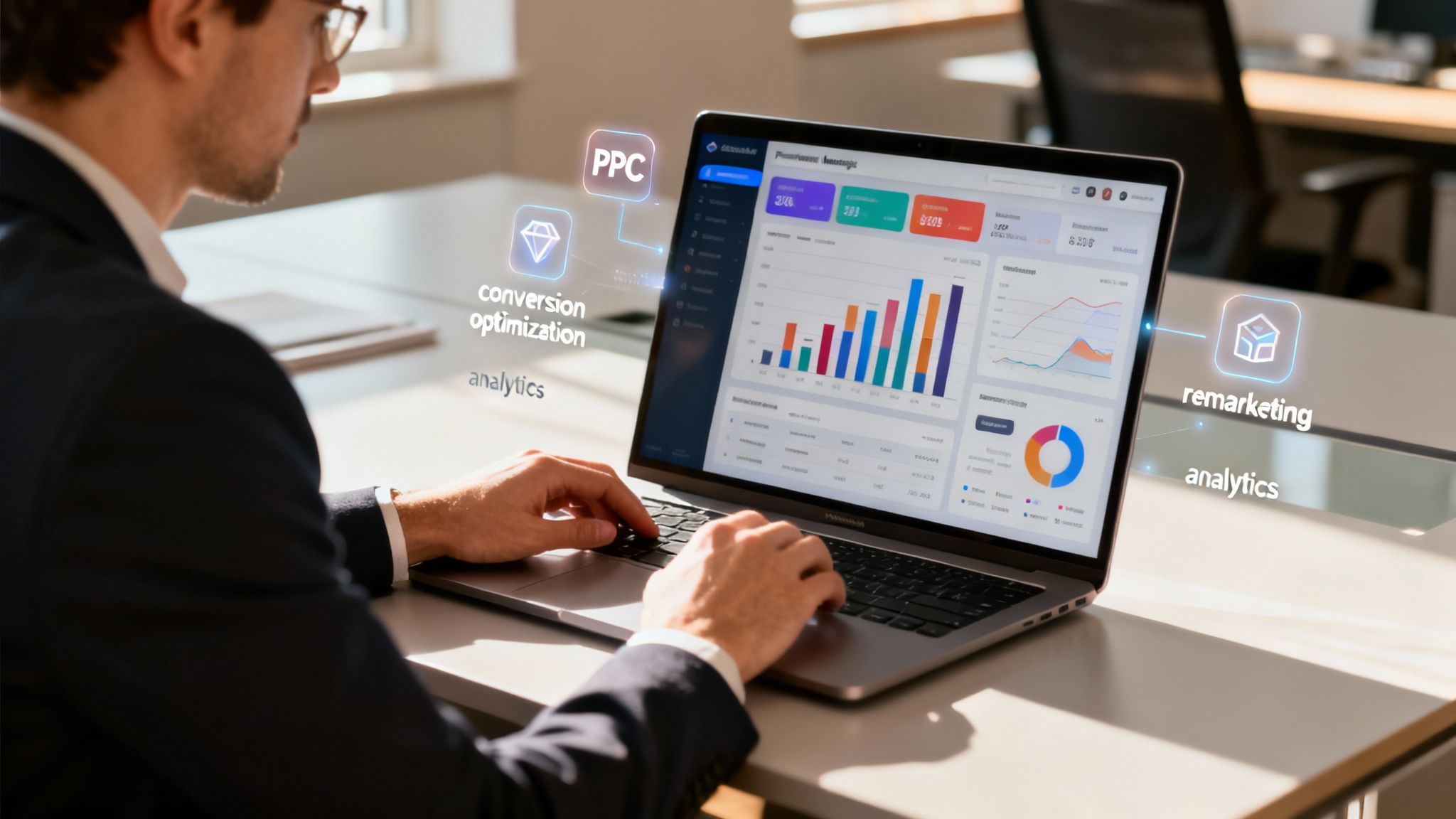
Ever hired a personal trainer, but you only paid them when you actually hit your fitness goals? That’s the easiest way to think about a performance marketing agency. You’re not paying for their time or the number of exercises they show you; you’re paying for the results.
This is a massive shift from the old-school marketing world, where hefty retainers and project fees were the norm, whether the campaign flew or flopped. A performance marketing agency flips that script entirely. Their success is baked into your success. If you don’t make money, neither do they. This simple alignment creates an incredibly powerful, results-obsessed partnership.
What Is a Performance Marketing Agency Anyway?
At its core, a performance marketing agency is a partner you pay based on measurable outcomes like sales, qualified leads, or new customers—not just for their effort. This model shifts the financial risk away from your business and onto the agency, making sure every dollar you spend is tied directly to a tangible, profitable result.
Shifting From Vanity Metrics to Real Value
The real difference comes down to what gets measured. Traditional marketing often gets bogged down in “vanity metrics” like impressions, reach, or clicks. Sure, these numbers show activity, but they don’t pay the bills. A million people might see your ad, but if not a single person buys your product, what was the point?
Performance marketing agencies cut through that noise. They focus relentlessly on the numbers that have a real, financial impact on your business.
- Sales and Revenue: The cold, hard cash generated directly from marketing campaigns.
- Qualified Leads: Potential customers who have shown genuine interest and are actually likely to convert.
- Return on Ad Spend (ROAS): How much revenue you get back for every single dollar spent on advertising.
- Cost Per Acquisition (CPA): The exact cost to bring one new paying customer through the door.
Let’s quickly compare the two approaches side-by-side.
Traditional vs Performance Marketing At a Glance
This table breaks down the fundamental differences between the old way of doing things and the performance-based model. It highlights how the focus shifts from activity to accountability.
| Aspect | Traditional Marketing Agency | Performance Marketing Agency |
|---|---|---|
| Payment Model | Retainers, project fees, commissions on ad spend. | Based on results: Cost per sale, lead, or action (CPA, CPL). |
| Primary Focus | Brand awareness, reach, impressions, creative execution. | Direct response, conversions, customer acquisition, ROI. |
| Key Metrics | Impressions, clicks, reach, engagement, brand recall. | ROAS, CPA, LTV, revenue, qualified leads. |
| Risk | Primarily on the client. Payment is for effort, not outcomes. | Shared risk. The agency's revenue is tied to client success. |
| Accountability | Often subjective; success can be hard to quantify. | Highly accountable; success is measured by hard numbers. |
| Optimisation | Campaigns optimised for visibility and engagement. | Campaigns relentlessly optimised for conversions and profitability. |
As you can see, the performance model forces a much higher level of accountability. There's simply no room for guesswork.
Every single strategy, from the ad copy to the landing page design, is tested and tweaked to improve those core KPIs. Decisions aren't made on gut feelings; they're guided by what the data proves is working.
The promise is simple and incredibly powerful: you are investing in measurable business outcomes, not just marketing activities. This transforms marketing from a cost centre into a predictable and scalable profit driver.
For any business that needs to justify every dollar in its marketing budget, this is a total game-changer. It gets rid of the ambiguity and financial risk that often comes with marketing investments. Instead of just hoping for a return, you build a system where returns are the very condition for payment.
This is exactly why more companies are partnering with a specialised search marketing agency that can point to clear, data-backed success. It’s about creating a transparent, growth-focused partnership where everyone is pulling in the same direction to get real results.
The Core Services That Fuel Real Results
To get your head around how performance marketing agencies actually drive growth, picture a high-performance engine. It’s not just one part doing all the work; it's a collection of specialised components working in perfect harmony to generate serious power. In the same way, agencies use a suite of core services, each with a specific job, to turn your marketing budget into tangible business results.
These services aren't just about flicking on some ads and hoping for the best. They form a complete system for attracting, converting, and keeping customers—profitably. Let's pop the hood and look at the essential components that make this results-driven engine roar.
Pay Per Click Management: The Art of Intent
Pay-Per-Click (PPC) advertising is all about capturing customers at the exact moment they’re searching for a solution you offer. An agency will manage your campaigns on platforms like Google Search, Meta (Facebook and Instagram), and LinkedIn, but their real value is in the precision and relentless optimisation.
They don't just "set and forget" your ads. They're constantly digging into keyword research, crafting ad copy that actually gets clicked, and managing bids to make sure you show up in front of high-intent buyers without blowing your budget on tyre-kickers. Think of it like having an expert salesperson who knows precisely when and how to approach a customer who is ready to pull out their wallet.
The agency's ultimate goal is to maximise your Return on Ad Spend (ROAS), making sure every dollar you put into clicks brings back significantly more in revenue.
Conversion Rate Optimisation: The Science of Persuasion
Getting traffic to your website is only half the battle. Conversion Rate Optimisation (CRO) is the science of turning those visitors into paying customers or qualified leads. A top-tier agency treats your website like a laboratory, constantly testing and tweaking the user experience to remove friction and encourage people to take action.
This process involves a few key activities:
- A/B Testing: Showing different versions of a webpage to different users to see which one performs better. This could be as simple as changing a button colour or as complex as a complete layout overhaul.
- User Experience (UX) Analysis: Watching how visitors interact with your site to pinpoint moments of confusion or frustration that cause them to leave.
- Landing Page Design: Building dedicated, high-impact pages specifically designed to convert traffic from a particular ad campaign.
CRO is a continuous loop of improvement. Small, data-backed changes can lead to huge increases in sales and leads over time, effectively making every dollar you spend on marketing work harder.
Analytics and Attribution: The Campaign GPS
If PPC is the fuel and CRO is the engine, then analytics and attribution are the campaign’s GPS. This service is all about understanding exactly where your results are coming from. Without clear data, you’re just throwing money at the wall and hoping something sticks.
Performance marketing agencies set up sophisticated tracking to monitor every customer interaction, from the first ad they see to the final purchase they make. They find the answers to critical questions like:
- Which marketing channel is bringing in the most valuable customers?
- How many times does a customer interact with us before they convert?
- What's the true lifetime value of a customer we acquired from this campaign?
This granular tracking allows the agency to double down on what’s working and cut the dead weight, ensuring your budget is always allocated for maximum impact. This concept map below shows how every single effort is geared towards measurable outcomes.
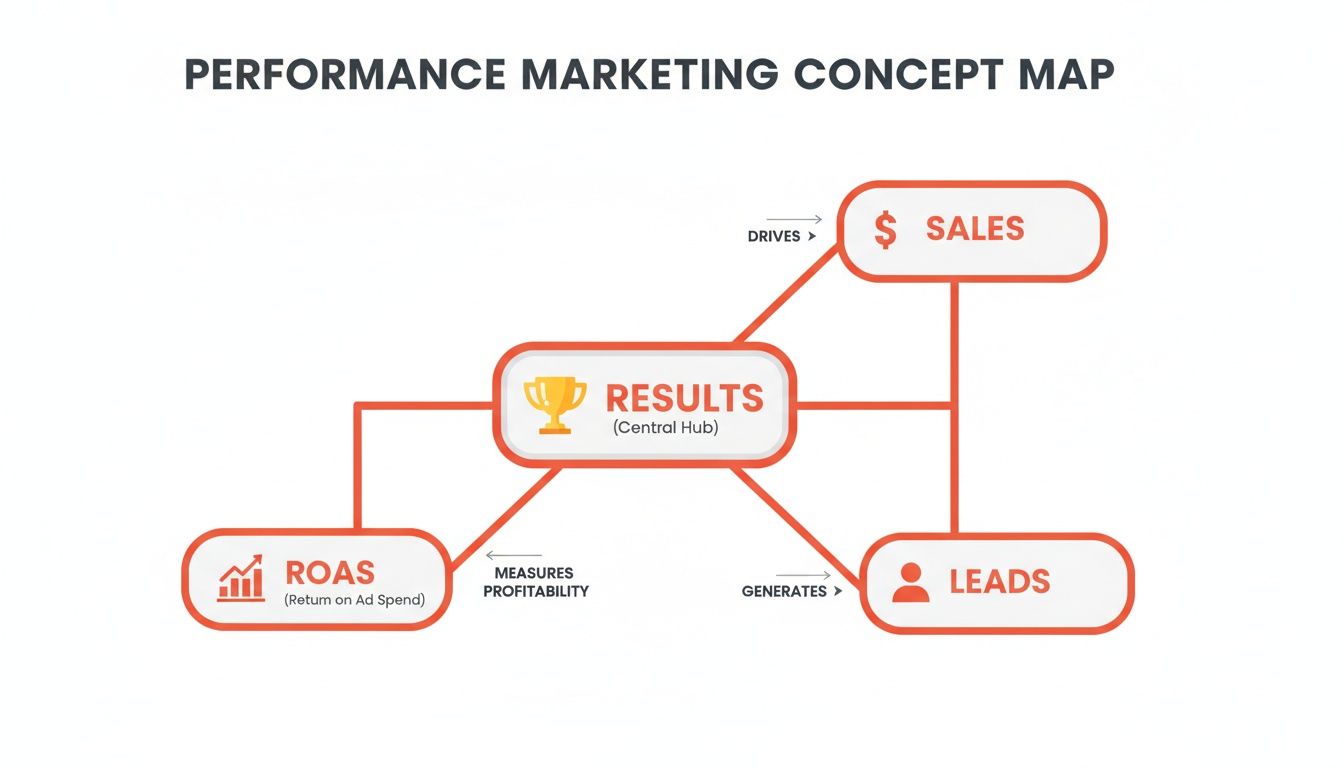
As the map makes clear, every service is ultimately judged by its ability to generate sales and leads while delivering a profitable ROAS. It's no surprise that Australian businesses are set to invest $1.5 billion in SEO services in 2025—a core part of performance marketing—precisely because it has a proven ability to generate returns.
Remarketing: The Art of the Second Chance
Did you know that a staggering 97% of people who visit your site for the first time leave without buying anything? Remarketing is your strategy for bringing them back into the fold. It's an incredibly powerful way to re-engage prospects who have already shown they're interested in what you offer.
An agency will build targeted ad campaigns that follow these users across the web, gently reminding them of what they left behind. For instance, if someone adds a product to their cart but gets distracted, remarketing ads can show them that exact product on their social media feed or on other websites they visit.
Many agencies take this a step further by using advanced Ecommerce Marketing Automation to make this follow-up even more effective and personal. This strategy keeps your brand top-of-mind and gives you a second, third, or even fourth chance to turn an interested browser into a loyal customer.
Understanding the Metrics That Actually Matter
In performance marketing, numbers don’t just tell a story; they write the cheques. Transparency is everything, and a good agency won't ever hide behind a smokescreen of confusing acronyms or fluffy "vanity metrics." They're laser-focused on the key performance indicators (KPIs) that directly track the financial health and growth of your business.
We’re not talking about abstract ideas like "brand awareness" here. We're talking about tangible, profitable outcomes.
This isn't about getting a dense spreadsheet lobbed into your inbox at the end of the month. It's about having a crystal-clear, live view of what’s working, what isn’t, and where every single dollar is going. The best performance marketing agencies give you the tools to see your return on investment in real time, turning complex data into simple, actionable insights.

Decoding the Core Performance Acronyms
To really get a grip on your campaign's success, you need to speak the language of performance. These aren't just industry buzzwords; they are the vital signs of your marketing pulse. A sharp agency makes these metrics dead simple for you to understand and follow.
Here are the four pillars of performance measurement:
- Cost Per Acquisition (CPA): This is the bottom line—what it costs you to land one new customer. Spend $500 on ads and get 10 new customers? Your CPA is $50. It’s the ultimate measure of efficiency.
- Return on Ad Spend (ROAS): This shows you the revenue you get back for every dollar spent on ads. A 4:1 ROAS means you made $4 for every $1 you put in. For profitability, this metric is the gold standard.
- Click-Through Rate (CTR): This is the percentage of people who see your ad and are compelled to click on it. A high CTR is a great sign that your creative and messaging are hitting the mark with your audience.
- Conversion Rate (CVR): Of all the people who clicked your ad and landed on your site, this is the percentage that actually took the action you wanted—like making a purchase. A strong CVR tells you your website is doing its job turning visitors into customers.
This relentless focus on measurable returns is fuelling some serious investment. For instance, social media advertising in Australia is projected to hit AU$7.5 billion by 2025, a trend driven by businesses demanding a clear ROI from their campaigns. Mastering platforms like Meta and LinkedIn to drive e-commerce sales and generate B2B leads is a core function of modern agencies.
Live Dashboards vs Static Reports
The days of waiting for a PDF report to land in your inbox a week after the month has already ended are over. Static reports are snapshots of the past; they’re old news. Modern performance marketing runs on live, interactive reporting dashboards that give you 24/7 access to your campaign data.
A live dashboard empowers you to make decisions based on what’s happening right now, not what happened last Tuesday. It turns reporting from a historical document into a strategic tool for growth.
This real-time visibility fosters a true partnership. You can see the exact same data your agency sees, ask informed questions on the fly, and truly understand the logic behind their optimisation strategies. A great agency doesn't just present data; they use it to provide actionable recommendations.
For a deeper dive, you can explore our guide on the most important digital marketing performance metrics. This proactive approach ensures your campaigns are always adapting and improving, constantly pushing for better results and a higher return on your investment.
How Performance Marketing Agencies Structure Their Fees
Figuring out how a performance marketing agency charges is a huge piece of the puzzle. It helps you set a realistic budget and make sure everyone is pulling in the same direction. Forget the old-school hourly billing you might see elsewhere; performance models are built to tie the agency's fee directly to the value they're creating for your business. It's all about transparency.
But here's the thing: not all pricing structures are created equal. Each one has its own quirks, its own pros and cons. The right fit really comes down to your business goals, your budget, and how much risk you're comfortable taking on. Let's pull back the curtain on the three most common fee structures you'll run into.
The Percentage of Ad Spend Model
This is one of the oldest and most straightforward models in the game. The agency’s fee is simply a set percentage of what you spend on ads each month. So, if an agency charges a 15% fee and your ad spend is $10,000, their management fee comes out to $1,500. Simple.
- Pros: It’s easy to understand and scales beautifully. As your budget grows, so do the resources the agency can dedicate to your account. It’s predictable and requires very little mental gymnastics.
- Cons: The big catch here is a potential conflict of interest. Because the agency makes more money when you spend more, there's an incentive to crank up the budget, even if it isn't the most efficient path to your goals.
The Flat Monthly Retainer Model
With a flat monthly retainer, you pay the same fixed fee every single month, no matter how much you spend on ads or what the results look like. The fee is typically based on the scope of work and the complexity of your account.
This model gives you maximum budget predictability, which is a massive plus for any business keeping a close eye on cash flow. You know exactly what your agency costs will be, month in and month out. No nasty surprises.
The trade-off, however, is that the fee isn't directly connected to performance. Whether your campaign has a record-smashing month or just a so-so one, the agency’s fee doesn't change. This can sometimes lead to a lack of urgency if you're not partnered with a truly results-obsessed agency.
The Hybrid or Performance-Based Model
This is where things get interesting. A hybrid model strikes a compelling balance, mixing the stability of a retainer with the pure accountability of performance incentives. It usually involves a lower flat monthly fee, plus bonuses or commissions tied to specific KPIs you've both agreed on beforehand.
You’ll often see hybrid structures like these:
- Base Retainer + Percentage of ROAS: A fixed fee to cover the basics, plus a kicker for smashing a target Return On Ad Spend.
- Base Retainer + Cost Per Lead/Sale: A fixed fee, plus a commission for every single qualified lead or sale they generate.
Many believe this model creates the best alignment between client and agency. The agency gets the security of a base fee to keep the lights on, but they're seriously motivated to drive killer results to earn those performance bonuses. It fosters a true partnership where everybody wins when the campaigns are firing on all cylinders.
To get a feel for how these different approaches stack up in the real world, it's worth digging into some detailed PPC pricing models to see what clicks with your business.
How to Choose the Right Performance Marketing Partner

Choosing a performance marketing agency is one of the biggest calls you'll make for your business's growth. This isn't just about outsourcing a task; you're bringing a strategic partner into your corner. The right agency acts as a growth engine, while a bad fit can burn through your budget and leave you stalled.
The market is flooded with options, which is both a good and a bad thing. In Australia, the advertising agency industry is a massive field, with revenue tipped to hit $3.9 billion in 2025. This means plenty of choices, but it also makes spotting the real experts a serious challenge. You can get more context from the Australian advertising industry report on IBISWorld.
To make a confident choice, you need a solid evaluation process. It's about asking the right questions, knowing the red flags, and looking past a slick sales deck to find genuine, battle-tested expertise.
Key Questions to Ask Potential Agencies
When you’re vetting potential performance marketing agencies, your questions need to get straight to the heart of their skills, transparency, and strategic mindset. Don't be shy; their answers will tell you if they're a true partner or just another vendor.
Here are a few essential questions to keep handy:
- Can you show me a case study from a business like mine? You're looking for experience in your industry, your business model (e.g., e-commerce vs. B2B), and your customer profile. Getting great results for a local café doesn't mean they can do the same for a national SaaS company.
- How do you handle campaign optimisation and testing? A top-tier agency will have a structured process for A/B testing, CRO, and continuous improvement. They should be able to explain how they use data to make decisions, not just gut feelings.
- What's your rhythm for communication and reporting? Vague promises are a problem. You want specifics: how often will we meet, who is my main point of contact, and will I get access to a live reporting dashboard?
- Who, exactly, will be working on my account? Get to know the team. Are they seasoned pros or fresh-faced juniors? Understanding who is actually managing your ad spend is absolutely crucial.
- How would you define success for a client like us? Their answer needs to go beyond clicks and impressions. A genuine performance partner will zero in on your core business goals, like lowering CPA or boosting customer lifetime value.
Red Flags to Watch Out For
Knowing what to avoid is just as important as knowing what to look for. Some agencies rely on high-pressure tactics and make over-the-top promises that sound great at first but often lead to disappointment.
Keep an eye out for these major red flags:
- Unrealistic Guarantees: Any agency promising "#1 rankings on Google" or guaranteeing specific outcomes should be treated with serious caution. Performance marketing has too many variables for those kinds of certainties.
- Vague Strategy and Reporting: If they can't clearly explain their strategy or show you a sample report that tracks meaningful KPIs, it’s a big sign of disorganisation or a lack of transparency.
- High-Pressure Sales Tactics: An agency that rushes you into signing a long-term contract without taking the time to understand your business is putting their sales targets ahead of your success.
- The One-Size-Fits-All Approach: If they pitch the exact same package to every client, they aren't interested in building a strategy that fits your unique goals and challenges.
The right agency acts as an extension of your team, not just a service provider. Their focus should be on building a long-term partnership based on transparency, shared goals, and a relentless drive for measurable results.
How to Properly Analyse Case Studies
Case studies are an agency's resume, but you have to read between the lines. Don't get distracted by big, flashy numbers without any context. A 200% jump in traffic sounds fantastic, but if it was all irrelevant traffic that didn’t convert, it’s worthless.
When you review a case study, look for real business impact:
- Improved Lead Quality: Did they just generate more leads, or did they attract leads that actually became paying customers?
- Profitable Sales Growth: Look for metrics like ROAS or CPA. Did the boost in sales come at a profitable cost?
- Long-Term Impact: Does the case study show steady, sustained growth over time, or just a one-off spike?
A strong case study tells a clear story: it lays out the initial problem, explains the strategy the agency put in place, and proves its value with data that ties directly to the client's bottom line. By approaching your search with this critical mindset, you can confidently pick a partner who will help you achieve real, sustainable growth.
Taking the Next Step: Partnering for Real Growth
Choosing to work with a performance marketing agency is a big move. It’s a decision to swap guesswork for predictable, scalable growth. You're committing to a partnership where results aren't just a vague hope—they're the entire point. It's about building a marketing engine that runs on data, accountability, and an relentless focus on your bottom line.
The right agency acts as a true extension of your team. They bring the expertise, the tech, and the strategic eye needed to cut through the noise of digital advertising. Every dollar you spend is backed by a clear, measurable outcome, transforming your marketing from a cost centre into a reliable driver of business success.
How We Do Things Differently
Here at Click Click Bang Bang, we reckon a modern marketing partnership needs a smarter, more flexible approach. We’ve built our agency around a few key ideas designed to get better results for our clients.
Our campaigns are built using an AI-first methodology. For SEO and PPC, this means we lean on advanced algorithms to analyse market trends, pinpoint high-value keywords, and optimise campaigns far faster and more accurately than any human could alone. It lets us find opportunities your competitors are completely missing and react to market shifts in real-time, giving you a serious competitive advantage.
We’ve moved beyond the rigid, long-term contracts that hold businesses hostage. Our model is built for the agility today's market demands.
Flexible Plans and a Risk-Free Start
We get that every business has different needs and budgets. That’s why we offer tiered, no-lock-in monthly plans. This gives you the freedom to scale your investment up or down as your business grows and changes. Whether you're a startup just dipping a toe in one channel or an established brand running complex campaigns, you only pay for what you need.
And to make the decision a total no-brainer, we back our ability to deliver results with a 30-day risk-free trial. This isn't some watered-down demo; it’s the full-service experience. You get to see the real-world impact of our strategies on your business, firsthand. You'll experience our process, our communication, and our reporting with complete peace of mind before making any longer-term commitment. It’s our way of proving our value and building a partnership on trust and tangible outcomes from day one.
Picking a performance marketing partner is a crucial decision, and the right one should make you feel confident, not cornered. If you’re ready to stop paying for effort and start investing in guaranteed results, it’s time to take the next step. Let’s build a transparent, data-driven partnership designed for one thing: your growth.
Got Questions? We've Got Answers
Stepping into the world of performance marketing agencies can feel a bit like learning a new language. You've probably got a few questions buzzing around. Let's tackle some of the most common ones head-on so you can move forward with confidence.
How Long Until I See Real Results?
Everyone wants to see the needle move on day one, and we get it. While you'll see initial data like clicks and impressions bubbling up within the first week or two, that's just the prelude.
Performance marketing is about building a sustainable growth engine, not a one-hit wonder. To get to the good stuff—meaningful optimisation and a tangible impact on your bottom line—it typically takes about 60 to 90 days. This gives an agency enough time to test, learn, and fine-tune your campaigns until they’re humming along profitably.
What's a Realistic Starting Budget?
There’s no magic number here; it really depends on your industry, goals, and how crowded your market is. For a small local business, a starting ad spend of $2,000 to $3,000 per month (plus the agency's fee) can be a great place to start making an impact.
But if you’re a national e-commerce brand or a B2B company in a fiercely competitive space, you'll likely need to invest $10,000 or more per month. This isn't about spending for spending's sake—it’s about gathering enough data, quickly, to make smart decisions and see real momentum. A good agency will work with you to land on a budget that matches your ambitions.
Who Actually Owns the Ad Accounts and Data?
This is a non-negotiable, so listen closely. You, the client, should always have full ownership and administrative access to your ad accounts (like Google Ads and Meta Business Manager) and your analytics platforms (like Google Analytics).
Think of an agency as a trusted partner who you grant access to, not the gatekeeper of your most valuable business assets. If any agency insists on setting up accounts in their name, it's a massive red flag.
This simple rule ensures that if you ever decide to part ways, all your invaluable historical campaign data and account history goes with you. That data is gold for any future marketing efforts.
Ready to work with a performance marketing agency that puts your growth first with transparent, data-driven strategies? Click Click Bang Bang brings an AI-first approach to SEO and PPC, flexible monthly plans, and a 30-day risk-free trial to prove our worth. Start your journey to predictable growth today.
Read NeXt
Or Read Our Latest
- Manual vs Automated Bidding for PPC Success
- Conversion Tracking Setup: A Complete AU Guide
- Instagram Advertising Australia: Complete 2026 Guide
- Pay Per Click: A Beginner’s Guide for Australian Marketers
- Display Advertising on Google: The Complete Australian Guide
- Stakeholder Communication Plan How to Build One That Works
Click. CLick. Subscribe.
Get our best PPC insights, industry updates, and power moves delivered straight to your inbox. No fluff, just high-caliber strategies that actually work.
Don’t Leave Just Yet
Try Us For 30-Days,
Risk Free!!
We guarantee that you’ll love our work within the first 30 days, if not you’ll get your money back.
What have you got to lose?