

Hiring a Search Marketing Agency in Australia
Last Updated
Think of a search marketing agency as your expert guide in the massive, bustling city that is the internet. Their entire job is to use strategies like SEO and PPC to make sure that when someone is actively looking for what you sell, they find you. They turn clicks into customers.
Why Partner with a Search Marketing Agency?
Imagine your business is a shop in that huge city. Without help, you might be tucked away on a quiet side street, hoping someone stumbles upon you. A search marketing agency is like a strategic partner that moves your shop right onto the main thoroughfare, complete with bright signs pointing directly to your door.
Their core mission is to connect your business with people who have a clear, immediate intent to buy.
This isn't just about running a few ads or chasing keywords. It's about building a sustainable growth engine for your business. An agency does this by:
- Getting inside your customers' heads: They dig deep to understand exactly what your audience is searching for, so your message lands perfectly.
- Fine-tuning your online presence: They work on your website and campaigns to make them as efficient and effective as possible.
- Driving the right kind of traffic: Their focus is on attracting visitors who are genuinely likely to become leads or sales, not just generating random clicks.
The image below breaks down the two main tools search marketing agencies use to get this done.
This diagram shows how both organic search results (SEO) and paid ads (PPC) work together on Google to give you maximum visibility.
Investing in Expertise and Growth
Let's be honest, mastering the ever-changing world of search marketing is a full-time job. For many Australian businesses, partnering with a specialist agency is a smart move, giving you access to a whole team of experts without the hefty overhead of hiring them in-house.
It's a strategic investment that’s becoming more and more common. In fact, the Australian digital advertising agency sector is on track to hit $3.7 billion in revenue by 2025, having grown at a steady 7.4% each year since 2020. This trend highlights just how much businesses are relying on these partnerships for real growth. You can find more data on the Australian digital ad industry over at IBISWorld.
If you're just starting out, our guide on digital marketing for small business is a great place to get your bearings.
Understanding SEO And PPC Services
A search marketing agency works to get your business seen in two different but connected ways: Search Engine Optimisation (SEO) and Pay-Per-Click (PPC) advertising. Getting your head around the difference is the first step to understanding how they can grow your business.
Think of SEO as building your own house in a great neighbourhood. It takes time, sweat, and a solid plan to construct, but once it's up, it attracts visitors naturally and builds real, lasting value. You own the asset.
PPC, on the other hand, is like renting a massive billboard on the busiest motorway in the country. You get immediate attention and a flood of traffic for as long as you're willing to pay for the space. One is a marathon, the other is a sprint. A smart agency knows you need to be running both races at the same time.
The infographic below gives you a simple look at how a search marketing agency connects your business with people actively looking for what you offer.
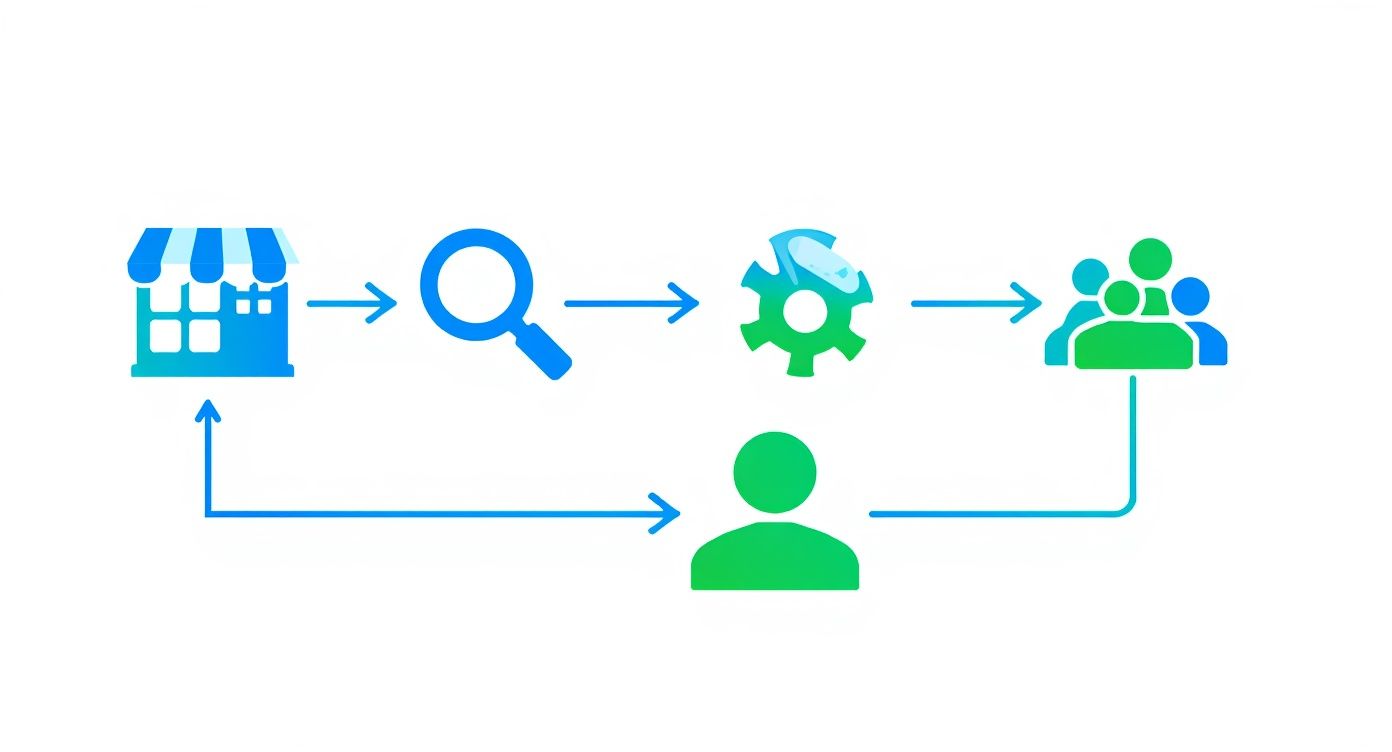
Essentially, the agency is the bridge. They use these search strategies to guide customers who are ready to buy, straight to your digital doorstep.
The Foundations Of Search Engine Optimisation
SEO is all about getting your website to show up higher in search engine results for the right phrases—driving unpaid, or ‘organic’, traffic your way. It’s a deep field that goes way beyond just stuffing a few keywords onto a page. A good agency’s SEO work will always cover three core areas.
- Technical SEO: This is the bedrock. It’s about making sure your website is built in a way that search engines can easily crawl, understand, and index. This means dialling in things like site speed, making sure it works perfectly on mobile, and hunting down broken links.
- On-Page SEO: This part focuses on the actual content on your website. It involves digging deep with keyword research to figure out what your customers are actually searching for, then creating high-quality, genuinely helpful content that answers their questions. It also includes optimising the small stuff, like page titles and meta descriptions.
- Off-Page SEO: This is all about building your website’s reputation and authority across the web. The main game here is link building—earning links from other credible, relevant websites. In Google’s eyes, these links are like votes of confidence, telling them your site is a trusted resource.
A huge part of great SEO is keeping a close eye on the key metrics for website performance, ensuring both users and search engines have the best possible experience.
The Immediacy Of Pay Per Click Advertising
PPC is exactly what it sounds like: you place ads right at the top of the search results and pay a small fee every time someone clicks on them. It’s a fantastic way to generate traffic and leads right now, while your long-term SEO efforts are still building momentum.
A well-run PPC campaign gives you a goldmine of real-time data. You learn which keywords actually lead to sales, what ad copy people respond to, and what offers get them clicking. This data is invaluable for feeding back into your SEO strategy, creating a powerful loop where both channels make each other stronger.
An agency’s job with PPC is to make sure every dollar you spend comes back with friends—what we call maximising your return on ad spend (ROAS). This isn't a "set and forget" deal; it requires careful setup, daily management, and constant tweaking. If you'd like to go deeper, our complete guide to PPC management services lays it all out.
The main activities include:
- Audience & Keyword Targeting: Finding the most profitable keywords and defining super-specific audience groups to make sure your ads are seen by the right people, at the right moment.
- Ad Creation & Testing: Writing punchy, compelling ad copy and creating visuals that stop the scroll and earn the click. Agencies are always A/B testing different ad versions to find what works best.
- Bid Management & Budgeting: Cleverly managing your ad budget and bids to get the lowest possible cost-per-acquisition (CPA) while getting your ads seen as much as possible.
- Landing Page Optimisation: Making sure the page people land on after they click your ad is built for one thing and one thing only: getting them to take action.
Comparing SEO And PPC At A Glance
To make things even clearer, let's break down the core differences between SEO and PPC. Seeing them side-by-side can help you understand where each one shines and how they fit together in a broader strategy.
| Attribute | SEO (Search Engine Optimisation) | PPC (Pay-Per-Click) |
|---|---|---|
| Cost | No direct cost for clicks. Investment is in time, content, and expertise. | You pay every time a user clicks on your ad. |
| Speed | Slow and steady. It can take 3-6 months to see significant results. | Almost instant. Traffic can start flowing within hours of campaign launch. |
| Traffic | Organic, unpaid traffic. Once you rank, the traffic is "free". | Paid traffic. It stops the moment you turn off your ad spend. |
| Longevity | Builds a long-term, sustainable asset. Rankings can last for years. | Short-term impact. Visibility is directly tied to your budget. |
| Targeting | Targets users based on their search queries. Less granular audience control. | Highly specific. Target by keywords, demographics, location, interests, etc. |
| Placement | Ranks in the organic search results, below the paid ads. | Appears at the very top of the search results page, marked as "Ad". |
| ROI | Often higher over the long term, as the cost per click is $0. | Can be measured instantly, but requires ongoing spend to maintain. |
| Best For | Building brand authority, creating a sustainable traffic source, long-term growth. | Quick lead generation, testing offers, promoting time-sensitive deals, targeting specific audiences. |
Ultimately, the choice isn't about picking one over the other. The most successful businesses use SEO and PPC together. PPC provides the immediate data and traffic to fuel growth, while SEO builds the foundational strength that will pay dividends for years to come.
Core Services of a Top Agency
So, what are you actually paying for when you partner with a search marketing agency? Beyond the promise of more traffic, their work is a delicate blend of technical precision, creative strategy, and constant analysis. A top agency doesn't just "do SEO" or "run ads"; they deliver a suite of interconnected services designed to get you tangible business results.
It all kicks off with a comprehensive SEO audit. Think of this as a full diagnostic workup for your website. The agency’s specialists will run deep scans to uncover all the technical gremlins holding you back—things like slow page speeds, broken links, or indexing errors that make you invisible to Google. They'll also analyse your existing content and backlink profile to get a clear picture of your current strengths and weaknesses.

This audit isn’t just a report that gathers dust; it forms the foundation of the entire strategy and leads directly into the next critical service.
Strategic Keyword Research
Effective search marketing hinges on one thing: understanding what your audience is actually typing into Google. An agency uses specialised tools and years of experience to move beyond the obvious, high-level keywords everyone else is chasing.
They uncover the gold hidden in long-tail phrases, question-based queries, and commercially-focused terms that signal a user is ready to pull out their wallet. This isn't a one-off task. It’s an ongoing process of discovery and refinement that informs every other activity, from the blog posts they write to how they structure your ad campaigns.
Paid Campaign Management
Over on the paid advertising side of the fence, a search marketing agency manages your budget to squeeze out the maximum possible return. And the investment in this space is significant—in Australia, spending on search advertising is projected to hit a whopping US$6.60 billion in 2025.
With Google dominating 93% of the Australian search market, most of that budget flows straight through Google Ads, making expert management absolutely essential. You can explore more Australian search advertising statistics to get the full picture.
Key paid services include:
- Campaign Setup and Structuring: Building out campaigns logically around themes and user intent. This ensures your ads are hyper-relevant and gives you tight control over spending.
- Compelling Ad Copywriting: Crafting ads that don't just attract clicks, but pre-qualify visitors. The goal is to pay only for relevant, high-intent traffic.
- Landing Page Optimisation: Making sure the page a user lands on after clicking an ad is perfectly aligned with the ad's promise and is ruthlessly designed to convert.
An agency’s real value in paid search is its ability to turn data into action. They are constantly testing ad variations, adjusting bids, and refining targeting to ensure every single dollar of your ad spend is working as hard as possible to grow your business.
Analytics and Transparent Reporting
Finally, the most crucial service of all: making sense of everything. A top search marketing agency provides clear, transparent reporting that ties every action back to your business goals. This goes way beyond vanity metrics like clicks or impressions.
They focus on what truly matters to your bottom line:
- Cost Per Acquisition (CPA): How much it costs you to land a new customer.
- Return On Ad Spend (ROAS): The revenue you generate for every dollar spent on ads.
- Organic Traffic Growth: A steady increase in non-paid visitors from search engines.
- Conversion Rate: The percentage of visitors who take the action you want them to, like making a purchase or filling out a form.
This reporting isn’t just a summary of what happened last month. It's a strategic roadmap for the future, outlining what worked, what didn’t, and how the strategy will adapt to drive even better results next month.
Winning Customers with Local Search

For any Australian business with a physical storefront, clinic, or service area, local search isn't just a part of the marketing mix—it's the whole game. Think about it. When someone searches for "cafe in Melbourne" or "electrician in Brisbane," they're not just window shopping. They have an immediate need and are ready to pull the trigger.
A sharp search marketing agency lives and breathes this stuff, making sure your business is the first one they see.
This is where the rubber meets the road—where online clicks turn into real-world customers walking through your door. The absolute prize here is dominating the Google 'map pack', that trio of local business listings that sits right at the top of location-based searches. Get in there, and you're golden.
This laser-focused approach has become essential because customer behaviour has completely shifted. In fact, a staggering 46% of all Google searches in Australia now carry local intent. That number alone shows just how critical a solid local strategy is for small and medium-sized businesses trying to connect with nearby customers.
Dominating the Map Pack
So, how does an agency get you into that prime digital real estate? It’s not a single magic trick but a combination of strategies built around trust, relevance, and proximity. It’s all about sending powerful local signals to Google that scream, "We are the best and most relevant answer for this customer right now."
The process boils down to a few key tactics:
- Google Business Profile (GBP) Optimisation: Your GBP is your digital shopfront, and it needs to be immaculate. An agency will obsess over every detail, filling out every section, adding high-quality photos, and ensuring your hours, address, and phone number are perfectly consistent across the web.
- Online Review Management: Good reviews are pure gold. They're a massive trust signal for both Google and potential customers. Agencies help build systems to encourage happy clients to leave feedback while professionally handling any negative comments to protect your hard-earned reputation.
- Location-Specific Content: You need content that speaks directly to your local community. This could be a blog post about a local event you sponsored or a service page that specifically name-drops the suburbs you serve. It shows Google you're a genuine local player.
By mastering local search, an agency doesn't just drive website traffic; it drives foot traffic. It connects your business with customers at the exact moment they’re ready to buy, turning a simple online search into a tangible sale.
This hyper-local focus is incredibly powerful. For a deeper dive into how these strategies can be tailored for businesses like yours, our guide on SEO for small businesses is packed with more valuable insights.
How to Choose the Right Agency Partner
Picking a search marketing agency is a massive decision. This isn’t just about hiring a supplier to run some ads; it's about finding a partner who will operate as a genuine extension of your team. The right agency will be just as invested in your business goals as you are.
The selection process is your chance to pop the bonnet and see how they really work. That means looking past the slick sales pitch and digging into their history, their processes, and, most importantly, their results. A great agency will be an open book, ready to show you exactly how they’ve helped businesses just like yours succeed.
Start by asking for detailed case studies. Look for examples from your industry or from businesses facing similar hurdles. Pay close attention to the specific problems they solved and the metrics they used to measure success—vague promises are a serious red flag.
Evaluate Their Experience and Reputation
Real-world results and happy clients are the ultimate proof of an agency's competence. While every agency puts their best work on display, you need to look for consistent patterns of success and positive feedback.
This vetting process involves a few key steps:
- Read Client Testimonials: Look for detailed reviews on their website and third-party platforms. Do clients rave about their communication, strategic thinking, and ability to deliver on their promises?
- Assess Industry Experience: Have they worked in your niche before? An agency with runs on the board in your sector will already understand your audience's pain points and the competitive landscape, giving you a valuable head start.
- Check for Transparency: How open are they about their processes and tools? When deciding how to choose the right agency partner, it can be beneficial to consider their internal operational tools and commitment to efficiency. For example, reviewing a time tracking software comparison for agencies can offer a glimpse into their operational sophistication.
Ask the Right Questions
Once you've shortlisted a few potential partners, it's time for a proper chat. The questions you ask now will reveal whether their approach truly lines up with your business objectives. Don't be shy—a good agency will welcome thorough questions as a sign of a serious client.
The goal is to find a partner who thinks strategically about your business, not just tactically about keywords and clicks. They should be focused on driving outcomes like increased revenue and lower customer acquisition costs, not just vanity metrics.
Get a checklist of crucial questions ready to guide your discussion. Here are a few essential ones to get you started:
- How do you define and measure success for a client like me? Their answer should go way beyond traffic and rankings, connecting directly to business metrics like leads, sales, and return on investment.
- What does your client onboarding process involve? A structured, well-defined onboarding process shows they're organised and serious about understanding your business from day one.
- Who will be my day-to-day point of contact? Understanding the team structure and your direct line of communication is vital for a smooth partnership.
- How frequently will we receive reports, and what do they include? Insist on seeing a sample report. It should be clear, insightful, and focused on the numbers that actually matter to your bottom line.
Got Questions? Let's Get Them Answered
Choosing a search marketing agency is a big move, and it's completely normal to have a few questions before you dive in. You need to be crystal clear on costs, how long things will take, and what you should expect to see along the way. We’ve rounded up the most common questions Australian businesses ask us and laid out some straight-up answers to help you move forward with confidence.
Think of this as the final check before signing on the dotted line. A good, transparent agency will always be happy to answer these questions and won't shy away from the details.
How Much Do Search Marketing Agencies Cost in Australia?
This is usually the first question on everyone's mind, and the honest answer is: it depends. There's no one-size-fits-all price tag because every business has different goals and is up against different levels of competition. That said, agency costs typically fall into a few common buckets.
- Monthly Retainers: This is the most popular model for ongoing SEO or PPC work. In Australia, you can expect retainers to start from around $1,500 per month for a basic, single-channel package. For a full-blown, multi-channel strategy targeting tough keywords, that figure can easily climb north of $10,000 per month.
- Project-Based Fees: If you need a specific, one-off job done—like a deep-dive SEO audit, a tricky technical fix, or setting up a brand new campaign—you'll likely pay a fixed project fee. It gives you cost certainty for a clearly defined piece of work.
- Performance-Based Models: Some agencies, especially in the PPC world, might structure their fees around results. This could be a percentage of your monthly ad spend or a model based on the revenue they generate, which ties their success directly to yours.
You should always ask for—and expect to receive—a detailed proposal that breaks down every single cost and clearly states what's being delivered. That level of transparency is the sign of a partner you can trust.
How Long Until I See Search Marketing Results?
Patience is key in search marketing, but the timeline for getting results is worlds apart for SEO and PPC. It’s super important to set realistic expectations for each channel right from the start.
PPC campaigns give you almost instant feedback. As soon as your ads are live, you can start seeing traffic and leads come through within hours. But getting to that sweet spot of true optimisation—where you're refining your targeting, nailing your ad copy, and getting a great return—usually takes about 1 to 3 months of consistent work.
SEO, on the other hand, is a long game. Think of it as building a valuable business asset that pays off over time. You’ll likely see the first positive signs, like better rankings and more organic traffic, within 3 to 4 months. But to lock in those solid, first-page rankings for the keywords that really matter, you're typically looking at 6 to 12 months of dedicated, high-quality effort.
What Should Agency Reports Actually Tell Me?
A good agency report is more than just a spreadsheet full of numbers; it should tell the story of your business's growth. It needs to go beyond basic metrics like clicks and impressions and get straight to what’s actually affecting your bottom line.
For SEO, a solid report will track:
- Organic Traffic Growth: A clear, upward trend in visitors you didn't pay for.
- Keyword Ranking Improvements: Are you climbing the ladder for the terms that bring in good customers?
- Conversions from Organic Search: How many leads or sales came directly from your SEO work?
For PPC, the report absolutely has to be about financial performance:
- Cost-Per-Acquisition (CPA): How much are you paying, on average, to win a new customer?
- Return On Ad Spend (ROAS): For every dollar you put into ads, how many dollars in revenue came back out?
The most important job of any report is to connect the agency's day-to-day work directly to your business goals. It shouldn't just be a look back at last month; it should also lay out the game plan for the month ahead.
Can AI Tools Replace a Search Marketing Agency?
AI marketing tools are fantastic assistants—they're incredibly powerful for speeding things up. But they don't replace human strategy and real-world experience. AI can automate research, crunch massive amounts of data, and even spit out content drafts, but it can’t think critically or creatively solve problems like a seasoned expert can.
An experienced search marketing agency uses AI to be more efficient, not to replace its own skills. The team brings a deep understanding of your market, interprets data with your business context in mind, and makes the strategic calls that lead to real growth. Think of AI as an advanced power tool in an expert’s workshop—it’s amazing in the right hands, but it can't build the house by itself.
Ready to get clear, measurable results from a team of experts? Click Click Bang Bang specialises in data-driven SEO and PPC campaigns that deliver real business growth. Start your journey with a risk-free trial and see the difference a strategic partner can make. Learn more at https://clickclickbangbang.com.au.
Read NeXt
Or Read Our Latest
- Manual vs Automated Bidding for PPC Success
- Conversion Tracking Setup: A Complete AU Guide
- Instagram Advertising Australia: Complete 2026 Guide
- Pay Per Click: A Beginner’s Guide for Australian Marketers
- Display Advertising on Google: The Complete Australian Guide
- Stakeholder Communication Plan How to Build One That Works
Click. CLick. Subscribe.
Get our best PPC insights, industry updates, and power moves delivered straight to your inbox. No fluff, just high-caliber strategies that actually work.
Don’t Leave Just Yet
Try Us For 30-Days,
Risk Free!!
We guarantee that you’ll love our work within the first 30 days, if not you’ll get your money back.
What have you got to lose?