

First Party Data Activation: A Practical Guide for 2026
Last Updated

You're probably already feeling the problem.
Your paid campaigns still spend money, but audience signals are weaker, remarketing pools are less reliable, and platform reporting often gives you just enough confidence to keep going without really proving what changed. Marketing managers across Australia are dealing with the same shift. The old habit of leaning on third-party identifiers and platform black boxes doesn't hold up the way it used to.
That's why first party data activation has moved from a “nice to have” data project to a practical media requirement. It isn't about hoarding records in a CRM or adding another martech subscription. It's about taking data you already own, with consent, and making it usable inside the platforms where you buy media and judge performance.
Why First Party Data Activation Is Your 2026 Priority
If your team feels like paid media has become harder to scale cleanly, that instinct is right. As privacy controls tightened and identity signals became less dependable, Australian marketers had to shift away from passive data storage and towards active audience use across channels. In practical terms, first party data activation means moving owned data into platforms such as Google and Meta so you can build audiences, personalise creative, and improve measurement from a consented customer base, as outlined in Dezentriq's explanation of first-party data activation.
That definition matters because many teams still confuse collection with activation. Collecting emails, purchase history, lead form entries, or site behaviour is only the starting point. Activation is the operational step that turns those records into something useful for campaign delivery and analysis.
What changes when you treat data as media infrastructure
Once you see first party data activation properly, the strategy gets clearer. Your CRM is no longer just a sales database. Your email list is no longer just for newsletters. Your website events are no longer just analytics inputs.
They become building blocks for:
- Audience targeting based on known customer behaviour
- Creative personalisation matched to intent or lifecycle stage
- Suppression so you stop wasting acquisition spend on existing customers
- More resilient measurement when platform-level visibility drops
Activation is where customer data stops being a record-keeping exercise and starts affecting bids, audiences, exclusions, and reporting.
In Australia, this matters most for retailers, lead generation businesses, and subscription brands. These are the categories where signal loss hurts quickly because campaign efficiency depends on being able to identify high-intent users, re-engage them, and separate new-customer activity from existing demand.
Why this is a priority now
The biggest shift isn't just technical. It's organisational. Teams that keep treating first party data as an IT or compliance project move slowly and usually end up with disconnected tools and weak reporting. Teams that treat it as a performance system make better media decisions.
That's the actual priority for 2026. Not collecting more data for its own sake. Building a marketing engine that can still target, personalise, and measure effectively when external signals continue to erode.
The Foundation Data Collection and Compliance
Good activation starts with disciplined collection. If the inputs are messy, duplicated, poorly consented, or trapped in separate systems, the output in Google Ads or Meta will be weak no matter how good your media buyer is.

A useful starting point is understanding the difference between raw first-party data and activation-ready first-party data. If you need a primer on that distinction, this overview of what first-party data is is a solid companion read.
What to collect first
Most businesses don't need to capture everything. They need to capture the right things consistently.
For an e-commerce brand, the most valuable signals usually include:
- Product view behaviour tied to category or brand interest
- Cart and checkout actions that show immediate purchase intent
- Transaction history including product type and recency
- Email sign-ups connected to on-site behaviour where possible
For B2B and lead generation, the useful inputs look different:
- Form submissions tied to service or product interest
- CRM stage changes such as qualified lead or opportunity
- Content engagement like whitepaper, webinar, or pricing-page activity
- Sales interaction notes that can define lead quality more accurately than ad platforms alone
The point isn't to create a giant spreadsheet of every possible field. It's to collect signals that reflect buying intent, customer value, and lifecycle stage.
The minimum stack that keeps things organised
You don't need a bloated stack to begin. Many organizations can build a reliable collection layer with a few core systems:
-
Consent management platform
This controls permissions and helps ensure your collection rules match user consent choices. -
Tag management system
Google Tag Manager is usually the practical starting point. It helps standardise how events and platform tags fire across the site. -
Analytics and event tracking
Your analytics setup needs clear naming conventions and event definitions. “Lead”, “viewed product”, and “added to cart” should mean the same thing everywhere. -
CRM or customer database
A CRM or customer database should contain known-user records, lifecycle stages, and sales outcomes. -
Email platform or marketing automation tool
Email engagement often adds context that ad platforms alone can't see.
Compliance isn't a side issue
A lot of marketers treat consent and governance as a hurdle before the “real” work starts. That's backwards. In practice, compliance quality affects whether your activation works at all.
If consent capture is vague, data usage gets constrained later. If records aren't stored consistently, matching becomes patchy. If one team collects fields that another team can't use safely, you create friction that slows every campaign launch and every reporting cycle.
Practical rule: collect fewer signals well before you collect more signals badly.
In Australian conditions, privacy-aware collection also makes the program more durable. If your setup relies on shortcuts, workarounds, or assumptions about user identity, you'll spend more time fixing breakages than improving performance.
What good collection looks like in practice
A sound setup usually has these traits:
- Clear event naming so media, analytics, and CRM teams aren't arguing over definitions
- Consent states recorded properly before data is reused for activation
- Fields normalised consistently across forms, CRM, and email tools
- Refresh processes in place so audiences don't go stale
- Ownership assigned so someone is responsible for data quality, not just campaign results
This stage feels unglamorous. It's also where most first party data activation projects either become useful or become expensive clutter.
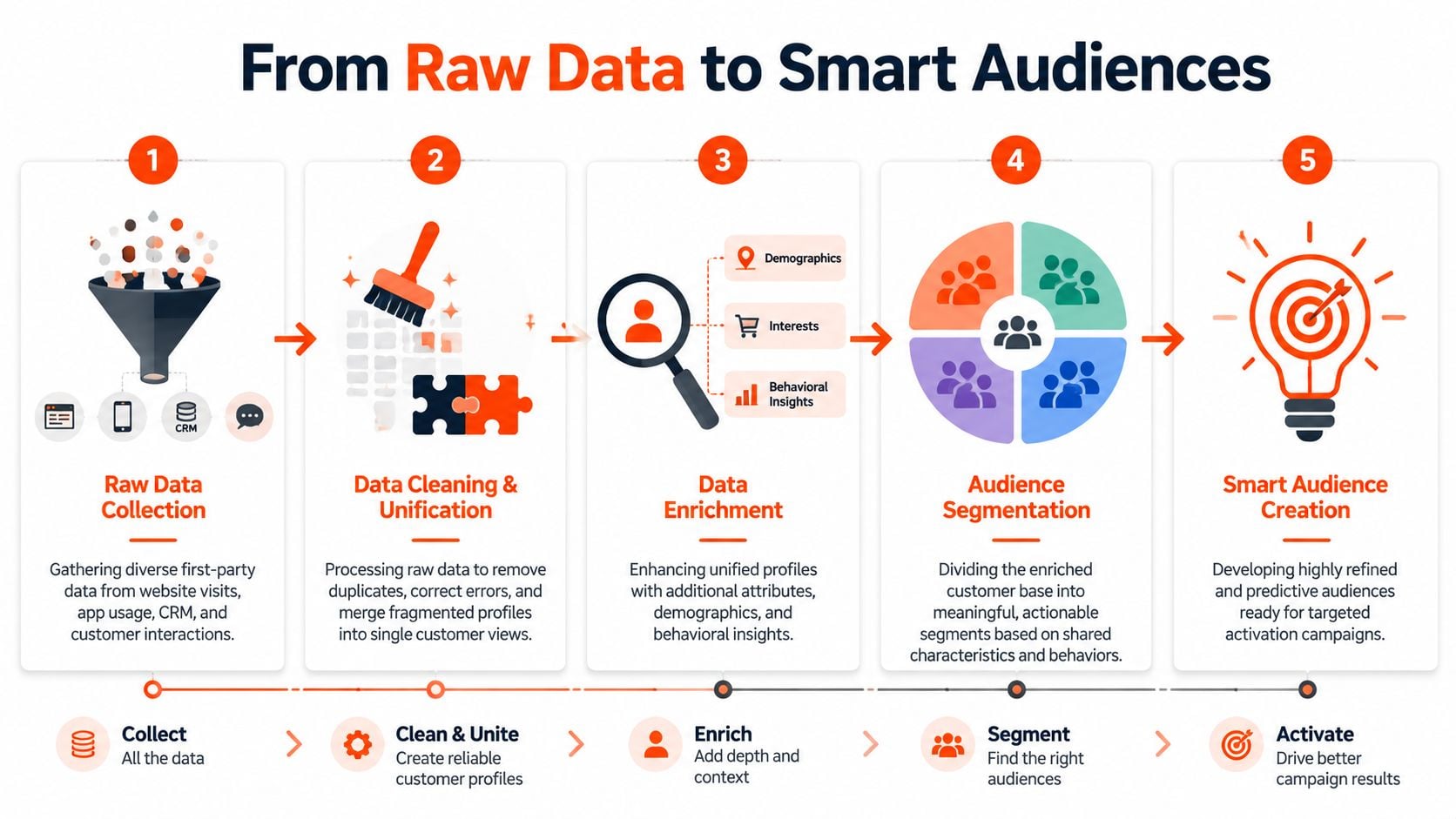
From Raw Data to Smart Audiences
A typical account has the raw material already. Product views sit in analytics, revenue sits in the commerce platform, lead stages sit in the CRM, and email engagement sits in the ESP. The problem is not collection. The problem is turning those signals into audiences you can use, then structuring them in a way you can measure later.
That second part matters more than many teams expect. If an audience definition is vague, it becomes hard to prove whether it improved acquisition efficiency, lifted conversion rate, or overlapped with people who were going to buy anyway. In practice, audience design and measurement design need to happen together.
Unification before segmentation
Useful segmentation starts with identity resolution. That might mean a CDP, a warehouse build, or a lighter middleware setup. The tool choice matters less than the outcome. One customer needs to appear as one usable record across site activity, CRM status, purchase history, and consented contact data.
Without that, audience logic breaks fast. A high-value customer can end up treated like a prospect. A recent lead can miss remarketing because the email address in the CRM does not match the one captured on-site. Analysts at FullThrottle note that cookie-based match rates can fall to 35 to 45%, which makes first-party identifiers far more important if you want audiences to reach meaningful scale.
Start simpler than the tech vendors suggest. Get a stable join key, normalise the fields that matter most, and make sure audience membership can refresh on a set cadence. If you cannot explain how a user enters and exits an audience, the segment is not ready for paid media.
What useful segmentation actually looks like
Good audience design follows commercial intent and business value. It does not start with age brackets or broad interests unless those traits are proven to matter in your account.
A paid social team might need a segment of repeat purchasers excluded from prospecting. A search team might need users who viewed service pages twice and started a quote form. A display team might need cart abandoners split by product margin, not by generic recency windows. That kind of structure gives you something practical to test across Google Display Ads audience targeting and other paid channels without flooding the account with low-signal segments.
Here's the difference in practice:
| Business type | Weak segment | Better segment |
|---|---|---|
| E-commerce | Women 25 to 44 | Cart abandoners who viewed high-margin products but didn't purchase |
| B2B services | Marketing job titles | Leads who visited pricing, submitted a form, and reached a qualified CRM stage |
| Subscription brand | All past trial users | Trial users who engaged with onboarding emails but didn't convert |
| Local SMB | All website visitors | Users who viewed service pages and started a booking or quote flow |
The strongest audiences answer a commercial question. Who is likely to buy soon, who needs to be excluded, who is slipping, and which customer group is worth using as a seed for expansion.
That focus also makes reporting cleaner. If the segment is built around a specific commercial behaviour, you can compare it against a broader control audience or track whether CPA, conversion rate, and revenue per user shift after activation.
A visual model helps make that process concrete:
A practical audience framework
For a first rollout, four audience groups are usually enough:
-
Customers and converters
Use these for suppression, retention, upsell, and value-based modelling. -
High-intent non-converters
Product viewers, pricing-page visitors, form starters, or checkout abandoners. -
Re-engagement pools
Past buyers or leads who have gone quiet but still show some recent signal. -
Seed audiences for expansion
Your best customer cohort, defined by value, repeat rate, or lead quality.
Keep the first version tight. Ten average segments create more reporting noise than four clear ones. In Australia especially, where privacy settings, consent controls, and platform data loss all affect match quality, simpler audience logic is usually easier to activate and much easier to prove.
Activating Your Audiences Across Paid Channels
Once the audiences are clean, activation becomes straightforward. You push them into the platforms where spend happens, then use them in ways that affect outcomes.
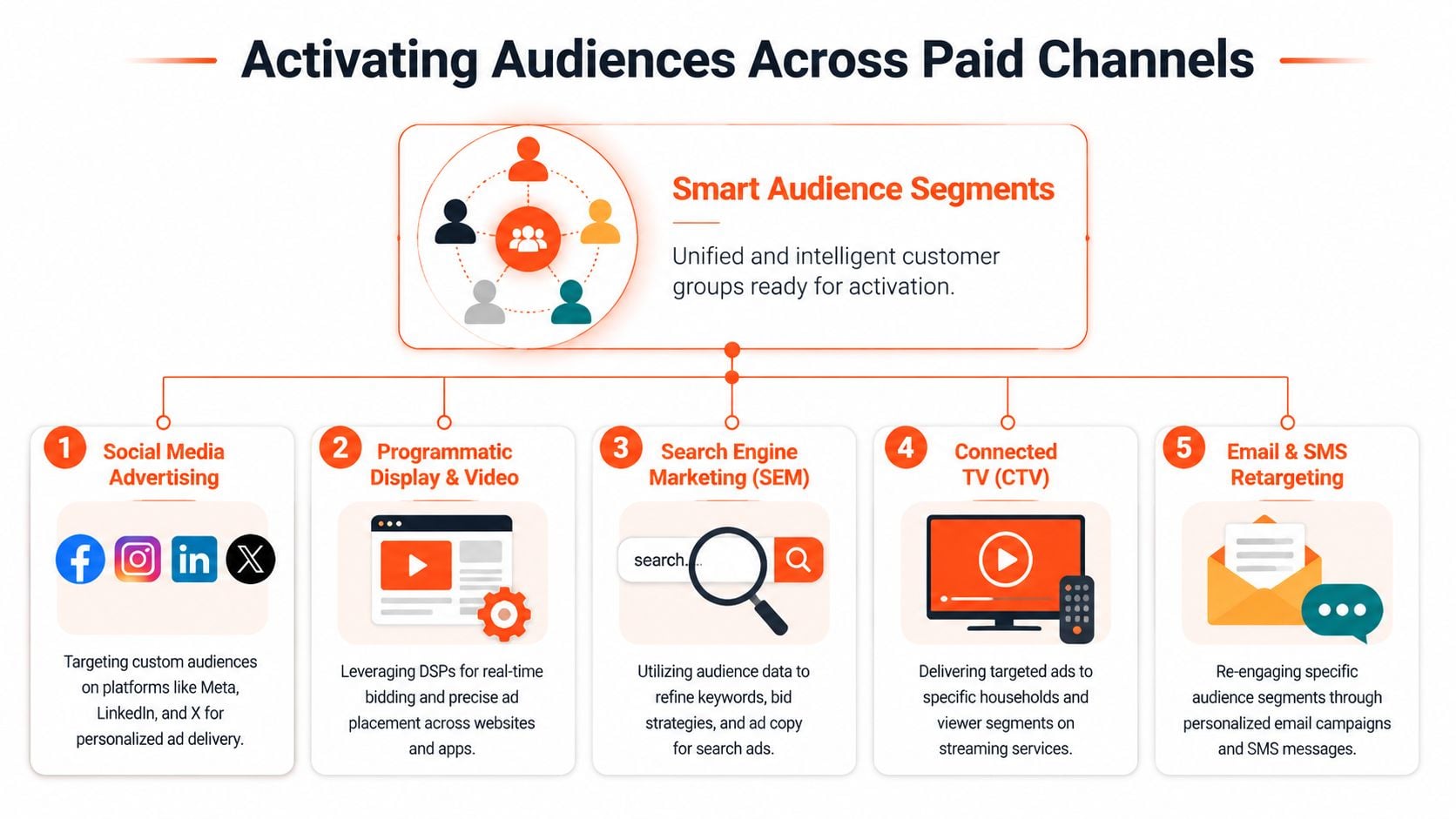
The business case for doing this is strong. Brands using first-party data for activation and personalisation have reported 8x ROI, more than 25% lower CPA, and up to 2.9x revenue growth, according to Avaus benchmark reporting. The same benchmark notes that even a few hundred engaged users can support basic personalisation.
Google Ads where activation often gets underused
A lot of advertisers only use first-party audiences in Google for simple remarketing. That leaves money on the table.
In practice, some of the strongest uses are:
-
Customer Match for re-engagement
Reconnect with previous buyers, lapsed customers, or warm leads across Search, Shopping, YouTube, and other eligible inventory. -
Suppression in acquisition campaigns
Exclude existing customers from prospecting so new-customer budgets aren't diluted. -
Intent layering
Apply first-party audiences to Search campaigns to adjust bidding, tailor ad copy, or separate high-value users from general traffic.
If your account also runs visual inventory, understanding where audience layering fits inside Google Display campaigns helps connect media strategy with data strategy.
Meta where audience quality matters more than audience size
Meta is often where marketers see the difference between “we uploaded a list” and “we built a real activation system”.
A weak setup sends one broad customer file and hopes the algorithm figures it out. A better setup sends distinct groups such as recent purchasers, high-value customers, abandoned-cart users, or qualified leads. That gives Meta clearer signals for retargeting, exclusions, and lookalike-style prospecting.
What tends to work:
- Retargeting based on recency and intent
- Creative mapped to audience stage
- Seed lists built from best customers, not all customers
- Exclusions that stop overlap between prospecting and retention
What tends not to work:
- Uploading stale files
- Using one generic ad set for every audience
- Treating all leads as equal
- Ignoring CRM outcomes after the lead form submission
Email and CRM are part of activation too
Marketers often frame activation as only a paid media task. It isn't. Your owned channels help validate whether the audience logic is sound.
If a segment performs well in email but poorly in paid media, the issue may be platform execution. If it performs poorly everywhere, the segment itself may be wrong. That's why CRM and email activation should sit alongside Google, Meta, and LinkedIn, not outside them.
Start small if needed
One encouraging point from the Avaus benchmark is accessibility. You don't need an enterprise-size database to begin. A growing business with a few hundred engaged users can already test personalisation and segmented activation if the data is clean and the use case is tight.
That's often the right way to start. One retention audience. One high-intent prospect segment. One exclusion list. Then scale once you can prove the segments are doing useful work.
Measuring Real Impact and Proving ROI
This is the part most guides rush past.
Plenty of teams can upload an audience into Google Ads or Meta. Far fewer can show whether that audience changed business outcomes in a way that justifies the effort. That's the measurement reality behind first party data activation.
LiveRamp's perspective on first-party data strategy puts it well: activation is not just a targeting problem. It's a measurement architecture problem, where CRM hygiene, consent capture, and rapid data refresh can matter as much as audience size.
Platform reporting isn't enough on its own
Platform dashboards are useful, but they don't answer the hardest question. Did the activated audience create incremental value, or did it only capture conversions that were already likely to happen?
That distinction matters a lot in Australia's privacy-focused environment. When signal quality is uneven, the risk of over-crediting a campaign goes up. You can see conversions in-platform and still miss the actual business effect.
If you can't separate “performed in platform” from “changed the outcome”, you haven't proved ROI yet.
What to measure besides conversions
The strongest reporting frameworks connect audience use to commercial decisions, not just campaign metrics.
Look at measures such as:
-
Conversion efficiency by audience type
Compare activated segments against broader targeting groups. -
New versus existing customer outcomes
Especially important when suppression lists are part of the strategy. -
Lead quality after the click
For B2B, CRM progression often matters more than raw lead count. -
Revenue quality and repeat value
For e-commerce or subscription brands, a sale is only one part of the story. -
Match quality and refresh reliability
If data reaches platforms slowly or inconsistently, performance conclusions can be misleading.
If your tracking setup is shaky, fix that first. A clean measurement layer is the difference between insight and wishful thinking. This guide to website conversion tracking is a practical reference if your current reporting still depends too heavily on platform defaults.
A simple way to test incrementality
You don't need a complicated analytics program to think properly about lift.
Use questions like these:
| Measurement question | Why it matters |
|---|---|
| Did the activated audience outperform broad targeting? | Shows whether segmentation improved efficiency |
| Did exclusions reduce wasted spend on existing customers? | Helps quantify media savings and cleaner acquisition |
| Did high-intent segments convert faster or better? | Indicates whether audience logic is commercially useful |
| Did CRM-qualified leads increase, not just form fills? | Prevents low-quality lead inflation |
| Did refreshed audiences sustain results over time? | Tests whether the process is durable, not just a one-off win |
This isn't perfect incrementality modelling. But it's far better than claiming success because a platform reported conversions after you uploaded a list.
Where measurement usually breaks
In agency and in-house environments, the failures are familiar:
- The CRM field definitions don't match the campaign naming.
- Consent status isn't captured cleanly enough to support reuse.
- Audiences refresh too slowly, so the platform works off stale signals.
- Sales outcomes never get fed back into media analysis.
- Teams optimise to cost per lead when the business primarily cares about qualified pipeline or repeat revenue.
Those aren't media buying mistakes. They're architecture mistakes.
Better measurement usually comes from cleaner operations, not more dashboard widgets.
If you want first party data activation to keep budget support internally, report it like an investment. Show what changed in acquisition efficiency, customer quality, suppression effectiveness, and downstream value. That's what stakeholders believe because that's what the business feels.
Common Pitfalls and Your Implementation Checklist
The biggest mistake is thinking first party data activation fails in the ad platform. It usually fails much earlier, in collection, identity, hygiene, or measurement design.
The most common traps are easy to recognise once you know what to watch for.
What to avoid
-
Stale audience files
If customer data isn't refreshed regularly, your targeting and exclusions drift out of sync with reality. -
Broad segments with weak intent
Demographic buckets often look neat but rarely outperform behaviour-based groups. -
Over-segmentation
Tiny audiences create management overhead and muddy reporting. -
No suppression strategy
Paying to reacquire customers you already have is one of the fastest ways to waste budget. -
Bought or low-trust contact data
If list quality is questionable, your match rates, engagement, and compliance risk all get worse. If your team is tempted to shortcut list growth, this guide to safer alternatives for email lists is worth reading first.
First-Party Data Activation Checklist
| Phase | Task | Key Outcome |
|---|---|---|
| Audit | Review website, CRM, email, and sales data sources | You know what signals exist and where gaps sit |
| Consent | Confirm permission capture and data-use rules | Audiences can be activated with less compliance friction |
| Tracking | Standardise event names and conversion definitions | Media and reporting use the same language |
| Identity | Unify records across platforms and systems | Customer profiles become usable for targeting and suppression |
| Segmentation | Build a small set of high-intent audiences | Campaigns focus on commercial behaviour, not guesswork |
| Activation | Push audiences into Google, Meta, LinkedIn, and owned channels | Data begins influencing media delivery |
| Exclusions | Remove customers or low-value groups from acquisition where needed | Spend gets cleaner and less repetitive |
| Reporting | Compare activated audiences against broader targeting | You can see whether activation improved outcomes |
| Optimisation | Refresh audiences, refine segment logic, and feed CRM outcomes back | The program gets stronger instead of stalling |
A sensible rollout is usually smaller than people expect. Start with one high-intent audience, one customer suppression list, and one reporting view that compares activated and non-activated performance. If that works, expand. If it doesn't, fix the process before adding more complexity.
If you want help turning first party data into something your paid media can effectively use and your stakeholders can confidently trust, Click Click Bang Bang can help. They specialise in PPC, tracking, and data-led campaign strategy across Google, Meta, and LinkedIn, with clear reporting and no long-term lock-ins.
Read NeXt
Or Read Our Latest
Click. CLick. Subscribe.
Get our best PPC insights, industry updates, and power moves delivered straight to your inbox. No fluff, just high-caliber strategies that actually work.
Don’t Leave Just Yet
Try Us For 30-Days,
Risk Free!!
We guarantee that you’ll love our work within the first 30 days, if not you’ll get your money back.
What have you got to lose?