

A Guide to Modern PPC Ad Management in Australia
Last Updated
PPC ad management is the whole process of planning, building, running, and fine-tuning pay-per-click ad campaigns to hit specific business goals. It's so much more than just buying ads; it’s about squeezing every last drop of value out of your budget by making sure your ads get in front of the right people, right when they’re ready to buy.
What Is PPC Ad Management and Why It Matters Now
Imagine your business has an incredible product, but it’s tucked away on a quiet side street with zero foot traffic. Pay-per-click (PPC) advertising is like renting the biggest, flashiest storefront in a packed shopping centre, putting you directly in the path of motivated buyers. PPC ad management is the art and science of running that storefront like a well-oiled machine.
This isn’t a "set it and forget it" game. It's a constant cycle of strategic moves designed to drive real, profitable results. It demands careful oversight to make sure your advertising budget is working as hard as you do.
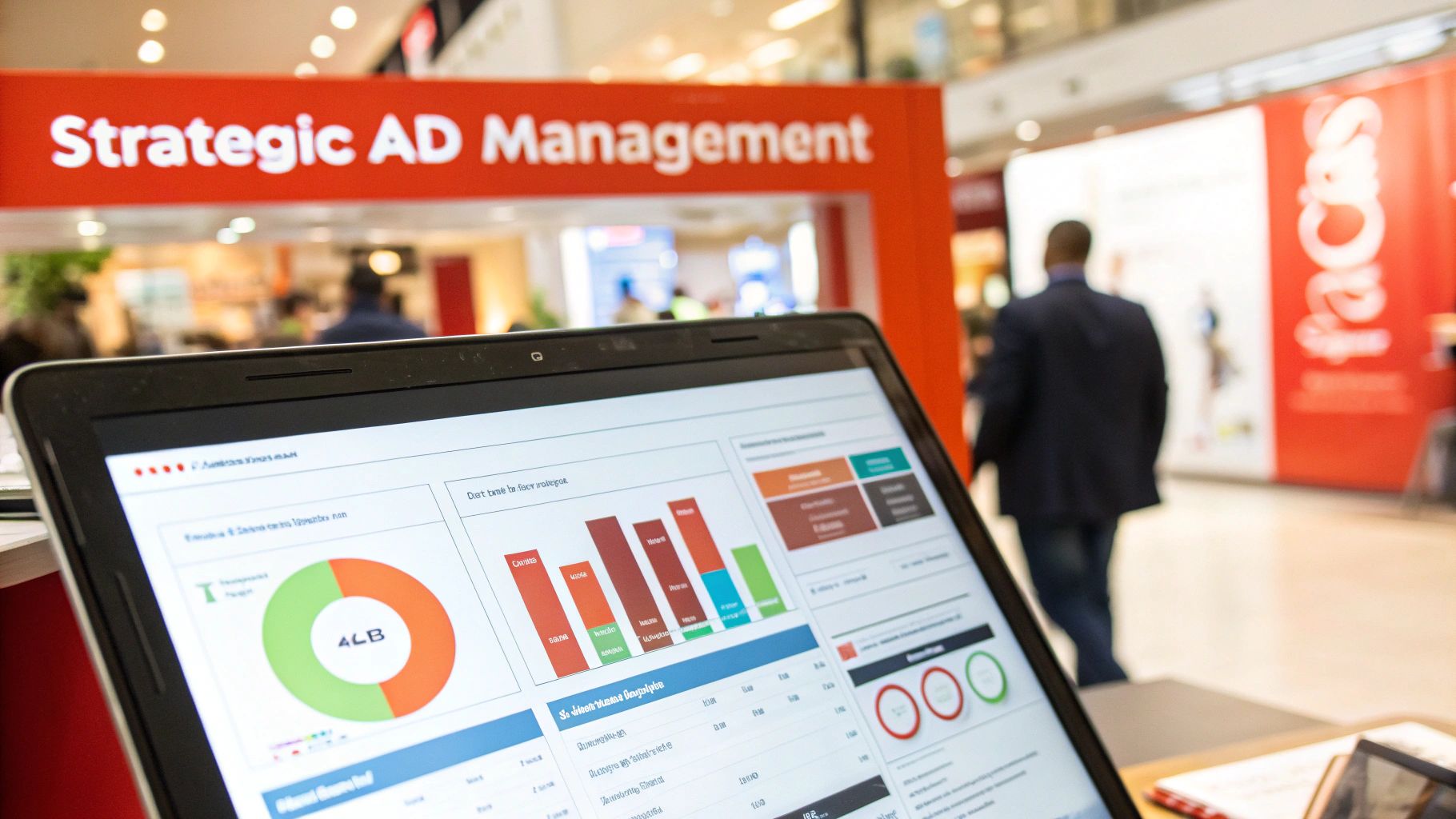
A platform like Google Ads, shown above, is the main arena where these campaigns play out. This is the command centre where a PPC manager turns strategy into action, targeting specific keywords and customer groups with laser precision.
The Core Responsibilities of PPC Management
Good PPC management is a hands-on job that goes way beyond just launching an ad. It’s a mix of crucial tasks that ultimately decide whether a campaign sinks or swims.
The key responsibilities really boil down to this:
- Keyword Research and Selection: Digging deep to find the high-intent search terms your potential customers are punching into Google to find products or services just like yours.
- Ad Creation and Copywriting: Writing compelling ad copy and choosing visuals that don’t just get noticed, but persuade people to actually click.
- Budget and Bid Management: Smartly allocating your ad budget and tweaking bids to get the most visibility without blowing through your cash.
- Performance Monitoring and Analysis: Keeping a close eye on key metrics like click-through rate (CTR), conversion rate, and return on ad spend (ROAS).
- Campaign Optimisation: Using that performance data to make smart adjustments—like refining keywords, A/B testing new ad copy, or tightening up your audience targeting.
This hands-on approach is what turns raw ad spend into tangible business results like leads and sales. Without someone actively managing the controls, businesses risk throwing good money after bad, paying for irrelevant clicks and ads that just don't perform.
Why Australian Businesses Are Investing Heavily
You don't have to look far to see the value of professional PPC management in the local market. Here in Australia, around 65% of small to medium-sized enterprises (SMEs) are actively running PPC campaigns. That's a huge number, and it shows just how powerful this channel is for getting immediate visibility and a strong return. On average, businesses are earning $2 for every $1 spent on Google Ads.
This kind of investment is essential just to keep up. With a well-managed campaign, you can claim prime digital real estate, connect with customers who are ready to buy, and get priceless data on what makes them tick. As we look ahead, understanding the biggest PPC trends for 2025 is going to be vital for staying ahead of the pack and making sure your strategy is ready for what's next.
Building Your First PPC Campaign Step by Step
Diving into the world of PPC for the first time can feel a bit like planning a major road trip. You know your destination—more leads, more sales—but you need a solid map to get there without getting lost. This guide is your compass, walking you through how to build a killer campaign from scratch, using Google Ads as our main example.
The absolute first thing you need to do, and honestly the most important, is to decide what success actually looks like for you. If you don't have clear goals, your campaign is just driving in circles. Are you trying to get email sign-ups? Push direct e-commerce sales? Or maybe get potential clients to book a call? Each of these goals needs a totally different game plan.
Defining Your Campaign Objectives
Before you even think about spending a cent, you need a goal you can actually measure. Fuzzy targets like "increase brand awareness" are a nightmare to track and almost impossible to prove an ROI on. Instead, lock in on concrete outcomes.
Your objectives should be:
- Specific: Don't just say "get more leads." Aim for something like "generate 25 qualified B2B leads per month."
- Measurable: Tie your goals to real numbers, or what we call key performance indicators (KPIs), like Conversion Rate or Cost Per Acquisition (CPA).
- Achievable: Be realistic. Set targets based on what your budget can handle and what's normal for your industry.
- Relevant: Make sure your PPC goals are actually helping your bigger business goals.
- Time-bound: Give yourself a deadline, like "achieve a 3:1 ROAS within the first quarter."
When you have these clear objectives locked in, every decision you make afterwards—from the keywords you pick to the ads you write—has a clear purpose. This clarity is the bedrock of good PPC management.
The Art of Keyword Research
Okay, so you know what you want. Now it's time to figure out how your customers are looking for it. Keyword research is like learning the local lingo; it’s about uncovering the exact phrases and questions your audience types into Google when they need what you've got.
Put yourself in your customer's shoes. Someone with a burst pipe isn't just searching for "plumbing services." They're frantically typing in "emergency plumber near me," "leaky tap repair Sydney," or "how to fix a running toilet." Each of those searches shows a different level of intent and urgency. Tools like Google Keyword Planner or Ahrefs are great for digging up these golden nuggets, along with how many people are searching for them and how tough the competition is.
This infographic lays out the typical workflow for getting a campaign off the ground, and it all starts with this crucial research phase.
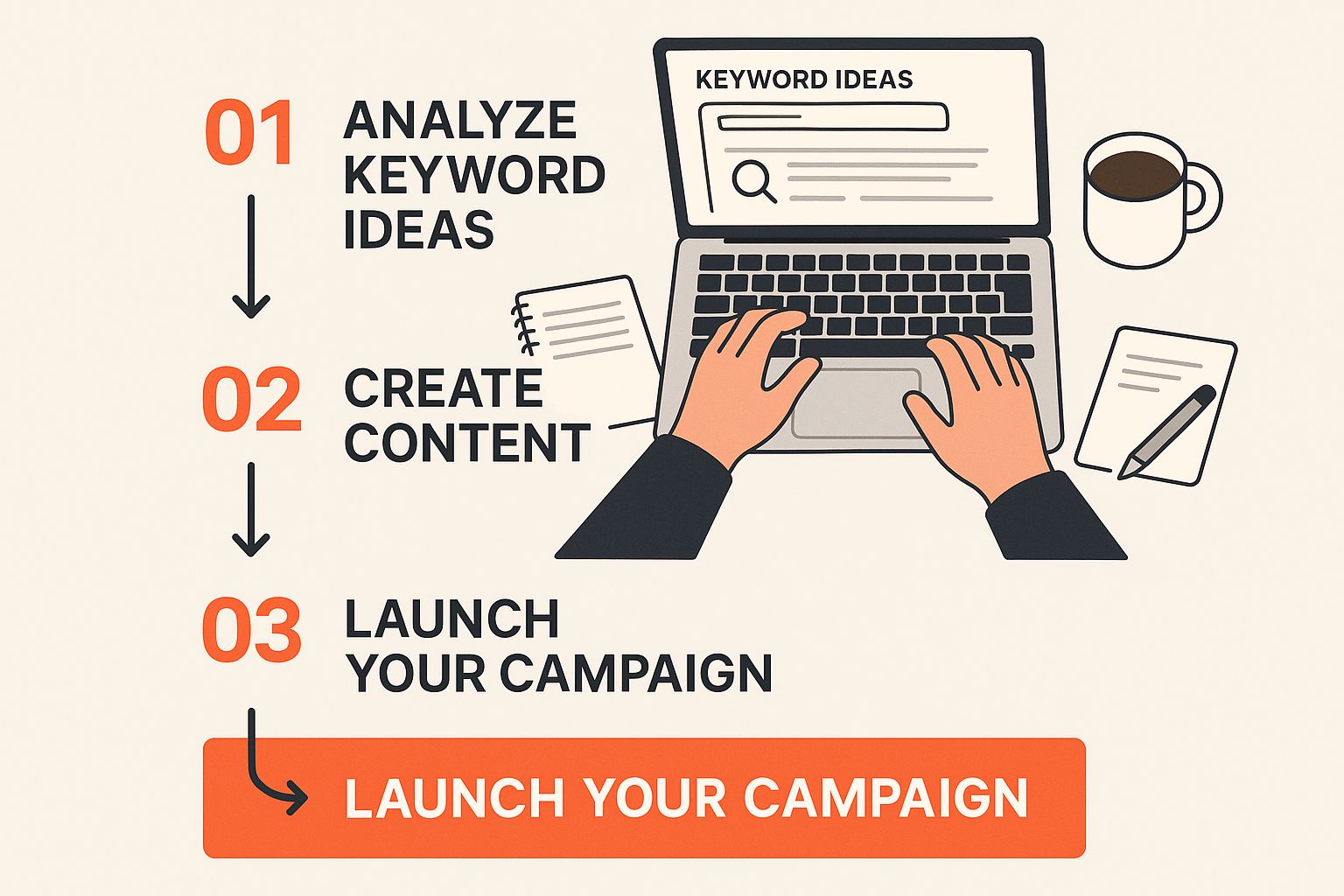
As you can see, moving from research to launch is a methodical process, and it all hinges on understanding what your audience is searching for.
Structuring for Success: Ad Groups and Copy
Once you've got your list of keywords, the next job is to get them organised. A common and very expensive mistake is to just dump all your keywords into one giant bucket. Don't do that. Instead, you need to sort them into tight, thematically-related ad groups.
For example, all your keywords about "emergency plumbing" should live in one ad group, while keywords for "bathroom renovations" get their own separate group.
This tight structure lets you write super-relevant ad copy. When someone searches "24/7 plumber," your ad needs to speak directly to that pain point with a headline like "Fast 24/7 Emergency Plumber." Google loves this relevance and rewards you with a higher Quality Score, which often means lower costs and better ad positions for you. To nail this from the get-go, you can explore a proven Google Ads campaign structure template to build on a solid foundation.
The golden rule of PPC is relevance. A user's search query, your ad, and your landing page must all tell the same cohesive story. Any disconnect in this journey will cause users to bounce, wasting your ad spend.
Budgeting and High-Converting Landing Pages
Finally, let's talk about money and where you're sending people. Set a daily budget you're comfortable with, and be patient—it takes time to collect enough data to know what's working. Your bidding strategy will depend on your goals. You might start by focusing on maximising clicks just to get some traffic, then later switch to a strategy that focuses on conversions or a target Return On Ad Spend (ROAS) once the data starts rolling in.
But the user's journey doesn't end when they click your ad. Your landing page has to deliver on the promise you made. If your ad shouts about a "50% Off Sale," that offer had better be front and centre on the landing page. The page itself should be clean, load quickly, and have a single, obvious call-to-action (CTA). Make it dead simple for the user to do what you want them to do.
Navigating the Australian Digital Ad Landscape
To get PPC ad management right in Australia, you first need to understand the local terrain. It's a unique market with its own consumer habits and platform preferences. A strategy that absolutely crushes it in the US or Europe might fall completely flat here if it doesn't account for how Aussies actually behave online.
The Australian market isn't just a smaller version of global trends; it has its own distinct rhythm. While Google Search remains the undisputed king for capturing people actively looking for a solution, the real story of growth and engagement is happening elsewhere. Video content and social commerce aren't just "emerging"—they are dominant forces you can't afford to ignore.
The Power Players in Australian Advertising
Mastering PPC means knowing which platforms to use and when. In Australia, the choice isn't just a simple toss-up between Google and Meta. It's about building a multi-channel presence that meets your customers exactly where they are, whether they're searching for an answer or just scrolling through their feed.
A winning strategy almost always involves a careful mix of platforms, tailored to your specific business goals:
- Google Search & Shopping: For e-commerce brands and service businesses, this is non-negotiable. It’s the go-to for catching customers who are actively looking to buy, making it essential for driving direct sales and high-quality leads.
- Meta (Facebook & Instagram): These platforms are absolute powerhouses for brand building and audience engagement. Their sophisticated targeting options make them perfect for reaching niche demographics with visually compelling ads, especially for fashion, lifestyle, and B2C products.
- TikTok & YouTube: Video is exploding, and these two are leading the charge. They offer unmatched opportunities for high-impact brand awareness campaigns that connect with younger audiences through creative, short-form content.
A truly effective Australian PPC strategy is rarely about finding a single "best" platform. Instead, it’s about creating an integrated, multi-channel approach that aligns your ad spend with where your target audience spends their time online.
The digital ad sector here is growing at a serious clip, which really underscores the importance of having a well-funded, strategic approach. In the financial year ending June 2025, Australian digital ad spending hit a record $17.2 billion, a massive 10.6% increase from the previous year.
This surge was heavily fuelled by video advertising, which jumped by 21.9% to reach $5.0 billion. Social platforms were a key driver of this video boom, with spending on social video ads rocketing up by 36.7% year-on-year to $1.9 billion—now making up 38% of all video ad expenditure. You can explore more on this record advertising growth to get a better sense of the market's trajectory.
Aligning Strategy with Aussie Consumer Behaviour
Understanding local consumer behaviour is the final piece of the puzzle. Aussies are heavy mobile users, which means every ad and landing page must be flawlessly optimised for smaller screens. A clunky mobile experience is a guaranteed way to burn through your ad budget.
On top of that, authenticity resonates deeply with Australian audiences. They value straightforward communication and are quick to tune out overly corporate or generic ad copy. Your campaigns need to reflect a genuine understanding of local culture and language to build that crucial trust and connection.
This focus on local nuance is what separates a generic campaign from a high-performing one. Effective PPC ad management means tailoring every single aspect of your strategy—from platform selection to ad creative—to the unique character of the Australian market. By doing that, you can make smarter decisions with your budget and build a much stronger connection with your audience.
Measuring PPC Performance with the Right Metrics
Launching a campaign is the fun part, but the real work starts after you go live. It’s all too easy to get mesmerised by a sea of data, especially vanity metrics like impressions and clicks. While those numbers tell you something is happening, they don't tell you if you're actually making money.
To get a real grip on your campaign's success, you have to zone in on the key performance indicators (KPIs) that connect your ad spend directly to your business goals. This means digging deeper than surface-level stats to find out what’s truly driving profitability and growth.
Key Performance Indicators That Actually Matter
Think of your campaign metrics like the dashboard in your car. Clicks and impressions are your speedometer – they show you're moving. But your conversion rate and return on ad spend? That’s your fuel gauge and your GPS. They tell you if you have enough gas to get where you're going and if you're even on the right road.
Here are the core metrics you absolutely need to master:
- Click-Through Rate (CTR): This is the percentage of people who saw your ad and were compelled enough to click. A high CTR is a great sign that your ad copy and targeting are hitting the mark, but it’s no guarantee of a sale.
- Conversion Rate: This is the big one. It’s the percentage of users who clicked your ad and then took the action you wanted them to, whether that's making a purchase, filling out a contact form, or calling your business. It's the ultimate measure of your campaign's effectiveness.
- Cost Per Acquisition (CPA): Sometimes called Cost Per Conversion, this metric tells you exactly how much you're shelling out to get one new customer. The calculation is simple: divide your total ad spend by the number of conversions. A low CPA means your campaign is running like a well-oiled machine.
- Return On Ad Spend (ROAS): Meet the king of profitability. ROAS measures the total revenue you generate for every single dollar you spend on ads. A ROAS of 4:1 means you're bringing in $4 for every $1 you invest. Game-changing stuff.
Focusing on these KPIs shifts your entire mindset. You stop just managing ads and start driving real, measurable results for the business.
Setting a Baseline with Australian Conversion Benchmarks
Your conversion rate is a vital sign for your campaigns, but it's important to know what "good" actually looks like. Conversion rates can vary wildly between platforms, and having some local benchmarks gives you a crucial starting point.
Take a look at how different platforms typically perform in Australia. This can help you set realistic expectations and spot when your campaigns might be underperforming.
Average PPC Conversion Rates by Platform in Australia
| Platform / Ad Type | Average Conversion Rate | Best For |
|---|---|---|
| Google Search Ads | 4.40% | Capturing high-intent users actively searching for your solution. |
| Google Display Ads | 0.57% | Building brand awareness and reaching broad audiences visually. |
| Google Shopping Ads | 1.91% | eCommerce businesses aiming to drive direct product sales. |
| Amazon Ads | Varies | Reaching ready-to-buy shoppers on a massive retail platform. |
| Social Media Ads | Varies by platform | Targeting specific demographics and interests with engaging content. |
These averages are your yardstick. For example, if your Google Search campaigns are converting at 1.5% while the Aussie average is 4.40%, that's a massive red flag. It tells you that something—whether it's your ad copy, landing page, or audience targeting—needs some urgent attention.
Attribution and Reporting: Tying It All Together
So, you have your metrics. But how do you connect the dots? The final piece of the puzzle is attribution. This is all about figuring out which ad clicks or marketing touches get the credit for a sale.
Tools like Google Analytics are indispensable here. They let you trace the entire customer journey, from the first time someone sees your ad to the moment they finally convert. This visibility is what allows you to make smart, data-backed decisions instead of just guessing what's working.
Without proper attribution, you're flying blind. You might cut a campaign with a high CPA, not realising it's the first touchpoint that introduces your brand to a huge chunk of your future customers.
Clear reporting is just as crucial. It's about taking all that complex data and weaving it into a simple story that shows the value you're delivering. A great report doesn't just list numbers; it provides insights and actionable next steps.
If you want to get this right without reinventing the wheel, using a pre-built PPC reporting template can save you hours of work and keep you focused on the KPIs that matter.
By mastering these core metrics and implementing solid tracking, you can prove the value of your marketing spend with confidence and steer your campaigns towards sustained, profitable growth.
Advanced Strategies to Optimise Your Campaigns
Getting a campaign live is just the starting line. The real art of effective PPC ad management is what comes next: the relentless process of refinement and optimisation. It’s all about methodically tweaking, testing, and tightening every element to turn a good campaign into a great one, pushing your Return on Ad Spend (ROAS) to new heights.
Once that initial data starts trickling in, it's time to graduate from the basics. We need to implement strategies that squeeze maximum value from every dollar you spend. This means plugging the leaks in your budget, making your ads ridiculously relevant, and connecting with your most valuable customers with pinpoint accuracy.
Mastering Your Negative Keyword Strategy
Think of a negative keyword list as a bouncer for your ad campaign. Its only job is to turn away irrelevant search queries that chew through your budget without any chance of a conversion. For example, if you sell premium "graphic design software," you definitely don't want to pay for clicks from people searching for "free graphic design software."
By adding "free" as a negative keyword, you instantly block your ads from showing for that search. This simple act is one of the most powerful ways to improve your campaign's profitability, hands down.
A robust negative keyword strategy involves:
- Proactive Additions: Before you even launch, start with a list of obvious negative terms for your industry. Think words like "jobs," "free," "DIY," or "training" that signal the searcher isn't looking to buy.
- Reactive Analysis: Get friendly with your Search Terms Report. This report shows you the exact queries people typed before clicking your ad. You should be mining this report weekly for irrelevant terms to add to your negative list.
- Match Type Management: Use different match types for control. Broad match negatives work well for general terms (like
free), phrase match is great for specific phrases ("how to"), and exact match lets you block very precise queries you want to avoid.
This ongoing process ensures your budget is spent only on clicks from users with genuine commercial intent. The direct result? A better CPA and a healthier ROAS.
The Power of Systematic A/B Testing
Guesswork is the enemy of profitable PPC. Instead of just assuming you know what works, you need to be testing. Constantly. A/B testing, or split testing, is a methodical process where you pit one variation against another to see which one performs better.
You can test almost anything, but you'll get the biggest bang for your buck by focusing on your ad copy and your landing pages.
For instance, you could run two identical ads with just one difference: the headline.
- Ad A Headline: "Premium Accounting Software for SMEs"
- Ad B Headline: "Save 10 Hours a Week on Bookkeeping"
After collecting enough data, you might find that Ad B’s benefit-driven headline pulls in a 30% higher click-through rate (CTR). At that point, you pause Ad A and create a new variation to test against your new winner. This cycle of continuous improvement is how you systematically lift your campaign's performance over time.
A/B testing isn't about finding one single "perfect" ad. It's about creating a culture of constant, incremental improvement that compounds into significant performance gains over the life of a campaign.
Leveraging Ad Extensions for Maximum Impact
Ad extensions are extra snippets of information that expand your ad, giving users more reasons to click. They are completely free to add and can seriously increase your ad's visibility and CTR, making your ad take up more valuable real estate on the search results page.
Think of them as free upgrades for your ads. Some of the most important extensions include:
- Sitelink Extensions: Add direct links to specific pages on your website, like "About Us," "Pricing," or "Contact Us."
- Callout Extensions: Highlight key benefits or features in short, punchy phrases, such as "Free Shipping" or "24/7 Customer Support."
- Structured Snippets: Showcase specific aspects of your products or services, like listing different "Brands" or "Service Types."
- Image Extensions: Add relevant visuals to your search ads, making them far more eye-catching and engaging.
Using a full suite of relevant ad extensions makes your ads more prominent and helpful. Google often rewards this by giving you a higher Ad Rank and, in turn, a lower cost-per-click. It's a no-brainer.
Advanced Targeting and Bid Management
Beyond just keywords, modern PPC platforms offer incredibly sophisticated ways to reach your ideal customer. Remarketing, for instance, lets you show targeted ads to people who have already visited your website. This is incredibly powerful because you're reaching a warm audience already familiar with your brand.
You can get even more granular with custom audiences. For example, you could create a remarketing list for users who abandoned their shopping cart and show them a unique ad with a discount code to entice them back.
Finally, effective bid management is crucial. While automated bidding strategies like "Maximise Conversions" are getting smarter all the time, manual CPC bidding still offers granular control when you need it. A hybrid approach often works best—using automation for broader campaigns while keeping manual control over your most important, high-intent keywords where every single click counts. Relentless optimisation is the core of successful PPC, turning raw data into profitable, repeatable results.
Got Questions About PPC Ad Management? We've Got Answers
Stepping into the world of paid advertising always brings up a few questions. That’s completely normal. Effective PPC ad management is a detailed discipline, and getting your head around the basics is the first step toward making smart decisions for your business.
Let's run through some of the most common questions we hear from Australian businesses navigating this powerful marketing channel. From figuring out a realistic budget to choosing the right platforms, getting these answers straight will give you the confidence to invest your marketing dollars wisely.
How Much Should I Budget for PPC in Australia?
This is the big one, and the honest answer is: there's no magic number. A sensible budget depends entirely on how competitive your industry is, what you're trying to achieve, and the geographic area you’re targeting. A local electrician might see great results with $1,000 a month, while a national e-commerce brand could easily invest over $20,000.
Instead of pulling a number out of thin air, a much better approach is to work backwards from your target Cost Per Acquisition (CPA). If you know a new customer is worth $600 in lifetime value to your business, then acquiring that customer for $60 is a no-brainer.
Your initial budget just needs to be enough to gather meaningful data. A good rule of thumb is to aim for enough spend to generate at least 15-20 conversions per month. This volume gives the ad platforms enough feedback to start optimising properly.
For many Australian small to medium-sized enterprises (SMEs), a realistic starting point often falls between $2,000 and $5,000 per month. This is usually enough to run proper tests, collect data, and find what works before scaling up.
What Is the Difference Between Google Ads and Social Media Ads?
Getting this distinction right is absolutely crucial because it shapes your entire strategy. The core difference comes down to one thing: user intent.
-
Google Ads (Pull Marketing): This is all about capturing existing demand. When someone types "emergency plumber Sydney" into Google, they have an immediate, high-intent problem they need solved right now. You’re pulling in people who are already looking for you.
-
Social Media Ads (Push Marketing): Platforms like Facebook, Instagram, and TikTok work differently. You’re targeting people based on their demographics, interests, and online behaviour. You are pushing your message in front of them while they're scrolling, effectively creating demand.
So, what does this mean in practice?
Google Ads is unbeatable for driving immediate leads and sales from people ready to buy. On the other hand, social media is incredibly powerful for building brand awareness, nurturing potential customers, and reaching niche audiences who might not even know a solution like yours exists yet.
A really solid PPC ad management strategy often uses both. You might run Instagram ads to introduce your brand to a new audience, then use Google remarketing ads to close the deal when they later search for your product category.
Should I Hire a PPC Agency or Manage It In-House?
This decision really boils down to a trade-off between time, expertise, and resources.
Managing PPC campaigns in-house gives you total control, but it comes with a seriously steep learning curve. This isn’t a part-time task you can palm off to an intern. It’s a full-time, specialised discipline that requires constant learning just to keep up with platform changes. Without dedicated expertise, you run a very real risk of burning through your ad spend on rookie mistakes.
Hiring a specialised PPC agency, by contrast, gives you immediate access to a team of experts who live and breathe paid advertising. They bring years of experience across different industries, access to advanced tools, and proven frameworks for getting campaigns off the ground and optimising them for performance.
While an agency has a management fee, a good one will generate a return on investment that far outweighs its cost. They do this by maximising your ad efficiency, stamping out wasted spend, and freeing up your time to focus on what you do best—running your business. For most businesses looking to scale, partnering with an agency is the more profitable and sustainable path.
Ready to unlock the full potential of your ad spend without the steep learning curve? The team at Click Click Bang Bang specialises in precision-driven PPC ad management that delivers real, measurable results. We handle the complexity so you can focus on growth. Get in touch with our PPC experts today.
Read NeXt
Or Read Our Latest
- Manual vs Automated Bidding for PPC Success
- Conversion Tracking Setup: A Complete AU Guide
- Instagram Advertising Australia: Complete 2026 Guide
- Pay Per Click: A Beginner’s Guide for Australian Marketers
- Display Advertising on Google: The Complete Australian Guide
- Stakeholder Communication Plan How to Build One That Works
Click. CLick. Subscribe.
Get our best PPC insights, industry updates, and power moves delivered straight to your inbox. No fluff, just high-caliber strategies that actually work.
Don’t Leave Just Yet
Try Us For 30-Days,
Risk Free!!
We guarantee that you’ll love our work within the first 30 days, if not you’ll get your money back.
What have you got to lose?