

Mastering IT Lead Generation Services for Growth
Last Updated

Think of IT lead generation services as a specialised scouting team for your tech business. But instead of searching for top athletes, they’re out there systematically finding your ideal customers—the ones with the right technical needs, budget, and authority to actually buy what you’re selling. Their whole mission is to build a predictable sales pipeline, freeing you from the feast-or-famine cycle of inconsistent growth.
What Are IT Lead Generation Services?

At its heart, an IT lead generation service is a strategic partner laser-focused on one main goal: finding, attracting, and qualifying potential clients within the notoriously complex tech sector. This goes way beyond generic marketing or just buying a list of contacts. It’s a methodical process designed to fill your sales funnel with opportunities that are genuinely interested and ready to have a conversation.
Imagine your company sells sophisticated cybersecurity software. Casting a wide net with general advertising is like shouting into a crowded stadium; you might get some attention, but most of it will be from the wrong people. It’s an expensive and inefficient way to operate.
An IT lead generation service, on the other hand, acts more like a skilled sniper. They use deep industry knowledge and specialised tools to pinpoint the exact companies and decision-makers—like the Chief Information Security Officer at a mid-sized financial firm—who are actively looking for solutions just like yours.
The Core Mission Beyond Simple Marketing
The real job of these services is to bridge the gap between your marketing efforts and your sales team's ability to close deals. They handle all the time-consuming groundwork of prospecting, which lets your expert closers focus on what they do best: closing. It's no surprise that companies with a well-defined lead generation process generate far more qualified leads.
To get a clearer picture, let's break down the core functions of a modern IT lead generation service.
Table: Core Functions of Modern IT Lead Generation
| Function | Objective | Key Activities |
|---|---|---|
| Identification | Build a targeted list of ideal prospects. | Market research, data mining, defining the Ideal Customer Profile (ICP). |
| Attraction | Engage prospects and capture their interest. | Personalised email outreach, content marketing, strategic cold calls. |
| Qualification | Vet leads to ensure they're a good fit. | BANT analysis (Budget, Authority, Need, Timeline), discovery calls. |
| Nurturing | Build relationships with long-term prospects. | Drip campaigns, sharing relevant content, follow-ups. |
Ultimately, this process ensures that by the time a lead reaches your sales team, they're not just a name on a list—they're a qualified opportunity.
The ultimate goal isn’t just to deliver a list of names. It’s to kick off meaningful conversations with decision-makers who have a genuine problem your technology can solve.
A Predictable Engine for Growth
When it all comes together, partnering with professional IT lead generation services transforms your sales process from a reactive, unpredictable scramble into a proactive, manageable system. You're no longer just waiting for the phone to ring or relying on sporadic website enquiries; you have a consistent flow of opportunities coming in.
For any tech company aiming for scalable and sustainable growth, this is a game-changer. It allows for more accurate revenue forecasting, better resource planning for your sales team, and a serious strategic advantage in a cut-throat market. By systematically warming up cold prospects and turning them into qualified leads, these services build the very foundation of a robust and reliable sales pipeline.
The Strategic Benefits for Your Tech Company

Bringing in specialised IT lead generation services is about making a fundamental shift—from a reactive sales model to a proactive growth engine. This isn't just about dumping more names into your CRM; it's a strategic move that delivers real, measurable results that go far beyond a simple contact list.
The biggest advantage? You stop playing a guessing game with your revenue. Instead of waiting and hoping for inconsistent inbound enquiries, you get a predictable stream of qualified opportunities. This lets your leadership team plan budgets, allocate resources, and set growth targets with a much higher degree of confidence. It’s the difference between hoping for growth and engineering it.
Empower Your Sales Team to Focus on Closing
One of the most immediate perks is freeing up your senior sales team. Let's be honest, prospecting is a time-intensive, often gruelling process. It takes a completely different skill set than closing high-value deals. When your top performers are bogged down with cold outreach and initial qualification, their most valuable skills are going to waste.
Outsourcing that initial legwork lets them do what they do best: nurture relationships with well-qualified leads and close contracts. This specialisation of roles makes a huge difference to your overall sales efficiency and team morale.
- Before: Your best closers spend hours every week just trying to find and vet potential leads.
- After: They walk in on Monday to a calendar full of appointments with decision-makers who have already been qualified and are genuinely interested in what you offer.
This shift means their time is invested in revenue-generating conversations, not dead-end prospecting. The impact on your bottom line can be huge, as your most expensive resources are now focused squarely on their highest-value activities.
By delegating the top-of-funnel activities, you're not just saving time; you're creating a more potent and efficient sales machine. Your team's focus shifts from finding opportunities to capitalising on them.
Gain Deeper Market Intelligence
A professional IT lead generation partner does a lot more than just find leads—they gather critical market intelligence along the way. Through thousands of conversations and outreach campaigns, they develop an on-the-ground understanding of your industry that's almost impossible to replicate internally.
This process uncovers invaluable data, giving you insights into:
- Evolving Customer Needs: You'll discover the emerging pain points and challenges your target audience is actually facing right now.
- Competitor Movements: You'll hear firsthand what other solutions prospects are considering and, more importantly, why they choose one over another.
- Untapped Market Segments: You might identify new industries or company profiles that show a strong, unexpected interest in your offerings.
This intelligence feeds directly back into your product development, marketing messaging, and overall business strategy. For instance, consistent feedback from prospects might reveal the need for a new feature you hadn't considered or highlight a competitive advantage you weren't even aware of. This strategic byproduct turns a lead generation campaign into a powerful source of business intelligence, giving you a distinct edge for long-term, sustainable growth.
Navigating Common B2B Tech Lead Generation Challenges
Jumping into a lead generation campaign without knowing the roadblocks is like setting sail without checking the weather. It’s a recipe for disaster. Even the most experienced teams hit major hurdles, which is why understanding these common challenges is the first step toward building a strategy that can actually weather the storm. It’s also the reason specialised IT lead generation services exist in the first place.
The journey is rarely a straight line. Many companies pour huge resources into campaigns only to see disappointing results. It’s not for a lack of effort—it's because they underestimate just how complex the B2B tech market really is. Let's get real about the frustrations that can sink even the best-laid plans.
The Persistent Problem of Poor Lead Quality
One of the biggest drains on any sales team is chasing leads who were never going to become customers. This isn't just inefficient; it's completely demoralising. The real problem is the sheer difficulty of finding prospects who perfectly match your Ideal Customer Profile (ICP). And an ICP isn't just about company size or industry—it’s about the nitty-gritty details, like their current tech stack, their budget cycles, and the structure of their internal buying committees.
Without a smart way to identify and filter these prospects, marketing teams often end up handing over a massive volume of low-quality leads to sales. This kicks off a painful cycle of wasted effort. Sales reps burn valuable time on discovery calls with companies that don't have the budget, the authority, or even a genuine need for the solution. It's a resource black hole that directly hits your bottom line.
Misalignment Between Sales and Marketing
Another classic point of friction is the great divide between sales and marketing. Marketing might be high-fiving over hitting their lead volume targets, but if the sales team discovers those leads are duds, the celebration is over fast. This misalignment usually comes down to poor communication and no shared definition of what a "qualified lead" actually is.
When sales and marketing operate in silos, valuable opportunities are almost guaranteed to fall through the cracks. A seamless lead handoff process, built on shared goals and clear definitions, is non-negotiable for success.
This gap breeds frustration on both sides and, crucially, creates a terrible experience for the potential customer. A prospect might have a great chat with a marketer, only to be tossed over to a salesperson who has zero context. This forces them to repeat everything, starting the conversation from scratch. It’s a disjointed journey that causes a lot of leads to simply give up and walk away.
The infographic below breaks down how these common challenges translate into tangible business costs, from wasted hours on unqualified leads to lost opportunities and the burden of compliance.
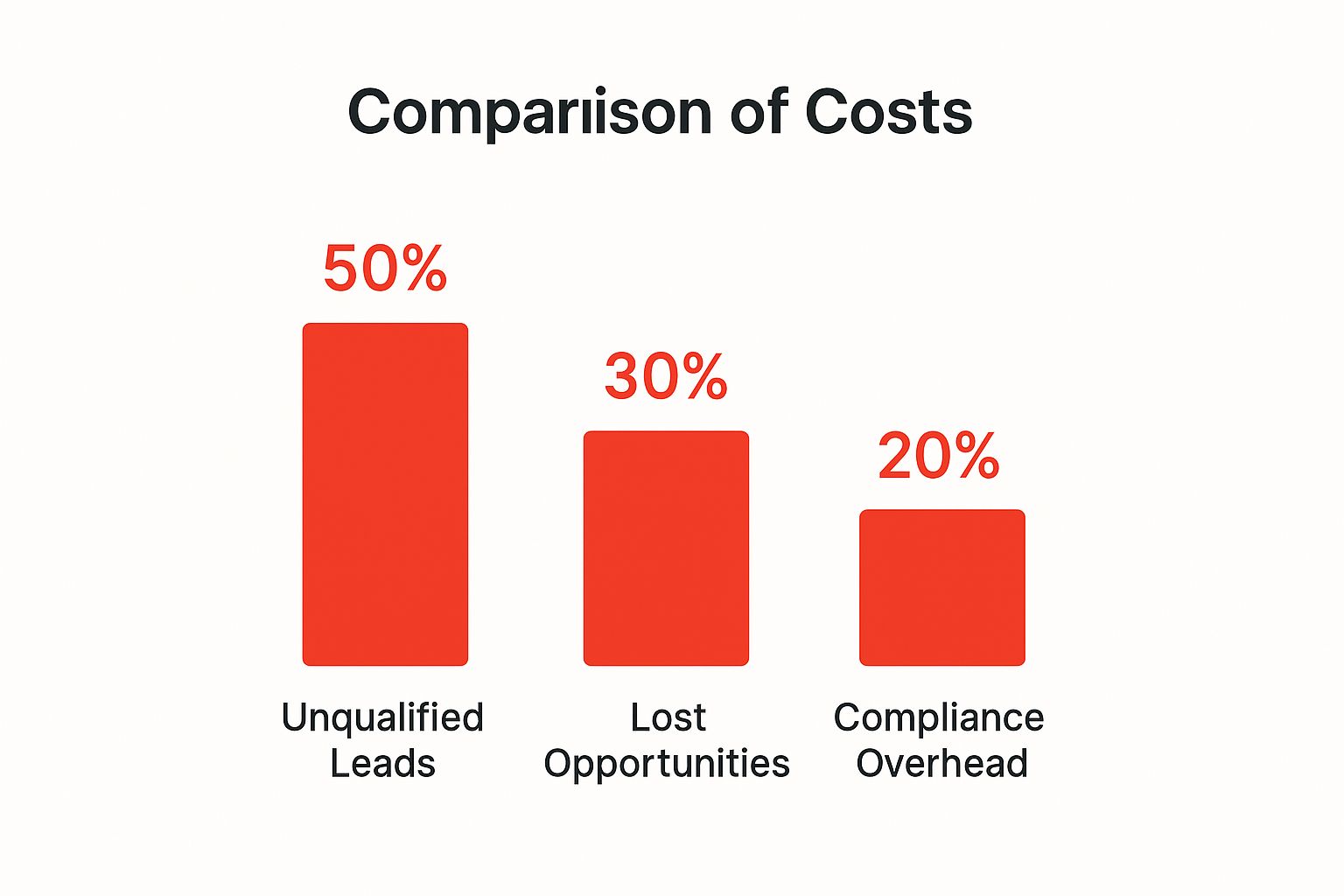
As the visual shows, the majority of wasted resources are tied to chasing leads who were never a good fit to begin with, which hammers home the need for much better qualification upfront.
The Growing Complexity of Data and Compliance
These days, just getting your hands on contact information isn't enough. That data has to be accurate, up-to-date, and compliant with ever-tightening privacy regulations. For Australian businesses, this means navigating a maze of complex rules governing how personal data can be collected, stored, and used for marketing.
Keeping a database clean and compliant is a huge operational headache. The B2B lead generation landscape in Australia is grappling with these critical issues, where finding quality leads is made even harder by the need to stick to strict privacy standards—all while trying to bridge the communication gap between sales and marketing. You can read more about these top B2B pain points to grasp the full scale of the challenge. This compliance overhead adds another layer of difficulty, making professional oversight more valuable than ever.
Proven Strategies Top Lead Generation Services Use
Top-tier IT lead generation services don’t just throw spaghetti at the wall to see what sticks. They run a sophisticated, multi-channel playbook designed to meet technical buyers where they are, no matter what stage of the journey they’re in.
These aren't random acts of marketing. They're carefully orchestrated campaigns built on proven methods. The goal is to move way beyond just collecting names on a list and start building genuine sales opportunities.
Mastering Content for Technical Audiences
One of the cornerstones of this approach is high-value content. In the tech world, your buyers are analytical, sceptical, and research-obsessed. They aren't swayed by flashy ads; they’re looking for deep expertise and real solutions to their complex problems. The best services get this. They create compelling assets that educate, build trust, and prove you know your stuff.
Instead of churning out generic blog posts, they develop in-depth content that hits on specific pain points. Think of it as providing the answer before the prospect has even fully formed the question. This positions your brand as a helpful authority, not just another vendor trying to make a sale.
This strategy often includes creating:
- In-depth Whitepapers: Detailed explorations of a niche technical challenge, backed by solid data and research.
- Compelling Case Studies: Real-world stories showing exactly how your solution solved a problem for a company just like theirs. This provides that crucial social proof.
- Informative Webinars: Live or on-demand sessions that offer practical advice and showcase your product's capabilities in a non-salesy, educational context.
Every piece of content has a dual purpose. It attracts prospects who are actively searching for solutions and doubles as a powerful lead magnet, capturing their details in exchange for genuinely valuable information.
Of course, for this to work, the landing pages for these assets need to be flawless. You can check out our comprehensive landing page optimisation checklist to make sure your valuable content actually generates the leads it deserves.
Executing Hyper-Personalised Account-Based Marketing
When you're chasing high-value enterprise clients, a broad, scattergun approach just won't cut it. This is where Account-Based Marketing (ABM) comes into play. ABM flips the traditional marketing funnel completely on its head.
Instead of casting a wide net and hoping for the best, it identifies a small number of high-potential target accounts and treats each one as its own unique market.
An ABM campaign is a tightly coordinated effort between marketing and sales to engage key stakeholders within a target company. It involves deep research to understand the organisation’s specific challenges, goals, and even internal politics. Every bit of outreach is then hyper-personalised, with messaging and content tailored to the unique needs of that single account.
Imagine you're targeting a major bank for your new fintech platform. An ABM approach means creating a custom presentation that directly addresses their known compliance hurdles and demonstrating exactly how your software integrates with their existing legacy systems. It's bespoke, relevant, and incredibly effective.
Before we dive into the final strategy, let's look at how these different approaches stack up.
Comparing IT Lead Generation Strategies
The table below breaks down some common lead generation tactics, highlighting where they shine and how success is typically measured in the IT space. This gives a clearer picture of how a multi-faceted strategy comes together.
| Strategy | Best For | Primary Channel | Key Metric |
|---|---|---|---|
| Content Marketing | Building authority & attracting inbound leads | Blog, SEO, Webinars, Whitepapers | Marketing Qualified Leads (MQLs), Cost per Lead (CPL) |
| Account-Based Marketing (ABM) | High-value, complex enterprise sales | Personalised Email, LinkedIn, Direct Mail | Account Engagement Score, Pipeline Velocity |
| Paid Search (PPC) | Capturing high-intent, active searchers | Google Ads, Microsoft Ads | Cost per Acquisition (CPA), Conversion Rate |
| Strategic Telemarketing | Qualifying leads & setting appointments | Outbound Calling, Integrated Outreach | Sales Qualified Appointments (SQAs), Conversion Rate |
As you can see, each strategy serves a distinct purpose. A truly effective lead generation service knows how to blend these tactics—using content to warm up an audience, ABM to target key accounts, and strategic calling to accelerate the journey from interest to a sales meeting.
The Evolution of Strategic Telemarketing
The word "telemarketing" might bring to mind images of outdated, robotic cold-calling scripts. But its modern application in IT lead generation is a world away from that. Today, it’s all about intelligent, conversation-driven outreach performed by highly trained professionals who genuinely understand the tech industry's nuances.
It’s not about mindlessly dialling hundreds of random numbers. It’s about targeted, informed follow-up. This method is especially powerful when it's woven into a broader campaign, combining phone calls with personalised emails and LinkedIn messages to create multiple, meaningful touchpoints.
Telemarketing remains a key part of the playbook for Australian lead generation services. For instance, a recent case study showed that a targeted three-month campaign involving 1,200 outbound calls successfully generated 250 qualified leads.
More impressively, it secured 45 appointments with key decision-makers, leading to a 35% conversion rate from appointment to the proposal stage. This proves that when executed professionally, direct outreach is a powerful tool for setting qualified appointments and speeding up the entire sales cycle.
How to Choose the Right Lead Generation Partner

Picking a partner for your IT lead generation services is one of the biggest calls you'll make for your sales pipeline. This isn't just about hiring a vendor; you're handing over a critical piece of your growth engine to an outside team. Get it right, and they become a true extension of your company. Get it wrong, and you'll burn time, waste budget, and potentially tarnish your brand's reputation.
To make the right choice, you have to look past the glossy brochures and slick sales pitches. You need a structured way to evaluate potential partners, one that helps you find a team who truly gets your unique challenges and is laser-focused on delivering real results. That means digging deep into their processes, their expertise, and their track record.
Scrutinise Their Industry Specialisation
First things first: filter for industry specialisation. This is non-negotiable. The world of tech sales is a minefield of complex jargon, long sales cycles, and very savvy buyers. A generic lead gen agency that works with plumbers one day and software companies the next simply won't have the depth of knowledge needed to represent your brand effectively.
They absolutely must speak the language of your industry fluently. This expertise is what allows them to have intelligent, credible conversations with technical decision-makers, accurately qualify opportunities, and cut through the noise in a crowded market. A lack of specialisation is a fast track to low-quality leads and conversations that go nowhere.
A partner who truly understands the IT landscape won't just generate leads; they will generate the right leads. They know the difference between a curious prospect and a qualified opportunity with a genuine business need.
Demand Process and Reporting Transparency
Vague promises are a massive red flag. A reputable partner will be an open book about their methodology and provide clear, consistent reporting. You need to know exactly how they're finding and qualifying leads on your behalf. No black boxes allowed.
Ask them the tough questions. What does their lead qualification framework actually look like? How do they define a Sales Qualified Lead (SQL)? What does the handover process to your sales team involve? This clarity is crucial for setting expectations and ensuring their team and yours can work together seamlessly.
Your evaluation process should include a checklist of key questions to ask potential providers:
- Lead Qualification: "What specific criteria do you use to qualify a lead before it's passed to our team?"
- Data and Compliance: "How do you source your data, and what steps do you take to ensure it is accurate and compliant with Australian privacy laws?"
- Reporting Metrics: "What Key Performance Indicators (KPIs) are included in your reports, and how frequently will we receive them?"
- Team Expertise: "What is the background and training of the agents who will be representing our brand?"
This level of due diligence isn't just for lead generation; it's a vital part of picking any marketing service. For more on this, our guide on how to choose a PPC agency that won’t waste your budget offers a similar framework for vetting potential partners.
Verify Their Track Record with Relevant Proof
Finally, look for undeniable proof that they’ve succeeded with companies like yours. Don't just settle for a list of client logos on a PowerPoint slide. Ask for detailed case studies and testimonials from businesses in the tech sector—preferably ones with a similar target audience or product complexity to your own.
A strong partner will be eager to show you their work. They should be able to provide hard data on the results they achieved, like the number of qualified appointments set, the pipeline value generated, or the client’s return on investment. If a potential provider gets cagey or hesitant when you ask for this information, it's a clear sign to walk away.
Measuring Success and Calculating Your ROI
Investing in IT lead generation services without a clear way to measure the outcome is like funding a project with no progress reports. To prove your investment is actually paying off, you need to look beyond vanity metrics like clicks and impressions and focus on tangible results that directly impact your bottom line.
The first step is getting visibility across your entire sales funnel, from the very first touchpoint with a prospect all the way to a signed contract. This clear line of sight allows you to accurately attribute revenue and understand the real financial impact of your campaigns.
Key Metrics That Truly Matter
To demonstrate real value, you need to calculate and interpret a few key performance indicators (KPIs). These numbers tell the true story of your campaign’s health and profitability, ensuring everyone from marketing to the C-suite is aligned on what success looks like.
Here are the essential metrics to get a handle on:
-
Cost Per Lead (CPL): This simple metric tells you how much you're spending to generate a single lead. You calculate it by dividing your total campaign spend by the number of leads generated. A low CPL is good, but it's meaningless without considering lead quality.
-
Customer Acquisition Cost (CAC): This is the big one—the total cost to acquire one new paying customer. It includes all marketing and sales expenses, from ad spend to sales commissions. Tracking this figure is vital for understanding profitability. To dive deeper, you can learn more about how to calculate your Customer Acquisition Cost in our detailed guide.
-
Lead-to-Customer Rate: This percentage shows how many of your leads actually become paying customers. A low conversion rate could signal issues with either the quality of the leads or a hiccup in your sales process.
Calculating Your Ultimate Return on Investment
The most crucial metric of all is your marketing Return on Investment (ROI). This figure shows exactly how much revenue you’ve generated for every dollar spent on your lead generation efforts. It’s the ultimate proof of success.
The formula for marketing ROI is straightforward: (Sales Growth – Marketing Cost) / Marketing Cost. The result is a ratio or percentage that clearly demonstrates the financial return of your investment.
For example, if you spent $10,000 on a lead generation campaign that resulted in $50,000 in new revenue, your ROI would be 400%. This is the kind of hard data that validates your strategy and justifies continued investment in professional IT lead generation services.
Your Questions, Answered
Jumping into the world of IT lead generation services naturally brings up a few questions. When you're thinking about bringing a specialist on board, you want to get clear on timelines, terminology, and whether it’s the right fit for your business. We get it.
This section tackles the most common queries we hear, with straight-to-the-point answers to help you move forward with confidence.
How Long Until We See Results?
This is the big one, and the honest answer is: it’s a process. A well-oiled campaign doesn't just switch on a firehose of sales-ready leads overnight. It’s all about building momentum, and that usually happens in phases.
- Months 1-2 (The Foundation & Calibration Phase): This initial period is all about research, building targeted lists, crafting the right messaging, and launching the first outreach. The main goal here is to gather data and see what resonates. You’ll start seeing some initial nibbles, but quality leads are just starting to show themselves.
- Months 3-4 (Hitting a Consistent Flow): By now, things are getting refined. Your provider knows which messages are hitting the mark, and you should start seeing a much more consistent, predictable flow of qualified appointments and Marketing Qualified Leads (MQLs) landing in your pipeline.
Think of it like planting a garden. The first month is about tilling the soil and planting the seeds. You won't get a full harvest straight away, but with consistent work over the next few months, you'll see predictable and sustainable growth.
What's the Difference Between an MQL and an SQL?
Getting this distinction right is absolutely critical for keeping your sales and marketing teams on the same page. While they’re both leads, they represent completely different stages of the buying journey and need to be handled differently.
An MQL (Marketing Qualified Lead) is someone who has shown some initial interest based on your marketing. Maybe they downloaded a whitepaper or sat in on a webinar. They've essentially put their hand up, but they're not necessarily ready for a sales call just yet.
On the other hand, an SQL (Sales Qualified Lead) has been properly vetted and is ready for a direct chat with your sales team. They’ve been qualified against criteria like budget, authority, need, and timeline (often called BANT). This is the lead your sales team is waiting for—someone with a clear problem and the means to fix it.
Are These Services a Good Fit for a Small Tech Start-up?
Absolutely. In fact, start-ups often get the most out of outsourcing this. For a small, agile team, the time, money, and expertise needed to build a solid prospecting machine in-house is often a massive drain. Your key people are probably already wearing too many hats as it is.
Partnering with an IT lead generation service lets a start-up:
- Tap into Expertise Instantly: You get a skilled team and proven strategies from day one, skipping the painful learning curve.
- Scale Up or Down: You can adjust the volume based on your budget and growth targets, giving you that much-needed flexibility.
- Focus on What You Do Best: Your team can pour their energy into developing the product and closing deals, knowing the top of the funnel is being consistently filled.
For a start-up, it’s not just about getting leads. It's about punching above your weight, establishing a market presence, and building a scalable sales foundation right from the get-go.
Ready to build a predictable sales pipeline without burning out your team? At Click Click Bang Bang, we specialise in data-driven campaigns that deliver qualified leads right where you need them. Find out how we can engineer your growth.
Read NeXt
Or Read Our Latest
- Manual vs Automated Bidding for PPC Success
- Conversion Tracking Setup: A Complete AU Guide
- Instagram Advertising Australia: Complete 2026 Guide
- Pay Per Click: A Beginner’s Guide for Australian Marketers
- Display Advertising on Google: The Complete Australian Guide
- Stakeholder Communication Plan How to Build One That Works
Click. CLick. Subscribe.
Get our best PPC insights, industry updates, and power moves delivered straight to your inbox. No fluff, just high-caliber strategies that actually work.
Don’t Leave Just Yet
Try Us For 30-Days,
Risk Free!!
We guarantee that you’ll love our work within the first 30 days, if not you’ll get your money back.
What have you got to lose?