

Boost Your Business with SEO for Small Businesses
Last Updated

Let’s be honest, for a small business, SEO can sound like some complex, technical dark art. In reality, it’s much simpler. SEO is all about making your website more visible in search results, so you show up right when people are actively looking for what you sell. For a local business, this isn’t about outsmarting Google with code; it’s about connecting with your community.
It’s hands down the best way to get a steady stream of ready-to-buy customers without needing a colossal advertising budget.
Why SEO Is a Game Changer for Small Businesses

Think of your business as a brilliant local shop tucked away on a quiet side street. Your products are top-notch and your service is amazing, but not enough people even know you’re there. SEO is the big, bright, flashing sign you put up on the main road, guiding a stream of customers right to your front door.
It completely levels the playing field. SEO lets you go toe-to-toe with the big guys by zeroing in on the only people who really matter: your local customers.
The best part? Unlike paid ads that vanish the second you stop paying, SEO builds real, lasting value. Every blog post you write and every little tweak you make to your site becomes a long-term asset, working 24/7 to bring you organic traffic for months, sometimes even years.
The Power of Local Intent
The real magic of SEO for small businesses is tapping into local intent. When someone searches for “best coffee near me” or “emergency plumber in Ballarat,” they aren’t just browsing—they have an immediate problem that needs solving.
When your business pops up at the top of those results, you become the instant, obvious solution at the exact moment a customer is ready to pull out their wallet.
You’re not interrupting people with ads; you’re offering a direct answer to a question they’re asking right now. That shift in dynamics is why local search converts so incredibly well.
Building Trust and Credibility
Ranking high on Google isn’t just about getting clicks; it’s about building trust. People instinctively trust the organic search results more than the sponsored ads. A strong search presence sends a clear signal: you’re a legitimate, authoritative, and reliable business in your industry.
That kind of credibility is priceless. It’s what turns a casual searcher into a loyal, repeat customer.
To really get your online presence firing, it pays to understand all the nuts and bolts of local SEO for small businesses. And while SEO is a huge piece of the puzzle, it works best when it’s part of a bigger plan. Check out our complete guide to digital marketing for small business to see how everything fits together.
Laying the Groundwork for Your Local SEO
Before we get into the nitty-gritty, it’s crucial to grasp why local SEO is such a powerhouse for small businesses. When a potential customer whips out their phone and searches for something with a phrase like “near me” or includes a location, Google’s whole game changes. Its priority shifts from showing the biggest global brand to highlighting the most relevant, trustworthy local option.
This is your single biggest leg up on the big national chains. You have a physical, boots-on-the-ground connection to the community they simply can’t replicate, and Google is wired to reward that proximity. Effective SEO for small businesses is all about leaning into this local advantage.
The Local Search Ecosystem Explained
Think of local search as an ecosystem with three main players, all working in sync to point customers your way. Understanding how they interact is the first step to making them work for you.
- Google Maps: This is way more than just a tool for directions; it’s a powerful search engine in its own right. Customers often kick off their search right inside the Maps app, hunting for businesses with good ratings that are just around the corner.
- The Local Pack: This is the prime real estate on a Google search page. It’s that box at the top with a map and three standout business listings pulled from Google Maps, showing off their address, phone number, and star rating. Getting your business into this box is a massive win.
- Organic Local Results: Below the Local Pack, you’ll find the classic “blue link” search results. Your ranking here is influenced by both your website’s overall authority and how relevant it is to the specific suburb or city mentioned in the search.
These three elements are all interconnected. A strong Google Business Profile gives you a better shot at the Local Pack, and a well-optimised website helps you climb the organic results. Together, they create a powerful, can’t-miss presence.
Why Mastering Local SEO Actually Moves the Needle
Getting your head around these fundamentals is the key to building a strategy that delivers real, tangible results for your business. The goal here isn’t just to see your name higher on a list; it’s to drive actions that grow your bottom line.
A focused local SEO strategy directly leads to more people walking through your door, more phone calls from customers ready to buy, and much higher conversion rates. Why? Because you’re reaching people who are nearby and have an immediate need.
The spotlight on local search is only getting brighter. In fact, the SEO industry in Australia is on track to hit a value of around $1.5 billion by 2025, a hefty 12% year-over-year increase. This boom is largely fuelled by small businesses cashing in on local search, especially when you consider that nearly 46% of all searches in Australia have local intent. Even more impressive, a whopping 78% of these local mobile searches lead to a store visit within 24 hours. You can dig into more data on the Australian SEO market in the latest industry report from searchscope.com.au.
Turning Searches into Customers
Let’s paint a picture. A homeowner in Parramatta has a burst pipe and water is going everywhere. They grab their phone and search “emergency plumber Parramatta.” They aren’t looking for a directory of every plumber in Australia; they need someone local, available, and reputable—right now.
The businesses that pop up in the Local Pack and at the top of the organic results are the ones that will get the call. They’ve proven to Google they’re relevant to Parramatta, have positive reviews, and make it easy to get in touch.
This is the very essence of SEO for small businesses. It’s not about abstract rankings on a screen; it’s about being the most visible and helpful solution at the exact moment a local customer needs you most. That immediate relevance is what makes local SEO one of the most powerful marketing tools you have.
Building Your Local SEO Action Plan
Alright, let’s move from theory to action. This is where we roll up our sleeves and build your local presence from the ground up, focusing on the stuff that actually gets results for small businesses. Think of it like laying the foundations for a house—get these core pieces right, and everything you build on top will be stable and strong.
The absolute centrepiece of any local SEO strategy is your Google Business Profile (GBP). Seriously. It’s not just a listing; it’s your digital shopfront on the world’s biggest search engine. For many people, it’s the very first time they’ll interact with your brand. Nailing this profile is non-negotiable.
Master Your Google Business Profile
Your GBP is the engine that gets you seen in Google Maps and the all-important “Local Pack” (that box of three businesses at the top of local search results). Optimising it properly is the single most important thing you can do for your local SEO. It’s a lot more than just plugging in your business name and hitting publish.
A complete, active profile tells Google you’re a legitimate, active, and trustworthy local business. This means filling out every single section with care—from your service areas right down to your opening hours.
Don’t skimp on the photos. High-quality, real photos of your work, your team, and your premises do more than just build trust with customers; they have a direct impact on how many people engage with your profile.
In fact, by 2025, Aussie small businesses that perfect these foundational practices will see the biggest returns. A verified and regularly updated Google Business Profile is the backbone of local search visibility, powering the map listings that attract nearby customers. The numbers don’t lie: businesses with photos on their GBP get 42% more requests for driving directions and 35% more clicks through to their websites. Good images are a strategic must-have. You can find more insights on optimising for local search in Australia on newdigital.com.au.
To help you get every detail right, we’ve put together a checklist. Run through these steps to make sure your profile is firing on all cylinders.
Google Business Profile Optimisation Checklist
A step-by-step checklist to ensure your Google Business Profile is fully optimised for maximum local visibility.
| Optimisation Task | Why It Matters | Action Step |
|---|---|---|
| Claim & Verify Profile | This proves to Google you own the business and is the first step to controlling your listing. | Go to google.com/business, find your business, and follow the verification steps (usually via a postcard). |
| Complete All Sections | A 100% complete profile signals trust and provides crucial information to customers and Google. | Fill in your business name, address, phone (NAP), website, hours, services, and categories. Don’t leave any field blank. |
| Upload High-Quality Photos | Photos dramatically increase engagement and build customer confidence. | Add a logo, cover photo, and at least 5-10 authentic images of your team, premises, and work in action. Keep adding new ones! |
| Select Primary & Secondary Categories | This tells Google exactly what you do, helping you appear for relevant searches. | Choose the most specific primary category possible (e.g., “Plumber” not “Home Services”). Add relevant secondary categories. |
| Write a Compelling Business Description | This is your chance to tell customers what makes you unique and include relevant keywords. | Craft a concise, helpful description of your business. Mention your key services and service areas naturally. |
| Use Google Posts | Regular posts keep your profile fresh and allow you to promote offers, news, and events directly in search results. | Create a new post at least once a week. It could be a special offer, a recently completed job, or a company update. |
| Enable Messaging & Set Up Q&A | Makes it easy for customers to contact you and provides a space to answer common questions publicly. | Turn on the messaging feature in your GBP dashboard. Proactively add and answer common questions in the Q&A section. |
| Encourage & Respond to Reviews | Reviews are a massive ranking factor and the ultimate form of social proof. | Actively ask happy customers for reviews. Make a habit of responding to all reviews—both positive and negative—promptly. |
Following this checklist is one of the highest-impact activities you can undertake. It ensures your business not only shows up but also stands out when local customers are looking for you.
Nail Your Local Keyword Research
Once your GBP is looking sharp, it’s time to figure out the exact words and phrases your customers are typing into Google. This is local keyword research, and it’s all about shifting your mindset from broad industry terms to the specific, location-based phrases that signal someone is ready to buy.
For example, instead of trying to rank for a super-competitive term like “plumber,” a business in Victoria would have a much better shot with “emergency plumber in Ballarat” or “blocked drain specialist Geelong.” These longer phrases are known as long-tail keywords. They have less competition and are used by people much closer to making a decision.
Think like a customer in a hurry. They won’t just type “bakery.” They’ll search for “sourdough bread near me” or “best meat pies in Fitzroy.” Your goal is to show up for those highly specific, action-oriented searches.
Here are a few simple ways to find these local keyword gems:
- Google Autocomplete: Just start typing searches into Google (e.g., “landscaper in…”) and watch the suggestions that appear. These are based on what people are actually searching for.
- “People Also Ask” Section: When you search for one of your main services, look for the “People Also Ask” box. It’s a goldmine of the exact questions your customers need answers to.
- Listen to Your Customers: Pay attention to the phrasing people use when they call or email you. They are literally handing you your best keywords on a silver platter.
This infographic gives you a great visual of how all the on-page SEO elements, driven by your keyword research, fit together on your website.
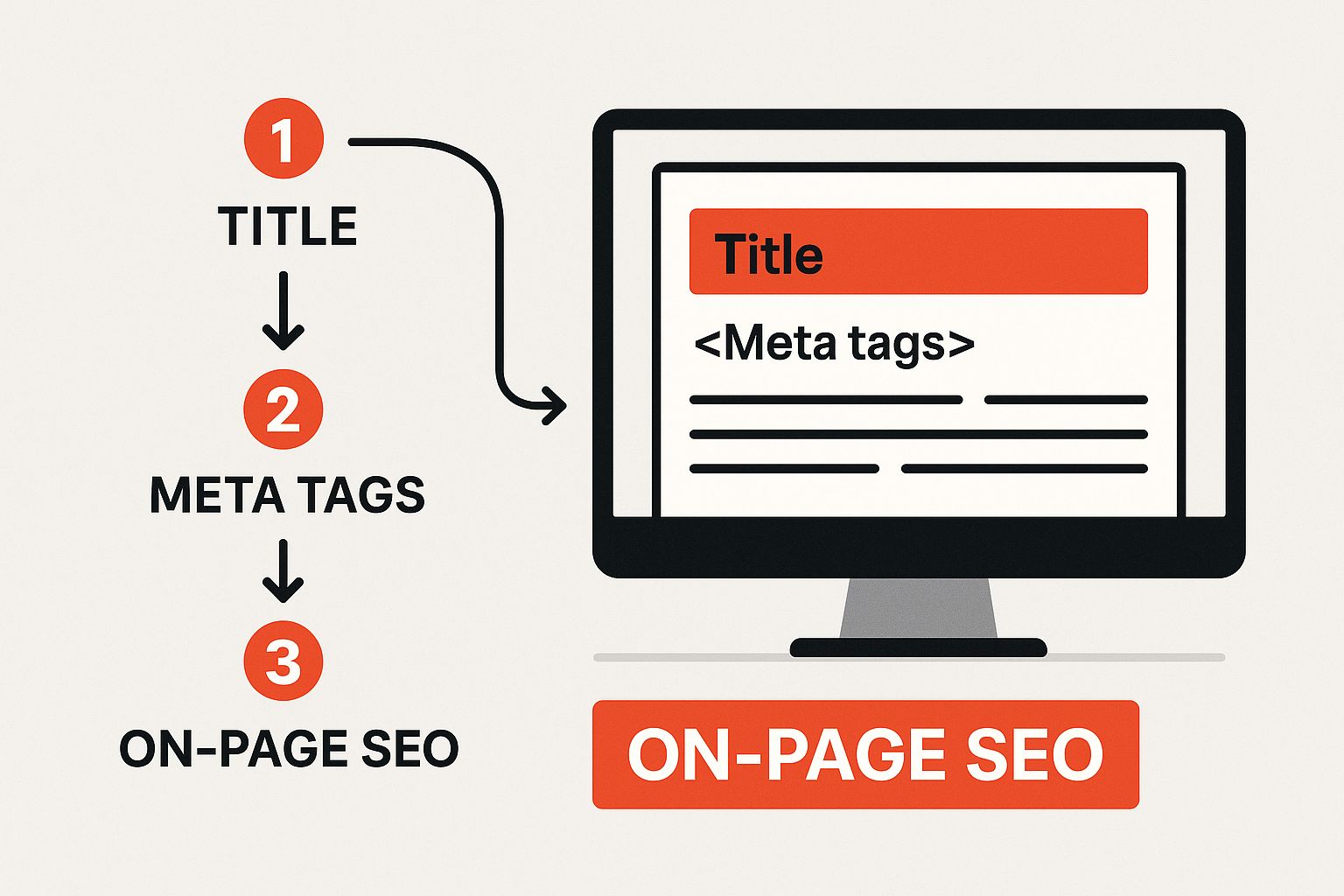
As the image shows, getting basics like your title tags and meta descriptions right is fundamental for telling search engines what your page is about.
Build Local Authority with Citations and Reviews
Finally, you need to cement your business’s credibility and geographic relevance across the web. You do this through two main activities: building citations and managing your reviews.
Citations are simply mentions of your business’s Name, Address, and Phone number (NAP) on other websites. Think of them as digital references. The best ones come from well-known Australian directories like Yellow Pages, TrueLocal, and other industry-specific sites.
Consistency here is absolutely critical. Your NAP details have to be identical everywhere—from your GBP to your Facebook page to the smallest online directory. Even a small inconsistency can confuse search engines and water down your local authority.
At the same time, you need to be actively encouraging and managing customer reviews. Reviews are a huge ranking factor for the Local Pack and an even bigger driver of customer trust. A steady stream of recent, positive reviews tells both Google and potential customers that you deliver a great service. Make sure you respond to all of them, good and bad; it shows you care.
Optimising Your Website for Search Engines
With your Google Business Profile tuned up, it’s time to shift focus to your most valuable digital asset: your website. If your GBP is your digital shopfront window, think of your website as the flagship store itself. On-page SEO is how you organise that store, making it incredibly easy for customers and Google to find exactly what they’re looking for.
This isn’t about getting bogged down in complicated code or technical wizardry. It’s about clarity and structure. Think of it this way: your page titles are the main signs for each department, your headings are the aisle markers, and your content is the friendly, knowledgeable staff ready to answer any question.
Crafting Titles and Descriptions That Earn Clicks
Your title tag and meta description are the very first things a potential customer sees in Google’s search results. They are your digital handshake, your 3-second elevator pitch to convince someone that your page has the answer they need. Their one job? To earn the click.
A great title tag is clear, concise, and includes your main keyword. A compelling meta description then expands on that, offering a benefit or a compelling reason to choose your link over the ten others on the page. It’s your prime real estate to stand out in a crowded list.
For instance, a generic title like “Plumbing Services” is forgettable and easily ignored. But something like “24/7 Emergency Plumber in Newcastle | Fast & Reliable” speaks directly to a customer’s urgent need and location, making it far more likely to get the click.
Structuring Content for Clarity and SEO
Once a visitor lands on your page, the content needs to deliver on the promise your title just made. The best way to do this is with a logical structure, using headings to break up the text and guide the reader through the information.
Search engines use these headings (H1, H2, H3, etc.) to understand the hierarchy and main topics of your page. A well-organised page isn’t just easier for people to read; it’s easier for search crawlers to understand, too.
- H1 (Main Title): You should only have one H1 per page. This is the big kahuna – the main title of your page or blog post, and it should contain your primary keyword.
- H2 (Subheadings): Use these to break up major sections of your content. They should be descriptive and are a great place to include secondary, related keywords.
- H3 (Sub-subheadings): Use these to further break down points within your H2 sections, making long or complex topics much more digestible.
This clear structure is a simple win. It improves readability and helps Google rank your content for more specific queries, a key part of effective SEO for small businesses.
Creating Content That Solves Problems
Honestly, the most powerful form of on-page SEO is creating genuinely helpful content. For most businesses, a blog is the single best tool for the job. Every article you publish is another fishing line in the water, another chance to rank on Google for the questions your customers are actually asking.
Think about the common problems and questions your customers bring up. Do they ask about costs, processes, or how to choose the right product? Each one of those questions is a golden blog post topic just waiting to be written.
By creating content that directly answers customer pain points, you do more than just improve your SEO. You build trust and establish your business as a go-to authority in your industry.
When you consistently provide valuable answers, people start to see you as the expert. This authority is a powerful driver of both traffic and sales. After all, once you’ve shown someone how to solve their problem, they’re much more likely to choose you when they need to buy. This is a fundamental way you can improve conversion rates on your website.
Optimising Images for Speed and Context
Finally, don’t neglect your images. This is a classic mistake. Large, unoptimised image files can dramatically slow down your website’s loading speed, which is a massive factor in both user experience and SEO rankings. Slow sites frustrate visitors and send them clicking the ‘back’ button in a heartbeat.
Before you upload any image to your website, make sure to follow these three simple steps:
- Resize it: Crop and resize the image to the actual dimensions it will be displayed at on the page. Don’t upload a giant 4000-pixel photo if it’s only going to show up as a small thumbnail.
- Compress it: Use a free online tool like TinyPNG or a website plugin to shrink the file size, often without any noticeable loss in quality.
- Name it descriptively: Instead of letting it be “IMG_1234.jpg,” name the file something that describes what’s in the image, like “emergency-plumber-ballarat-van.jpg.” This gives search engines extra context about your page’s content.
These simple, practical on-page SEO changes are entirely within your control. By optimising these elements, you turn your website from a simple digital brochure into a powerful, 24/7 tool for attracting and converting customers.
Staying Ahead With AI and Voice Search
The way your customers find you online is always in flux. Right now, two of the biggest shifts are the rise of AI-powered search results and the explosion of voice search on phones and smart speakers. For a small business, this isn’t about chasing the latest trend—it’s about making sure you’re still visible where it counts.
Think about it. People don’t talk to their devices the way they type into Google. A typed search is usually short and to the point, something like “plumber Sydney.”
But a voice search is far more natural, more conversational. Someone is much more likely to ask their smart speaker, “Hey Google, who is the best emergency plumber in Sydney?” This move toward full-sentence questions completely changes the game for your SEO strategy.
Answering the Questions People Are Actually Asking
To catch this growing wave of voice traffic, your website needs to give direct, clear answers to these conversational queries. It’s not enough to just list your services anymore. You have to get inside your customer’s head, figure out the specific questions they have, and create content that answers them head-on.
This is where a detailed Frequently Asked Questions (FAQ) page becomes one of your most powerful tools. By building out a solid FAQ section, you create dedicated content that perfectly matches the long, question-based phrases people are speaking into their devices.
Just think about the questions you get asked every single day over the phone or by email:
- “How much does it cost to fix a leaking tap?”
- “Do you offer weekend appointments in the Northern Beaches?”
- “What are the signs I need a roof repair?”
Each one of these is a golden opportunity for an FAQ entry. Answering them helps you show up for these highly specific, ready-to-act searches.
Structuring Your Content for Voice and AI
Beyond just an FAQ page, it’s vital to structure all your content so it can be easily digested by both people and search engines. Using clear headings and short, punchy paragraphs helps AI tools quickly pull out the key information on your page.
This approach doesn’t just help with your traditional search rankings. It also massively boosts your chances of being featured in “rich results” like featured snippets—those answer boxes that pop up right at the top of Google. In many cases, these are the exact answers that voice assistants read aloud.
To optimise for voice search, focus on providing the single best answer to a specific question. Structure your content clearly so that a search engine can easily pull out a concise, helpful response.
This proactive approach is becoming non-negotiable as more small businesses get serious about their online presence. A recent study of 700 Australian SMEs found that 36% are now actively investing in SEO to connect with local customers. With roughly one-third of Aussies using voice search daily—often for local services—tailoring your content to answer questions is a key way to stand out. You can dive into more data on local search trends in Australia on redsearch.com.au.
Adapting your SEO for small businesses to embrace AI and voice search isn’t about some massive overhaul. It’s a subtle but critical pivot. It’s about creating content that feels more natural, conversational, and genuinely helpful, ensuring you meet your customers exactly where they are.
How to Measure Your SEO Success
Pouring your time and energy into SEO without tracking the results is like driving with your eyes closed. You’re moving, sure, but are you getting anywhere? You need to know if your strategy is actually working.
The good news is you don’t need a complicated analytics setup to figure this out. A couple of powerful, free tools from Google are all you need to get started.
Getting a handle on a few key metrics will help you make smarter marketing decisions, prove your return on investment, and even spot new opportunities for growth. This isn’t about getting lost in data; it’s about focusing on the numbers that truly matter to a small business.
Key Tools for Your SEO Toolkit
To measure the success of your SEO for small businesses, you’ll mostly be using two platforms.
- Google Search Console (GSC): Think of this as your direct line of communication from Google. It shows you which keywords people are using to find your site, how often you appear in search results (impressions), and how many of those people click through to your site (clicks).
- Google Analytics 4 (GA4): This tool picks up where GSC leaves off, telling you what happens after someone lands on your website. It tracks how many visitors you get from search engines (organic traffic), which pages they visit, and how long they stick around.
These two work together to paint the full picture. GSC tells you how you’re doing on Google’s search results page, and GA4 shows you what those visitors do once they’re on your actual site.
The goal of measurement isn’t just to see numbers go up. It’s to understand the story those numbers are telling about your customers and your business.
Metrics That Actually Matter
Forget about vanity metrics. For a small business, SEO success really boils down to a handful of key performance indicators (KPIs) that show you’re attracting the right kind of attention.
- Organic Traffic: This is the number of visitors who land on your website from a non-paid, organic search result. A steady increase in organic traffic over time is the clearest sign your SEO efforts are paying off. Simple as that.
- Keyword Rankings: Inside GSC, you can keep an eye on your average ranking position for your most important keywords, like “electrician in Geelong.” Seeing these rankings climb means you’re becoming more visible to the exact people you want to reach.
- Click-Through Rate (CTR): This is the percentage of people who see your website in search results and actually click on it. A healthy CTR suggests your page titles and meta descriptions are doing their job—they’re compelling, relevant, and stand out from the crowd.
- Local Pack Performance: For any business with a physical location, tracking actions from your Google Business Profile is absolutely crucial. You need to know how many people are clicking to call, requesting directions, or visiting your website directly from your local listing. These are often your hottest leads.
Tracking these KPIs gives you a clear, no-nonsense view of your progress. If you want to take a deeper look at evaluating your marketing efforts, you can learn more about how to measure advertising effectiveness in our related guide.
Common Questions About Small Business SEO
Diving into the world of SEO can feel like learning a new language, and it’s natural to have a few questions. As a small business owner, you’re probably wondering where to start and what to really expect. Let’s tackle some of the most common queries we hear from people just like you.
How Long Does SEO Take to Show Results?
This is the big one, isn’t it? Unlike flicking a switch on paid ads for instant traffic, SEO is more like planting a garden. You’ve got to prepare the soil, plant the seeds, and nurture them before you see any growth.
Generally, you can expect to see some early signs of life—a bit of movement in your rankings—within three to six months. But for the kind of significant, business-changing results that bring in consistent leads, you’re usually looking at a timeline closer to six to twelve months. This all depends on things like how competitive your industry is, where you’re starting from, and how consistently you work at it. Patience and steady effort are your best friends here; the results truly do compound over time.
Can I Do SEO Myself?
Absolutely. Plenty of the foundational pieces of SEO for small businesses are well within reach for a savvy business owner. You can definitely handle things like optimising your Google Business Profile, doing some basic local keyword research, and writing genuinely helpful blog posts for your customers.
The trick is not to try and boil the ocean. Start small and focus on getting the fundamentals right, just like we’ve covered in this guide. Nail one thing at a time—whether that’s perfecting your on-page SEO or building out a solid review strategy—and you’ll make real progress without getting bogged down.
How Much Does SEO Cost?
The cost of SEO is all over the map. If you take the DIY route, your biggest investment is your time and energy. If you decide to bring in a freelancer or an agency, you could be looking at anything from a few hundred to several thousand dollars a month, depending on what you need done.
The most important shift in thinking for a small business is to see SEO not as a cost, but as an investment. Good SEO builds a tangible asset for your business—one that keeps generating leads and customers for years to come, delivering one of the best returns you can get in marketing.
What’s More Important On-Page or Off-Page SEO?
It’s a classic question, but it’s not really an either/or scenario. Think of them as two sides of the same coin; you need both for it to have any value.
On-page SEO—all the stuff on your actual website like content and structure—is your foundation. Without a solid, well-optimised site, all your other efforts are built on sand and will eventually crumble.
Then comes off-page SEO—things like getting customer reviews and building local citations. This is what builds your website’s authority and signals to Google that your well-built site is also trustworthy and relevant in your community. You really do need both to win. Start by pouring a strong on-page foundation, then build on it with your off-page efforts.
Ready to stop guessing and start growing with precision-driven advertising? Click Click Bang Bang creates data-focused campaigns that get real results. Explore our PPC management plans at https://clickclickbangbang.com.au.
Read NeXt
Or Read Our Latest
- Manual vs Automated Bidding for PPC Success
- Conversion Tracking Setup: A Complete AU Guide
- Instagram Advertising Australia: Complete 2026 Guide
- Pay Per Click: A Beginner’s Guide for Australian Marketers
- Display Advertising on Google: The Complete Australian Guide
- Stakeholder Communication Plan How to Build One That Works
Click. CLick. Subscribe.
Get our best PPC insights, industry updates, and power moves delivered straight to your inbox. No fluff, just high-caliber strategies that actually work.
Don’t Leave Just Yet
Try Us For 30-Days,
Risk Free!!
We guarantee that you’ll love our work within the first 30 days, if not you’ll get your money back.
What have you got to lose?