

Search Ads Optimisation: A Practical Guide for 2026
Last Updated

Australia's search advertising market reached a record AUD 8.0 billion in 2025, accounting for 43.8% of total internet advertising expenditure, with the category growing 11.5% year on year, according to IAB Australia's reported Internet Advertising Revenue data. That scale changes the optimisation question. Search ads optimisation isn't mainly about finding a slightly cheaper click. It's about securing the right share of eligible auctions, then ensuring Google receives clean enough conversion signals to value the traffic properly.
Australian advertisers also operate in a noisy, policy-sensitive environment. Google reported 438.6 million ads removed and 594,000 advertiser accounts suspended in Australia in 2025, as documented in its Australian Ads Safety Report. The practical response is a disciplined system that connects query intent, ad rank, creative breadth, landing page experience, bidding, and measurement quality.
Why Search Ads Optimisation Starts with Auction Mechanics
A bid is only one input into the auction. Google evaluates the bid alongside expected click-through rate, ad relevance, landing page experience, and the expected impact of ad assets before determining whether an ad appears and where it appears. The Google Ads explanation of ad position and auction metrics shows why visibility should be managed as a share-of-voice problem, not a bid problem.
Google's auction is often described as second-price. In practical terms, the advertiser's final cost depends on the competitive threshold required to retain a position, rather than automatically equalling the maximum bid. A higher bid can help, but weak relevance or a poor post-click experience can still restrict rank and inflate the price required to compete.
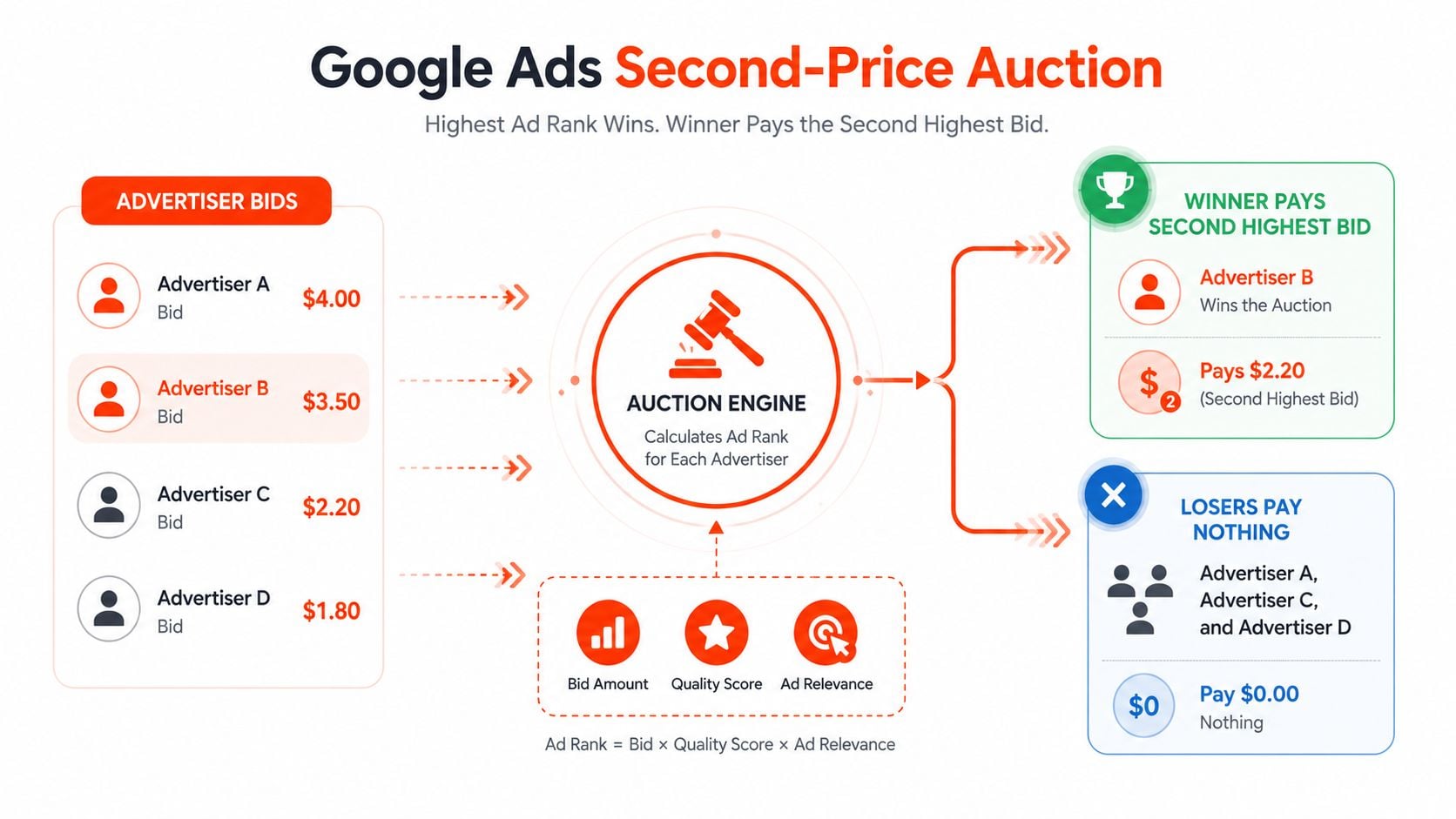
Treat every query as a micro-auction
A campaign doesn't face one uniform auction. Search terms create different competitive environments according to intent, device, location, audience context, and time. A Sydney search for a commercial service can behave differently from a regional search, just as Melbourne retail demand can produce a different auction mix from a national campaign.
That's why an account can show acceptable average CPC while losing valuable visibility in a profitable segment. A blended average conceals the auctions where the business needs stronger rank, better relevance, or a more compelling offer.
Practical rule: Before changing bids, identify which eligible auctions matter commercially and determine whether the account is losing them because of budget, rank, relevance, or conversion quality.
The optimisation sequence should therefore strengthen the inputs Google can evaluate. Start with intent and query control, improve ad relevance and asset coverage, fix landing page friction, choose bidding based on signal maturity, and then validate whether reported conversions represent valuable business outcomes.
For a broader practitioner perspective on account structure and testing, the Sprints & Sneakers paid search optimisation resource is useful context. Advertisers who want a deeper explanation of how bid, quality, and assets interact can also review this guide to the Google Ads Ad Rank formula.
Building a Keyword Strategy That Matches Intent
Keyword research should begin with the customer's job, not a list of phrases. An informational search asks for understanding, a commercial search evaluates options, and a transactional search signals readiness to act. Each intent needs a different ad promise, landing page, and conversion expectation.
Consider an Australian fashion retailer. “Linen dresses Australia” may combine product discovery with location relevance, so the ad should lead to a tightly filtered category page with Australian currency, delivery information, and clear product availability. A generic homepage wastes the intent already expressed in the query.
A B2B example is “payroll software for accountants”. That search contains a defined audience and use case. The strongest destination is likely a page built for accountants, with workflow details, integration information, proof, and a qualification path. Sending that visitor to a broad software homepage forces them to reconstruct the relevance the campaign should have provided.
Build groups around commercial meaning
Group terms when they share the same message and destination. Separate brand, generic category, competitor, location, and use-case themes when the offer or landing page needs to change. Add negative keywords continuously, especially after reviewing search terms for research queries, employment searches, free tools, support requests, and audiences outside the service area.
Match types now provide guidance rather than acting as perfectly sealed containers. Exact match remains useful for high-value terms that need close scrutiny, phrase match can capture controlled variations, and broad match can discover demand when audience signals, conversion tracking, and exclusions are reliable.
| Match Type Behaviour in 2026 | Best Use Case | Risk Level |
|---|---|---|
| Exact match | High-value queries with strict commercial control | Lower |
| Phrase match | Intent themes with managed variation | Moderate |
| Broad match | Discovery and scale with strong conversion signals and negatives | Higher |
The right choice depends on the account's ability to judge traffic quality. A broad strategy with polluted conversions can teach automation to pursue cheap but unqualified actions. A tightly restricted exact structure can protect efficiency but miss valuable language and emerging demand.
Use the Google Ads keyword research guide as a practical reference for building themes, reviewing search terms, and connecting keywords to landing pages. The key principle is simple: organise campaigns around intent that changes the buying experience, not around superficial variations of the same phrase.
Quality Score and the True Cost of a Click
Quality Score is a diagnostic, not a trophy. Its three familiar inputs, expected click-through rate, ad relevance, and landing page experience, show where the auction is receiving weak evidence that the ad will help the searcher.
Expected click-through rate reflects how compelling the ad is likely to be for the query and context. A keyword alone cannot produce a strong result. The advertiser still needs a clear value proposition, language that matches the search, and assets that give the user a reason to choose the ad.
Ad relevance measures whether the message answers the intent behind the query. A retailer targeting a specific product category should make that category obvious. A professional services advertiser should avoid forcing unrelated services into one responsive search ad structure.
Landing page experience completes the chain. The page should load reliably on mobile, repeat the relevant promise, make the next step obvious, and provide enough information for the visitor to act with confidence. Faster pages will not rescue an unclear offer, and persuasive copy will not compensate for a broken form.
| Quality Score Input Matrix | What It Measures | Optimisation Lever |
|---|---|---|
| Expected click-through rate | Likelihood of a click in the relevant auction | Test benefits, specificity, offers, and intent-led headlines |
| Ad relevance | Alignment between query, ad message, and theme | Tighten grouping and write directly to the searcher's need |
| Landing page experience | Relevance, usability, transparency, and post-click quality | Improve message match, mobile usability, speed, trust, and conversion paths |
Australian benchmark data for Google Search ads places stronger accounts around 4.0% average CTR, with top-quartile performance above 6.5%, average CPC around A$2.10, and conversion rate near 4.6%. Bottom-quartile CPC can exceed A$3.10, while conversion rate can fall below 2.0%, according to CM Beyer's Australian Marketing Benchmarks.
These figures are reference points, not universal targets. They show why auction participation and signal quality must be assessed together. A conversion-rate improvement can reduce acquisition cost directly, while a small CPC reduction may have little effect if the landing page still converts poorly.
Fix the weakest quality input before treating bid changes as the primary answer. Reliable conversion signals also matter, because post-privacy measurement leaves automation dependent on the quality and consistency of the evidence it receives. The practical goal is stronger share of voice from useful, commercially relevant signals, not a higher Quality Score in isolation.
Choosing Between Manual, Automated, and Portfolio Bidding
Bidding strategy should follow signal maturity. Manual CPC can suit a tightly controlled lead-generation account with a monthly budget under $2,000, particularly when conversion volume is limited or lead quality varies sharply. It gives the strategist room to protect priority terms and restrict exposure while tracking is repaired.
Enhanced CPC can provide a transitional approach, but it still relies on usable conversion data. Automated strategies such as Maximise Conversions and Maximise Conversion Value can work well when the account supplies consistent, meaningful actions. Target CPA and target ROAS need even more stability because the system is being asked to optimise towards an economic constraint, not just collect conversions.
The operational guidance in the table below uses the thresholds supplied in the brief. They're decision aids, not universal guarantees.
| Bidding Strategy Selection Matrix | Best For | Min Conv/Month | Risk Level |
|---|---|---|---|
| Manual CPC | Controlled budgets, concentrated lead generation, incomplete signals | Not required | Lower |
| Enhanced CPC | Transitional accounts with some reliable conversion history | Not fixed | Moderate |
| Target impression share | Visibility objectives for defined brand or priority coverage | Not required | Moderate |
| Maximise Conversions | Accounts seeking volume with stable tracking | Not fixed | Moderate to high |
| Target CPA | Mature lead-generation campaigns with consistent conversion quality | 30 | High if signals are weak |
| Maximise Conversion Value or target ROAS | E-commerce or value-based accounts with dependable revenue data | 30 | High if values are incomplete |
| Portfolio bidding | Multiple campaigns that can share reliable signals | Strategy dependent | Moderate to high |
Switching too early to automation often starves the system of trustworthy feedback. Post-privacy measurement makes that problem harder because fewer observable interactions and inconsistent imported outcomes can distort the model's view of value.
For practical configuration considerations, the Growth 4 Trades Google Ads settings guide offers a useful operational reference. Teams assessing target CPA should also review the target CPA bidding guide before making a strategy change.
Diagnosing Visibility with Impression Share Signals
Impression share tells you how much of the eligible search opportunity your ads captured. It becomes useful when read alongside the reasons for lost visibility. Google Ads exposes six core auction signals, including impression share, overlap rate, outranking share, position above rate, top of page rate, and absolute top of page rate, as described in Google's Australian support documentation.
Use the metrics diagnostically:
- Search impression share shows the portion of eligible impressions received.
- Lost impression share due to budget indicates that budget limits prevented participation.
- Lost impression share due to rank indicates that ad rank restricted eligibility or position.
- Top impression share shows performance among first-page placements.
- Absolute top impression share focuses on the highest position.
- Overlap, outranking, and position-above metrics describe how competitors appear alongside or above your ads.
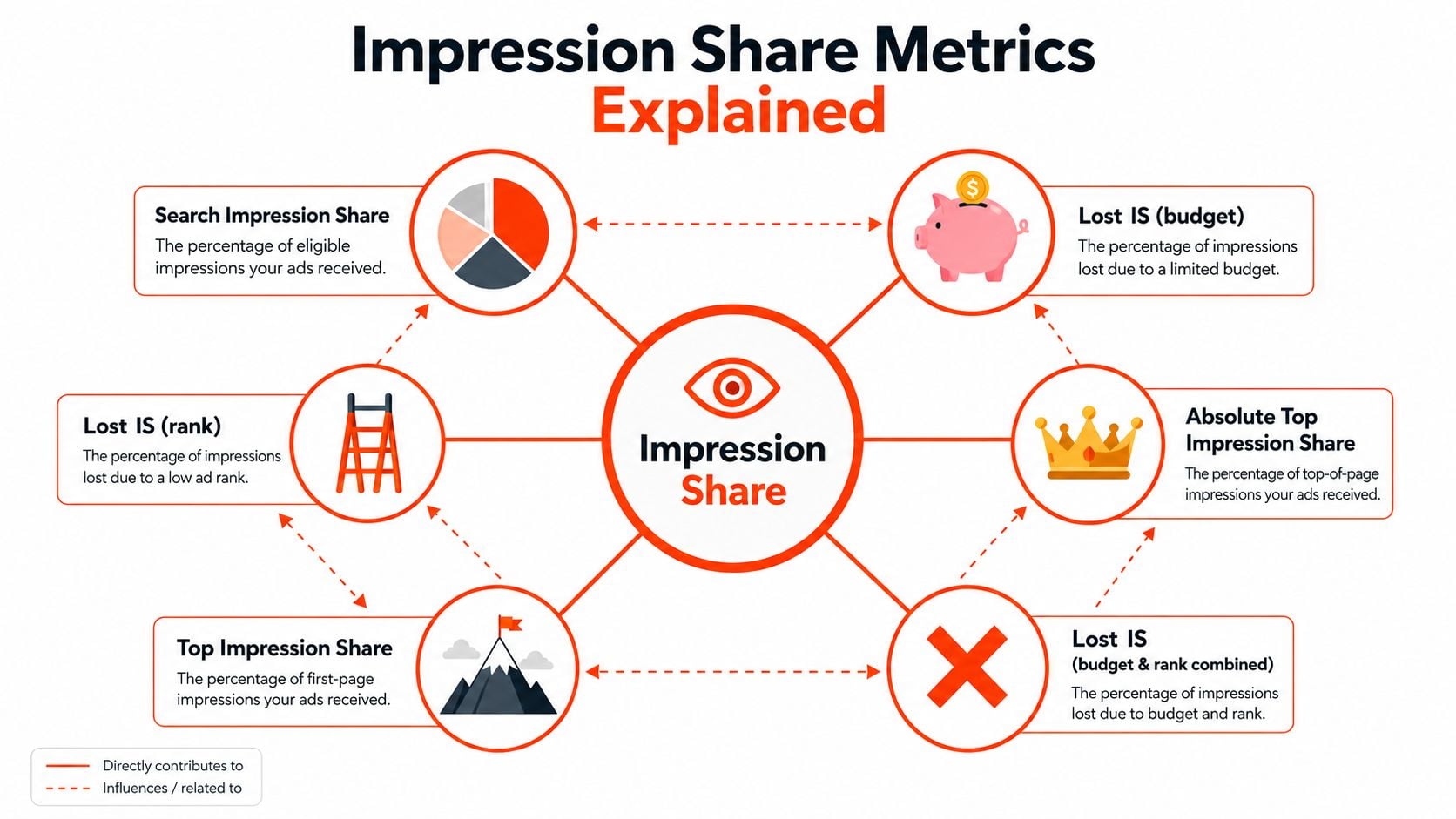
Separate budget problems from rank problems
If lost impression share due to budget dominates, more budget may create additional coverage, assuming the traffic converts profitably. If lost impression share due to rank dominates, raising the budget won't solve the underlying auction weakness. Review expected CTR, relevance, assets, landing page experience, and bids before increasing spend.
Segment the diagnosis by campaign, search term theme, device, location, and time. A national average may hide a strong metropolitan campaign and a weak regional one, or a profitable product category competing against an inefficient category under the same budget.
The useful question isn't “How do we get more impressions?” It's “Which valuable impressions are we losing, and what prevents us from winning them?”
Competitor metrics add context but not a complete explanation. A high outranking share can coexist with poor commercial performance if the campaign is winning low-value searches. Treat visibility as a means to reach qualified demand, not as the final KPI.
Ad Copy, Responsive Assets, and Extensions Working Together
Responsive search ads work best as an asset system. Headlines establish relevance and differentiation, descriptions handle objections and explain the next step, while sitelinks, callouts, structured snippets, image assets, and price assets expand the information available on the results page.
Start with distinct message roles rather than writing near-duplicates. Useful roles include the product or service, the customer problem, the differentiator, proof, commercial terms, and the call to action. For Australian campaigns, use AUD pricing where appropriate, explain delivery or service coverage clearly, and avoid claims that create compliance uncertainty.
Pinning should be reserved for language that must appear in a defined position, such as legally required wording or a critical qualification. Excessive pinning reduces the system's ability to combine assets across queries. Let optional messages rotate, then use asset performance and search-term context to decide what deserves another iteration.
A practical creative review asks:
- Relevance: Does the ad reflect the exact problem or product category?
- Specificity: Does it give the searcher a reason to choose this advertiser?
- Coverage: Do the assets address price, delivery, proof, features, and next steps?
- Compliance: Are qualifications, GST treatment, availability, and claims accurate?
- Destination: Does every prominent promise appear on the landing page?
Extensions shouldn't be treated as decorative extras. Sitelinks can route users to financing, delivery, contact, or product collections. Callouts can clarify service conditions. Structured snippets can make categories or capabilities scannable. Price assets can qualify traffic before the click, which may reduce volume while improving commercial fit.
Review creative in cycles, not after every fluctuation. A single asset impression pattern rarely proves that the message is universally stronger. Look for consistent evidence across relevant queries, destinations, and conversion outcomes, then replace the weakest message with a materially different idea.
Landing Page Experience and Conversion Rate Optimisation
The landing page is where auction promise becomes business evidence. Google evaluates the page's relevance and usability, while the customer decides whether the offer feels credible, clear, and easy to accept. That makes post-click quality both a conversion issue and an input into future search ads optimisation.
Message match should be immediate. If the ad promotes payroll software for accountants, the page headline should identify that audience and use case instead of forcing visitors to interpret generic software language. Product pages should make the searched category, price, availability, delivery conditions, and returns information easy to find.
Prioritise tests by commercial impact
Test the elements closest to the decision first:
- Hero message: Match the headline and first-screen value proposition to the query.
- Call to action: Make the next action specific, visible, and appropriate to the buying stage.
- Form friction: Remove fields that sales or fulfilment doesn't need immediately.
- Trust signals: Add relevant testimonials, security information, credentials, guarantees, and business details.
- Pricing and delivery: Show currency, shipping thresholds, service areas, and important conditions clearly.
- Mobile experience: Check tap targets, layout, loading behaviour, and form usability on real devices.
Australian businesses should use locally relevant evidence where it helps the decision. That can include Australian delivery expectations, local service coverage, ABN details, applicable industry credentials, and transparent GST treatment. A trust badge has value only when visitors understand what it verifies.
Run controlled A/B tests or ad-driven experiments with a defined hypothesis. Changing a button colour without understanding the bottleneck may move a surface metric while leaving revenue unchanged. Prioritise tests that affect offer clarity, qualification, friction, and confidence before cosmetic adjustments.
The post-click experience also feeds the account's signal quality. Stronger engagement and better conversion evidence can support more informed optimisation, but the relationship isn't automatic. A fast page with an unclear proposition still fails the customer.
Measurement Hygiene and KPIs That Matter
Measurement hygiene often has more impact than micro-bid adjustments. If Google receives duplicate leads, unqualified form fills, inflated purchase values, or imported conversions with incorrect timing, automated bidding can optimise efficiently towards the wrong outcome.
Audit the full path from click to commercial result. Check GA4 configuration, Google Ads conversion actions, enhanced conversions, server-side tagging where appropriate, CRM imports, offline qualification events, consent handling, and deduplication. First-party data can improve continuity, but it cannot correct a poorly defined conversion.
Last-click attribution creates a serious blind spot. Brand searches, remarketing audiences, and returning users may receive credit for demand created elsewhere. Search can remain valuable while platform-reported conversions overstate its incremental contribution, particularly in markets where brand demand already captures substantial attention.
Use a KPI hierarchy
| KPI Hierarchy for Search Ads Optimisation | Primary KPI | Secondary KPI | Validation Source |
|---|---|---|---|
| E-commerce growth | Contribution-aware acquisition cost or profit-based value | Conversion rate, average order value, impression share lost to rank or budget | Shopify or commerce platform, finance data, controlled tests |
| Lead generation | Cost per qualified lead or sales-accepted opportunity | Lead-to-sale rate, response time, search-term quality | CRM, sales pipeline, offline conversion imports |
| Brand coverage | Qualified impression share in priority themes | Top and absolute top impression share, competitor overlap | Google Ads, search-term and auction analysis |
| Local services | Cost per qualified enquiry | Location quality, call quality, booked-job rate | CRM, call tracking, booking system |
Platform conversions become more reliable when the action is deduplicated, tied to a meaningful business event, and reconciled against an external system. Require third-party validation when lead quality varies, sales cycles are long, revenue values are estimated, or brand demand may dominate reported performance.
Incrementality testing matters because scale can conceal weak attribution. Holdout tests, geo experiments, and carefully designed campaign pauses can show whether search generated additional demand or captured demand that was already likely to convert. This distinction matters when evaluating share of voice, especially after privacy changes reduce user-level visibility across the journey.
Advertisers reviewing commercial assumptions can use the Lead Printer's ROI Calculator as a planning aid, then check its output against CRM outcomes and actual margins. A calculator can structure the conversation. It cannot replace clean conversion definitions.
The operating principle is signal quality before bid sophistication. Improve the data, then assess visibility, traffic, conversion quality, and commercial value together. That approach makes search ads optimisation a durable growth process rather than a sequence of reactive account changes.
Click Click Bang Bang helps Australian businesses connect Google Search strategy with keyword structure, ad assets, landing page experience, conversion tracking, and performance reporting. If your account is losing valuable visibility or optimising towards unreliable leads, visit Click Click Bang Bang to discuss a measurement-led PPC programme built around your commercial goals.
Read NeXt
Or Read Our Latest
- Search Ads Optimisation: A Practical Guide for 2026
- Manual vs Automated Bidding for PPC Success
- Conversion Tracking Setup: A Complete AU Guide
- Instagram Advertising Australia: Complete 2026 Guide
- Pay Per Click: A Beginner’s Guide for Australian Marketers
- Display Advertising on Google: The Complete Australian Guide
Click. CLick. Subscribe.
Get our best PPC insights, industry updates, and power moves delivered straight to your inbox. No fluff, just high-caliber strategies that actually work.
Don’t Leave Just Yet
Try Us For 30-Days,
Risk Free!!
We guarantee that you’ll love our work within the first 30 days, if not you’ll get your money back.
What have you got to lose?