

How to Choose an SEO Outsourcing Company That Delivers Results
Last Updated

So, what exactly is an SEO outsourcing company? Think of them as a specialised agency you bring on board to manage and execute your entire search engine optimisation strategy.
When you partner with one, your business gets immediate access to expert knowledge, advanced tools, and proven processes—all without the hefty cost and lengthy process of building an in-house team from scratch. For many businesses, it’s the single most effective move to accelerate online growth and visibility.
Why Outsourcing SEO Is a Smart Business Move

Deciding to hand over your SEO is much more than just a cost-saving exercise; it’s a strategic play to gain a serious competitive edge. Let's be honest, modern SEO is an incredibly complex beast. It's a multi-faceted discipline that demands constant attention and a diverse skill set that you're almost never going to find in a single employee.
Many businesses find themselves constantly playing catch-up with Google's relentless algorithm updates, which can roll out hundreds of times a year. What worked yesterday might get you penalised today, and just staying on top of these changes is a full-time job. This is where the value of a dedicated, expert team becomes crystal clear.
Access Specialised Expertise Instantly
When you partner with an SEO outsourcing company, you’re not just hiring one person; you’re tapping into an entire team of specialists. This usually includes a mix of:
- Technical SEO Experts: The pros who get into the weeds of site speed, schema markup, and crawlability issues that can absolutely tank your rankings if ignored.
- Content Strategists: These are the planners who identify high-value topics and map out content that actually attracts and engages the people you want to reach.
- Link-Building Specialists: Experts focused on the critical task of acquiring high-quality backlinks to build your site's authority and credibility in Google's eyes.
- Data Analysts: The people who dive into the metrics to figure out what’s working, what isn’t, and how to refine the strategy to deliver tangible ROI.
This collective brainpower ensures your strategy is well-rounded and robust. An in-house generalist might have a bit of knowledge in each area, but a good agency brings deep, specialised experience from solving complex challenges for dozens of clients across various industries.
Partnering with an SEO agency isn't about just delegating tasks. It's about bringing on a dedicated growth partner whose success is directly tied to yours. It’s what enables your business to scale effectively in a very crowded market.
Gain a Strategic Advantage
Ultimately, outsourcing frees you up to focus on your core business—the things you actually do best. While you’re concentrating on product development, customer service, and sales, your SEO partner is dedicating their entire day to driving qualified organic traffic to your website.
They also show up on day one with an arsenal of expensive, state-of-the-art tools for keyword research, competitor analysis, and performance tracking. For most individual businesses, the cost of these tools alone would be prohibitive.
This immediate access to advanced tech and a team of seasoned professionals gives you a massive advantage, allowing you to compete with much larger players in your industry and see measurable results much faster than you could on your own.
Getting Your Ducks in a Row Before You Outsource
Jumping into conversations with an SEO agency without doing your homework is a bit like going grocery shopping hungry and without a list—you’ll probably spend too much and forget what you actually came for. Before you even think about sending that first enquiry, you need to get your internal house in order.
This isn’t about becoming an SEO expert overnight. It’s about figuring out what success actually looks like for your business. This way, you can clearly explain your needs and properly judge whether an agency is the right fit to get you there. A solid foundation prevents crossed wires down the line and sets the stage for a partnership that actually works.
Define Business Goals, Not Just SEO Metrics
This is the most common mistake I see. A business tells an agency, "We want more traffic," or "We need to rank number one for this keyword." While those are parts of the SEO puzzle, they are not business goals. Any top-tier SEO company will immediately steer the conversation back to what you're really trying to achieve.
Instead of vague wishes, get specific about the commercial outcomes you need. Think in terms of real-world results that hit your bottom line.
- Lead Generation: Do you need to increase qualified sales leads from organic search by 25% in the next six months?
- E-commerce Sales: Is the goal to boost online revenue from non-branded organic traffic by 40% over the next financial year?
- Market Share: Are you aiming to capture a specific percentage of search visibility against your top three competitors?
Having these clear, measurable objectives turns the discussion from abstract SEO tasks into a strategic conversation about business growth.
Settle on a Realistic Budget
Budget talks can be awkward, but they’re non-negotiable. Being upfront about what you can invest helps filter out agencies that aren't a good fit and lets potential partners tailor a realistic strategy for you. Remember, good SEO is an investment, not a cost centre.
The trend is clear: serious businesses are investing significantly, especially in competitive markets. For instance, outsourcing SEO has exploded among Australian enterprises, with a massive 75% now handing over content marketing and SEO to specialists. With nearly half (45%) of enterprise-level companies pouring over $20,000 a month into SEO, it’s obvious that the big players recognise the value. You can find more insights into enterprise SEO spending and see how others are allocating their resources.
Pro Tip: Don't just pull a number out of thin air. Work out the lifetime value (LTV) of a new customer you get from organic search. This helps you frame your SEO budget as a direct investment in revenue, which makes it much easier to justify internally.
Identify Your Key Performance Indicators (KPIs)
Once your business goals are set, the next step is to nail down the Key Performance Indicators (KPIs) that will track your progress. These are the specific metrics that actually matter, moving you beyond vanity numbers like total traffic.
Here’s how goals and KPIs should connect:
| Business Goal | Primary KPI | Secondary KPIs |
|---|---|---|
| Increase Sales Leads | Number of Marketing Qualified Leads (MQLs) from Organic Search | Conversion Rate on Key Landing Pages, Keyword Rankings for "Bottom of Funnel" Terms |
| Boost E-commerce Revenue | Total Revenue from Organic Channel | Average Order Value (AOV), Non-Branded Keyword Traffic, Cart Abandonment Rate |
| Improve Brand Authority | Branded Search Volume Growth | Number of High-Authority Backlinks, Share of Voice vs. Competitors |
Having this level of clarity is crucial. It ensures both you and your future agency are looking at the same scoreboard and agree on what a "win" looks like. It also stops agencies from hiding poor performance behind irrelevant metrics. When you know what data truly moves the needle, you can hold your partner accountable for delivering real results.
How to Properly Vet Potential SEO Partners
You’ve got your goals mapped out and a budget in mind. Now for the make-or-break part: seeing past the slick sales presentations to find an SEO outsourcing company that can actually deliver. A killer pitch can promise the world, but real competence shows up when you start digging into their process, their thinking, and their track record. This is where you separate the true strategic partners from the task-doers.
The vetting process is your chance to really put an agency under the microscope. It’s all about asking the sharp, specific questions that reveal how deep their knowledge goes and making sure their whole approach clicks with your long-term business goals.
Let's break down how to nail this.
This checklist gives you a quick look at the core areas—goals, budget, and KPIs—that you need to have sorted before you even start the conversations.
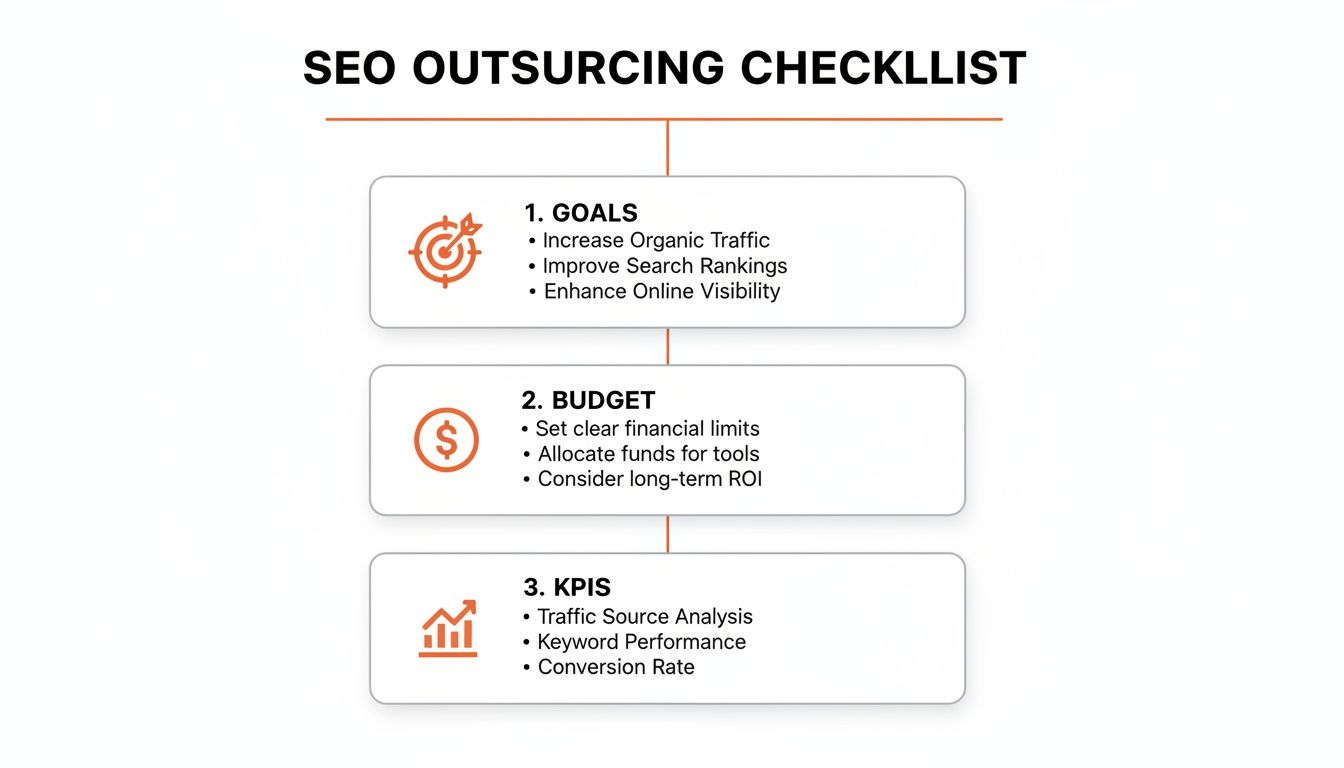
Having these elements clearly defined from the get-go means you’re judging every potential partner against the same solid, meaningful criteria. No guesswork needed.
Assess Their Technical SEO Acumen
Technical SEO is the absolute, non-negotiable foundation of any decent campaign. Simple as that. If a site isn’t crawlable, indexable, and fast, even the world's greatest content won't see the light of day on page one. You need a partner who lives and breathes the technical stuff, not just one who gets excited about keywords.
Pay attention to the language they use. Do they bring up things like:
- Core Web Vitals? They should be able to clearly explain how they'd diagnose and fix issues with Largest Contentful Paint (LCP), First Input Delay (FID), and Cumulative Layout Shift (CLS).
- Schema Markup? Ask them how they would use structured data to make your specific products or services stand out in the search results.
- Crawl Budget Optimisation? This is a huge deal for bigger websites. A competent agency will have a clear plan for making sure Googlebot crawls your most important pages efficiently.
- International SEO? If you're targeting multiple countries, they need to be fluent in
hreflangtags, ccTLDs, and the other signals needed to get it right.
A vague, waffly answer here is a massive red flag. A real expert will light up, keen to get into the nitty-gritty of a technical audit and how they’d tackle your site’s unique challenges.
Scrutinise Their Content and Link Building Philosophy
This is where you can instantly spot the difference between a high-quality agency and a low-effort content mill. The entire conversation needs to be about strategic value, not just cranking out volume. If their main pitch is "we'll write X blogs and build Y links per month," you should be very, very cautious.
When it comes to content, ask them to walk you through their process from start to finish. How do they find topics that hit that sweet spot between search intent and your business goals? Who's actually writing the content—subject matter experts or generalist writers churning out articles? A top-tier agency will be talking about creating "topic clusters" and building your site's authority around core themes, not just firing off random blog posts.
As for link building, the focus has to be on quality and relevance.
The days of mass-producing dodgy backlinks are long gone; today, that’s just a fast track to a Google penalty. Your potential partner should be talking about earning links through genuine outreach, creating link-worthy resources, and building relationships—not buying links from private blog networks (PBNs).
A great question to throw at them is, "Can you show me an example of a link you're really proud of and explain why it was so valuable for that client?" Their answer will tell you everything you need to know about their approach.
Evaluate Their Use of Data and AI
In modern SEO, data isn't just for end-of-month reports; it's the engine that drives the entire strategy. Any agency worth its salt should be able to clearly explain how they use analytics to inform every decision they make. Ask them how they’d use your Google Analytics and Search Console data in the first 30 days to spot quick wins and long-term opportunities.
On top of that, AI is becoming a bigger and bigger piece of the puzzle. You need to figure out if they’re using it as a strategic asset or just as a way to cut corners.
- Strategic Use: Using AI for deeper data analysis, spotting keyword patterns at scale, or predicting search trends.
- Cost-Cutting Use: Using AI to churn out generic, low-quality content that offers zero real value to a human reader.
Ask them straight up: "How does AI fit into your workflow, specifically for content creation and technical analysis?" Their transparency here is crucial. The goal is to find an agency that uses AI to make their experts smarter, not to replace them entirely.
To help you keep track, here’s a quick rundown of what to look for and what to run from when you’re assessing these capabilities.
Key Capabilities to Evaluate in a Potential SEO Partner
| Capability Area | What to Look For (Green Flags) | What to Avoid (Red Flags) |
|---|---|---|
| Technical SEO | Proactively discusses Core Web Vitals, schema, crawl budget, and international SEO specifics. Shows examples of technical audits. | Gives vague answers, focuses only on on-page basics, or seems dismissive of technical details. |
| Content Strategy | Focuses on topic clusters, search intent, and building authority. Can explain their process for creating expert-led content. | Pitches a set number of blog posts per month. Can't articulate how content drives business goals. |
| Link Building | Talks about "earning" high-quality, relevant links through outreach and valuable content. Can show proud examples. | Mentions PBNs, guest posting on low-quality sites, or focuses on the sheer quantity of links. |
| Data & Analytics | Explains how they'll use your GA4/GSC data to find opportunities from day one. Links SEO efforts to business KPIs. | Focuses only on vanity metrics like rankings and traffic. Reporting seems like a data dump with no insights. |
| AI & Automation | Describes using AI as a tool to enhance analysis, find patterns, and assist human experts. Is transparent about its use. | Hides their use of AI or pitches it as a way to produce massive amounts of cheap, generic content. |
Using a framework like this helps you standardise your evaluation and make a much more objective decision, ensuring you pick a partner based on substance, not just a flashy sales deck.
When you're thinking about potential SEO partners, it's helpful to understand the best practices for assessing specialised talent, much like when you're looking into hiring remote SEO experts directly. Knowing how to evaluate individual skills can really sharpen your assessment of an entire agency's team. This is just one part of a thorough evaluation; for a deeper look at what a partnership could involve, exploring professional search engine optimisation consulting services can give you a clearer picture of what true strategic collaboration looks like.
Decoding Proposals, Pricing and Contracts
An agency’s proposal is so much more than a price tag; it’s a window into their strategic thinking, confidence, and transparency. Once you start receiving proposals from potential SEO partners, you need to know how to read between the lines. This is where you’ll uncover how they value their work and, just as importantly, how they structure their partnerships.
The document should feel less like a generic quote and more like the beginning of a strategic plan, one that’s actually built for your business. A strong proposal will clearly reference the goals you talked about and outline an initial approach to get there, proving they genuinely listened.
Understanding Common Pricing Models
SEO pricing isn't one-size-fits-all, and agencies typically lean on a few common models. Each has its pros and cons, and the right one for you really depends on your budget, goals, and how you prefer to work with a partner.
- Monthly Retainer: This is the most common model you'll see. You pay a fixed fee each month for an agreed-upon scope of ongoing work. It’s predictable for budgeting and absolutely ideal for long-term, sustained SEO growth.
- Project-Based Fees: Best for a specific, one-off task with a clear start and end. Think of things like a comprehensive technical audit or a complex website migration. The price is fixed for a very defined scope of work.
- Performance-Based: In this model, the agency's pay is tied directly to hitting specific KPIs, like achieving page-one rankings or a certain lift in organic leads. It sounds great in theory, but it can lead to a narrow focus on easily gamed metrics.
For most businesses looking for a true growth partner, a monthly retainer offers the best structure for building real momentum. It allows the agency to plan long-term strategies for content, technical fixes, and link acquisition. If you're trying to gauge costs, you can get a clearer picture by exploring our detailed guide on what search engine optimisation costs in the current market.
Scrutinising the Contract Details
The contract is where all the promises made in the proposal get legally defined. Don’t just skim it—this document governs your entire relationship. Pay close attention to a few critical areas to avoid any nasty surprises down the track.
First up, the Scope of Work (SOW) needs to be incredibly specific. It should detail exactly what activities are included in your fee, from the number of articles and links to the specific technical tasks they’ll handle. Vague terms like "SEO optimisation" are a massive red flag.
Next, look at the reporting and communication clauses. The contract should specify the frequency and format of reports (e.g., a monthly PDF report plus access to a live dashboard) and outline a regular meeting cadence. This ensures you're always in the loop.
Finally, get clear on the term length and exit clauses. Many agencies require a minimum commitment of 6-12 months, which is fair—SEO takes time to show results. A flexible partner, however, might offer a 30 or 60-day notice period for termination, which shows they’re confident in their ability to deliver value.
A transparent contract is a sign of a confident and honest partner. If an agency is hesitant to clarify terms or seems to hide details in confusing legal jargon, it's a clear warning sign. The best partners want you to feel secure and informed from day one.
Spotting Hidden Fees and Understanding Terms
Hidden costs can quickly turn a reasonable investment into a financial headache. Be on the lookout for extra charges that might not be included in the retainer fee.
Common examples to watch for:
- Content Creation Costs: Is the writing and design of content included, or is that billed separately?
- Third-Party Tool Fees: Does the agency pass on the costs for specialised software or analytics platforms?
- Additional Reporting: Are deep-dive reports or extra strategy sessions considered out-of-scope?
A trustworthy SEO outsourcing company will be upfront about all potential costs from the get-go. The Australian market shows a strong ROI from these partnerships, with 81% of businesses reporting positive outcomes. This success is fuelling investment, as 34% of companies now allocate over $1,000 monthly just for link building—a task often outsourced to specialists. This is happening in a market where SEO software spending alone is projected to grow from $2.1 billion to $5.2 billion by 2030. You can discover more insights about these digital marketing statistics to see the full picture.
Negotiating a contract that feels fair and balanced is the final step. Don't be afraid to ask for a trial period or a shorter initial commitment. A great partner will be willing to work with you to build a foundation of trust.
Setting Your Partnership Up for Success

You’ve signed the contract and you’re ready to get started. What happens next is crucial. The decisions you and your new SEO partner make over the next 90 days will absolutely set the tone for the entire relationship. This isn't just about handing over the keys; it’s about building a foundation for communication, integration, and, of course, results.
A smooth onboarding process is non-negotiable. It makes sure your internal team and the agency are perfectly aligned on goals, workflows, and expectations from day one. Getting this right prevents frustrating miscommunications down the line and fast-tracks your journey to seeing real business outcomes.
The Kick-Off Meeting Agenda
Your first official kick-off meeting is easily the most important session you'll have. Think of it less as a formal introduction and more as a strategic alignment workshop. This is where the contract transforms from a document into a tangible action plan. A well-structured agenda is key to making sure you cover all the essentials and leave with a clear path forward.
Your meeting should be built around a few core pillars:
- Goal Reaffirmation: Quickly revisit the core business goals and KPIs. This ensures everyone in the room, from your marketing lead to their technical SEO specialist, is rowing in the same direction.
- Defining Roles and Responsibilities: Who is the main point of contact on each side? Who has the final say on content or technical changes? Clarifying this now prevents bottlenecks later.
- Initial 90-Day Roadmap: The agency should come prepared with a clear, prioritised plan for the first three months. This will likely cover a technical audit, keyword mapping, and the first wave of content creation.
- Access and Onboarding Logistics: This is where you iron out the practical steps of giving the agency the access they need to your systems.
This meeting sets the precedent for a proactive, organised partnership. It’s your chance to establish a collaborative dynamic, not just a client-vendor one.
Granting Access to Essential Platforms
For your new partner to hit the ground running, they need access to your digital ecosystem. The process needs to be both secure and efficient. Get ready to grant access to a handful of key platforms, usually with specific permission levels to protect sensitive data.
The must-haves typically include:
- Google Analytics (GA4): You'll want to provide "Editor" or "Analyst" level access. This lets them analyse traffic data, set up conversions, and understand user behaviour without giving them full administrative control.
- Google Search Console (GSC): This one is non-negotiable. Full user access is essential for them to monitor indexing issues, submit sitemaps, and analyse search query performance straight from the source.
- Your Website CMS: Whether you're on WordPress, Shopify, or a custom platform, they'll need editor-level access to implement on-page SEO changes, publish content, and manage technical elements.
- Google Business Profile: If local SEO is part of your strategy, granting them "Manager" access is critical for optimising your local presence and managing reviews.
Establish clear communication channels from day one. A shared Slack or Teams channel is often more effective for quick questions than relying solely on email, while a scheduled weekly or fortnightly call keeps everyone aligned on progress and priorities.
Integrating SEO with Other Marketing Channels
Your SEO strategy shouldn't exist in a vacuum. The real magic happens when it’s woven into your other marketing efforts, creating a powerful, unified approach. When your SEO company works in tandem with your PPC or social media teams, your entire marketing machine becomes more efficient.
For instance, insights from your PPC campaigns are a goldmine for SEO. Keywords that convert well in paid search are often prime targets for organic optimisation. To make sure your outsourced SEO content is top-notch and aligns with what search engines want, it's vital to discuss and adhere to established SEO content writing best practices with your new partner.
Likewise, high-performing organic content can be amplified through paid social campaigns to reach a wider audience and attract valuable backlinks. Encourage open lines of communication between your new agency and any other marketing partners or internal teams you have. This kind of collaboration ensures every channel is reinforcing the others, maximising your overall return on investment.
Measuring Real SEO Performance and ROI
Once you’ve signed on the dotted line and the partnership is underway, the game shifts entirely to accountability. Let’s be frank: true success isn't measured by flashy reports filled with vanity metrics. Raw traffic numbers and rankings for obscure keywords might look impressive, but they don't pay the bills.
Real performance is about tangible business impact—the kind that shows up on your profit and loss statement.
You and your SEO partner need to be crystal clear on what a genuine win looks like. This means tying every SEO activity directly back to the business goals you defined from the outset. If the goal was to drive more qualified leads, then the number one KPI is just that: the volume of sales-ready leads coming from organic search.
Moving Beyond Vanity Metrics
It’s incredibly easy to get distracted by metrics that look good on paper but don’t actually move the needle. A huge spike in website visitors means nothing if none of them ever convert. Likewise, a number one ranking for a keyword nobody is searching for won't drive a single dollar of revenue.
Your reporting should be ruthlessly focused on business-critical KPIs.
- Cost Per Acquisition (CPA): This is the bottom line. How much are you spending to acquire a new customer through your organic search efforts? This is the ultimate measure of ROI.
- Lead Quality Score: Are the leads flowing in from SEO genuinely qualified and likely to convert, or are they just tyre-kickers wasting your sales team's time?
- Conversion Rate by Landing Page: Which specific pages are absolute powerhouses at turning visitors into customers, and which ones are leaking potential revenue?
These are the numbers that tell the real story of your investment. To get the full picture, it's worth understanding the entire spectrum of digital marketing performance metrics that separate busy work from tangible results.
Establishing a Reporting Cadence
Finding the right rhythm for performance reviews is crucial. You need to connect often enough to be agile and make quick adjustments, but you also need to give the strategies enough time to actually work. SEO is a long game, after all; monumental shifts don't happen overnight.
A monthly deep-dive meeting, supported by shared access to a live data dashboard, strikes the perfect balance. This setup allows for regular strategic alignment without getting bogged down in daily fluctuations, ensuring you can hold your agency accountable for meaningful, long-term progress.
Tracking true ROI is more critical than ever, especially considering the market's trajectory. In 2025, the Australian SEO market exploded to a staggering $1.5 billion in value, posting a solid 12% year-over-year growth. This surge is largely fuelled by the rapid adoption of AI tools, with forecasts pointing to $1.75 billion by the end of 2025.
For businesses like e-commerce retailers and SMEs, this means outsourcing SEO is a game-changer. With 93% of online experiences in Australia kicking off with a search engine, staying competitive is paramount. You can discover more about the state of Australian SEO in 2025 and how it's impacting businesses across the country.
Common Questions About Outsourcing SEO
When you're thinking about bringing on an SEO partner, a few big questions always come up. Getting straight answers is the only way to feel confident you're making the right move and finding a team that truly lines up with your business goals.
What Does Outsourcing SEO Actually Cost?
Costs can swing quite a bit, but you'll find most quality agencies in Australia offer monthly retainers anywhere from $2,500 to $7,500. Where you land in that range really depends on the scope of work, how competitive your industry is, and the growth you're chasing.
You might see some places offering project-based pricing for one-off jobs, like a technical audit, but a monthly retainer is the standard for anyone serious about long-term growth.
A quick word of caution on bargain-basement prices. Real, effective SEO takes a huge amount of expertise, time, and investment in sophisticated tools. A price that seems too good to be true often signals a low-quality service that could end up doing more harm than good to your website's authority.
How Long Does It Take to See Real Results?
This is the big one, and the honest answer is: it takes time. While you’ll likely see some positive movement in your metrics within the first 3 to 4 months, the significant, business-driving results typically take 6 to 12 months to really kick in.
Think of it as a long-term investment. The first few months are all about laying a solid foundation – think technical fixes, deep-dive research, and mapping out a solid strategy.
Patience is the name of the game here. Sustainable growth in organic traffic and leads is something you build over time, not overnight. If an agency promises you page-one rankings in a couple of weeks, that’s a massive red flag. True success comes from consistent, strategic effort that builds your site's authority month after month.
Ready to see how a data-driven, AI-first approach can transform your organic growth? Click Click Bang Bang creates precision-focused SEO strategies that deliver measurable results. Explore our SEO services and get started today!
Read NeXt
Or Read Our Latest
- Manual vs Automated Bidding for PPC Success
- Conversion Tracking Setup: A Complete AU Guide
- Instagram Advertising Australia: Complete 2026 Guide
- Pay Per Click: A Beginner’s Guide for Australian Marketers
- Display Advertising on Google: The Complete Australian Guide
- Stakeholder Communication Plan How to Build One That Works
Click. CLick. Subscribe.
Get our best PPC insights, industry updates, and power moves delivered straight to your inbox. No fluff, just high-caliber strategies that actually work.
Don’t Leave Just Yet
Try Us For 30-Days,
Risk Free!!
We guarantee that you’ll love our work within the first 30 days, if not you’ll get your money back.
What have you got to lose?