

Mastering SEO & SEM Services for Australian Business
Last Updated

If you're looking to get your business seen on Google, you're essentially looking at two main avenues: SEO (Search Engine Optimisation) and SEM (Search Engine Marketing). SEO is all about earning free, organic traffic over the long haul, while SEM focuses on using paid ads for instant visibility.
These aren't competing services; they're two sides of the same coin. When used together, they form a complete digital strategy that covers all your bases.
How SEO and SEM Drive Business Growth
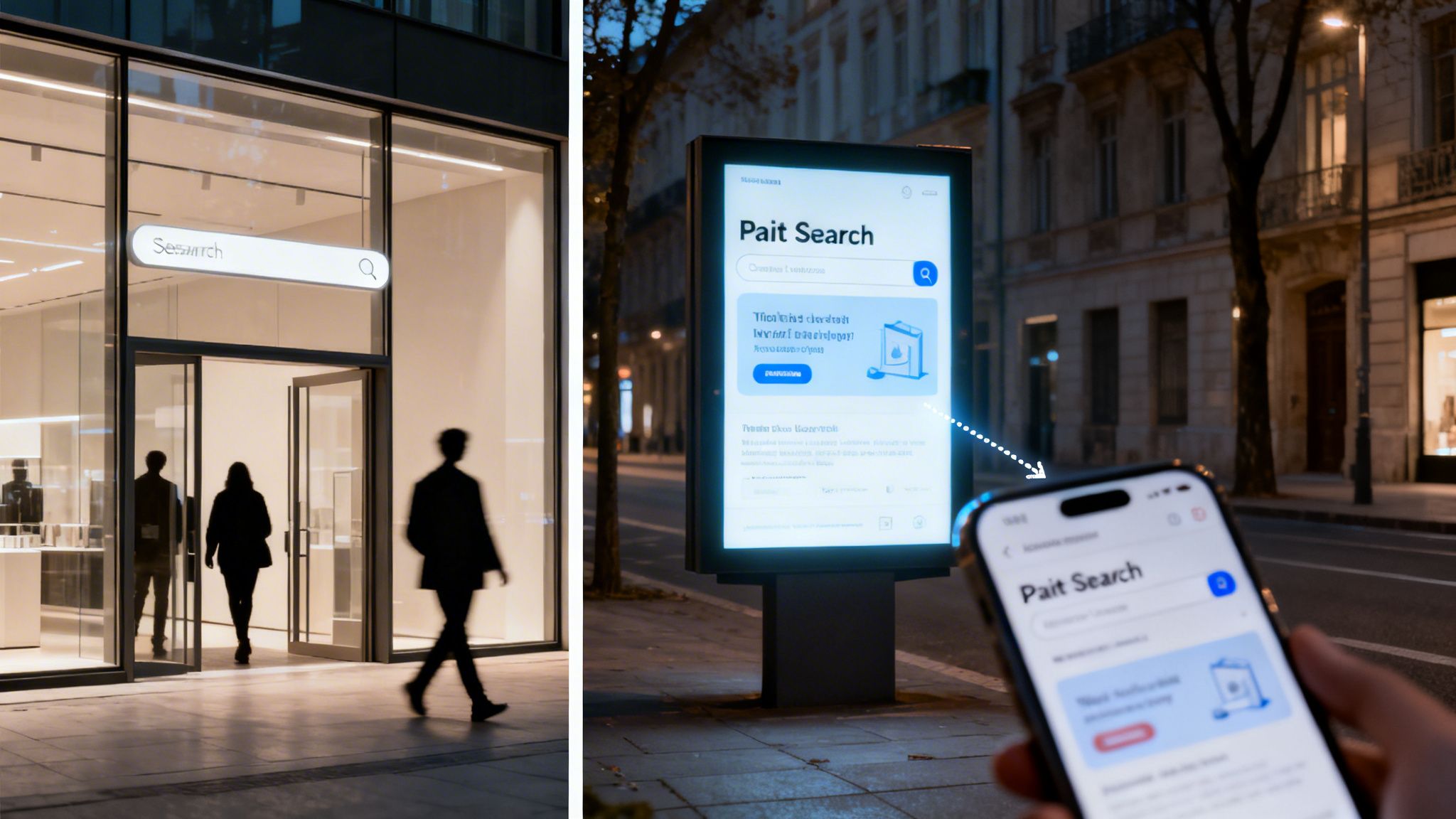
Let's break down how your business actually gets found online. Think of SEO as building an incredible, trustworthy shopfront on the busiest street on the internet. It’s a long-term investment that builds a reputation and attracts customers naturally. SEM, on the other hand, is like running a billboard ad on that same street—it gets people through the door the moment you pay for it.
SEO: Building Your Digital Foundation
At its core, SEO is about earning a search engine’s trust. It involves deep, foundational work that signals to Google that your website is a credible and valuable resource for its users. This isn't a quick fix; it's a methodical process.
The work generally falls into three key areas:
- Technical Excellence: This is the nuts and bolts. We ensure your website is fast, secure, and easy for Google to crawl and make sense of.
- Quality Content: This means creating genuinely helpful articles, guides, and pages that directly answer your customers' biggest questions.
- Building Authority: Trust is earned, not given. This involves getting high-quality backlinks from other reputable websites, which act like votes of confidence in your site.
SEM: Paying for Immediate Impact
SEM gives you that instant visibility through paid placements, often called Pay-Per-Click (PPC) ads. You pay to appear right at the top of search results for specific keywords, letting you capture the attention of customers who are actively looking to buy right now. For a deeper dive, check out our guide on https://clickclickbangbang.com.au/what-is-sem/.
This handy table breaks down the core differences at a glance.
SEO vs SEM At a Glance
| Attribute | SEO (Search Engine Optimisation) | SEM (Search Engine Marketing – Paid Ads) |
|---|---|---|
| Cost | No direct cost per click, but requires investment in resources (content, technical work). | Pay-per-click (PPC) model; you pay each time someone clicks your ad. |
| Speed | Takes time to build momentum (months to a year). Results are long-lasting. | Immediate visibility and traffic as soon as the campaign is live. |
| Placement | Appears in the "organic" search results, below the paid ads. | Appears at the very top of the search results, marked as "Sponsored". |
While the table highlights their differences, remember that these two channels work best in tandem.
SEO is the marathon, building sustainable brand equity and a steady stream of organic traffic. SEM is the sprint, delivering quick wins, highly targeted traffic, and immediate data to inform your strategy.
The Australian Search Environment
Understanding both is non-negotiable in the Australian market. For any business, but especially e-commerce retailers, SEO & SEM services have become the cornerstone of growth. A staggering 93% of Australian internet users begin their hunt for products on a search engine.
The data backs this up. Organic search consistently delivers 33% of all website traffic across major industries, making it an incredibly reliable and valuable channel. The field is also constantly moving forward; to really get a handle on it, it's worth understanding the difference between AI SEO vs traditional SEO.
Ultimately, SEO and SEM have distinct roles, but their real power is unleashed when they’re combined. This synergy creates a formidable digital presence, ensuring your business is visible to potential customers at every single stage of their journey.
The Core Pillars of a Modern SEO Strategy
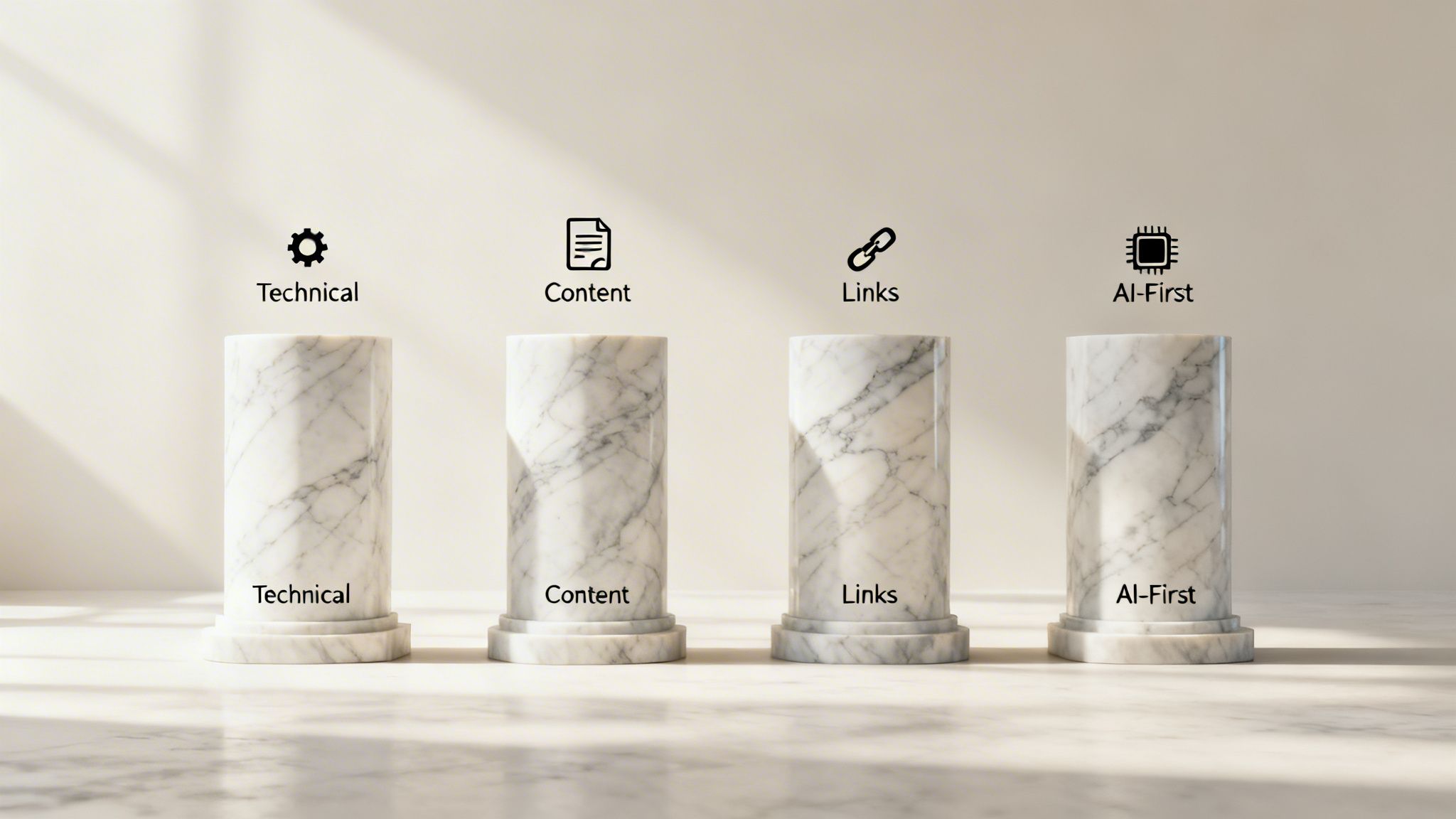
To build a lasting presence in search results, you can’t just throw a few keywords at a page and hope for the best. A winning SEO strategy is like a well-built structure supported by four essential pillars. If one is weak, the whole thing becomes unstable.
These pillars work in concert to build trust with search engines while delivering real value to your audience. Let's break down what each one involves and why they’re non-negotiable for any business serious about growth.
Technical SEO: The Foundation
Technical SEO is the invisible bedrock of your website. It’s all the work done behind the scenes to make sure search engines can find, crawl, and understand your content without hitting any roadblocks. If your site’s foundation is cracked, everything you build on top of it is at risk.
Think about it: you could write the best article in the world, but if your site takes forever to load or is a mess on mobile, users will bail before they even read the first sentence. And you can bet Google notices.
Key technical elements include:
- Site Speed: Ensuring your pages load quickly for users on all devices. A slow site is a major reason visitors abandon ship.
- Mobile-Friendliness: With most searches now happening on mobile, your site must provide a seamless experience on smaller screens.
- Crawlability and Indexing: This is all about making it easy for search engine bots to navigate your site structure and add your pages to their massive database.
- Site Security: Using HTTPS isn't optional anymore; it’s a standard trust signal for both users and search engines.
On-Page SEO and Content: The Substance
Once your technical foundation is solid, the next pillar is your on-page SEO and the actual content you create. This is the stuff your visitors see and interact with—the articles, guides, and product pages. It’s about creating genuinely helpful, high-quality content that directly answers your customers' questions, all while being optimised for the right keywords.
Great content doesn’t just attract visitors; it builds authority and turns browsers into buyers. You're showing your expertise and building a relationship, one helpful page at a time. If you want to learn more about the differences between on-page and off-page SEO, we have an article that dives deeper into this relationship.
An effective SEO strategy ensures that when your ideal customer asks Google a question, your website is there to provide the most helpful and comprehensive answer.
For small and medium-sized businesses (SMBs) in Australia, this focus on quality is critical. Organic search drives 33% of traffic and remains the most cost-effective marketing channel out there. With 86% of Australian SEOs now adopting AI for optimisation and 72% prioritising content, the return can be up to 5x higher than paid-only campaigns. But with new challenges like AI Overviews potentially dropping traffic by 30%, a robust, multi-pillar strategy is more crucial than ever.
Off-Page SEO and Link Building: The Reputation
Off-page SEO is all about building your website's authority and reputation across the web. The main way this is done is through link building—the process of getting high-quality backlinks from other reputable websites.
Think of backlinks as votes of confidence. When a trusted site in your industry links to your content, it signals to Google that you're a credible source. This can give your rankings a significant boost and is all about earning credibility where it counts.
AI-First SEO: The Future-Proofing
The final, and most forward-thinking, pillar is AI-First SEO. Search is no longer just about matching keywords to pages. It’s about understanding intent and context, with engines like Google now powered by sophisticated AI that aims to deliver direct, conversational answers.
This shift means your content needs to be structured not just for human readers, but for AI systems, too. An AI-First approach focuses on creating clear, authoritative, and well-structured information that generative AI models can easily find, understand, and use as a source. It’s about ensuring your business stays visible and relevant in an AI-driven search world, securing your spot at the top for years to come.
How Winning PPC Campaigns Are Built
While SEO is your long game for building digital authority, sometimes you just need results now. That's where Pay-Per-Click (PPC) advertising, the engine of most SEM strategies, comes into its own. Building a winning PPC campaign isn't about chucking money at Google and hoping for the best; it’s a disciplined process of strategy, targeting, and creative execution designed to deliver immediate, profitable returns.
Think of it like being an expert archer. You don't just fire arrows into the woods and hope you hit something. You pick your target, aim with precision, and choose the right arrow for the job to guarantee a direct hit. A successful PPC campaign works on the exact same principles, making sure every dollar you spend has a purpose.
Strategic Campaign Setup
The foundation of any profitable PPC effort is its initial setup. This is where you lay the groundwork—defining your goals, structuring your account logically, and doing the deep keyword research that separates the pros from the amateurs. A core part of building successful PPC campaigns is getting to grips with platforms like Google Ads campaigns.
This setup phase breaks down into a few critical steps:
- Keyword Research: This is about finding the exact search terms your ideal customers use when they're ready to buy. It means digging deeper than the obvious head terms to uncover high-intent, long-tail keywords that your competitors are probably overlooking.
- Campaign Structuring: You need to organise your account into logical campaigns and ad groups based on themes, products, or services. A tidy structure ensures your ads are hyper-relevant to the search query, which is a massive factor in driving performance and lowering costs.
- Conversion Tracking: This is non-negotiable. You must correctly install tracking code to measure what actually matters—sales, form submissions, or phone calls. Without it, you’re flying blind and have no way of knowing which ads are making you money and which are just burning cash.
Precision Audience Targeting
Once your campaign is properly structured, the next job is to aim it at the right people. Modern PPC platforms offer incredibly powerful targeting options that go way beyond simple keywords. This allows you to zero in on your ideal customer and stop wasting money on irrelevant clicks.
You can layer targeting options to refine your audience with pinpoint accuracy. For instance, a B2B software company could target users who have visited specific competitor websites, work in a certain industry, and are physically located within a major business district. This is the kind of precision that makes seo & sem services so powerful. For a deeper dive into building these campaigns, check out our detailed guide on PPC and Google AdWords management.
Intelligent Bidding and Budgeting
With your targets locked in, you need to manage your ad spend like a hawk. This involves setting a daily budget you're comfortable with and picking a bidding strategy that actually aligns with your campaign goals. Remember, you're not just paying for clicks; you're investing in potential customers.
A well-managed budget doesn't just cap spending; it maximises your return. The goal is to funnel funds towards the keywords and campaigns that generate the highest ROI, effectively turning your ad spend into a predictable revenue engine.
Today’s platforms offer automated bidding strategies that use machine learning to optimise for conversions, clicks, or brand visibility. This lets the system adjust bids in real-time for every single auction—a task that's impossible to do manually—ensuring you get the most value out of every single dollar.
Compelling Ad Creative
Finally, you need an ad that actually grabs someone's attention and makes them want to click. Your ad creative—the headline and description—is your three-second elevator pitch. It has to be relevant, compelling, and have a crystal-clear call-to-action (CTA).
A great ad does three things incredibly well:
- Reflects the Search Query: It directly answers the user's need, confirming they've found exactly what they were looking for.
- Highlights a Unique Value Proposition: It answers the silent question in every searcher's mind: "Why should I choose you over all the others?"
- Includes a Strong Call-to-Action: It tells the user exactly what to do next (e.g., "Shop Now," "Get a Free Quote," or "Download the Guide").
For B2B companies in Australia, SEM and PPC services deliver unmatched precision. In fact, 57% of B2B businesses report getting more leads from search engines than any other channel. Paid results on Google can snag 70% of clicks for commercial-intent queries, and remarketing strategies alone can boost conversions by 2.5x. These numbers show just how powerful a well-executed SEM campaign can be. You can find more insights on these paid search trends in detailed industry reports.
Choosing Your Strategy: SEO, SEM, or Both?
The million-dollar question for any business is no longer if you should be on Google, but how. Trying to decide between SEO, SEM, or a combination of both can feel like a headache, but it really just boils down to what you want to achieve, how quickly you need it, and what your budget looks like.
There’s no single “best” answer here. The right approach is the one that lines up with your immediate and long-term goals.
Think of it like this: are you building a permanent, trusted landmark that will stand for years, or do you need to throw a blockbuster event right now and sell every ticket? Your answer points you down the right path. Let's dig into the scenarios to help you figure out the best mix of SEO & SEM services for your business.
Choose SEO for Long-Term Authority
Search Engine Optimisation is your play for building a sustainable, long-term asset. It's the digital equivalent of earning a prime piece of real estate on the internet's busiest high street, rather than just renting a billboard for a month.
SEO is the right choice when your goals are all about building a brand that lasts.
An SEO-first strategy is for you if your primary goals are:
- Building Brand Credibility: SEO is about earning trust. By consistently putting out high-quality content and getting authoritative backlinks, you slowly but surely position your brand as the go-to expert in your industry.
- Generating Sustainable Traffic: It takes time to get the ball rolling, but a strong organic presence delivers a continuous stream of qualified traffic without you having to pay for every single click. This pipeline gets more and more cost-effective as time goes on.
- Creating a Long-Term Asset: A highly-ranked website is a valuable business asset that actually appreciates over time. It keeps generating leads and sales month after month, delivering a powerful compounding return on your initial investment.
SEO is a marathon, not a sprint. The whole point is to build a fortress of authority that’s tough for competitors to knock down, making sure your business stays visible and relevant for years.
Choose SEM for Immediate Impact
Search Engine Marketing, specifically the Pay-Per-Click (PPC) side of things, is your go-to for speed and precision. Think of it as a marketing special ops team, deployed to hit a specific target quickly and efficiently.
With PPC, you get instant visibility right at the top of the search results, putting your message squarely in front of customers who are actively looking to buy right now.
An SEM-first approach is the perfect fit if you need to:
- Launch a New Product or Service: When you’ve got something new, you can’t afford to wait months for organic rankings to kick in. SEM gets you immediate market feedback and drives those crucial initial sales from day one.
- Drive Leads for a Time-Sensitive Offer: Running a seasonal sale, promoting a webinar, or trying to cash in on a short-term trend? PPC lets you turn the traffic on and off like a tap, guaranteeing maximum exposure when it counts most.
- Test and Validate Quickly: SEM is brilliant for rapid market research. You can test out different messages, price points, and offers to see what your audience actually responds to before you commit to a bigger, long-term strategy.
Getting a paid campaign off the ground follows a clear, strategic process, moving from initial setup to ad creation and finally, the launch.
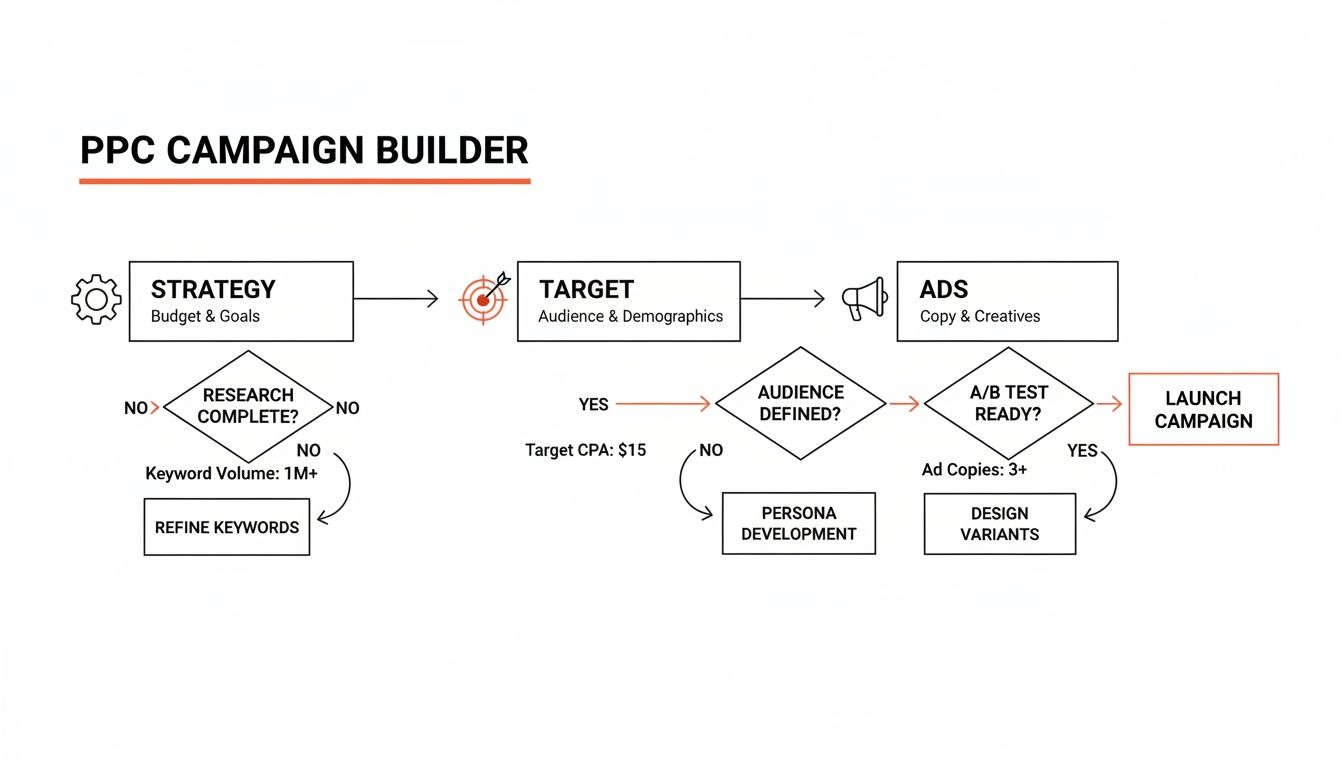
This flowchart shows the core parts of building a PPC campaign. It all starts with strategy, moves into precise targeting, and ends with creating compelling ad creative that gets the click.
The Integrated Hybrid Approach: The Ultimate Power Play
While SEO and SEM are powerful on their own, their true potential is unlocked when they work together. An integrated strategy creates a brilliant feedback loop where each channel makes the other one stronger.
This hybrid approach allows you to dominate the entire search results page, capturing customers at every single stage of their buying journey.
Here's how they create a powerful synergy:
- Fast-Track Your SEO with SEM Data: Your PPC campaigns are a goldmine of data. You can see instantly which keywords are actually converting into sales and use that intelligence to prioritise your long-term SEO content strategy. No more guessing which keywords are commercially valuable.
- Lower Ad Costs with Strong SEO: A well-optimised website with high-quality content leads to a better Quality Score in Google Ads. This means Google sees your landing pages as highly relevant, rewarding you with lower costs-per-click and better ad positions. It’s a win-win.
- Dominate the SERP: When you have a top organic ranking and a paid ad on the same page, you massively increase your visibility and credibility. You effectively push competitors further down the page and establish your brand as the undeniable market leader.
To make the decision even clearer, we've put together a simple matrix to help you match your business goals to the right service.
Decision Matrix: Which Service Fits Your Business Goal?
| Business Goal | Best Fit Service | Rationale |
|---|---|---|
| I need leads/sales immediately. | SEM (PPC) | PPC provides instant visibility at the top of search results, driving traffic and leads from day one. |
| I need to build long-term brand credibility. | SEO | Earning top organic rankings through quality content and authority signals builds trust and establishes you as an expert. |
| I have a tight, short-term budget. | SEM (PPC) | PPC allows for precise budget control. You can start small, test, and scale what works without a long-term commitment. |
| I want the most cost-effective traffic over time. | SEO | While it's an upfront investment, organic traffic is "free." A strong SEO foundation delivers compounding returns for years. |
| I'm launching a new product or testing a market. | SEM (PPC) | SEM provides rapid feedback. You can quickly test messaging, demand, and pricing before investing in a full-scale launch. |
| I need to dominate my market and maximise visibility. | Both (SEO + SEM) | An integrated approach allows you to own more real estate on the search results page, capture traffic at all stages, and use data from each channel to improve the other. |
Ultimately, the choice isn't always a hard "either/or." Many businesses start with SEM for quick wins while their long-term SEO strategy builds momentum in the background.
Measuring Success and What to Expect
So, you’re ready to invest in SEO & SEM services. It's a big move, but it's vital to know what you're getting into. The timelines, the metrics, and the eventual return on your investment look completely different for SEO versus SEM.
Understanding this difference is the key to tracking success properly. One channel gives you slow, compounding growth over time, while the other delivers immediate, data-rich feedback. Knowing what to watch for—and when—means you can confidently gauge performance and make sure your agency is delivering real business value.
The SEO Marathon: Measuring Long-Term Growth
SEO is the ultimate long game. Think of it as building a valuable, long-term asset for your business, not a quick-fire solution for a slow sales month. Meaningful, game-changing results rarely happen overnight.
It’s a bit like planting a tree. The first few months are all about preparing the soil and nurturing the roots underground. You won't see much happening on the surface, but this foundational work is what allows the tree to eventually grow strong and bear fruit for years.
For most businesses, you can expect to see real traction after the 3 to 6-month mark. This is when all the technical fixes, new content, and link-building efforts start to snowball and actually move the needle.
To track our SEO progress, we’ll be watching a few key metrics:
- Organic Traffic Growth: This is the most obvious one. Are more people finding your site through non-paid search results month on month?
- Keyword Ranking Improvements: We monitor your position for a group of commercially important keywords. Watching your rankings climb from page three to page one is a clear sign we’re on the right track.
- Lead and Conversion Quality: It's not just about more traffic; it's about the right traffic. Are the leads coming from organic search a good fit for your business? High-quality leads are a sure sign your content is hitting the mark with your ideal audience.
The SEM Sprint: Tracking Immediate Returns
On the other hand, SEM—specifically PPC advertising—is all about speed and immediate results. The second your campaigns go live, you can start pushing traffic to your site and bringing in leads. This makes it a powerful tool for businesses that need to make an impact now.
Because you're paying for every single click, the focus isn't on long-term authority. It's about immediate efficiency and profitability. Success is measured by how well your ad spend is converting into real, tangible business outcomes.
For SEM campaigns, we’re laser-focused on the metrics that directly affect your bottom line:
- Click-Through Rate (CTR): This shows us how compelling your ad is. A high CTR means your message is resonating with the people you’re targeting.
- Conversion Rate: Of the people who click your ad, what percentage actually do what you want them to (like make a purchase or fill out a form)? This is the ultimate test of your landing page's effectiveness.
- Return On Ad Spend (ROAS): This is the holy grail. For every dollar you put into ads, how many dollars in revenue are you getting back? A 3x ROAS means you’re making $3 for every $1 spent.
A great real-world example is an Australian e-commerce store launching a new product. With a well-targeted Google Shopping campaign, they could hit a 3x ROAS within the first month. Or think of a B2B firm using LinkedIn Ads to cut its cost-per-lead in half by simply refining its audience targeting. These are the kinds of concrete, data-backed wins that define a successful SEM strategy, all shown in clear reports that tell you exactly where your money is going and what it’s achieving.
Your Agency Onboarding Checklist
Kicking off a new partnership with an SEO or SEM agency should feel like the start of something great, not a chaotic scramble for logins and information. A smooth onboarding process is one of the best predictors of campaign success, because it means your new team has everything they need to start delivering results, fast.
Think of it like handing over the keys to a high-performance car. You wouldn't just toss them over and walk away. You’d show the driver where the turbo button is, explain the quirks of the gearbox, and make sure they have the destination plugged into the GPS. This checklist does the same thing for your digital marketing.
Defining Your Goals
The very first conversation you have, that initial kickoff call, is the most important. This is where you and the agency's strategist get on the same page. You need to come prepared to talk about more than just "more traffic."
The aim here is to lock in clear, measurable Key Performance Indicators (KPIs). For instance, instead of saying "we want more leads," a much better goal is "we want to generate 20 qualified sales leads per month at a cost per acquisition under $150." That's a target everyone can work towards and measure against.
Providing Essential Access
For an agency to do their job, they need to get under the hood of your digital assets. This is a simple step, but it’s often where delays happen. Getting these logins sorted out upfront will speed everything up considerably.
Typically, they’ll need access to:
- Website Backend: Administrator access to your CMS (like WordPress or Shopify) is a must for technical SEO fixes and on-page optimisations.
- Google Analytics: This is the dashboard for tracking performance, understanding user behaviour, and reporting on results.
- Google Ads & Other Ad Accounts: For any PPC campaigns, your agency will need full access to manage budgets, build out ads, and optimise bidding.
- Google Business Profile: This is absolutely critical for local SEO, allowing the agency to manage and optimise your local presence.
A seamless handover of these accounts is vital. The faster an agency can get in and start working, the faster you’ll start seeing the results you’re paying for.
Sharing Key Business Insights
Your new agency partners are experts in digital marketing, but you are the undisputed expert on your business. That onboarding questionnaire they send over is your chance to transfer that knowledge. Don't rush it; take the time to give them thorough, detailed answers.
This information is what allows them to shape a strategy that speaks directly to your ideal customer. It ensures the ad copy, the keyword targeting, and the content they create are all perfectly aligned with your brand's voice and position in the market. It’s the difference between a generic, off-the-shelf campaign and a truly bespoke strategy built for you.
Common Questions About SEO and SEM Services
Jumping into the world of SEO and SEM services always brings up a lot of questions. And rightly so—as a business owner, you want to know exactly where your investment is going before you commit.
We get it. So, let's cut through the noise and tackle the questions we hear most often from Australian businesses. These are practical answers based on what actually works.
How Long Does SEO Really Take to See Results?
This is the big one, and the honest-to-goodness answer is: it takes patience. While you might spot some small wins early on, real, meaningful SEO results—like a steady flow of organic traffic and top rankings for keywords that matter—typically take 4 to 6 months to show.
Think of it like building a valuable piece of digital real estate, not just flipping a property for a quick buck. The first few months are all about laying a solid foundation: fixing technical issues, sorting out your content strategy, and showing Google you’re a credible authority. It’s a long-term asset play, not a short-term sugar hit.
Can I Do SEO and SEM Myself?
It's definitely tempting to try and manage this in-house, especially when you're just starting out. But the truth is, search marketing is a complex beast that changes all the time. A good agency brings specialised knowledge, expensive tools, and a track record of what actually works, helping you sidestep costly mistakes.
The real value of an agency is their ability to scale your efforts and get a much better return on investment than you likely could on your own. They turn raw data into a winning strategy.
Hiring pros frees you up to do what you do best: run your business. Let them worry about algorithm updates and campaign optimisation while you focus on your customers. It’s about using expert knowledge to get a genuine competitive edge.
What Is a Good Starting SEM Budget?
Your starting budget for paid ads really comes down to your industry, how fierce the competition is, and what you’re trying to achieve. For a small Australian business, a monthly ad spend of $1,500 – $3,000 on a platform like Google Ads is a realistic starting point. Keep in mind, this doesn't include agency management fees.
This amount is usually enough to gather the data needed to start optimising properly. The goal isn't to spend big right away; it’s to spend smart. You start small, collect data, prove the return on ad spend (ROAS), and then you can scale up your investment with confidence once you know what's working.
How Do SEO and SEM Work Together?
They’re a powerhouse duo. The insights you get from your paid SEM campaigns—like which ad copy resonates or which keywords are converting into actual customers—can be used to supercharge your SEO strategy. You’re essentially using paid data to make your organic efforts smarter and faster.
At the same time, having a strong organic presence and high-quality landing pages from your SEO efforts improves your Google Ads Quality Score. A better Quality Score can lead to lower ad costs and better ad positions. When you use both, you’re not just showing up in search results; you’re dominating them and connecting with customers at every single stage of their journey.
At Click Click Bang Bang, we build integrated strategies that get you seen and drive real growth. Our data-driven approach to SEO and PPC ensures every dollar works harder for your business. Discover how our SEO & SEM services can transform your visibility.
Read NeXt
Or Read Our Latest
- Manual vs Automated Bidding for PPC Success
- Conversion Tracking Setup: A Complete AU Guide
- Instagram Advertising Australia: Complete 2026 Guide
- Pay Per Click: A Beginner’s Guide for Australian Marketers
- Display Advertising on Google: The Complete Australian Guide
- Stakeholder Communication Plan How to Build One That Works
Click. CLick. Subscribe.
Get our best PPC insights, industry updates, and power moves delivered straight to your inbox. No fluff, just high-caliber strategies that actually work.
Don’t Leave Just Yet
Try Us For 30-Days,
Risk Free!!
We guarantee that you’ll love our work within the first 30 days, if not you’ll get your money back.
What have you got to lose?