

Conversion rate optimisation agency melbourne: Conversion Ra
Last Updated

On the hunt for a conversion rate optimisation agency in Melbourne? Smart move. You're looking for a partner to turn your hard-won website traffic into actual revenue, squeezing more value from every visitor without just cranking up your ad spend.
Why Melbourne Businesses Are Investing In CRO
In a market as competitive as Melbourne's, just getting traffic to your website is only half the job done. Local businesses, from e-commerce stores on Chapel Street to B2B firms in the CBD, are quickly figuring out the real win is converting that traffic into paying customers. This is where Conversion Rate Optimisation (CRO) stops being a buzzword and starts being a serious growth lever.
So what exactly is CRO? Before we get into the nitty-gritty, it's worth getting the fundamentals down. This guide on What is Conversion Rate Optimization (CRO) is a great primer on its core principles. At its heart, CRO is a structured, data-led process for improving your website to get a higher percentage of visitors to do what you want them to do—buy a product, fill out a form, or book a demo.
The Shift From Traffic To Revenue
For a long time, the go-to digital marketing goal was simple: more traffic. More clicks, more sessions, more eyeballs. But savvy Melbourne businesses are now asking a much more important question: "What are we actually doing with the traffic we already have?"
This change in mindset is everything. Let's say your online store gets 10,000 visitors a month with a 1% conversion rate, giving you 100 sales. You could spend a fortune on ads to double your traffic to 20,000 visitors and get 200 sales. Or, you could work with a Melbourne CRO agency to lift your conversion rate from 1% to just 2%. That gets you the same 200 sales, but without spending an extra cent on acquiring new traffic.
CRO is all about efficiency. It multiplies the return on your existing marketing spend, making your SEO and PPC campaigns far more profitable by ensuring the traffic they generate actually converts.
Not sure if your site has a conversion problem? Here’s a quick-glance table to help you self-diagnose some common bottlenecks and see where a CRO agency can step in.
Signs Your Melbourne Business Needs CRO Help
| Symptom | Potential Cause | How a CRO Agency Helps |
|---|---|---|
| High website traffic, low sales or leads | Poor value proposition, confusing navigation, slow page speed | User research, A/B testing headlines and CTAs, technical SEO audit |
| High shopping cart abandonment rate | Unexpected shipping costs, complex checkout process, lack of trust signals | Checkout flow analysis, testing simplified forms, adding trust badges and reviews |
| Low engagement on key landing pages | Unclear call-to-action (CTA), weak ad copy, poor mobile experience | Heatmap and session recording analysis, CTA redesign, mobile-first optimisation |
| Lots of "junk" or unqualified leads | Misleading offer, form asks for too much or too little information | Lead qualification analysis, form field testing, refining on-page messaging |
| Ad campaigns have high CTR but low conversions | Landing page doesn't match the ad's promise (message mismatch) | A/B testing landing page copy and design to align with ad creative |
If any of those symptoms sound familiar, you're not alone. The good news is that they are all solvable with a structured approach.
Real-World Scenarios in Melbourne
Let's ground this in a couple of common examples we see all the time:
- An E-commerce Store: A boutique selling handcrafted leather goods has decent traffic but a sky-high cart abandonment rate. A CRO agency would dig into the user behaviour data, quickly spot a clunky, confusing checkout process, and A/B test a streamlined, one-page checkout. That single change could easily recover thousands in lost sales every month.
- A B2B Tech Firm: A software company in the CBD is getting leads, but the sales team complains they’re mostly low-quality. Through CRO analysis, an agency might find the "Request a Demo" form is too long and intimidating. By shortening the form and sharpening the value proposition on the page, they manage to boost high-quality submissions by 30%.
These examples show how CRO delivers real, tangible business results. It’s not about making wild guesses; it's a scientific discipline that uses data to find problems and test solutions. If you're keen to get a head start, you can explore some foundational strategies on how to improve conversion rates right now.
Ultimately, investing in CRO is about unlocking the potential that’s already sitting in your business. It’s the process that turns your website from a digital brochure into your most powerful sales and revenue-generating tool.
What a Top Melbourne CRO Agency Actually Does
When you bring on a top conversion rate optimisation (CRO) agency in Melbourne, you're not just paying for a slick report or a few quick design changes. You’re investing in a rigorous, data-led process designed to get inside your customers' heads and systematically grow your revenue. It's a discipline that swaps guesswork for scientific measurement.
A good agency won't start by randomly changing button colours or rewriting headlines based on a hunch. Instead, they act like digital detectives, using a suite of powerful tools to figure out exactly where and why your website is leaking money.
The Diagnostic and Discovery Phase
The whole process kicks off with a deep-dive analysis. A CRO agency will immerse itself in your website’s performance data, using a mix of quantitative and qualitative methods to build a complete picture of user behaviour.
This usually involves tools and techniques like:
- Google Analytics 4 (GA4) Analysis: They go way beyond surface-level metrics like total traffic. They’re hunting for drop-off points in your funnels, spotting pages with unusually high exit rates, and segmenting your audience to see if specific demographics or traffic sources are underperforming.
- Heatmapping and Scroll Mapping: Using tools like Hotjar or Microsoft Clarity, they generate visual maps showing where users click, how they move their mouse, and how far they actually scroll. This can instantly reveal that your most important call-to-action is being completely ignored or that critical info is "below the fold," where no one ever sees it.
- User Session Recordings: This is like getting to watch over your users’ shoulders. An agency reviews anonymised recordings of real visitors navigating your site, seeing firsthand where they hesitate, rage-click on broken elements, or get lost in confusing menus. This kind of qualitative insight is gold for understanding user frustration.
Through this initial diagnostic work, the agency pinpoints the exact friction points that are costing you sales. It might be a clunky checkout process, an uninspiring product page, or a mobile menu that’s a nightmare to use. From there, they can build a case for what to fix first, which leads directly to a continuous cycle of improvement that turns traffic into tangible results.
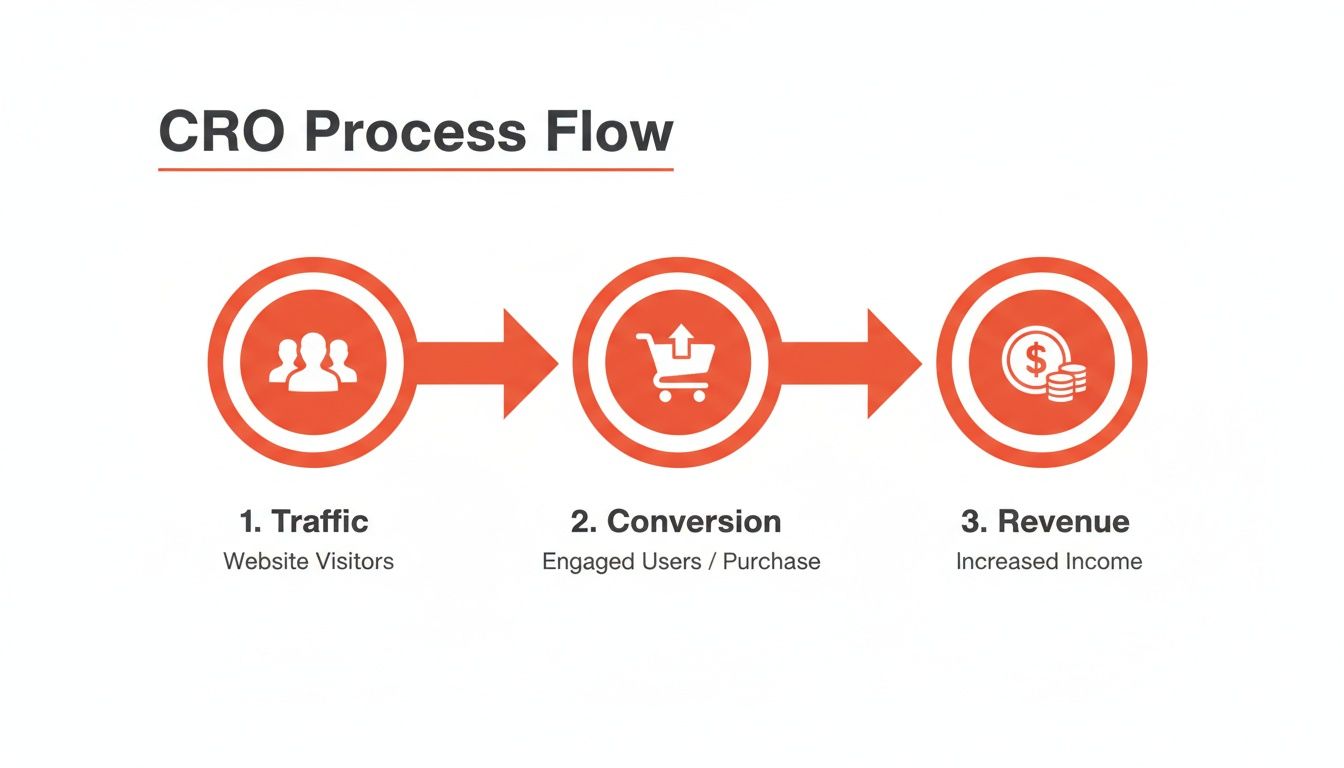
This process isn't just about making things look prettier; it’s about transforming your existing website visitors into customers, which directly fuels revenue growth.
The Cycle of Hypothesis, Testing, and Analysis
Once the problem areas are flagged, the real work of a CRO agency begins. They don’t just implement changes and hope for the best. Instead, they operate on a continuous loop of improvement, never assuming they have the right answer until the data proves it.
First, they form an evidence-based hypothesis. Based on all that diagnostic data, they’ll come up with a clear, testable idea. For example: "We believe changing the main call-to-action on product pages from 'Learn More' to 'Add to Cart' will increase conversions, because user recordings show high engagement but hesitation to commit to a purchase."
Next, they launch a controlled test. To validate the hypothesis, they'll design and run an experiment. This is usually an A/B test, where 50% of your traffic sees the original page (the "control") and 50% sees the new version (the "variation"). For more complex changes, they might run a multivariate test to assess multiple combinations of elements at once.
Finally, they analyse the results. The test runs until it reaches statistical significance—a fancy way of saying the results aren't just down to random chance. The agency then crunches the numbers to declare a winner.
Here’s a key takeaway: not every test is a winner. A professional agency is completely transparent about this. A failed test is still incredibly valuable because it tells you what your audience doesn't respond to, saving you from making a permanent, site-wide change that could have tanked your conversion rate.
This data-first approach is now the standard in Australia. Melbourne's CRO scene is booming, reflecting a national trend where Google searches for 'conversion rate optimisation' have surged nearly 500% since 2012. Aussie businesses have realised that optimising the traffic they already have is a goldmine.
By methodically addressing user drop-offs, agencies in this space are achieving typical conversion rate uplifts of 15-20% for their clients. A proper audit is always the best place to start, and you can learn more about our approach to a comprehensive web site audit here. This entire process ensures every change is a step forward, directly contributing to a stronger return on your marketing spend and a healthier bottom line.
Your Vetting Checklist for a CRO Partner in Melbourne

Picking a CRO partner is a high-stakes game. The right agency can become a genuine growth engine, finding revenue you didn't know you had. But the wrong one? They can burn through your budget with very little to show for it.
This practical checklist will help you vet any conversion rate optimisation agency in Melbourne with confidence. It’s about separating the true experts from the pretenders so you can make a smart investment. Forget the slick sales pitches; your focus should be on evidence, process, and proven results. A top-tier agency will have no problem opening up their playbook for you.
Scrutinise Their Case Studies
Case studies are your first real look into what an agency can do. You need to look past the glossy PDF and dig into the actual substance. A strong case study isn't a self-congratulatory pat on the back; it’s a clear demonstration of their problem-solving process.
When you're reviewing their work, ask yourself these questions:
- Is it just a list of tactics? Be wary of agencies that just say, "We changed the button colour and conversions went up." You want to see the full story: What was the initial problem? How did they use data to diagnose it? What was their hypothesis, and how did their test validate or invalidate it?
- Are the results specific and measurable? Vague claims like "improved engagement" are a huge red flag. Look for hard numbers, like a 15% increase in lead form submissions or a 20% reduction in checkout abandonment.
- Is the industry relevant? While CRO principles are fairly universal, experience in your specific industry—whether it’s e-commerce, B2B SaaS, or lead generation—is a massive advantage. An agency that already knows your market understands your customers' unique pain points and what they expect.
This level of digging helps you see if they're driven by data-backed insights or if they just got lucky a few times.
Evaluate Their Methodology
A professional CRO agency works more like a science lab than an art studio. Their methodology should be clear, repeatable, and built entirely around data. If an agency can't walk you through their process in simple terms, that's a major warning sign.
They should be able to explain their entire workflow, which usually looks something like this:
- Research and Analysis: How do they gather the numbers (quantitative data from tools like GA4) and the "why" behind them (qualitative insights from heatmaps, session recordings, and user surveys)?
- Hypothesis Generation: How do they turn all that research into clear, testable ideas? A solid hypothesis follows a structure like, "We believe that [making this change] for [this specific audience] will result in [this outcome] because [of this data-driven reason]."
- Prioritisation: With a long list of ideas, how do they decide what to test first? A good agency will use a prioritisation framework (like P.I.E. – Potential, Importance, Ease) to focus on tests that deliver the biggest impact for the least effort.
- Testing and Implementation: What tools are in their stack for A/B testing (e.g., Google Optimize, VWO, Optimizely)? Crucially, how do they ensure their tests are statistically valid and not just random noise?
- Learning and Iteration: What happens after a test is finished? How do they document what they've learned—especially from failed tests—and use those insights to fuel the next round of experiments?
A critical red flag is any agency that guarantees specific results, like "we'll double your conversion rate in three months." Real CRO is a process of discovery, and no one can predict the outcome of a test with 100% certainty. Confident experts talk about their process, not guaranteed outcomes.
Assess Their Local Market Intelligence
Working with a conversion rate optimisation agency in Melbourne gives you a home-ground advantage: deep local market understanding. Australian consumer behaviour has its own quirks and nuances. An agency that gets this—from local payment preferences like Afterpay to expectations around shipping costs—can design far more effective tests.
For example, Melbourne's top CRO agencies have a huge well of experience to draw from. Some have run over 13,000 A/B tests for major Australian brands, giving them an almost unfair advantage in knowing what makes local consumers tick. This relentless testing at scale allows them to develop battle-tested strategies that can lift conversion rates by 20-50% in Australia's competitive e-commerce and SaaS markets. You can find more detail on how local expertise drives these results from leading Melbourne CRO specialists.
When you're vetting a local agency, ask them how their understanding of the Melbourne and wider Australian market shapes their strategy. Their ability to connect with local consumer psychology is an asset that a generic offshore firm simply can't match. This knowledge ensures their optimisation efforts aren't just technically sound but are also culturally relevant, giving your business a vital edge.
Key Questions to Ask Before You Sign Anything
Okay, you’ve shortlisted a few conversion rate optimisation agencies in Melbourne. Their case studies look solid, and you’re feeling pretty good about their process. But hold on. Before you put pen to paper and give them the keys to your website, there's one last critical step.
This is where you move past the sales pitch and really see how an agency thinks on its feet. A final round of sharp, specific questions will tell you everything you need to know about their experience, transparency, and what they’re actually like to work with.
You’re not looking for slick, jargon-heavy answers here. You want clear, confident responses that show they’ve been in the trenches and know their stuff. Anything else is a red flag.
Questions About Process and Strategy
These questions are all about getting inside their head. You want to see if there’s a logical, repeatable framework behind their recommendations or if they’re just guessing.
-
"Can you walk me through a past project where you identified a key user problem and how your test solved it?"
Listen closely to how they answer this. It’s not about the final conversion lift—it’s about their problem-solving ability. A great answer will start with the data. Something like, "We noticed in session recordings that users on mobile were repeatedly trying to click a static banner…" From there, they should explain the hypothesis they formed and the specific A/B test they designed to prove or disprove it. A weak answer skips the 'why' and just jumps to "we got a 20% lift."
-
"What's your process for prioritising what to test first for the biggest impact?"
Any decent website has dozens, if not hundreds, of potential optimisation opportunities. A top-tier agency doesn't just throw darts at a board. Their response should mention a structured prioritisation framework, like PIE (Potential, Importance, Ease) or a similar model they've developed. They need to show they focus on changes that balance high potential impact with the effort required, ensuring you get the best return on your investment early on.
Digging into Their Data and Reporting
In a CRO partnership, transparency isn't just a nice-to-have; it's everything. You need to be crystal clear on how they measure success and how they'll communicate wins and losses.
A brilliant question to ask is: "What does a 'failed' test look like to you, and how do you handle it?"
The only right answer here is that there’s no such thing as a "failed" test. An experienced agency will immediately explain that an inconclusive or losing test is a hugely valuable learning. It tells you what doesn't resonate with your audience, prevents you from rolling out a bad change, and sharpens future hypotheses. If they get defensive or try to sidestep the question, it's a sign they're more concerned with looking perfect than with genuine, evidence-based learning.
A CRO partner who is transparent about their "losing" tests is a partner you can trust. It shows they are committed to learning and evidence-based iteration, not just chasing vanity metrics.
Here are a few more must-asks on data and reporting:
- "How do you ensure your test results are statistically significant?" They should confidently talk about sample size, test duration, and statistical confidence levels (look for 95% or higher). This confirms they’re making decisions based on solid data, not just a lucky streak.
- "What KPIs will you report on beyond the primary conversion rate?" A great agency knows that a higher conversion rate isn't always a win. They should mention tracking secondary metrics like Average Order Value (AOV), Revenue Per Visitor (RPV), or lead quality to ensure their changes are actually driving meaningful business growth, not just more low-value actions.
Understanding the Client Relationship
Finally, you need to get a feel for the day-to-day reality of working with them. These questions help set expectations for communication and collaboration from the get-go.
- "Who will be my main point of contact, and what is their direct experience with CRO?" You need to make sure you're not getting palmed off to a junior account manager who just relays messages. Ideally, you want direct access to the strategist who is actually running your experiments.
- "How much involvement will you need from my team?" This is a practical but crucial question. It clarifies expectations around development resources for implementing tests, who needs to approve copy, and how frequent meetings will be. Knowing this upfront avoids major bottlenecks and frustration down the road.
Asking these targeted questions will help you cut through the noise and find a conversion rate optimisation agency in Melbourne that will act as a true partner in your growth.
Understanding CRO Pricing and Measuring Success

Let's talk about the money. When you bring on a conversion rate optimisation agency in Melbourne, you're not just buying a service; you're making an investment. It’s crucial to understand both the costs and, more importantly, how you’ll measure the returns.
This isn’t about bargain hunting. The goal is to find a pricing model that aligns with your business objectives and ensures the agency is just as invested in your growth as you are. A transparent pricing structure and a clear reporting framework aren't just nice-to-haves—they're non-negotiable.
Common Pricing Models for CRO Agencies
Most Melbourne CRO agencies will offer one of a few core pricing models. Each has its pros and cons, and the right fit will hinge on your budget, risk appetite, and the project's scope.
- Monthly Retainer: This is the industry standard. You pay a fixed fee each month for an agreed-upon scope of work, which typically covers research, experimentation, analysis, and reporting. It fosters a long-term, strategic partnership and gives you predictable costs.
- Performance-Based: Here, the agency's fee is tied directly to the results they generate, like a lift in revenue or qualified leads. It sounds great because it minimises your upfront risk, but these agreements can be tricky to structure and demand absolutely bulletproof tracking.
- Hybrid Model: A popular middle ground. This model combines a lower monthly retainer with a performance bonus. It strikes a balance between predictable costs for you and a powerful performance incentive for the agency, creating a shared-risk partnership.
When you're looking at proposals, think value, not just cost. A seasoned agency with a higher retainer might deliver a far stronger ROI by focusing on high-impact tests from day one, while a cheaper option could burn months (and your budget) on experiments that go nowhere.
Setting Up for Success: Robust Tracking and Reporting
Once you’ve signed the dotted line, the first order of business is getting the measurement framework right. Any agency worth its salt will insist on this. Without accurate data, every test result is just noise.
This initial phase involves a deep dive to verify your analytics and conversion tracking are configured perfectly. Key steps include:
- Goal and Event Tracking: Making sure every primary and secondary conversion—from form fills and demo requests to key button clicks—is being tracked flawlessly in Google Analytics 4.
- Data Integrity Audits: Hunting down and fixing any issues that could be polluting your data, like cross-domain tracking problems, broken funnels, or spam traffic.
Your agency should also provide access to a live reporting dashboard. This transparency is critical. You need the ability to check in on test results, key metrics, and overall progress whenever you want, not just when a monthly PDF lands in your inbox.
Measuring What Truly Matters: KPIs Beyond the Conversion Rate
A rising conversion rate is a good start, but it becomes a vanity metric if it doesn’t drive real business growth. A skilled conversion rate optimisation agency in Melbourne will zero in on a broader set of Key Performance Indicators (KPIs) to prove the true impact of their work.
These are the metrics that actually move the needle:
- Revenue Per Visitor (RPV): This KPI shows exactly how much revenue you generate, on average, from every single person who lands on your site. It’s a powerful metric that balances both conversion rate and average order value.
- Average Order Value (AOV): Are the website changes encouraging customers to spend more with each purchase? Sometimes, an experiment might slightly dip the conversion rate but dramatically increase AOV, leading to a significant net revenue win.
- Lead Quality: For B2B businesses, this is everything. The agency should work alongside your sales team to track the lead-to-opportunity rate. A lift in high-quality leads that convert into actual sales is infinitely more valuable than a flood of junk leads.
- Customer Lifetime Value (CLV): This is the ultimate long-game metric. CRO efforts that attract and retain more valuable customers will have a compounding effect on your business growth for years to come.
In the Melbourne market, this data-first approach is delivering incredible results. For instance, local specialist Social Garden recently helped a client achieve a 9.56% lead-to-enrolment conversion rate—a figure that demolishes the typical 2-5% industry benchmark. They achieved this through highly targeted data-driven optimisation in Australia.
This is a perfect example of how focusing on the right metrics translates directly to huge wins. By building a framework to measure the true ROI, you ensure your CRO program contributes directly to your bottom line. You can learn more about how we do this in our overview of conversion rate optimisation services.
Common Questions We Hear About CRO in Melbourne
Deciding to invest in a conversion rate optimisation agency in Melbourne is a big step, and it's smart to have questions before you commit. We get it. Over the years, we've heard them all.
To give you some clarity, here are the straight-up answers to the most common queries we get from Melbourne business owners.
How Long Does It Take to See Results from CRO?
This is always the first question, and the honest answer is: it depends. Anyone promising a magic bullet is selling you a myth. While you might see an immediate lift from "quick wins"—like fixing a busted checkout button or a broken form—a proper CRO program is a long game.
You should expect to see the first wave of statistically significant data from A/B tests within 2 to 3 months. This time is vital for gathering enough clean data to make informed calls. Real, sustainable growth comes from an iterative process where every test builds on the learnings of the last. A solid CRO strategy delivers compounding gains over 6 to 12 months and beyond as it continuously refines your user experience.
Can a Small Business with Low Traffic Still Benefit?
Absolutely. It’s a common misconception that you need massive traffic to do CRO. While high traffic definitely speeds up A/B testing, low-traffic sites can get huge value from other CRO methods.
For a business with lower visitor numbers, a good agency will pivot to qualitative analysis. This isn't guesswork; it's a different kind of data. We're talking about things like:
- Heuristic Reviews: An expert evaluation of your site against established usability principles to find the obvious roadblocks.
- User Session Recordings: Literally watching how real users move through your site to see exactly where they get stuck or frustrated.
- Customer Surveys and Polls: Just asking your audience what's holding them back. It's amazing what you can learn by simply talking to your customers.
For a small business, fixing these core usability problems can have an outsized impact. It makes sure every single visitor you fought hard to get has the best possible experience, making every visit count.
Is CRO a One-Off Project or an Ongoing Process?
Think of CRO like fitness, not a crash diet. You can absolutely hire an agency for a one-off project to solve a specific problem. But the companies that truly pull ahead of their competitors treat CRO as a continuous improvement process.
Your customers' expectations change. New competitors show up. Technologies evolve. What worked like a charm six months ago might be completely ineffective today. The "always be testing" mindset is what separates market leaders from everyone else.
Ongoing CRO ensures your website is a living asset that adapts and evolves. It’s the key to maintaining a competitive edge and maximising your site’s profitability over the long term, rather than just getting a temporary boost.
What Is the Difference Between SEO and CRO?
This is a simple but critical distinction. SEO and CRO are partners in growth, but they have very different jobs.
SEO (Search Engine Optimisation) is all about acquisition. Its job is to get more qualified visitors to your website by increasing your visibility in search engines. In short, SEO fills the top of your funnel by getting the right people to show up.
CRO (Conversion Rate Optimisation) is all about efficiency. Its job is to turn a higher percentage of the visitors who are already on your site into customers or leads. CRO takes the traffic SEO brings in and makes sure it delivers tangible business results.
Put it this way: SEO brings people to the party; CRO makes sure they have a great time and decide to stay. They’re most powerful when working together. For those focused on e-commerce, there are some great Conversion Rate Optimization tips that actually work for Shopify. This synergy is the foundation of a great digital marketing ROI.
At Click Click Bang Bang, we build data-driven strategies that integrate seamlessly, ensuring the traffic we generate through SEO and PPC has the highest possible chance of converting. Discover how our approach can fuel your growth today.
Read NeXt
Or Read Our Latest
- Manual vs Automated Bidding for PPC Success
- Conversion Tracking Setup: A Complete AU Guide
- Instagram Advertising Australia: Complete 2026 Guide
- Pay Per Click: A Beginner’s Guide for Australian Marketers
- Display Advertising on Google: The Complete Australian Guide
- Stakeholder Communication Plan How to Build One That Works
Click. CLick. Subscribe.
Get our best PPC insights, industry updates, and power moves delivered straight to your inbox. No fluff, just high-caliber strategies that actually work.
Don’t Leave Just Yet
Try Us For 30-Days,
Risk Free!!
We guarantee that you’ll love our work within the first 30 days, if not you’ll get your money back.
What have you got to lose?