

7 Best Google Ads Managers in Australia for 2026
Last Updated
Choosing the right Google Ads manager is one of those decisions that usually lands on your desk after something has already gone wrong. Maybe campaigns are running but leads are patchy. Maybe revenue looks fine on the surface, yet nobody trusts the reporting. Or maybe you're spending enough to know Google Ads should matter, but not seeing the consistency you expected. In Australia, that matters because digital ad spend reached A$16.4 billion in the 2023 financial year, with search alone accounting for A$6.65 billion, or about 40.5% of digital ad revenue, according to the IAB Australia figures referenced here. Search isn't a side channel. It's one of the biggest performance levers in the market.
That's why the best Google Ads manager isn't the cheapest freelancer or the agency with the flashiest proposal. You need someone who can track conversions properly, structure campaigns cleanly, and make the budget work harder over time. If they can't measure qualified leads, sales, and real downstream outcomes, they're guessing.
This guide gets to the shortlist quickly, then helps you decide who fits your business. If you want a stronger grounding in campaign setup and account hygiene first, review Raven SEO's Google Ads insights.
1. Click Click Bang Bang
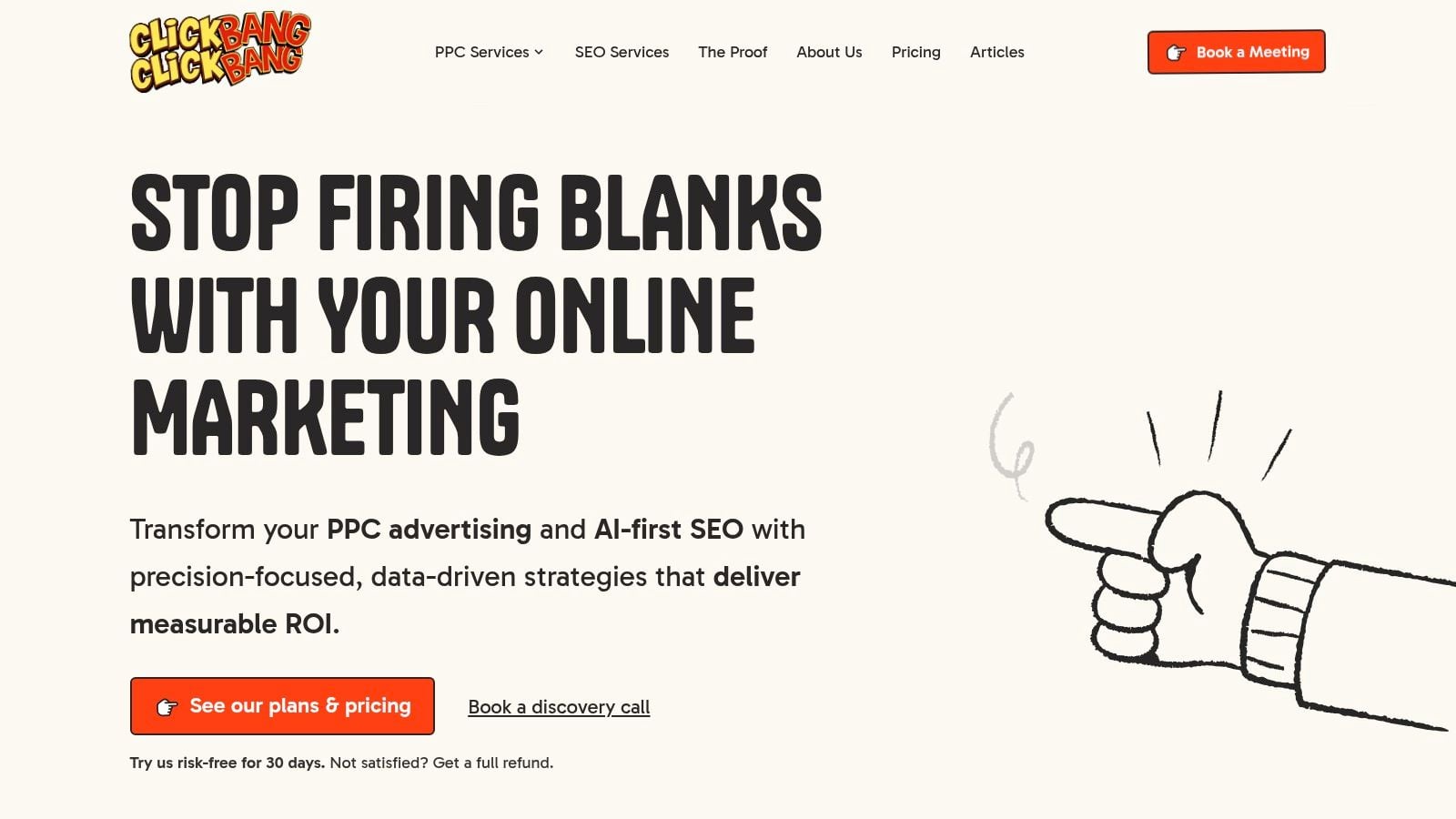
Click Click Bang Bang is the most practical option here for businesses that want clear scope, fast launch, and fewer procurement headaches. A lot of agencies still hide the commercial detail until late in the sales process. CCBB does the opposite. You can see the package structure, the setup fee, and what each tier is designed to cover.
That transparency matters more than most buyers realise. Google's own guidance says strong sitewide tagging through Google tag or Google Tag Manager, plus linking Google Ads with Google Analytics and offline CRM data, forms the foundation for accurate measurement and stronger Smart Bidding performance, as outlined in Google Ads measurement best practice. If an agency can't explain how it handles that foundation, the campaign layer is secondary.
For businesses comparing a specialist partner, CCBB's Google Ads agency service is built around that implementation-first approach.
Why it stands out
CCBB positions itself as AI-first, but the more important point is that it doesn't treat AI as a substitute for tracking, account structure, and human oversight. That's the right way to use it. Good managers use automation to speed analysis, improve creative testing, and support optimisation. Bad managers use it as an excuse to stop thinking.
Its onboarding is straightforward. There's a strategist consultation, a focused questionnaire, and campaigns can go live within seven days. Clients also get a live reporting portal and monthly performance summaries, which is useful if you've been burned by agencies that only send screenshots and broad commentary.
The pricing is also unusually accessible for a full-service AU agency model:
- Click Starter: $997 + GST for one platform, up to 3 campaigns, with a $5,000 ad spend cap
- Campaign Surge: $1,497 + GST for up to 2 platforms, 5 campaigns, with a $7,500 ad spend cap
- Conversion Bang!: $2,497 + GST for up to 3 platforms, 10 campaigns, with a $12,500 ad spend cap
- Foundations setup: $997 + GST in month one for account setup, initial strategy, and conversion tracking
Best fit and trade-offs
This is a strong fit for ecommerce brands, B2B lead generation teams, startups, and SMBs that need hands-on execution without a long-term contract. The month-to-month structure and 30-day risk-free trial lower the commitment risk, which is rare.
Practical rule: If you're under pressure to launch quickly, prioritise agencies that can explain setup, tracking, reporting access, and first 30-day actions in plain English.
There are still trade-offs. Very small operators may find the setup fee and monthly retainer too heavy if spend is modest. Larger advertisers should also clarify exactly how campaign caps, reporting depth, and cross-channel scope work once complexity increases.
Pros and cons are fairly clear:
- Pros: Transparent pricing, fast onboarding, live reporting, month-to-month terms, AU-based support
- Pros: Full-service PPC coverage across Google, Meta, and LinkedIn, plus SEO
- Cons: First-month cost can be a stretch for sole operators
- Cons: Larger or highly technical accounts should confirm how plan limits apply in practice
2. Sparro by Brainlabs
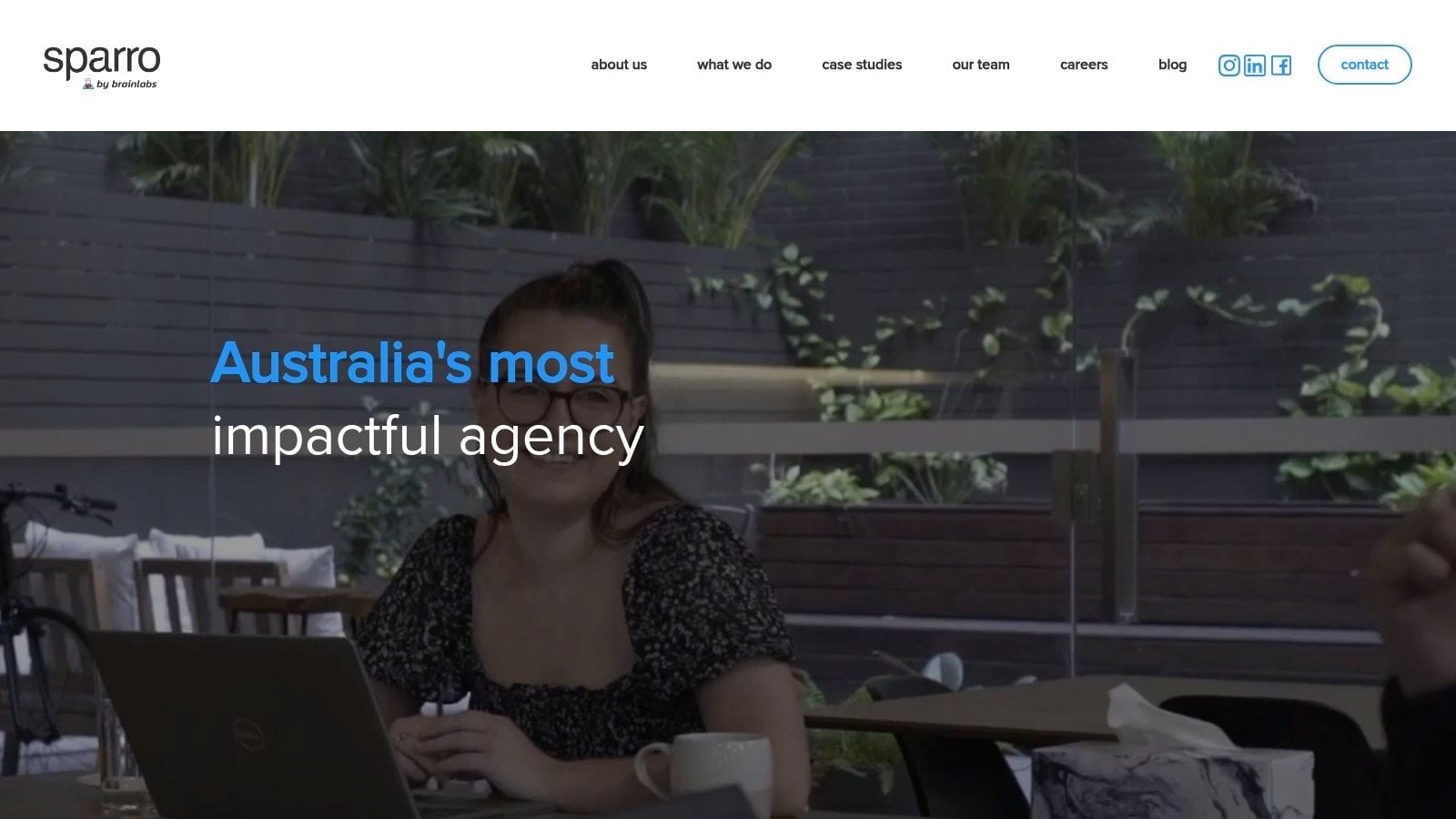
Sparro sits in the “serious scale” category. If you're a mid-market or enterprise brand with multiple channels, internal stakeholders, and a need for data integration beyond ad platform reporting, this is the type of agency that makes sense.
Its strength isn't just paid search. It's the way paid search connects with creative, CRO, media planning, and broader performance strategy. That matters because Google Ads management often breaks down when the account manager can only optimise bids and keywords but can't influence landing pages, creative testing, or attribution choices. Sparro's in-house creative capability through Jack Nimble gives it a stronger test-and-learn environment than many search-only shops.
Where Sparro fits best
This isn't the agency I'd point a very small local advertiser toward first. It's better suited to brands with enough budget and operational maturity to use enterprise-grade support properly. Proposal-based pricing also means you'll need a proper scoping process rather than a quick self-serve decision.
Its Sparro website shows the broader service stack, and that stack is the main draw. Paid search is part of a larger system.
For businesses that want a smaller specialist benchmark while comparing larger operators, it's worth also looking at Click Click Bang Bang's Google Ads management offering.
Bigger agencies are usually strongest when your bottleneck is coordination across teams, not just campaign setup.
Pros and cons look like this:
- Pros: Strong at scale, integrated media and creative capability, suitable for complex ecommerce and full-funnel accounts
- Pros: Recognised profile in the AU market
- Cons: Likely overbuilt for smaller budgets
- Cons: No public pricing, so shortlist only if you're ready for a sales process
3. WebSavvy
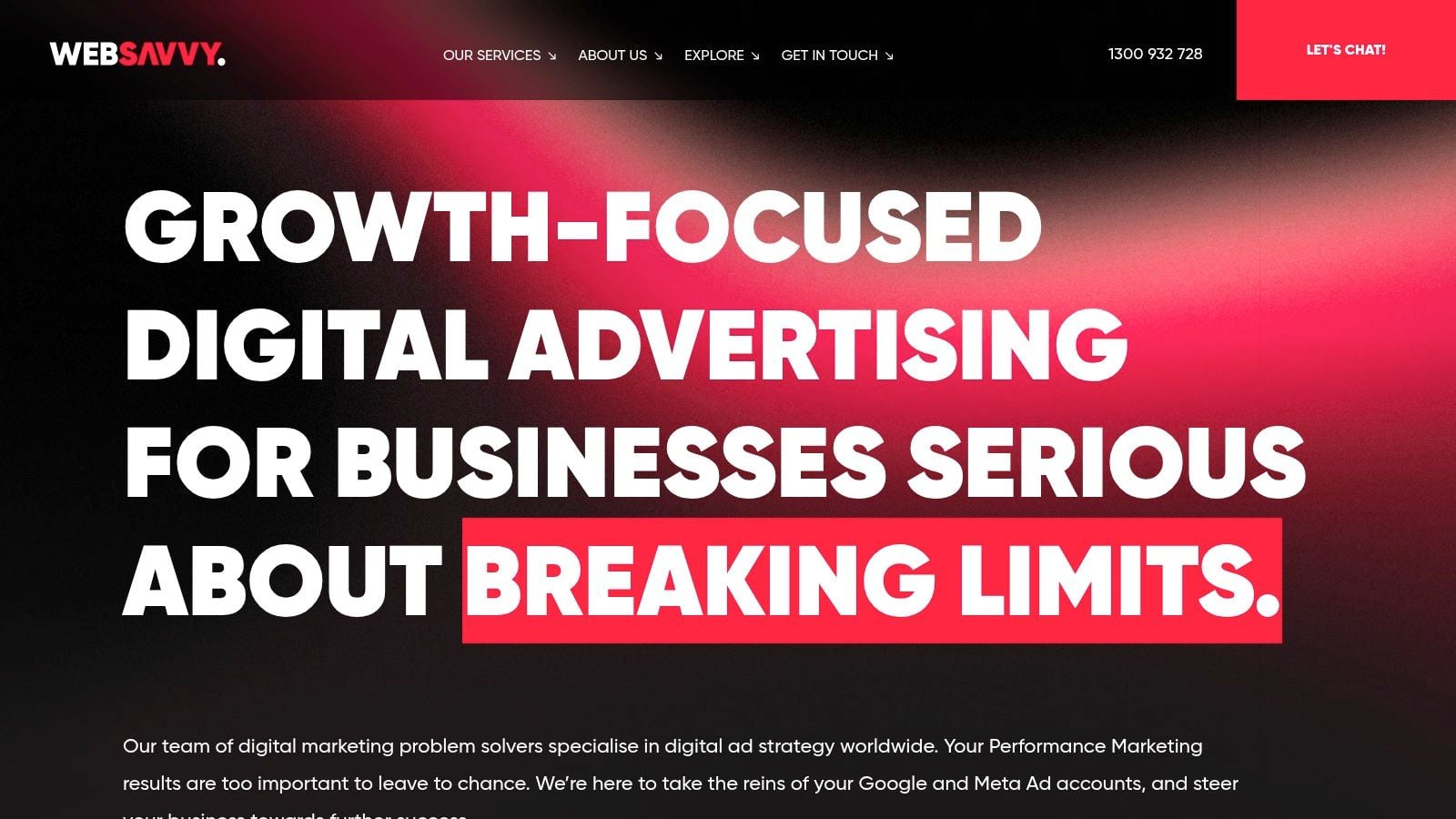
WebSavvy has the profile many buyers need but often overlook. Senior-led, performance-focused, and grounded in practitioner education rather than broad agency theatre. If you want a Google Ads manager who's likely to care about setup discipline, naming conventions, feed quality, and campaign logic, WebSavvy is appealing.
That's especially useful for ecommerce and lead generation advertisers who already know the basics and want cleaner execution. The agency also publishes practical resources, which is often a good signal. Agencies that teach usually have stronger internal process than agencies that only sell.
Why practitioners tend to rate this style of agency
WebSavvy's service mix covers Search, YouTube, and programmatic where relevant. It also offers free audits, which can be useful if you need a second opinion before moving accounts. I'd still treat any free audit carefully. The useful part isn't the list of errors. It's whether the agency can separate issues that are urgent from issues that are cosmetic.
Its WebSavvy website gives a good sense of that practical tone.
If your revenue depends heavily on product feeds, campaign structure, and catalog quality, compare that approach with a dedicated Google Shopping agency in Australia before you decide.
- Pros: Senior-led feel, practical educational resources, relevant for ecommerce and lead generation
- Pros: Broader performance toolkit without losing Google Ads depth
- Cons: No public rates
- Cons: You'll need to validate who manages the account after the pitch
4. Rocket Agency
A common hiring mistake is choosing a Google Ads manager based on polish alone. Rocket Agency makes a better case than that. Its offer points to something more useful for buyers who need a clear decision framework. Channel coverage, scope definition, and the relationship between media buying and conversion improvement.
Rocket covers Search, Shopping, YouTube, and Performance Max. A key distinction is its apparent treatment of Google Ads as part of a wider performance system that includes CRO, testing, and analytics. That matters if your account is already generating traffic but too much of that traffic dies on weak landing pages, poor forms, or unclear measurement. In that situation, a manager focused only on bids and search terms will usually hit a ceiling.
Best for businesses that need more than account management
Rocket is a strong fit for B2B lead generation teams and ecommerce businesses that want process without the bureaucracy that can come with a larger agency model. I'd shortlist them if your internal team is asking sharper questions about attribution, lead quality, or landing-page performance, not just CPCs.
Its Rocket Agency website is worth reviewing with a practical lens. Check whether they explain how they diagnose account problems, what sits inside the monthly scope, and who is responsible for strategy versus execution. Those answers tell you more than broad claims about growth.
One trade-off is cost efficiency. Smaller advertisers may not need a wider testing and analytics framework if the main issue is basic account cleanup. In those cases, ask a direct question: are they solving a measurement and conversion problem, or selling a service layer your budget cannot support yet?
- Pros: Good channel breadth, clear connection between ads, CRO, and analytics, thoughtful positioning around scope
- Pros: Relevant for both lead gen and ecommerce
- Cons: No public pricing
- Cons: Smaller accounts may pay for a broader operating model than they need
5. Reload Media
Reload Media is attractive when you don't want Google Ads handled in isolation. The agency combines paid search with lifecycle marketing, email, SMS, loyalty, and SEO. That setup is particularly useful for ecommerce brands that have enough customer data to improve retention and repeat purchase, not just acquisition.
A strong Google Ads manager should influence more than bidding. While search captures demand, the account performs better when first-party data, customer lists, and post-click flows are fed back into the system. That's one reason Google now stresses measurement durability, account structure, and data-driven optimisation as core best practice in its account optimisation guidance.
Where Reload is strongest
If you run an online store with a meaningful product catalogue and repeat-purchase potential, Reload's broader capability can help. The team depth also matters if you need specialist support across search, shopping, display, and retention channels rather than one generalist.
Its Reload Media website shows that cross-channel orientation clearly.
A manager who can't connect ad traffic to CRM quality, repeat purchase, or sales outcomes will eventually optimise to the wrong goal.
- Pros: Strong ecommerce orientation, useful if you need paid search plus lifecycle marketing support
- Pros: Better fit than a pure PPC shop when retention economics matter
- Cons: Likely more than a small advertiser needs
- Cons: Bespoke pricing means slower comparison shopping
6. Online Marketing Gurus
Online Marketing Gurus is a large independent Australian agency with broad channel capability. That scale makes it attractive to SMBs and mid-market teams that want one provider across SEO, PPC, content, paid social, and analytics. If your business wants a single agency relationship rather than a set of specialists, OMG can be a workable choice.
The key question isn't whether a big agency can run Google Ads. It's whether your account gets the right level of senior attention. Large agencies usually have stronger process, reporting infrastructure, and onboarding systems. They can also be uneven when account complexity is moderate but not large enough to command top-tier resources.
What to verify before signing
OMG offers a free audit, which is fine as a starting point. Just make sure the proposal goes beyond account errors and gets into measurement quality, lead qualification, and decision-making logic. For many advertisers, that's where the key difference sits. Searches for the best Google Ads manager often focus on hiring a person or agency, but the bigger issue is whether they can set up GA4, enhanced conversions, offline conversion imports, and consent-aware measurement correctly. That buyer-side gap is reflected in recent Google Ads education, which increasingly stresses clean signals over surface-level activity.
Its Online Marketing Gurus website is the place to start, but the proposal meeting is where you'll learn whether the fit is real.
- Pros: Broad service stack, suitable for SMB to mid-market, free audit available
- Pros: Process maturity and reporting structure can suit in-house marketing teams
- Cons: Pricing isn't public
- Cons: You'll need to confirm senior oversight and exact Google Ads depth
7. Megaphone Marketing
Megaphone is the growth-focused option on this list. If you're in ecommerce or a fast-moving service category and want aggressive creative testing, broad media support, and lots of published examples of campaign thinking, it's worth considering.
Its Google Ads coverage includes Search, Shopping, Display, and remarketing. The bigger draw, though, is the culture around testing and media planning. That can work well for brands that already have a solid offer, decent conversion paths, and the appetite to iterate quickly.
The real trade-off
This style of agency can be excellent for growth-stage ecommerce. It can also be frustrating if you operate in a highly regulated B2B niche where every creative change and claim needs legal review. Speed is an advantage only if your organisation can support it.
Recent Google Ads training has also put more emphasis on channel mix, micro-conversions, and audience segmentation, including the idea that smaller budgets often do better by focusing on bottom-of-funnel profitability before scaling into broader demand generation, as discussed in this Google Ads training reference. That's the lens to use with Megaphone. Fast growth is appealing, but only if the strategy matches your budget and sales cycle.
Its Megaphone Marketing website gives you a good feel for that high-tempo style.
- Pros: Strong creative testing culture, useful for growth-focused ecommerce brands
- Pros: Broad Google Ads execution with planning resources
- Cons: Public pricing isn't listed
- Cons: May be less natural for tightly controlled or compliance-heavy sectors
Top 7 Google Ads Managers Comparison
| Provider | Implementation Complexity 🔄 | Resource Requirements ⚡ | Expected Outcomes ⭐📊 | Ideal Use Cases 💡 | Key Advantages |
|---|---|---|---|---|---|
| Click Click Bang Bang | Low–Medium, rapid onboarding, structured setup fee and workflows | Small–Medium budgets; tiered monthly plans, one‑time setup $997 + ad spend caps | Quick, measurable lift in visibility, engagement and conversions with near‑term reporting | Startups, SMBs, e‑commerce and B2B testing paid + organic with low contract risk | AI‑first automation, fast launch (ads in ~7 days), transparent live reporting, 30‑day trial |
| Sparro (by Brainlabs) | High, enterprise integrations, full‑funnel media and data systems | Large budgets; enterprise data & creative resources, proposal pricing | Scalable, cross‑channel performance for high‑volume accounts and long‑term growth | Mid‑to‑large brands and enterprise e‑commerce needing scale and advanced analytics | Enterprise data capability, in‑house creative (Jack Nimble), award recognition |
| WebSavvy | Medium, rigorous process, practitioner‑led workflows and free audits | Medium budgets; senior practitioner support and DOOH/programmatic options | Improved search/YouTube performance with strong setup and education support | Ecommerce and lead‑gen advertisers wanting proven Google Ads expertise and guidance | 19+ years experience, practitioner resources, DOOH integration, free audit offering |
| Rocket Agency | Medium–High, integrated CRO, testing and analytics with tailored scopes | Medium–Large budgets; scope varies by channel mix, proposal pricing | Strong B2B lead‑gen and ecommerce outcomes supported by testing and analytics | B2B and ecommerce teams needing integrated CRO and transparent fee discussion | Google Premier Partner, integrated CRO/A‑B testing, clear scope/fee communication |
| Reload Media | Medium–High, cross‑channel planning plus lifecycle marketing integration | Medium–Large budgets; bespoke proposals, multi‑discipline teams | Compounded ROAS through combined paid search, SEO and lifecycle marketing | Retail and ecommerce brands wanting lifecycle (email/SMS/loyalty) plus paid search | Ecommerce pedigree, lifecycle marketing integration, award‑winning team |
| Online Marketing Gurus (OMG) | Medium, mature processes and large operational scale | Small–Mid to Mid‑market budgets; large agency resources, free audit available | Better conversion efficiency and scalable reporting across channels | SMBs through mid‑market seeking performance‑first multi‑channel services | Large team, process maturity, free digital audit, broad service coverage |
| Megaphone Marketing | Medium, high‑velocity creative testing and playbook driven workflows | Medium budgets; growth‑stage tooling and in‑house planning aids | Rapid ROAS iteration and scalable results for DTC/ecommerce brands | Growth‑stage ecommerce/DTC focused on fast testing and creative scale | Strong creative testing culture, published case studies, in‑house playbooks/tools |
Your Checklist for Hiring the Perfect Google Ads Partner
A Google Ads manager usually looks good in a pitch. The real test comes 60 days later, when spend is live, reporting gets messy, and someone has to explain why lead volume is up but sales quality is down. That is the point of this checklist. It helps you choose a partner based on operating discipline, not presentation skills.
Fit matters more than hype. Competition in Australian digital advertising remains strong, and weak account management shows up fast in wasted spend, poor tracking, and vague reporting. A good partner should be able to explain what they are optimising, why they are prioritising it, and what trade-offs come with that choice.
Start with measurement, because every later decision depends on it. Google's own guidance is clear on two fundamentals: ad relevance affects performance, and conversion tracking is the starting point for judging success. Ask the agency to walk through the account setup in plain English. They should be able to explain primary conversions, micro-conversions, offline conversion imports, enhanced conversions, and how those signals influence bidding. Strong managers do not chase generic benchmarks. They define what a profitable lead, sale, or booked call looks like for your business, then build the account around that outcome.
Use these questions in every pitch meeting:
- Who owns tracking setup? Ask who handles Google tag installation or Google Tag Manager, GA4 linking, CRM integration, and call tracking.
- What counts as a conversion? Ask them to separate form fills from qualified leads, booked meetings, purchases, repeat purchases, and other lower-value actions.
- How is performance reported? Ask for live dashboard access and a sample monthly report. You want both.
- Who runs the account? Ask whether the strategist on the call is the day-to-day manager or whether the work is handed to a junior team member.
- How is budget allocated? Ask when they would prioritise Search, Shopping, remarketing, Performance Max, or YouTube, and what evidence would trigger that shift.
- What happens in the first 30 days? Ask for a step-by-step launch plan covering audit, rebuilds, creative, tracking checks, and optimisation milestones.
- How are tests chosen? Ask what they test first, how long a test runs, and what threshold they use before changing course.
Then examine commercial terms with the same level of scrutiny. Setup fees, minimum terms, retainers, media spend tiers, landing page scope, creative inclusions, and pause conditions all affect the actual cost of the engagement. A reliable partner explains these details clearly and early. If basic pricing questions create friction during sales, account communication usually gets harder after signing.
One more filter helps. Ask what the agency would do if results stall for six weeks. Experienced operators have a framework for that situation. They review search terms, conversion quality, bidding inputs, offer strength, landing page friction, audience exclusions, and attribution gaps before asking you to spend more.
Hire the team that can explain how the account will learn, measure, and improve, with specifics tied to your sales process.
The shortlist from this article maps well to different business needs. Click Click Bang Bang suits advertisers who want transparent pricing, fast onboarding, live reporting, and flexible month-to-month terms. Sparro and Reload fit larger brands that need broader channel support and more organisational depth. WebSavvy appeals to teams that want a specialist operator with a disciplined approach. Rocket and OMG are better fits for businesses that want mature processes and wider service coverage. Megaphone makes sense for brands that rely on rapid creative testing and high campaign velocity.
If you want a Google Ads partner that combines transparent pricing, fast onboarding, live reporting, and flexible month-to-month plans, Click Click Bang Bang is a strong place to start. It's especially well suited to Australian ecommerce brands, B2B lead generation teams, startups, and SMBs that want hands-on support without locking into a long contract.
Read NeXt
Or Read Our Latest
- Reporting Portal Login: Access Your Client Dashboard Fast
- How to Calculate Sample Size for A/B Tests and Campaigns
- How to Fix Google Merchant Center Errors Step by Step
- What Is Pagination and Why It Matters for AU Sites
- What Is Value Proposition? PPC & SEO Guide
- How to Choose a Google Ads Agency Australia
Click. CLick. Subscribe.
Get our best PPC insights, industry updates, and power moves delivered straight to your inbox. No fluff, just high-caliber strategies that actually work.
Don’t Leave Just Yet
Try Us For 30-Days,
Risk Free!!
We guarantee that you’ll love our work within the first 30 days, if not you’ll get your money back.
What have you got to lose?