

Social Media Advertising Firms: Top Agencies & Quick Hiring Guide
Last Updated

A social media advertising firm is your strategic partner for managing and optimising paid campaigns on platforms like Facebook, LinkedIn, and TikTok. They do a whole lot more than just boost posts, using their deep platform expertise to turn your ad spend into measurable business growth.
What Social Media Advertising Firms Actually Do
Think of a social media advertising firm as an expert navigator for the complex, ever-shifting world of paid social. Their job isn't just to manage campaigns; it's to act as a genuine extension of your marketing team, translating your business goals into a profitable advertising strategy.
They take care of the entire lifecycle of a paid social campaign, going miles beyond what that simple "boost post" button can ever achieve. A top-tier firm’s work often includes comprehensive social media management, which weaves together strategy, creative, and sharp analysis to drive real outcomes.
Beyond Boosting Posts
The real magic of these firms is their deep, specialised knowledge. They get the nuances of each platform's algorithm, know the ins and outs of audience targeting, and understand what creative actually works. They don't guess; they use data to make every decision.
And this expertise has never been more critical. Just look at the Australian market: local brands poured a massive $4.26 billion into social media ads last year, a 12.1% jump from the year before. That spending now makes up nearly a third (29.3%) of all digital ad spend, showing just how vital these channels are for any business chasing sales and leads online. You can dig into more of these trends in Meltwater's recent analysis.
A great agency doesn't just run ads; they build a scalable system for customer acquisition. They connect your product or service to the right people, at the right time, with a message that resonates and compels action.
A Partnership Focused on Growth
At the end of the day, you're looking for a partner who is completely aligned with your core objectives. Their day-to-day responsibilities usually cover:
- Audience Research and Targeting: Pinpointing and reaching your ideal customers using a combination of demographic, interest, and behavioural data.
- Creative Development: Crafting compelling ad copy, images, and videos designed to stop the scroll and grab attention.
- Campaign Optimisation: Constantly A/B testing variables like headlines, audiences, and ad formats to squeeze every last drop of performance out of your budget and maximise return.
- Technical Implementation: Setting up and managing tracking pixels, conversion APIs, and analytics to accurately measure results and attribute sales back to the right ads.
Hiring one of these specialised firms is an investment in a dedicated team whose entire job is to navigate this intricate system. They handle the technical headaches and strategic planning, freeing you up to focus on running your business while they get on with growing it.
What a Top Social Media Ad Agency Actually Does For You
So, you're thinking about partnering with a social media advertising firm. What should you actually expect them to do? It's way more than just ticking boxes on a generic checklist. A high-calibre agency delivers specialised strategies that play to the unique strengths and audience quirks of each social platform. The goal isn't just to be everywhere; it's to be ruthlessly effective where it counts for your business.
Think about it: a winning campaign on LinkedIn looks completely different from one that goes viral on TikTok. A top-tier firm gets this. They'll build a specific game plan for each channel, making sure every dollar of your ad spend is aimed with precision to hit your business goals. This platform-specific expertise is what separates a true partner from a run-of-the-mill campaign manager.
This diagram breaks down how the best firms juggle audience targeting, killer creative, and data-driven growth to get results.
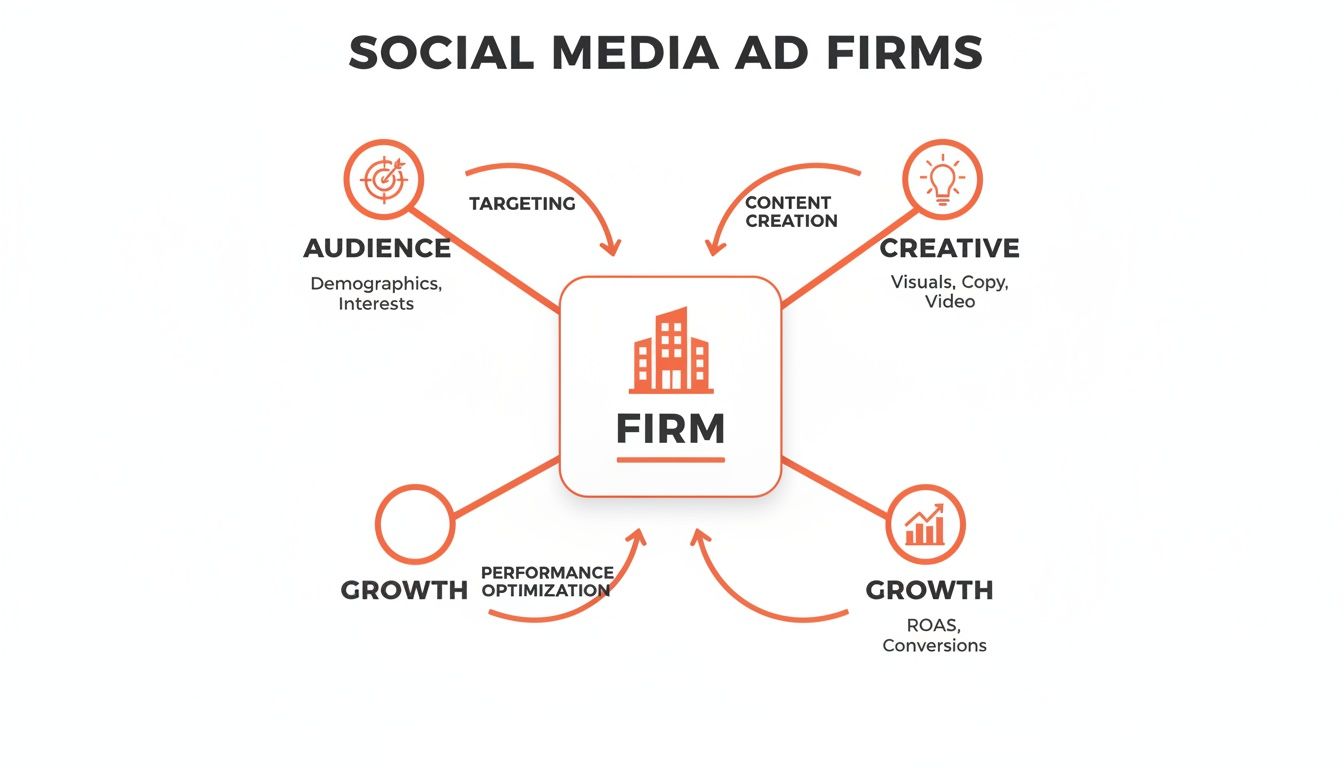
The key takeaway? Success isn't about just one of these things. It's about the strategic fusion of all three—pinpointing the right audience, hitting them with compelling creative, and using data to scale what works.
To get a clearer picture, let's look at how this plays out across the major platforms. Each has a distinct role, audience, and set of tools, and a savvy agency knows exactly how to get the most out of them.
Social Media Platform Advertising Focus
| Platform | Primary Use Case | Ideal Target Audience | Common Campaign Types |
|---|---|---|---|
| Meta (Facebook & Instagram) | E-commerce sales & direct-to-consumer lead generation | Broad consumer audiences (B2C), niche interest groups | Dynamic Product Ads, Retargeting Funnels, Lead Forms |
| High-value B2B lead generation & professional networking | Decision-makers, C-suite executives, specific job titles & industries | Lead Gen Forms, InMail Ads, Content Promotion (Whitepapers) | |
| TikTok | Brand awareness, community building, viral marketing | Younger demographics (Gen Z, Millennials), trend-followers | Short-form Video Ads, Branded Hashtag Challenges, Influencer Collabs |
| X (formerly Twitter) | Real-time engagement, brand conversation, customer service | News followers, tech-savvy users, specific communities | Promoted Posts, Follower Campaigns, Website Traffic Ads |
This table highlights the core focus for each platform, but a skilled agency will often blend these strategies. For instance, they might use TikTok for top-of-funnel awareness and then retarget those engaged users on Instagram to drive a sale. Now, let's dig into the specifics.
Meta Ads for E-commerce and Lead Generation
For most businesses, Meta (Facebook and Instagram) is the beating heart of their social advertising efforts. These platforms are absolute powerhouses for e-commerce brands and anyone selling directly to consumers. An expert firm will go deep, implementing sophisticated tactics to drive revenue.
This often involves setting up dynamic product ads, which are brilliant—they automatically show items from your catalogue to people who have already shown interest on your site. They'll also build out complex retargeting funnels to bring back potential customers who abandoned their carts or browsed specific products, gently guiding them back to finish their purchase.
LinkedIn Ads for High-Value B2B Connections
When the goal is generating high-value B2B leads, the conversation immediately shifts to LinkedIn. This is the undisputed champion for reaching decision-makers in a professional context. A skilled agency moves beyond just broad targeting to pinpoint your ideal clients with surgical accuracy.
They use LinkedIn’s incredible data to find users by:
- Specific job titles (e.g., "Chief Financial Officer," "Head of HR")
- Company size (e.g., businesses with 50-200 employees)
- Industry (e.g., "Software," "Financial Services")
- Seniority level (e.g., "Director," "VP," "C-Suite")
This allows B2B companies to put their message directly in front of the exact people with the power to make purchasing decisions. The result is high-quality leads that your sales team can actually close. For a deeper look at this process, check out our guide on how our social media ads agency operates.
TikTok and X for Brand Building and Engagement
While Meta and LinkedIn are giants for direct-response ads, platforms like TikTok and X (formerly Twitter) fill different, but equally vital, roles. TikTok is completely unmatched for building brand awareness, especially with younger demographics, through short, snappy, and engaging video content.
X, on the other hand, is all about real-time engagement and community building. It’s the perfect spot to jump into trending conversations, handle customer service issues, and drive traffic to your latest blog post or company announcement.
This kind of strategic diversification is more important than ever. The Australian internet advertising market recently exploded to $17.2 billion, a 10.6% jump fuelled by major events. Social media and video were massive growth drivers in this surge, with video ads now making up 29% of the total spend.
A truly comprehensive partnership involves more than just launching campaigns. It's a continuous cycle of strategy, creative development, A/B testing, pixel implementation, and meticulous conversion tracking to ensure every dollar is accounted for and optimised.
Ultimately, the core service of any top-tier social media advertising firm is to deliver a complete, end-to-end solution. From the initial strategic blueprint and creative direction to the nitty-gritty technical setup and ongoing performance analysis, they manage the entire process to deliver measurable growth for your business.
Translating Campaign Goals Into Real-World KPIs
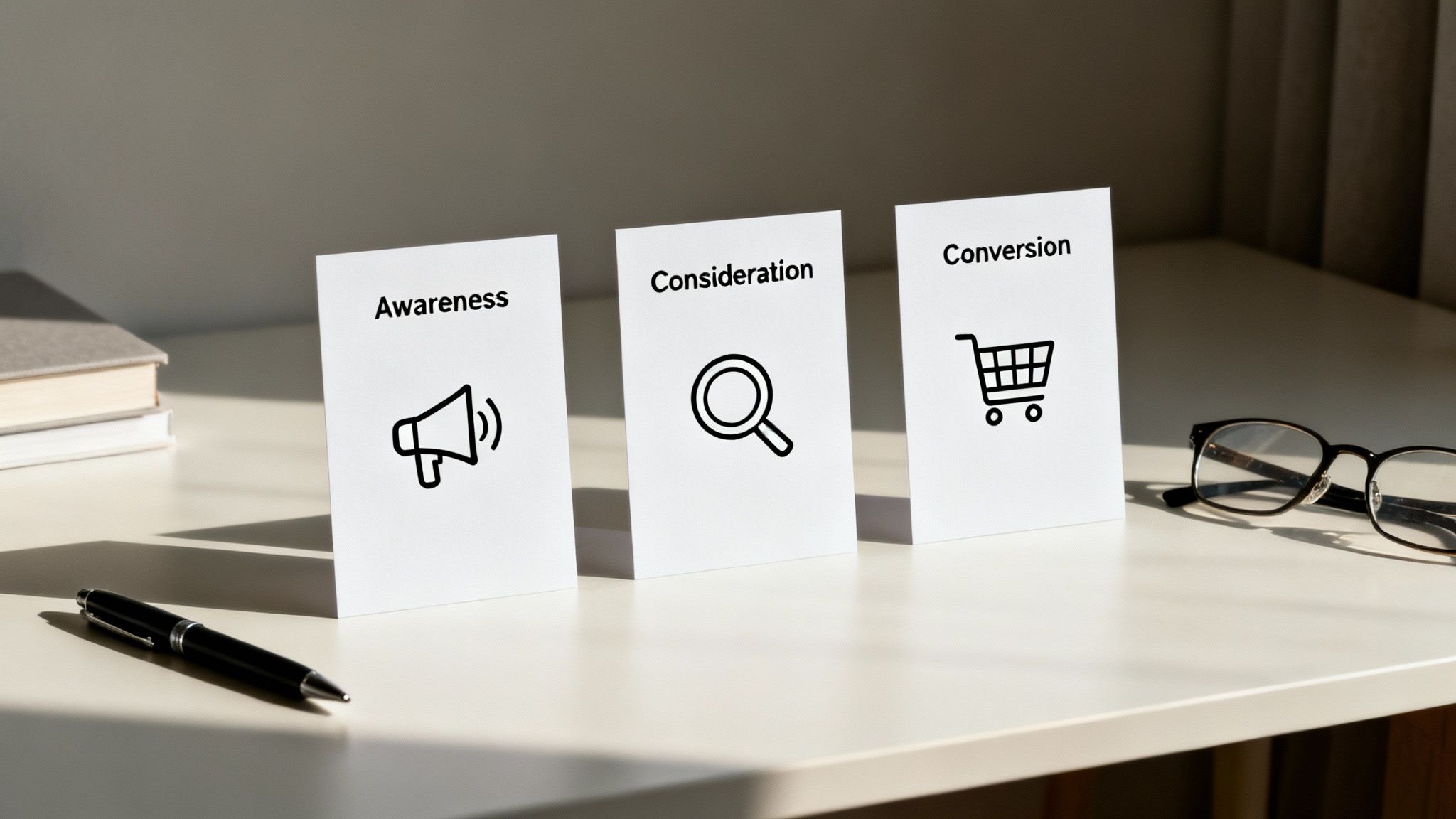
Running social media ads without clear goals is like driving with no destination in mind. You’ll burn through fuel (your budget) but won't get anywhere meaningful. This is exactly where a skilled social media advertising firm proves its worth. They don’t just “run ads”; they translate your business objectives into specific campaign types, each measured by the right Key Performance Indicators (KPIs).
Getting your head around this process is vital. It’s how you hold your agency accountable and see real value from your investment. Most campaigns align with one of three stages that mirror a customer's journey with your brand.
Awareness: The Digital Billboard
Think of an Awareness campaign as putting up a massive digital billboard on a busy highway. The goal isn't to get someone to pull over and buy something right there and then. It’s about introducing your brand to a broad but relevant audience who has probably never heard of you before.
The main game here is reach and recall. You’re building familiarity, planting a seed, and making sure your brand name becomes part of the conversation.
Key KPIs for Awareness campaigns include:
- Impressions: The total number of times your ad was displayed. This is your raw visibility metric.
- Reach: The number of unique people who saw your ad. It tells you the sheer size of the audience you've touched.
- Ad Recall Lift: A metric, often measured through platform polls, that estimates how many people are likely to remember seeing your ad.
Consideration: The Window Shopper
Once someone knows you exist, the next challenge is to pique their interest. A Consideration campaign is like getting that person to stop, walk up to your shop window, and take a closer look at what you’re offering. They aren't ready to buy just yet, but they're curious and actively checking out their options.
At this point, the focus shifts from pure visibility to genuine engagement. You want to see people interacting with your content, visiting your website, or downloading a resource.
KPIs for Consideration campaigns are much more action-oriented:
- Click-Through Rate (CTR): The percentage of people who saw your ad and actually clicked on it. A higher CTR often means your creative is compelling and your audience targeting is spot-on.
- Cost Per Click (CPC): The average amount you pay for each of those clicks. An efficient campaign will drive this number down over time.
- Landing Page Views: The number of times people have landed on your website after clicking your ad. This confirms the traffic is actually arriving where you want it.
A classic mistake is judging an Awareness campaign with Conversion metrics. It's like being disappointed your highway billboard didn't ring up a sale on the spot. Each stage has its own definition of success, and a good firm knows precisely how to measure it.
Conversion: Closing The Deal
This is the final step, where that initial interest turns into decisive action. A Conversion campaign is like having an expert salesperson on the floor, ready to help that interested window shopper make a purchase. The goal is direct and crystal clear: generate a specific, valuable outcome for the business.
This is where the money is made, and the KPIs are laser-focused on financial returns and efficiency. They directly answer the big question: "Is this advertising profitable?" Understanding these crucial digital marketing performance metrics is non-negotiable for gauging the true success of your campaigns.
The most important KPIs for Conversion campaigns are:
- Return On Ad Spend (ROAS): This is the ultimate measure of profitability. For every dollar you spend on ads, how much revenue do you get back? A 4:1 ROAS means you made $4 for every $1 you spent.
- Cost Per Acquisition (CPA): How much does it cost, on average, to acquire one new customer or lead? This tells you how efficient your customer acquisition efforts really are.
- Conversion Rate: The percentage of people who clicked your ad and then completed the desired action, like making a purchase or filling out a form.
Ultimately, a top-tier social media advertising firm will build a strategy that moves customers through all three stages, using the right KPIs to measure success at every single step. This data-driven approach ensures your budget is working as hard as it possibly can to grow your bottom line.
How to Compare Agency Pricing Models
Figuring out the money side of hiring a social media advertising firm can feel like trying to decipher a new language. You'll see proposals throwing around terms like retainers, ad spend percentages, and performance fees, which makes comparing apples with apples a real headache. Getting your head around these models is the key to finding a partner that fits your budget and goals, without getting locked into a structure that just doesn’t make sense for your business.
First things first: you need to separate two distinct costs. There’s the management fee (what you pay the agency for their brains and time) and your ad spend (the money that goes straight to platforms like Meta or LinkedIn). Any agency worth its salt will make this distinction crystal clear from day one.
Let's break down the most common ways they structure their fees.
Flat Monthly Retainer
This is the most straightforward and common model out there. You simply agree to pay the agency a fixed fee each month for a defined scope of work. Think of it as a subscription for their expertise—you know exactly what the bill will be, which makes budgeting a breeze.
This model is a great fit for businesses that need consistent, ongoing campaign management and optimisation. The catch? The scope of work needs to be nailed down. You should have a crystal-clear understanding of what that monthly fee buys you, from strategy and creative work to reporting and meetings.
Percentage of Ad Spend
With this model, the agency's management fee is a slice of your monthly ad spend, usually somewhere between 10% and 20%. So, if you spend $10,000 on ads in a month and the fee is 15%, you’ll pay the agency $1,500 for their services.
It's a popular structure because it scales with your marketing budget. As you pour more money into ads, the agency’s workload and responsibility tend to grow, and their compensation follows suit. The potential downside is that it could, in theory, discourage an agency from finding ways to spend less. That’s why it’s vital to make sure they are laser-focused on efficiency metrics like ROAS and CPA, not just spending your money. You can learn more about the nuances of social media advertising costs to get a better handle on budgeting for your campaigns.
A pricing model isn't just a number; it's a reflection of the agency's partnership philosophy. A flexible, transparent model that avoids long-term lock-in shows a firm is confident in its ability to deliver tangible results month after month.
Performance-Based Fees
This is often pitched as the ultimate results-driven model. Here, the agency's fee is tied directly to hitting specific, pre-agreed KPIs. For instance, they might earn a set amount for every qualified lead they generate (Cost Per Lead) or take a percentage of the revenue from sales they drive (Revenue Share).
The big plus is that you’re only paying for real outcomes, which keeps your risk low. The challenge, however, is that this model demands incredibly precise tracking and a rock-solid definition of what a "lead" or a "sale" actually is to avoid any arguments later on. It works best for businesses with a very clear and easily measurable conversion event.
The social media ad market in our region is booming—it’s projected to hit US$5.58 billion in 2025 for Australia & Oceania. This growth is pushing more agencies to adopt models that prove their direct value and ROI. You can find more insights into this growth in Statista's market analysis.
Ultimately, choosing the right model comes down to your business’s maturity, your need for budget predictability, and how much risk you're willing to take. The best social media ad firms offer flexible options, making sure the financial arrangement supports a healthy partnership focused on growth.
Your Vetting Checklist for Finding the Right Firm

Choosing the right social media advertising firm is a massive decision. Get it right, and you’ve got a powerful growth engine for your business. Get it wrong, and you can burn through your budget with painfully little to show for it.
To make a smart choice, you have to look past the polished sales pitch and dig into how they actually operate. Think of it like a job interview for a critical role, because that's exactly what it is.
This checklist is your framework for that interview. It’s designed to help you ask the tough questions and spot the green flags that signal a truly exceptional partner.
Assess Their Industry and Platform Expertise
Not all agencies are created equal. Many have carved out deep expertise in specific niches, like e-commerce or B2B software, which gives them a huge head start. They already get your customer's pain points, know the competitive landscape, and understand the messaging that resonates.
Likewise, an agency that crushes it with LinkedIn ads for corporate clients might not be the best choice for a consumer brand trying to build a community on TikTok. You need a partner whose skills are a direct match for your goals and, most importantly, where your audience spends their time.
Ask them directly:
- Do you have experience with clients in our industry? Can you share some case studies or anonymised results?
- Which social media platforms do you truly specialise in? How does that line up with our target audience?
- How do you stay on top of the constant platform updates and algorithm changes? This reveals their commitment to actually being experts.
Scrutinise Their Case Studies and Past Performance
A sales pitch will always sound impressive, but case studies tell the real story. They are your best window into an agency's problem-solving skills and their ability to deliver real, measurable results.
Don't just accept a glossy PDF at face value. Look for case studies that mirror your own situation—whether it's your industry, business size, or specific goal like lead generation or online sales. This is the clearest evidence they can replicate past successes for you.
Green Flag: Look for agencies that are transparent about the entire story. That means the initial challenges, the strategy they developed, the actions they took, and the specific, quantifiable outcomes. Vague claims like "increased engagement" are a red flag; concrete metrics like "achieved a 3.5x ROAS" are what you want to see.
Understand Their Strategic and Onboarding Process
A great partnership starts with a smooth, well-defined process from day one. How an agency onboards a new client says a lot about how organised and client-focused they are. A chaotic or vague onboarding is often a preview of a disorganised and frustrating partnership down the track.
You're looking for a clear, documented plan that shows they’ve thought through every step, from initial discovery to launching the first campaign. This process should be designed to get them up to speed on your business quickly and efficiently.
Here’s what to ask about their process:
- What does your client onboarding look like, step-by-step? A great agency, like our team at Click Click Bang Bang, uses detailed questionnaires and strategist consultations to ensure deep alignment before a single dollar is spent.
- How long does it typically take from signing the contract to our first ads going live? An efficient firm should be able to get campaigns running within a week or two, not a month.
- What’s your process for campaign optimisation when performance dips? Their answer will show if they're proactive problem-solvers or just passive campaign managers.
Evaluate Communication and Reporting Transparency
Clear communication and transparent reporting are the bedrock of a healthy agency-client relationship. You should never be left wondering what your agency is working on or how your campaigns are performing. The best firms make it easy to see exactly where your money is going and what results it's generating.
Static monthly PDFs are becoming a thing of the past. Modern agencies should offer more dynamic and accessible reporting solutions.
Look for these green flags of transparency:
- A dedicated point of contact and a clear communication schedule (e.g., weekly check-ins, monthly strategy calls).
- Access to a live data dashboard or portal that lets you see real-time campaign performance whenever you want.
- Clear, easy-to-understand reports that focus on the KPIs that actually matter to your business goals (ROAS, CPA), not just vanity metrics.
Vendor Evaluation Checklist
To pull this all together, we've created a simple table to guide your conversations. Use this as your cheat sheet during your vetting calls to make sure you cover all the critical bases and compare potential partners effectively.
| Evaluation Area | Key Questions to Ask | What to Look For (Green Flags) |
|---|---|---|
| Industry & Platform Expertise | Do you have direct experience in our industry? Which platforms are your strongest, and why are they right for us? | They provide relevant case studies and have a clear rationale for platform selection that aligns with your audience. |
| Past Performance & Results | Can you walk me through a case study, explaining the challenges, strategy, and specific results (KPIs)? | They share specific metrics (ROAS, CPA, lead volume) and are transparent about both successes and learning curves. |
| Strategy & Onboarding | What is your step-by-step onboarding process? How do you develop the initial campaign strategy? | A documented, thorough process that includes deep dives into your business, goals, and customers before launch. |
| Communication & Reporting | Who will be our main point of contact? What is your communication rhythm? Can we see a sample report or dashboard? | A dedicated contact, a regular meeting schedule, and access to a live, transparent dashboard with business-focused metrics. |
| Team & Culture Fit | Who will be working on our account? What is your agency's approach to client partnerships? | You meet the actual team members (not just sales), and their communication style feels collaborative and proactive. |
| Pricing & Contract Terms | Can you explain your pricing model in detail? What are the contract length, terms, and notice period? | Clear, straightforward pricing with no hidden fees. Flexibility in contract terms is a plus. |
By systematically working through these areas, you can cut through the sales chatter and conduct a thorough, structured evaluation. This thoughtful approach will empower you to find a social media advertising firm that isn't just a vendor, but a genuine partner invested in your long-term success.
Setting Your Partnership Up for Success
Choosing the right social media advertising firm is a huge step, but the work doesn’t stop once the contract is signed. A great partnership is built on a foundation of clear communication and a smooth, structured onboarding process right from day one.
This initial phase is critical. It sets the tone for the entire relationship and ensures your new partners have everything they need to hit the ground running. A disorganised or vague start often signals a chaotic partnership ahead. In contrast, a top-tier firm will guide you through a well-defined process designed to get them deeply acquainted with your business, goals, and ideal customers.
This isn’t just about ticking boxes and administrative setup; it's about genuine strategic alignment. The first few days should feel productive and collaborative, moving you swiftly from signing a contract to seeing your first ads go live.
The Onboarding Blueprint
A typical onboarding journey involves a few key steps to get your campaigns off the ground efficiently. While the exact details might vary between firms, the core components should look something like this:
-
Discovery and Strategy Session: This is way more than a simple kick-off call. Think of it as an in-depth workshop where the agency’s strategists dive headfirst into your business. Expect to discuss your target audience, unique value proposition, past marketing efforts, and, most importantly, your ultimate business objectives.
-
Technical Account Setup: Next, the team gets under the hood to handle the technical essentials. This means getting the necessary access to your ad accounts, setting up tracking pixels on your website, and configuring conversion APIs to make sure every lead and sale is measured accurately.
-
Creative and Campaign Build-out: With a clear strategy and the technical foundation in place, the agency starts crafting your initial campaigns. They’ll develop ad copy, source or design creative assets, and build the audience targeting structures for your first set of ads.
This structured process ensures nothing gets missed. For example, a forward-thinking agency like Click Click Bang Bang uses detailed questionnaires and strategist consultations to achieve deep alignment, enabling them to move from contract to live ads in just seven days.
An agency’s onboarding process is a direct reflection of its organisational skills and client focus. A clear, efficient, and thorough setup is a strong indicator of a proactive partner committed to delivering results, not just managing tasks.
Reporting: From a Static PDF to a Live Dashboard
Once campaigns are running, the focus shifts to performance and communication. This is where you’ll see a massive difference between average and excellent social media advertising firms.
Outdated agencies might still rely on sending a static PDF report once a month, leaving you completely in the dark about what’s happening in real-time. This old model is no longer good enough.
Modern, transparent agencies prioritise giving you access to a dynamic, live reporting dashboard. This gives you 24/7 access to your campaign data, allowing you to see key metrics like Return On Ad Spend (ROAS) and Cost Per Acquisition (CPA) whenever you want. No more waiting weeks for an update.
This commitment to transparency and data ownership is non-negotiable. It fosters a truly collaborative relationship where both sides are looking at the same numbers, making informed decisions together to drive your business forward.
Common Questions About Hiring a Social Media Ad Agency
Bringing a social media advertising firm on board is a big step, and it naturally comes with some important questions. Getting straight answers is key to making a smart decision and setting your business up for a successful partnership. Let's tackle the most common ones we hear.
How Much Should I Expect to Pay a Social Media Advertising Firm?
This is the big one, and the honest answer is: it varies. Costs can swing quite a bit depending on the agency’s model and the amount of work involved. It’s crucial to remember you’re paying for two distinct things: the agency's management fee for their expertise and time, and your actual ad spend that goes directly to platforms like Meta or LinkedIn.
You'll typically run into a few common pricing structures:
- Percentage of ad spend: This is usually 10-20% of whatever your monthly ad budget is.
- Flat monthly retainer: A set fee that can be anywhere from $1,500 to over $10,000, based on how complex your campaigns are.
- Performance-based fees: Here, the agency gets paid based on hitting specific goals, like a certain number of leads or sales.
Keep an eye out for firms that offer flexible, tiered plans without trying to lock you into a long, rigid contract. A risk-free trial period is a massive green flag—it shows the agency is confident they can get you results, fast.
How Long Until I See Results from Social Media Ads?
While you'll see surface-level numbers like impressions and clicks pop up almost right away, the results that actually move the needle—leads and sales—take a bit more time. Think of the first 30-90 days as a critical ‘learning phase’. This is when the agency is in the trenches, testing different audiences, ad creatives, and messages to figure out what your customers respond to.
You should definitely expect to see positive signs in leading metrics within the first month. But a clear picture of your Return On Ad Spend (ROAS) usually comes into focus over the first quarter. An agency with a quick, efficient onboarding process can speed this up, but the winning formula is always a mix of patience and data-driven adjustments.
The initial weeks are an investment in data. A good agency uses this period to gather insights that will fuel profitable campaign scaling later on, turning early learnings into long-term growth.
What Is the Difference Between SEO and Social Media Advertising?
Both of these are designed to get more eyes on your business online, but they go about it in fundamentally different ways. An SEO agency is focused on earning you visibility in organic (unpaid) search results on engines like Google. They do this through things like content creation, improving your website’s structure, and building your site’s authority over time.
A social media advertising firm, on the other hand, specialises in creating and managing paid campaigns on platforms like Facebook, Instagram, and LinkedIn. Their job is to put your message directly in front of very specific groups of people with incredible precision. The most effective modern agencies often integrate both, using learnings from paid ads to inform a smarter organic SEO strategy for a powerful, unified approach to growth.
Ready to see how a dedicated, data-driven approach can transform your social media advertising? The team at Click Click Bang Bang combines AI-first strategies with transparent reporting to deliver real results, fast. Explore our PPC plans and start your risk-free trial today!
Read NeXt
Or Read Our Latest
- Manual vs Automated Bidding for PPC Success
- Conversion Tracking Setup: A Complete AU Guide
- Instagram Advertising Australia: Complete 2026 Guide
- Pay Per Click: A Beginner’s Guide for Australian Marketers
- Display Advertising on Google: The Complete Australian Guide
- Stakeholder Communication Plan How to Build One That Works
Click. CLick. Subscribe.
Get our best PPC insights, industry updates, and power moves delivered straight to your inbox. No fluff, just high-caliber strategies that actually work.
Don’t Leave Just Yet
Try Us For 30-Days,
Risk Free!!
We guarantee that you’ll love our work within the first 30 days, if not you’ll get your money back.
What have you got to lose?