

Mastering SEO Services for Website Success
Last Updated

Investing in SEO services for your website isn't about ticking off a technical checklist; it's a strategic move to secure long-term visibility and drive real revenue. The whole point is to blend technical fixes, smart content, and authority-building to make your site irresistible to search engines like Google.
Done right, this connects you directly with customers who are already searching for exactly what you sell.
What Are SEO Services for Website Growth?
Think of your website like a brick-and-mortar shop. You could have the best products in the world, but if your store is tucked away in a hidden alley with a dodgy door and no signage, you’re not going to make many sales. Good SEO is like hiring a team of expert architects, marketers, and town planners all at once. Their job is to move your hidden shop to a prime spot on the main street and turn it into a flagship store.
This transformation isn't a single trick. It involves several interconnected strategies, each playing a critical part in attracting customers and growing your business. It’s all about making your website not just visible, but genuinely valuable and authoritative in the eyes of both search engines and your ideal clients. A non-negotiable first step in any solid SEO strategy is to perform a comprehensive website audit to pinpoint exactly where the opportunities for improvement lie.
To give you a better idea of what you’re investing in, here’s a quick look at the main pillars of a complete website SEO service.
The Core Components of an SEO Strategy
Breaking it down helps to see how each piece contributes to the bigger picture. Each discipline tackles a specific aspect of your website's performance, and they all work together.
-
Technical SEO: This is the bedrock of your online presence. It’s about ensuring your site has a solid structure, loads quickly, is secure, and is a breeze for Google’s crawlers to explore. Think of it as having a sturdy building with easy-to-use entrances and no structural issues.
-
On-Page SEO: This is the in-store experience. It involves optimising individual pages with the right keywords, clear headings, and compelling meta descriptions. This is your clear signage and well-organised aisles that guide customers exactly where they need to go.
-
Content Creation: These are the valuable products you put on your shelves. High-quality blog posts, detailed service pages, and helpful guides answer your customers' questions and prove you’re an expert. This gives people a reason to visit, stick around, and trust you.
-
Link Building (Off-Page SEO): Think of these as the main roads leading directly to your shop, along with glowing five-star reviews from trusted local figures. Earning backlinks from reputable websites builds your site's authority and tells Google that you're a credible, trustworthy business.
You can learn more about how all these elements come together in our guide to Search Engine Optimisation.
The table below offers a snapshot of how each type of SEO service contributes to your bottom line.
The Core Components of Website SEO at a Glance
| SEO Service Type | Primary Goal | Key Business Outcome |
|---|---|---|
| Technical SEO | Ensure the website is easily crawlable, fast, and secure for search engines. | Improved user experience and higher potential for rankings. |
| On-Page SEO | Optimise page content and HTML for specific keywords to improve relevance. | Increased organic traffic for targeted search terms. |
| Content Creation & SEO | Create valuable content that answers user questions and attracts backlinks. | Enhanced brand authority and a steady flow of qualified leads. |
| Link Building (Off-Page) | Earn high-quality backlinks from other reputable websites to build authority. | Stronger domain authority, leading to better overall rankings. |
| Local SEO | Optimise for location-based searches and visibility in local map packs. | Increased foot traffic and more local customer enquiries. |
| E-commerce SEO | Optimise product pages, categories, and site structure for online stores. | More product visibility in search results and higher sales. |
As you can see, a comprehensive SEO strategy is much more than just keywords; it's a full-funnel approach to building a powerful online presence.
The growing investment in these services is no accident—it's a direct response to their proven impact. In 2025, Australian businesses are on track to pour a massive $1.5 billion into SEO. Why? Because organic results consistently snag 85-90% of all clicks, leaving paid ads in the dust. Discover more about these local SEO statistics and their implications.
The Four Pillars of a Powerful SEO Strategy
Any solid SEO strategy, the kind that actually delivers results, is built on four distinct but deeply interconnected pillars. Getting your head around how they work together is the first step to understanding what you're really paying for with professional SEO services. Each one tackles a different part of your website's performance, and if you neglect one, you'll find the others start to wobble.
I like to use the analogy of building a successful retail shop. First, you need a solid, well-built store with good plumbing and electricity (Technical SEO). Then you need clear signage and a logical layout so people can find what they're looking for (On-Page SEO). Of course, you need amazing products on the shelves that people actually want (Content Creation). Finally, you need good roads leading to your store and plenty of word-of-mouth recommendations to bring people in (Link Building).
A proper SEO service doesn't just focus on one of these; it makes sure all four areas are firing on all cylinders.
The diagram below shows how these core pieces fit together to support your website's growth.
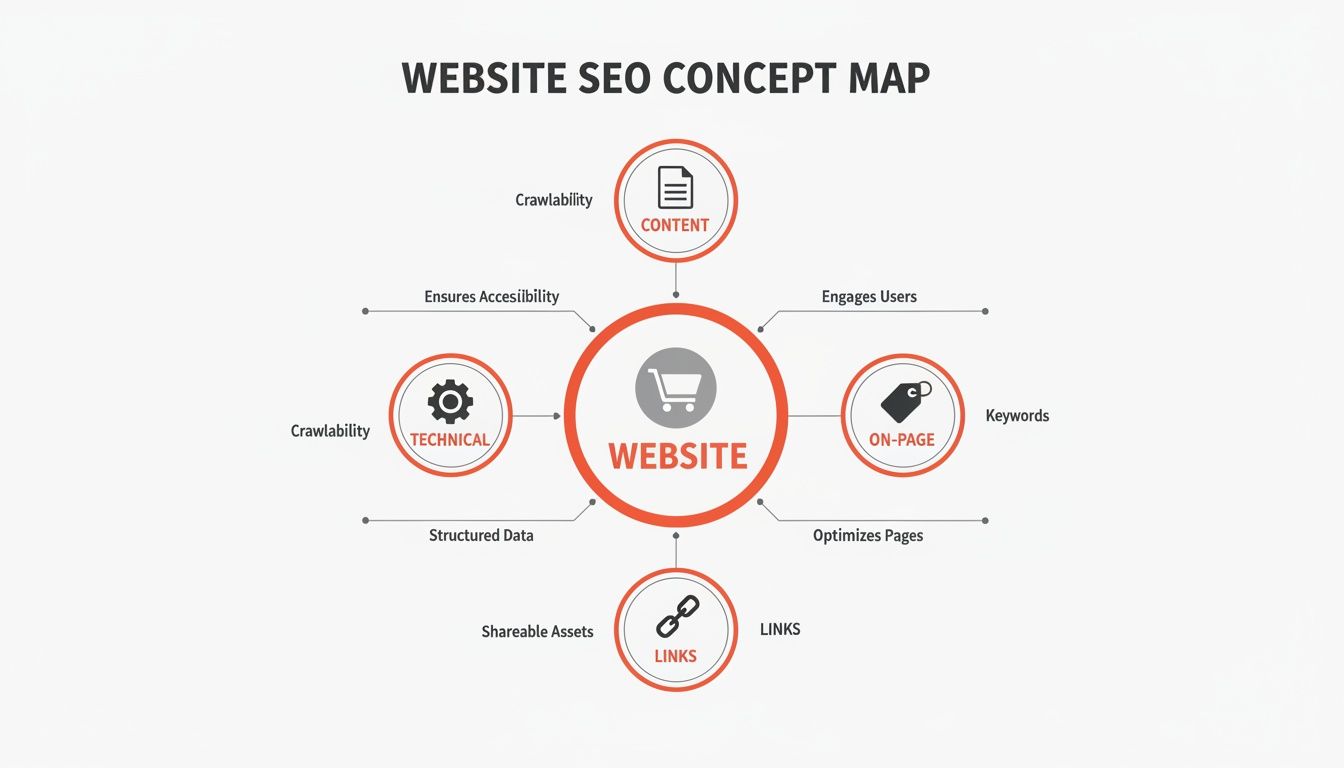
As you can see, while they're all separate disciplines, they ultimately work in concert to turn your website into a powerful, high-performing asset.
Pillar 1: The Technical SEO Foundation
Technical SEO is all the work that happens behind the scenes. It’s about making sure your website gives both users and search engine crawlers a flawless experience. If Google's bots can't properly access, understand, or index your site, even the most brilliant content will be completely invisible. It’s the non-negotiable foundation for everything else.
Key activities here include:
- Improving Site Speed: A slow-loading website is a deal-breaker for visitors. A delay of just a few seconds can send your bounce rate through the roof. Technical SEO tackles this by optimising images, streamlining code, and getting your server to respond faster.
- Ensuring Mobile-Friendliness: The majority of searches now happen on mobile devices, so Google rightly prioritises sites that deliver a seamless mobile experience. This means having a responsive design that adapts perfectly to any screen size.
- Securing Your Site with HTTPS: A secure website (you'll see the "https://" in the URL) protects user data and is a confirmed, albeit small, ranking factor. It's a fundamental mark of trust for both users and search engines.
- Optimising Crawlability and Indexability: This involves using tools like
robots.txtand sitemaps to give search engines a clear road map, ensuring they can easily discover and index all your important pages without getting lost in the irrelevant ones.
Without a strong technical foundation, any money you spend on content or links is essentially being built on quicksand.
Pillar 2: On-Page SEO Optimisation
Once your site is technically sound, we shift focus to the content on your actual pages. On-page SEO is all about optimising individual web pages to rank higher and attract more relevant traffic. This is where you make it crystal clear to Google what your page is about and why it matches what someone is searching for.
On-page optimisation is your chance to speak directly to search engines, telling them exactly what your content is about and why it's the best answer for a specific query.
This pillar involves a few critical elements:
- Keyword Research and Integration: This means finding the exact terms and phrases your target audience is typing into Google and then weaving them naturally into your titles, headings, and body text.
- Crafting Compelling Meta Titles and Descriptions: These are the little snippets of text that show up in the search results. A well-written meta acts like a mini-advertisement, convincing users to click on your link instead of a competitor's.
- Logical Content Structure: Using header tags (H1, H2, H3) to create a clear hierarchy makes your content much easier for both people and search engines to read and understand.
- Internal Linking: Strategically linking to other relevant pages on your own website is a simple but powerful way to distribute authority and guide users deeper into your site.
When you nail on-page SEO, your content becomes undeniably relevant to what a searcher needs.
Pillar 3: High-Value Content Creation
Content is the engine that drives your entire SEO strategy. It’s what pulls people in, keeps them engaged, and ultimately turns them into customers. High-quality content is how you prove your expertise, build trust, and give other websites a good reason to link back to you. Without it, your website is just an empty digital shopfront.
The aim is to create content that helps your audience at every stage of their journey. In fact, studies often show that longer, in-depth articles of over 2,400 words tend to rank best on Google because they provide comprehensive answers to complex questions.
This is all about producing different types of assets, such as:
- Blog Posts: In-depth articles that answer your customers' questions and target those informational "how-to" or "what-is" style keywords.
- Service Pages: Detailed pages that clearly explain what you offer and are optimised for keywords that show someone is ready to buy.
- Guides and Resources: Long-form content like e-books or ultimate guides that establish you as an authority and become a go-to resource in your industry.
Great content is always about quality over quantity. One deeply researched, genuinely helpful article will deliver far more long-term value than a dozen superficial posts ever will.
Pillar 4: Authoritative Link Building
Link building, often called off-page SEO, is the process of getting other websites to link to yours. In Google's world, a link from a reputable site is like a vote of confidence. It signals that your content is trustworthy and authoritative, and a strong backlink profile is one of the most powerful ranking factors there is.
But here’s the catch: not all links are created equal. The focus is always on quality, not quantity. A single link from a respected industry publication is worth infinitely more than hundreds of links from low-quality, spammy websites.
Effective link building isn't about spamming comments sections. It’s about strategies like:
- Guest Blogging: Writing genuinely useful articles for other reputable websites in your niche in exchange for a link back to your site.
- Digital PR: Creating newsworthy content, data, or stories that journalists and bloggers actually want to cover and link to.
- Broken Link Building: A clever tactic where you find broken links on other sites and suggest your own relevant content as a perfect replacement.
Together, these four pillars create a powerful, self-reinforcing loop. Great technical SEO lets your amazing content get discovered, which then helps you earn authoritative links, which in turn boosts your rankings and brings even more people to your site.
How AI Is Reshaping Modern SEO Services
The ground beneath the world of search is shifting, and Artificial Intelligence is the tectonic plate doing the moving. This isn't some far-off concept anymore; it's happening right now, fundamentally changing what effective seo services for website growth actually looks like.
For any business owner, getting your head around this evolution is crucial. It’s the difference between choosing a partner who’s navigating the future versus one who’s still clinging to the past.

The most obvious change is Google's own dive into AI, especially with its Search Generative Experience (SGE). SGE serves up AI-powered summaries and answers right at the top of the search results, often making it unnecessary for a user to click through to a website at all. This creates an entirely new battleground for visibility where simply ranking #1 isn't the whole game anymore.
This shift is driving a huge surge in "no-click" searches, where users find what they need without ever leaving Google. A forward-thinking SEO strategy has to adapt to this new reality. The goal is now to become the authoritative source featured within those AI-generated snippets.
The New Rules of AI-Powered SEO
Let's be blunt: old-school tactics like keyword stuffing and churning out flimsy, low-quality content are dead. An SEO service provider still focused on those methods is building your online presence on a foundation of sand. The new focus has to be on strategies that prove genuine expertise and authority to AI-driven search engines.
Modern SEO services are adapting in three key ways:
- Building Topical Authority: Instead of just targeting isolated keywords, the aim is to become the undeniable expert on an entire topic. This means creating a deep, interconnected web of content that covers a subject from every angle, leaving no doubt in Google's AI that you are the go-to source.
- Prioritising Expert-Driven Content: AI can spot generic, surface-level content a mile away. Success now hinges on creating content that bleeds real-world experience, unique insights, and human expertise—the very qualities AI is designed to recognise and reward.
- Optimising for Semantic Search: Search engines no longer just match keywords; they understand intent and context. SEO must now focus on answering the questions behind the queries, using natural language and structuring information in a way that's easy for both humans and AI to digest.
The data paints a pretty clear picture of this transition. With 65% of Aussie searches now ending click-free due to AI summaries, and Australia leading globally with 1.42 AI queries per person, the old playbook is fading fast. Budgets are shifting dramatically, with only 45% of 2025 search budgets ticketed for old methods, down from 75% in 2023, as funds are redirected to AI optimisation and building content authority.
How SEO Professionals Use AI as a Tool
It's really important to understand that modern SEO isn't about replacing human experts with AI; it's about empowering them. The best professionals use AI as a powerful co-pilot, not as an autopilot. It’s this strategic partnership that drives superior results for your website.
AI tools provide the data and scale, but a human strategist provides the creativity, critical thinking, and business acumen. This combination is what drives meaningful growth.
Smart agencies use AI to get an edge by:
- Advanced Data Analysis: AI can process colossal amounts of data to identify complex patterns, keyword opportunities, and competitive gaps that would be impossible for a human to spot.
- Smarter Content Strategy: AI tools help analyse top-ranking content to figure out what topics, formats, and structures are killing it, allowing strategists to create content that is engineered for success from the get-go.
- Predictive Analytics: By analysing trends, AI can help forecast which topics are likely to blow up, allowing businesses to get ahead of the curve and capture emerging search interest before their competitors.
Ultimately, the rise of AI makes human expertise more valuable, not less. The best seo services for website success are now those that blend sophisticated AI-driven analysis with irreplaceable human creativity and strategic oversight. To dig deeper into this dynamic, you might want to check out our guide on how AI can be used for SEO.
When you're evaluating an agency, make sure to ask them how they are using AI to enhance their work, not just automate it.
Specialised SEO Services for Your Niche
Handing your business a generic, one-size-fits-all SEO plan is a bit like a doctor prescribing the same medicine for every single ailment. It just doesn't work. The most effective seo services for website success are always the ones finely tuned to your specific business model, your industry, and what you’re actually trying to achieve.
After all, what drives growth for an online shoe store is worlds away from what generates leads for a B2B software company.
Understanding this difference is what moves the conversation from "what is SEO?" to "what can SEO do for my business?" A tailored strategy makes the value real, connecting every action directly to the outcomes that matter most to you—whether that’s online sales, qualified leads, or local foot traffic.
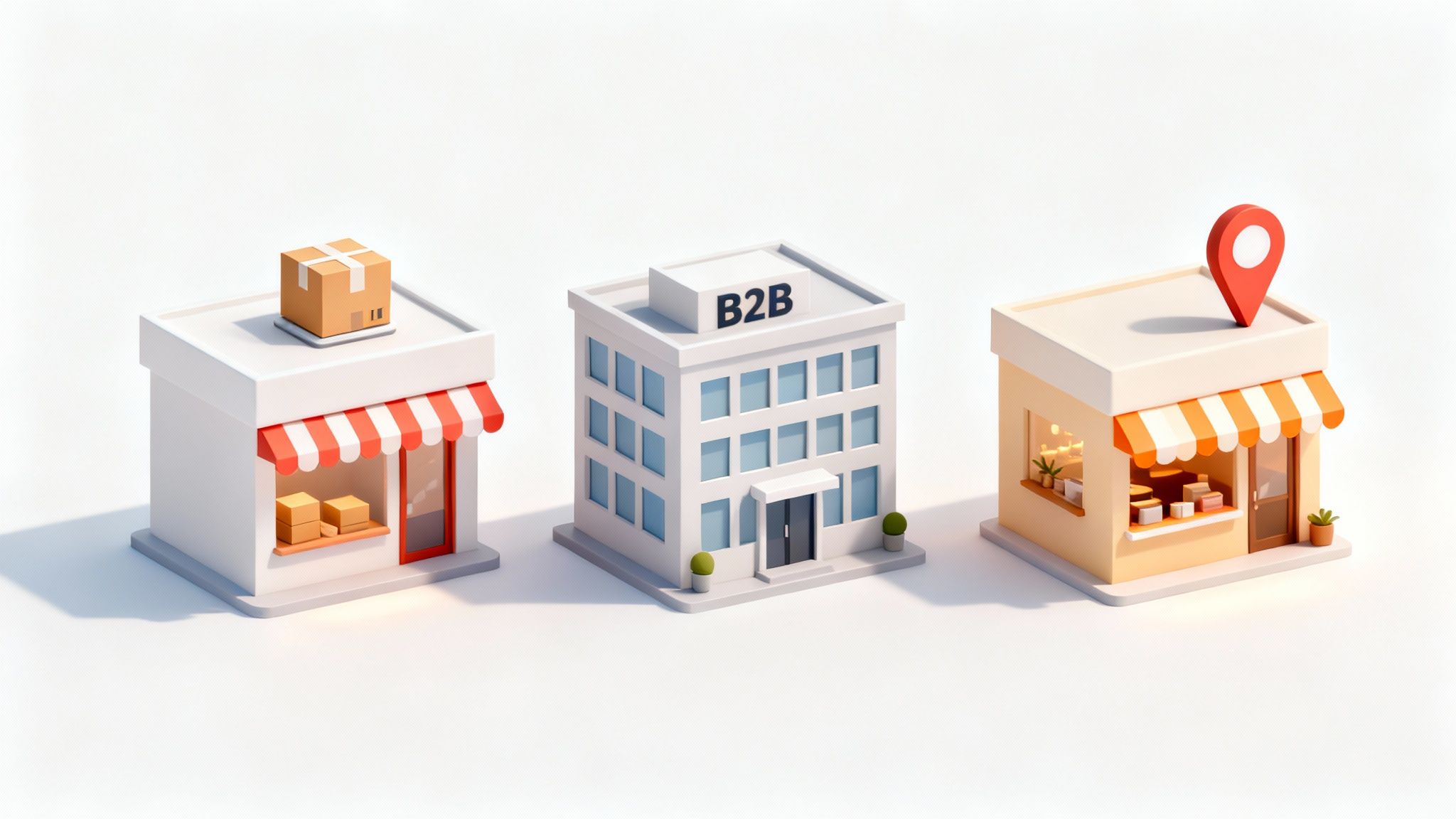
Let’s break down how a specialised SEO strategy gets applied to three common business types, each with its own unique challenges and opportunities.
SEO Services for E-commerce Websites
For an e-commerce business, your website isn’t just a website; it’s your digital storefront. Every product page is a potential sale waiting to happen. E-commerce SEO is all about making those products as visible as possible in search results, often for thousands of different product-related queries. It’s a game of scale and precision.
Key strategies include:
- Product Page Optimisation: This goes way beyond just slotting in a few keywords. It involves writing unique, benefit-driven product descriptions, optimising high-quality images, and encouraging customer reviews—which are absolute gold for social proof and ranking signals.
- Structured Data (Schema Markup): Implementing schema markup is like adding digital price tags and product details directly onto your search listings. It can show information like price, stock availability, and review ratings right there on the search results page, making your listings far more compelling and boosting click-through rates.
- Faceted Navigation Management: Big e-commerce sites often have filters for things like size, colour, or brand. If not managed correctly, these filters can accidentally create thousands of duplicate, low-value pages that confuse search engines and water down your site's authority. A specialist ensures this is handled properly from the get-go.
SEO Services for B2B Companies
For Business-to-Business (B2B) companies, the goal isn't usually an immediate online transaction. It’s about generating qualified leads, building authority, and nurturing long-term relationships. The sales cycle is longer, and the decision-makers are looking for expertise and trust, not just a checkout button.
B2B SEO isn't just about attracting traffic; it's about attracting the right traffic. The focus shifts from high volume to high value, targeting decision-makers with content that solves their complex business problems.
This demands a completely different strategic approach:
- High-Value Content Funnels: The heart of B2B SEO is creating in-depth content like whitepapers, case studies, and webinars that address specific industry pain points. This content is designed to capture leads by offering genuinely valuable information in exchange for contact details.
- Keyword Targeting for Intent: B2B search queries are often informational and problem-focused (e.g., "how to improve supply chain efficiency"). The strategy is to target these top-of-funnel keywords to attract potential clients early in their research phase, long before they're ready to buy.
- Building Industry Authority: Earning links and mentions from respected industry publications and trade journals is crucial. This builds the credibility needed to convince other businesses that you are the right partner to solve their problems.
Local SEO for Small and Medium Businesses
For businesses that serve a specific geographic area—from a local plumber to a neighbourhood cafe—Local SEO is the single most critical driver of growth. This discipline is all about making your business pop up for nearby customers, especially in Google's "Map Pack" and for those all-important "near me" searches.
Local SEO has become a secret weapon for Australian businesses. Think about it: "near me" searches have exploded by 500% since 2015, and an incredible 76% of people who search for something local on their phone visit a store within 24 hours. Research also shows that almost half of all Google searches are for local information, proving its immense power to drive real-world action. You can learn more about these powerful local SEO findings.
Effective Local SEO services for your website will always prioritise:
- Google Business Profile (GBP) Optimisation: Your GBP listing is your digital shopfront in local search. A fully optimised profile with accurate information, glowing reviews, and regular posts is often the very first interaction a local customer has with your brand.
- Building Local Citations: This involves getting your business name, address, and phone number (NAP) listed consistently across relevant online directories. This consistency reinforces your location and legitimacy to search engines, building trust.
- Targeting "Near Me" Searches: Content and on-page optimisation are tailored to capture local intent. This often means including neighbourhood and city names within page titles, headings, and service descriptions to attract highly relevant, ready-to-buy local traffic.
Understanding SEO Pricing Models and Timelines
When you're ready to bring in professional help for your website's SEO, two questions always pop up first: "How much is this going to cost?" and "How long until I see results?"
Let's cut through the noise and tackle these head-on. Getting a handle on the investment and the timeline is absolutely key to a successful partnership. SEO isn't a one-and-done task; it's an ongoing investment in your digital shopfront, and agencies structure their pricing in a few common ways to reflect that.
Common SEO Pricing Structures
Choosing the right model really boils down to your budget, the scope of work you need, and how you want to work with your SEO partner. Most Australian agencies will offer one of the following.
-
Monthly Retainer: This is the most common setup by a long shot. You pay a set fee each month for a continuous, rolling SEO strategy. It covers everything from the initial technical deep-dive to creating content and building links. This model works best for building a deep partnership and allows the strategy to evolve as your business grows.
-
Project-Based Fees: Got a specific, one-time goal? Maybe you need a full-scale website audit before a redesign, or you're a local business that needs its Google Business Profile set up from scratch. A project-based fee is perfect for this. You agree on a fixed price for a clearly defined job, making it predictable and contained.
-
Hourly Consulting Rates: Some experts offer their time by the hour. This is ideal if you just need strategic advice, some training for your in-house team, or help wrestling with a very specific, technical problem without signing up for a long-term engagement.
For a much deeper dive, our guide breaks down how much you should budget for Search Engine Optimisation right here in the Australian market.
To give you a clearer picture, here’s a quick look at what you can generally expect at different monthly investment levels.
Typical SEO Investment Tiers and Expected Outcomes
| Investment Level (Monthly) | Typical Inclusions | Expected 6-Month Outcome |
|---|---|---|
| $1,500 – $3,000 | Foundational technical SEO, on-page optimisation, basic keyword research, local SEO setup, light content creation (e.g., 1-2 blog posts). | Improved site health and indexation. Small but noticeable ranking gains for less competitive, long-tail keywords. A solid base for future growth. |
| $3,000 – $6,000 | All foundational work plus consistent content marketing, initial high-quality backlink acquisition, more in-depth competitor analysis, and regular reporting. | Tangible increase in organic traffic and visibility for a broader set of target keywords. Start to see leads or sales coming through organic channels. |
| $6,000+ | A comprehensive, aggressive strategy. Advanced content strategies (e.g., pillar pages, video), high-authority link building, conversion rate optimisation (CRO), and deep data analysis. | Significant growth in organic traffic, leads, and revenue. Top rankings for core commercial keywords and a clear, positive return on investment (ROI). |
Remember, these are just general guidelines. The right investment for you depends entirely on your industry's competitiveness, your starting point, and your growth ambitions.
Setting Realistic Timelines for SEO Success
This is the big one, and it's absolutely crucial: SEO is a marathon, not a sprint. Anyone promising you guaranteed #1 rankings overnight is selling snake oil.
Real, sustainable growth takes time because you're fundamentally building genuine authority and trust with search engines. You can't fake that.
SEO is like planting a tree. The initial work is all underground—preparing the soil and nurturing the roots. You won't see much on the surface at first, but that foundational work is what allows for strong, lasting growth later on.
Here’s a realistic roadmap of what you can expect as you invest in SEO services.
The First 3 Months (The Foundation)
This initial phase is all about discovery, strategy, and fixing the foundational cracks.
- Activities: Comprehensive audits, deep-dive keyword research, competitor analysis, fixing technical gremlins, and initial on-page optimisation.
- Expected Results: You won't see a massive surge in traffic just yet. Instead, progress looks like improved site health, better indexation by Google, and maybe some small ranking gains for less competitive, long-tail keywords.
Months 4-6 (Building Momentum)
With a solid foundation poured, the focus shifts to creating high-value content and building your site's authority.
- Activities: Consistent blog content creation, earning the first few high-quality backlinks, and optimising for user experience.
- Expected Results: This is where you'll start to see tangible movement. Expect a noticeable lift in organic traffic, higher rankings for more of your target keywords, and better engagement metrics like time on page.
Months 7-12 and Beyond (Scaling Growth)
Now, with momentum on your side, the strategy gets refined and scaled up.
- Activities: Advanced content strategies (think topic clusters and skyscraper content), high-authority link building campaigns, and conversion rate optimisation to turn traffic into revenue.
- Expected Results: Significant growth in organic traffic and leads becomes the new normal. You should be holding top rankings for many of your core keywords and seeing a clear, positive return on your investment.
Choosing the Right SEO Partner for Your Business
Picking an SEO agency is a huge decision. It’s not like just outsourcing a simple task; it’s bringing on a partner who can genuinely accelerate your growth. But get it wrong, and you’re looking at wasted time, a drained budget, and a whole lot of frustration.
Making a confident choice really boils down to asking the right questions and knowing what a good answer looks like. A great partner for SEO services for website growth will feel like an extension of your own team. They’ll be transparent, obsessed with data, and laser-focused on your business goals—not just chasing vanity metrics like rankings for the sake of it.
Your Agency Vetting Checklist
Before you even think about signing a contract, run every potential agency through this checklist. Their answers will tell you everything you need to know about their competence, honesty, and whether they're actually invested in helping you succeed.
- How do you approach strategy and reporting? Look for a clear, repeatable process. A good agency should be able to explain exactly how they'll build a strategy based on your unique business, not some cookie-cutter template. Crucially, ask what key performance indicators (KPIs) they track to prove success beyond just a bump in traffic.
- What's your experience in our industry? While not always a deal-breaker, having experience in your niche is a massive head start. It means they already get your customer's search habits and the competitive battlefield. Don't be shy—ask for case studies or specific examples.
- How do you adapt to algorithm and AI changes? This one is critical. A forward-thinking agency won't just talk about reacting to algorithm updates. They’ll talk about building long-term topical authority and focusing on user experience, which are the things that make your site resilient to whatever Google throws at it.
- What does your communication and collaboration process look like? You're hiring a partner, not a black box where your money disappears. A solid agency will have a clear schedule for meetings, updates, and check-ins, making sure you’re always in the loop.
This kind of structured evaluation helps you cut through the slick sales pitches and compare agencies on a truly level playing field.
Red Flags to Watch Out For
Just as important as knowing what to look for is knowing what to run from. Certain promises and practices are major red flags that should have alarm bells ringing.
If an agency guarantees a #1 ranking on Google, run. Don't walk, run. No one can guarantee specific rankings because Google's algorithm is a complex, ever-changing beast. This kind of promise is a hallmark of outdated, ineffective, or even shady SEO practices.
Here are a few other warning signs to keep an eye on:
- Lack of Transparency: If they're cagey about their methods or won't give you a straight answer about their link-building tactics, it's a huge red flag. Good SEO isn't a secret.
- Focus on Quantity Over Quality: An obsession with getting hundreds of low-quality links is a one-way ticket to a future Google penalty. It's a short-term tactic that causes long-term damage.
- No Customised Strategy: If they whip out a generic, one-size-fits-all plan without first diving deep into your business, they aren't truly invested in your specific goals.
Choosing your SEO partner is a decision that will have a direct impact on your business's visibility and bottom line for years to come. Use this framework to find a team that aligns with your values and is genuinely committed to delivering sustainable, long-term results.
Common Questions About Website SEO Services
When you're looking to grow your business with SEO, a few practical questions always come up. Let's tackle the most common ones business owners ask, so you can get a clear picture of what to expect before you dive in.
How Long Does SEO Take to Show Results?
This is the big one, and the honest answer is: it takes time. While you might see some quick wins from technical fixes in the first few weeks, real, meaningful SEO results typically start to show up in four to six months. It's best to think of it as a long-term investment that builds on itself, not a quick-win marketing tactic.
The first couple of months are all about laying the foundation—audits, strategy development, and sorting out your on-page SEO. After that, you'll start seeing early indicators like better rankings for more specific, long-tail search terms. Substantial growth in organic traffic and, most importantly, leads, usually becomes clear after the six-month mark as your website's authority and content library grow.
Can I Just Do SEO Myself?
You can absolutely handle some of the basics yourself. Things like writing title tags or setting up your Google Business Profile are great starting points. However, the reality is that modern SEO has become a seriously complex and demanding full-time job.
A professional agency brings a deep well of expertise in areas that are tough to manage part-time, like technical SEO, advanced data analysis, deep-dive competitor research, and scalable link-building strategies. These are highly specialised skills that come with dedicated resources and sophisticated tools, allowing an agency to accelerate results far beyond what’s usually possible for an in-house team juggling multiple roles.
What Is the Difference Between SEO and PPC?
The main difference comes down to paid vs. earned traffic. SEO is all about earning organic (unpaid) visibility in search results. It’s a process of building a sustainable asset that generates traffic and builds authority over the long haul.
PPC (Pay-Per-Click), on the other hand, involves paying for prominent ad placements to get immediate traffic. The catch? That traffic stops the moment you stop paying. They're most powerful when they work together: SEO builds lasting brand credibility and a solid foundation, while PPC delivers quick data and targeted campaigns that can actually inform and improve your long-term SEO strategy.
How Do I Know if SEO Is Actually Working?
A good agency will never leave you guessing about your return on investment. You should expect transparent, regular reporting focused on key performance indicators (KPIs) that are directly tied to your business goals.
The true measure of SEO success isn't just about rankings; it's about tracking tangible business outcomes. Clear reporting should translate complex data into a straightforward story of growth, showing you exactly how SEO is impacting your bottom line.
Here are the essential metrics you should be watching:
- Organic Traffic Growth: A clear increase in visitors coming from search engines.
- Keyword Ranking Improvements: Tracking your position for the search terms that matter most.
- Conversion Rates: Measuring how many of those organic visitors turn into leads or customers.
- Backlink Profile Strength: Seeing how your website's authority is growing over time.
This data-driven approach ensures you can clearly see the value your investment is delivering.
Ready to see how a data-driven, AI-first SEO strategy can transform your website's performance? At Click Click Bang Bang, we create customised SEO and PPC campaigns that deliver real, measurable results. Start your journey to the top of the search results today.
Read NeXt
Or Read Our Latest
- Manual vs Automated Bidding for PPC Success
- Conversion Tracking Setup: A Complete AU Guide
- Instagram Advertising Australia: Complete 2026 Guide
- Pay Per Click: A Beginner’s Guide for Australian Marketers
- Display Advertising on Google: The Complete Australian Guide
- Stakeholder Communication Plan How to Build One That Works
Click. CLick. Subscribe.
Get our best PPC insights, industry updates, and power moves delivered straight to your inbox. No fluff, just high-caliber strategies that actually work.
Don’t Leave Just Yet
Try Us For 30-Days,
Risk Free!!
We guarantee that you’ll love our work within the first 30 days, if not you’ll get your money back.
What have you got to lose?